
- Home
- »
- Power Generation & Storage
- »
-
Drone Battery Market Size, Share, Trends Report, 2026-2033GVR Report cover

Drone Battery Market (2026 - 2033)
Size, Share & Trends Analysis Report By Technology (Lithium-based, Nickel-based), By Point Of Sale (Aftermarket, OEMs), By Region (North America, Europe, Asia Pacific, Latin America, Middle East & Africa), And Segment Forecasts
Market Size, 2025
$3.3BMarket Estimate, 2026
$3.8BMarket Forecast, 2033
$10.0BCAGR, 2026–2033
15.0%Drone Battery Market Summary
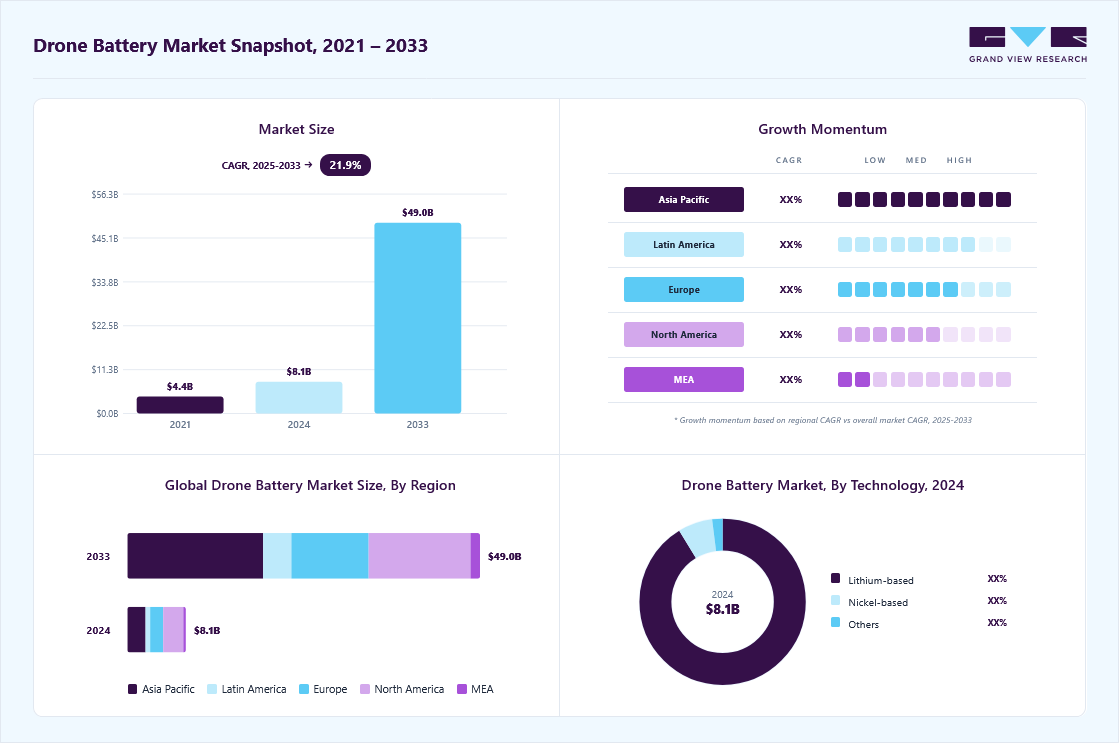
The global drone battery market size was valued at USD 3.3 billion in 2025 and is projected to grow from USD 3.8 billion in 2026 to USD 10.0 billion by 2033, at a CAGR of 15.0% from 2026 to 2033. North America dominated the market, accounting for a revenue share of 33.8% in 2025. The increasing use of drones across defense, agriculture, logistics, and media sectors is driving market growth.
 Source: Grand View Research, IR Documents, Primary Interviews, Paid DatabasesTo learn more about this report,
 Download Free Sample Report
 Key Market Trends & Insights
- By technology: Lithium-based segment dominated the market, with a revenue share of 97.6% in 2025.
- By point of sale: OEMs segment held the largest market share of 73.7% in 2025.
Regional Highlights
- Largest regional market: North America (33.8% revenue share, 2025)
- Fastest-growing regional market: Asia Pacific (highest CAGR, 2026-2033)
- By country: The U.S. held the largest market share in 2025.
Market Size & Forecast
- Market size in 2025: USD 3.3 Billion
- Estimated market size in 2026: USD 3.8 Billion
- Projected market size by 2033: USD 10.0 Billion
- CAGR (2026-2033): 15.0%
Three ways to get this report
Buy it, customize it, or ask a question.Ask an Analyst
Analyst response in 1 business day
- AccessReport author, directly
- Reply timeWithin 1 working day
- No sales callDirect answer only
- FormatEmail reply
- CostFree, no cost
Get the Full Report
What the study covers
- FormatsPDF · Excel · Dashboard
- Timeline2026–2033 annual, 2025 base
- Coverage20+ countries, 5 regions
- Companies10+ key players profiled
Customize the Report
20% free customization
- IncludeCountries, segments, points
- TailorTo your product definition
- ExtendDeeper competitor detail
- OrA fully bespoke study
- Turnaround5–10 working days
As drone operations demand longer flight times and greater reliability, the need for high-performance battery systems is rising rapidly. Advancements in lithium-based technologies and emerging alternatives like solid-state and lithium-sulfur batteries are boosting energy density and reducing weight. In addition, expanding drone delivery services and autonomous flight systems is accelerating battery R&D. Supportive government regulations and incentives encourage drone adoption, creating strong momentum for battery innovation and production through 2033. Technological advancements, including integrating artificial intelligence and IoT, are transforming the drone battery market by enabling real-time monitoring, predictive maintenance, and efficient power management. These innovations improve flight safety, extend battery life, and optimize energy usage, particularly in high-demand applications such as delivery, surveillance, and agricultural monitoring. As drones become more embedded in mission-critical operations, the need for intelligent, high-performance batteries continues to grow in both civilian and commercial sectors. To learn more about this report, Download Free Sample Report
 Industries are increasingly investing in drone technologies to improve operational efficiency, and adopting flexible models such as battery leasing or battery-as-a-service is gaining traction. These models help reduce upfront investment and ensure consistent performance through managed services. The trend is especially strong in regions such as Asia Pacific, where drone usage is accelerating due to rapid digitalization and expanding logistics infrastructure. While challenges such as limited battery range and regulatory constraints remain, ongoing R&D and supportive government initiatives are expected to drive long-term growth in the global drone battery market.
Market Dynamics
The drone battery market is primarily driven by the increasing adoption of drones across commercial, industrial, defense, and consumer applications, where battery performance largely determines flight endurance, payload capacity, and operational efficiency. Growing use of drones for precision agriculture, infrastructure inspection, aerial surveying, mapping, logistics, emergency response, and military operations is accelerating demand for high-performance battery solutions. In addition, continuous advancements in lithium-ion and lithium-polymer battery technologies, battery management systems (BMS), and fast-charging capabilities are improving energy density, charging efficiency, and battery lifespan, supporting the deployment of advanced unmanned aerial vehicles across global markets.
The rapid expansion of commercial and industrial drone operations remains a major driver for the drone battery market. Industries such as agriculture, construction, mining, utilities, logistics, oil & gas, and energy are increasingly utilizing drones for asset inspection, precision spraying, surveying, monitoring, and infrastructure maintenance, creating sustained demand for lightweight, high-capacity batteries that enable longer flight durations and greater operational efficiency. As governments continue to establish supportive regulatory frameworks for commercial drone operations and beyond-visual-line-of-sight (BVLOS) missions, drone fleet deployments are expected to increase significantly, further strengthening battery demand.
Furthermore, increasing investments in drone manufacturing, growing adoption of delivery drones, and rising defense procurement of unmanned aerial systems are encouraging battery manufacturers to develop advanced energy storage solutions with higher energy density, faster charging capability, and improved safety. Continuous innovation in battery chemistry and battery management technologies is enabling drone operators to improve mission reliability, reduce operational downtime, and expand the use of drones across both commercial and defense applications.
Despite strong growth prospects, limited battery capacity continues to restrict drone flight time, particularly for heavy-payload and long-range applications, necessitating frequent battery replacement or recharging, which increases operational downtime. In addition, lithium-based batteries remain susceptible to thermal runaway, overheating, and performance degradation under harsh environmental conditions, and stringent transportation regulations and safety certification requirements increase manufacturing complexity and overall operating costs.
The development of next-generation battery technologies, including solid-state, lithium-sulfur, and silicon-anode batteries, presents significant growth opportunities for the drone battery market by enabling higher energy density, improved safety, faster charging, and extended flight endurance. Combined with the expansion of autonomous drone operations, drone delivery services, and beyond-visual-line-of-sight applications, these technological advancements are expected to accelerate demand for advanced battery solutions capable of supporting longer missions, heavier payloads, and more demanding commercial and defense operations over the forecast period.
Analyst Perspective
The drone battery market is experiencing robust growth driven by the expanding adoption of unmanned aerial vehicles across commercial, industrial, consumer, and defense applications. Increasing deployment of drones for agriculture, infrastructure inspection, surveying, logistics, public safety, and military operations is accelerating demand for high-performance battery solutions with longer flight endurance and faster charging capabilities. Although limitations in battery energy density, safety concerns, and fluctuations in raw material prices remain key challenges, ongoing advancements in lithium-based battery technologies, battery management systems, and next-generation energy storage solutions are improving overall performance and efficiency. Over the forecast period, companies that invest in battery innovation, strengthen partnerships with drone OEMs, and expand manufacturing capabilities are expected to enhance their competitive position and capitalize on the growing global demand for advanced drone power solutions.
Technology Insights
Based on technology, the lithium-based segment led the market with the largest revenue share of 97.6% in 2025. The technology segment is pivotal in the drone battery market by driving advancements that enhance flight time, reliability, and overall performance. Lithium-based batteries hold the largest market share among the various sub-segments due to their high energy density, lightweight design, and superior charge-discharge efficiency. These attributes make lithium-ion and lithium-polymer batteries the preferred choice across commercial, industrial, and defence drone applications. As drone operations become more demanding regarding range and payload, the need for high-performance battery technologies continues to rise, cementing lithium-based solutions as the industry standard.
Ongoing innovation within the lithium segment-such as improvements in thermal management, fast-charging capabilities, and safety mechanisms-further strengthens its market position. In addition, lithium-based batteries are highly adaptable to a wide range of drone sizes and use cases, from small consumer drones to large, long-range delivery drones. Their compatibility with smart battery systems also enables integration with real-time monitoring tools, essential for predictive maintenance and mission-critical reliability. As a result, the dominance of lithium-based technologies is expected to persist, supported by continuous R&D and growing demand across diverse drone applications worldwide.
Point of Sale Insights
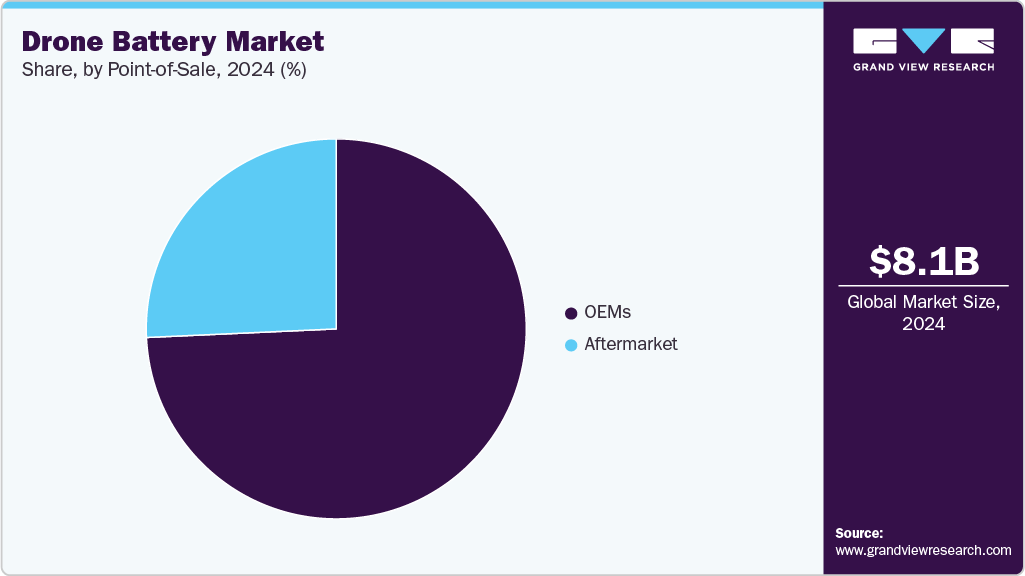
Based on point of sale, the OEMs segment led the market with the largest revenue share of 73.7% in 2025. The Point-of-Sale segment is experiencing significant growth, driven by rising demand for efficient and reliable battery solutions across consumer and commercial drone applications. Within this segment, the OEM (Original Equipment Manufacturer) subsegment holds the largest market share due to its ability to deliver batteries specifically designed for seamless integration with drone systems. These batteries offer enhanced safety, performance, and compatibility, making them the preferred choice for end-users who prioritize quality and reliability. The growing adoption of drones in defence, logistics, and agriculture continues to boost OEM battery sales, supported by strong collaborations between drone manufacturers and battery suppliers.
 To learn more about this report, Download Free Sample Report
 The aftermarket subsegment is also expanding steadily, fueled by the increasing need for battery replacements, upgrades, and extended operations as drone usage intensifies. This subsegment caters to operators seeking flexible, cost-effective alternatives beyond OEM offerings. However, OEMs maintain a competitive edge due to their ability to provide certified, warrantied products that ensure optimal performance. As drone fleets expand and battery wear becomes more frequent, the Point-of-Sale segment especially the OEM subsegment is expected to remain a major contributor to market growth through 2033.
Regional Insights
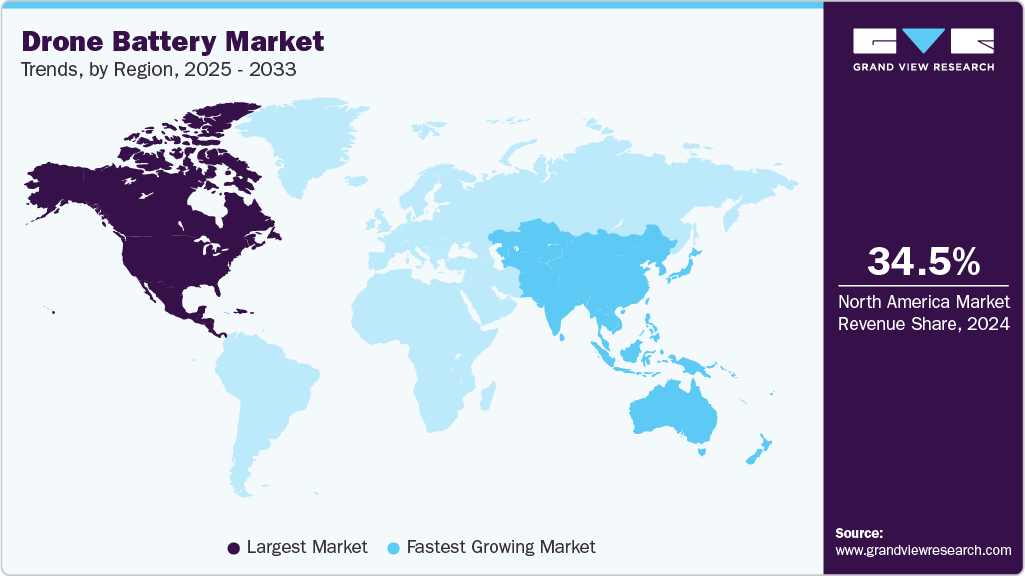
North America dominated the drone battery market with the largest revenue share of 33.8% in 2025. The North American drone battery market is experiencing robust growth, fueled by the rapid expansion of drone applications across defense, agriculture, logistics, and public safety sectors. Key drivers include rising demand for longer flight times, improvements in battery energy density, and growing investment in unmanned aerial systems (UAS) by government and private entities. Technological advancements, such as integrating smart battery management systems and AI-powered diagnostics, enhance battery performance, safety, and operational efficiency. OEMs are leading the market with high-quality, integrated battery solutions, while the aftermarket segment is also expanding to meet replacement and upgrade needs. The U.S. remains the dominant market due to its advanced defense and logistics infrastructure, while Canada is witnessing steady growth, particularly in remote area monitoring and resource exploration using drones.
 To learn more about this report, Download Free Sample Report
 U.S. Drone Battery Market Trends
The drone battery market in the U.S. held the largest share in North America region in 2025. Technological advancements are significantly improving the performance and management of drone batteries in the U.S. Innovations in battery chemistry, such as lithium-metal and solid-state technologies, enable longer flight durations, faster charging, and enhanced safety. Integrating artificial intelligence (AI) and Internet of Things (IoT) in battery systems allows real-time monitoring, predictive maintenance, and smart power management, which are critical for mission-critical drone operations. These developments are making drone batteries more efficient, reliable, and attractive to defense, logistics, agriculture, and public safety sectors that demand high performance and operational continuity.
Asia Pacific Drone Battery Market Trends
The drone battery industry in the Asia Pacific is anticipated to grow at the fastest CAGR from 2026 to 2033. The Asia Pacific drone battery market is experiencing rapid growth, driven by the expanding use of drones across agriculture, logistics, infrastructure inspection, and public safety. Rising demand for high-endurance drone operations and strong government support for drone technology adoption are key growth drivers. Countries such as China and India are leading the regional market, with China being a global hub for drone manufacturing and India actively promoting drone use through initiatives such as the Production Linked Incentive (PLI) scheme for drone and battery manufacturing. The push for localization and self-reliance in drone ecosystems further accelerates battery innovation and production.
Technological advancements in lithium-based and hybrid battery systems enable longer flight times and improved power efficiency, crucial for commercial-scale applications. Integrating AI and IoT technologies enhances real-time battery health monitoring, energy optimization, and safety. As industrial and commercial drone deployment continues to rise, the demand for high-performance and cost-effective battery solutions will remain strong globally, positioning Asia Pacific as a key growth engine in the global drone battery market.
Europe Drone Battery Market Trends
The European drone battery market is growing steadily, supported by the region’s expanding drone applications in defense, environmental monitoring, precision agriculture, and logistics. The EU’s focus on green technology, coupled with stringent battery efficiency and sustainability regulations, is driving innovation in lightweight, high-capacity battery systems. Countries such as Germany, France, and the UK are at the forefront, investing in R&D and public-private collaborations to enhance drone performance and operational safety. The rise of drone delivery trials and smart city projects is also fueling demand for reliable, long-lasting battery solutions.
Key trends in the region include the adoption of lithium-silicon and solid-state batteries, integrating battery management systems with AI for predictive diagnostics, and the growing use of recyclable and eco-friendly materials to meet EU environmental directives. In addition, partnerships between battery tech firms and drone manufacturers are helping to overcome cost and scalability challenges, ensuring steady progress in the region’s drone battery landscape.
Latin America Drone Battery Market Trends
The Latin American drone battery market is gaining momentum as drone usage expands across agriculture, mining, infrastructure inspection, and emergency services. Countries such as Brazil, Chile, and Mexico are at the forefront, leveraging drones for operations in remote and hard-to-reach areas, which drives demand for high-capacity, long-endurance battery systems. The region’s challenging geography and infrastructure gaps make battery reliability and performance crucial. Ongoing advancements in lithium-based technologies, regional partnerships, and growing regulatory support for UAV operations are helping reduce costs and improve accessibility, positioning Latin America as an emerging market for drone battery innovation.
Middle East & Africa Drone Battery Market Trends
The Middle East and Africa drone battery market is driven by the expanding adoption of drones across sectors such as oil & gas, infrastructure inspection, agriculture, and defense. With vast, remote terrains and increasing demand for aerial surveillance and logistics, countries such as Saudi Arabia and the United Arab Emirates are investing in drone technologies that require advanced, long-endurance battery systems. These nations also align with broader technological and sustainability goals, including Saudi Arabia’s Vision 2030 and the UAE’s Energy Strategy 2050, emphasizing innovation and efficiency across critical industries. As drone deployment grows in commercial and governmental applications, the need for high-performance, reliable batteries continues to rise, positioning the region as a promising frontier in the global drone battery landscape.
Key Drone Battery Company Insights
Some of the key players in the drone battery market include Eaglepicher Technologies, Oxis Energy Ltd, Plug Power Inc., HES Energy Systems, and Intelligent Energy.
-
In April 2024, a leading drone manufacturer partnered with Solid Energy Systems to develop high-capacity lithium-metal batteries to extend drone flight times for commercial delivery services. This collaboration focuses on enhancing battery energy density and safety to meet the growing demand for longer and more reliable drone operations.
-
In March 2024, the U.S. Department of Transportation announced over USD 250 million in funding to support research and development of advanced drone battery technologies and infrastructure. This initiative targets improvements in battery efficiency, fast charging, and recycling capabilities to accelerate drone adoption in logistics, agriculture, and emergency response sectors, particularly in remote and underserved areas.
Key Drone Battery Companies:
The following key companies have been profiled for this study on the drone battery market.
-
Eaglepicher Technologies
-
Oxis Energy Ltd
-
Plug Power Inc
-
HES Energy Systems
-
Intelligent Energy
-
RRC Power Solutions
-
Micromulticopter Aero Technology Co., Ltd.
-
SolidEnergy Systems
-
Sion Power
-
Doosan Mobility Innovation
-
Shenzhen Grepow Battery Co. Ltd.
-
Epsilor
Competitive Benchmarking
Category
Operating Strategies
Competitive Edge
Weakness
Established Players (e.g., Amperex Technology Limited (ATL), LG Energy Solution, Ltd., Panasonic Energy Co., Ltd., Samsung SDI Co., Ltd., EaglePicher Technologies, LLC, RRC Power Solutions GmbH)
- Focus on large-scale manufacturing of lithium-ion and lithium-polymer battery cells and battery packs supported by advanced R&D and global supply chains.
- Emphasize long-term OEM partnerships, battery performance, safety, battery management systems (BMS), and continuous product innovation for commercial, industrial, and defense drone applications.
- Benefit from strong manufacturing capabilities, advanced battery technologies, extensive production capacity, and established relationships with drone manufacturers worldwide.
- Large-scale operations enable economies of scale, reliable product quality, technological leadership, and stable global distribution networks.
- Face high capital investment requirements for battery manufacturing, raw material procurement, and technology development.
- Profitability can be affected by fluctuations in lithium and other critical mineral prices, supply chain disruptions, and evolving battery safety regulations.
Emerging & Specialized Players (e.g., Doosan Mobility Innovation Co., Ltd., Intelligent Energy Limited, Sion Power Corporation, SolidEnergy Systems Corp. (SES AI), Tattu (Shenzhen Grepow Battery Co., Ltd.))
- Focus on advanced battery chemistries, hydrogen fuel cell systems, high-energy-density batteries, and application-specific power solutions for commercial and industrial UAVs.
- Emphasize technology innovation, customized battery solutions, strategic collaborations, and expansion into high-endurance and next-generation drone applications.
- Benefit from specialized technologies, greater operational flexibility, and the ability to address evolving drone performance requirements through innovative energy storage solutions.
- Agile business models support faster commercialization of emerging battery technologies and customized product development.
- Limited manufacturing scale and global market presence compared to established battery manufacturers.
- Commercial expansion often requires significant investment in production capacity, certification, strategic partnerships, and customer acquisition while competing against well-established battery suppliers.
Drone Battery Market Report Scope
Report Attribute
Details
Market definition
The global Drone Battery Market refers to the revenue generated from the sales of rechargeable batteries used to power unmanned aerial vehicles (UAVs), including lithium-ion, lithium-polymer, nickel-based, and other advanced battery chemistries, across commercial, consumer, industrial, and defense drone applications.
Market size in 2025
USD 3.3 billion
Estimated market size in 2026
USD 3.8 billion
Projected market size by 2033
USD 10.0 billion
Growth rate
CAGR of 15.0% from 2026 to 2033
Base year for estimation
2025
Historical data
2021 - 2024
Forecast period
2026 - 2033
Quantitative units
Revenue in USD million/billion and CAGR from 2026 to 2033
Report coverage
Revenue forecast, company ranking, competitive landscape, growth factors, and trends
Segments covered
Technology, point of sale, region
Regional scope
North America; Europe; Asia Pacific; Latin America; Middle East & Africa
Country scope
U.S, Canada, Mexico, Germany, UK, Russia, France, Italy, Spain, India, China, Japan, Australia, Brazil, Argentina, South Africa, Saudi Arabia, UAE
Key companies profiled
Amperex Technology Limited (ATL), Doosan Mobility Innovation Co., Ltd., EaglePicher Technologies, LLC, Intelligent Energy Limited, LG Energy Solution, Ltd., Panasonic Energy Co., Ltd., RRC Power Solutions GmbH, Samsung SDI Co., Ltd., Sion Power Corporation, SolidEnergy Systems Corp. (SES AI), and Tattu (Shenzhen Grepow Battery Co., Ltd.)
Customization scope
Free report customization (equivalent up to 8 analysts' working days) with purchase. Addition or alteration to country, regional & segment scope.
Pricing and purchase options
Avail customized purchase options to meet your exact research needs. Explore purchase options
Global Drone Battery Market Report Segmentation
This report forecasts revenue and volume growth at global, regional, and country levels and provides an analysis of the latest industry trends in each of the sub-segments from 2021 to 2033. For the purpose of this study, Grand View Research has segmented the global drone battery market report on the basis of technology, point of sale, and region:
 To learn more about this report, Download Free Sample Report
 -
Technology Outlook (Revenue, USD Million, 2021 - 2033)
-
Lithium-based
-
Nickel-based
-
Others
-
-
Point of Sale Outlook (Revenue, USD Million, 2021 - 2033)
-
Aftermarket
-
OEMs
-
-
Regional Outlook (Revenue, USD Million, 2021 - 2033)
-
North America
-
U.S.
-
Canada
-
Mexico
-
-
Europe
-
Germany
-
UK
-
Spain
-
France
-
Italy
-
Russia
-
-
Asia Pacific
-
China
-
India
-
Japan
-
Australia
-
-
Latin America
-
Brazil
-
Argentina
-
-
Middle East & Africa
-
Saudi Arabia
-
South Africa
-
UAE
-
-
Research Methodology
The drone battery market figures in this report are based on a proven research process that combines executive interviews with secondary research from proprietary databases, company filings, and recognized regulatory and institutional sources. Market size is built through value-chain sizing - reconciling supply-side and demand-side estimates - and triangulated with bottom-up and top-down approaches. Every estimate passes multiple levels of expert validation before publication, with each drone battery segment quantified using the revenue-capture definitions in the table below.
Segment Definition
Technology
Revenue Capture Definition
Lithium-based
This segment includes lithium-polymer (LiPo), lithium-ion (Li-ion), lithium iron phosphate (LFP), lithium-sulfur, and other lithium-based batteries used in commercial, consumer, industrial, and defense drones. Market revenue is attributed to the manufacturing and sale of battery cells, battery packs, battery management systems (BMS), charging solutions, and associated integration services supplied to drone manufacturers, distributors, and aftermarket customers.
Nickel-based
Nickel-based batteries, including nickel-metal hydride (NiMH) and nickel-cadmium (NiCd), are primarily used in select consumer, industrial, and legacy drone platforms where durability and reliability take precedence over energy density. Revenue is generated through battery manufacturing, replacement battery sales, distribution activities, battery pack assembly, and related power management solutions for UAV applications.
Others
This segment includes emerging battery technologies such as solid-state batteries, sodium-ion batteries, silver-zinc batteries, and other advanced battery chemistries developed for specialized drone applications. Revenue is generated through the commercialization of advanced battery systems, integrated power solutions, research-driven deployments, and customized energy storage products designed for high-endurance, mission-critical UAV operations.
Point of Sale
Revenue Capture Definition
Aftermarket
The aftermarket segment includes revenue from replacement drone batteries purchased after the initial drone sale. Revenue capture comprises standalone battery pack sales, battery upgrades, spare batteries, replacement programs, battery maintenance products, authorized service center sales, online retail distribution, and accessories supplied to commercial operators, government agencies, recreational users, and industrial drone fleet owners.
OEMs
The OEM segment includes batteries supplied directly to drone manufacturers for installation in newly manufactured unmanned aerial vehicles. Revenue is generated through battery cell procurement, integrated battery pack manufacturing, battery management systems (BMS), customized power solutions, and long-term supply agreements with commercial, industrial, consumer, and defense drone manufacturers, including batteries sold as part of complete drone systems.
Estimation Model
Layer Name
Key Question
Description
Drone Deployment Demand Base Layer
What forms the demand base?
Identify global demand for drone batteries based on unmanned aerial vehicle deployments across commercial, consumer, industrial, and defense applications. Assess drone shipments, fleet expansion, battery replacement cycles, and adoption across agriculture, logistics, infrastructure inspection, mapping, public safety, and military operations to establish the addressable market opportunity.
Battery Manufacturing & Supply Layer
Where are drone batteries produced and supplied?
Estimate the production capacity of lithium-based, nickel-based, and emerging drone battery technologies across key regions. Analyze battery cell production, battery pack assembly, raw material availability, OEM partnerships, distribution channels, and supply chain infrastructure to assess market accessibility and supply dynamics.
Technology & Sales Channel Adoption Layer
How extensively are drone batteries adopted?
Analyze the adoption of lithium-based, nickel-based, and advanced battery technologies across OEM and aftermarket sales channels. Evaluate battery replacement rates, flight endurance requirements, charging performance, fleet utilization, and application-specific power requirements influencing battery demand across various drone platforms.
Revenue Layer
How is market revenue generated?
Revenue is generated through the sale of drone battery cells, battery packs, battery management systems, integrated power solutions, and replacement batteries supplied through OEM and aftermarket channels. Drone production, battery replacement frequency, battery chemistry, capacity, pricing, and technology advancements determine the overall market value.
Delivered Customizations
This report has been delivered with the following In-depth customizations
Client Request
Customization Delivered
Value Adds
Drone Battery Competitive Landscape Assessment
Detailed competitive landscape analysis covering manufacturers and suppliers of lithium-based, nickel-based, and next-generation drone battery technologies. The study profiled key market participants based on geographic presence, organizational structure, product portfolio, manufacturing capacity, technology capabilities, OEM partnerships, distribution networks, customer base, strategic initiatives, and investments in battery innovation and production expansion.
Enabled evaluation of competitive positioning, manufacturing capabilities, technology leadership, OEM relationships, distribution strengths, and market participation across the drone battery value chain.
Technology & Sales Channel Assessment
Evaluation of global drone battery demand across lithium-based, nickel-based, and emerging battery technologies through OEM and aftermarket sales channels. Included assessment of battery chemistries, battery management systems, charging technologies, drone adoption trends, application requirements, regulatory considerations, and regional market dynamics across commercial, industrial, consumer, and defense sectors.
Highlighted technology adoption trends, sales channel dynamics, and regional demand opportunities. Supported strategic planning, product portfolio optimization, partnership evaluation, and investment prioritization decisions.
Opportunity Assessment
Identification of high-growth opportunities associated with next-generation battery technologies, autonomous drone operations, drone delivery services, and beyond visual line of sight applications. Assessed emerging opportunities arising from advancements in battery chemistry, increasing commercial drone deployments, expansion of defense UAV programs, and growing investments in high-performance energy storage solutions.
Enabled prioritization of high-growth opportunities and emerging application segments. Supported long-term business planning, product development strategies, manufacturing expansion initiatives, and investment decisions aligned with evolving drone industry requirements.
Frequently Asked Questions About This Report
The drone battery market size was valued at USD 3.3 billion in 2025 and is estimated at USD 3.8 billion in 2026.
Lithium-based segment dominated the market, with a revenue share of 97.6% in 2025.The technology segment is pivotal in the drone battery market by driving advancements that enhance flight time, reliability, and overall performance.
North America dominated the market with revenue share of 33.8% in 2025.
Asia Pacific is anticipated to register the fastest CAGR of 17.7% over the forecast period.
OEMs segment held the largest market share of 73.7% in 2025 and aftermarket subsegment is second fastest growing market
The drone battery market is expected to grow at a CAGR of 15.0% from 2026 to 2033, reaching USD 10.0 billion by 2033.
The key driver of the global drone battery market is the increasing adoption of drones across commercial, industrial, consumer, and defense applications, supported by advancements in lithium-based battery technologies that deliver longer flight endurance, faster charging, and improved operational efficiency.
The key players operating in the drone battery market include Amperex Technology Limited (ATL), Doosan Mobility Innovation Co., Ltd., EaglePicher Technologies, LLC, Intelligent Energy Limited, LG Energy Solution, Ltd., Panasonic Energy Co., Ltd., RRC Power Solutions GmbH, Samsung SDI Co., Ltd., Sion Power Corporation, SolidEnergy Systems Corp. (SES AI), and Tattu (Shenzhen Grepow Battery Co., Ltd.)
About the Author(s)
Power Generation & Storage Research Team
Energy & Power · Power Generation & StorageThis report was authored by the power generation & storage research team at Grand View Research - comprising two research analysts, one senior research analyst, and one industry expert - with specialized expertise in the power generation & storage segment of the energy & power industry. All findings are based on proprietary energy & power databases, executive interviews, and regulatory analysis, subject to internal peer review prior to publication.
Last Updated:
Speak to Analyst

Customize this report to your needs - add regions, segments, or data points, with 20% free customization.
Or view our licence options:


ISO 9001:2015 & 27001:2022 Certified
We are GDPR and CCPA compliant! Your transaction & personal information is safe and secure. For more details, please read our privacy policy.


