
- Home
- »
- Next Generation Technologies
- »
-
Drone Edge Computing Market Size & Forecast Report, 2033GVR Report cover

Drone Edge Computing Market (2026 - 2033)
Size, Share & Trends Analysis Report By Component (Hardware, Software, Services), By Drone Type, By Computing Type, By Application, By End Use, By Region, And Segment Forecasts
Market Size, 2025
$3.8BMarket Estimate, 2026
$4.7BMarket Forecast, 2033
$19.6BCAGR, 2026–2033
22.8%Drone Edge Computing Market Summary
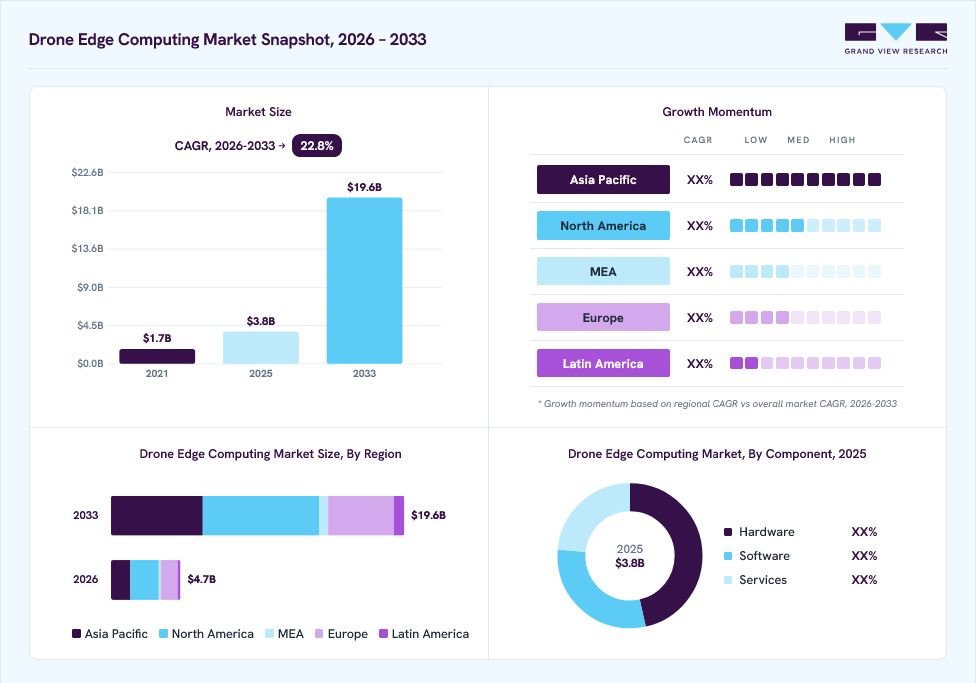
The global drone edge computing market size was valued at USD 3.8 billion in 2025 and is projected to grow from USD 4.7 billion in 2026 to USD 19.6 billion by 2033, at a CAGR of 22.8% from 2026 to 2033. The market in North America dominated with a revenue share of 41.1% in 2025. The market growth is driven by the rising adoption of autonomous drones, the increasing demand for real-time data processing, and the rapid expansion of 5G connectivity.
 Source: Grand View Research, IR Documents, Primary Interviews, Paid DatabasesTo learn more about this report,
 Download Free Sample Report
 Key Market Trends & Insights
- By component: Hardware held the largest revenue share of 46.4% in 2025
- By drone type: Multi-rotor held the largest revenue share of 53.0% in 2025
- By computing type: Onboard edge computing held the largest revenue share in 2025
- By application: Surveillance and monitoring held the largest revenue share in 2025
- By end use: Defense and security held the largest revenue share in 2025
Regional Highlights
- Largest regional market: North America (41.1% revenue share in 2025)
- Fastest-growing regional market: Asia Pacific (fastest CAGR, 2026-2033)
- By country: The U.S. held the largest market share in 2025
Market Size & Forecast
- Market Size in 2025: USD 3.8 Billion
- Estimated Market Size in 2026: USD 4.7 Billion
- Projected Market Size by 2033: USD 19.6 Billion
- CAGR (2026-2033): 22.8%
Three ways to get this report
Buy it, customize it, or ask a question.Ask an Analyst
Analyst response in 1 business day
- AccessReport author, directly
- Reply timeWithin 1 working day
- No sales callDirect answer only
- FormatEmail reply
- CostFree, no cost
Get the Full Report
What the study covers
- FormatsPDF · Excel · Dashboard
- Timeline2026–2033 annual, 2025 base
- Coverage20+ countries, 5 regions
- Companies10+ key players profiled
Customize the Report
20% free customization
- IncludeCountries, segments, points
- TailorTo your product definition
- ExtendDeeper competitor detail
- OrA fully bespoke study
- Turnaround5–10 working days
The growing use of AI-powered navigation, onboard computer vision, and low-latency analytics, along with the increasing deployment of drones for surveillance, infrastructure inspection, and emergency response, is accelerating demand for compact, high-performance edge computing solutions.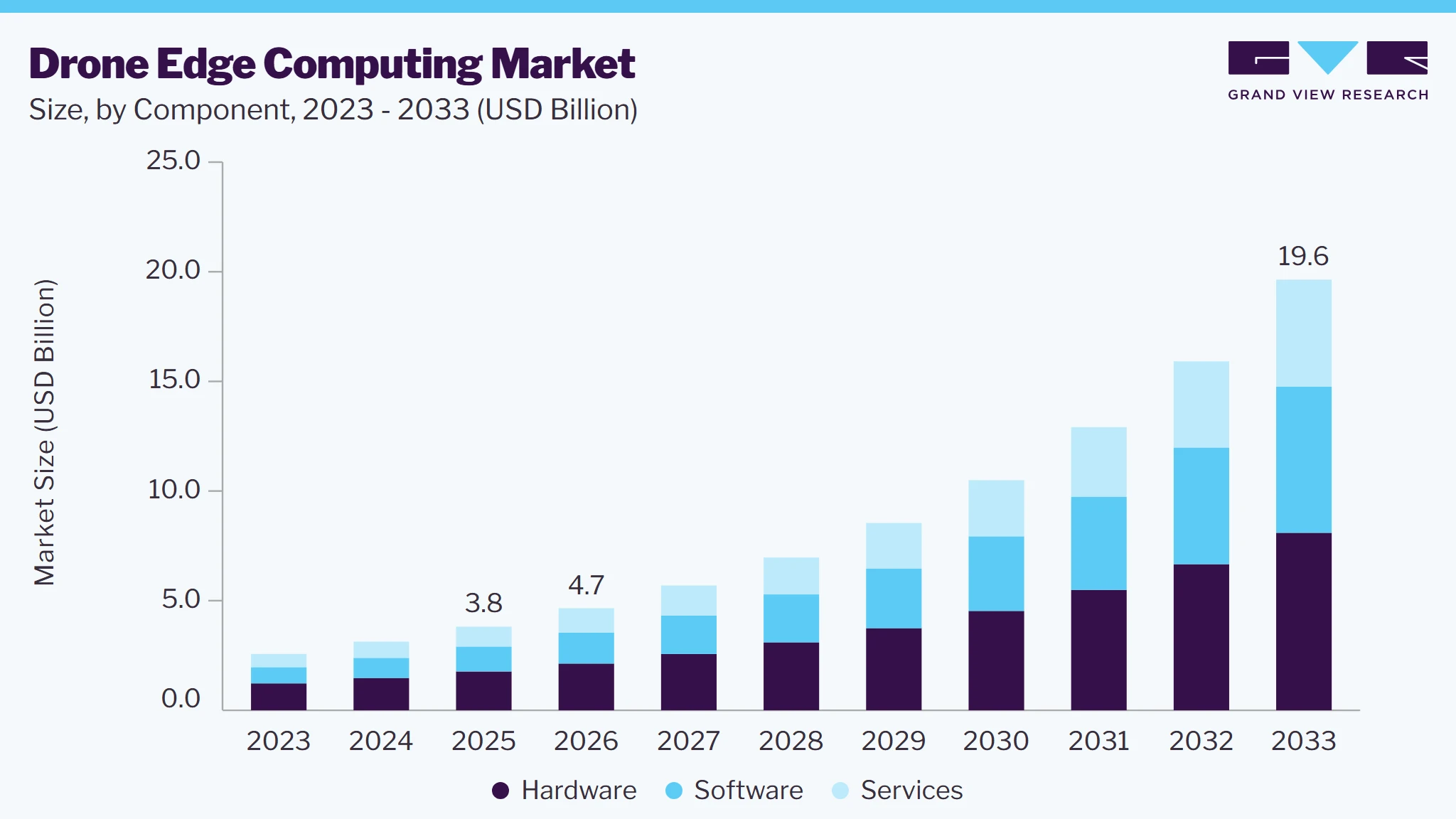 To learn more about this report, Download Free Sample Report
 The growth of the drone edge computing market is driven by the increasing deployment of beyond-visual-line-of-sight (BVLOS) operations, rising demand for autonomous fleet coordination, and the growing need for reliable computing in connectivity-constrained environments. The shift toward distributed task offloading, collaborative multi-drone networks, real-time video analytics, energy-efficient computing, and secure local data processing is encouraging operators to integrate edge infrastructure across commercial and industrial drone applications. In addition, the expansion of drone-based emergency response, smart-city monitoring, infrastructure inspection, and aerial communication networks is supporting market expansion.
The increasing use of drones for data-intensive applications, expansion of onboard artificial intelligence capabilities, and growing requirement for uninterrupted aerial data processing are strengthening demand for drone edge computing solutions. Drone operators are increasingly adopting onboard computing architectures that process imagery, sensor readings, telemetry, and other data closer to the point of collection, reducing dependence on continuous communication with remote cloud platforms. The growing use of high-resolution cameras, LiDAR, multispectral sensors, thermal imaging, and other sophisticated payloads is further driving demand for compact computing systems capable of handling large volumes of data directly on drones.
Additionally, the increasing emphasis on data sovereignty, cybersecurity, and secure processing of sensitive aerial information is accelerating the adoption of drone edge computing. Government agencies, defense organizations, critical infrastructure operators, and commercial enterprises are increasingly seeking solutions that can analyze and store sensitive drone-generated information locally rather than transmitting raw data to centralized cloud environments. Local processing can reduce exposure to interception, unauthorized access, and data-transfer vulnerabilities while supporting compliance with organizational security requirements. These capabilities are particularly important for surveillance, infrastructure monitoring, public safety, and industrial applications involving confidential operational information.
Moreover, the growing development of specialized edge processors, AI accelerators, and energy-efficient computing architectures is creating new opportunities for drone edge computing providers. The integration of graphics processing units, neural processing units, field-programmable gate arrays, and system-on-chip architectures is enabling drones to execute advanced computer vision, object recognition, image classification, and sensor-fusion workloads within constrained onboard environments. These developments are encouraging the transition toward smaller, more efficient, and application-specific edge computing platforms that improve drone payload efficiency and operational endurance.
Market Dynamics
The drone edge computing market is experiencing significant growth, driven by the increasing adoption of autonomous drone swarms and growing demand for distributed decision-making across multiple UAVs. Operators are increasingly deploying edge-enabled drones that can process sensor information, coordinate tasks, and make operational decisions locally without relying continuously on centralized control stations. The ability of distributed computing architectures to support dynamic task allocation, collaborative perception, and mission continuity during connectivity disruptions is encouraging developers to integrate edge intelligence into next-generation drone fleets.
The drone edge computing market is driven by the growing need for drones to make rapid decisions without depending on remote cloud servers. Edge computing enables onboard processing of navigation data, imagery, sensor inputs, and environmental information, supporting faster obstacle detection, route adjustment, and mission execution. This capability is particularly valuable for applications requiring immediate responses, where communication delays can affect operational accuracy and safety.
The increasing complexity of autonomous drone operations is strengthening demand for localized computing capabilities. Drones performing inspection, mapping, monitoring, and emergency-response tasks increasingly require continuous interpretation of multiple sensor inputs during flight. Processing these inputs locally can reduce transmission delays and network dependence while enabling autonomous functions under variable connectivity conditions. As operators seek greater autonomy with limited human intervention, edge-enabled computing architectures are becoming increasingly important.
The drone edge computing market faces limitations due to limited onboard power availability and thermal constraints. Edge processors consume energy that competes directly with propulsion, navigation, and payload systems, potentially reducing flight endurance when intensive computing workloads are performed continuously. Higher processing requirements can also generate additional heat, creating thermal-management challenges within compact drone structures and limiting the ability to deploy powerful computing hardware on smaller platforms.
Resource constraints become more challenging when drones process high-resolution imagery, LiDAR information, or complex artificial intelligence models during flight. Operators must balance computational performance, battery consumption, payload weight, and thermal stability while maintaining reliable mission performance. The need for specialized processors, optimized algorithms, cooling mechanisms, and efficient workload allocation can increase system complexity and deployment costs. These limitations may restrict adoption where extended flight duration or lightweight configurations are critical operational requirements.
The drone edge computing market presents opportunities through the development of drones functioning as mobile edge nodes for temporary or underserved connectivity environments. UAVs can provide computing resources closer to users and devices in remote areas, disaster zones, temporary events, and rapidly changing operational environments. Their mobility enables flexible positioning of computing resources, supporting localized data processing and communication services where conventional fixed infrastructure is unavailable or difficult to deploy.
The integration of aerial edge computing with next-generation wireless networks can further expand the range of applications requiring distributed processing and flexible connectivity. Drones can support task offloading, temporary network coverage, data collection, and localized analytics while coordinating with ground-based edge infrastructure. This architecture can serve smart-city operations, emergency response, industrial monitoring, and remote connectivity requirements. Continued development of resource-allocation methods, edge-cloud coordination, and autonomous deployment can strengthen the commercial viability of these distributed aerial computing models.
Market Concentration & Characteristics
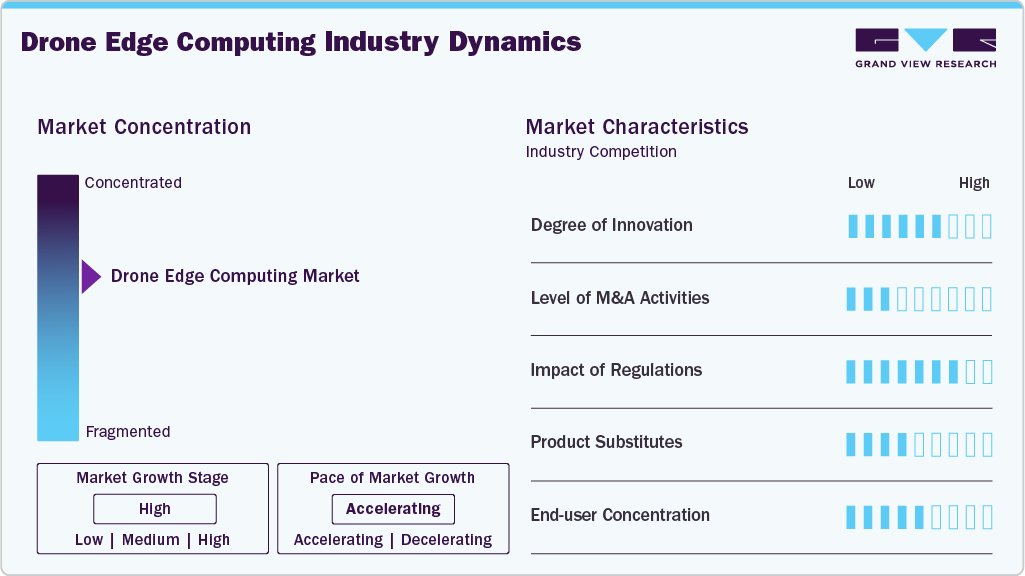
The drone edge computing market is moderately fragmented, comprising drone manufacturers, edge computing providers, semiconductor companies, AI technology developers, cloud service providers, telecommunications companies, and specialized edge hardware suppliers competing across surveillance, inspection, mapping, agriculture, logistics, emergency response, and autonomous drone applications. The market is shaped by increasing demand for real-time onboard processing, autonomous operations, low-latency analytics, distributed computing, and reduced dependence on centralized cloud infrastructure. Technology partnerships, hardware-software integration, strategic collaborations, platform compatibility, and established relationships with enterprise or government customers enable leading companies to strengthen their positions across diverse application areas.
 To learn more about this report, Download Free Sample Report
 The market is characterized by a high level of innovation, supported by advancements in AI accelerators, energy-efficient processors, onboard machine learning, sensor fusion, real-time analytics, and compact computing architectures. The market witnesses a moderate level of merger and acquisition activity, as companies often expand capabilities through strategic partnerships, technology collaborations, investments, and platform integration rather than frequent acquisitions. Competition from conventional cloud computing and centralized processing solutions remains relevant, particularly for applications that can tolerate higher latency or continuous connectivity. Increasing demand for autonomous decision-making, secure local data processing, edge-cloud coordination, and real-time interpretation of high-volume sensor data continues to strengthen competitive positioning.
Analyst Perspective
The drone edge computing market is advancing through the increasing integration of onboard AI accelerators, autonomous navigation, sensor fusion, and real-time computer vision across commercial and mission-critical drone platforms. Manufacturers are strengthening their portfolios through compact processing architectures, energy-efficient chipsets, localized analytics, AI-enabled perception, and secure edge-to-cloud coordination. The growing deployment of drones for infrastructure inspection, precision agriculture, emergency response, logistics, and surveillance is driving demand for computing systems that can process complex sensor data locally while maintaining reliable operation under bandwidth constraints and intermittent connectivity.
Component Insights
The hardware segment dominated the drone edge computing industry, accounting for the largest revenue share of 46.4% in 2025, propelled by increasing integration of high-performance processors, GPUs, NPUs, memory modules, sensors, and communication components directly into drone platforms. Edge-enabled drones require ruggedized computing hardware capable of processing imagery, telemetry, navigation, and sensor data under demanding operating conditions. Growing deployment across surveillance, mapping, infrastructure inspection, agriculture, and autonomous missions continues to strengthen demand for advanced onboard hardware in the market.
The software segment is expected to grow at a significant CAGR of over 24.0% from 2026 to 2033. The segment growth is driven by increasing adoption of AI inference, computer vision, autonomous navigation, sensor fusion, and real-time analytics applications. Edge software enables drones to interpret mission data locally, reducing latency, bandwidth consumption, and dependence on cloud connectivity. Rising demand for autonomous flight, intelligent decision-making, predictive analytics, fleet coordination, and adaptive mission management is expected to accelerate the adoption of advanced edge software across drone applications.
Drone Type Insights
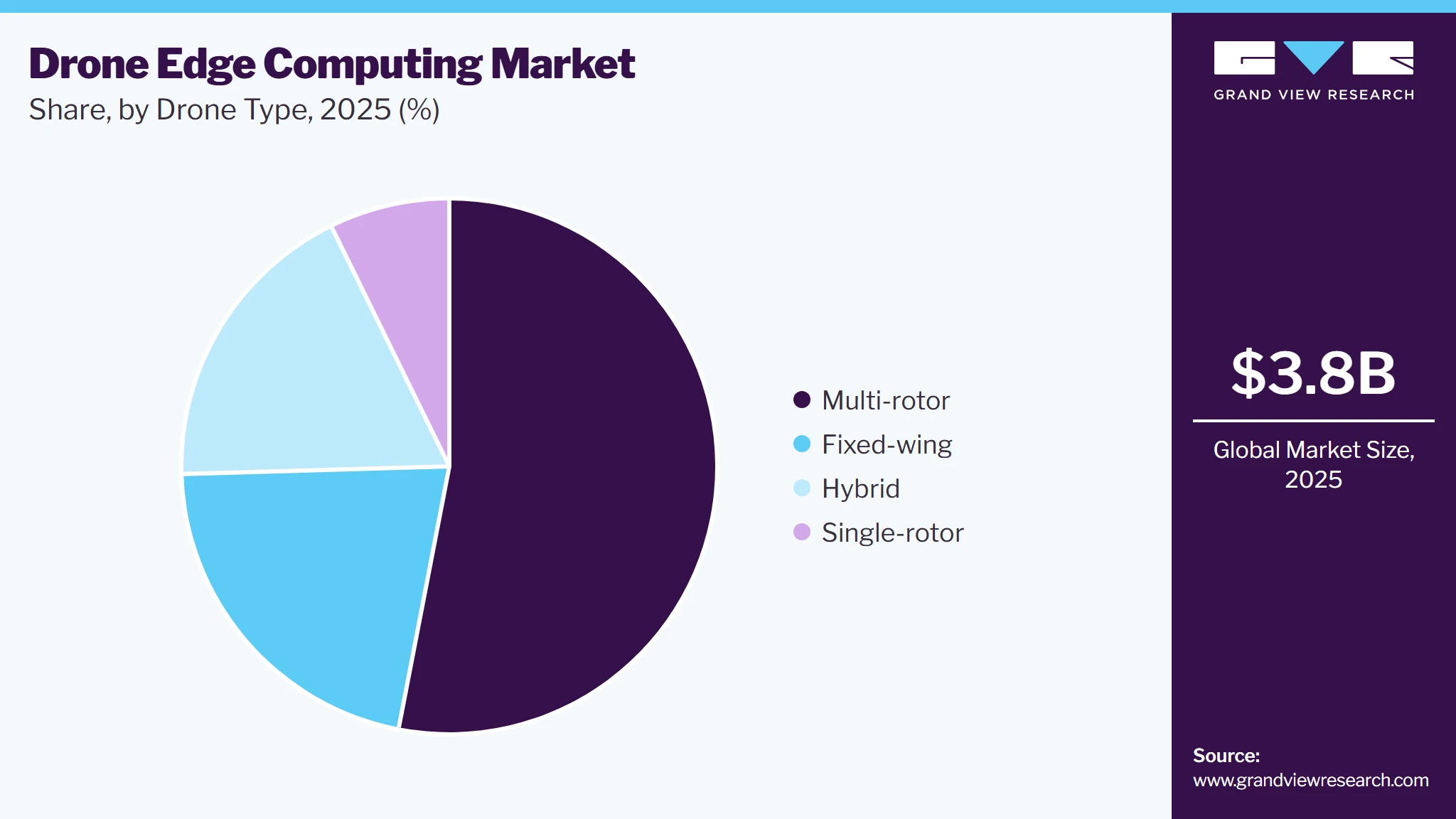
The multi-rotor segment dominated the drone edge computing market, accounting for the largest revenue share of 53.0% in 2025, fueled by growing demand for vertical takeoff capability, hovering stability, precise maneuverability, and flexible deployment. Drone operators are increasingly adopting multi-rotor platforms for surveillance, infrastructure inspection, mapping, agriculture, and public-safety missions where controlled flight and localized data collection are essential. The growing integration of cameras, thermal sensors, AI processors, and edge analytics within compact multi-rotor platforms continues to strengthen their position in the drone edge computing industry.
 To learn more about this report, Download Free Sample Report
 The hybrid segment is expected to grow at a significant CAGR from 2026 to 2033, driven by increasing demand for extended flight endurance, vertical takeoff and landing, longer-range missions, and flexible operational deployment. Hybrid drones combine hovering capabilities with efficient forward flight, making them suitable for applications that require coverage over large geographic areas while maintaining localized computing capabilities. Rising adoption for infrastructure inspection, precision agriculture, long-distance surveillance, emergency response, and logistics operations is supporting demand for hybrid platforms equipped with advanced edge computing systems.
Computing Type Insights
The onboard edge computing segment accounted for the largest market share of 51.9% in 2025, driven by increasing demand for real-time data processing, autonomous navigation, obstacle detection, and sensor-fusion capabilities directly onboard drones. Drone operators are increasingly integrating AI processors, GPUs, NPUs, and edge analytics systems to process imagery, telemetry, and sensor data locally while reducing communication latency. The growing deployment of autonomous drones for surveillance, inspection, mapping, and precision operations continues to strengthen demand for onboard edge computing architectures in the drone edge computing industry.
The distributed edge computing segment is expected to witness a significant CAGR from 2026 to 2033, driven by increasing requirements for coordinated multi-drone operations, localized data processing, fleet intelligence, and resilient connectivity. Operators are increasingly connecting drones with edge gateways, ground stations, local servers, and communication networks to distribute computational workloads closer to operating environments. The growing adoption of drone swarms, large-scale infrastructure monitoring, emergency response, and connected logistics networks is accelerating the deployment of distributed edge computing architectures in the market.
Application Insights
The surveillance and monitoring segment dominated the drone edge computing industry, accounting for the largest revenue share of 29.6% in 2025, fueled by increasing requirements for real-time aerial intelligence, persistent asset monitoring, perimeter surveillance, and automated threat detection. Drone operators are increasingly deploying edge computing to process high-resolution imagery, video feeds, thermal data, and sensor information directly on the platform, reducing latency and dependence on remote data centers. Growing demand for continuous infrastructure inspection, border monitoring, public safety, and situational awareness is strengthening the adoption of edge-enabled drones in the market.
The delivery and logistics segment is expected to grow at the fastest CAGR from 2026 to 2033, driven by increasing adoption of autonomous package delivery, real-time route optimization, obstacle avoidance, and time-sensitive transportation operations. Logistics providers are increasingly integrating onboard edge computing to process navigation, location, package, and environmental data locally, enabling rapid decisions during flight without continuous cloud connectivity. The expansion of last-mile delivery, medical supply transportation, warehouse operations, and urban drone logistics is accelerating demand for low-latency computing capabilities across delivery and logistics applications.
End Use Insights
The defense and security segment dominated the drone edge computing market, accounting for the largest revenue share of 26.0% in 2025, driven by increasing adoption of autonomous surveillance, border monitoring, tactical reconnaissance, and real-time threat detection capabilities. Defense organizations are increasingly deploying drones equipped with onboard AI processors, computer vision, sensor fusion, and edge analytics to process mission data locally. Growing requirements for low-latency intelligence, secure communications, autonomous decision-making, and operations in connectivity-limited environments are strengthening demand for edge computing capabilities.
The transportation and logistics segment is expected to witness the highest CAGR from 2026 to 2033, driven by increasing deployment of autonomous delivery drones, real-time route optimization, traffic monitoring, and automated fleet coordination. Logistics operators are increasingly integrating edge computing into drones to process navigation, obstacle detection, package monitoring, and flight-control data locally, reducing dependence on centralized data centers. Growing adoption of urban air mobility, last-mile delivery, and time-sensitive logistics operations is expected to accelerate demand for low-latency computing capabilities in the drone edge computing industry.
Regional Insights
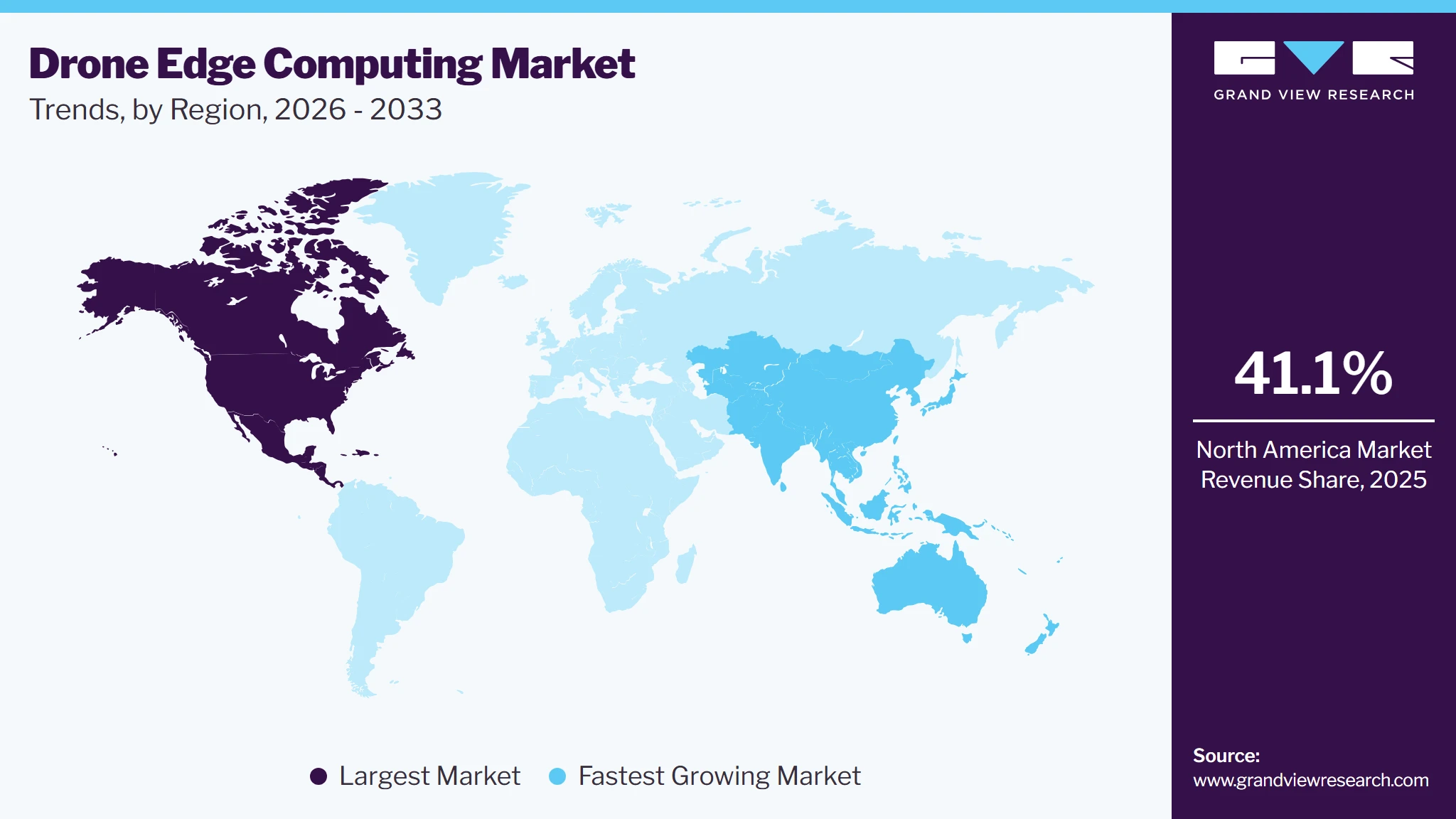
The North America drone edge computing market held the largest global revenue share of 41.1% in 2025, driven by a strong ecosystem of semiconductor manufacturers, edge-AI technology providers, cloud platforms, and advanced drone developers. Increasing deployment of autonomous unmanned aerial systems for defense, infrastructure inspection, public safety, and industrial monitoring is strengthening demand for localized data processing. The expansion of beyond-visual-line-of-sight operations and investment in low-latency AI infrastructure are further encouraging the adoption of onboard and ground-based edge computing architectures.
 To learn more about this report, Download Free Sample Report
 U.S. Drone Edge Computing Market Trends
The U.S. drone edge computing industry dominated, with a share of 87.7% in 2025, driven by substantial investment in autonomous aerial systems, defense modernization, AI infrastructure, and commercial drone operations. Government programs increasingly emphasize real-time processing of intelligence, surveillance, and reconnaissance data, creating demand for ruggedized computing platforms capable of operating in disconnected environments. The expansion of BVLOS operations, logistics applications, and infrastructure inspection is further increasing requirements for onboard AI inference, local analytics, and reliable edge-to-cloud coordination.
Europe Drone Edge Computing Market Trends
The Europe drone edge computing industry is expected to grow at a significant CAGR of 21.6% from 2026 to 2033. The market growth is driven by increasing adoption of autonomous aerial systems, environmental monitoring, infrastructure inspection, smart-city initiatives, and distributed AI technologies. The European Union is investing in decentralized intelligence, swarm coordination, and edge-native AI through Horizon Europe research programs, while the U-Space regulatory framework is supporting more structured drone operations. Increasing emphasis on digital sovereignty and distributed computing infrastructure is further encouraging localized processing for drone applications.
The UK drone edge computing market is expected to grow significantly in the coming years, driven by increasing investment in autonomous systems, defense drones, offshore infrastructure inspection, and advanced air mobility. Government investment exceeding £4 billion in autonomous systems is strengthening the country's ecosystem for uncrewed technologies, while the establishment of a dedicated Drone Center aims to accelerate the deployment of small uncrewed aircraft systems. These initiatives are increasing demand for edge-enabled platforms capable of processing imagery, navigation data, and mission intelligence with limited dependence on remote computing infrastructure.
The drone edge computing market in Germany is supported by strong industrial automation capabilities, investment in distributed computing infrastructure, and increasing integration of unmanned aircraft into controlled airspace. Germany is participating in European initiatives focused on sovereign edge computing infrastructure, while military and civilian flight demonstrations are advancing the safe integration of remotely piloted systems into shared airspace. The country's automotive, manufacturing, logistics, and infrastructure sectors are creating demand for drones capable of performing localized AI analytics and real-time decision-making in the drone edge computing industry.
Asia Pacific Drone Edge Computing Market Trends
The Asia Pacific drone edge computing industry is expected to grow at the fastest CAGR of 24.9% from 2026 to 2033, driven by rapid drone adoption, expanding 5G infrastructure, smart-city programs, precision agriculture, disaster-response requirements, and industrial automation. China, Japan, India, and South Korea are developing large ecosystems around autonomous drones, AI processors, telecommunications infrastructure, and edge platforms. The region's diverse geography and connectivity requirements are also encouraging localized processing for applications where continuous cloud connectivity is difficult or costly.
The China drone edge computing market is expanding alongside large-scale commercial drone deployment, smart-agriculture programs, urban aerial services, and domestic AI hardware development. The country's extensive 5G infrastructure and strong ecosystem of drone and telecommunications technology providers are supporting integration of edge computing into autonomous aerial platforms. Agricultural drones increasingly use onboard analytics for crop monitoring, spraying, and field assessment, while urban applications are creating requirements for real-time video processing, traffic monitoring, and aerial data analytics without continuous reliance on centralized cloud infrastructure.
The drone edge computing market in Japan is gaining traction owing to the country's emphasis on Society 5.0, disaster management, infrastructure monitoring, precision agriculture, and advanced autonomous systems. The combination of mature 5G networks, strong semiconductor capabilities, and an aging infrastructure base is encouraging the deployment of drones capable of performing localized inspection and analytics. Edge processing is particularly valuable for disaster-response operations because drones can rapidly analyze imagery, identify affected areas, and support situational awareness when conventional communications infrastructure is disrupted.
Key Drone Edge Computing Company Insights
Some of the key players operating in the market are NVIDIA Corporation and Intel Corporation.
-
NVIDIA Corporation is a leading player in the drone edge computing market through its NVIDIA Jetson platform, which provides compact, energy-efficient AI computing capabilities for autonomous machines, including drones. Its GPU-accelerated architecture supports onboard computer vision, sensor processing, object detection, navigation, and AI inference without requiring continuous cloud connectivity. NVIDIA’s combination of AI processors, software development tools, and edge computing technologies positions the company strongly in the drone edge computing industry.
-
Intel Corporation is a leading player in the drone edge computing industry through its edge processors, computer-vision technologies, and AI acceleration solutions. The company’s Intel Core, Atom, and Movidius technologies support real-time image processing, autonomous navigation, object recognition, and analytics in resource-constrained environments. Its combination of processors, AI software, and edge computing capabilities enables drone developers to build localized computing architectures for industrial inspection, surveillance, mapping, and autonomous operations, strengthening its market position.
Skydio, Inc. and Autel Robotics Co., Ltd. are some of the emerging participants in the drone edge computing market.
-
Skydio, Inc. is an emerging player in the drone edge computing market through its autonomous drone platforms, AI-powered navigation, and onboard computer-vision capabilities. The company develops drones that use artificial intelligence to interpret surroundings, avoid obstacles, and autonomously navigate complex environments without relying entirely on remote operators. Its focus on onboard autonomy, real-time perception, and intelligent flight operations positions Skydio to benefit from increasing demand for edge-enabled drone systems across inspection, public safety, defense, and infrastructure applications in the drone edge computing industry.
-
Autel Robotics Co., Ltd. is an emerging player in the drone edge computing industry through its enterprise and commercial drone platforms incorporating intelligent flight control, computer vision, obstacle avoidance, and real-time imaging capabilities. The company integrates advanced processors, sensing technologies, and autonomous functions into compact UAV platforms, enabling localized processing for aerial inspection, surveying, public safety, and industrial applications. Its expanding portfolio of intelligent drones and emphasis on autonomous capabilities position Autel Robotics as an emerging participant in the drone edge computing industry.
Key Drone Edge Computing Companies
The following key companies have been profiled for this study on the drone edge computing market.
-
Cisco Systems, Inc.
-
SZ DJI Technology Co., Ltd.
-
NVIDIA Corporation
-
Intel Corporation
-
Qualcomm Technologies, Inc.
-
Microsoft Corporation
-
Amazon Web Services
-
Skydio, Inc.
-
IBM Corporation
-
Autel Robotics Co., Ltd.
Competitive Benchmarking
Category
Operating Strategies
Competitive Edge
Weakness
Established Players (Cisco Systems, Inc., NVIDIA Corporation, Intel Corporation)
- Focus on integrating onboard AI, edge processors, and autonomous computing across diverse drone platforms.
- Invest heavily in R&D, partnerships, and software ecosystems supporting real-time aerial data processing.
- Strong technology portfolios, established customer relationships, and extensive expertise support competitive positioning.
- Ability to deliver scalable, secure, low-latency computing solutions for complex autonomous drone applications.
- Dependence on complex hardware architectures can increase system costs and integration requirements.
- Large organizational structures may reduce agility when responding to rapidly evolving drone computing technologies.
Emerging Players (Skydio, Inc., IBM Corporation, Autel Robotics Co., Ltd.)
- Emerging players are focusing on developing AI-enabled autonomous drones with onboard processing for real-time decision-making.
- Invest in lightweight computing, advanced sensors, and software integration to improve drone autonomy.
- Agile product development enables rapid adoption of emerging AI, computer vision, and edge technologies.
- Specialized autonomous platforms provide efficient real-time processing for inspection, surveillance, mapping, and industrial applications.
- Smaller scale can limit R&D resources, manufacturing capacity, and global deployment capabilities.
- Limited established customer networks may constrain adoption across large-scale enterprise and government applications.
Recent Developments
-
In July 2026, Cisco Systems, Inc. introduced Cisco Unified Edge, an AI-ready modular computing platform combining compute, storage, networking, security, observability, and centralized cloud management. The platform is designed to support distributed AI workloads closer to where data is generated. Its combination of edge computing and secure networking capabilities can support drone deployments requiring localized processing, resilient connectivity, and centralized management of distributed aerial systems in the drone edge computing industry.
-
In May 2026, Skydio, Inc. continued expanding its autonomous drone platform around AI-driven real-time navigation and perception, with its Skydio Autonomy technology using AI and advanced sensors to interpret complex environments during flight. The company’s focus on autonomous inspection, public safety, security, and other mission-critical applications demonstrates increasing integration of localized intelligence into drone platforms. This strengthens Skydio’s position as an application-focused participant in the drone edge computing market.
-
In February 2026, SZ DJI Technology Co., Ltd. announced the DJI Enterprise Drone Onboard AI Challenge, encouraging developers to deploy AI algorithms directly on DJI drones. The initiative builds on DJI’s expansion of onboard intelligent computing across platforms such as the M4T and M400, enabling localized AI processing closer to real-world operations. The initiative demonstrates DJI’s focus on expanding onboard intelligence and developer adoption within the drone edge computing industry.
Drone Edge Computing Market Report Scope
Report Attribute
Details
Market size value in 2025
USD 3.8 billion
Estimated market size in 2026
USD 4.7 billion
Projected market size by 2033
USD 19.6 billion
Growth Rate
CAGR of 22.8% from 2026 to 2033
Base year for estimation
2025
Historical data
2021 - 2024
Forecast period
2026 - 2033
Quantitative units
Revenue in USD million/billion and CAGR from 2026 to 2033
Report Product
Revenue forecast, company ranking, competitive landscape, growth factors, and trends
Segments covered
Component, drone type, computing type, application, end use, and region
Region scope
North America; Europe; Asia Pacific; Latin America; Middle East & Africa
Country scope
U.S.; Canada; Mexico; UK; Germany; France; China; Japan; India; South Korea; Australia; Brazil; Saudi Arabia; UAE; South Africa
Key companies profiled
Cisco Systems, Inc.; SZ DJI Technology Co., Ltd.; NVIDIA Corporation; Intel Corporation; Qualcomm Technologies, Inc.; Microsoft Corporation; Amazon Web Services; Skydio, Inc.; IBM Corporation; Autel Robotics Co., Ltd.
Customization scope
Free report customization (equivalent to up to 8 analyst’s working days) with purchase. Addition or alteration to country, regional & segment scope.
Pricing and purchase options
Avail customized purchase options to meet you exact research needs. Explore purchase options
Global Drone Edge Computing Market Report Segmentation
This report forecasts revenue growth at the global, regional & country levels and provides an analysis of the latest technological trends in each of the sub-segments from 2021 to 2033. For this study, Grand View Research has segmented the drone edge computing market report based on component, drone type, computing type, application, end use, and region:
-
Component Outlook (Revenue, USD Million/Billion, 2021 - 2033)
-
Hardware
-
Software
-
Services
-
-
Drone Type Outlook (Revenue, USD Million/Billion, 2021 - 2033)
-
Fixed-wing
-
Multi-rotor
-
Single-rotor
-
Hybrid
-
-
Computing Type Outlook (Revenue, USD Million/Billion, 2021 - 2033)
-
Onboard Edge Computing
-
Ground Station Edge Computing
-
Distributed Edge Computing
-
-
Application Outlook (Revenue, USD Million/Billion, 2021 - 2033)
-
Surveillance and Monitoring
-
Mapping and Surveying
-
Delivery and Logistics
-
Disaster Management
-
Others
-
-
End Use Outlook (Revenue, USD Million/Billion, 2021 - 2033)
-
Defense and Security
-
Agriculture
-
Energy and Utilities
-
Transportation and Logistics
-
Media and Entertainment
-
Others
-
-
Regional Outlook (Revenue, USD Million/Billion, 2021 - 2033)
-
North America
-
U.S.
-
Canada
-
Mexico
-
-
Europe
-
UK
-
Germany
-
France
-
-
Asia Pacific
-
China
-
Japan
-
India
-
South Korea
-
Australia
-
-
Latin America
-
Brazil
-
-
Middle East and Africa (MEA)
-
Saudi Arabia
-
UAE
-
South Africa
-
-
Research Methodology
The drone edge computing market figures in this report are based on a proven research process that combines executive interviews with secondary research from proprietary databases, company filings, and recognized regulatory and institutional sources. Market size is built through value-chain sizing-reconciling supply-side and demand-side estimates-and triangulated with bottom-up and top-down approaches. Every estimate passes multiple levels of expert validation before publication, with each drone edge computing segment quantified using the revenue-capture definitions in the table below.
Segment Definition
Component
Revenue capture definition
Hardware
Revenue is generated from processors, AI accelerators, GPUs, sensors, memory modules, networking equipment, and compact computing units installed on drones or edge infrastructure for real-time data processing and autonomous operations.
Software
Revenue is captured from operating systems, AI algorithms, computer-vision software, analytics platforms, workload-management tools, and edge applications that enable drones to process, analyze, and interpret data locally during missions.
Services
Revenue is generated from consulting, system integration, deployment, maintenance, technical support, managed services, and software updates that enable organizations to implement and operate edge computing capabilities across drone platforms.
Drone Type
Revenue capture definition
Fixed-wing
Revenue is generated from edge computing solutions integrated with fixed-wing drones designed for long-endurance and wide-area operations, supporting real-time processing of imagery, mapping data, surveillance information, and environmental sensor inputs.
Multi-rotor
Revenue is captured from edge computing solutions deployed on multi-rotor drones used for inspection, surveillance, agriculture, mapping, and public safety, enabling onboard computer vision, navigation, obstacle detection, and real-time analytics.
Single-rotor
Revenue is generated from edge computing solutions integrated with single-rotor drones supporting extended flight durations and heavier payloads, enabling localized processing of surveillance, inspection, navigation, and sensor data during operations.
Hybrid
Revenue is captured from edge computing solutions integrated with hybrid drones combining vertical takeoff capabilities with efficient forward flight, supporting autonomous navigation, sensor fusion, flight transitions, and real-time mission decision-making.
Computing Type
Revenue capture definition
Onboard Edge Computing
Revenue is generated from computing systems installed directly on drones to process imagery, sensor data, navigation information, and artificial intelligence workloads locally, reducing latency and dependence on continuous cloud connectivity.
Ground Station Edge Computing
Revenue is captured from computing infrastructure positioned at drone ground stations to process aerial data close to operations, supporting real-time analytics, mission control, data management, and reduced transmission requirements to distant cloud platforms.
Distributed Edge Computing
Revenue is generated from distributed architectures that coordinate computing resources across drones, ground stations, network infrastructure, and edge servers, enabling workload distribution, collaborative processing, and real-time analytics across connected aerial systems.
Application
Revenue capture definition
Surveillance and Monitoring
Revenue is generated from edge computing solutions supporting aerial surveillance, security monitoring, border observation, infrastructure monitoring, and public safety through real-time video analytics, object detection, tracking, and localized decision-making.
Mapping and Surveying
Revenue is captured from edge computing solutions used to process aerial imagery, LiDAR data, geographic information, and sensor measurements during mapping, land surveying, construction monitoring, and three-dimensional terrain reconstruction operations.
Delivery and Logistics
Revenue is generated from edge computing systems supporting autonomous delivery drones through real-time route optimization, obstacle detection, navigation, package monitoring, fleet coordination, and localized decision-making during transportation and delivery operations.
Disaster Management
Revenue is captured from edge computing solutions supporting disaster assessment, search and rescue, emergency communications, damage identification, and situational awareness by processing aerial imagery and sensor information locally during emergency operations.
Others
Revenue is generated from edge computing solutions used across precision agriculture, environmental monitoring, traffic management, telecommunications, media production, wildlife monitoring, and other drone applications requiring localized data processing and real-time analytics.
End Use
Revenue capture definition
Defense and Security
Revenue is generated from edge computing solutions used for reconnaissance, surveillance, perimeter security, tactical intelligence, target identification, and autonomous mission support requiring secure, low-latency processing of sensitive aerial data.
Agriculture
Revenue is captured from edge computing solutions supporting precision agriculture through localized processing of multispectral imagery, crop conditions, soil information, field data, and sensor inputs for monitoring, spraying, and agricultural decision-making.
Energy and Utilities
Revenue is generated from edge computing solutions that support the inspection and monitoring of power lines, pipelines, renewable energy assets, transmission infrastructure, and other utility facilities through real-time analysis of aerial imagery and sensor data.
Transportation and Logistics
Revenue is captured by edge computing solutions supporting autonomous delivery, traffic monitoring, infrastructure inspection, route optimization, fleet coordination, and real-time processing of aerial data across transportation and logistics operations.
Media and Entertainment
Revenue is generated from edge computing solutions supporting aerial photography, live event coverage, sports broadcasting, cinematic production, and content creation through real-time image processing, stabilization, tracking, and video analytics.
Others
Revenue is captured from edge computing solutions used by construction, telecommunications, environmental services, research organizations, emergency agencies, and other end users requiring real-time drone data processing and autonomous capabilities.
Estimation Model
Layer Name
Key Question
Description
Drone End-User Layer
Who are the potential end users?
Identifies defense organizations, public safety agencies, infrastructure operators, agricultural companies, logistics providers, telecommunications operators, energy companies, emergency-response agencies, and other organizations that require real-time drone data processing, autonomous operations, monitoring, and localized analytics.
Edge Computing Technology Development Layer
Who can provide drone edge computing solutions?
Drone edge computing development involves drone manufacturers, semiconductor companies, AI technology providers, edge computing companies, processor manufacturers, software developers, sensor suppliers, companies, and system integrators, all supporting onboard processing, AI inference, computer vision, sensor fusion, connectivity, and edge-cloud coordination.
Drone Platform Integration Layer
Where are edge computing solutions deployed?
Edge computing solutions are deployed across commercial UAVs, autonomous drones, drone swarms, industrial inspection platforms, surveillance systems, delivery drones, emergency-response UAVs, and other aerial platforms requiring real-time processing, autonomous navigation, localized analytics, and reduced dependence on centralized cloud infrastructure.
Revenue Generation Layer
How is revenue generated?
Revenue is generated through drone hardware sales, edge computing modules, AI processors, software licenses, autonomous navigation systems, edge analytics platforms, cloud-edge services, system integration, maintenance, upgrades, partnerships, and customized solutions for enterprise, government, defense, and commercial drone applications.
Delivered Customizations
This report has been delivered with the following In-depth customizations
Client Request
Customization Delivered
Value Adds
Drone Edge AI Deployment Assessment & Onboard Processing Strategy
Evaluated onboard edge computing architectures across autonomous drones, surveillance, inspection, agriculture, logistics, and emergency-response applications, integrating AI processors, computer vision, sensor fusion, and real-time data processing capabilities.
Improves processing speed, reduces latency, supports autonomy, and optimizes drone performance.
Edge Computing Hardware Integration & Power Optimization Strategy
Assessed integration of compact processors, AI accelerators, GPUs, NPUs, sensors, and thermal-management technologies within drone platforms to balance computational performance, power consumption, payload weight, and flight endurance.
Enhances computing efficiency, extends flight endurance, reduces payload constraints, and supports reliable operations.
Edge-to-Cloud Connectivity & Real-Time Analytics Strategy
Evaluated edge-to-cloud architectures enabling localized drone data processing, selective data transmission, remote monitoring, and real-time analytics across connectivity-constrained environments, integrating wireless networks, cloud platforms, and distributed computing technologies.
Reduces bandwidth requirements, improves responsiveness, strengthens connectivity resilience, and enables scalable analytics.
Frequently Asked Questions About This Report
The onboard edge computing segment led with a 51.9% revenue share in 2025.
The global drone edge computing market size was valued at USD 3.8 billion in 2025 and is estimated at USD 4.7 billion for 2026.
The global drone edge computing market is expected to grow at a CAGR of 22.8% from 2026 to 2033, reaching USD 19.6 billion by 2033.
The hardware segment dominated with a 46.4% revenue share in 2025.
North America dominated the drone edge computing market with a share of 41.1% in 2025.
Key factors that are driving the market growth include increasing demand for real-time data processing, and the rapid expansion of 5G connectivity. The growing use of AI-powered navigation, onboard computer vision, and low-latency analytics, along with the increasing deployment of drones for surveillance, infrastructure inspection, and emergency response, is accelerating demand for compact, high-performance edge computing solutions.
Some key players operating in the drone edge computing market include Cisco Systems, Inc., SZ DJI Technology Co., Ltd., NVIDIA Corporation, Intel Corporation, Qualcomm Technologies, Inc., Microsoft Corporation, Amazon Web Services, Skydio, Inc., IBM Corporation, Autel Robotics Co., Ltd.
The Asia Pacific is the fastest-growing region with a CAGR of over 24.0% from 2026 to 2033.
The multi-rotor segment dominated with a 53.0% revenue share in 2025.
The defense and security segment dominated the market with a share of 26.0% in 2025.
About the Author(s)
Next Generation Technologies Research Team
Technology · Next Generation TechnologiesThis report was authored by the next generation technologies research team at Grand View Research - comprising two research analysts, one senior research analyst, and one industry expert - with specialized expertise in the next generation technologies segment of the technology industry. All findings are based on proprietary technology databases, executive interviews, and regulatory analysis, subject to internal peer review prior to publication.
Last Updated:
Speak to Analyst

Customize this report to your needs - add regions, segments, or data points, with 20% free customization.
Or view our licence options:


ISO 9001:2015 & 27001:2022 Certified
We are GDPR and CCPA compliant! Your transaction & personal information is safe and secure. For more details, please read our privacy policy.


