
- Home
- »
- Network Security
- »
-
Edge Security Market Size And Share Report, 2026-2033GVR Report cover

Edge Security Market (2026 - 2033)
Size, Share & Trends Analysis Report By Component (Solutions, Services), By Deployment Mode (Cloud Based, On Premise), By Organization Size, By End-use (Manufacturing, Healthcare, Telecom & IT), By Region, And Segment Forecasts
Market Size, 2025
$31.5BMarket Estimate, 2026
$37.5BMarket Forecast, 2033
$144.2BCAGR, 2026–2033
21.2%Edge Security Market Summary
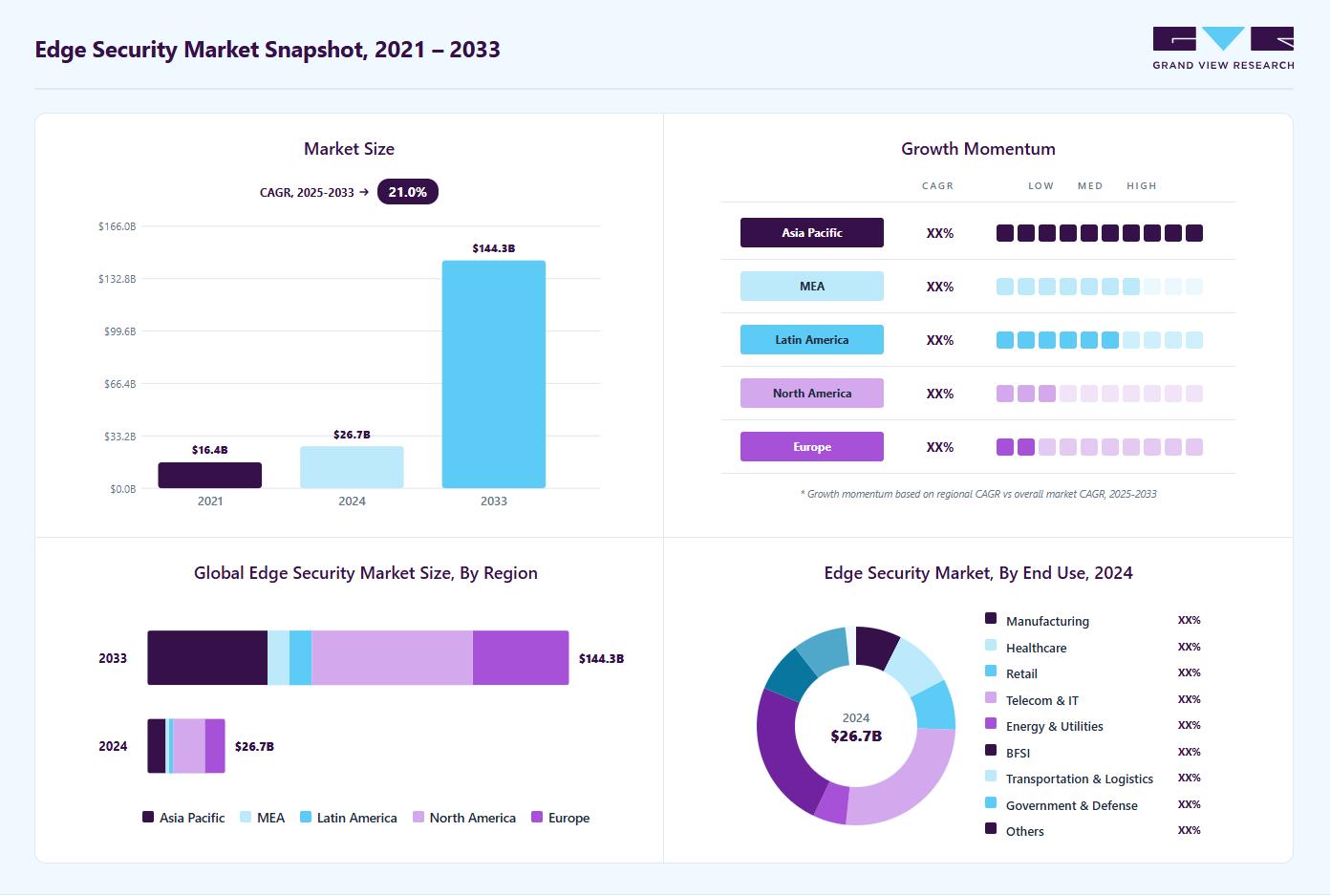
The global edge security market size was valued at USD 31.5 billion in 2025 and is projected to grow from USD 37.5 billion in 2026 to USD 144.2 billion by 2033, at a CAGR of 21.2% from 2026 to 2033. The North America dominated the market, accounting for a revenue share of 39.3% in 2025. The edge security market is driven by the growing need to secure distributed data, applications, and connected devices as organizations increasingly adopt hybrid work, edge computing, and IoT.
 Source: Grand View Research, IR Documents, Primary Interviews, Paid DatabasesTo learn more about this report,
 Download Free Sample Report
 Key Market Trends & Insights
- By Component: Solutions segment dominated the market, with a revenue share of 62.6% in 2025.
- By Deployment Mode: On-premises segment dominated the market, with a revenue share of 59.2% in 2025.
- By Organization Size: Large enterprises segment dominated the market in 2025.
- By End Use: Telecom & IT segment held the largest market share in 2025.
Regional Highlights
- Largest regional market: North America (39.3% revenue share, 2025)
- Fastest-growing regional market: Asia Pacific (highest CAGR, 2026-2033)
- By country: The U.S. held the largest market share in 2025.
Market Size & Forecasts
- Market size in 2025: USD 31.5 Billion
- Estimated market size in 2026: USD 37.5 Billion
- Projected market size by 2033: USD 144.2 Billion
- CAGR (2026-2033): 21.2%
Three ways to get this report
Buy it, customize it, or ask a question.Ask an Analyst
Analyst response in 1 business day
- AccessReport author, directly
- Reply timeWithin 1 working day
- No sales callDirect answer only
- FormatEmail reply
- CostFree, no cost
Get the Full Report
What the study covers
- FormatsPDF · Excel · Dashboard
- Timeline2026–2033 annual, 2025 base
- Coverage20+ countries, 5 regions
- Companies10+ key players profiled
Customize the Report
20% free customization
- IncludeCountries, segments, points
- TailorTo your product definition
- ExtendDeeper competitor detail
- OrA fully bespoke study
- Turnaround5–10 working days
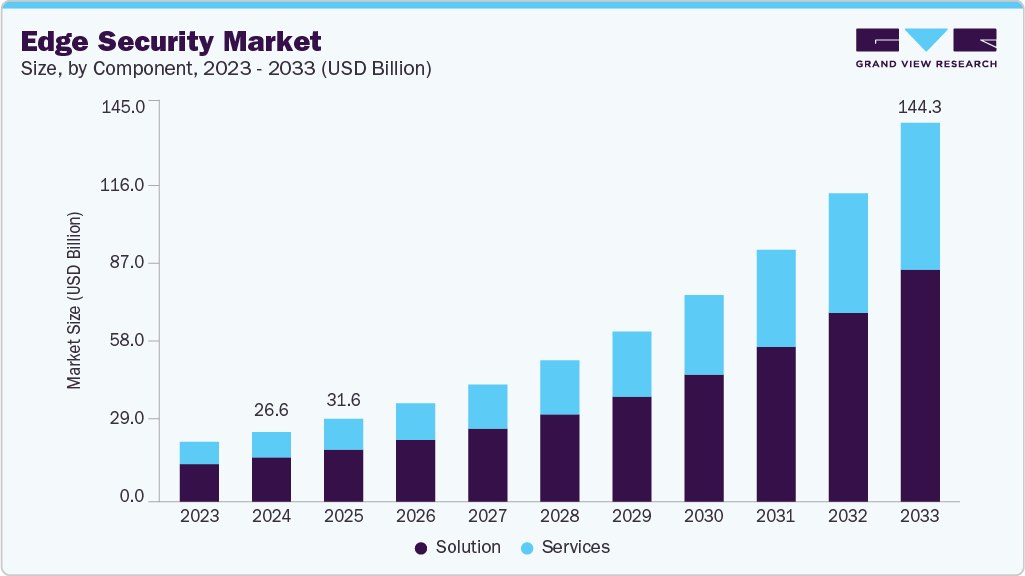
Rising cyber threats targeting remote environments are accelerating the adoption of Zero Trust Network Access (ZTNA), Secure Access Service Edge (SASE), and AI-powered security solutions. Additionally, the integration of AI and machine learning (ML) enhances real-time threat detection, automated response, and intelligent protection at the network edge, making edge security critical for latency-sensitive industries such as manufacturing, healthcare, and logistics.With increasing cyberattacks targeting remote and edge devices, organizations are prioritizing zero trust network architectures (ZTNA), Secure Access Service Edge (SASE), and AI-driven edge firewalls to secure decentralized infrastructures. Moreover, the integration of artificial intelligence (AI) and machine learning (ML) into edge security platforms is significantly driving market growth by enabling faster, more adaptive threat detection and autonomous response at the network edge. AI-powered edge security systems analyze large volumes of data directly at the edge, detect unusual behavior in real time, and react to threats instantly. This is valuable in time-sensitive environments such as manufacturing lines, connected medical devices, and smart logistics networks, where even a slight delay can compromise safety or disrupt critical operations.
 To learn more about this report, Download Free Sample Report
 In addition, the rapid adoption of 5G, autonomous technologies, and smart infrastructure in sectors like manufacturing, healthcare, and logistics is driving the need for real-time edge security solutions. Therefore, both governments and enterprises are bolstering regulatory frameworks and increasing investments to safeguard edge environments. For instance, in January 2025, Federal Communications Commission (FCC) launched U.S. Cyber Trust Mark, a cybersecurity labeling program, which aims to enhance the security of consumer IoT devices by certifying products that meet government-endorsed cybersecurity standards. Designed to function like an "Energy Star" label for connected devices, this initiative encourages manufacturers to adopt secure-by-design practices, fostering transparency in edge-connected ecosystems.
Market Dynamics
The edge security market is primarily driven by the rapid expansion of distributed IT environments, including hybrid work models, IoT ecosystems, and edge computing infrastructure. As enterprises move data and applications closer to endpoints, the attack surface has significantly increased, leading to a surge in cyber threats targeting remote devices and decentralized networks. This has accelerated the adoption of advanced security frameworks such as Zero Trust Network Access (ZTNA), Secure Access Service Edge (SASE), and cloud-native security solutions that provide continuous authentication and secure access across distributed environments.
At the same time, the integration of artificial intelligence (AI) and machine learning (ML) is transforming edge security by enabling real-time threat detection, predictive analytics, and automated response mechanisms. These technologies allow organizations to identify and mitigate anomalies directly at the edge, reducing latency and improving response times in critical environments such as healthcare, manufacturing, and smart logistics. However, challenges such as high implementation costs, complex integration with legacy systems, and a shortage of skilled cybersecurity professionals continue to restrain market growth to some extent.
The rapid expansion of hybrid work environments, IoT ecosystems, cloud-native applications, and edge computing is significantly increasing the number of connected endpoints across enterprise networks. As data processing shifts closer to the edge, traditional perimeter-based security models are becoming less effective in protecting distributed environments. This has accelerated the demand for Edge Security solutions that provide continuous visibility, authentication, and protection across users, devices, applications, and workloads operating outside centralized data centers.
In parallel, the growing frequency and sophistication of cyberattacks targeting remote endpoints and edge devices is pushing organizations to strengthen their security posture through Zero Trust Network Access (ZTNA), Secure Access Service Edge (SASE), and AI-driven security frameworks. Sectors such as BFSI, healthcare, manufacturing, and critical infrastructure are increasingly investing in these solutions to safeguard sensitive data, ensure secure remote access, and maintain operational continuity. As a result, edge security has become a core component of modern cybersecurity strategies focused on resilience, scalability, and real-time threat mitigation.
Despite strong market growth, the adoption of edge security solutions is constrained by high implementation costs and architectural complexity. Enterprises often struggle with integrating advanced security frameworks such as ZTNA, SASE, and AI-driven edge protection into existing legacy IT environments. The need for continuous monitoring, real-time analytics, and multi-layered security orchestration increases operational overhead, making deployment resource-intensive, particularly for small and medium-sized enterprises.
Additionally, the shortage of skilled cybersecurity professionals further limits effective deployment and management of advanced edge security infrastructures. Organizations face challenges in configuring, maintaining, and optimizing these solutions across highly distributed environments, which can slow down adoption and delay full-scale implementation in certain industries and regions.
The rapid rollout of 5G networks, increasing adoption of IoT devices, and growth of edge computing are creating significant opportunities for edge security vendors. As industries such as manufacturing, healthcare, logistics, and smart cities rely on real-time data processing at the edge, the need for intelligent and scalable security solutions is rising rapidly. This shift is driving demand for cloud-native, API-driven, and AI-enabled edge security platforms capable of securing high-speed, low-latency environments.
Furthermore, the integration of artificial intelligence (AI) and machine learning (ML) is opening new opportunities for autonomous threat detection, predictive analytics, and self-healing security systems. Emerging economies in Asia Pacific, Latin America, and the Middle East & Africa are also witnessing accelerated digital transformation, offering strong growth potential for vendors providing cost-effective, scalable edge security solutions tailored to rapidly evolving enterprise needs.
Analyst Perspective
From an analyst’s perspective, the edge security market is evolving rapidly due to the decentralization of enterprise IT environments, driven by hybrid work, cloud computing, IoT, and edge computing. Organizations are increasingly adopting Zero Trust Network Access (ZTNA), Secure Access Service Edge (SASE), and AI-driven security solutions to protect distributed endpoints and enable real-time threat detection. Demand is particularly strong across BFSI, healthcare, manufacturing, and critical infrastructure sectors. While integrated edge-to-cloud platforms are gaining traction, deployment complexity, legacy-system integration, and cybersecurity skill shortages remain key challenges. Looking ahead, AI, machine learning, 5G, and expanding IoT deployments are expected to support market growth and strengthen edge security as a core component of modern enterprise cybersecurity architecture.
Component Insights
Based on component, the solutions segment led the market with the largest revenue share of 62.6% in 2025 due to the rising demand for AI-driven security platforms that protect IT environments across edge, cloud, and hybrid infrastructures. Organizations are adopting comprehensive solutions such as Secure Access Service Edge (SASE), Zero Trust Network Access (ZTNA), and Firewall-as-a-Service (FWaaS), which unify access control, threat detection, and policy enforcement into a single framework.
A key driver further accelerating adoption is the rise of secure AI-enabled browsing tools embedded within these platforms. For instance, in April 2025, Palo Alto Networks unveiled Prisma Access Browser 2.0, the industry’s first SASE-native secure browser, which uses Precision AI and LLM-based data classification to prevent data leaks and block AI-generated threats in real time. The solution enables secure workflows by monitoring clipboard activity, screenshots, and keystrokes without impacting user experiences, supporting zero trust strategies, and enhancing protection directly at the edge.
The service segment is expected to register the fastest growth during the forecast period due to the increasing complexity of hybrid edge environments and the rising reliance on specialized expertise for seamless deployment, integration, and management of edge security architectures. As organizations adopt frameworks like SASE, SSE, ZTNA, and AI-powered edge firewalls, they lack the internal resources to implement and operate these solutions effectively. This drives demand for professional services like consulting, architecture, implementation, compliance, and managed security services that deliver continuous monitoring, threat detection, incident response, and patch management directly at edge locations. For instance, in January 2024, Kyndryl partnered with Cisco to launch two new Security Edge Services Consult SSE with Cisco Secure Access and Managed SSE with Cisco Secure Access offering modular consulting and fully managed SSE deployments through a cloud-delivered model. These services help enterprises bridge the talent gap, simplify SSE adoption, and transition smoothly to SASE architectures, highlighting the essential role of service in driving the edge security market.
Deployment Mode Insights
Based on the deployment mode, the on-premises segment led the market with the largest revenue share of 59.2% in 2025, due to growing concerns around data sovereignty and latency-sensitive operations. Additionally, in applications like industrial automation, smart factories, and connected medical devices, edge security solutions need to respond in real time without relying on cloud connectivity, which increases the demand for locally hosted infrastructure.
Moreover, on-premises deployment offers deeper customization, seamless integration with legacy systems, and granular control over access policies, features that are non-negotiable for large enterprises. For instance, in April 2024, Fortinet announced updates to its FortiGate Next-Generation Firewall appliances to enhance on-prem edge security performance for operational technology (OT) networks. These appliances offer improved segmentation, deep packet inspection, and real-time threat intelligence deployed locally to meet compliance and uptime requirements. Subsequently, the aforementioned factors are contributing significantly in driving the growth of the global edge security market.
The cloud-based segment is expected to grow at the fastest CAGR of 22.0% over the forecast period due to increasing enterprise demand for scalable and centrally managed edge security solutions that can adapt to dynamic digital ecosystems. As organizations accelerate digital transformation and adopt hybrid work models, cloud-based deployments offer faster provisioning and simplified management across distributed users and locations.
Additionally, the rise of Security-as-a-Service (SECaaS) models and cloud-native architectures like SASE and ZTNA is also fueling adoption, as these solutions integrate threat intelligence, data protection, and access control into one cloud-delivered platform. For instance, in June 2025, Zscaler expanded its Zero Trust Exchange with AI-powered data protection and digital experience monitoring capabilities delivered through its global cloud platform, enabling organizations to secure edge access with high performance and minimal operational burden. The flexibility to scale on demand, coupled with continuous feature updates and lower upfront costs, is driving the rapid growth of the cloud segment during the forecast period.
Organization Size Insights
Based on the organization size, the large enterprises segment led the market with the largest revenue share of 67.0% in 2025 due to its extensive and highly distributed edge deployments, which demand security architectures like SASE, ZTNA, and AI-enhanced edge firewalls. These organizations possess both financial resources and in-house expertise to adopt high-performance edge security frameworks that unify access control, threat detection, encryption, and incident response.
 To learn more about this report, Download Free Sample Report
 A significant catalyst reinforcing this trend is the increasing focus on emerging threats and future-proofing strategies on scale. For example, in March 2025, IBM and Vodafone collaborated on a proof-of-concept to integrate IBM’s Quantum-Safe cryptography into Vodafone Secure Net, deploying post-quantum, encryption-resistant protection for millions of smartphone users across Europe. Therefore, the dominance of the large-enterprise segment is driven by these organizations’ ability to deploy cutting-edge and resilient edge security solutions.
The small and medium enterprises segment is expected to grow at the highest CAGR of 22.0% during the forecast period, driven by the increasing demand to secure distributed endpoints, remote workforces, and cloud-based operations. As cyber threats are increasing, SMEs are turning to cloud-native, AI-powered edge security solutions that offer enterprise-grade protection with simplified deployment and management. For instance, in January 2024, Check Point Software launched its Quantum Spark 1900 and 2000 firewalls for SMBs with features like zero-touch provisioning, integrated threat prevention, and centralized cloud management.
These solutions offer a 99.8% block rate against phishing, malware, DNS, and IoT attacks, empowering SMEs to adopt robust, scalable edge security without overextending their resources. This shift toward affordable, automated, and easily managed solutions is accelerating edge security adoption among SMEs, hence driving the growth of the segment.
End Use Insights
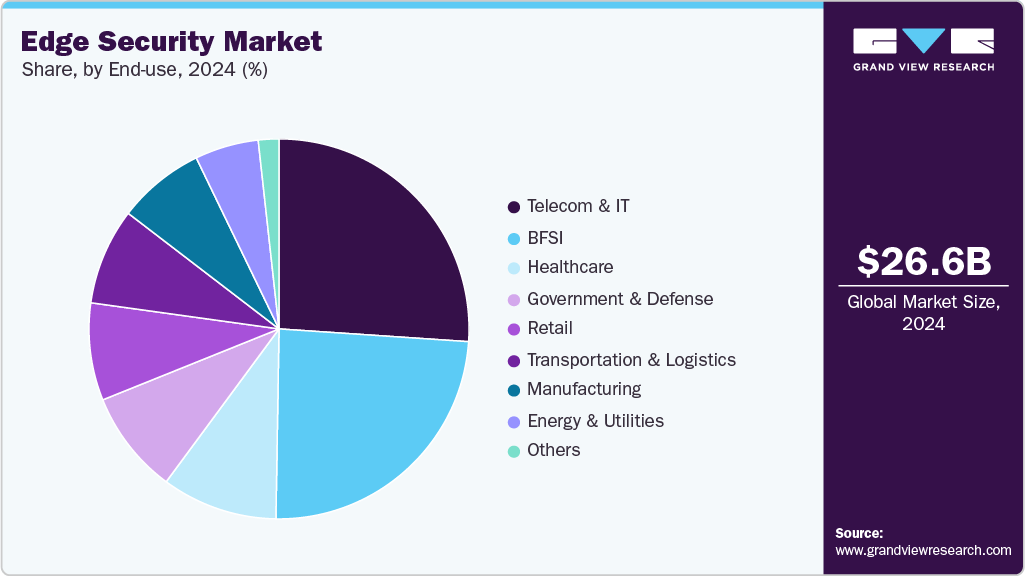
Based on the end use, the telecom & IT segment led the market with the largest revenue share of 26.0% in 2025, driven by its critical role in deploying and securing digital infrastructure from 5G networks to cloud connectivity and IoT ecosystems. Telecom operators ensure secure data transmission across countless endpoints, base stations, edge data centers, and mobile devices. This scale is driving the adoption of advanced edge security frameworks such as SASE, AI-enhanced threat detection, and zero-trust architectures.
Additionally, these solutions are essential to protect both the network itself and the downstream industries that rely on it for connectivity and services. For instance, in May 2025, Airtel launched an AI-powered fraud detection system, which automatically scans and blocks malicious websites for all mobile and broadband customers, a real-time security measure delivered directly by the carrier’s network. Consequently, the above-mentioned factors are contributing significantly in spurring the edge security market share.
The healthcare segment is expected to register the fastest growth of 22.9% during the forecast period. Evolving regulatory mandates to secure electronic protected health information (ePHI) are significantly driving the growth of the healthcare segment by compelling providers to adopt advanced, edge-native cybersecurity architectures that ensure data protection and operational resilience.
Additionally, as patient data flows through a network of distributed endpoints from remote monitoring devices and wearable health sensors to edge-based diagnostic systems, the need for edge security solutions is increasing. For instance, in December 2024, the U.S. Department of Health and Human Services (HHS) issued a Notice of Proposed Rulemaking (NPRM) to update the HIPAA Security Rule, emphasizing mandatory practices such as system activity monitoring, asset inventory management, and network segmentation. Consequently, these factors are contributing notably in spurring market growth.
Regional Insights
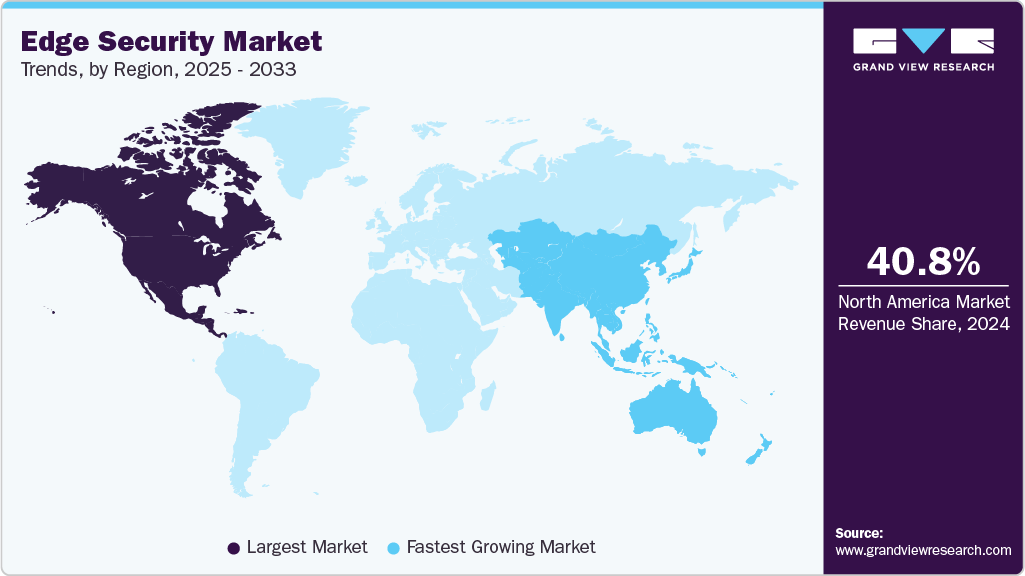
North America dominated the global edge security market, with the largest revenue share of 39.3% in 2025, driven by the regulatory environment and public-private collaboration to secure critical infrastructure and data at the edge. The U.S. government’s launch of the Cyber Trust Mark in 2025 specifically targets IoT and edge device manufacturers, setting minimum security standards that vendors must meet to sell into federal and regulated markets. Additionally, the National Institute of Standards and Technology (NIST) is actively working on edge-focused zero trust architecture guidelines, which are influencing procurement decisions in the defense and healthcare sectors. Moreover, major telecom providers like AT&T and Verizon are also contributing substantially to driving the market growth in this region.
 To learn more about this report, Download Free Sample Report
 U.S. Edge Security Market Trends
The edge security market in the U.S. held the largest share of the North American market in 2025. The U.S. edge security market is shaped by national cybersecurity strategies, regulatory initiatives, and enterprise-level innovation. Federal efforts such as the Cyber Trust Mark and expanded BGP/RPKI requirements for companies seeking government contracts are setting higher benchmarks for edge and IoT device security. This policy-driven environment compels vendors and integrators to embed edge-native protections and cryptographic controls into their offerings.
Europe Edge Security Market Trends
The Europe edge security market is anticipated to register significant growth from 2026 to 2033, owing to a strategic emphasis on digital sovereignty and regional cybersecurity resilience. Additionally, European Union institutions are accelerating edge security market growth by implementing robust protective frameworks aimed at enhancing cyber resilience, regulatory compliance, and digital sovereignty across member states. The rollout of legislation like the NIS2 Directive and the Digital Operational Resilience Act (DORA) mandates that critical infrastructure providers, including those in finance, energy, and telecom, adopt advanced, real-time cybersecurity measures at the edge.
The UK edge security market is experiencing notable growth driven by government-driven regulatory and legislative action aimed at improving cybersecurity across digital infrastructure and connected devices. In May 2025, the government introduced the Cyber Security and Resilience Bill, an expansion of existing NIS regulations that mandate mandatory incident reporting, detailed cybersecurity audits, and tighter security controls across sectors. This legislation is driving demand for edge-native solutions capable of real-time monitoring, zero-trust segmentation, and automated incident response, enabling companies to meet increasing compliance obligations.
Germany edge security market is experiencing growth driven by increasing cyber threats, stringent regulatory frameworks, and rapid digital transformation across industries. A key trend is the strong emphasis on data sovereignty and compliance, prompting many organizations to adopt edge computing to keep sensitive data locally encrypted and processed, thereby reducing exposure to cyber risks and ensuring adherence to strict data residency laws. The market is further propelled by widespread investments in cloud-native security solutions, AI-powered threat detection, and zero-trust frameworks, reflecting Germany’s focus on advanced, automated defenses. Additionally, government initiatives aimed at bolstering national cybersecurity resilience and the establishment of dedicated cyber defense units underscore the strategic importance of edge security. The competitive landscape features both global leaders and strong local players innovating in areas such as DevSecOps integration and AI-enhanced monitoring.
Asia Pacific Edge Security Market Trends
The Asia Pacific edge security market is expected to register the fastest CAGR of 23.0% from 2026 to 2033, driven by a dual surge in 5G-driven network expansion and AI-powered threat detection. Leading telcos, such as Singapore’s Singtel and SK Telecom, are embedding edge-native security and AI-driven anomaly detection directly into 5G infrastructure, reducing response latency and managing threats at points of ingress. Meanwhile, government initiatives like Singapore’s edge data-center rollouts, paired with IoT public-sector projects, are adding urgency to securing distributed compute nodes. In India, the rapid deployment of security services to support its cloud-first strategy has positioned edge analytics as a key enabler of operational resilience.
Japan edge security market is experiencing substantial growth, due to a combination of government-driven cybersecurity reforms and strategic infrastructure modernization that underscores the importance of protecting distributed edge environments. Additionally, the Active Cyberdefence Law empowers Japanese authorities to proactively identify and neutralize foreign cyber threats and mandates critical infrastructure operators to report breaches. This legislative shift is pushing enterprises to deploy advanced edge-native systems such as Zero Trust frameworks, micro‑segmentation tools, and AI-powered anomaly detectiondirectly at network boundaries and device endpoints, ensuring that real‑time threat detection aligns with national defense requirements.
China edge security market held a substantial revenue share in 2025, driven by its aggressive rollout of AI-enhanced cybersecurity initiatives and large-scale edge computing deployments. The Ministry of Industry and Information Technology (MIIT) emphasized integrating AI into cybersecurity at an industry expo in Shanghai, noting this move will "spur the development of new technologies, products and models in the cybersecurity space".
Additionally, China is deploying 5G-enabled edge computing in strategic use cases, such as China Telecom's trials that combine network slicing with Multi-access Edge Computing (MEC) for smart manufacturing-processing real-time video streams with <20 ms latency and isolating data flows at the edge for improved performance and security. Consequently, the aforementioned factors are contributing significantly to boosting market growth.
Key Edge Security Company Insights
Key players operating in the edge security industry are Palo Alto Networks, Fortinet, Cisco Systems, Zscaler, and others. Companies are focusing on various strategic initiatives, including new product development, partnerships & collaborations, and agreements to gain a competitive advantage over their rivals. The following are some instances of such initiatives.
-
In August 2024, Fortinet completed the acquisition of Lacework, and this acquisition enhances Fortinet’s Security Fabric by integrating Lacework’s advanced cloud security technology, which includes AI and machine learning capabilities, enabling consistent protection across on-premises and cloud environments.
-
In May 2024, Palo Alto Networks launched new security solutions infused with its proprietary Precision AI technology, combining machine learning, deep learning, and generative AI to provide real-time protection against advanced cyber threats. These solutions, including AI Access Security, AI Security Posture Management, and AI Runtime Security, are designed to help organizations safely adopt AI by securing AI ecosystems.
Key Edge Security Companies
The following key companies have been profiled for this study on the edge security market.
-
Palo Alto Networks
-
Fortinet
-
Cisco Systems
-
Zscaler
-
Cloudflare
-
Check Point Software Technologies
-
Akamai Technologies
-
VMware (Broadcom)
-
Trend Micro
-
McAfee (Trellix)
-
Forcepoint
-
Sophos
-
Barracuda Networks
-
Hewlett Packard Enterprise (Aruba Networks)
- Juniper Networks
Competitive Benchmarking
Category
Operating Strategies
Competitive Edge
Weakness
Mature Players (Palo Alto Networks, Fortinet, Cisco Systems, Zscaler, Cloudflare, Check Point Software Technologies, Akamai Technologies)
- Focus on building unified edge security platforms integrating Zero Trust (ZTNA), SASE, cloud security, firewall-as-a-service, and DDoS protection. Strong emphasis on AI/ML-driven threat intelligence, automation, and global cloud edge expansion through continuous innovation and acquisitions.
- Strong global enterprise footprint, highly scalable and integrated security ecosystems, leadership in Zero Trust and SASE adoption, advanced AI-driven threat detection, and robust cloud-edge infrastructure capabilities.
- High cost of deployment, complex integration across heterogeneous IT environments, and potential vendor lock-in, making solutions less accessible for small and mid-sized organizations.
Emerging Players (VMware (Broadcom), Hewlett Packard Enterprise (Aruba Networks), Juniper Networks, Trend Micro, McAfee (Trellix), Forcepoint, Sophos, Barracuda Networks)
- Focus on specialized or infrastructure-led security approaches such as secure networking, SD-WAN, endpoint security, cloud workload protection, and mid-market edge security solutions. Increasing shift toward cloud-native, XDR, and AI-assisted threat detection capabilities.
- Strong niche expertise in networking or endpoint security, cost-effective offerings for mid-market and SMB segments, faster innovation cycles in specific domains, and strong integration capabilities with broader security ecosystems.
- Limited end-to-end platform coverage compared to mature players, weaker global cloud-edge infrastructure presence, and dependency on partnerships with larger vendors for full-stack Zero Trust and SASE deployments.
Edge Security Market Report Scope
Report Attribute
Details
Market size in 2025
USD 31.5 billion
Estimated Market size in 2026
USD 37.5 billion
Projected Market size by 2033
USD 144.2 billion
Growth rate
CAGR of 21.2% from 2026 to 2033
Base year for estimation
2025
Historical data
2021 - 2024
Forecasts period
2026 - 2033
Quantitative units
Revenue in USD billion/billion and CAGR from 2026 to 2033
Report coverage
Revenue forecasts, company market share analysis, competitive landscape, growth factors, and trends
Segments covered
Component, Deployment Mode, Organization Size, End Use, Region
Regional scope
North America; Europe; Asia Pacific; Latin America; MEA
Country scope
U.S.; Canada; Mexico; Germany; UK; France; Italy; Spain; China; Japan; India; South Korea; Australia; Brazil; Saudi Arabia; South Africa; UAE
Key companies profiled
Palo Alto Networks; Fortinet; Cisco Systems; Zscaler; Cloudflare; Check Point Software Technologies; Akamai Technologies; VMware (Broadcom) Trend Micro; McAfee (Trellix); Forcepoint; Sophos; Barracuda Networks; Hewlett Packard Enterprise (Aruba Networks); Juniper Networks
Customization scope
Free report customization (equivalent to up to 8 analysts' working days) with purchase. Addition or alteration to country, regional & segment scope.
Pricing and purchase options
Avail customized purchase options to meet your exact research needs. Explore purchase options
Global Edge Security Market Report Segmentation
This report forecasts revenue growth at the global, regional, and country levels and provides an analysis of the latest industry trends in each of the sub-segments from 2021 to 2033. For this study, Grand View Research has segmented the global edge security market report based on component, deployment mode, organization size, end use, and region:
-
Component Outlook (Revenue, USD Billion, 2021 - 2033)
-
Solutions
-
Secure Access Service Edge (SASE)
-
Secure Web Gateways (SWG)
-
Cloud Access Security Brokers (CASB)
-
Firewall-as-a-Service (FWaaS)
-
Zero Trust Network Access (ZTNA)
-
Edge Firewalls/UTM Appliances
-
-
Services
-
Professional Services
-
Managed Services
-
-
-
Deployment Mode Outlook (Revenue, USD Billion, 2021 - 2033)
-
On-Premises
-
Cloud-Based
-
-
Organization Size Outlook (Revenue, USD Billion, 2021 - 2033)
-
Large Enterprises
-
Small & Medium Enterprises
-
-
End Use Outlook (Revenue, USD Billion, 2021 - 2033)
-
Manufacturing
-
Healthcare
-
Retail
-
Telecom & IT
-
Energy & Utilities
-
BFSI
-
Transportation & Logistics
-
Government & Defense
-
Others
-
-
Regional Outlook (Revenue, USD Billion, 2021 - 2033)
-
North America
-
U.S.
-
Canada
-
Mexico
-
-
Europe
-
UK
-
Germany
-
France
-
-
Asia Pacific
-
China
-
India
-
Japan
-
South Korea
-
Australia
-
-
Latin America
-
Brazil
-
-
Middle East & Africa
-
UAE
-
Saudi Arabia
-
South Africa
-
-
Research Methodology
The edge security market figures in this report are based on a proven research process that combines executive interviews with secondary research from proprietary databases, company filings, and recognized regulatory and institutional sources. Market size is built through value-chain sizing - reconciling supply-side and demand-side estimates - and triangulated with bottom-up and top-down approaches. Every estimate passes multiple levels of expert validation before publication, with each edge security segment quantified using the revenue-capture definitions in the table below.
Segment Definition
Segment - Component
Revenue Capture Definition
Solutions
Revenue generated from Edge Security software platforms including Zero Trust Network Access (ZTNA), Secure Access Service Edge (SASE), firewall-as-a-service (FWaaS), cloud security platforms, AI-driven threat detection systems, DDoS protection, identity and access management (IAM), and endpoint security tools that secure distributed networks, edge devices, and hybrid cloud environments.
Services
Revenue from consulting, deployment, integration, and managed security services supporting Edge Security implementation. This includes architecture design, Zero Trust transformation, cloud-edge integration, security policy configuration, monitoring services, and ongoing managed detection and response (MDR) across distributed environments.
Segment - Deployment Mode
Revenue Capture Definition
On-Premises
Revenue generated from traditional and hybrid edge security deployments installed within enterprise data centers or private infrastructure, including hardware-based firewalls, network security appliances, and localized edge protection systems.
Cloud-Based
Revenue from cloud-native Edge Security platforms delivered through SaaS models, including ZTNA, SASE, cloud firewalls, and AI-driven security services that secure distributed users, workloads, and applications across multi-cloud and edge environments.
Segment - Organization Size
Revenue Capture Definition
Large Enterprises
Revenue from enterprise-grade Edge Security solutions requiring advanced threat intelligence, global scalability, multi-cloud integration, and complex Zero Trust architectures across large distributed networks.
Small and Medium-sized Enterprises (SMEs)
Revenue generated from standardized, cost-effective Edge Security solutions with simplified deployment, pre-configured policies, and cloud-based security controls tailored for limited IT and cybersecurity maturity.
Segment - End Use
Revenue Capture Definition
Manufacturing
Revenue from securing industrial IoT, operational technology (OT), smart factories, and connected production systems against cyber threats at the edge.
Healthcare
Revenue from protecting electronic health records (EHR), connected medical devices, telehealth systems, and ensuring compliance with healthcare data security regulations.
Retail
Revenue generated from securing POS systems, e-commerce platforms, digital payments, and customer data across distributed retail environments.
Telecom & IT
Revenue from securing cloud infrastructure, distributed networks, 5G ecosystems, and enterprise IT services using edge-native security frameworks.
Energy & Utilities
Revenue from protecting smart grids, energy distribution systems, and critical infrastructure against cyberattacks targeting OT and IoT environments.
BFSI
Revenue from securing financial transactions, digital banking platforms, fraud prevention systems, and regulatory compliance across distributed banking ecosystems.
Transportation & Logistics
Revenue generated from securing connected vehicles, fleet management systems, supply chain platforms, and logistics IoT networks.
Government & Defense
Revenue from protecting classified data, critical infrastructure, national security systems, and digital government platforms using Zero Trust-based Edge Security.
Others
Revenue from sectors such as education, hospitality, and media adopting Edge Security solutions to protect distributed users, cloud workloads, and connected devices.
Estimation Model
Layer
Question
Analysis
Security Demand Layer (TAM)
Who can potentially require edge security?
All organizations operating digital infrastructure that generate or process data outside centralized environments. This includes enterprises, government agencies, BFSI, healthcare, IT & telecom, manufacturing, retail, education, and critical infrastructure operators that require protection for distributed endpoints, cloud workloads, IoT devices, and remote users.
Edge Readiness Layer (SAM)
Who can technically adopt edge security solutions?
Organizations with distributed IT environments such as cloud, hybrid cloud, and multi-cloud setups, along with IoT deployments and remote workforce models. These entities possess identity management systems, API-driven architectures, and modern security stacks capable of supporting Zero Trust Network Access (ZTNA), SASE, and edge-based threat detection.
Active Adoption Layer (SOM)
Who actively deploys edge security today?
Large enterprises, digital-native companies, government bodies, BFSI institutions, healthcare providers, and regulated industries that have already implemented Zero Trust architectures, AI-based threat detection, and secure access frameworks to protect sensitive data and ensure regulatory compliance.
Revenue Realization Layer
How is revenue generated?
Revenue is generated through subscription-based cloud security platforms, edge security software licenses, identity and access management (IAM) solutions, ZTNA and SASE deployments, managed security services, consulting, integration, implementation, and ongoing support services.
Delivered Customizations
This report has been delivered with the following In-depth customizations
Client Request
Customization Delivered
Value Adds
Edge security readiness & maturity assessment
Assessed cybersecurity maturity across IAM, ZTNA, SASE, endpoint security, cloud security, and Zero Trust readiness in hybrid, multi-cloud, IoT, and edge environments.
Identifies security gaps and enables phased Edge Security adoption aligned with digital transformation goals.
Edge security ecosystem integration review
Evaluated integration of Edge Security with IAM, SIEM, XDR, SASE, SSE, and endpoint/cloud security tools across distributed environments.
Improves security visibility, reduces attack surface, and enables unified policy enforcement across edge ecosystems.
Competitive benchmarking & vendor positioning
Benchmarked key vendors including Palo Alto Networks, Fortinet, Cisco Systems, Zscaler, Cloudflare, and others based on Zero Trust, SASE, AI-driven security, and scalability.
Supports vendor selection, procurement strategy, and clear differentiation between platform leaders and niche security players.
Frequently Asked Questions About This Report
The global edge security market size was valued at USD 31.5 billion in 2025 and is expected to reach USD 37.5 billion in 2026.
Some of the key companies operating in the edge security market include Palo Alto Networks, Fortinet, Cisco Systems, Zscaler, Cloudflare, Check Point Software Technologies, Akamai Technologies, VMware (Broadcom) Trend Micro, McAfee (Trellix), Forcepoint, Sophos, Barracuda Networks, Hewlett Packard Enterprise (Aruba Networks), Juniper Networks and Others
The market growth is driven by the rising need to protect data and applications at distributed endpoints as enterprises adopt hybrid work models, edge computing, and IoT at scale. With increasing cyberattacks targeting remote and edge devices, organizations are prioritizing zero trust network architectures (ZTNA), Secure Access Service Edge (SASE), and AI-driven edge firewalls to secure decentralized infrastructures.
Asia Pacific is the fastest-growing region over the forecast period.
The solutions segment led with a 62.6% revenue share in 2025, while services segment is the fastest-growing segment.
The on-premises segment led with a 59.2% revenue share in 2025, while cloud-based segment is the fastest-growing segment.
The telecom & IT segment led with a 26.0% revenue share in 2025, while healthcare segment is the fastest-growing segment.
The global edge security market is expected to witness a compound annual growth rate of 21.2% from 2026 to 2033 to reach USD 144.2 billion by 2033.
North America dominated with 39.3% revenue share in 2025.
About the Author(s)
Network Security Research Team
Technology · Network SecurityThis report was authored by the network security research team at Grand View Research - comprising two research analysts, one senior research analyst, and one industry expert - with specialized expertise in the network security segment of the technology industry. All findings are based on proprietary technology databases, executive interviews, and regulatory analysis, subject to internal peer review prior to publication.
Last Updated:
Speak to Analyst

Customize this report to your needs - add regions, segments, or data points, with 20% free customization.
Or view our licence options:


ISO 9001:2015 & 27001:2022 Certified
We are GDPR and CCPA compliant! Your transaction & personal information is safe and secure. For more details, please read our privacy policy.


