
- Home
- »
- Advanced Interior Materials
- »
-
Elastomeric Membrane Market Size, Share Report 2026-2033GVR Report cover

Elastomeric Membrane Market (2026 - 2033)
Size, Share & Trends Analysis Report By Application (Roofing, Underground Construction), By Product (Sheet Membrane, Liquid Applied Membranes), By Region, And Segment Forecasts
Market Size, 2025
$13.4BMarket Estimate, 2026
$14.1BMarket Forecast, 2033
$19.0BCAGR, 2026–2033
4.4%Elastomeric Membrane Market Summary
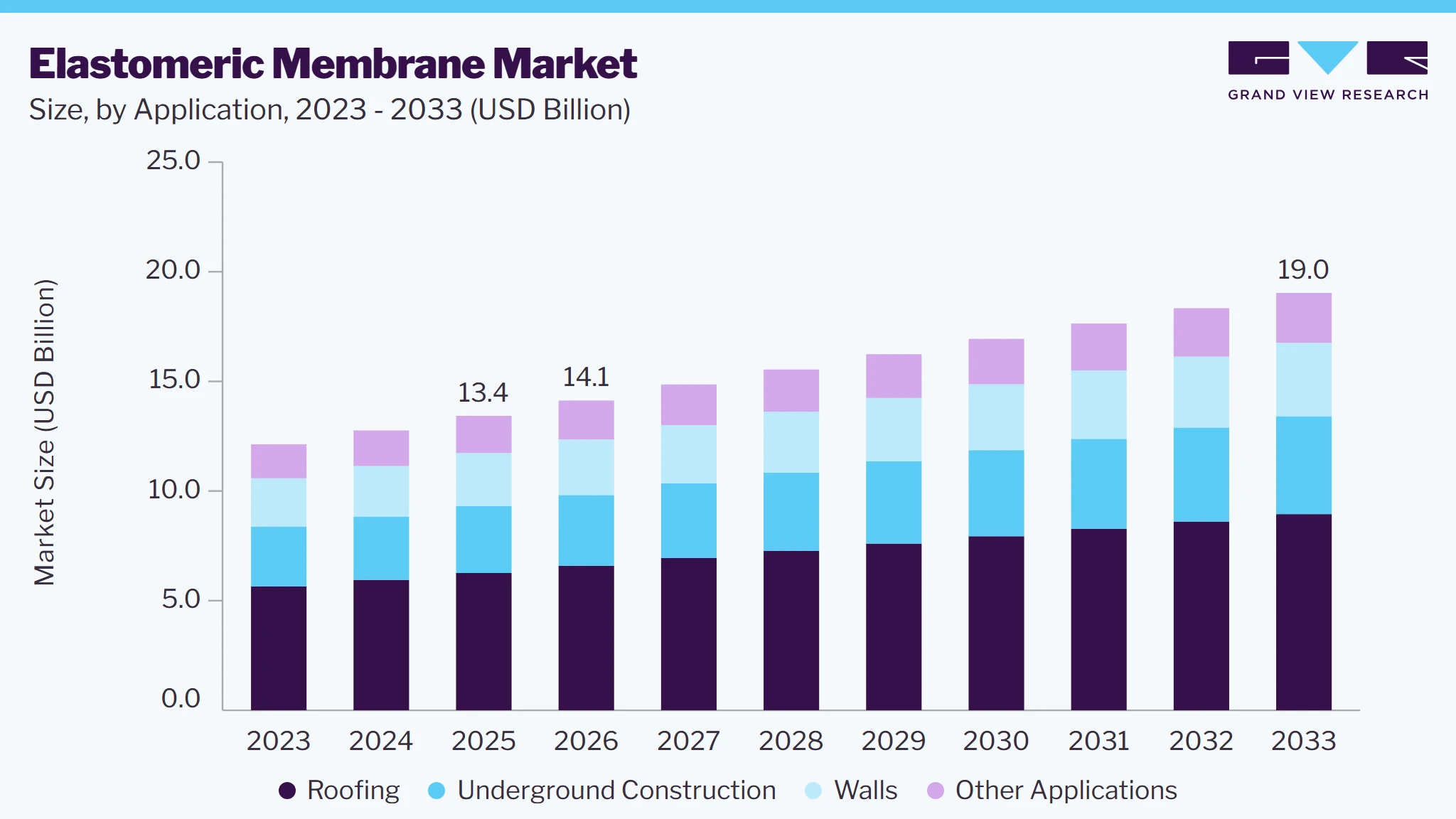
The global elastomeric membrane market size was valued at USD 13.4 billion in 2025 and is projected to grow from USD 14.1 billion in 2026 to USD 19.0 billion by 2033, at a CAGR of 4.4% from 2026 to 2033. Asia Pacific dominated the market, accounting for a revenue share of 31.7% in 2025. The growth of urbanization and infrastructure development, particularly in emerging economies, has led to a surge in commercial and residential construction projects.
 Source: Grand View Research, IR Documents, Primary Interviews, Paid DatabasesTo learn more about this report,
 Download Free Sample Report
Key Market Trends & Insights
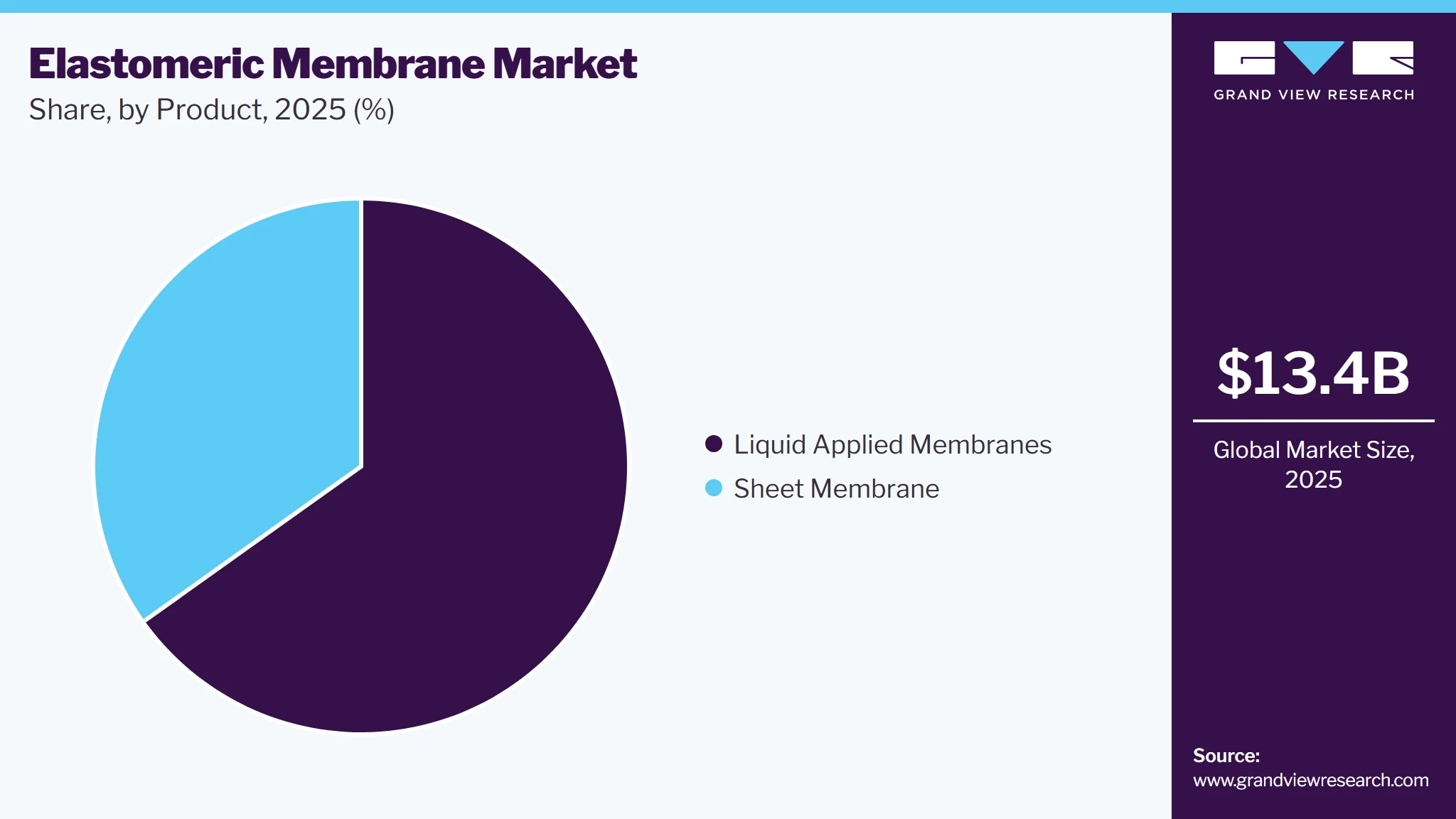
- By product: Liquid applied membranes segment led the market with the largest revenue share of 65.1% in 2025.
- By Application: Roofing segment led the market with the largest revenue share of 46.6% in 2025.
Regional Highlights
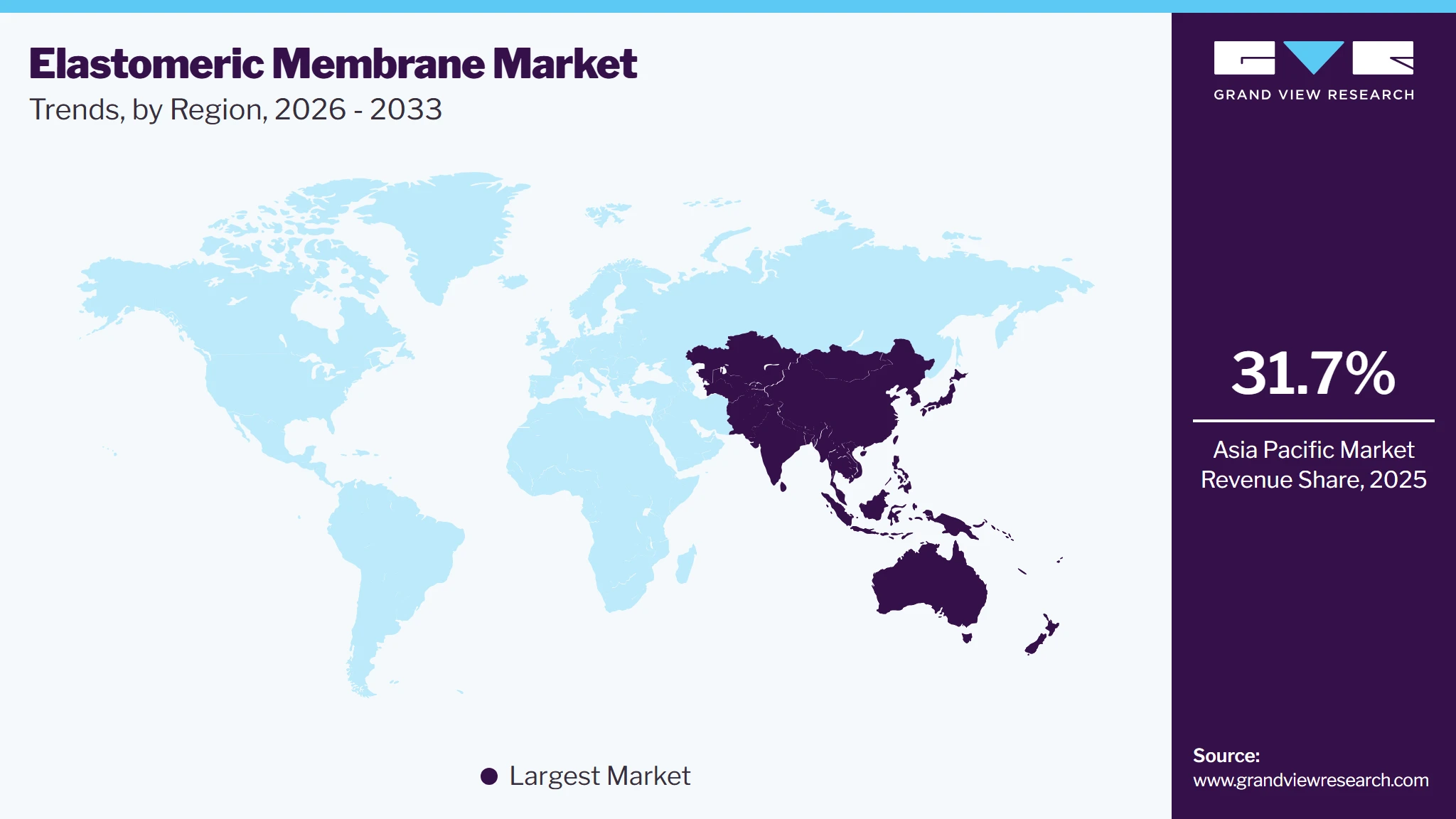
- Largest regional market: Asia Pacific (31.7% revenue share, 2025)
- By country: China held the largest market share in 2025.
Market Size & Forecast
- Market size in 2025: USD 13.4 Billion
- Estimated market size in 2026: USD 14.1 Billion
- Projected market size by 2033: USD 19.0 Billion
- CAGR (2026-2033): 4.4%
Prism AI by Grand View Research Free to tryAsk a question about the elastomeric membrane marketTry asking✓Every figure cited from GVR research Prefer the report? Download free sample →The growth of urbanization and infrastructure development, particularly in emerging economies, has led to a surge in commercial and residential construction projects. Elastomeric membranes are widely preferred due to their superior flexibility, weather resistance, and longevity, making them ideal for roofing and waterproofing applications. In addition, stringent building codes and regulations emphasizing energy efficiency and sustainability have further propelled the adoption of elastomeric membranes in modern construction practices.
Technological advancements in elastomeric membrane manufacturing have significantly boosted market growth. The development of advanced polymer formulations and reinforced membranes has enhanced their performance characteristics, such as improved adhesion, tear resistance, and ease of application. Self-adhesive and liquid-applied elastomeric membranes have gained traction due to their ease of installation and seamless waterproofing capabilities. In addition, the growing emphasis on eco-friendly and recyclable materials has led manufacturers to introduce sustainable elastomeric membrane solutions, aligning with global environmental goals and green building initiatives.
 To learn more about this report, Download Free Sample Report
The increasing investments in infrastructure projects, particularly in the transportation and energy sectors, are also fueling the demand for elastomeric membranes. Roadways, bridges, tunnels, and underground structures require high-performance waterproofing solutions to prevent deterioration and extend their service life. Similarly, the renewable energy sector, including solar and wind power plants, relies on elastomeric membranes for protecting critical components from environmental damage. With governments and private entities allocating substantial budgets for infrastructure development, the elastomeric membrane industry is expected to witness steady growth.
Another key driver is the rising awareness regarding the benefits of elastomeric membranes in reducing maintenance costs and enhancing building lifespan. These membranes offer excellent resistance to temperature fluctuations, UV radiation, and moisture, preventing structural damage and leaks over time. Their high elasticity allows them to accommodate structural movements, making them particularly beneficial for regions prone to extreme weather conditions. As a result, industries such as commercial real estate, industrial facilities, and residential housing are increasingly integrating elastomeric membranes into their building envelopes to ensure long-term durability and cost savings.
Market Dynamics
The elastomeric membrane market is witnessing steady growth due to increasing demand for durable, flexible, and waterproof building materials across residential, commercial, and infrastructure projects. Rising investments in sustainable construction, rooftop waterproofing, and underground infrastructure are driving product adoption. Manufacturers are introducing advanced polymer formulations with improved UV resistance, weatherability, and service life to meet evolving building performance requirements. Government emphasis on energy-efficient buildings and green construction standards further supports market expansion. Growing renovation activities and the need for long-lasting moisture protection continue to strengthen demand across both developed and emerging economies.
Rapid urbanization and increasing investments in residential, commercial, and industrial construction are significantly driving the elastomeric membrane market. These membranes provide superior waterproofing, crack-bridging capability, and long-term durability, making them essential for roofs, basements, tunnels, bridges, and foundation structures. Their ability to withstand extreme weather conditions while extending building lifespan has made them a preferred solution for modern construction projects.
Additionally, governments worldwide are investing in smart cities, transportation infrastructure, public buildings, and affordable housing initiatives, creating sustained demand for advanced waterproofing systems. The growing focus on minimizing maintenance costs and improving structural integrity is encouraging contractors and developers to adopt elastomeric membranes in both new construction and renovation projects.
Fluctuating prices of petroleum-based raw materials such as bitumen, synthetic rubber, and specialty polymers remain a major challenge for the elastomeric membrane market. Variations in crude oil prices, supply chain disruptions, and rising manufacturing costs directly impact product pricing and profit margins. Small and regional manufacturers often face difficulties in maintaining competitive pricing while ensuring consistent product quality.
The increasing adoption of green building certifications and sustainable construction practices presents significant opportunities for the elastomeric membrane market. Manufacturers are developing low-VOC, recyclable, and environmentally friendly membrane systems with enhanced thermal performance and longer service life. Growing investments in cool roofs, energy-efficient buildings, and climate-resilient infrastructure are expected to accelerate the adoption of advanced elastomeric membrane technologies across both developed and emerging markets.
Market Concentration & Characteristics
The elastomeric membrane industry exhibits a moderate-to-high level of market concentration, dominated by established global players such as Sika AG, BASF SE, and Carlisle Companies Inc., alongside regional manufacturers. These key players benefit from economies of scale, advanced R&D capabilities, and strong distribution networks, allowing them to maintain market leadership. The degree of innovation is a crucial factor, with companies continuously developing advanced formulations, eco-friendly solutions, and high-performance membranes to meet stringent industry demands. Regulatory impact is significant, as strict environmental and safety regulations drive manufacturers to invest in sustainable and energy-efficient products, particularly in developed markets. Compliance with green building certifications, such as LEED and BREEAM, further influences product development strategies.
 To learn more about this report, Download Free Sample Report
In terms of market dynamics, the presence of substitutes such as bituminous membranes, PVC, and TPO membranes impacts competitiveness, requiring elastomeric membrane manufacturers to differentiate their offerings through enhanced durability, flexibility, and weather resistance. End-user concentration is another defining characteristic, with demand primarily driven by the construction, roofing, and infrastructure sectors. Large-scale commercial and industrial projects, as well as government initiatives promoting resilient and energy-efficient structures, contribute significantly to market growth. In addition, regional variations play a critical role, with North America and Europe witnessing stable demand due to well-established construction sectors, while rapid urbanization and infrastructural investments in Asia-Pacific create lucrative expansion opportunities for market participants.
Analyst Perspective
The elastomeric membrane market is evolving from a conventional waterproofing materials industry into a technology-driven market focused on high-performance roofing and building envelope solutions, advanced polymer formulations, seamless waterproofing technologies, energy-efficient membranes, and sustainable construction materials. Growth is being supported by increasing investments in residential and commercial construction, infrastructure modernization, green building initiatives, and urban development projects. End users increasingly demand membrane systems that provide superior waterproofing, UV resistance, crack-bridging capability, weather durability, and long-term structural protection while complying with evolving building codes and environmental standards. Innovation is centered on advanced elastomer technologies, low-VOC and recyclable formulations, cool roof systems, liquid-applied waterproofing solutions, and high-performance membranes designed to improve building longevity, energy efficiency, and climate resilience.
Application Insights
Based on application, the roofing segment led the market with the largest revenue share of 46.6% in 2025 and is expected to grow at a CAGR of 4.5% over the forecast period, driven by the increasing demand for durable, weather-resistant, and energy-efficient roofing solutions across residential, commercial, and industrial construction. The superior waterproofing and flexibility of elastomeric membranes make them an ideal choice for roofing applications, particularly in regions experiencing extreme weather conditions such as heavy rainfall, high temperatures, and strong winds.
The underground construction segment is expected to grow at the fastest CAGR of 5.6% over the forecast period. As metropolitan areas grow, governments and private entities are investing in subway systems, underground parking facilities, and utility tunnels, necessitating high-performance elastomeric membranes to prevent water ingress and structural deterioration. The rising demand for sustainable and long-lasting waterproofing solutions has further bolstered the adoption of elastomeric membranes, which offer superior flexibility, chemical resistance, and crack-bridging capabilities, ensuring the longevity of underground structures in diverse environmental conditions.
Product Insights
Based on product, the liquid applied membranes segment led the market with the largest revenue share of 65.1% in 2025 and is expected to grow at a CAGR of 4.5% over the forecast period, driven by its superior waterproofing capabilities, ease of application, and adaptability to complex surface geometries. Unlike sheet-based membranes, liquid-applied elastomeric membranes offer seamless coverage, reducing the risk of water ingress and improving overall structural integrity. The increasing demand for cost-effective and long-lasting waterproofing solutions in commercial, residential, and industrial construction projects is fueling the adoption of these membranes.
 To learn more about this report, Download Free Sample Report
The sheet membrane segment is expected to grow significantly at a CAGR of 4.9% over the forecast period. Increasing demand for advanced waterproofing solutions in commercial, residential, and industrial construction is driving the demand for sheet membranes. As infrastructure development continues to expand worldwide, particularly in urban areas, the need for reliable and high-performance waterproofing materials has intensified. In addition, technological advancements in polymer formulations have enhanced the performance characteristics of sheet membranes, improving their elasticity, UV resistance, and thermal stability.
Regional Insights
North America elastomeric membrane market is driven by the expanding construction industry, particularly in commercial and residential infrastructure. Rising investments in urban redevelopment, sustainable building initiatives, and energy-efficient construction projects have significantly increased the demand for advanced waterproofing and roofing solutions. In addition, stringent building codes and regulations, including LEED (Leadership in Energy and Environmental Design) certification and ENERGY STAR guidelines, have encouraged the use of high-performance waterproofing materials, further supporting market growth.
 To learn more about this report, Download Free Sample Report
U.S. Elastomeric Membrane Market Trends
The elastomeric membrane industry in the U.S. is driven by the increasing focus on technological advancements and regulatory compliance. Manufacturers are investing in R&D to develop eco-friendly and high-performance elastomeric membranes that align with stringent environmental regulations, such as those set by the U.S. Environmental Protection Agency (EPA) and state-level building codes. The market is also influenced by the rising adoption of energy-efficient roofing solutions that enhance insulation and reduce overall energy consumption in buildings.
Asia Pacific Elastomeric Membrane Market Trends
Asia Pacific dominated the elastomeric membrane market with the largest revenue share of 31.7% in 2025, primarily driven by rapid urbanization and infrastructure development across key countries such as China, India, and Southeast Asia. As these regions experience growing populations and increased demand for residential, commercial, and industrial construction, the need for durable, efficient, and cost-effective building materials has surged. Elastomeric membranes, known for their waterproofing and weather-resistant properties, are widely adopted in roofing, waterproofing, and protective coatings for buildings and infrastructure projects. This growing infrastructure development, coupled with the rise in residential and commercial construction projects, significantly boosts the demand for elastomeric membranes.
The elastomeric membrane market in China held the largest share in the Asia Pacific region in 2025. China elastomeric membrane industry is driven by expanding manufacturing sector, which supports local production capabilities and reduces dependency on imports. Leading domestic and international players are investing in R&D to develop advanced formulations, including self-adhesive and liquid-applied membranes, catering to diverse industry needs. The growth of the automotive and industrial sectors also influences market expansion, as elastomeric membranes are used for waterproofing applications beyond construction.
Europe Elastomeric Membrane Market Trends
The elastomeric membrane industry in Europe is primarily driven by technological innovation and product diversification. Market players are increasingly focusing on developing self-adhering, spray-applied, and reinforced elastomeric membranes to enhance ease of application, durability, and overall performance. The market is also witnessing a growing preference for bio-based and solvent-free elastomeric membranes, as sustainability and environmental concerns push manufacturers to develop greener alternatives.
The elastomeric membrane industry in Germany is driven by the expansion of the residential housing sector, fueled by population growth, urbanization, and increasing demand for modern, energy-efficient living spaces. Government initiatives such as the KfW Energy-Efficient Construction and Renovation Program promote the use of advanced waterproofing and insulation materials, including elastomeric membranes, in both new construction and renovation projects.
Latin America Elastomeric Membrane Market Trends
Latin America elastomeric membrane industry is driven by the growing adoption of energy-efficient roofing systems, which is driving the demand for elastomeric membranes. With rising concerns over energy consumption and heat island effects in urban areas, developers are increasingly integrating reflective and cool roofing technologies. Elastomeric membranes with reflective coatings help reduce heat absorption, lower indoor cooling costs, and improve overall building energy efficiency, making them a preferred choice for modern construction projects.
Middle East & Africa Elastomeric Membrane Market Trends
The Middle East & Africa elastomeric membrane industry is anticipated to grow over the forecast period. Rising awareness of energy efficiency and sustainability is a key driver, with stringent environmental regulations promoting the use of eco-friendly elastomeric membranes. Green building certifications and regulatory frameworks, such as Estidama in the UAE and South Africa’s SANS energy codes, are compelling construction companies to adopt sustainable solutions. Additionally, the increasing demand for high-performance waterproofing and roofing solutions in residential, commercial, and industrial sectors is driving market penetration.
Key Elastomeric Membrane Company Insights
Some of the key players operating in the market include Versico Roofing Systems and Owens Corning.
-
Versico Roofing Systems is a provider of commercial roofing solutions specializing in single-ply roofing membranes. Versico offers a range of elastomeric membrane products, including TPO (thermoplastic polyolefin), EPDM (ethylene propylene diene monomer), and PVC roofing membranes. These products provide excellent weather resistance, energy efficiency, and ease of installation, making them popular choices for commercial and industrial buildings.
-
Owens Corning offers modified bitumen roofing membranes, underlayments, and waterproofing solutions designed for enhanced durability and weather protection in the elastomeric membrane segment. Its roofing membranes are commonly used in both residential and commercial applications, providing superior resistance to UV exposure, moisture, and extreme temperatures.
Sika AG and Johns Manville Corporation are some of the emerging market participants in the elastomeric membrane industry.
-
Sika AG offers a comprehensive range of elastomeric membranes under its Sarnafil and Sikaplan product lines, which include TPO, PVC, and bituminous membranes. These membranes are widely used for roofing, waterproofing, and structural protection in commercial, industrial, and infrastructure applications.
-
Johns Manville Corporation offers EPDM, TPO, and PVC membranes designed for commercial and industrial roofing applications. Johns Manville's membranes are recognized for their exceptional durability, ease of installation, and energy efficiency. The company also provides liquid-applied roofing systems, adhesives, and insulation solutions, ensuring a complete roofing system for various climate conditions and building requirements.
Key Elastomeric Membrane Companies
The following key companies have been profiled for this study on the elastomeric membrane market.
-
Versico Roofing Systems
-
Owens Corning
-
Sika AG
-
Johns Manville Corporation
-
Polyglass U.S.A., Inc.
-
Tremco Incorporated
-
SOPREMA
-
PABCO Building Products, LLC
-
CertainTeed Corporation
-
Carlisle Companies Incorporated
-
Firestone Building Products
-
GAF
-
Sarnafil Roofing Systems
-
Bauder Ltd.
Competitive Benchmarking
Category
Operating Strategies
Competitive Edge
Weakness
Established Players (Sika AG, Carlisle Companies Incorporated, SOPREMA, GAF, Owens Corning, Johns Manville Corporation, CertainTeed Corporation, Firestone Building Products)
Expand global manufacturing capacity and distribution networks to support growing construction demand.
Invest in R&D to develop high-performance, UV-resistant, energy-efficient, and sustainable elastomeric membranes.
Strengthen market presence through acquisitions, strategic partnerships, and comprehensive waterproofing solution portfolios.
Strong global brand recognition and extensive contractor/distributor networks.
Broad product portfolios covering roofing, waterproofing, insulation, and building envelope systems.
Advanced material technology, strong R&D capabilities, and substantial financial resources.
High manufacturing and operational costs across global facilities.
Exposure to fluctuations in polymer, bitumen, and synthetic rubber raw material prices.
Longer product development and certification timelines due to regulatory and performance standards.
Emerging Players (Versico Roofing Systems, Polyglass U.S.A., Inc., Tremco Incorporated, PABCO Building Products, LLC, Sarnafil Roofing Systems, Bauder Ltd.)
Focus on specialized roofing and waterproofing membrane solutions for regional markets.
Expand through contractor partnerships, regional distributors, and localized manufacturing.
Develop cost-effective and application-specific membrane systems for commercial and infrastructure projects.
Greater flexibility in product customization for regional building requirements.
Faster product development and quicker response to changing customer needs.
Strong regional market presence with competitive pricing strategies.
Limited global manufacturing footprint and distribution reach.
Lower international brand recognition than multinational competitors.
Relatively limited financial resources for large-scale acquisitions, R&D, and global expansion.
Recent Developments
-
In February 2023, Kamdhenu Paints launched 'Kamo Damp Proof,' an advanced waterproof coating designed for roofs and walls, further strengthening its presence in the elastomeric membrane industry. This high-performance coating is formulated with cutting-edge elastomeric technology, providing superior protection against water seepage, moisture damage, and harsh weather conditions. 'Kamo Damp Proof' offers excellent flexibility, crack-bridging capabilities, and UV resistance, making it an ideal solution for long-lasting waterproofing in residential, commercial, and industrial structures.
Elastomeric Membrane Market Report Scope
Report Attribute
Details
Market size in 2025
USD 13.4 billion
Estimated market size in 2026
USD 14.1 billion
Projected market size by 2033
USD 19.0 billion
Growth rate
CAGR of 4.4% from 2026 to 2033
Base year for estimation
2025
Historical data
2021 - 2024
Forecast period
2026 - 2033
Quantitative units
Revenue in USD million/billion, and CAGR from 2026 to 2033
Report coverage
Revenue forecast, company ranking, competitive landscape, growth factors, and trends
Segments covered
Application, product, region
Regional scope
North America; Europe; Asia Pacific; Central & South America; Middle East & Africa
Country scope
U.S.; Canada; Mexico; UK; Germany; France; Italy; Spain; China; India; Japan; South Korea
Key companies profiled
Versico Roofing Systems, Owens Corning, Sika AG, Johns Manville Corporation, Polyglass U.S.A., Inc., Tremco Incorporated, SOPREMA, PABCO Building Products, LLC, CertainTeed Corporation, Carlisle Companies Incorporated, Firestone Building Products, GAF, Sarnafil Roofing Systems, Bauder Ltd.
Customization scope
Free report customization (equivalent up to 8 analysts' working days) with purchase. Addition or alteration to country, regional & segment scope.
Pricing and purchase options
Avail customized purchase options to meet your exact research needs. Explore purchase options
Global Elastomeric Membrane Market Report Segmentation
This report forecasts revenue growth at global, regional, and country levels and provides an analysis of the latest industry trends in each of the sub-segments from 2021 to 2033. For this study, Grand View Research has segmented the global elastomeric membrane market report based on application, product, and region:
 To learn more about this report, Download Free Sample Report
-
Application Outlook (Revenue, USD Million, 2021 - 2033)
-
Roofing
-
Walls
-
Underground Construction
-
Other Applications
-
-
Product Outlook (Revenue, USD Million, 2021 - 2033)
-
Sheet Membrane
-
Liquid Applied Membranes
-
-
Regional Outlook (Revenue, USD Million, 2021 - 2033)
-
North America
-
U.S.
-
Canada
-
Mexico
-
-
Europe
-
Germany
-
UK
-
France
-
Italy
-
Spain
-
-
Asia Pacific
-
China
-
Japan
-
India
-
South Korea
-
-
Central & South America
-
Middle East & Africa
-
Research Methodology
The elastomeric membrane market figures in this report are based on a proven research process that combines executive interviews with secondary research from proprietary databases, company filings, and recognized regulatory and institutional sources. Market size is built through value-chain sizing - reconciling supply-side and demand-side estimates - and triangulated with bottom-up and top-down approaches. Every estimate passes multiple levels of expert validation before publication, with each elastomeric membrane segment quantified using the revenue-capture definitions in the table below.
Segment Definition
Segment - Application
Revenue capture definition
Roofing
Revenue generated from the sale of elastomeric membranes used in flat and low-slope roofing systems for residential, commercial, and industrial buildings. These membranes provide waterproofing, UV resistance, weather protection, and crack-bridging performance. They help extend roof lifespan while reducing maintenance requirements.
Walls
Revenue generated from the sale of elastomeric membranes applied to exterior, cavity, and foundation walls. These membranes prevent water infiltration, improve air barrier performance, and protect structures from moisture-related damage. Their flexibility accommodates minor structural movement and cracking.
Underground Construction
Revenue generated from the sale of elastomeric membranes used in basements, tunnels, foundations, retaining walls, and other below-grade structures. They provide long-term waterproofing against groundwater and soil moisture. Their durability enhances structural protection and service life.
Other Applications
Revenue generated from the sale of elastomeric membranes used in bridges, balconies, podium decks, parking structures, water containment systems, and other specialty construction projects. These membranes offer seamless waterproofing, flexibility, and resistance to harsh environmental conditions. They support long-term infrastructure durability.
Segment - Product
Revenue capture definition
Sheet Membrane
Revenue generated from the sale of prefabricated elastomeric sheet membranes supplied in rolls for roofing, foundation, and tunnel waterproofing applications. These membranes offer uniform thickness, high tensile strength, and reliable waterproof performance. They are widely used where consistent installation quality is required.
Liquid Applied Membranes
Revenue generated from the sale of liquid elastomeric waterproofing membranes applied by spray, roller, or brush to form seamless protective barriers. These membranes are ideal for complex surfaces, joints, and irregular structures. They provide excellent adhesion, flexibility, and long-lasting moisture protection.
Estimation Model
Layer Name
Key Question
Description
Construction & Infrastructure Activity
Where is the demand for elastomeric membranes generated?
Estimates demand by assessing residential, commercial, industrial, and infrastructure construction activities, including new developments and renovation projects requiring waterproofing systems.
Application Penetration
How extensively are elastomeric membranes used across applications?
Evaluates the adoption of elastomeric membranes in roofing, walls, underground construction, and other waterproofing applications based on performance requirements, building codes, and environmental conditions.
Product Type Mix
Which membrane technologies contribute the most to market revenue?
Analyzes the market share of sheet membranes and liquid applied membranes by comparing installation methods, durability, project suitability, lifecycle costs, and end-user preferences.
Revenue Validation & Market Forecast
What is the total market value and future growth potential?
Validates revenue using manufacturer sales, distributor networks, construction spending, pricing trends, and regional demand to develop accurate market size estimates and long-term forecasts.
Delivered Customizations
This report has been delivered with the following In-depth customizations
Client Request
Customization Delivered
Value Adds
Regional construction opportunity assessment
Comprehensive evaluation of regional demand across major regions based on construction output, infrastructure investments, urbanization trends, renovation activities, climate conditions, and adoption of waterproofing technologies. The analysis also identifies country-level growth opportunities, key end-use industries, and emerging investment hotspots.
Enables stakeholders to prioritize high-growth regions, optimize regional investment strategies, identify attractive expansion markets, and align production and distribution networks with future construction demand.
Competitive landscape analysis
Detailed profiling of leading elastomeric membrane manufacturers, including product portfolios, manufacturing capabilities, geographic presence, pricing strategies, recent product launches, mergers & acquisitions, partnerships, R&D investments, sustainability initiatives, and competitive positioning across key application segments.
Supports competitive benchmarking, identifies market gaps, evaluates strategic strengths and weaknesses of key players, and helps companies formulate effective product differentiation and market expansion strategies.
Sustainability and regulatory assessment
In-depth analysis of green building regulations, environmental compliance requirements, low-VOC membrane adoption, recyclable and bio-based material developments, energy-efficient roofing systems, and certification standards influencing elastomeric membrane manufacturing and application across major global markets.
Helps manufacturers ensure regulatory compliance, accelerate sustainable product development, capitalize on green construction opportunities, and strengthen long-term competitiveness in environmentally driven markets.
Frequently Asked Questions About This Report
The elastomeric membrane market size was estimated at USD 13.4 billion in 2025 and is expected to reach USD 14.1 billion in 2026.
The key factors that are driving the elastomeric membrane market include rising demand for advanced waterproofing solutions in residential, commercial, and industrial construction.
Asia Pacific held the highest revenue market share of 31.7% in 2025, driven by rapid urbanization, large-scale infrastructure investments, expanding residential and commercial construction, and increasing adoption of advanced waterproofing systems.
The underground construction segment is the fastest-growing application in the elastomeric membrane market.
The liquid-applied membrane segment is the fastest-growing product segment in the elastomeric membranes market.
The roofing segment accounted for the largest revenue share of 46.6% in 2025, due to increasing demand for durable waterproofing systems, expanding commercial and residential construction, and growing adoption of energy-efficient roofing solutions.
The elastomeric membrane market is expected to grow at a compound annual growth rate of 4.4% from 2026 to 2033 to reach USD 19.0 billion by 2033.
The liquid applied membranes segment held the highest revenue market share of 65.1% in 2025, due to its seamless waterproofing performance, superior adhesion to complex surfaces, and growing adoption across roofing, infrastructure, and renovation projects.
Some of the key players operating in the elastomeric membrane market include Versico Roofing Systems, Owens Corning, Sika AG, Johns Manville Corporation, Polyglass U.S.A., Inc., Tremco Incorporated, SOPREMA, PABCO Building Products, LLC, CertainTeed Corporation, Carlisle Companies Incorporated, Firestone Building Products, GAF, Sarnafil Roofing Systems, and Bauder Ltd.
About the Author(s)
Advanced Interior Materials Research Team
Advanced Materials · Advanced Interior MaterialsThis report was authored by the advanced interior materials research team at Grand View Research - comprising two research analysts, one senior research analyst, and one industry expert - with specialized expertise in the advanced interior materials segment of the advanced materials industry. All findings are based on proprietary advanced materials databases, executive interviews, and regulatory analysis, subject to internal peer review prior to publication.
Last Updated:
Speak to Analyst

Customize this report to your needs - add regions, segments, or data points, with 20% free customization.
Or view our licence options:


ISO 9001:2015 & 27001:2022 Certified
We are GDPR and CCPA compliant! Your transaction & personal information is safe and secure. For more details, please read our privacy policy.


