
- Home
- »
- Automotive & Transportation
- »
-
Electric Scooters Market Size & Share Report, 2026-2033GVR Report cover

Electric Scooters Market (2026 - 2033)
Size, Share & Trends Analysis Report By Drive (Belt Drive, Chain Drive, Hub Motors), By Battery (Lead Acid, Li-Ion), By Product, By Battery Fitting (Detachable, Fixed), By End-use (Personal, Commercial), By Region, And Segment Forecasts
Market Size, 2025
$47.4BMarket Estimate, 2026
$52.9BMarket Forecast, 2033
$99.0BCAGR, 2026–2033
9.4%Electric Scooters Market Summary
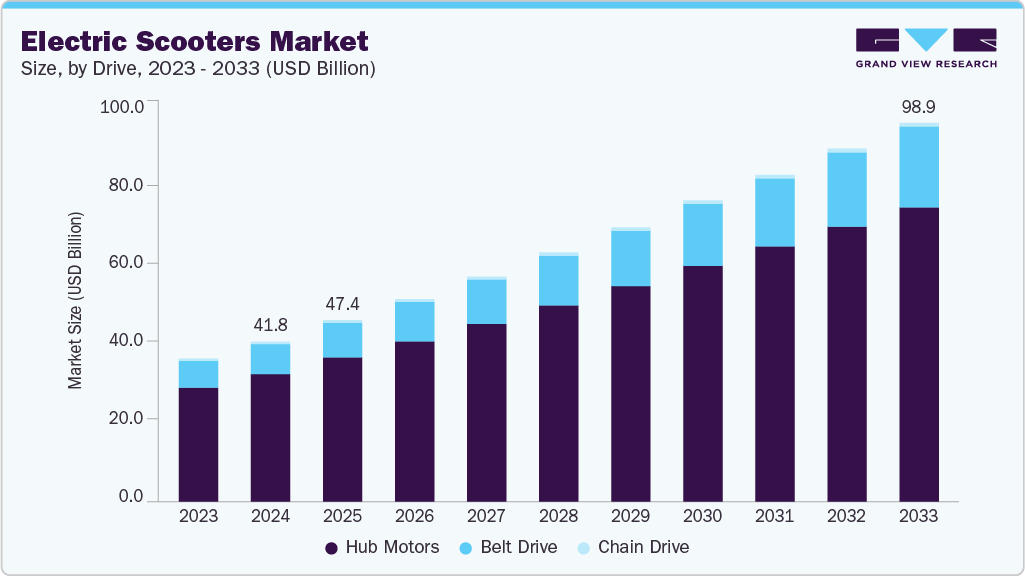
The global electric scooters market size was valued at USD 47.4 billion in 2025 and is projected to grow from USD 52.9 billion in 2026 to USD 99.0 billion by 2033, at a CAGR of 9.4% from 2026 to 2033. The market in Asia Pacific dominated with a revenue share of 76.1% in 2025. The increasing demand for fuel-efficient vehicles, coupled with growing concerns over greenhouse gas and carbon emissions, is anticipated to drive the adoption of electric scooters (e-scooters) over the forecast period.
 Source: Grand View Research, IR Documents, Primary Interviews, Paid DatabasesTo learn more about this report,
 Download Free Sample Report
 Key Market Trends & Insights
- By drive: Hub motors segment held the largest market share of 79.4% in 2025.
- By battery: Lithium-ion battery segment held the largest market share of 76.5% in 2025.
- By end use: Personal segment held the largest market share of 71.4% in 2025.
- By battery fitting: Fixed segment held the largest market share of 54.2% in 2025.
Regional Highlights
- Largest regional market: Asia Pacific (76.1% revenue share, 2025)
- By country: China held the largest market share in 2025
Market Size & Forecast
- Market size in 2025: USD 47.4 Billion
- Estimated market size in 2026: USD 52.9 Billion
- Projected market size by 2033: USD 99.0 Billion
- CAGR (2026-2033): 9.4%
Three ways to get this report
Buy it, customize it, or ask a question.Ask an Analyst
Analyst response in 1 business day
- AccessReport author, directly
- Reply timeWithin 1 working day
- No sales callDirect answer only
- FormatEmail reply
- CostFree, no cost
Get the Full Report
What the study covers
- FormatsPDF · Excel · Dashboard
- Timeline2026–2033 annual, 2025 base
- Coverage20+ countries, 5 regions
- Companies10+ key players profiled
Customize the Report
20% free customization
- IncludeCountries, segments, points
- TailorTo your product definition
- ExtendDeeper competitor detail
- OrA fully bespoke study
- Turnaround5–10 working days
Stringent emission norms by the government agencies, such as emission standards for greenhouse gas (GHG) emissions by the U.S. Environmental Protection Agency (EPA), BS-VI in India, and China VI, are driving the market for electric scooters.Besides, the electric scooters have high mechanical efficiency, offer quieter operations, and require low maintenance over the conventional counterparts; thus, electric scooters are gaining consumer traction in the market. In addition, the inclusion of electric scooter fleets in shared mobility and vehicle renting ecosystems is propelling the demand for the electric scooters industry.
 To learn more about this report, Download Free Sample Report
 The COVID-19 pandemic has led to a global economic slowdown. Lockdown implementations in various parts of the world aimed to curb the spread of the virus led to supply chain disruptions and a temporary halt in manufacturing activities. The electric scooters became particularly vulnerable due to their dependency on global sourcing for the materials and components of their batteries. In addition, the initial purchase cost of electric vehicles is more significant than their gas-powered and hybrid counterparts, which further impacts the growth of electric scooters in the emerging economies of the world. However, post-pandemic, increasing government initiatives, such as tax rebates and policy changes, have resulted in a surge in demand for electric scooters.
Increasing adoption of electric scooter sharing services in countries such as Spain, the U.S., Germany, and France has spurred the demand for battery-powered two-wheelers. Companies such as Razor, Lime, Bird, Jump, and Spin offering e-scooter sharing services are procuring these vehicles mainly from manufacturers such as Xiaomi, Gogoro, Inc., and Ninebot-Segway. The penetration of these sharing services is witnessing a growth in the adoption rate. Moreover, increasing monetary and non-monetary incentives are encouraging the adoption of battery-operated two-wheelers. Moreover, the need for sustainable urban mobility and smart transportation infrastructure is driving the transition from conventional to electric modes of transport.
The participation of vehicle manufacturers and governments in meeting the standards for zero emissions is significantly contributing to reducing the carbon emission gap by 2030. Furthermore, the issue of battery charging electric scooters is mitigated by the increasing interest in building renewable energy stations and the adoption of updated technologies, such as vehicle-to-grid technologies and smart charging.
Moreover, governments across the globe have formulated several policies to increase the penetration of electric scooters in the market. The government offers various benefits to consumers and manufacturers in the form of subsidies. For instance, in the U.S., the Corporate Average Fuel Economy (CAFÉ) standards are increasing the adoption of energy-efficient automobiles by framing regulations for enhancing the utilization of alternative fuel vehicles and the reduction of fossil fuel consumption. Similarly, the Canadian government is developing a strategy to reduce the country’s greenhouse gas emissions and increase the number of zero-emission vehicles. Besides this, the swift adoption of scooter-sharing services has triggered the demand for battery-powered two-wheelers. This, in turn, creates a highly conducive environment for the growth of the electric scooter industry.
Market Dynamics
The electric scooter market is experiencing rapid growth driven by increasing demand for sustainable transportation, supportive government initiatives, and advancements in battery technologies. Consumers are increasingly adopting electric scooters as a cost-effective and environmentally friendly alternative to conventional two-wheelers. However, challenges related to charging infrastructure limitations and high battery costs are expected to hinder market growth. Furthermore, opportunities arising from battery innovation and the growth of shared mobility services are expected to contribute to the growth of the market during the forecast period.
The increasing focus on reducing carbon emissions and environmental pollution is a major driver of the electric scooter market. Governments, businesses, and consumers are actively seeking cleaner transportation alternatives to conventional internal combustion engine vehicles. Electric scooters produce zero tailpipe emissions, making them an attractive solution for reducing urban air pollution. Rising awareness of climate change and sustainability goals is encouraging consumers to shift toward electric mobility options. Urban areas facing severe traffic congestion and environmental concerns are witnessing growing adoption of electric scooters for daily commuting. The lower operating and maintenance costs associated with electric scooters further enhance their appeal among cost-conscious consumers. These factors are significantly contributing to market growth.
The transition toward sustainable transportation is also being supported by corporate sustainability initiatives and green mobility programs. Many cities are promoting electric vehicle adoption as part of broader environmental strategies aimed at improving air quality and reducing dependence on fossil fuels. Consumers are increasingly considering environmental impact when making vehicle purchasing decisions. The availability of a wide range of electric scooter models across different price points is expanding market accessibility. Growing environmental consciousness among younger populations is further accelerating adoption. These trends are expected to continue driving market expansion.
The lack of widespread charging infrastructure remains a significant restraint for the electric scooter market. Consumers often face challenges related to charging accessibility, particularly in regions where public charging networks are still under development. Limited charging availability creates concerns regarding vehicle usability and convenience for long-distance travel. Urban and rural areas experience uneven charging infrastructure development, affecting adoption rates across different locations. Insufficient charging facilities discourage potential buyers from transitioning to electric mobility solutions. These challenges are particularly relevant in emerging markets where charging ecosystems are still evolving. Thus, infrastructure limitations continue to constrain market growth.
Continuous improvements in battery technology are playing a critical role in driving the electric scooter market. Advances in lithium-ion battery performance have enhanced vehicle range, charging speed, energy density, and overall reliability. These improvements are helping address consumer concerns regarding range limitations and charging convenience. Manufacturers are developing electric scooters with longer battery life and improved performance characteristics to meet evolving customer expectations. Enhanced battery efficiency is also contributing to lower operating costs and better user experiences. Technological innovation is enabling the introduction of lighter, more powerful, and feature-rich electric scooter models. These developments are supporting broader market adoption.
Research and development activities focused on battery innovation continue to create opportunities for product enhancement. Improvements in battery management systems and energy storage technologies are increasing vehicle efficiency and safety. Manufacturers are investing in advanced battery solutions to improve competitiveness and differentiate their products. Faster charging capabilities are making electric scooters more practical for everyday use. The continued evolution of battery technology is expected to strengthen consumer confidence and drive future market growth.
Analyst Perspective
The electric scooter market is benefiting from the global shift toward sustainable mobility and the increasing demand for affordable urban transportation solutions. Manufacturers are focusing on improving battery performance, vehicle range, smart connectivity features, and charging convenience to enhance product competitiveness. The market is also witnessing growing participation from both established automotive companies and specialized electric mobility providers, fostering innovation and product diversification. Rising adoption among personal commuters, delivery fleets, and shared mobility operators is expected to support continued market growth as cities increasingly prioritize cleaner and more efficient transportation alternatives.
Drive Insights
Based on drive, the hub motors segment led the market with the largest revenue share of 79.4% in 2025 and is expected to grow at a significant CAGR during the forecast period. The hub drives offer efficient power transmission, quieter operations, and lower repair & maintenance costs compared to their counterparts in the market. This is encouraging prominent players in the electric scooter market, such as Yadea Technology Group Co., Ltd., NIU International, and Yamaha Motor Corporation, among others, to offer a range of hub-drive electric scooters in the market.
The belt drive segment is expected to grow at the fastest CAGR during the forecast period. The segmental growth is attributed to its advantages, including low maintenance, longevity, and lighter weight. Belt drive electric scooters offer better performance, enhanced pickup, infinite gear ratios, and protect the electric scooter from overloading and slips. Thus, belt-drive scooters are expected to experience higher implementation adoption.
Battery Insights
Based on battery, the lithium-ion battery segment led the market with the largest revenue share of 76.5% in 2025, due to their superior energy density, lighter weight, longer lifecycle, and declining cost curve. OEMs across Asia, Europe, and North America have shifted almost entirely toward Li-ion chemistries such as LFP and NMC, enabling higher range and lower maintenance compared to lead-acid batteries. Their widespread adoption in both entry-level and premium electric scooters solidifies Li-ion as the dominant battery type through the forecast period.
The “Other” battery category, primarily solid-state, sodium-ion, and next-generation chemistries, is projected to record at a significant CAGR during the forecasted period. This growth is driven by major innovations aimed at improving safety, charging speed, and cost efficiency. Although still emerging, these technologies are gaining momentum due to strong R&D investments, pilot deployments in Asia and Europe, and the push for alternatives to conventional lithium-based chemistry. Their small base and rapid technological improvement result in the fastest growth rate.
Battery Fitting Insights
Based on battery fitting, the fixed segment led the market with the largest revenue share of 54.2% in 2025, supported by their use in mass-produced, cost-focused electric scooters. This design offers stability, lower upfront costs, and simpler assembly for manufacturers. Fixed battery configurations dominate in markets where charging at home or at designated points remains the primary mode of energy replenishment.
The detachable (removable/swappable) batteries segment is expected to register at the fastest CAGR during the forecast period, driven by the expanding popularity of battery-swapping ecosystems and Battery-as-a-Service (BaaS) models. These batteries solve range anxiety and charging-time barriers, making them highly suitable for dense cities and delivery fleets. The rapid growth of swapping infrastructures in India, China, and Southeast Asia, along with OEM partnerships supporting standardized removable battery systems, positions this segment as the fastest-growing over the forecast period.
End-use Insights
Based on end use, the personal segment led the market with the largest revenue share of 71.4% in 2025 and is projected to grow at a significant CAGR over the forecast period. Electric scooters are changing the landscape of personal vehicles, as the scooters are eco-friendly, affordable, lightweight, low-maintenance, and easily maneuverable; they are widely preferred over other electric counterparts. In addition, electric scooters are popular among millennials and low to middle-income groups. Many manufacturers are integrating connected vehicle technology into these scooters to provide an initiative driving experience. Moreover, the increasing focus of electric scooter manufacturers on developing private charging stations or designated spots to charge electric scooters is expected to boost the adoption of e-scooters among consumers.
 To learn more about this report, Download Free Sample Report
 The commercial segment is expected to witness at the fastest CAGR of 12.0% during the forecast period. Electric scooters are an economical and viable option for last-mile delivery in commercial applications, such as factories, universities, warehouses, and industrial sites with large land areas. E-scooters may be an option for efficient and fast transportation. As the trend of shared mobility gains traction, many vehicle rental facilities are increasing the number of e-scooters that can be used on per-mile or time-based packages for long-distance commutes, thus contributing to segmental growth.
Regional Insights
The North America electric scooters market is undergoing a structural shift in electric scooter usage, transitioning from the earlier chaotic, high-churn shared mobility deployments in downtown cores toward more organized, suburban-first commuting models. Operators are forming partnerships with corporate campuses, universities, and transit agencies, which are changing product requirements; fleets are increasingly demanding long-range, durable, and easily serviceable scooters instead of lightweight, short-trip rentals. This shift is supported by industry forecasts projecting North America’s steady multi-billion-dollar market growth ahead, driven by maturing fleet monetization and predictable replacement cycles. As a result, manufacturers must now optimize for reliability, battery-swapping support, and suburban depot charging, which are becoming more important than curbside collection models that once dominated the region.
U.S. Electric Scooters Market Trends
The electric scooters market in the U.S. is anticipated to grow at a significant CAGR during the forecast period. In the U.S., the biggest market driver is the fragmented regulatory landscape, which forces manufacturers and operators to localize hardware and firmware for different states. Some states enforce strict power and speed caps. In contrast, others allow higher-powered scooters for personal or suburban use, resulting in a differentiated product market where OTA-locked speed modes, tamper-proof throttles, and modular compliance features are key selling points. This patchwork, validated by state-by-state legal classification updates, is pushing brands to offer region-specific SKUs and compliance roadmaps rather than one-size-fits-all scooters. The U.S. market increasingly rewards players that can adapt product specifications to regulatory nuances as much as they can optimize battery range or price.
Europe Electric Scooters Market Trends
The electric scooters market in Europe was identified as a lucrative region in 2025. Europe has become the regulatory laboratory for the global micro mobility industry. Heavy municipal intervention, through licensing, fleet caps, geo-fencing, and mandatory safety telemetry, has pushed operators into a new era of professionalization. Fleets now require high-grade telematics, predictive maintenance protocols, and real-time data-sharing with transit authorities. Countries such as the UK have maintained extended rental-trial frameworks that require operators to demonstrate robust safety performance and fleet discipline to retain permits, which is shaping Europe into a region where strong municipal relationships matter more than raw fleet size. Consequently, Europe is evolving into the most compliance-first market globally, rewarding operators who invest early in data, safety, and integration with public transit APIs.
The Germany electric scooters market exhibits a distinct dual-speed market profile. On the one hand, premium commuter-focused scooters are gaining traction among affluent urban professionals who demand long range, robust build quality, and integrated analytics. On the other hand, German cities are increasingly incorporating electric scooters into urban logistics pilots, particularly for last-mile parcel delivery, where telematics, serviceability, and charging-dock integration become critical. Supported by forecasts indicating a healthy medium-term CAGR, Germany’s market shows a decisive move toward premiumization and logistics-grade performance. Brands that can integrate with logistics-routing platforms and offer German-grade reliability are positioned to lead.
The electric scooters market in the UK continues to operate under a rolling rental-trial framework rather than permanent national regulation, which has produced a market defined by caution among investors but discipline among operators. The repeated trial extensions have delayed long-term capex commitments. Yet, they have simultaneously forced operators to focus intensely on fleet safety, utilization, and data reporting to justify continued access to cities. As a result, the UK electric scooter market is consolidating around a few highly compliant operators that excel in municipal engagement, safety telemetry, and multimodal integration with buses and rail. This unique policy environment ensures that the operators with the strongest compliance records, not necessarily the largest fleets, capture long-term advantage.
Asia Pacific Electric Scooters Market Trends
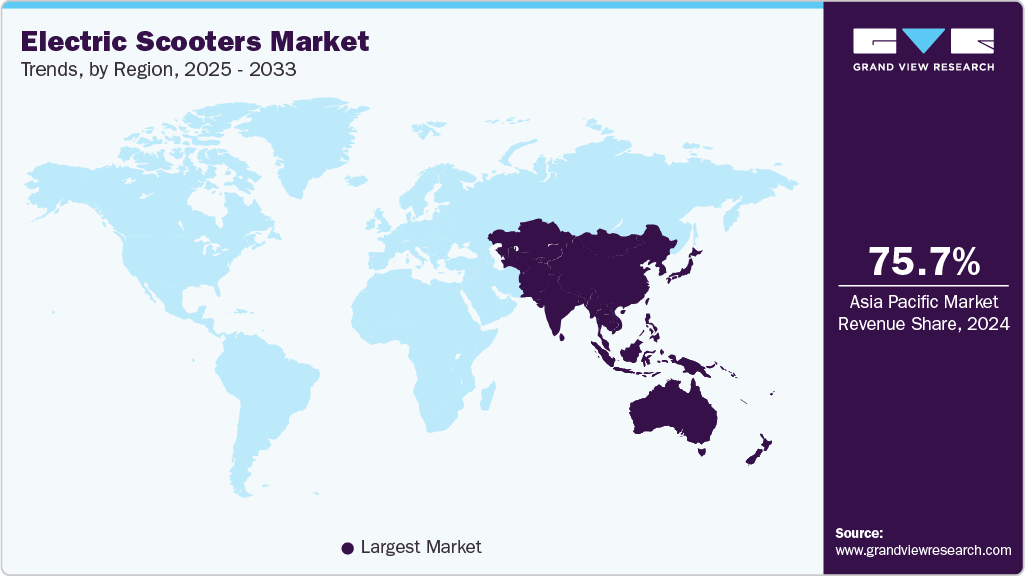
Asia Pacific dominated the global electric scooters market with the largest revenue share of 76.1% in 2025 and is expected to grow at the fastest CAGR during the forecast period. APAC is the world’s most diverse micromobility ecosystem, functioning as a multi-speed laboratory for electric scooter innovations. China and India anchor the region with their sheer scale, while Southeast Asian markets flourish through affordability-driven consumer adoption and the growth of delivery fleets. Meanwhile, premium micromobility solutions are emerging in Japan, Singapore, and Australia, where technology-driven safety features and compact vehicle formats are dominant. APAC’s dynamic policy experimentation, from battery-swapping pilots in India and China to city-specific subsidies, makes the region highly fragmented but simultaneously fast-growing. As industry outlooks confirm strong regional expansion, with China forming the largest base and India delivering the fastest growth, the APAC region demands tailored, country-specific strategies rather than a unified playbook.
 To learn more about this report, Download Free Sample Report
 The electric scooters market in China held the largest share in the Asia Pacific region in 2025. The electric scooters market in China is evolving from volume-centric manufacturing to a market defined by value, safety improvements, and stronger quality differentiation. Tightening safety norms, particularly in battery and thermal standards, is prompting manufacturers to enhance design integrity, integrate more advanced BMS systems, and strengthen domestic supply chains. Consolidation trends within Chinese manufacturers emphasize compliance and quality, helping eliminate ultra-low-cost products that fail to meet evolving national standards. This quality-driven shift is enabling Chinese brands not only to dominate the domestic market but also to expand global exports with improved safety credentials and enhanced battery technology offerings.
The Japan electric scooters market remains a premium, slow-and-steady adopter of electric scooters, guided by regulatory caution and consumer demand for compact, high-quality engineering. Japanese cities, with their narrow streets and quiet residential zones, favor smaller-form, highly reliable scooters designed for low-noise operation and long battery life. Local governments and industry players are actively conducting controlled pilots for last-mile logistics in retail, hospitality, and parcel delivery, with a focus on operational efficiency and safety. Market forecasts indicate stable, moderate growth driven by affluent consumers, stringent build-quality expectations, and methodical regulatory endorsement.
The electric scooters market in India is anticipated to grow at the fastest CAGR during the forecast period, characterized by a powerful combination of consumer adoption and the electrification of commercial fleets. Government incentives, such as FAME subsidies, have historically boosted demand. However, recent subsidy adjustments in 2024 briefly moderated growth, but the market rebounded through strong localized manufacturing and rising demand from delivery fleets. India’s adoption patterns are deeply affected by affordability, widespread two-wheeler culture, and the rapid expansion of battery-swapping and BaaS models. OEMs that localize production, integrate supply chains, and remain resilient against policy fluctuations are best positioned to capture India’s large and rapidly scaling market.
Key Electric Scooters Company Insights
Some of the major players in the global electric scooters industry include AllCell Technologies LLC, BMW Motorrad International, BOXX Corp., Gogoro Inc., Green Energy Motors Corp., Greenwit Technologies Inc., Honda Motor Co. Ltd., Jiangsu Xinri E-Vehicle Co., Ltd., KTM AG, and Mahindra GenZe, among others, driven by their advancements in battery engineering, platform innovation, intelligent power management systems, lightweight chassis designs, and high-performance urban mobility solutions. These companies continue to strengthen their market position through investments in next-generation lithium-ion and solid-state battery technologies, enhanced thermal management systems, modular scooter architectures, and IoT-enabled connectivity features. Their strategic collaborations with battery suppliers, charging-network providers, and city governments further support large-scale deployments, sustainable mobility transitions, and expansion into both consumer and commercial e-scooter segments worldwide.
-
AllCell Technologies is recognized for its advanced lithium-ion battery pack engineering, especially for e-scooters requiring enhanced safety and durability. The company’s proprietary phase change material (PCM) thermal management system significantly improves battery longevity and reduces risks associated with overheating, an essential requirement for high-demand urban fleets. AllCell collaborates with leading electric scooter OEMs and fleet operators who rely on its robust thermal solutions to extend battery life cycles, optimize performance, and improve ride safety. Its expertise in custom battery design and scalable pack manufacturing positions it as a critical supplier for premium and commercial electric scooter platforms globally.
-
BMW Motorrad brings premium engineering and automotive-grade safety standards to the electric scooter market, most notably through its high-end models such as the CE series, which feature powerful drivetrains, automotive-tier electronics, and advanced urban-mobility ergonomics. BMW leverages decades of motorcycle innovation to offer e-scooters with superior ride stability, regenerative braking, and integrated digital dashboards. With strong brand equity and a global dealership network, BMW Motorrad plays a growing role in the premium e-mobility segment, targeting commuters seeking a combination of performance, safety, and luxury in electric two-wheel transportation.
Key Electric Scooters Companies:
The following key companies have been profiled for this study on the electric scooters market.
- AllCell Technologies LLC
- BMW Motorrad International
- BOXX Corp.
- Gogoro, Inc.
- Green Energy Motors Corp.
- Greenwit Technologies Inc.
- Honda Motor Co. Ltd.
- Jiangsu Xinri E-Vehicle Co., Ltd.
- KTM AG
- Mahindra GenZe.
Competitive Benchmarking
Category
Operating Strategies
Competitive Edge
Weakness
Established Players (Honda Motor Co., Ltd., BMW Motorrad International, KTM AG)
- Established players focus on large-scale manufacturing, product innovation, dealership network expansion, and strategic investments in electric mobility technologies. They leverage extensive R&D capabilities and strong brand recognition to strengthen their position in the electric scooter market.
- Strong global presence, established distribution networks, advanced engineering expertise, robust financial resources, and high consumer trust enable these companies to maintain a competitive advantage.
- Large operational structures may reduce flexibility in responding to rapidly changing market trends. Higher manufacturing and operational costs can also impact pricing competitiveness in cost-sensitive markets.
Emerging Players (Gogoro, Inc., Green Energy Motors Corp., Greenwit Technologies Inc.)
- Emerging players focus on innovative battery technologies, smart connectivity features, battery-swapping ecosystems, and cost-effective electric mobility solutions. Many emphasize technology-driven differentiation and targeted expansion into high-growth urban mobility markets.
- Agility in innovation, specialized electric vehicle expertise, faster product development cycles, and strong focus on emerging mobility trends allow these companies to address evolving consumer demands effectively.
- Compared to established manufacturers, these companies often have smaller distribution networks, lower brand visibility, limited production scale, and fewer financial resources for large-scale expansion initiatives.
Recent Developments
-
In December 2023, Gogoro, a Taiwanese player, unveiled the Gogoro CrossOver GX250 domestically produced electric scooter in India. The company offers a tailor-made scooter to Indian riders. The introduction of these models marked a strategic move for the company to tap into the Indian electric scooter market.
-
In September 2023, Bird, a key player in the electric micro mobility market, acquired Spin, an electric scooter and e-bike rental company, for USD 19 million. This acquisition has reduced competition and aided the company in maintaining a dominant position in the market.
Electric Scooters Market Report Scope
Report Attribute
Details
Market size in 2025
USD 47.4 billion
Estimated market size in 2026
USD 52.9 billion
Projected market size by 2033
USD 99.0 billion
Growth rate
CAGR of 9.4% from 2026 to 2033
Base year for estimation
2025
Historical data
2021 - 2024
Forecast period
2026 - 2033
Quantitative units
Revenue in USD billion and CAGR from 2026 to 2033
Report coverage
Revenue forecast, company market share, competitive landscape, growth factors, and trends
Segments covered
Drive, battery, battery fitting, end-use, region
Regional scope
North America; Europe; Asia Pacific; Latin America; MEA
Country scope
U.S.; Canada; Mexico; Germany; UK; France; China; Japan; India; South Korea; Australia; Brazil; Saudi Arabia; UAE; and South Africa
Key companies profiled
AllCell Technologies LLC; BMW Motorrad International; BOXX Corp.; Gogoro, Inc.; Green Energy Motors Corp.; Greenwit Technologies Inc.; Honda Motor Co. Ltd.; Jiangsu Xinri E-Vehicle Co., Ltd.; KTM AG; Mahindra GenZe
Customization scope
Free report customization (equivalent up to 8 analysts' working days) with purchase. Addition or alteration to country, regional & segment scope.
Pricing and purchase options
Avail customized purchase options to meet your exact research needs. Explore purchase options
Global Electric Scooters Market Report Segmentation
This report forecasts revenue growth at the global, regional, and country levels and provides an analysis of the latest industry trends in each of the sub-segments from 2021 to 2033. For this study, Grand View Research has segmented the global electric scooters market report based on drive, battery, product, battery fitting,end-use, and region:
-
Drive Outlook (Revenue, USD Billion, 2021 - 2033)
-
Belt Drive
-
Chain Drive
-
Hub Motors
-
-
Battery Outlook (Revenue, USD Billion, 2021 - 2033)
-
Lead Acid
-
Li-Ion
-
Other
-
-
Product Outlook (Revenue, USD Billion, 2021 - 2033)
-
Standard
-
Folding
-
Self-Balancing
-
Maxi
-
Three-wheeled
-
-
Battery Fitting Outlook (Revenue, USD Billion, 2021 - 2033)
-
Detachable
-
Fixed
-
-
End-use Outlook (Revenue, USD Billion, 2021 - 2033)
-
Personal
-
Commercial
-
-
Regional Outlook (Revenue, USD Billion, 2021 - 2033)
-
North America
-
U.S.
-
Canada
-
Mexico
-
-
Europe
-
Germany
-
UK
-
France
-
-
Asia Pacific
-
China
-
Japan
-
India
-
South Korea
-
Australia
-
-
Latin America
-
Brazil
-
-
Middle East and Africa (MEA)
-
Saudi Arabia
-
UAE
-
South Africa
-
-
Research Methodology
The electric scooters market figures in this report are based on a proven research process that combines executive interviews with secondary research from proprietary databases, company filings, and recognized regulatory and institutional sources. Market size is built through value-chain sizing - reconciling supply-side and demand-side estimates - and triangulated with bottom-up and top-down approaches. Every estimate passes multiple levels of expert validation before publication, with each electric scooters segment quantified using the revenue-capture definitions in the table below.
Segment Definition
Segment - Drive
Revenue capture definition
Belt Drive
This segment captures revenue generated from electric scooters that use a belt-driven transmission system to transfer power from the motor to the wheel.
Chain Drive
This segment captures revenue generated from electric scooters equipped with chain-driven power transmission systems.
Hub Motors
This segment captures revenue generated from electric scooters that utilize motors integrated directly into the wheel hub.
Segment - Battery
Revenue capture definition
Lead Acid
This segment captures revenue generated from electric scooters powered by lead-acid batteries.
Li-Ion
This segment captures revenue generated from electric scooters powered by lithium-ion batteries.
Other
This segment captures revenue generated from electric scooters utilizing alternative battery technologies such as nickel-metal hydride (NiMH), solid-state batteries.
Segment - Battery Fitting
Revenue capture definition
Detachable
This segment captures revenue generated from electric scooters equipped with removable battery packs.
Fixed
This segment captures revenue generated from electric scooters with permanently integrated battery systems.
Segment - End Use
Revenue capture definition
Personal
This segment captures revenue generated from electric scooters purchased for individual transportation and personal mobility purposes.
Commercial
This segment captures revenue generated from electric scooters deployed for business and commercial applications.
Estimation Model
Layer Name
Key Question
Description
Two-Wheeler Mobility Demand Base Layer
Who requires personal and short-distance transportation solutions?
Establish the total potential demand base by identifying two-wheeler users, urban commuters, students, working professionals, delivery personnel, shared mobility operators, and commercial fleet users. It evaluates factors such as urbanization, commuting patterns, vehicle ownership trends, fuel costs, and transportation demand before applying market-specific filters.
Addressable Electric Mobility Market Layer
Which two-wheeler users can realistically adopt electric scooters?
Refine the total mobility ecosystem into the serviceable electric scooter market by considering factors such as charging infrastructure availability, government incentives, consumer purchasing power, environmental awareness, battery technology adoption, and electric vehicle regulations. It determines the portion of two-wheeler users that can potentially transition to electric scooters.
Electric Scooter Adoption & Deployment Layer
Who is actively purchasing and using electric scooters?
Estimate annual demand generation by analyzing adoption rates across personal and commercial users. It incorporates sales of electric scooters based on battery type, drive systems, battery fitting configurations, and usage across personal mobility, fleet operations, delivery services, and shared mobility platforms.
Revenue Layer
How does electric scooter adoption translate into market revenue?
Convert electric scooter demand into market revenue through the sale of electric scooters. Revenue is generated by applying average selling prices across different scooter categories.
Delivered Customizations
This report has been delivered with the following In-depth customizations
Client Request
Customization Delivered
Value Adds
Market Size by Volume (000’ Units) & Revenue (USD Million/Billion) Analysis
Delivered market size estimates and forecasts in terms of both sales volume (000' Units) and market revenue (USD Million/Billion) across global, regional, and country-level markets
Analysis of annual electric scooter shipments, unit sales trends, and revenue generation across key markets
Enabled comprehensive understanding of market growth from both demand and revenue perspectives
Supported production planning, capacity expansion, and supply chain optimization
Assisted in identifying high-volume and high-value market segments
Government Incentives & Regulatory Analysis
Assessment of EV subsidies, tax incentives, emission regulations, vehicle safety standards, and electrification policies influencing electric scooter adoption
Analysis of regulatory developments across key markets
Supported regulatory planning and market entry decisions
Identified policy-driven growth opportunities
Competitive Benchmarking & Strategic Landscape Analysis
Delivered benchmarking of major electric scooter manufacturers based on product portfolio, battery technology, pricing, geographic presence, partnerships, production capacity, and innovation initiatives
Analysis of mergers & acquisitions, funding activities, product launches, and strategic collaborations
Supported competitive intelligence and strategic decision-making
Enabled identification of market gaps and expansion opportunities
Assisted in strengthening market positioning
Frequently Asked Questions About This Report
Based on drive, the hub motors segment led the market with the largest revenue share of 79.4% in 2025, while belt drive is the fastest-growing drive.
Based on battery, the lithium-ion battery segment led the market with the largest revenue share of 76.5% in 2025 and is the fastest-growing battery type.
Based on battery fitting, the fixed segment led the market with the largest revenue share of 54.2% in 2025, while the detachable segment is the fastest-growing.
Based on end use, the personal segment led the market with a 71.4% revenue share in 2025, while the commercial segment is the fastest-growing.
The global electric scooters market size was valued at USD 47.4 billion in 2025 and is expected to reach USD 52.9 billion in 2026.
The global electric scooters market is expected to grow at a compound annual growth rate of 9.4% from 2026 to 2033 to reach USD 99.0 billion by 2033.
Asia Pacific dominated the global market with the largest revenue share of 76.1% in 2025 and is the fastest-growing region. Most electric scooter manufacturers have emerged from China, Taiwan, and Japan, acquiring the largest share all over the world.
Some key players operating in the electric scooters market include AllCell Technologies LLC; BMW Motorrad International; BOXX Corp.; Gogoro, Inc.; Green Energy Motors Corp.; Greenwit Technologies Inc.; Honda Motor Co. Ltd.; Jiangsu Xinri E-Vehicle Co., Ltd.; KTM AG; and Mahindra GenZe.
The increasing demand for fuel-efficient vehicles, coupled with growing concerns over greenhouse gas and carbon emissions, is anticipated to drive the growth of the electric scooters market over the forecast period.
About the Author(s)
Automotive & Transportation Research Team
Technology · Automotive & TransportationThis report was authored by the automotive & transportation research team at Grand View Research - comprising two research analysts, one senior research analyst, and one industry expert - with specialized expertise in the automotive & transportation segment of the technology industry. All findings are based on proprietary technology databases, executive interviews, and regulatory analysis, subject to internal peer review prior to publication.
Last Updated:
Speak to Analyst

Customize this report to your needs - add regions, segments, or data points, with 20% free customization.
Or view our licence options:


ISO 9001:2015 & 27001:2022 Certified
We are GDPR and CCPA compliant! Your transaction & personal information is safe and secure. For more details, please read our privacy policy.


