
- Home
- »
- IT Services & Applications
- »
-
Energy And Utilities Analytics Market Size Report, 2033GVR Report cover

Energy And Utilities Analytics Market (2026 - 2033)
Size, Share & Trends Analysis Report By Component, By Deployment Mode, By Organization Size, By Utility, By Application, By Region, And Segment Forecasts
Market Size, 2025
$5.3BMarket Estimate, 2026
$5.8BMarket Forecast, 2033
$11.9BCAGR, 2026–2033
10.8%Energy And Utilities Analytics Market Summary
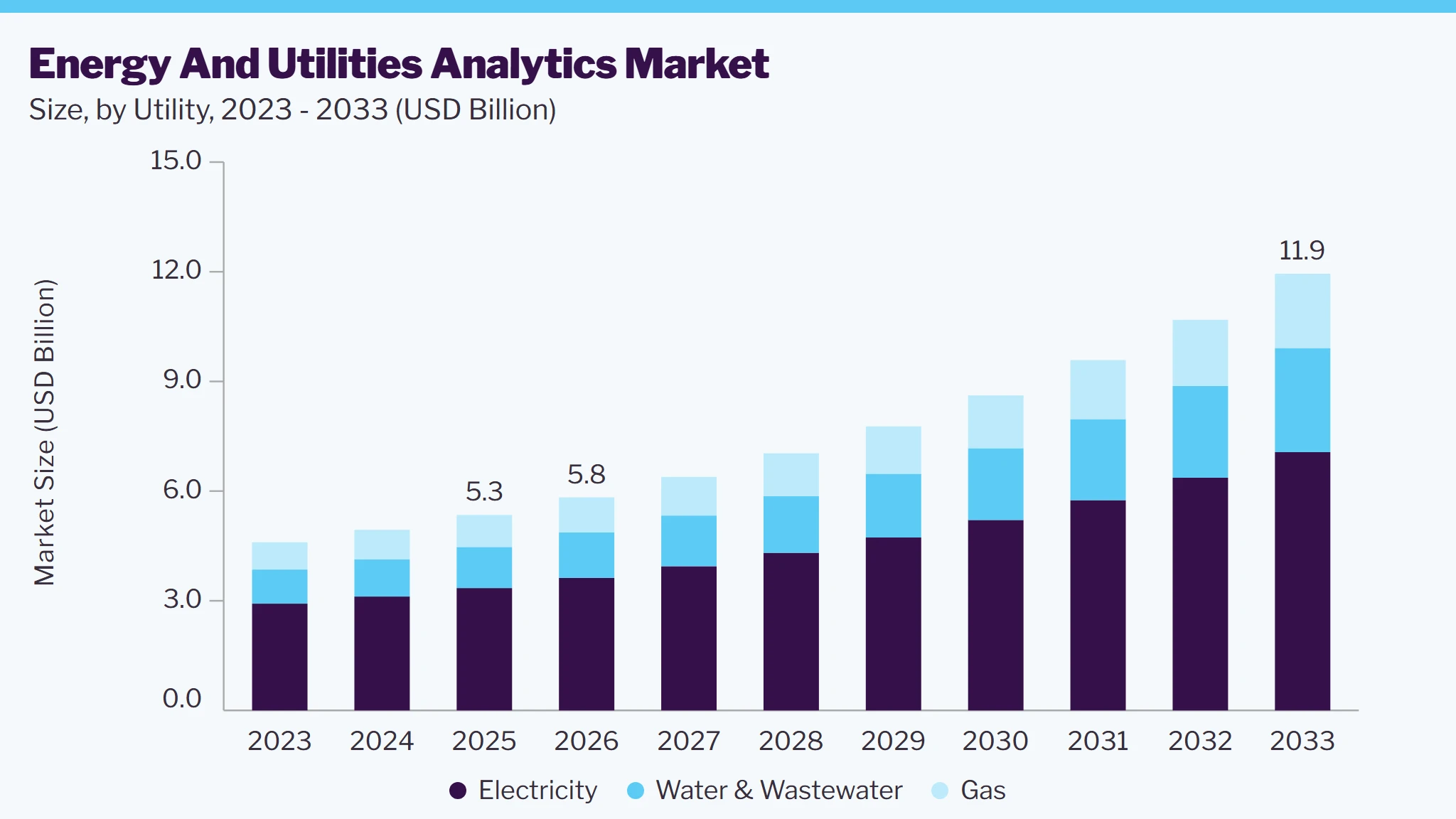
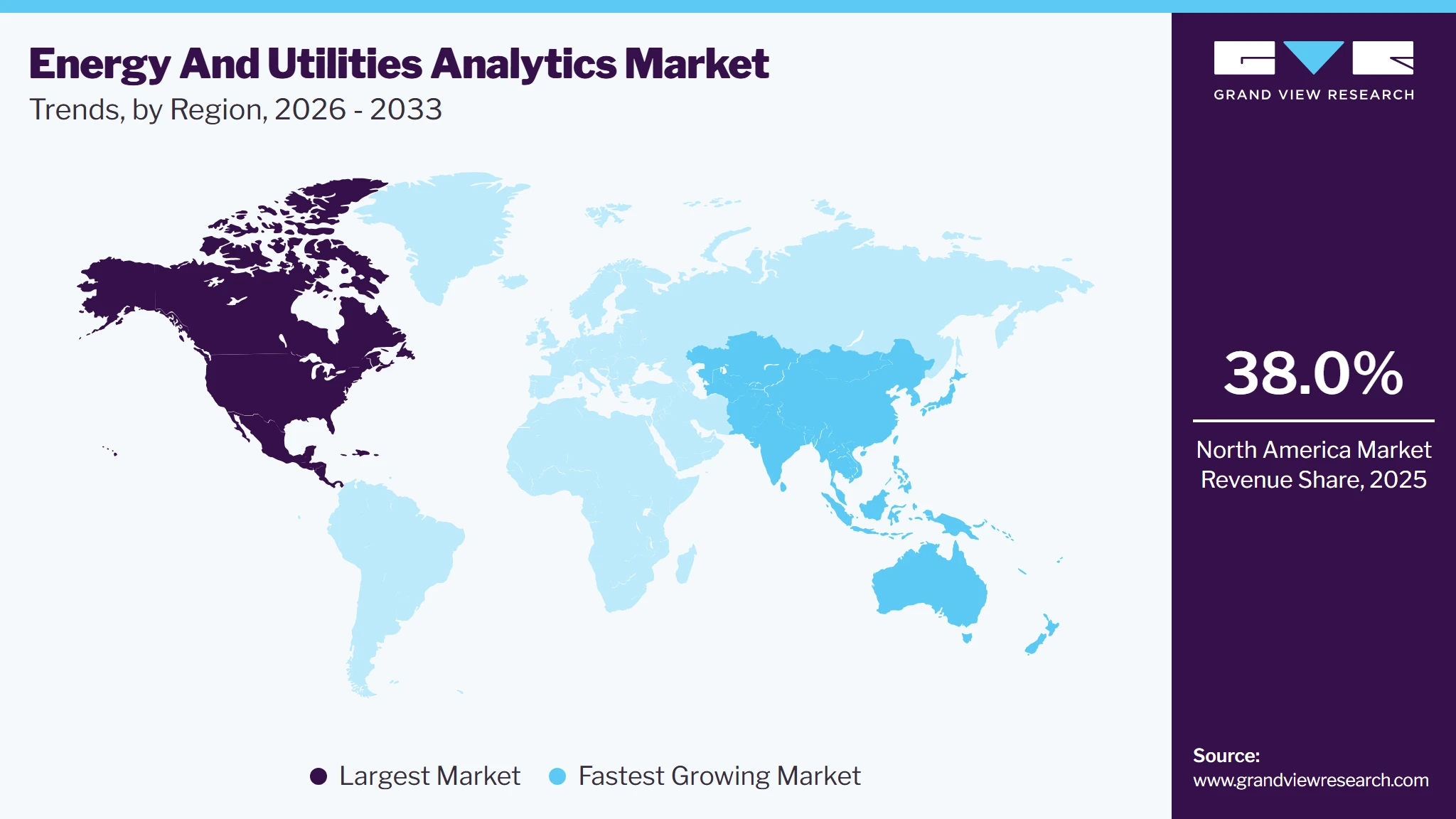
The global energy and utilities analytics market size was valued at USD 5.3 billion in 2025 and is projected to grow from USD 5.8 billion in 2026 to USD 11.9 billion by 2033, at a CAGR of 10.8% from 2026 to 2033. North America dominated the market, accounting for the largest revenue share of 38.0% in 2025. The market is shaped by the rapid digitalization of power systems and the increasing complexity of electricity networks.
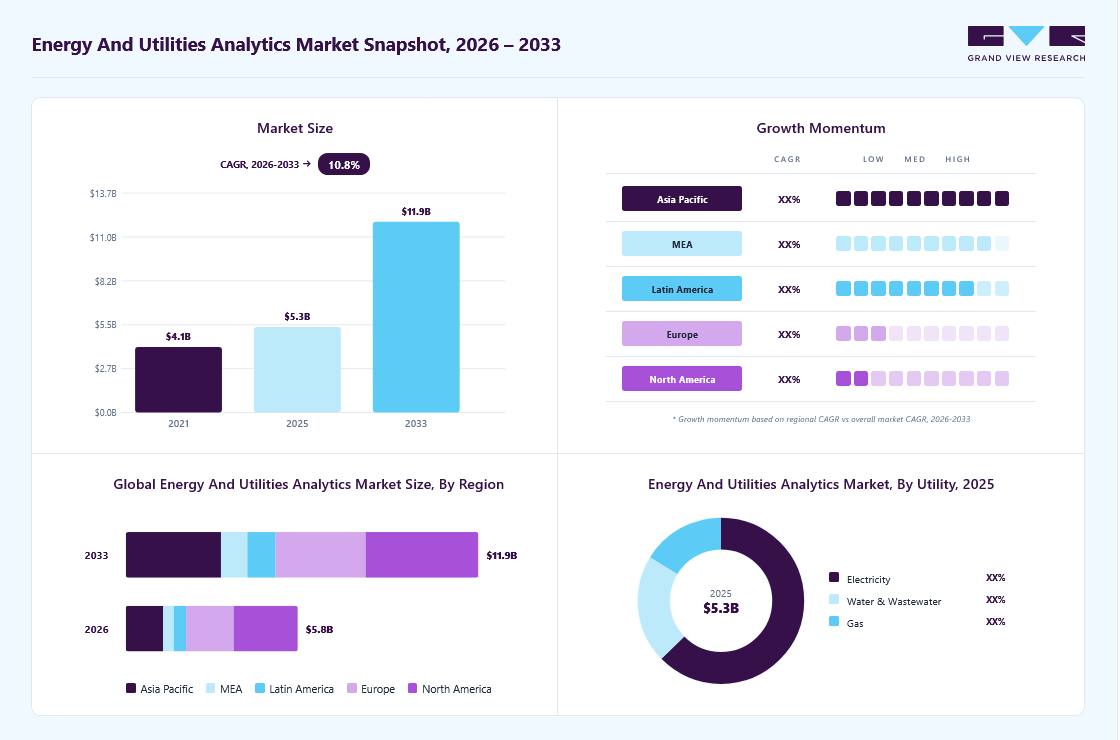 Source: Grand View Research, IR Documents, Primary Interviews, Paid DatabasesTo learn more about this report,
 Download Free Sample Report
 Key Market Trends & Insights
- By component: The solutions segment held the largest market share of around 66.9% in 2025.
- By deployment mode: The on-premises segment held the largest market revenue share in 2025.
- By organization size: The large enterprises segment led the market with the largest revenue share in 2025.
- By utility: The electricity segment held the largest market revenue share in 2025.
- By application: The grid & network optimization segment led the market with the largest revenue share in 2025.
Regional Highlights
- Largest regional market: North America (38.0% revenue share, 2025)
- Fastest-growing regional market: Asia Pacific (highest CAGR, 2026-2033)
- Leading country: U.S. held the largest share in 2025
Market Size & Forecasts
- Market size in 2025: USD 5.3 Billion
- Estimated market size in 2026: USD 5.8 Billion
- Projected market size by 2033: USD 11.9 Billion
- CAGR (2026-2033): 10.8%
Three ways to get this report
Buy it, customize it, or ask a question.Ask an Analyst
Analyst response in 1 business day
- AccessReport author, directly
- Reply timeWithin 1 working day
- No sales callDirect answer only
- FormatEmail reply
- CostFree, no cost
Get the Full Report
What the study covers
- FormatsPDF · Excel · Dashboard
- Timeline2026–2033 annual, 2025 base
- Coverage20+ countries, 5 regions
- Companies10+ key players profiled
Customize the Report
20% free customization
- IncludeCountries, segments, points
- TailorTo your product definition
- ExtendDeeper competitor detail
- OrA fully bespoke study
- Turnaround5–10 working days
 To learn more about this report, Download Free Sample Report
 Rising electricity demand from data centers, industrial electrification, cooling, and other digital applications is increasing pressure on utilities to improve grid utilization, reliability, and operational efficiency. The IEA estimates that global grid capacity needs to increase by at least 30% by 2035, creating strong demand for analytics that can improve planning, forecasting, asset utilization, and network management.
Market Dynamics
The increasing complexity of energy infrastructure and growing electricity demand are encouraging utilities to adopt AI and advanced analytics for predictive maintenance, load forecasting, outage prediction, asset monitoring, and grid optimization. AI-enabled analytics can help utilities identify equipment failures before they occur, optimize maintenance schedules, improve grid reliability, and manage increasingly variable renewable generation. The growing deployment of sensors, smart meters, and connected grid infrastructure is also generating large volumes of operational data, creating favorable conditions for analytics adoption.
The presence of aging IT and operational technology systems, fragmented data sources, and inconsistent data formats remains a major barrier to analytics adoption. Many utilities operate legacy systems that were not designed to integrate with modern cloud, IoT, and AI platforms, making data consolidation and real-time analytics difficult. In addition, poor data quality, interoperability challenges, cybersecurity requirements, and high modernization costs can extend implementation timelines and increase the overall cost of deploying advanced analytics solutions.
The rapid integration of solar, wind, battery storage, electric vehicles, and other distributed energy resources is creating significant opportunities for advanced analytics. Utilities can use predictive and prescriptive analytics to forecast renewable generation, balance supply and demand, optimize distributed resources, identify grid congestion, and improve energy storage utilization. As electricity systems become more decentralized and intermittent generation accounts for a larger share of the power mix, analytics can increasingly serve as a critical layer for real-time grid planning, flexibility management, and system optimization.
Market Concentration & Characteristics
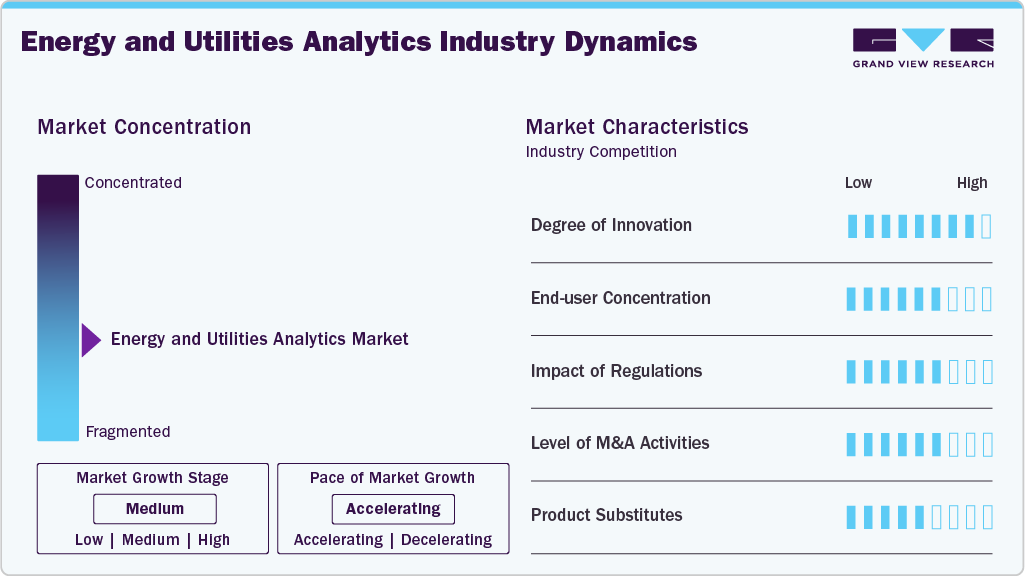
The energy and utilities analytics industry is moderately fragmented, comprising large technology and cloud providers, specialized analytics vendors, utility software providers, and consulting firms. Leading players compete across predictive analytics, asset management, grid optimization, demand forecasting, and customer analytics, while partnerships between utilities, technology providers, and systems integrators are expanding the deployment of analytics across energy and utility operations. The market includes both end-to-end platforms and specialized solutions targeting specific utility functions.
 To learn more about this report, Download Free Sample Report
 The market is characterized by rapid adoption of AI/ML, predictive and prescriptive analytics, IoT-enabled monitoring, and real-time data processing. Vendors are increasingly integrating analytics with smart grids, digital twins, edge computing, and cloud platforms to support predictive maintenance, renewable energy forecasting, outage management, and grid optimization. At the same time, data interoperability, cybersecurity, legacy infrastructure integration, and the convergence of analytics with AI and automation remain key areas of industry focus.
Analyst Perspective
The market is expected to witness strong growth as utilities adopt AI-driven analytics to improve grid reliability, asset performance, demand forecasting, and operational efficiency. The growing integration of renewable energy, distributed energy resources, and smart-grid infrastructure is further increasing demand for real-time analytics. However, legacy systems, fragmented data, and cybersecurity concerns may constrain adoption. Vendors offering scalable, interoperable, and AI-enabled analytics platforms are likely to gain a competitive advantage as utilities transition toward more intelligent and data-driven operations.
Component Insights
The solutions segment accounted for the largest market share of 66.9% in 2025, driven by the growing adoption of integrated analytics platforms that consolidate data from diverse energy sources and enable utilities to improve operational visibility, energy management, and cost efficiency. The increasing complexity of managing multiple energy sources is further encouraging organizations to adopt centralized analytics solutions that transform fragmented operational data into actionable insights. For instance, in July 2026, Teletrac Navman launched Energy Hub, a solution within its TN360 platform that unifies fuel, EV charging, and other energy data while providing analytics on energy consumption, costs, charging behavior, and operational performance. The solution is designed to provide organizations with a unified view of energy usage and support more data-driven decision-making. As energy operations become increasingly data-intensive and organizations prioritize real-time visibility, optimization, and integration of diverse energy data, demand for analytics solutions is expected to remain strong, supporting the segment's continued dominance.
The services segment is projected to register the fastest CAGR during the forecast period, driven by the increasing need for implementation, integration, customization, managed analytics, and ongoing support. Growing adoption of cloud-based platforms, AI-driven analytics, and legacy-system modernization is also encouraging utilities to rely on specialized service providers for deployment and optimization. In addition, the need to integrate data from smart meters, IoT devices, grid infrastructure, and operational systems is creating greater demand for professional and managed analytics services. Consequently, as utilities prioritize faster deployment while addressing technical and interoperability challenges, demand for specialized analytics services is expected to increase rapidly throughout the forecast period.
Deployment Mode Insights
The on-premises segment accounted for a significant market share in 2025, driven by utilities' preference for maintaining greater control over sensitive operational and infrastructure data, particularly for critical grid and energy management applications. The need for enhanced data security, regulatory compliance, low-latency processing, and integration with legacy operational technology systems continues to support on-premises deployments. However, the increasing adoption of cloud-based analytics and scalable AI platforms is expected to gradually shift new deployments toward hybrid and cloud environments during the forecast period.
The cloud segment is projected to register the fastest CAGR during the forecast period, driven by the growing need for scalable and cost-efficient analytics infrastructure as utilities generate increasing volumes of data from smart meters, connected assets, distributed energy resources, and grid systems. For instance, in March 2026, Hitachi announced initiatives to enhance its Lumada Data Science Laboratory and accelerate AI and data-driven solutions, highlighting the increasing role of cloud-based data infrastructure and AI in addressing complex energy and social infrastructure challenges. Cloud deployment also enables utilities to integrate diverse data sources, scale computing resources, and access advanced analytics and AI capabilities without substantial investments in on-premises infrastructure. Consequently, increasing digitalization and demand for scalable analytics environments are expected to accelerate adoption of cloud-based energy and utilities analytics solutions.
Organization Size Insights
The large enterprises segment accounted for the largest market share in 2025, driven by the scale of their energy operations, extensive asset bases, and ability to invest in advanced analytics infrastructure for grid optimization, predictive maintenance, demand forecasting, and asset performance management. The increasing deployment of AI and analytics by large utilities to improve operational efficiency and manage increasingly complex grid environments is further strengthening segment demand. For instance, in September 2026, Avangrid announced an expanded use of AI, advanced analytics, and digital grid capabilities to improve data analysis, asset management, grid reliability, and customer service. The growing emphasis among large energy organizations on enterprise-wide digital transformation and AI-enabled decision-making is therefore expected to support the continued dominance of the large enterprises segment.
The small & medium enterprises (SMEs) segment is projected to witness the fastest CAGR in the market due to the growing availability of affordable, cloud-based and AI-enabled energy management tools. These tools bring advanced analytics, once limited to large industrial users, within reach of smaller businesses that lack big budgets and in-house energy expertise. Tightening energy efficiency regulations, including audit and reporting requirements, are also pushing SMEs to digitize energy monitoring, while utilities and energy service providers increasingly treat them as a high-potential customer base. For instance, Energie AG Oberösterreich launched the AI-Enabled Energy Audit and Consulting for SMEs Challenge 2026, which seeks AI-supported systems that automate energy data analysis and produce audit reports compliant with Austrian efficiency regulations. Initiatives like this show how utilities are investing in scalable, AI-driven analytics tailored to smaller enterprises, lowering cost and expertise barriers to adoption. As regulatory compliance needs rise and analytics become easier to deploy, SMEs are expected to be the fastest-growing adopters of energy and utilities analytics over the forecast period.
Utility Insights
The electricity segment accounted for the largest market share in 2025 due to the rapid shift toward renewable-heavy power systems, which is pushing utilities to adopt analytics for forecasting, load balancing, and grid optimization. Rising electricity demand from electrification, data centers, and distributed energy resources, along with the need for grid resilience against extreme weather, is also making real-time monitoring and data-driven asset management essential across power networks. For instance, in November 2024, Schneider Electric announced new smart grid solutions at Enlit Europe 2024, including a net-zero dashboard for tracking grid decarbonization, DERMS for managing distributed renewable assets, and satellite- and AI-based tools to help utilities prepare for extreme weather. The launch reflects how vendors are building analytics-led offerings around the electricity value chain, which deepens analytics adoption among power utilities. Hence, electricity is expected to remain the leading segment as grids become more digital, flexible, and renewable-integrated.
The water & wastewater segment is projected to witness the fastest CAGR due to mounting water scarcity and the heavy losses from aging distribution networks, which push utilities to adopt analytics for leak detection, demand forecasting, and non-revenue water reduction. The rollout of smart meters and IoT sensors across water networks, together with stricter regulatory and sustainability targets, is generating large volumes of operational data that utilities increasingly rely on AI-driven platforms to turn into maintenance and investment decisions. For instance, in June 2023, Orbis Intelligent Systems and AI specialist VODA.ai entered a strategic partnership to support US utilities and municipalities with their leakage strategies, combining Orbis's leak-identifying monitoring hardware with VODA.ai's AI-based pipe failure predictions. Such partnerships show how vendors are pairing field sensing with predictive analytics to help water utilities cut losses and prioritize pipe replacement more precisely. Consequently, water and wastewater is expected to be the fastest-growing segment as utilities digitize networks and shift from reactive repairs to data-driven asset management.
Application Insights
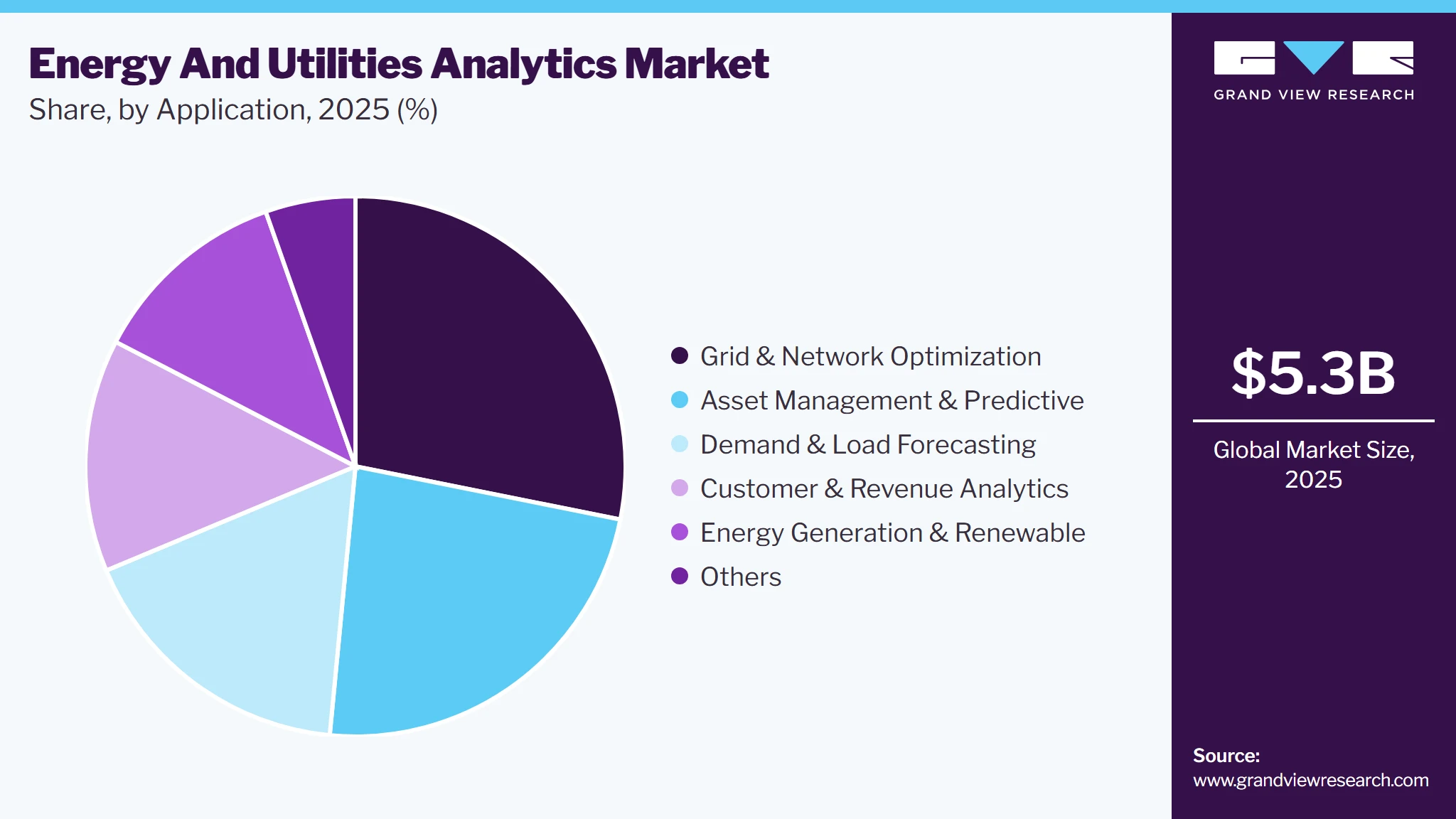
The grid & network optimization segment accounted for the largest market share in 2025, driven by the pressure on utilities to modernize aging grids that must now absorb variable renewable generation, distributed energy resources, and fast-growing loads from electrification. Rising demand from data centers and large-load customers is also making real-time visibility, load forecasting, and congestion management a core priority, which pushes utilities to invest in analytics that improve reliability and use existing network capacity more efficiently. For instance, in March 2026, GridCARE and National Grid announced a collaboration to deploy AI-driven grid optimization, using AI models and grid simulations to identify underused network capacity so that large-load customers can be connected faster and at lower cost. Such deployments show how analytics are being used to extract more capacity from existing infrastructure without waiting on lengthy network upgrades. Hence, grid & network optimization is expected to retain its leading position as utilities prioritize reliability, flexibility, and faster interconnection.
 To learn more about this report, Download Free Sample Report
 The energy generation & renewable energy analytics segment is projected to witness the fastest CAGR due to the rapid build-out of solar and wind capacity, whose output depends on weather and is hard to predict, which makes forecasting and performance analytics essential for operators. Growing grid-integration requirements and the financial penalties for gaps between scheduled and actual generation are also pushing generators and asset owners to adopt AI-based tools for forecasting, asset optimization, and trading. For instance, in April 2026, Amperon launched a new AI-based short-term probabilistic forecasting tool for solar and wind generation assets, giving operators a view of the range of likely outputs rather than a single estimate. Such launches show how vendors are building analytics that help renewable operators manage variability, reduce imbalance costs, and improve dispatch decisions. Consequently, energy generation & renewable energy analytics is expected to be the fastest-growing application as renewable capacity scales, and operators rely more on data-driven forecasting.
Regional Insights
The North America energy and utilities analytics market held the largest global revenue share of 38.0% in 2025. North America's energy and utilities analytics market is shaped by large-scale grid modernization in the U.S. and Canada, where utilities are replacing aging infrastructure and extending advanced metering and sensor coverage to generate granular operational data. Surging electricity demand from data centers, electrification of transport and buildings, and large-load interconnection requests are pushing utilities to adopt AI-driven load forecasting, capacity planning, and grid optimization tools. The region is also seeing growing use of analytics for wildfire and extreme-weather resilience, outage prediction, and predictive maintenance, particularly among investor-owned utilities facing reliability and regulatory scrutiny. Federal and state funding for grid resilience, clean energy targets, and the rising share of distributed energy resources are further accelerating demand for DER management and renewable forecasting analytics. Strong cloud and AI vendor presence, along with active partnerships between utilities and technology providers, keeps the region at the forefront of analytics adoption.
 To learn more about this report, Download Free Sample Report
 U.S. Energy And Utilities Analytics Market Trends
The energy and utilities analytics market in the U.S. is experiencing robust growth due to rising electricity demand from data centers, electrification, and large-load connections, which is pushing utilities and power companies to adopt analytics for forecasting, grid planning, and portfolio optimization. Aging grid infrastructure, increasing extreme-weather risk, and the growing share of renewables and distributed energy resources are also driving investment in AI-enabled tools that improve reliability, asset management, and market decision-making. For instance, in March 2026, Equilibrium Energy announced a strategic agreement with NRG Energy to deploy its AI-native PowerOS platform across NRG's enterprise portfolio optimization operations, which was the platform's first publicly announced deployment. The agreement shows how U.S. power companies are moving from pilots to enterprise-scale AI deployments to handle grid complexity, rising demand, and market volatility. As utilities continue to digitize operations and scale such deployments, the U.S. market is expected to sustain strong growth over the forecast period.
Asia Pacific Energy And Utilities Analytics Market Trends
The energy and utilities analytics market in the Asia Pacific is driven by rapid growth in electricity demand, large-scale urbanization and ambitious renewable capacity additions in China, India, Japan, South Korea and Australia. Smart meter rollouts and grid digitization programs, particularly in China and India, are generating large volumes of data that utilities increasingly use for loss reduction, theft detection, demand forecasting and outage management. The rising share of solar and wind is creating strong demand for generation forecasting and grid balancing analytics, while rooftop solar and storage growth in Australia and Japan is accelerating DER management. Water scarcity and high non-revenue water losses in several economies are also pushing water utilities toward AI-based leak detection and network analytics. Government-backed smart grid and smart city initiatives, along with growing cloud adoption and local technology partnerships, are further supporting regional uptake.
China energy and utilities analytics marketis witnessing steady growth due to the country's large-scale grid digitization, supported by state-owned operators investing in smart grid infrastructure, data platforms and AI-based planning and operations. Rapid additions of wind and solar capacity, together with growing electricity demand and national energy security and carbon targets, are further increasing the need for analytics in forecasting, grid balancing and distribution network planning. For instance, in July 2026, China Southern Power Grid unveiled a suite of AI technologies at the World AI Conference in Shanghai, including a "Power-Carbon-Computing Synergy Platform" built around a power-industry foundation model and an AI-native distribution network planning agent. The launch shows how China's grid operators are building industry-specific AI and analytics ecosystems that link grid, carbon, and computing data to support new power system construction. As these deployments scale across provinces and utilities, the Chinese market is expected to keep growing steadily over the forecast period.
The energy and utilities analytics market in India is at an emerging stage due to the ongoing smart meter rollout and the push to cut high aggregate technical and commercial (AT&C) losses, which are encouraging DISCOMs to move toward data-driven operations. Government support for AI/ML adoption in power distribution, including a focus on smart meter analytics, theft detection, and predictive maintenance, along with rising renewable capacity and demand, is building the foundation for analytics adoption, though deployment is still limited by data readiness and skills. For instance, in May 2026, India Smart Grid Forum and Gujarat Urja Vikas Nigam exchanged an MoU to implement AI/ML-based data analytics across GUVNL's subsidiary DISCOMs, with demand forecasting as a key focus area. The agreement shows how state utilities are beginning to translate policy intent into structured analytics programs aimed at better forecasting, procurement, and distribution planning. As smart meter coverage expands and more DISCOMs build analytics capability, the Indian market is expected to gain momentum from a low base over the forecast period.
Europe Energy And Utilities Analytics Market Trends
The energy and utilities analytics market in Europe is shaped by the EU's decarbonization agenda, where the rapid growth of wind and solar is driving demand for generation forecasting, grid balancing and flexibility management analytics. Utilities and grid operators are investing in grid digitization and smart meter data platforms to integrate distributed energy resources, EVs and heat pumps, supported by EU funding and regulatory frameworks that promote grid modernization and cross-border market integration. Energy efficiency directives and carbon reporting requirements are also pushing industrial and commercial users, including SMEs, toward energy monitoring, audit automation and emissions tracking tools. Volatile wholesale power prices and energy security concerns have increased the use of analytics for price forecasting, trading and demand-side management, while water utilities are applying AI to leak detection and network performance. Strict data privacy and cybersecurity rules, along with strong collaboration between utilities, startups and technology vendors, shape how solutions are deployed across the region.
Key Energy And Utilities Analytics Company Insights
Key players operating in the market include ABB Ltd., Accenture plc, Amazon Web Services, Capgemini SE, GE Vernova Inc., Honeywell International Inc., IBM, Itron, Inc., Microsoft Corporation, Oracle Corporation, SAP SE, SAS Institute Inc., Schneider Electric SE, Siemens AG, Teradata Corporation.
-
ABB is a Swiss electrification and automation leader that serves the market through its ABB Ability platform and Genix Industrial Analytics and AI Suite, which help utilities manage aging grid assets. It is expanding its grid automation and analytics capabilities, including the December 2025 agreement to acquire Netcontrol and an investment in Gridcog's DER modeling platform. Its strength lies in pairing installed electrical hardware with software and analytics.
-
Accenture is a global professional services firm that helps utilities apply analytics, AI, and cloud to grid modernization, asset management, and customer operations, having built its capabilities through acquisitions such as BRIDGE Energy Group and joint ventures such as K4 Digital with Kansai Electric Power. In September 2025, it expanded its collaboration with Google Cloud and Eneva to use AI to optimize energy operations in Brazil. Its strength lies in end-to-end delivery backed by hyperscaler partnerships.
Key Energy And Utilities Analytics Companies
The following key companies have been profiled for this study on the energy and utilities analytics market.
-
ABB Ltd.
-
Accenture plc
-
Amazon Web Services
-
Capgemini SE
-
GE Vernova Inc.
-
Honeywell International Inc.
-
IBM
-
Itron, Inc.
-
Microsoft Corporation
-
Oracle Corporation
-
SAP SE
-
SAS Institute Inc.
-
Schneider Electric SE
-
Siemens AG
-
Teradata Corporation
Competitive Benchmarking
Operating Strategies
Competitive Edge
Weaknesses
Mature Players: ABB Ltd.; Accenture plc; Amazon Web Services; GE Vernova Inc.; Honeywell International Inc.; IBM; Microsoft Corporation; Oracle Corporation; SAP SE; Schneider Electric SE; Siemens AG
- Expanding integrated grid, asset performance and customer analytics offerings, often through acquisitions and alliances, while embedding AI and generative AI across cloud, software and industrial platforms.
- Shifting toward subscription and software-led models, with utility-specific solutions for forecasting, DER management, grid optimization and predictive maintenance.
- Large installed bases of grid equipment, enterprise software and cloud infrastructure give them proprietary operational data, deep utility relationships and a strong position to bundle and cross-sell.
- Broad portfolios spanning hardware, software, cloud and services support end-to-end deployments for large utilities and grid operators.
- Complex solutions, long utility procurement cycles, and integration with legacy on-premises and OT systems can lengthen implementation and onboarding.
- Hardware-led players depend on utility capital spending cycles, while cloud and software players have limited grid-edge depth and rely on partners for OT integration.
Emerging Players: Capgemini SE; Itron, Inc.; SAS Institute Inc.; Teradata Corporation
- Focusing on specialized capabilities such as metering and grid-edge analytics (Itron), advanced analytics and AI modeling, data platforms, and utilities-focused data and AI services.
- Partnering with hyperscalers and utilities to extend reach and moving toward cloud-delivered and AI-enabled offerings.
- Specialized domain or analytics expertise lets them tailor solutions to specific utility use cases such as smart meter data, load forecasting, and revenue protection.
- Greater focus and flexibility make it easier to adapt offerings and form targeted partnerships.
- Smaller scale and narrower portfolios than the diversified leaders limit their ability to bundle end-to-end solutions.
- Dependence on hyperscaler platforms and partners, together with competition from larger vendors' native analytics offerings, makes long-term differentiation harder to maintain.
Recent Developments
-
In October 2026, Accenture completed the acquisition of Mjølner Informatics, adding approximately 400 professionals and strengthening its software engineering and digital capabilities for energy and utilities clients.
-
In May 2026, Bidgely’s Analytics Workbench uses AI and consumption analytics to help utilities optimize demand, manage EV loads, improve energy efficiency, and target customer programs.
Energy And Utilities Analytics Market Report Scope
Report Attribute
Details
Market size in 2025
USD 5.3 billion
Estimated market size in 2026
USD 5.8 billion
Projected market size by 2033
USD 11.9 billion
Growth rate
CAGR of 10.8% from 2026 to 2033
Actual data
2021 - 2025
Forecast period
2026 - 2033
Quantitative units
Revenue in USD billion and CAGR from 2026 to 2033
Report coverage
Revenue forecast, company share, competitive landscape, growth factors, and trends
Segments covered
Component, deployment mode, organization size, utility, application, region
Regional scope
North America; Europe; Asia Pacific; Latin America; MEA
Country scope
U.S.; Canada; Mexico; UK; Germany; France; China; Japan; India; South Korea; Australia; Brazil; UAE; KSA; South Africa
Key companies profiled
ABB Ltd.; Accenture plc; Amazon Web Services; Capgemini SE; GE Vernova Inc.; Honeywell International Inc.; IBM; Itron, Inc.; Microsoft Corporation; Oracle Corporation; SAP SE; SAS Institute Inc.; Schneider Electric SE; Siemens AG; Teradata Corporation
Customization scope
Free report customization (equivalent to up to 8 analyst working days) with purchase. Addition or alteration to country, regional & segment scope.
Pricing and purchase options
Avail customized purchase options to meet your exact research needs. Explore purchase options
Global Energy And Utilities Analytics Market Report Segmentation
This report forecasts revenue growth at global, regional, and country levels and provides an analysis of the latest industry trends in each of the sub-segments from 2021 to 2033. For this study, Grand View Research has segmented the global energy and utilities analytics market report based on component, deployment mode, organization size, utility, application, and region:
-
Component Outlook (Revenue, USD Billion, 2021 - 2033)
-
Solutions
-
Services
-
-
Deployment Mode Outlook (Revenue, USD Billion, 2021 - 2033)
-
On-Premises
-
Cloud
-
-
Organization Size Outlook (Revenue, USD Billion, 2021 - 2033)
-
Large Enterprises
-
Small & Medium Enterprises (SMEs)
-
-
Utility Outlook (Revenue, USD Billion, 2021 - 2033)
-
Electricity
-
Water & Wastewater
-
Gas
-
-
Application Outlook (Revenue, USD Billion, 2021 - 2033)
-
Grid & Network Optimization
-
Asset Management & Predictive Maintenance
-
Demand & Load Forecasting
-
Customer & Revenue Analytics
-
Energy Generation & Renewable Energy Analytics
-
Others
-
-
Regional Outlook (Revenue, USD Billion, 2021 - 2033)
-
North America
-
U.S.
-
Canada
-
Mexico
-
-
Europe
-
UK
-
Germany
-
France
-
-
Asia Pacific
-
China
-
Japan
-
India
-
South Korea
-
Australia
-
-
Latin America
-
Brazil
-
-
Middle East and Africa
-
UAE
-
KSA
-
South Africa
-
-
Research Methodology
The energy and utilities analytics market figures in this report are based on a proven research process that combines executive interviews with secondary research from proprietary databases, company filings, and recognized regulatory and institutional sources. Market size is built through value-chain sizing—reconciling supply-side and demand-side estimates—and triangulated with bottom-up and top-down approaches. Every estimate passes multiple levels of expert validation before publication, with each energy and utilities analytics segment quantified using the revenue-capture definitions in the table below.
Segment Definition
Component
Revenue Capture Definition
Solutions
Revenue generated from energy and utilities analytics software, platforms, and applications that collect, integrate, process, and analyze utility data to support grid optimization, asset management, demand forecasting, customer analytics, energy efficiency, and other operational and strategic decision-making activities.
Services
Revenue generated from professional, managed, and analytics-as-a-service offerings that support the implementation, integration, customization, management, maintenance, and operation of energy and utilities analytics solutions and platforms.
Deployment Mode
Revenue Capture Definition
On-Premises
Revenue generated from energy and utilities analytics solutions deployed and hosted on an organization's own servers or data centers, including analytics platforms used for grid operations, asset management, forecasting, and utility data analysis within internal IT environments.
Cloud
Revenue generated from energy and utilities analytics solutions delivered through public, private, or hybrid cloud infrastructure, including cloud-based analytics platforms, SaaS applications, and managed analytics services used to process and analyze utility data.
Organization Size
Revenue Capture Definition
Large Enterprises
Revenue generated from energy and utilities analytics solutions purchased or subscribed to by large organizations to support large-scale utility operations, including grid management, asset optimization, demand forecasting, customer analytics, and enterprise-wide decision-making.
Small & Medium Enterprises (SMEs)
Revenue generated from energy and utilities analytics solutions purchased or subscribed to by small and medium-sized organizations to support cost-effective data analysis, energy management, operational monitoring, forecasting, and other utility-related decision-making activities.
Utility
Revenue Capture Definition
Electricity
Revenue generated from analytics solutions and services used by electricity utilities and power companies to analyze generation, transmission, distribution, consumption, and customer data for grid optimization, demand forecasting, asset management, outage management, and operational efficiency.
Water & Wastewater
Revenue generated from analytics solutions and services used by water and wastewater utilities to analyze water consumption, distribution networks, treatment operations, asset conditions, and customer data for network optimization, predictive maintenance, demand management, and operational efficiency.
Gas
Revenue generated from analytics solutions and services used by gas utilities and gas network operators to analyze gas generation, transmission, distribution, consumption, and infrastructure data for demand forecasting, asset management, network optimization, leak detection, and operational efficiency.
Application
Revenue Capture Definition
Grid & Network Optimization
Revenue generated from analytics solutions and services used to analyze grid and network data for load balancing, network planning, congestion management, power flow optimization, outage management, and improved reliability and efficiency of utility infrastructure.
Asset Management & Predictive Maintenance
Revenue generated from analytics solutions and services used to monitor asset condition, identify anomalies, predict equipment failures, estimate asset performance, and optimize maintenance schedules for utility infrastructure and equipment.
Demand & Load Forecasting
Revenue generated from analytics solutions and services used to forecast electricity, gas, water, or other utility demand and load patterns using historical consumption, weather, customer, market, and operational data.
Customer & Revenue Analytics
Revenue generated from analytics solutions and services used to analyze customer consumption, billing, payment, segmentation, engagement, and revenue data to improve customer management, revenue performance, and service delivery.
Energy Generation & Renewable Energy Analytics
Revenue generated from analytics solutions and services used to analyze power generation and renewable energy data for generation forecasting, renewable resource assessment, generation optimization, asset performance monitoring, and integration of variable renewable energy into utility operations.
Others
Revenue generated from energy and utilities analytics solutions and services used for other applications, including energy efficiency analytics, fraud and theft detection, regulatory and compliance analytics, workforce optimization, risk management, and strategic planning.
Estimation Model
Layer
Key Questions
Description
Energy & Utilities Analytics Infrastructure Layer (TAM)
Who might require energy and utilities analytics solutions?
Electricity, gas, and water & wastewater utilities and energy companies requiring analytics to improve operations, assets, demand management, and decision-making.
Energy & Utilities Analytics Requirement Layer (SAM)
Who can technically and commercially adopt analytics solutions?
Utilities with digital infrastructure and relevant operational, asset, customer, consumption, and network data suitable for analytics applications.
Active Energy & Utilities Analytics Adoption Layer (SOM)
Who actively uses or purchases analytics solutions today?
Utilities and energy companies actively deploying analytics for grid optimization, predictive maintenance, forecasting, customer analytics, and renewable energy management.
Revenue Realization Layer
How is revenue generated?
Revenue from software licenses, subscriptions, SaaS, analytics services, implementation, integration, customization, and support.
Delivered Customizations
This report has been delivered with the following in-depth customizations
Client Request
Customization Delivered
Value Adds
Energy & utilities analytics market strategy and enterprise technology assessment
Assessment of energy and utilities analytics adoption across grid and network optimization, asset management and predictive maintenance, demand and load forecasting, customer and revenue analytics, and energy generation and renewable energy analytics.
Evaluation of analytics demand across large enterprises and SMEs and key utilities including electricity, gas, and water & wastewater.
Developed an energy and utilities analytics industry strategy aligned with AI/ML adoption, smart-grid modernization, IoT-enabled infrastructure, renewable energy integration, and increasing demand for real-time decision-making.
Identified growth opportunities across AI-driven predictive analytics, grid optimization, renewable energy analytics, asset intelligence, and customer analytics.
Energy & utilities analytics technology and vendor benchmarking
Comparative assessment of leading analytics providers based on product portfolio, AI/ML capabilities, cloud architecture, data integration, scalability, security, deployment models, and utility-specific functionality.
Benchmarking of established and emerging players across electricity, gas, and water & wastewater utilities.
Delivered a structured vendor evaluation and technology benchmarking framework to support competitive positioning and analytics investment decisions.
Identified vendors based on analytics capabilities, innovation, utility customer base, technology ecosystem, scalability, and application coverage.
Energy & utilities analytics use-case, technology, and adoption assessment
Assessment of key analytics use cases across grid optimization, predictive maintenance, demand forecasting, renewable generation, customer analytics, and energy efficiency.
Evaluation of adoption drivers and technology requirements, including data integration, AI/ML capabilities, cloud readiness, cybersecurity, interoperability, scalability, and real-time analytics.
Provided actionable recommendations for prioritizing analytics opportunities based on utility digital maturity, AI adoption, smart-grid development, renewable integration, deployment preferences, and operational requirements.
Identified high-priority opportunities across analytics applications, deployment modes, organization sizes, and utility segments.
Frequently Asked Questions About This Report
The on-premises segment held the largest market revenue share in 2025.
The global energy and utilities analytics market size was estimated at USD 5.3 billion in 2025 and is expected to reach USD 5.8 billion in 2026.
The global energy and utilities analytics market is expected to grow at a compound annual growth rate of 10.8% from 2026 to 2033 to reach USD 11.9 billion by 2033.
Asia Pacific is the fastest-growing region over the forecast period.
North America dominated with 38.0% revenue share in 2025.
Key factors include rapid digitalization of power systems and the increasing complexity of electricity networks. Rising electricity demand from data centers, industrial electrification, cooling, and other digital applications is increasing pressure on utilities to improve grid utilization, reliability, and operational efficiency.
Key players operating in the energy and utilities analytics market include ABB Ltd.; Accenture plc; Amazon Web Services; Capgemini SE; GE Vernova Inc.; Honeywell International Inc.; IBM; Itron, Inc.; Microsoft Corporation; Oracle Corporation; SAP SE; SAS Institute Inc.; Schneider Electric SE; Siemens AG; Teradata Corporation.
The solutions segment led with a 66.9% revenue share in 2025, while services segment is the fastest-growing segment.
The electricity segment held the largest market revenue share in 2025.
About the Author(s)
IT Services & Applications Research Team
Technology · IT Services & ApplicationsThis report was authored by the it services & applications research team at Grand View Research - comprising two research analysts, one senior research analyst, and one industry expert - with specialized expertise in the it services & applications segment of the technology industry. All findings are based on proprietary technology databases, executive interviews, and regulatory analysis, subject to internal peer review prior to publication.
Last Updated:
Speak to Analyst

Customize this report to your needs - add regions, segments, or data points, with 20% free customization.
Or view our licence options:


ISO 9001:2015 & 27001:2022 Certified
We are GDPR and CCPA compliant! Your transaction & personal information is safe and secure. For more details, please read our privacy policy.


