
- Home
- »
- Advanced Interior Materials
- »
-
Engineered Fabrics Market Size & Share Report, 2025-2030GVR Report cover
![Engineered Fabrics Market (2025 - 2030)Report]()
Engineered Fabrics Market (2025 - 2030)
Size, Share & Trends Analysis Report By Material (Polypropylene, Polyester, Nylon, Aramid, Carbon Fiber), By End-use (Construction & Infrastructure, Automotive, Healthcare), By Region (North America, Asia Pacific), And Segment Forecasts
Market Size, 2024
$32.5BMarket Estimate, 2026
$36.0BMarket Forecast, 2030
$44.4BCAGR, 2025–2030
5.3%Engineered Fabrics Market Summary
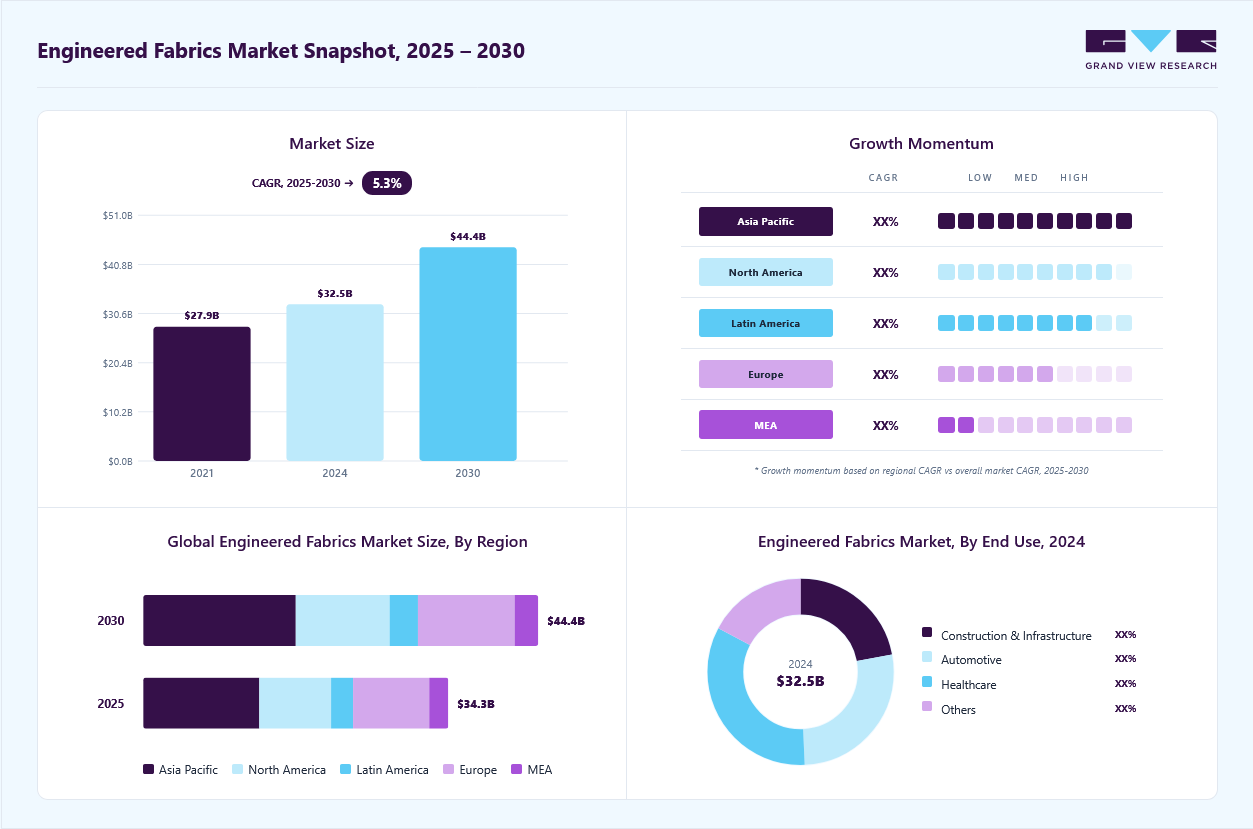
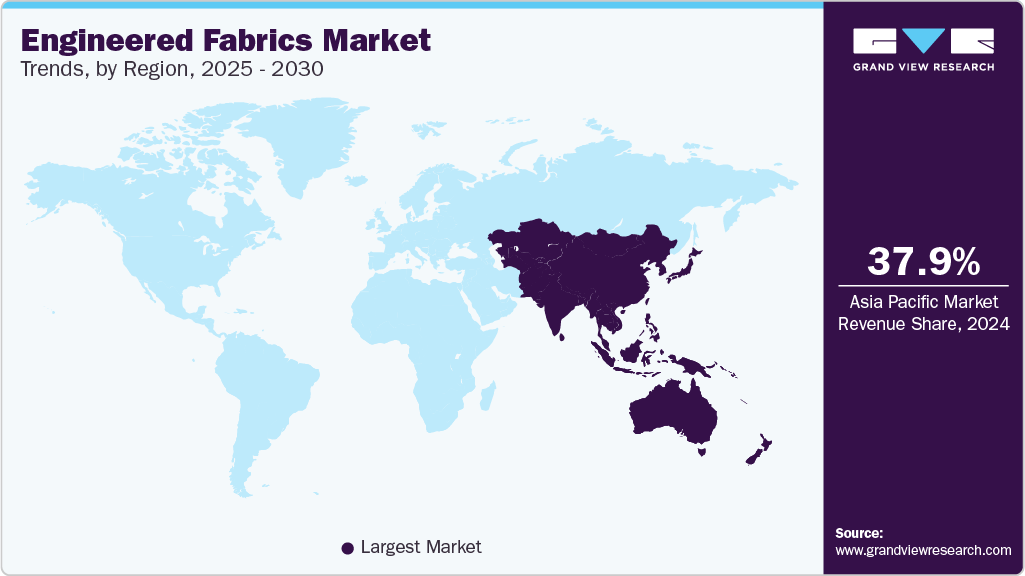
The global engineered fabrics market size was valued at USD 32.5 billion in 2024 and is projected to grow from USD 36.0 billion in 2026 to USD 44.4 billion by 2030, at a CAGR of 5.3% from 2025 to 2030. Asia Pacific dominated the market, accounting for a revenue share of 37.9% in 2024 This growth driven by their versatile applications across industries such as healthcare, automotive, construction, and personal care.
Key Market Trends & Insights
- China engineered fabrics market leads in the Asia Pacific region and is a global powerhouse in engineered fabric production.
- Based on material, the polypropylene segment led the market and accounted for the largest revenue share of 39.2% in 2024.
- Based on end-use, the healthcare segment dominated the market and accounted for the largest revenue share of 33.4% in 2024.
Market Size & Forecast
- 2024 Market Size: USD 32.54 Billion
- 2030 Projected Market Size: USD 44.36 Billion
- CAGR (2025-2030): 5.3%
- Asia Pacific: Largest market in 2024
These fabrics offer advanced properties such as high strength, durability, breathability, and resistance to chemicals and moisture, making them ideal for use in medical textiles, geotextiles, filtration systems, and hygiene products.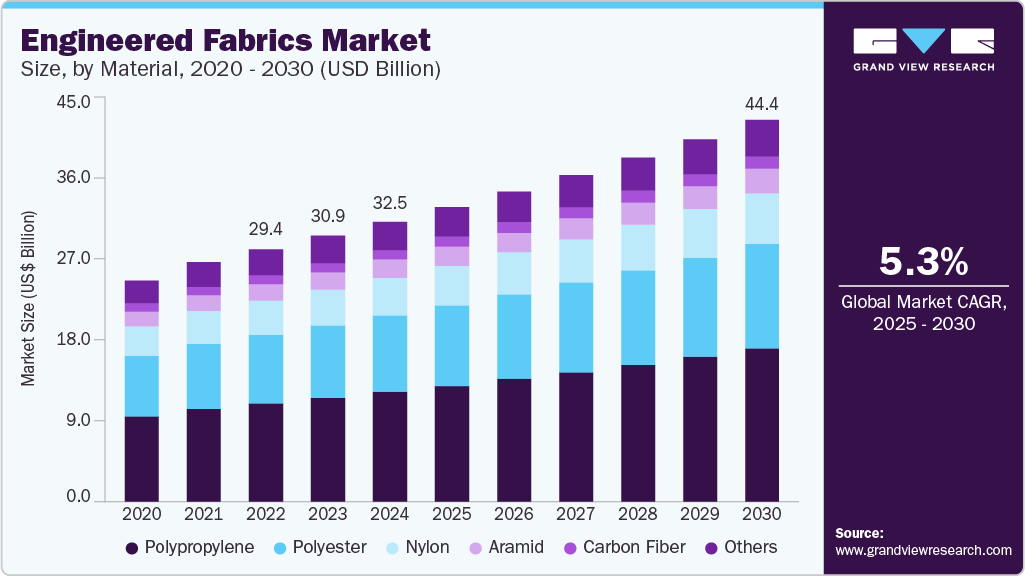
In addition, growing environmental awareness has spurred the development of sustainable and biodegradable variants, further driving their adoption in both industrial and consumer markets. The rising demand for engineered fabrics is primarily driven by their expanding use in sectors such as healthcare, automotive, and construction. In healthcare, the need for high-performance medical textiles such as surgical gowns, masks, and wound dressings has surged, especially after the COVID-19 pandemic. In the automotive and construction sectors, engineered fabrics contribute to lightweighting, insulation, and enhanced durability, aligning with trends toward energy efficiency and sustainability. In addition, increasing urbanization and infrastructure development, coupled with consumer preference for functional, durable, and hygienic products, continue to boost demand globally.
Innovation in engineered fabrics is centered around enhancing functionality while incorporating sustainability. Advanced manufacturing techniques, such as nanotechnology and 3D weaving, are enabling the creation of fabrics with improved strength, thermal regulation, and antimicrobial properties. The development of smart textiles engineered fabrics embedded with sensors or responsive materials is opening new possibilities in healthcare monitoring and wearable technology. Furthermore, manufacturers are investing in eco-friendly materials, including biodegradable polymers and recycled fibers, to address environmental concerns and regulatory requirements, paving the way for next-generation engineered fabrics that are both high-performing and sustainable.
Market Concentration & Characteristics
The engineered fabrics market is moderately concentrated, with a mix of global players and specialized regional manufacturers. Leading companies such as DuPont, Berry Global, Freudenberg Group, and Ahlstrom-Munksjö dominate due to their strong R&D capabilities, wide product portfolios, and established supply chains. These firms often form strategic partnerships and invest in innovation to maintain a competitive edge. However, regional players are gaining traction by offering cost-effective solutions tailored to local demands. Despite the dominance of key players, the market remains dynamic, with opportunities for new entrants driven by technological advancements and niche applications.
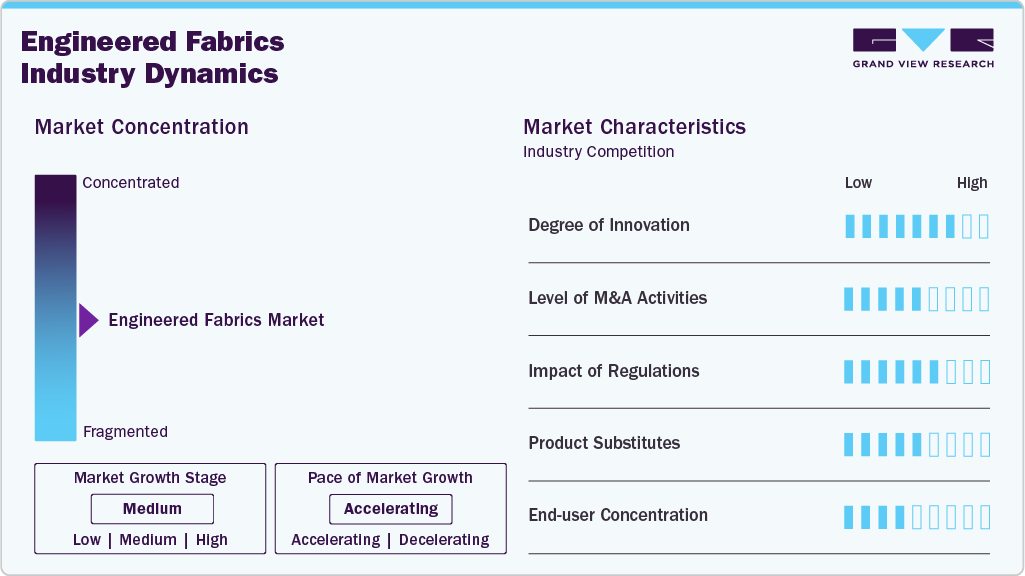
While engineered fabrics offer unique performance characteristics, they face competition from traditional materials such as woven textiles, plastics, and paper-based products in certain applications. For instance, in packaging, paper and biodegradable plastics are emerging as alternatives due to growing environmental concerns. In apparel and hygiene products, natural fibers like cotton sometimes serve as substitutes, especially in markets prioritizing comfort and sustainability. However, the superior durability, functionality, and customizability of engineered fabrics often give them an edge over these substitutes, particularly in high-performance and specialized industrial uses.
Material Insights
The polypropylene segment led the market and accounted for the largest revenue share of 39.2% in 2024, driven by its excellent balance of performance, cost-effectiveness, and versatility. It offers key properties such as high chemical resistance, low moisture absorption, light weight, and good mechanical strength, making it ideal for a wide range of applications from medical and hygiene products to automotive and industrial uses. In addition, polypropylene is easy to process using methods such as meltblown and spunbond techniques, which are widely adopted in nonwoven fabric production. Its recyclability and adaptability to both disposable and durable end-use products further reinforce its dominance in the market.
Polyester is experiencing accelerated growth in the engineered fabrics market due to its exceptional versatility, affordability, and adaptability to evolving consumer and industrial demands. Its inherent properties such as wrinkle resistance, durability, and moisture-wicking capabilities make it ideal for a wide range of applications, from everyday clothing to activewear and home furnishings. The rise of fast fashion and active lifestyles has further propelled its demand, as consumers seek functional and stylish apparel at accessible price points. In addition, advancements in recycling technologies have bolstered the appeal of recycled polyester, aligning with global sustainability trends and reducing reliance on virgin materials. The Asia Pacific region, particularly countries such as China and India, plays a pivotal role in this growth, driven by robust textile manufacturing infrastructures, expanding middle-class populations, and supportive governmental policies. As a result, polyester's market share continues to expand, positioning it as a leading material in the engineered fabrics industry.
End-use Insights
The healthcare segment dominated the market and accounted for the largest revenue share of 33.4% in 2024, driven by the high demand for medical-grade nonwovens used in products such as surgical gowns, masks, drapes, and wound care materials. This demand surged significantly during the COVID-19 pandemic and continues to remain elevated due to heightened hygiene awareness and stringent infection control practices. Engineered fabrics offer essential properties such as barrier protection, breathability, and disposability, making them ideal for healthcare environments. In addition, the ongoing growth of aging populations and increased healthcare spending globally further contribute to the sector’s dominant share in the market.
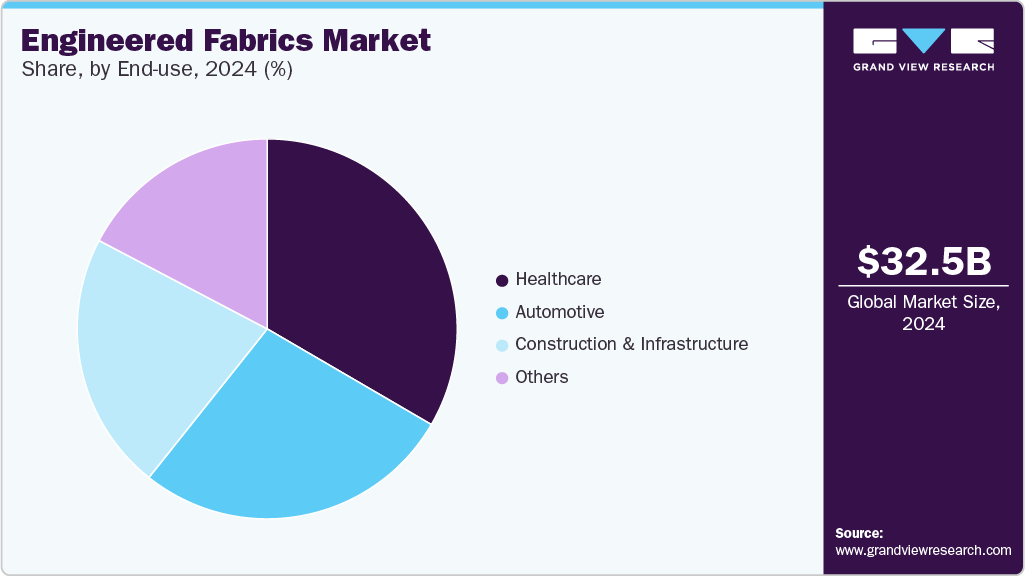
The automotive sector is emerging as one of the faster growing segments, driven by the increasing demand for lightweight, durable, and high-performance materials. Engineered fabrics are used in interior components, insulation, headliners, seat covers, and cabin air filters, helping manufacturers reduce vehicle weight and improve fuel efficiency. As electric vehicle (EV) adoption rises and automakers focus on sustainability and passenger comfort, the use of advanced nonwoven and composite fabrics is expanding rapidly. Moreover, the push for enhanced aesthetics and acoustic performance in vehicles supports the accelerated growth of engineered fabrics in this sector.
Regional Insights
Asia Pacific dominated the market and accounted for the largest revenue share of about 37.9% in 2024, driven by its strong manufacturing base, abundant raw materials, and high demand across end use industries such as healthcare, automotive, construction, and hygiene. Countries such as China, India, and Japan are key contributors, benefiting from cost-effective production, large-scale industrial infrastructure, and growing consumer markets. Rapid urbanization, expanding healthcare sectors, and government initiatives supporting industrial textiles further bolster growth. In addition, Asia Pacific is a hub for both export and domestic consumption, making it the largest and most dynamic regional market for engineered fabrics.
China Engineered Fabrics Market Trends
China engineered fabrics market leads in the Asia Pacific region and is a global powerhouse in engineered fabric production, driven by its extensive textile industry, low-cost labor, and strong export capabilities. The country’s dominance is supported by rising domestic demand in healthcare, automotive, and construction sectors, alongside government incentives promoting advanced material development. Investments in smart manufacturing and environmentally sustainable production are also positioning China at the forefront of innovation in engineered fabrics.
North America Engineered Fabrics Market Trends
North America holds a significant share in the engineered fabrics market, fueled by advanced technological capabilities, high-quality standards, and strong demand from healthcare, automotive, and industrial sectors. The region’s focus on R&D and innovation drives the development of high-performance fabrics with specialized properties. Strict regulatory frameworks and consumer emphasis on safety, hygiene, and sustainability continue to support growth, especially in applications such as medical textiles and protective apparel.
The U.S. is the largest contributor to the North American engineered fabrics market, characterized by its robust healthcare infrastructure, mature automotive industry, and strong presence of global manufacturers. The demand for nonwoven fabrics used in surgical products, filtration, and hygiene items remains high. Furthermore, U.S. companies are leading in the development of smart and eco-friendly fabrics, supported by significant investments in R&D and growing awareness of environmental impact.
Europe Engineered Fabrics Market Trends
Europe is a mature and innovation-driven market for engineered fabrics, with strong demand in automotive, hygiene, and construction applications. The region’s strict environmental and safety regulations have pushed manufacturers toward sustainable and high-performance fabric solutions. Technological advancements, coupled with government support for green initiatives and smart textiles, are driving continued innovation in the market. The presence of established players and a focus on circular economy practices further enhance Europe’s position in the global engineered fabrics landscape.
Germany engineered fabrics market plays an important role in Europe owing to its leadership in technical textiles and automotive manufacturing. The country’s emphasis on precision engineering, quality, and innovation has made it a hub for high-performance engineered fabric development. Demand is strong across sectors such as mobility, healthcare, and industrial filtration. German manufacturers are also at the forefront of integrating sustainability and smart technologies into fabric design and production.
Central & South America Engineered Fabrics Market Trends
Central & South America is an emerging market for engineered fabrics, with growing demand fueled by expanding healthcare services, infrastructure development, and rising hygiene awareness. Countries such as Brazil and Mexico are leading the regional adoption, driven by urbanization and government investments in public health and construction. Although the region faces challenges such as economic instability and supply chain limitations, the long-term outlook remains positive due to increasing consumer demand for functional and affordable materials.
Middle East & Africa Engineered Fabrics Market Trends
The Middle East & Africa region is witnessing gradual growth in the engineered fabrics market, driven by infrastructural development, healthcare expansion, and rising disposable incomes. Countries such as the UAE and South Africa are investing in modernizing their medical and industrial sectors, creating new opportunities for nonwoven and technical fabrics. While market penetration remains relatively low compared to other regions, growing awareness and improving import-export networks are expected to support future growth in the region.
Key Engineered Fabrics Company Insights
Some of the key players operating in market include DuPont, Freudenberg Performance Materials
-
DuPont is a global leader in advanced materials and specializes in engineered fabrics such as Tyvek and Sontara, widely used in medical, protective apparel, and industrial applications. Its products are known for high durability, breathability, and barrier protection.
-
A division of Germany’s Freudenberg Group, this company is a key player in technical textiles and nonwovens. It supplies engineered fabrics for automotive interiors, medical textiles, construction, and filtration, with a strong focus on sustainability and innovation.
Kimberly-Clark Corporation, Ahlstrom are some of the emerging market participants in engineered fabrics market.
-
Known for its hygiene and healthcare products, Kimberly-Clark manufactures high-quality nonwoven fabrics used in diapers, feminine care, surgical gowns, and masks. The company emphasizes comfort, absorbency, and safety in its engineered fabric solutions.
-
Ahlstrom is a leading supplier of fiber-based materials, producing engineered fabrics for medical, filtration, food packaging, and industrial uses. It focuses on sustainability, offering biodegradable and eco-friendly nonwovens to meet growing regulatory and consumer demands.
Key Engineered Fabrics Companies:
The following are the leading companies in the engineered fabrics market. These companies collectively hold the largest market share and dictate industry trends.
- DuPont
- Freudenberg Performance Materials
- Kimberly-Clark Corporation
- Ahlstrom
- Berry Global Inc.
- Toray Industries, Inc.
- MEHLER ENGINEERED PRODUCTS GMBH
- Emtexglobal USA
- Johns Manville
- Avgol Nonwovens
Recent Developments
-
In October 2024, Trelleborg launched Dartex END464-E fabric at the Healthcare Design (HCD) Conference + Expo in Indianapolis. This fabric is designed for healthcare seating, that offers durability and resistance to harsh chemical cleaning agents. It is certified to the Global Recycled Standard, aligning with sustainability goals.
-
In April 2024, Avient showcased its high-performance engineered fiber solutions, called Dyneema, known as the world's strongest fiber. These materials are utilized in applications ranging from protective clothing and workwear to synthetic ropes and cables, offering high strength-to-weight ratios and resistance to various environmental factors.
Engineered Fabrics Market Report Scope
Report Attribute
Details
Market size in 2024
USD 32.5 billion
Estimated Market size in 2026
USD 36.0 billion
Projected Market size by 2030
USD 44.4 billion
Growth rate
CAGR of 5.3% from 2025 to 2030
Base year for estimation
2024
Historical data
2018 - 2023
Forecast period
2025 - 2030
Quantitative units
Revenue in USD million/billion and CAGR from 2025 to 2030
Report coverage
Revenue forecast, company ranking, competitive landscape, growth factors, and trends
Segments covered
Material, end-use, region
Regional scope
North America; Europe; Asia Pacific; Central & South America; Middle East & Africa
Country scope
U.S.; Canada; Mexico; UK; Germany; France; Italy; Spain; China; India; Japan; South Korea
Key companies profiled
DuPont; Freudenberg Performance Materials; Kimberly-Clark Corporation; Ahlstrom; Berry Global Inc.; Toray Industries, Inc.; MEHLER ENGINEERED PRODUCTS GMBH; Emtexglobal USA; Johns Manville; Avgol Nonwovens
Customization scope
Free report customization (equivalent up to 8 analysts’ working days) with purchase. Addition or alteration to country, regional & segment scope.
Pricing and purchase options
Avail customized purchase options to meet your exact research needs. Explore purchase options
Global Engineered Fabrics Market Report Segmentation
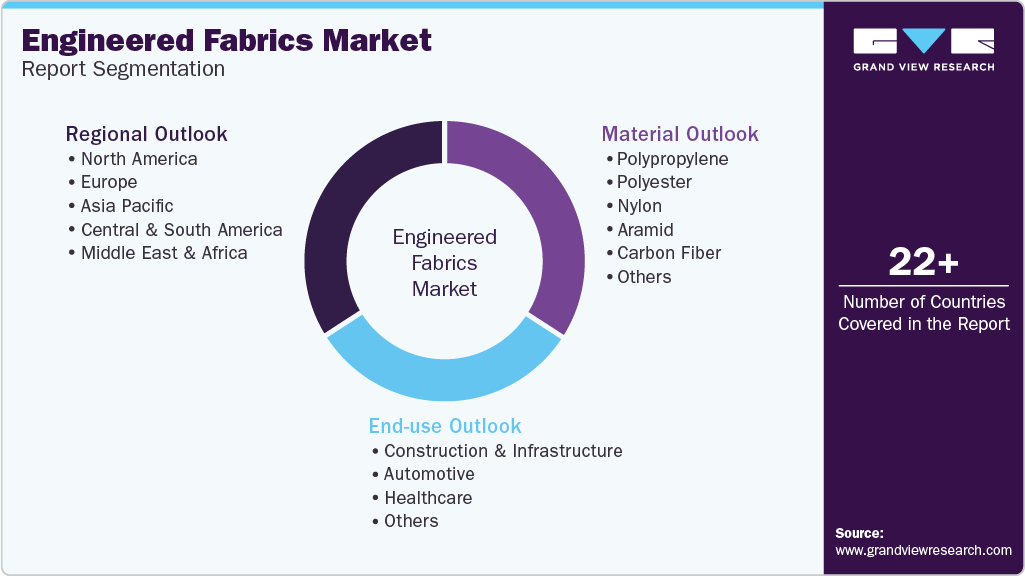
This report forecasts revenue growth at global, regional, and country levels and provides an analysis of the latest industry trends in each of the sub-segments from 2018 to 2030. For this study, Grand View Research has segmented the global engineered fabrics market report based on material, end-use and region.
-
Material Outlook (Revenue, USD Million, 2018 - 2030)
-
Polypropylene
-
Polyester
-
Nylon
-
Aramid
-
Carbon Fiber
-
Others
-
-
End-use Outlook (Revenue, USD Million, 2018 - 2030)
-
Construction & Infrastructure
-
Automotive
-
Healthcare
-
Others
-
-
Regional Outlook (Revenue, USD Million, 2018 - 2030)
-
North America
-
U.S.
-
Canada
-
Mexico
-
-
Europe
-
Germany
-
UK
-
France
-
Italy
-
Spain
-
-
Asia Pacific
-
China
-
Japan
-
India
-
South Korea
-
-
Central & South America
-
Middle East & Africa
-
Frequently Asked Questions About This Report
The global engineered fabrics market size was valued at USD 32.5 billion in 2024 and is projected to grow from USD 36.0 billion in 2026.
The global engineered fabrics Market is expected to grow at a compound annual growth rate of 5.3% from 2025 to 2030 to reach USD 44.4 billion by 2030.
The polypropylene segment led the market and accounted for the largest revenue share of 39.2% in 2024, driven by its low cost, lightweight nature, and excellent mechanical and chemical resistance, making it ideal for high-volume applications.
DuPont, Freudenberg Performance Materials, Kimberly-Clark Corporation, Ahlstrom, Berry Global Inc., Toray Industries, Inc., MEHLER ENGINEERED PRODUCTS GMBH, Emtexglobal USA, Johns Manville, and Avgol Nonwovens are prominent companies in the Engineered Fabrics Market.
Key factors driving the market include rising demand from healthcare and automotive sectors, growing focus on sustainability, and advancements in nonwoven fabric technologies.
About the Author(s)
Advanced Interior Materials Research Team
Advanced Materials · Advanced Interior MaterialsThis report was authored by the advanced interior materials research team at Grand View Research - comprising two research analysts, one senior research analyst, and one industry expert - with specialized expertise in the advanced interior materials segment of the advanced materials industry. All findings are based on proprietary advanced materials databases, executive interviews, and regulatory analysis, subject to internal peer review prior to publication.
Last Updated:
Speak to Analyst


Customize this report to your needs — add regions, segments, or data points, with 20% free customization.
Or view our licence options:


ISO 9001:2015 & 27001:2022 Certified
We are GDPR and CCPA compliant! Your transaction & personal information is safe and secure. For more details, please read our privacy policy.


