
- Home
- »
- Next Generation Technologies
- »
-
Esports Market Size, Share & Growth Report, 2026-2033GVR Report cover

Esports Market (2026 - 2033)
Size, Share & Trends Analysis Report By Revenue Source (Sponsorship, Advertising, Merchandise & Tickets, Media Rights, Publisher Fees), By Streaming (On-demand, Live Streaming), By Region, And Segment Forecasts
Market Size, 2025
$2.6BMarket Estimate, 2026
$3.3BMarket Forecast, 2033
$13.3BCAGR, 2026–2033
22.2%Esports Market Summary
The global esports market size was valued at USD 2.6 billion in 2025 and is projected to grow from USD 3.3 billion in 2026 to USD 13.3 billion by 2033, growing at a CAGR of 22.2% from 2026 to 2033. North America dominated the global market with the largest revenue share of 35.3% in 2025. The market is driven by the growing popularity of competitive gaming, rising investment from game publishers and tournament organizers, and increasing viewership across live-streaming platforms. The expanding ecosystem of professional leagues, sponsorships, media rights, and digital engagement enhances audience participation, strengthens monetization opportunities, supports the expansion of global tournaments, and accelerates market growth.
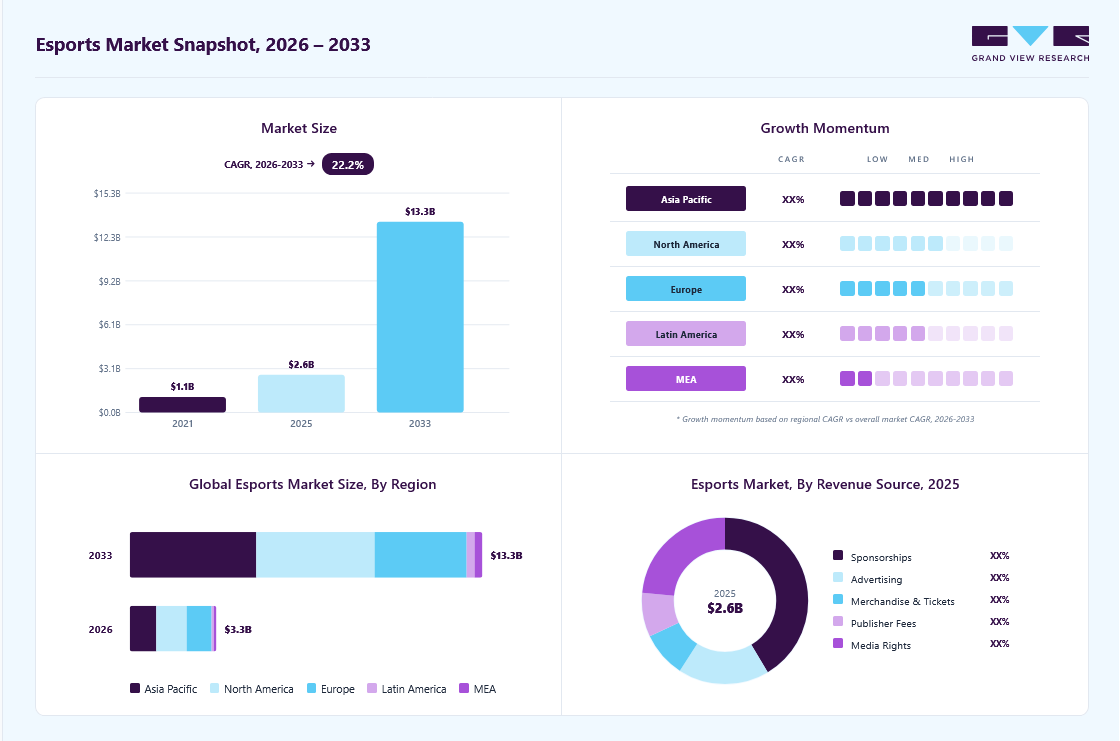 Source: Grand View Research, IR Documents, Primary Interviews, Paid DatabasesTo learn more about this report,
 Download Free Sample Report
Key Market Trends & Insights
- By revenue source: Sponsorship segment held the largest market share of 41.5% in 2025.
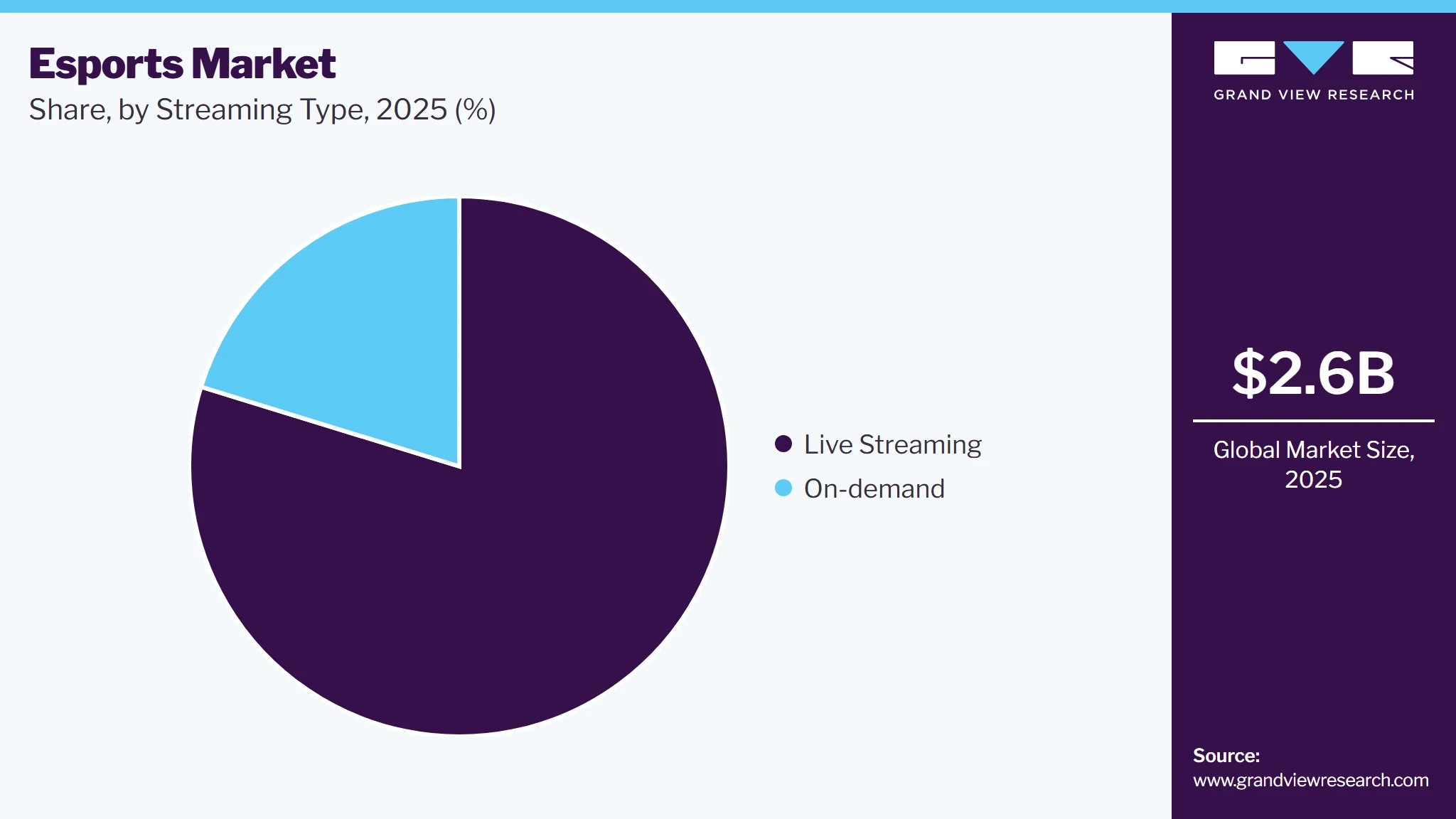
- By streaming: Live streaming segment accounted for the largest market share of 78.3% in 2025.
Regional Highlights
- Largest regional market: North America (35.3% revenue share in 2025)
- Fastest growing regional market: Asia Pacific (highest CAGR 25.0%, 2026-2033)
- By Country: The U.S. held the largest market share in 2025.
Market Size & Forecast
- Market size in 2025: USD 2.6 Billion
- Estimated market size in 2026: USD 3.3 Billion
- Projected market size by 2033: USD 13.3 Billion
- CAGR (2026-2033): 22.2%
Prism AI by Grand View Research Free to tryAsk a question about the esports marketTry asking✓Every figure cited from GVR research Prefer the report? Download free sample →The growing popularity of mobile gaming and the widespread availability of high-speed internet have significantly contributed to increased esports participation and viewership. Moreover, strategic partnerships between game developers and esports organizations, coupled with the rising adoption of cloud gaming platforms, are expected to further fuel the growth of the esports industry in the coming years.
The growing trend of live streaming is significantly transforming the esports industry, with an increasing number of gamers and fans engaging with content on platforms such as Twitch Interactive Inc. and YouTube, LLC. This surge in streaming activity enhances visibility and extends audience reach while facilitating real-time interaction between players and viewers. The interactive nature of these platforms strengthens viewer engagement and contributes to the development of dedicated fan communities, thereby supporting sustained esports industry growth.
 To learn more about this report, Download Free Sample Report
In addition, substantial investments from global stakeholders fuel the esports ecosystem's development. Venture capitalists, media companies, and major brands recognize the lucrative potential of esports and are investing in infrastructure, content creation, and talent development. These formidable investments are accelerating the commercialization and professionalization of esports, thrusting the market forward.
Market Dynamics
The esports market is experiencing strong growth, driven by expanding global gaming audiences, increasing investments in professional esports ecosystems, and rising demand for interactive digital entertainment. Growing expenditure on franchise-based leagues, tournament infrastructure, gaming arenas, and creator-driven content is accelerating the development of competitive gaming worldwide. The integration of advanced broadcasting technologies, AI-powered analytics, cloud gaming, 5G connectivity, and cross-platform multiplayer experiences enhances fan engagement, tournament accessibility, player performance analysis, and revenue generation, creating significant long-term opportunities for the global esports market.
Growing financial support from game publishers, media companies, venture capital firms, and non-endemic brands is strengthening the professional competitive gaming ecosystem. Investments are expanding league structures, prize pools, event production quality, training facilities, and player development programs. These initiatives attract skilled participants, improve spectator experiences, and increase commercial opportunities across sponsorship, advertising, media rights, and merchandise.
The expansion of dedicated esports arenas, franchise-based competitions, and international championships is encouraging broader participation from teams, broadcasters, and commercial partners. Advanced event production technologies, multilingual streaming, and enhanced digital engagement are improving audience reach across global markets. As organizations continue to invest in premium competitive experiences, the ecosystem becomes more sustainable, supporting higher viewer retention and stronger long-term commercial value.
A significant share of esports revenue continues to rely on sponsorship agreements, advertising partnerships, and media-related income, creating financial vulnerability during periods of reduced marketing expenditure. Economic uncertainty often leads brands to reassess promotional budgets, affecting tournament funding, team operations, and event scale. This dependence limits revenue diversification for many organizations operating within the competitive gaming ecosystem.
Many professional teams and tournament organizers are still developing sustainable business models beyond sponsorship income. Revenue from ticket sales, digital subscriptions, merchandise, and premium content remains inconsistent across different regions and competitions. Limited diversification can reduce financial stability, making organizations more susceptible to fluctuations in advertiser demand, changing consumer preferences, and competitive pressures from other digital entertainment formats.
The rapid adoption of smartphones, affordable internet access, and high-performance mobile devices is creating new opportunities for competitive gaming across emerging economies. Mobile-first tournaments are attracting millions of participants and viewers by lowering hardware barriers while expanding access to organized competitions. This broader accessibility enables publishers and tournament organizers to reach previously underserved player communities.
Advancements in cloud gaming, low-latency mobile networks, and integrated streaming capabilities are improving the quality of competitive mobile gameplay. Publishers are introducing dedicated esports formats, regional leagues, and community tournaments designed specifically for mobile titles. These developments are increasing audience participation, encouraging new sponsorship opportunities, and enabling organizers to expand competitive ecosystems across diverse geographic markets.
Market Concentration & Characteristics
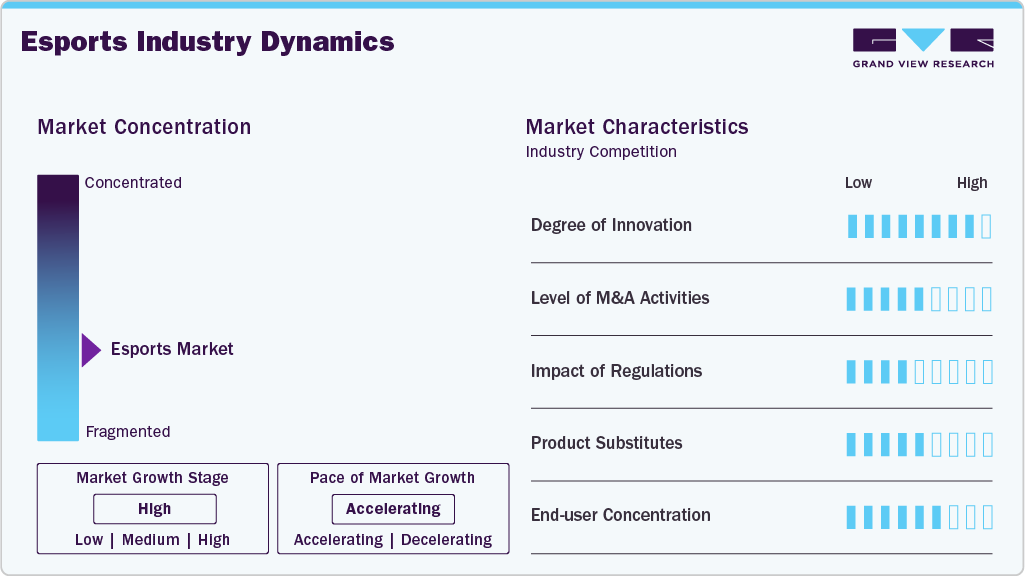
The esports market is fragmented, with leading game publishers, tournament organizers, esports organizations, streaming platforms, media companies, and technology providers competing across professional leagues, online tournaments, collegiate competitions, and mobile esports ecosystems. Rising investments in competitive gaming infrastructure, digital content creation, and fan engagement are driving market expansion. Companies are strengthening their competitive positions through strategic partnerships, media rights agreements, tournament expansion, platform integration, and continuous investments in artificial intelligence, cloud gaming, advanced broadcasting technologies, real-time analytics, and immersive audience engagement solutions.
 To learn more about this report, Download Free Sample Report
The market is characterized by a high degree of innovation, supported by continuous advancements in cloud gaming, AI-powered player analytics, interactive live streaming, virtual production technologies, cross-platform gameplay, and immersive spectator experiences. Merger and acquisition activity remains moderate as companies expand content portfolios, strengthen streaming capabilities, and enhance tournament operations. Regulatory impact is moderate, driven by evolving online gaming regulations, player welfare policies, data privacy requirements, and esports governance standards across different regions. The threat of product substitutes remains high, as traditional sports, casual gaming, video streaming platforms, and other digital entertainment offerings compete for consumer attention and engagement.
Analyst Perspective
The esports market is experiencing substantial expansion, driven by the growing popularity of competitive gaming, rising investment from publishers, sponsors, and media companies, and the rapid evolution of digital entertainment ecosystems. The growing adoption of cloud gaming, AI-powered performance analytics, interactive live streaming, advanced tournament management platforms, and low-latency network technologies is enhancing player experiences, audience engagement, and event accessibility. Organizations are increasingly focusing on franchise-based leagues, creator-driven content, and cross-platform competitions to strengthen fan loyalty and diversify revenue streams. Market participants are well-positioned to leverage emerging opportunities, reinforcing long-term market expansion and sustainable commercial value across the global competitive gaming ecosystem.
Revenue Source Insights
Based on revenue source, the sponsorships segment led the market with the largest revenue share of 41.5% in 2025 and is expected to grow at a considerable CAGR over the forecast period. Booths, interactive advertising, posters, freebies, video displays, and other creative methods enable the brand to target potential customers. The increasing competition in the sponsorship industry has led brands to seek differentiation and authenticity through sponsorships in the esports and gaming industry. Many non-endemic brands entered eSports on familiar ground through a digital extension of traditional sponsorship relationships, thereby strengthening the dominance of this segment.
The media rights segment is projected to grow at a CAGR of over 25.0%, emerging as a key revenue driver in the market. This growth is fueled by rising demand for exclusive broadcasting deals, increasing viewership, and strategic partnerships with streaming platforms. Traditional sports networks and tech companies are investing heavily, drawn by esport’s appeal to younger audiences and advanced streaming technologies that enhance content delivery and viewer engagement.
Streaming Insights
Based on streaming, the live streaming segment dominated the market with the largest revenue share of 78.3% in 2025, driven by increasing demand for real-time esports content, enhanced viewer interaction, and substantial investments in streaming infrastructure. The widespread adoption of platforms such as Twitch and YouTube, combined with rising audience engagement and global accessibility, continues to strengthen the segment’s position as a key contributor to market growth.
 To learn more about this report, Download Free Sample Report
The on-demand segment is expected to witness significant CAGR from 2025 to 2033, driven by the rising popularity of game streaming, increasing mobile access, and demand for flexible, user-driven content. Improved internet infrastructure, expanding global viewership, and availability of diverse platforms further accelerate the growth of this segment within the market.
Regional Insights
North America dominated the Esports market with the largest revenue share of 35.3% in 2025, primarily driven by the region's focus on technological innovation and digital infrastructure. The widespread adoption of high-speed internet and 5G connectivity enhances streaming quality and viewer engagement, supporting the growth of esports platforms. Additionally, integrating esports programs in educational institutions and establishing dedicated gaming venues further solidify North America's leadership in the market.
 To learn more about this report, Download Free Sample Report
U.S. Esports Market Trends
The Esports market in the U.S. held the largest share in the North America region in 2025, driven by the country's strong focus on innovation and technological advancement. Additionally, the expansion of high-tech training facilities, increased investment in intellectual esports programs, and the concentration of professional leagues and tournaments contribute to the rising demand for esports infrastructure and services in the U.S. The growing involvement of traditional sports organizations and media companies further accelerates market development.
Europe Esports Market Trends
The Europe esports industry is expected to grow significantly from 2025 to 2033, driven by several key factors. The region's advanced digital infrastructure and widespread high-speed internet access facilitate seamless online gaming experiences. Additionally, the increasing popularity of mobile-friendly games attracts a diverse demographic, expanding the player base. Investments in esports infrastructure, such as arenas and gaming centers, by both private and public sectors, further propel market growth. Moreover, integrating virtual reality (VR) and augmented reality (AR) technologies enhances spectator experiences, making esports more immersive and appealing. European educational institutions also contribute by offering esports-related courses and degree programs, thereby cultivating a skilled workforce to support the industry's expansion.
The UK esports market is expected to grow at the highest rate in the coming years, supported by a robust digital infrastructure, widespread smartphone adoption, and a strong online gaming culture. The country's active gaming community and increasing integration of brand sponsorships into esports tournaments and teams are further propelling market expansion. Additionally, the UK's position as a hub for international esports competitions enhances its global appeal and contributes to sustained esports industry growth.
The market for esports in France is fueled by the country's strong digital infrastructure, high internet penetration, and a dynamic gaming community supporting grassroots and professional-level competitions. Government-backed initiatives, including developing a national esports strategy and introducing esports-specific visas, aim to attract international talent and position France as a global esports hub. Additionally, esports have been integrated into mainstream media, such as national broadcasts of major tournaments and the active participation of prominent French teams. These factors contribute to the sustained growth and professionalization of the country's esports sector.
Asia Pacific Europe Esports Market Trends
The Asia Pacific esports industry is expected to grow at the highest CAGR from 2025 to 2033, driven by rapid digital transformation, rising mobile gaming adoption, and strong institutional backing. The region is experiencing significant growth in competitive gaming due to widespread smartphone penetration, expanding internet access, and increasing popularity of mobile-first esports titles. Additionally, a growing youth population with strong digital engagement and rising sponsorship deals and brand partnerships further accelerate market development in Asia Pacific.
The Japan esports market is gaining traction, fueled by a strong gaming culture, government support, and strategic collaborations. Eased regulations, integration into education, and advanced infrastructure promote professional leagues and talent development. These factors collectively contribute to the sustained expansion of Japan's esports market, positioning it as a significant player in the global esports industry.
The market for esports in India is witnessing significant growth, owing to its large, digitally literate youth population, widespread smartphone penetration, and affordable data access. Government initiatives to expand digital infrastructure and recognize esports as a legitimate industry further boost its development. Additionally, increased investment, rising popularity of mobile gaming, and the emergence of organized tournaments create a supportive environment for sustained market expansion across the country.
Key Esports Company Insights
Some of the key players operating in the market include Activision Blizzard, Inc., and Tencent Holding Limited.
-
Activision Blizzard, Inc. is a developer and publisher of interactive entertainment content, and it is prominent for iconic franchises like Call of Duty, World of Warcraft, and Overwatch. The company delivers immersive gaming experiences across console, PC, and mobile platforms. With a strong presence in esports and digital distribution, the company leverages cutting-edge technology, live services, and global reach to engage Billions of players worldwide, driving innovation in the gaming industry.
-
Tencent Holding Limited is a technology and entertainment company specializing in social networking, gaming, digital content, and cloud services. Through subsidiaries like Riot Games and investments in numerous gaming studios, it is a major player in the esports and online gaming industry. With a strong digital ecosystem, Tencent integrates AI, cloud computing, and big data to enhance user engagement. Its vast international presence and strategic innovation make it a dominant force in the digital economy.
Cloud9 Esports and G Esports Holding GmbH are some emerging market participants in the esports industry.
-
Cloud9 Esports is an American esports organization based in Santa Monica, California. It operates competitive teams in titles such as League of Legends, Valorant, and Counter-Strike. The organization participates in professional leagues and international tournaments, contributing to the growing commercialization of esports. Cloud9 is part of an industry driven by rising global viewership, increasing brand investments, advanced streaming technologies, and expanding tournament infrastructure that support continued market growth.
-
G2 Esports is an emerging esports organization that has built a strong brand around its competitive teams in games such as League of Legends, CS: GO, and Valorant. The organization focuses on content creation, fan engagement, and participation in international competitions, which has helped it gain significant influence in the market. G2’s strategic approach to team building and branding, and its international presence have positioned it as a rising powerhouse in the esports industry.
Key Esports Companies
The following key companies have been profiled for this study on the esports market.
-
Activision Blizzard, Inc.
-
Electronic Arts Inc.
-
Gameloft SE
-
HTC Corporation
-
Intel Corporation
-
Modern Times Group (MTG)
-
Nintendo of America Inc.
-
NVIDIA Corporation
-
Tencent Holding Limited
-
Valve Corporation
-
Cloud9 Esports
-
G Esports Holding GmbH.
Competitive Benchmarking
Category
Operating Strategies
Competitive Edge
Weakness
Established Players (Activision Blizzard, Inc., Tencent Holding Limited, Gameloft SE)
- Focus on expanding global tournament ecosystems through publisher collaborations, media partnerships, and regional league development.
- Invest heavily in streaming technologies, player development, and fan engagement to strengthen competitive ecosystems.
- Strong global brand recognition, exclusive game portfolios, and extensive commercial partnership networks ensure leadership.
- Ability to deliver large-scale tournaments, premium broadcasts, and integrated digital experiences across global audiences.
- Dependence on flagship game titles increases exposure to changing player preferences and market trends.
- Large organizational structures can delay innovation and reduce flexibility in rapidly evolving competitive gaming ecosystems.
Emerging Players (Valve Corporation
, Cloud9 Esports
, G Esports Holding GmbH.)
- Emerging players focus on expanding regional tournaments through creator partnerships, community engagement, and localized competitive gaming events.
- Invest in mobile esports platforms, innovative fan experiences, and digital content to accelerate market presence.
- Agile operating models enable rapid innovation, localized engagement, and faster adaptation to evolving gaming trends.
- Strong community relationships and niche tournament offerings attract dedicated audiences across emerging esports markets.
- Limited financial resources restrict large-scale tournament expansion, international reach, and premium broadcast capabilities.
- Lower brand recognition reduces sponsorship opportunities and competitive positioning against established esports organizations.
Recent Developments
-
In April 2025, Nintendo highlighted its esports initiatives during a Nintendo Switch 2 Direct event, introducing new IPs and enhancing Splatoon with esports features like improved matchmaking and live streaming integration. This expansion aims to tap into the growing competitive gaming market, strengthening Nintendo's position in esports through strategic partnerships and global audience engagement.
-
In April 2025, Modern Times Group (MTG) announced the acquisition of Plarium, a leading gaming studio. This strategic move aims to strengthen MTG's position in the gaming industry by expanding its portfolio and enhancing its direct-to-consumer platform, Plarium Play.
-
In March 2025, Gameloft launched a new mobile esports platform for Asphalt 9: Legends, focusing on community-driven tournaments and competitive play. This initiative aims to enhance the mobile esports ecosystem and attract a larger audience by offering regular in-app events, live streaming, and player rewards.
Esports Market Report Scope
Report Attribute
Details
Market size in 2025
USD 2.6 billion
Estimated market size in 2026
USD 3.3 billion
Projected market size by 2033
USD 13.3 billion
Growth rate
CAGR of 22.2% from 2026 to 2033
Base year for estimation
2025
Historical data
2021 - 2024
Forecast period
2026 - 2033
Quantitative units
Revenue in USD million, and CAGR from 2026 to 2033
Report coverage
Revenue forecast, company ranking, competitive landscape, growth factors, and trends
Segments covered
Revenue source, streaming, region
Regional scope
North America; Europe; Asia Pacific; Latin America; MEA
Country scope
U.S.; Canada; Mexico; U.K.; Germany; France; China; Japan; India; South Korea; Australia; Brazil; Saudi Arabia; UAE; South Africa
Key companies profiled
Activision Blizzard, Inc.; Electronic Arts Inc.; Gameloft SE; HTC Corporation; Intel Corporation; Modern Times Group (MTG); Nintendo of America Inc.; NVIDIA Corporation; Tencent Holding Limited; Valve Corporation; Cloud9 Esports; G Esports Holding GmbH.
Customization scope
Free report customization (equivalent up to 8 analysts' working days) with purchase. Addition or alteration to country, regional & segment scope.
Pricing and purchase options
Avail customized purchase options to meet your exact research needs. Explore purchase options
Global Esports Market Report Segmentation
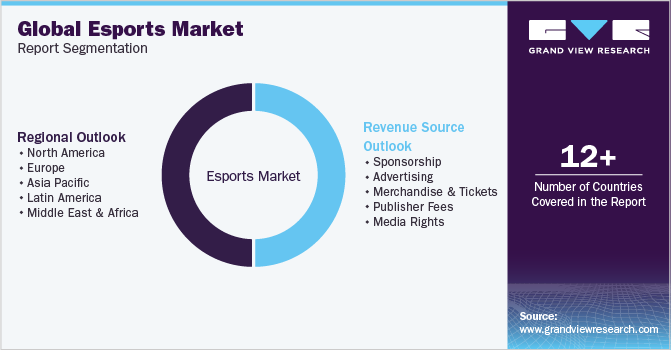
This report forecasts revenue growth at global, regional, and country levels and provides an analysis of the latest technological trends in each of the sub-segments from 2021 to 2033. For this study, Grand View Research has segmented the global esports market report based on revenue source, streaming, and region:
 To learn more about this report, Download Free Sample Report
-
Revenue Source Outlook (Revenue, USD Million, 2021 - 2033)
-
Sponsorships
-
Advertising
-
Merchandise & Tickets
-
Publisher Fees
-
Media Rights
-
-
Streaming Outlook (Revenue, USD Million, 2021 - 2033)
-
On-demand
-
Live Streaming
-
-
Regional Outlook (Revenue, USD Million, 2021 - 2033)
-
North America
-
U.S.
-
Canada
-
Mexico
-
-
Europe
-
UK
-
Germany
-
France
-
-
Asia Pacific
-
China
-
Japan
-
India
-
South Korea
-
Australia
-
-
Latin America
-
Brazil
-
-
Middle East & Africa
-
UAE
-
Saudi Arabia
-
South Africa
-
-
Research Methodology
The esports market figures in this report are based on a proven research process that combines executive interviews with secondary research from proprietary databases, company filings, and recognized regulatory and institutional sources. Market size is built through value-chain sizing - reconciling supply-side and demand-side estimates - and triangulated with bottom-up and top-down approaches. Every estimate passes multiple levels of expert validation before publication, with each esports segment quantified using the revenue-capture definitions in the table below.
Segment Definition
Segment - Revenue Source
Revenue capture definition
Sponsorships
Revenue is generated through sponsorship agreements between esports organizations, tournament organizers, teams, players, and global brands seeking visibility across competitive gaming events. This segment is driven by increasing brand investments, expanding global audiences, and rising demand for targeted digital marketing through esports platforms.
Advertising
Revenue is captured through digital advertisements displayed during live broadcasts, streaming platforms, tournament events, gaming applications, and esports-related content. This segment is propelled by growing online viewership, enhanced audience engagement, and increasing advertiser spending on interactive digital entertainment channels.
Merchandise & Tickets
Revenue is generated through sales of team merchandise, gaming accessories, event tickets, VIP experiences, and official collectibles associated with esports tournaments and organizations. This segment is driven by rising fan loyalty, expanding live event attendance, and increasing demand for branded esports products and experiences.
Publisher Fees
Revenue is captured through licensing agreements, tournament hosting fees, game publishing rights, and developer-supported esports programs that enable competitive gaming events. This segment is supported by the increasing commercialization of game titles and the expansion of publisher-led competitive ecosystems.
Media Rights
Revenue is generated through broadcasting, streaming, and content distribution rights licensed to digital platforms, television networks, and media companies covering esports competitions. This segment is driven by growing global viewership, increasing demand for exclusive live content, and expanding investments in premium esports broadcasting.
Segment – Streaming
Revenue capture definition
On-demand
Revenue is generated through recorded esports matches, tournament highlights, player content, instructional videos, and premium video-on-demand services available across digital platforms. This segment is driven by increasing demand for flexible content consumption, creator-driven engagement, and extended monetization of esports media assets.
Live Streaming
Revenue is captured through real-time broadcasts of esports tournaments, professional matches, live events, and interactive gaming content streamed across dedicated digital platforms. This segment is propelled by rising concurrent viewership, audience interaction, sponsorship opportunities, and continuous advancements in streaming technologies that enhance fan engagement.
Estimation Model
Layer No.
Layer Name
Key Question
Description
01
Ecosystem Participation Layer
Who are the primary participants?
Identifies the key stakeholders participating in the esports market, including game publishers, professional esports teams, tournament organizers, streaming platforms, sponsors, media companies, educational institutions, gaming cafés, and corporate brands investing in competitive gaming, audience engagement, digital entertainment, talent development, and global esports competitions.
02
Infrastructure Enablement Layer
What enables esports operations?
Market expansion depends on the availability of high-speed internet connectivity, cloud gaming infrastructure, advanced gaming hardware, streaming platforms, tournament management software, payment systems, cybersecurity solutions, analytics platforms, and broadcast production capabilities supporting seamless competitive gaming experiences worldwide.
03
Competition & Engagement Layer
Where are esports activities conducted?
Esports activities are conducted across professional tournaments, franchise leagues, collegiate competitions, mobile gaming championships, online multiplayer events, gaming festivals, content creator competitions, community tournaments, and international esports championships, supporting player participation, audience engagement, and competitive entertainment.
04
Monetization Layer
How is revenue generated?
Revenue is generated through tournament sponsorship agreements, advertising placements, media licensing, publisher support programs, premium digital content, event ticket sales, team merchandise, fan memberships, in-game promotional collaborations, subscription services, and commercial partnerships supporting long-term ecosystem sustainability.
Delivered Customizations
This report has been delivered with the following In-depth customizations
Client Request
Customization Delivered
Value Adds
Global Esports Tournament Ecosystem Assessment & Investment Strategy
Conducted detailed assessment of global esports tournaments, franchise leagues, publisher ecosystems, sponsorship models, prize pool structures, streaming platforms, and audience engagement metrics to identify investment opportunities and competitive positioning.
Improves investment decisions, strengthens competitive positioning, enhances audience engagement, and supports sustainable ecosystem expansion.
Esports Media Rights, Streaming Platform & Fan Engagement Analysis
Evaluated media rights agreements, live streaming platforms, multilingual broadcasting capabilities, viewer engagement tools, creator collaborations, and digital content distribution strategies to optimize audience reach, monetization, and platform performance.
Enhances media monetization, improves fan engagement, expands audience reach, and strengthens digital content strategies.
Mobile Esports Expansion & Regional Market Entry Strategy
Assessed mobile esports adoption, regional tournament ecosystems, smartphone gaming trends, publisher partnerships, infrastructure readiness, and consumer participation across emerging markets to support market entry and long-term commercial expansion.
Accelerates regional expansion, improves market penetration, strengthens partnership opportunities, and increases commercial competitiveness.
Frequently Asked Questions About This Report
The global esports market size was valued at USD 2.6 billion in 2025 and is estimated at USD 3.3 billion for 2026.
North America dominated with a 35.3% revenue share in 2025.
Key factors driving market growth include the increasing live streaming of games, enhanced infrastructure for league tournaments, growing popularity of mobile gaming, widespread availability of high-speed internet, and the rising adoption of cloud gaming platforms.
The sponsorships segment dominated with a 41.5% revenue share in 2025.
The live streaming segment dominated the market with a share of 78.3% in 2025.
The U.S. accounted for the largest share, with 73.4% of revenue in 2025.
The global esports market is expected to grow at a CAGR of 22.2% from 2026 to 2033, reaching USD 13.3 billion by 2033.
Key players include Activision Blizzard, Inc.; Electronic Arts Inc.; Gameloft SE; HTC Corporation; Intel Corporation; Modern Times Group (MTG); Nintendo of America Inc.; NVIDIA Corporation; Tencent Holding Limited; Valve Corporation; Cloud9 Esports; G Esports Holding GmbH.
The Asia Pacific is the fastest-growing region with a CAGR of over 25.0% from 2026 to 2033.
About the Author(s)
Next Generation Technologies Research Team
Technology · Next Generation TechnologiesThis report was authored by the next generation technologies research team at Grand View Research - comprising two research analysts, one senior research analyst, and one industry expert - with specialized expertise in the next generation technologies segment of the technology industry. All findings are based on proprietary technology databases, executive interviews, and regulatory analysis, subject to internal peer review prior to publication.
Last Updated:
Speak to Analyst

Customize this report to your needs - add regions, segments, or data points, with 20% free customization.
Or view our licence options:


ISO 9001:2015 & 27001:2022 Certified
We are GDPR and CCPA compliant! Your transaction & personal information is safe and secure. For more details, please read our privacy policy.


