
- Home
- »
- Organic Chemicals
- »
-
Ethyl Acetate Market Size, Share & Trends Report, 2033GVR Report cover

Ethyl Acetate Market (2026 - 2033)
Size, Share & Trends Analysis Report By Application (Paint & Coatings, Inks), By End-use (Artificial Leather, Automotive), By Distribution Channel (Online, Offline), And Segment Forecasts
Market Size, 2025
$6.6BMarket Estimate, 2026
$7.1BMarket Forecast, 2033
$11.5BCAGR, 2026–2033
7.2%Ethyl Acetate Market Summary
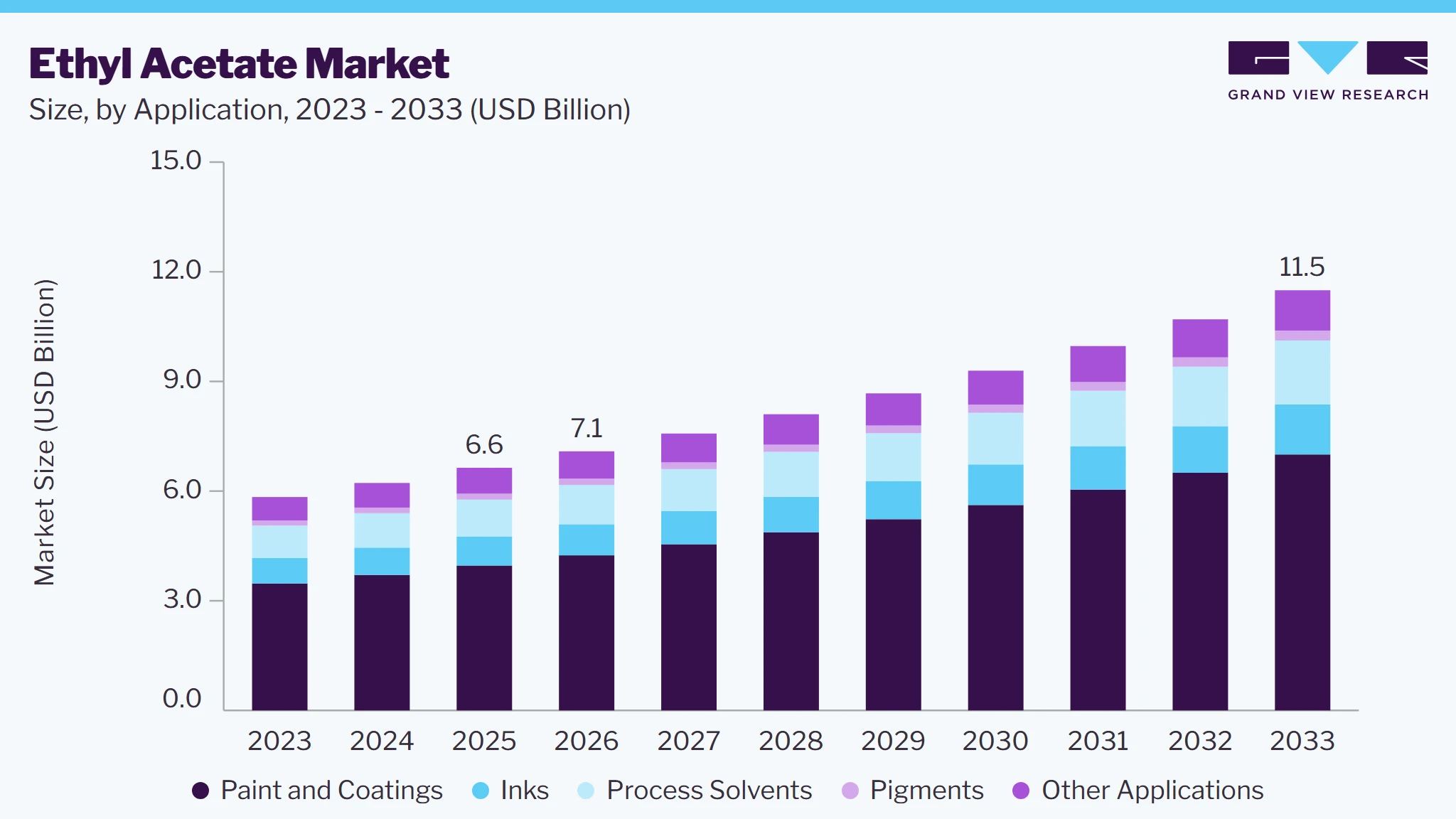
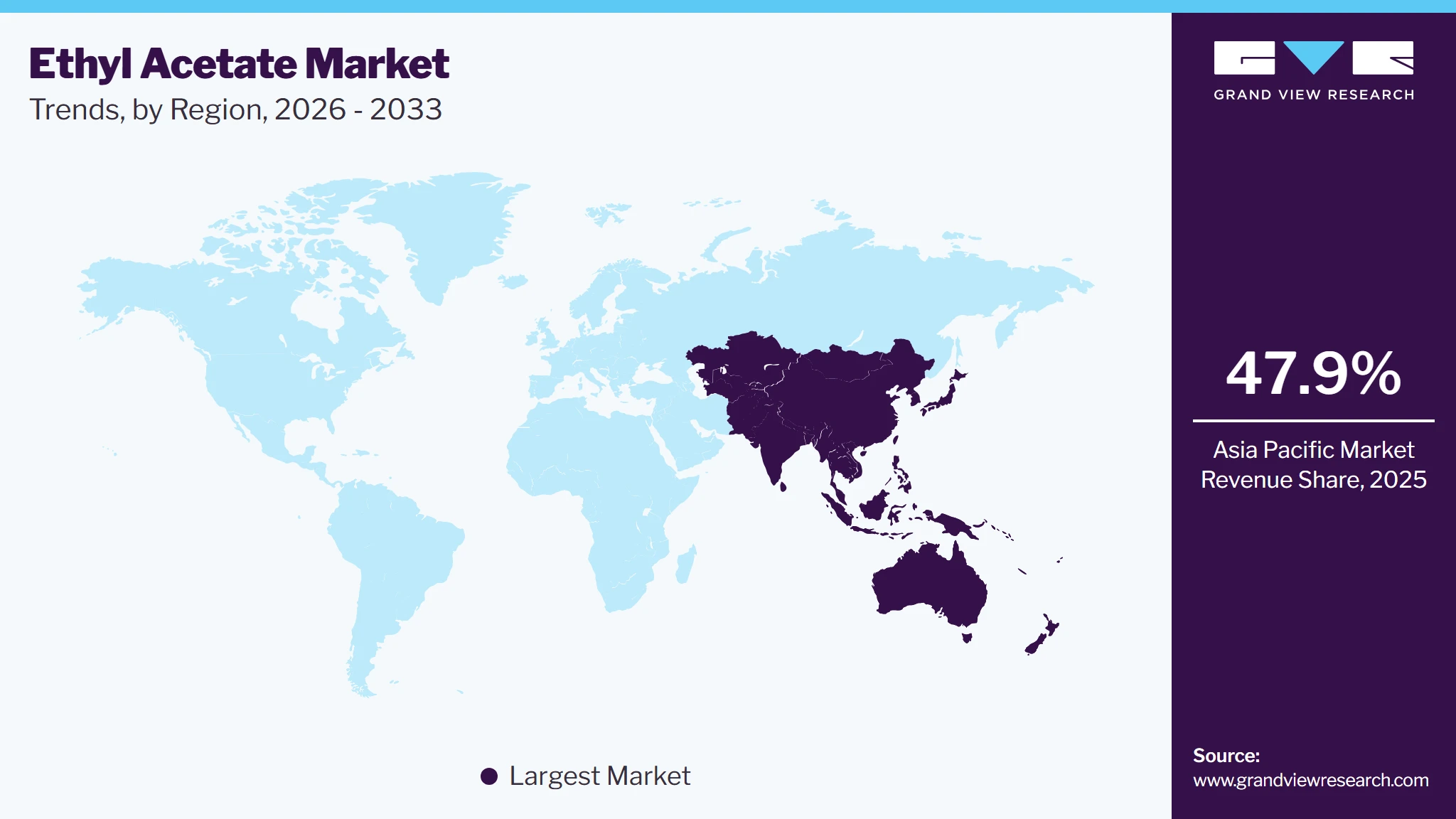
The global ethyl acetate market size was valued at USD 6.6 billion in 2025 and is projected to grow from USD 7.1 billion in 2026 to USD 11.5 billion by 2033, at a CAGR of 7.2% from 2026 to 2033. Asia Pacific market dominated, with a revenue share of 47.9% in 2025. The market's growth is attributed to the flourishing food & beverage and automotive industries, along with the growing preference for flexible packaging solutions across the globe.
 Source: Grand View Research, IR Documents, Primary Interviews, Paid DatabasesTo learn more about this report,
 Download Free Sample Report
Key Market Trends & Insights
- By application: Paints & coatings segment accounted for the largest share of the Ethyl Acetate market, representing 59.7% of total revenue in 2025.
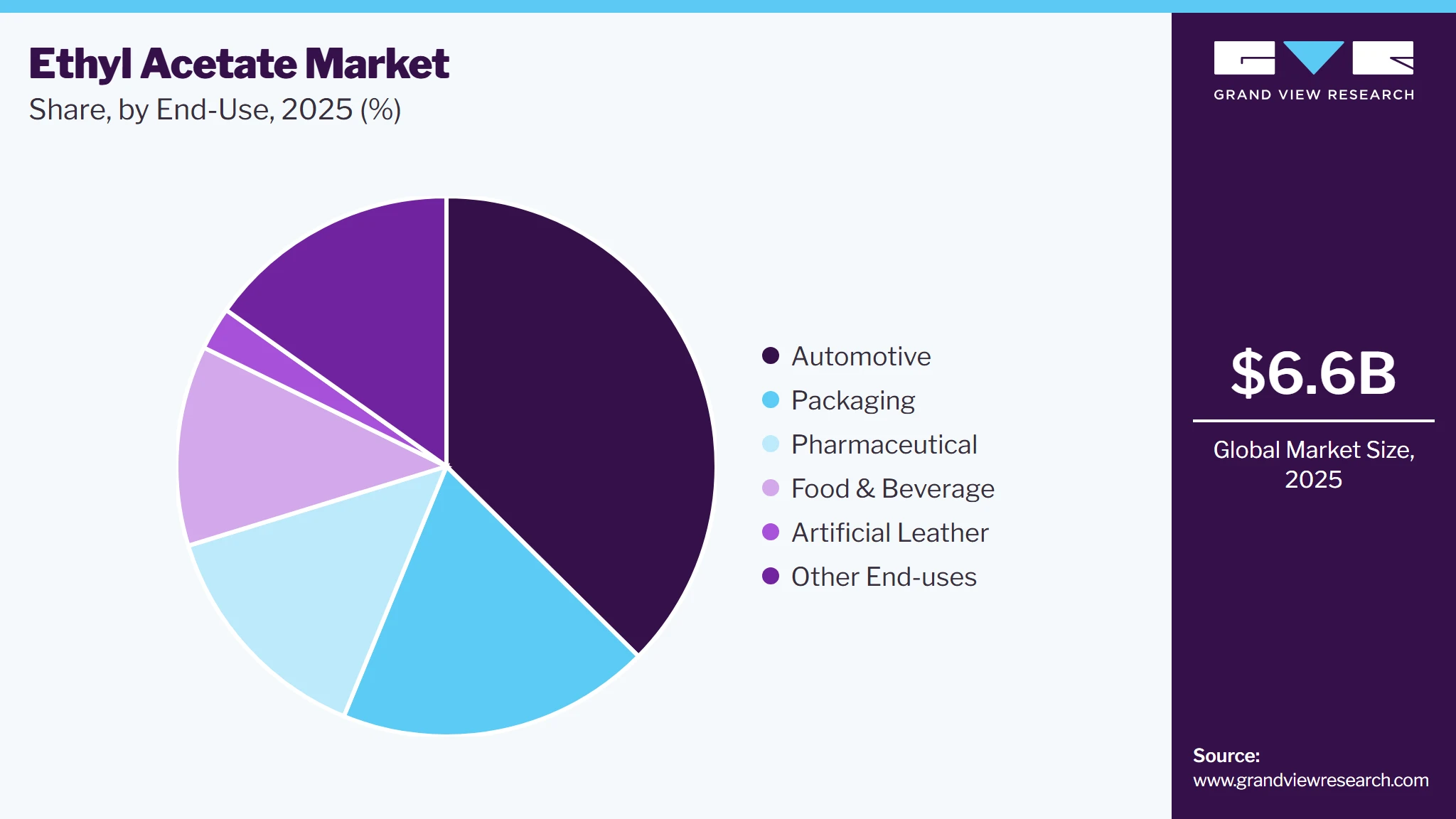
- By end-use: Automotive segment accounted for the largest share of the Ethyl Acetate market, representing 37.4% of total revenue in 2025.
- By distribution channel: Offline segment accounted for the largest share of the Ethyl Acetate market, representing 77.9% of total revenue in 2025.
Regional Highlights
- Largest regional market: Asia Pacific (47.9% revenue share, 2025)
- By country: China held the largest market share in 2025.
Market Size & Forecast
- Market size in 2025: USD 6.6 Billion
- Estimated market size in 2026: USD 7.1 Billion
- Projected market size by 2033: USD 11.5 Billion
- CAGR (2026-2033): 7.2%
GVR research-powered AIAsk Prism AI about the ethyl acetate marketGet cited answers from GVR research on market growth, segments, regulations and forecasts.Start with✓ Source-linked answers ✓ Market-specific context ✓ Traceable figuresExplore Prism AI ↗In the packaging industry, flexible packaging solutions are witnessing the highest demand owing to their several benefits, including low cost & weight, increased flexibility, easy recyclability, and improved shelf life. Ethyl acetate solvents find application in car care products within the automotive sector. In addition, they are employed in chromatographic separation processes in the pharmaceutical industry. Furthermore, these solvents enhance the flavor of food and beverage products. The increasing demand for environmentally friendly and convenient packaging solutions is driving the demand for flexible packaging. This is expected to have a positive impact on the demand for solvent-based printing inks, which, in turn, is expected to fuel the product demand over the forecast period.
 To learn more about this report, Download Free Sample Report
Solvents play a vital role in the production of synthetic leather. Given that volatile organic compounds (VOCs) are utilized in the footwear and leather manufacturing sectors, ethyl acetate is projected to have widespread usage in synthetic leather production methods. The stringent enforcement of governmental regulations on natural leather production, coupled with the rising demand for cruelty-free leather accessories like belts and apparel, is likely to fuel the market growth over the forecast period.
Market Dynamics
The ethyl acetate market is experiencing steady growth, driven by increasing demand from paints & coatings, adhesives, printing inks, pharmaceuticals, packaging, and food & beverage industries. As a fast-evaporating solvent with excellent solvency and relatively low toxicity, ethyl acetate is widely used in industrial and consumer applications. Rising investments in construction, automotive manufacturing, flexible packaging, and pharmaceutical production continue to support market expansion. However, fluctuations in ethanol and acetic acid prices, tightening environmental regulations on volatile organic compound (VOC) emissions, and the growing adoption of bio-based solvents are influencing production economics and competitive dynamics across the global market
The expanding paints & coatings industry remains one of the primary drivers of the ethyl acetate market. Ethyl acetate is extensively used as a solvent in architectural, automotive, industrial, wood, and protective coatings due to its excellent solvency, rapid evaporation rate, and ability to produce high-quality finishes. Increasing infrastructure development, urbanization, and renovation activities across emerging economies continue to drive demand for decorative and industrial coatings, thereby supporting ethyl acetate consumption.
In addition, the growing use of adhesives and sealants across packaging, construction, automotive, furniture, and footwear manufacturing is further strengthening market demand. The expansion of flexible packaging and increasing production of pressure-sensitive adhesives and laminating adhesives have increased the requirement for high-performance solvents, positioning ethyl acetate as a preferred solvent in numerous adhesive formulations.
The ethyl acetate market is constrained by volatility in raw material prices, particularly ethanol and acetic acid, which directly impact manufacturing costs and producer margins. Additionally, stringent environmental regulations governing VOC emissions and solvent handling are encouraging manufacturers to adopt low-VOC formulations and alternative solvent systems. Competition from substitute solvents such as methyl acetate, acetone, and water-based formulations, along with fluctuations in demand from construction and automotive industries during economic slowdowns, may further limit market growth.
Significant opportunities exist in the growing adoption of bio-based ethyl acetate, supported by increasing sustainability initiatives and stringent environmental regulations promoting renewable chemicals. Rising investments in green solvents, expansion of pharmaceutical manufacturing, increasing demand for flexible packaging, and growing consumption of specialty coatings and printing inks are expected to create new growth avenues. Furthermore, rapid industrialization across Asia Pacific, Latin America, and the Middle East, coupled with advancements in bioethanol production technologies and expanding downstream applications, are anticipated to support long-term market expansion.
Analyst Perspective
The ethyl acetate market is witnessing steady growth, driven by increasing demand across paints & coatings, printing inks, packaging, pharmaceuticals, adhesives, food & beverages, and specialty chemicals. Rising construction activities, expanding automotive production, and the rapid growth of flexible packaging continue to strengthen solvent consumption worldwide. In addition, increasing pharmaceutical manufacturing and growing demand for environmentally preferable solvents are encouraging investments in production capacity and process optimization. Manufacturers are also focusing on bio-based ethyl acetate production, operational efficiency, and supply chain integration to improve sustainability and maintain competitiveness amid evolving environmental regulations and fluctuating feedstock prices
Application Insight
The paints & coatings segment accounted for the largest share of the ethyl acetate market, representing 59.7% of total revenue in 2025. This is attributed to its advantages, such as quick drying, viscosity control, low VOC content, and enhanced adhesion. Ethyl acetate acts as a solvent, effectively dissolving and dispersing key components like pigments, resins, and additives in paint and coating formulations. Also, it helps control the viscosity of the formulation, ensuring optimal consistency for smooth application and uniform coverage on surfaces.
The product is compatible with various resins, binders, and additives used in different types of paints and coatings, making it suitable for a wide range of applications. Its presence can enhance the stability and shelf life of paint and coating formulations, minimizing issues like settling or separation over time.Process solvents was the second-largest application segment and is predicted to grow at a CAGR of 6.9% during the forecast period. Ethyl acetate is commonly employed for solvent extraction and separation processes in industries like pharmaceuticals and chemicals. It helps extract desired compounds from raw materials and facilitates the separation of different components. In the pharmaceutical industry, ethyl acetate serves as a process solvent for various stages of drug synthesis and purification. It aids in the isolation and purification of active pharmaceutical ingredients (APIs) and contributes to the preparation of pharmaceutical intermediates.
Distribution Channel Insight
The offline segment accounted for the largest share of the ethyl acetate market, representing 77.9% of total revenue in 2025 as it enables manufacturers to establish direct relationships with the end-users, thereby enabling a close understanding of the client's specific needs and ensuring timely supply. Direct sales often allow for customized solutions, where the manufacturer tailors the product's specifications to meet the exact requirements of the end-users.
The online distribution channel segment is predicted to grow atthe fastest CAGR of 7.0% over the forecast period as it enables sellers to reach a wider customer base beyond their local or regional markets, potentially increasing sales opportunities. Online platforms provide efficient communication channels, allowing buyers to inquire about products, pricing, and delivery details in real time.
End-use Insight
The automotive segment accounted for the largest share of the ethyl acetate market, representing 37.4% of total revenue in 2025. The growth is attributed to the growing sales of passenger vehicles along with the increasing adoption of electric vehicles (EVs) globally. The product is used in the auto refinishing process that involves repairing and refurbishing automobiles & other transportation vehicles. It is also used as an auto thinner, as it is a common ingredient found in varnishes, lacquers, and thinners that coat surfaces. Packaging was the second-largest segment and is expected to grow at a CAGR of 6.7% over the forecast period. Ethyl acetate is utilized in the production of flexible packaging materials, such as plastic films and pouches.
 To learn more about this report, Download Free Sample Report
Its ability to dissolve and disperse polymer resins contributes to the formulation of effective coating solutions that enhance packaging durability and barrier properties. The product also serves as a solvent in solvent-based printing inks used for packaging materials. It aids in achieving vibrant and durable printed designs on surfaces like paper, cardboard, and plastic. The food & beverage segment is expected to grow at a significant CAGR over the forecast period. Ethyl acetate serves as a flavor enhancer in the food and beverage industry. It imparts fruity and pleasant notes to a range of products, including confectioneries, baked goods, candies, chewing gum, and beverages like coffee and tea. In addition, it is used to extract natural aromas and flavors from botanical sources, such as fruits, herbs, and spices. These extracts are then incorporated into food and beverage formulations to enhance sensory experiences.
Regional Insights
Asia Pacific for 47.9% of the ethyl acetate market revenue in 2025. China maintained a leading position in the Asia Pacific ethyl acetate market. The region is among one of the largest producers and consumers of ethyl acetate led by China, India, and Japan. Asia Pacific is considered to be one of the fastest-growing regions in the world in terms of economic progress, industrialization, and growth of major end-use sectors. China and India are the major countries contributing to the growth of the regional market. Europe was the second-largest region and is expected to grow at the highest CAGR of 7.4% over the forecast period. The region has the presence of major industrial economies including Germany, France, and the UK that have a continuously growing number of suppliers and manufacturers of food products and beverages, automobiles, chemical products, and packaging solutions.
 To learn more about this report, Download Free Sample Report
The presence of several major automobile manufacturing units in the region is expected to drive product demand in the coming years. High demand for paints & coatings in furniture, automotive, and other industries in various countries including Saudi Arabia, Kuwait, and UAE is predicted to fuel the product demand. In addition, the food & beverages sector in the Middle East region has been developing with several growth opportunities for international investors. Reliance on food trade, changing consumer preferences & lifestyles, and strategic geographic position are expected to fuel the growth of the food & beverages industry in the region.
Key Companies & Market Share Insights
The key players are engaged in continuous innovations to increase the consumer base, along with the development of cost-effective products. These companies are also involved in adopting several strategic initiatives, such as mergers & acquisitions and new product launches, to gain a competitive edge. For instance, in February 2023, Celanese Corp. introduced a range of enhanced sustainable options for several acetyl chain materials, incorporating mass balance bio-content. These new alternatives, labeled as ECO-B, align with the innovative bio-based solutions previously introduced to cater to engineered materials customers.Some of the prominent players in the global ethyl acetate market include:
Key Ethyl Acetate Companies
The following key companies have been profiled for this study on the ethyl acetate market.
-
Celanese Corporation
-
Daicel Corporation
-
Eastman Chemical Company
-
INEOS
-
IOL
-
Jiangsu SOPO (Group) Co., Ltd.
-
Jubilant Pharmova Limited
-
KAI CO. LTD.
-
Linde PLC
-
Sasol Limited
-
SHOWA DENKO KK
-
Sipchem
-
Solvay
-
Yip's Chemical Holdings Limited
Competitive Benchmarking
Category
Operating Strategies
Competitive Edge
Weakness
Established Players (Celanese Corporation, Daicel Corporation, Eastman Chemical Company, INEOS, Linde PLC, Sasol Limited, Solvay, Sipchem, SHOWA DENKO KK)
- Focused on large-scale integrated chemical manufacturing and long-term raw material sourcing strategies.
- Expanded production capacities to strengthen supply reliability across coatings, adhesives, pharmaceuticals, and packaging applications.
- Invested in process efficiency, low-emission production technologies, and sustainability initiatives.
- Benefited from strong global presence and diversified customer base across multiple end-use industries.
- Maintained advanced production technologies with high operational efficiency and consistent product quality.
- Leveraged integrated value chains for better cost control and raw material availability.
- Faced exposure to volatility in ethanol and acetic acid feedstock prices.
- Encountered high compliance costs related to environmental and emission regulations.
- Large operational structures reduced flexibility in regional pricing adjustments.
Category
Operating Strategies
Competitive Edge
Weakness
Emerging / Regional Players (IOL, Jiangsu SOPO (Group) Co., Ltd., Jubilant Pharmova Limited, KAI CO. LTD., Yip's Chemical Holdings Limited.)
- Focused on regional market expansion and cost-competitive ethyl acetate production.
- Targeted demand from pharmaceuticals, flexible packaging, paints, and printing inks industries.
- Expanded export activities across Asia and Middle East markets.
- Benefited from lower manufacturing costs and regional customer proximity.
- Maintained flexibility in serving small and mid-sized industrial buyers.
- Strengthened presence in price-sensitive markets through competitive pricing strategies.
- Limited global distribution reach compared to multinational producers.
- Lower investment capacity in advanced production technologies and sustainability initiatives.
- Higher sensitivity to raw material price fluctuations and supply disruptions.
Ethyl Acetate Market Report Scope
Report Attribute
Details
Market size in 2025
USD 6.6 billion
Estimated market size in 2026
USD 7.1 billion
Projected market size by 2033
USD 11.5 billion
Growth rate
CAGR of 7.2% from 2026 to 2033
Base year for estimation
2025
Historical data
2021 - 2024
Forecast period
2026 - 2033
Quantitative units
Volume in kilotons; revenue in USD million/billion and CAGR from 2026 to 2033
Report coverage
Revenue & Volume forecast, company ranking, competitive landscape, growth factors, and trends
Segments covered
Application, end-use, distribution channel, region
Regional scope
North America; Europe; Asia Pacific; Latin America; MEA
Country scope
U.S.; Canada; Mexico; Germany; UK; France; Italy; Spain; The Netherlands; Sweden; Norway; China; India; Japan; South Korea; Australia; Singapore; Malaysia; Thailand; Brazil; Argentina; Saudi Arabia; UAE; Kuwait
Key companies profiled
Celanese Corp.; INEOS; Eastman Chemical Company; Solvay; Sasol Ltd.; SHOWA DENKO KK; IOL
Customization scope
Free report customization (equivalent up to 8 analysts' working days) with purchase. Addition or alteration to country, regional & segment scope.
Pricing and purchase options
Avail customized purchase options to meet your exact research needs. Explore purchase options
Global Ethyl Acetate Market Report Segmentation
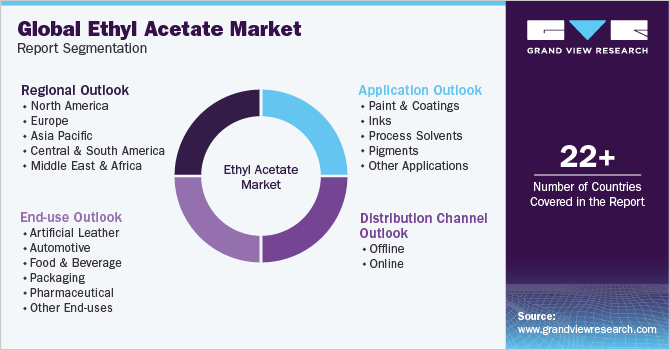
This report forecasts revenue and volume growth at global, regional, and country levels and provides an analysis of the latest trends in each of the sub-segments from 2021 to 2033. For this study, Grand View Research has segmented the ethyl acetate market report on the basis of application, end-use, distribution channel, and region:
 To learn more about this report, Download Free Sample Report
-
Application Outlook (Volume, Kilotons; Revenue, USD Million, 2021 - 2033)
-
Paint & Coatings
-
Inks
-
Process Solvents
-
Pigments
-
Other Applications
-
-
End-use Outlook (Volume, Kilotons; Revenue, USD Million, 2021 - 2033)
-
Artificial Leather
-
Automotive
-
Food & Beverage
-
Packaging
-
Pharmaceutical
-
Other End-uses
-
-
Distribution Channel Outlook (Volume, Kilotons; Revenue, USD Million, 2021 - 2033)
-
Offline
-
Online
-
-
Regional Outlook (Volume, Kilotons; Revenue, USD Million, 2021 - 2033)
-
North America
-
U.S.
-
Canada
-
Mexico
-
-
Europe
-
Germany
-
UK
-
France
-
Italy
-
Spain
-
The Netherlands
-
Sweden
-
Norway
-
-
Asia Pacific
-
China
-
India
-
Japan
-
South Korea
-
Australia
-
Singapore
-
Malaysia
-
Thailand
-
-
Central & South America
-
Brazil
-
Argentina
-
-
Middle East & Africa
-
Saudi Arabia
-
UAE
-
Kuwait
-
-
Research Methodology
The ethyl acetate market figures in this report are based on a proven research process that combines executive interviews with secondary research from proprietary databases, company filings, and recognized regulatory and institutional sources. Market size is built through value-chain sizing-reconciling supply-side and demand-side estimates-and triangulated with bottom-up and top-down approaches. Every estimate passes multiple levels of expert validation before publication, with each ethyl acetate segment quantified using the revenue-capture definitions in the table below.
Segment Definition
Segment - Application
Revenue capture definition
Paints & Coatings
Revenue is generated through the commercialization of ethyl acetate as a high-performance solvent in architectural, automotive, industrial, wood, and protective coatings. Excellent solvency, rapid evaporation, and superior film-forming properties continue to drive demand across coating formulations.
Inks
Business income is derived from the use of ethyl acetate in printing inks for flexible packaging, publication printing, labels, and specialty printing applications. Growing demand for high-quality printing, packaging, and fast-drying ink formulations supports market expansion.
Process Solvents
Revenue is generated through the utilization of ethyl acetate as an industrial process solvent across pharmaceuticals, specialty chemicals, agrochemicals, electronics, and chemical synthesis. Its favorable solvency characteristics and relatively low toxicity continue to support widespread industrial adoption.
Pigments
Business income is generated through the application of ethyl acetate in pigment dispersion, specialty coatings, and colorant formulations. Increasing production of industrial coatings, decorative paints, and specialty pigments contributes to sustained product demand.
Other Applications
Revenue is generated through the commercialization of ethyl acetate across adhesives, sealants, nail care products, cosmetics, pharmaceuticals, laboratory chemicals, food flavorings, cleaning agents, and other specialty industrial applications. Continuous product innovation and expanding industrial usage support long-term revenue growth
Segment - End Use
Revenue capture definition
Artificial Leather
Revenue is generated through the use of ethyl acetate in synthetic leather manufacturing, polyurethane coatings, finishing formulations, and adhesive systems. Growing footwear, furniture, automotive interiors, and fashion industries continue to support demand.
Automotive
Business income is derived from ethyl acetate consumption in automotive coatings, refinishing paints, adhesives, sealants, and component manufacturing. Increasing vehicle production and demand for lightweight materials continue to strengthen market growth.
Food & Beverage
Revenue is generated through the utilization of food-grade ethyl acetate as a flavoring agent, extraction solvent, decaffeination solvent, and processing aid. Growing processed food and beverage manufacturing supports steady market demand.
Packaging
Revenue is generated through the commercialization of ethyl acetate in flexible packaging inks, laminating adhesives, coatings, and printing formulations. Expansion of e-commerce, packaged food consumption, and flexible packaging production continues to drive demand
Pharmaceuticals
Business income is generated through the use of ethyl acetate in pharmaceutical manufacturing, extraction, purification, active pharmaceutical ingredient (API) production, and specialty formulations. Rising pharmaceutical production and healthcare expenditure support sustained market growth
Other End Use
Revenue is generated through the utilization of ethyl acetate across cosmetics, electronics, agrochemicals, laboratory chemicals, specialty chemicals, textiles, and industrial manufacturing. Diversified end-use applications continue to strengthen market opportunities
Segment - Distribution Channel
Revenue capture definition
Offline
Revenue is generated through direct sales by manufacturers, chemical distributors, specialty chemical suppliers, industrial procurement contracts, and regional dealer networks serving paints, coatings, pharmaceuticals, packaging, and chemical manufacturers. Long-term supply agreements account for the majority of market revenue
Online
Business income is derived through B2B e-commerce platforms, digital procurement portals, online chemical marketplaces, and direct manufacturer websites serving laboratories, research organizations, SMEs, and specialty chemical buyers. Increasing digital procurement continues to support channel expansion
Estimation Model
Layer Name
Key Question
Description
Downstream Industry Demand Layer
Downstream Industry Demand Layer
Assess global demand across major downstream industries including paints & coatings, packaging, automotive, pharmaceuticals, food & beverages, printing, cosmetics, specialty chemicals, and industrial manufacturing. This layer establishes the addressable demand base by evaluating solvent consumption across key end-use sectors utilizing ethyl acetate
Ethyl Acetate Adoption Layer
Ethyl Acetate Adoption Layer
Evaluate adoption of ethyl acetate across paints & coatings, printing inks, process solvents, pigments, adhesives, pharmaceuticals, food processing, cosmetics, packaging, and other specialty industrial applications. Adoption is influenced by product performance, regulatory compliance, manufacturing technologies, and downstream industry expansion.
Consumption Intensity Layer
Consumption Intensity Layer
Quantify ethyl acetate consumption by evaluating formulation inclusion rates, manufacturing throughput, solvent replacement trends, production volumes, application-specific dosage, and regional consumption patterns. The assessment estimates annual consumption intensity across major end-use industries and regional markets.
Revenue Layer
How is market revenue generated?
Market revenue is generated through the production, distribution, and commercialization of ethyl acetate supplied to manufacturers of paints & coatings, printing inks, adhesives, pharmaceuticals, food ingredients, cosmetics, packaging materials, and specialty chemicals. Commercial performance is influenced by ethanol and acetic acid pricing, production economics, downstream demand, environmental regulations, manufacturing efficiency, long-term supply agreements, and expanding industrial applications
Delivered Customizations
This report has been delivered with the following In-depth customizations
Client Request
Customization Delivered
Value Adds
Regional Segmentation
Comprehensive regional assessment of the ethyl acetate market across North America, Europe, Asia Pacific, Latin America, and Middle East & Africa, including country-level analysis of production capacity, feedstock availability, manufacturing footprint, import-export dynamics, pricing trends, downstream demand, and regulatory developments. The study further evaluates consumption across paints & coatings, packaging, pharmaceuticals, food & beverages, printing inks, and other major end-use industries.
Enables identification of high-growth regional markets, manufacturing hubs, and emerging consumption centers. Supports capacity expansion planning, sourcing strategies, geographic prioritization, and investment decision-making through comprehensive regional market intelligence.
Cross- Segmentation Benchmarking
Detailed cross-segmentation analysis evaluating ethyl acetate demand across major application segments including paints & coatings, inks, process solvents, pigments, and other applications, mapped against end-use industries such as automotive, packaging, pharmaceuticals, food & beverages, artificial leather, and specialty chemicals.
Supports portfolio optimization by identifying high-growth application-end-use combinations, demand concentration trends, and evolving consumption patterns, enabling targeted business development and efficient resource allocation.
Pricing Analysis
Comprehensive assessment of historical and current ethyl acetate pricing trends, including feedstock cost movements (ethanol and acetic acid), production economics, energy costs, regional supply-demand balances, capacity utilization, trade flows, and pricing variations across major regions.
Supports procurement planning, supplier negotiations, pricing strategy development, and margin optimization by providing enhanced visibility into cost structures, pricing volatility, and future market outlook across the ethyl acetate value chain.
Frequently Asked Questions About This Report
Paints & Coatings application segment dominated the market with a revenue share of 59.7% in 2025.
Automotive application segment dominated the market with a revenue share of 37.4% in 2025.
Offline distribution channel segment dominated the market with a revenue share of 77.9% in 2025.
The global ethyl acetate market size was valued at USD 6.6 billion in 2025 and is estimated at USD 7.1 billion in 2026.
Asia Pacific market dominated, with a revenue share of 47.9% in 2025.
Key players include Celanese Corp.; INEOS; Eastman Chemical Company; Solvay; Sasol Ltd.; SHOWA DENKO KK; IOL
Growing investments in the construction, pharmaceuticals, and automotive sector are likely to drive the ethyl acetate market growth. There has also been a significant rise in the production of sustainable packaging products such as flexible packaging due to increasing environmental concerns, which is anticipated to propel the demand for solvent-based printing inks in the packaging industry over the forecast period.
The global ethyl acetate market is forecast to grow at a CAGR of 7.2% from 2026 to 2033, reaching USD 11.5 billion by 2033.
About the Author(s)
Organic Chemicals Research Team
Bulk Chemicals · Organic ChemicalsThis report was authored by the organic chemicals research team at Grand View Research - comprising two research analysts, one senior research analyst, and one industry expert - with specialized expertise in the organic chemicals segment of the bulk chemicals industry. All findings are based on proprietary bulk chemicals databases, executive interviews, and regulatory analysis, subject to internal peer review prior to publication.
Last Updated:
Speak to Analyst

Customize this report to your needs - add regions, segments, or data points, with 20% free customization.
Or view our licence options:


ISO 9001:2015 & 27001:2022 Certified
We are GDPR and CCPA compliant! Your transaction & personal information is safe and secure. For more details, please read our privacy policy.


