
- Home
- »
- Advanced Interior Materials
- »
-
Europe Mass Timber Engineering Products Market Report 2033GVR Report cover

Europe Mass Timber Engineering Products Market (2026 - 2033)
Size, Share & Trends Analysis Report By Product (CLT, Glulam, Hybrid Mass Timber Engineering Products), By Country (Italy, Spain, Portugal), And Segment Forecasts
Market Size, 2025
$3.9BMarket Estimate, 2026
$4.1BMarket Forecast, 2033
$6.9BCAGR, 2026–2033
7.8%Europe Mass Timber Engineering Products Market Summary
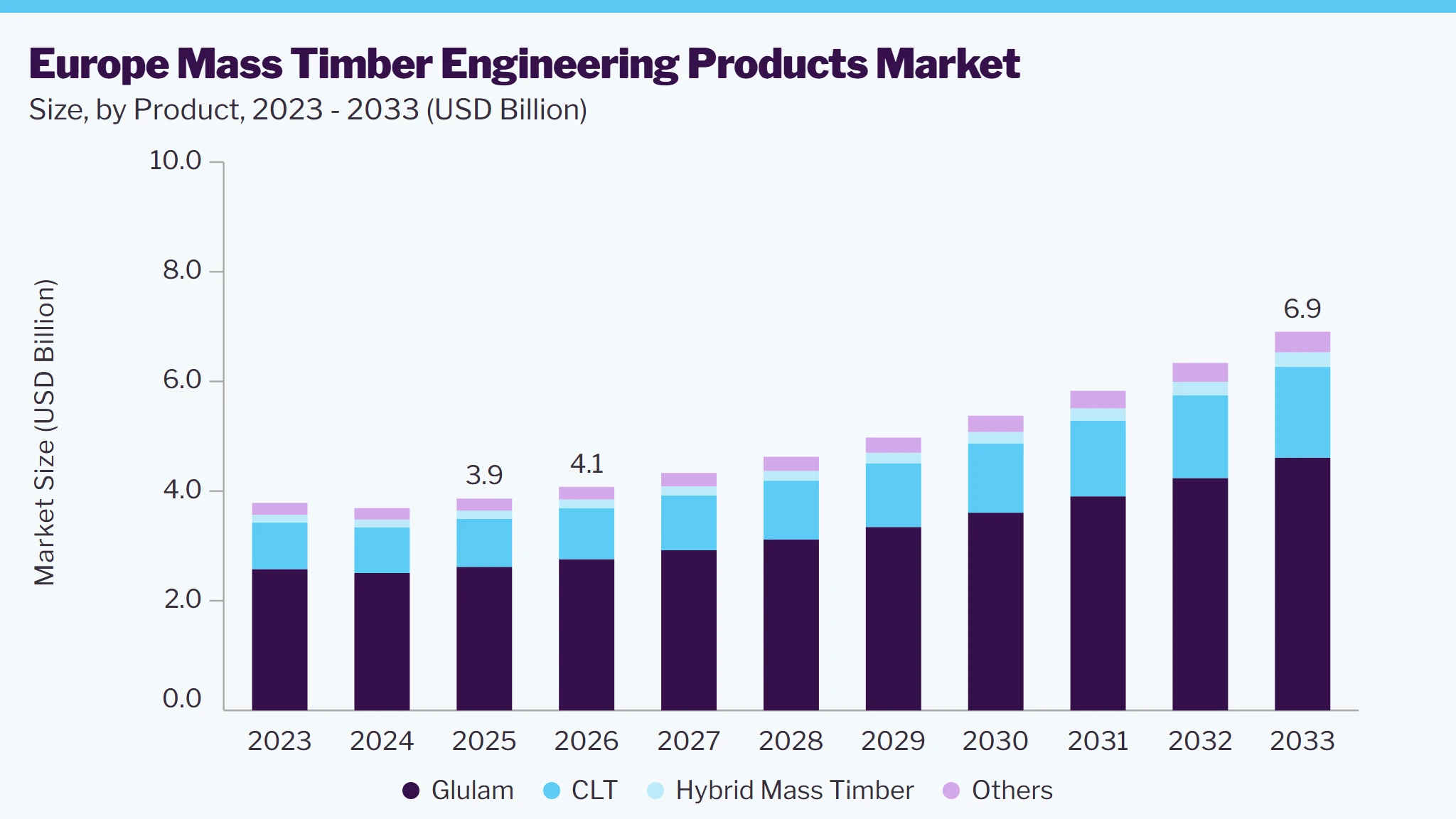
The Europe mass timber engineering products market size was valued at USD 3.9 billion in 2025 and is projected to grow from USD 4.1 billion in 2026 to USD 6.9 billion by 2033, at a CAGR of 7.8% from 2026 to 2033. The industry is gaining traction as the construction industry adopts engineered wood systems for residential, commercial, industrial, and institutional buildings.
Key Market Trends & Insights
- By product: Glulam segment dominated the market with a revenue share of 67.8% in 2025.
Market Size & Forecast
- Market size in 2025: USD 3.9 Billion
- Estimated market size in 2026: USD 4.1 Billion
- Projected market size by 2033: USD 6.9 Billion
- CAGR (2026-2033): 7.8%
Three ways to get this report
Buy it, customize it, or ask a question.Ask an Analyst
Analyst response in 1 business day
- AccessReport author, directly
- Reply timeWithin 1 working day
- No sales callDirect answer only
- FormatEmail reply
- CostFree, no cost
Get the Full Report
What the study covers
- FormatsPDF · Excel · Dashboard
- Timeline2026–2033 annual, 2025 base
- Coverage20+ countries, 5 regions
- Companies10+ key players profiled
Customize the Report
20% free customization
- IncludeCountries, segments, points
- TailorTo your product definition
- ExtendDeeper competitor detail
- OrA fully bespoke study
- Turnaround5–10 working days
Products such as cross-laminated timber (CLT), glued laminated timber (glulam), laminated veneer lumber (LVL), and other structural timber components support the development of load-bearing walls, floors, roofs, beams, and columns. Demand is supported by growing interest in low-carbon construction, prefabricated building systems, and resource-efficient structural materials.
 Source: Grand View Research, IR Documents, Primary Interviews, Paid DatabasesTo learn more about this report,
 Download Free Sample Report
The primary drivers include decarbonisation targets in the built environment, increasing adoption of off-site construction, and the need to improve construction productivity. Mass timber components can be manufactured to precise dimensions in factory settings, supporting shorter on-site installation periods and reducing material waste when projects are planned effectively. Their relatively low weight can also reduce structural loads and influence foundation requirements, depending on building design and site conditions. Demand is further supported by growing interest in hybrid construction, where engineered timber is combined with concrete or steel to achieve project-specific structural and performance requirements.
Technological developments are improving the precision, consistency, and design flexibility of mass timber engineering products. Computer-aided design, building information modelling (BIM), automated cutting, CNC machining, and digital fabrication support accurate production of complex components and coordinated assembly. Advances in engineered connections, fire-protection systems, acoustic detailing, and moisture management are expanding the range of building applications that timber structures can serve. Prefabricated wall, floor, roof, and structural-frame assemblies are also supporting greater integration between manufacturing and on-site construction.
Market Dynamics
Demand for CLT, glulam, hybrid mass timber engineering products, and other structural timber solutions is influenced by construction investment, sustainability objectives, timber availability, and building regulations. While digital fabrication, off-site construction, and hybrid structural designs create growth opportunities, high initial costs, supply chain constraints, fire-safety requirements, and competition from steel and concrete influence market expansion across European countries.
The growing demand for low-carbon construction materials is a major driver of the market as the European Union focuses on reducing emissions from the building sector. Buildings are responsible for approximately 40% of EU energy consumption and 36% of energy-related greenhouse-gas emissions, making the decarbonization of buildings a major policy priority. This is encouraging developers, architects, and construction companies to consider materials and construction systems that can contribute to lower lifecycle emissions.
The regulatory shift toward whole-life carbon assessment is further strengthening this demand. Under the revised Energy Performance of Buildings Directive (EPBD), Member States must ensure that the life-cycle global warming potential (GWP) of new buildings with a useful floor area above 1,000 m² is calculated and disclosed from 2028, with the requirement extending to all new buildings from 2030. The Directive also requires Member States to establish roadmaps by 2027 for introducing limits on the cumulative lifecycle GWP of new buildings. These requirements increase the importance of construction materials embodied and lifecycle emissions during building design and procurement.
The high initial cost of mass timber construction remains a major restraint, particularly because mass timber projects often require specialized engineering, design, manufacturing, transportation, and installation processes. Unlike conventional construction, timber components are frequently engineered and prefabricated according to project-specific requirements, which can increase upfront design and production costs. The need for specialized expertise in timber engineering, fire protection, connections, and moisture management can further increase project preparation expenses.
Growing interest in industrialised construction creates opportunities for manufacturers to supply integrated mass timber engineering products rather than individual structural components. Engineered wall panels, floor cassettes, roof assemblies, beams, columns, and connection systems can be developed as coordinated packages to support faster installation and simplify project execution. Manufacturers can also expand into hybrid structural solutions that combine timber with steel or concrete to address specific requirements for span, stability, acoustics, and fire performance.
Market Concentration & Characteristics
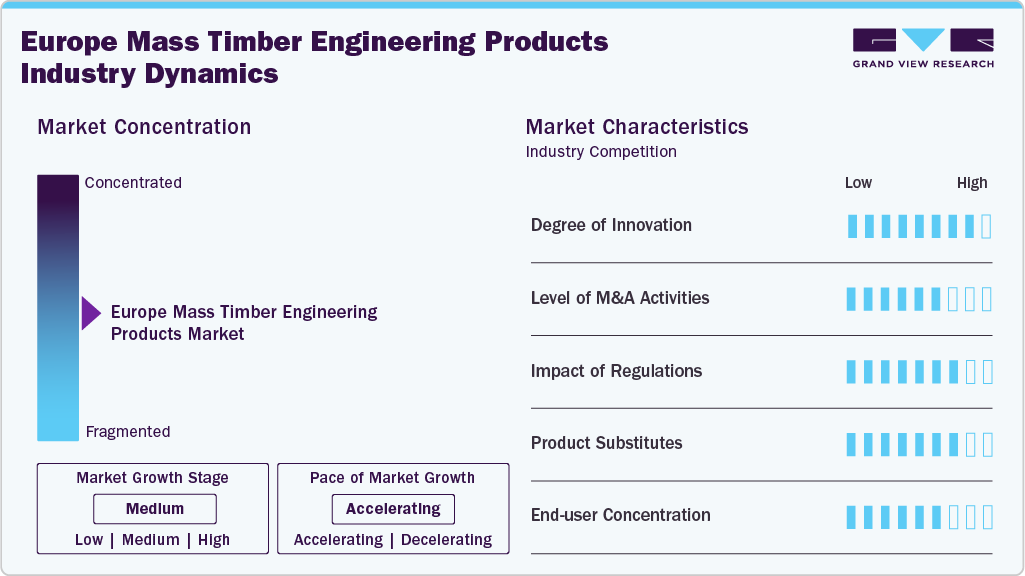
The industry includes established engineered wood manufacturers, specialist mass timber producers, timber construction system suppliers, and integrated building solution providers. Competitive positioning depends on manufacturing capacity, product quality, structural engineering expertise, certification, project references, and relationships with architects, developers, and contractors. Companies with integrated design, fabrication, and installation capabilities can provide coordinated solutions for complex building projects. Regional forestry resources, access to suitable timber grades, and proximity to production facilities also influence sourcing and distribution. The market combines larger manufacturers serving multiple European countries with specialized suppliers focusing on particular products, applications, or national markets.
 To learn more about this report, Download Free Sample Report
Mass timber engineering products primarily compete with structural steel, reinforced concrete, precast concrete systems, and conventional timber framing. Steel and concrete remain established choices for projects requiring specific load-bearing capacity, long spans, fire performance, or extensive contractor familiarity. Hybrid structural systems also provide an alternative by combining timber with concrete or steel to balance structural performance, construction requirements, and environmental objectives. Conventional timber framing may compete in lower-rise buildings where full mass timber systems are not necessary.
Analyst Perspective
The industry is positioned for growth as construction stakeholders adopt engineered timber solutions to support sustainable building practices, prefabrication, and reduced construction time. CLT and glulam remain important product categories, supported by established manufacturing capabilities in countries such as Germany, Austria, and Sweden. Market development will depend on construction investment, timber availability, production capacity, regulatory compliance, and the competitiveness of engineered timber against steel and concrete. Manufacturers investing in automated fabrication, integrated engineering services, and hybrid structural systems are well positioned to address evolving requirements across residential, commercial, institutional, and industrial construction.
Product Insights
The glulam segment held the highest revenue share of 67.8% in 2025, supported by its established use in structural beams, columns, arches, and long-span building applications. Its strength, design flexibility, and ability to accommodate customised structural requirements support demand across residential, commercial, industrial, and public buildings. Established manufacturing capabilities and familiarity among architects and structural engineers further strengthen its position across European construction markets.
The CLT segment is expected to grow at a CAGR of 8.5% over the forecast period, driven by increasing adoption of prefabricated timber construction, demand for low-carbon building materials, and advancements in digital manufacturing. CLT panels offer structural versatility for walls, floors, and roofs while supporting factory-based production and faster on-site assembly. Growing interest in multi-storey timber buildings, modular construction, and sustainable residential and commercial developments is expected to create additional opportunities for CLT manufacturers across Europe.
Country Insights
Germany Mass Timber Engineering Products Market Trends
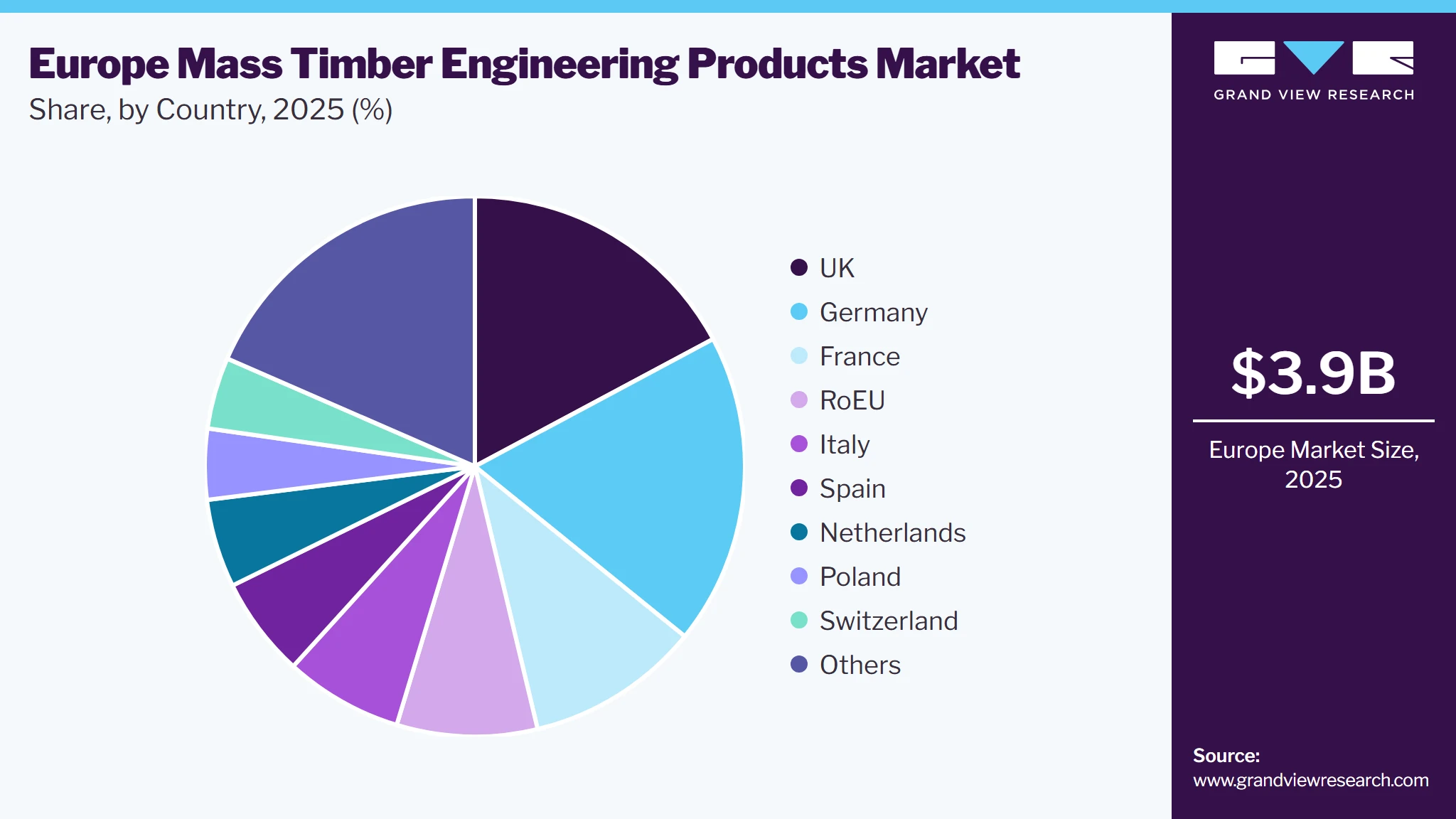
The Germany mass timber engineering products market dominated Europe with the highest revenue share of 18.6% in 2025, supported by its established timber-processing industry, strong engineering capabilities, and growing interest in prefabricated building systems. Cross-laminated timber (CLT), glulam beams, and engineered timber panels are used in residential buildings, offices, educational facilities, and hybrid structures. A notable trend is the integration of digital design, automated manufacturing, and prefabricated structural components to improve construction precision and installation efficiency. Demand is also influenced by energy-efficient building practices and efforts to reduce embodied carbon, while fire protection, acoustic performance, and compliance with German building regulations remain important considerations.
 To learn more about this report, Download Free Sample Report
UK Mass Timber Engineering Products Market Trends
The mass timber engineering products market in the UK market is focused on expanding the safe use of mass timber engineering products in low-carbon construction and modern methods of construction. The government's Timber in Construction Roadmap 2025 supports greater use of sustainable timber, stronger domestic supply chains, improved technical skills, and innovation in engineered mass timber systems. CLT panels, glulam components, and prefabricated timber structures are attracting interest in housing, schools, offices, and other suitable buildings. Key trends include factory-based construction, whole-life carbon assessment, and hybrid timber systems, alongside greater attention to fire safety, moisture protection, durability, and insurer acceptance.
France Mass Timber Engineering Products Market Trends
The mass timber engineering products market in France is benefiting from building-sector decarbonisation objectives and the environmental performance requirements associated with RE2020, the country's environmental regulation for new buildings. This is encouraging construction stakeholders to evaluate timber-based structural systems through life-cycle carbon assessments alongside energy performance and other building requirements. CLT, glulam, and prefabricated timber components are gaining relevance in residential developments, offices, educational buildings, and public-sector construction. A key trend is the integration of engineered timber with concrete and steel in hybrid structures, supported by digital fabrication and off-site assembly. Product traceability, sustainable timber sourcing, fire performance, and cost competitiveness remain important factors influencing adoption.
Italy Mass Timber Engineering Products Market Trends
The mass timber engineering products market in Italy is characterised by the integration of engineered timber with seismic-resistant structural design, reflecting the country's exposure to earthquakes and the importance of structural safety. Manufacturers are also adopting CNC machining, factory-based prefabrication, and customised structural components to improve construction precision and reduce on-site assembly time. Interest in sustainable building renovation and hybrid timber systems is creating additional opportunities, including projects that combine timber with steel or concrete.
Key Europe Mass Timber Engineering Products Company Insights
Some of the key players operating in the market include Stora Enso and Binderholz.
-
Stora Enso is a Finland-based renewable materials company that develops and manufactures wood-based products for construction, packaging, and other applications. Its product portfolio includes cross-laminated timber (CLT), laminated veneer lumber (LVL), glulam, and other mass timber solutions, supporting sustainable and resource-efficient construction.
-
Binderholz specializes in solid wood and mass timber engineering products, including cross-laminated timber (CLT), glulam, solid wood panels, structural timber, and sawn timber. It operates an integrated wood-processing value chain and follows a zero-wood-waste approach, converting production residues into biofuels and energy.
Lignotrend and DERIX Group are some of the emerging market participants in the Europe mass timber engineering products market.
-
Lignotrend is a German manufacturer specializing in sustainable engineered timber products for modern construction. The company develops prefabricated wood building systems, including ceiling, wall, and roof elements, supporting efficient and environmentally conscious timber construction.
-
DERIX Group is a German timber construction company specializing in engineered wood products, including cross-laminated timber (CLT) and glulam. The group provides sustainable timber solutions for residential, commercial, and public buildings, supporting modern wood construction projects across Europe and beyond.
Key Europe Mass Timber Engineering Products Companies
-
Stora Enso
-
binderholz
-
KLH Massivholz GmbH
-
Mayr-Melnhof Holz
-
HASSLACHER Group
-
Pfeifer Group
-
DERIX Group
-
Lignotrend
-
Egoin
-
Schilliger Holz
Competitive Benchmarking
Category
Operating Strategies
Competitive Edge
Weakness
Established Players (Stora Enso, binderholz, KLH Massivholz GmbH, Mayr-Melnhof Holz, HASSLACHER Group, Pfeifer Group)
Invest in CLT, glulam, LVL, and other engineered timber production capacity to address growing demand across European construction markets.
Expand manufacturing and project capabilities through facility investments, advanced fabrication technologies, and integrated engineering services.
Focus on sustainably sourced timber, prefabrication, and digital manufacturing to serve large residential, commercial, institutional, and infrastructure projects.
Strong manufacturing capabilities and established positions across European mass timber engineering products markets.
Broad product portfolios covering CLT, glulam, LVL, and customised structural timber components.
Extensive engineering, fabrication, and project experience supporting complex and large-scale timber construction projects.
High capital requirements for manufacturing facilities, timber processing, drying equipment, and automated fabrication systems.
Exposure to fluctuations in timber availability, raw material prices, and energy costs.
Transportation and logistics of large prefabricated timber components can increase project costs and limit economical delivery distances.
Emerging and Specialist Players (DERIX Group, Lignotrend, Egoin, Schilliger Holz)
Strengthen CLT, glulam, and other engineered timber production capabilities to capture growing demand across European construction markets.
Develop partnerships with architects, engineers, developers, and contractors to increase adoption of mass timber engineering products.
Focus on project-specific fabrication, digital manufacturing, and sustainable engineered wood solutions for residential, commercial, institutional, and hybrid construction projects.
Specialised expertise in mass timber engineering products and engineered wood solutions suited to customised project requirements.
Established regional manufacturing capabilities and access to European timber supply chains.
Flexible product portfolios and fabrication capabilities support specialised applications and evolving regional construction demand.
Comparatively narrower geographic reach or more specialised product portfolios than larger diversified timber groups.
High investment requirements for expanding production capacity and adopting advanced manufacturing technologies.
Dependence on regional construction activity, timber supply, logistics costs, and continued adoption of mass timber building systems can influence market expansion.
Recent Developments
-
In July 2026, Binderholz agreed to acquire the entire share capital of Kuhmo Oy, a major Finnish sawmilling company. Kuhmo processes more than 1 million m³ of roundwood annually and produces approximately 500,000 m³ of sawn timber, primarily from pine and spruce. The acquisition is expected to strengthen Binderholz's presence in Finland and secure access to high-quality coniferous timber for its further-processing operations, including solid-wood and engineered-wood products.
-
In September 2025, HASSLACHER Group's investment in Element5 strengthened its North American mass-timber manufacturing footprint. The expanded Ontario facility combines CLT and glulam production capabilities and is designed to increase the group's ability to supply engineered timber for large-scale construction projects in Canada and the U.S. HASSLACHER has indicated a combined mass-timber production capacity of up to 100,000 m³ annually across the relevant operations.
Europe Mass Timber Engineering Products Market Report Scope
Report Attribute
Details
Market size in 2025
USD 3.9 billion
Estimated market size in 2026
USD 4.1 billion
Projected market size by 2033
USD 6.9 billion
Growth rate
CAGR of 7.8% from 2026 to 2033
Base year for estimation
2025
Historical data
2021 - 2024
Forecast period
2026 - 2033
Quantitative units
Revenue in USD billion, volume in thousand cubic meters, and CAGR from 2026 to 2033
Report coverage
Revenue forecast, company ranking, competitive landscape, growth factors, and trends
Segments covered
Product, region
Regional scope
Europe
Country scope
Italy; Spain; Portugal; Poland; Germany; Austria; Switzerland; France; Netherlands; Luxembourg; UK; Ireland; Denmark; Sweden; Norway
Key companies profiled
Stora Enso; binderholz; KLH Massivholz GmbH; Mayr-Melnhof Holz; HASSLACHER Group; Pfeifer Group; DERIX Group; Lignotrend; Egoin; Schilliger Holz
Customization scope
Free report customization (equivalent up to 8 analysts working days) with purchase. Addition or alteration to country, regional & segment scope.
Pricing and purchase options
Avail customized purchase options to meet your exact research needs. Explore purchase options
Europe Mass Timber Engineering Products Market Report Segmentation
This report forecasts volume & revenue growth at regional & country levels and provides an analysis of the industry trends in each of the sub-segments from 2021 to 2033. For this study, Grand View Research has segmented the Europe mass timber engineering products market report based on product and country:
-
Product Outlook (Volume, Thousand Cubic Meters, Revenue, USD Billion, 2021 - 2033)
-
CLT
-
Glulam
-
Hybrid Mass Timber Engineering Products
-
Others
-
-
Country Outlook (Volume, Thousand Cubic Meters, Revenue, USD Billion, 2021 - 2033)
-
Italy
-
Spain
-
Portugal
-
Poland
-
Germany
-
Austria
-
Switzerland
-
France
-
Netherlands
-
Luxembourg
-
UK
-
Ireland
-
Denmark
-
Sweden
-
Norway
-
Research Methodology
The Europe mass timber engineering products market figures in this report are based on a proven research process that combines executive interviews with secondary research from proprietary databases, company filings, and recognized regulatory and institutional sources. Market size is built through value-chain sizing-reconciling supply-side and demand-side estimates-and triangulated with bottom-up and top-down approaches. Every estimate passes multiple levels of expert validation before publication, with each Europe mass timber engineering products segment quantified using the revenue-capture definitions in the table below.
Segment Definition
Product
Revenue Capture Definition
CLT
Revenue generated from the sale of factory-manufactured solid timber panels formed by bonding multiple timber layers perpendicular to each other, primarily used for structural walls, floors, roofs, and other load-bearing building components.
Glulam
Revenue generated from the sale of engineered timber products manufactured by bonding multiple layers of timber parallel to the grain, primarily used for structural beams, columns, arches, and long-span load-bearing applications.
Hybrid Mass Timber
Revenue generated from the sale of engineered structural products and systems that combine mass timber with materials such as steel or concrete, primarily used in load-bearing frames, floors, columns, beams, and other building components requiring integrated structural performance.
Others
Revenue generated from the sale of other mass timber engineering products, including laminated veneer lumber (LVL), dowel-laminated timber (DLT), nail-laminated timber (NLT), and other engineered timber components used in structural framing, floor systems, roofs, and specialised construction applications.
Estimation Model
Layer Name
Key Question
Description
Parent Market Analysis
What is the overall size and growth outlook of the European engineered wood and timber construction market?
The broader market is assessed through construction activity, timber availability, sustainability initiatives, and adoption of prefabricated and low-carbon building systems to establish the addressable market for Europe mass timber engineering products.
Mass Timber Engineering Products Penetration Analysis
What share does each product category contribute to the European market?
Market penetration is assessed across CLT, glulam, hybrid mass timber engineering products, and others based on product adoption, manufacturing capacity, structural applications, and prefabrication trends to determine category-wise revenue contributions.
Regional and End-Use Demand Assessment
Which European countries, applications, and building types generate the highest demand?
Demand is evaluated across Germany, the UK, France, Italy, Spain, and other European countries based on construction activity, regulations, and sustainability targets. Applications and end uses, including walls, floors, roofs, beams, columns, residential, commercial, industrial, and institutional buildings, are assessed to determine revenue contributions.
Company Revenue Validation and Market Forecasting
How is the market size validated and forecast?
Market estimates are validated using company revenues, production capacities, product portfolios, manufacturing facilities, project pipelines, and expansion initiatives. Top-down and bottom-up approaches are triangulated to estimate market size and forecast growth for Europe mass timber engineering products.
Delivered Customizations
We have successfully delivered the following deep-dive customizations
Client Request
Customization Delivered
Value Adds
Product & Technology Benchmarking
Comparative assessment of CLT, glulam, hybrid mass timber engineering products, and other engineered timber solutions based on structural properties, production processes, dimensional capabilities, prefabrication suitability, and end-use applications across Europe.
Helps identify product differentiation opportunities, evaluate manufacturing capabilities, prioritize technology investments, and align product portfolios with evolving European construction requirements.
Regional Regulatory & Building Code Assessment
Evaluation of European construction product requirements, structural timber design standards, fire safety provisions, national building codes, and country-specific requirements across Germany, the UK, France, Italy, Spain, and other key markets.
Supports country-specific market entry planning, product compliance, certification decisions, and identification of regulatory requirements affecting project adoption and commercialisation.
Timber Supply Chain & Sustainability Assessment
Analysis of regional timber availability, sourcing networks, forestry certification, raw material price trends, processing capacity, transportation requirements, and carbon considerations across the European mass timber value chain.
Helps assess supply chain reliability, identify sourcing and logistics efficiencies, strengthen procurement planning, and evaluate opportunities to improve resource efficiency and environmental performance.
Frequently Asked Questions About This Report
Growing adoption of low-carbon construction materials, increasing demand for prefabricated building systems, and advancements in engineered timber manufacturing are driving the European mass timber engineering products market.
Some key players in the Europe mass timber engineering products market include Stora Enso, binderholz, KLH Massivholz GmbH, Mayr-Melnhof Holz, HASSLACHER Group, Pfeifer Group, DERIX Group, Lignotrend, Schilliger Holz, and Egoin.
The Europe mass timber engineering products market is expected to grow at a CAGR of 7.8% from 2026 to 2033, reaching USD 6.9 billion by 2033.
The Germany mass timber engineering products market dominated Europe with the highest revenue share of 18.6% in 2025.
The glulam segment held the highest revenue share of 67.8% in 2025, while CLT segment is the fastest-growing product.
The Europe mass timber engineering products market size was valued at USD 3.9 billion in 2025 and is estimated at USD 4.1 billion in 2026.
About the Author(s)
Advanced Interior Materials Research Team
Advanced Materials · Advanced Interior MaterialsThis report was authored by the advanced interior materials research team at Grand View Research - comprising two research analysts, one senior research analyst, and one industry expert - with specialized expertise in the advanced interior materials segment of the advanced materials industry. All findings are based on proprietary advanced materials databases, executive interviews, and regulatory analysis, subject to internal peer review prior to publication.
Last Updated:
Speak to Analyst

Customize this report to your needs - add regions, segments, or data points, with 20% free customization.
Or view our licence options:


ISO 9001:2015 & 27001:2022 Certified
We are GDPR and CCPA compliant! Your transaction & personal information is safe and secure. For more details, please read our privacy policy.


