
- Home
- »
- Next Generation Technologies
- »
-
Extended Reality Market Size And Share Report, 2026-2033GVR Report cover

Extended Reality Market (2026 - 2033)
Size, Share & Trends Analysis Report By Component (Hardware, Software, Services), By Application, By Industry Vertical, By Enterprise Size, By Region, And Segment Forecasts
Market Size, 2025
$257.8BMarket Estimate, 2026
$342.7BMarket Forecast, 2033
$2,509.1BCAGR, 2026–2033
32.9%Extended Reality Market Summary
The global extended reality market size was valued at USD 257.8 billion in 2025 and is projected to grow from USD 342.7 billion in 2026 to USD 2,509.1 billion in 2033, at a CAGR of 32.9% from 2026 to 2033. North America dominated the market, accounting for the largest revenue share of approximately 41.0% in 2025. The market for augmented and virtual reality technologies is growing due to increased spending, rising government support, and high demand for improved visual information and shorter distances.
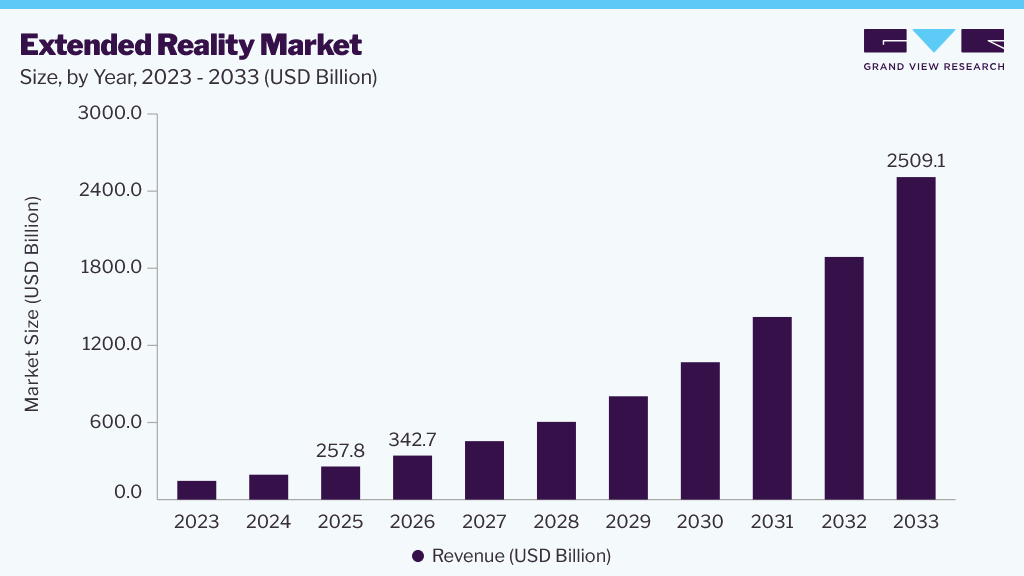 Source: Grand View Research, IR Documents, Primary Interviews, Paid DatabasesTo learn more about this report,
 Download Free Sample Report
Key Market Trends & Insights
- By component: The hardware segment held the largest market share of around 65.0% in 2025.
- By application: The virtual reality segment held the largest market share of over 55.0% in 2025.
- By industry vertical: The gaming segment held the largest market share of over 32.0% in 2025.
- By enterprise size: The large enterprise segment held the largest market share of over 64.5% in 2025.
Regional Highlights
- Largest regional market: North America (41.0% revenue share, 2025)
- Fastest-growing regional market: Middle East & Africa (highest CAGR, 2026-2033)
Market Size & Forecast
- Market size in 2025: USD 257.8 Billion
- Estimated market size in 2026: USD 342.7 Billion
- Projected market size by 2033: USD 2,509.1 Billion
- CAGR (2026-2033): 32.9%
Three ways to get this report
Buy it, customize it, or ask a question.Ask an Analyst
Analyst response in 1 business day
- AccessReport author, directly
- Reply timeWithin 1 working day
- No sales callDirect answer only
- FormatEmail reply
- CostFree, no cost
Get the Full Report
What the study covers
- FormatsPDF · Excel · Dashboard
- Timeline2026–2033 annual, 2025 base
- Coverage20+ countries, 5 regions
- Companies10+ key players profiled
Customize the Report
20% free customization
- IncludeCountries, segments, points
- TailorTo your product definition
- ExtendDeeper competitor detail
- OrA fully bespoke study
- Turnaround5–10 working days
The increasing adoption of extended reality (XR) across manufacturing, automotive, healthcare, education, and enterprise training is driving market growth. Growing investments in industrial digitalization and Industry 4.0 are accelerating the deployment of XR solutions for workforce training, remote assistance, and process optimization. For instance, in March 2025, Ericsson, Bharti Airtel, and Volvo Group announced a research collaboration in India to explore XR, digital twin technologies, and AI over 5G Advanced networks for manufacturing applications. The initiative supports industrial XR deployment through immersive workforce training and real-time operational optimization.
The expansion of 5G infrastructure is driving the adoption of extended reality by enabling low-latency communication, high-bandwidth connectivity, and real-time content delivery, which are required for immersive applications. These capabilities support cloud-based XR, remote collaboration, industrial automation, and enterprise training. For Instance, in March 2025, Ericsson, T-Mobile, and Qualcomm Technologies conducted XR trials over a commercial 5G Standalone network using 5G Advanced capabilities, demonstrating the commercial readiness of next-generation immersive applications.
Analyst Perspective
The extended reality market is entering a phase of commercial expansion as enterprises increasingly integrate immersive technologies into training, design, field operations, healthcare, and customer engagement. Continued improvements in spatial computing, artificial intelligence, edge computing, and 5G connectivity are expanding the practical use of XR across industrial and commercial environments. Technology providers are prioritizing lightweight devices, enterprise software platforms, and developer ecosystems to accelerate adoption. However, hardware affordability, interoperability across platforms, content availability, and data security remain important considerations that could influence the pace of large-scale deployment.
Component Insights
By component, the hardware segment held the largest market share, at around 65.0%, in 2025. The growth of the hardware segment can be attributed to technological innovations in hardware components, such as displays, sensors, processors, and optics, which have led to the development of lightweight and affordable XR headsets and accessories. For instance, in September 2025, Meta Platforms, Inc. introduced new mixed-reality hardware and platform enhancements at Meta Connect 2025, expanding its XR ecosystem with improved display technologies, AI capabilities, and developer tools.
The services segment is anticipated to witness the fastest CAGR during the forecast period. Cloud-based XR platforms drive the demand for XR services by providing scalable infrastructure, collaborative tools, and access to advanced development frameworks. Service providers use these platforms to accelerate development cycles, reduce costs, and offer subscription-based XR services. The increasing demand for customized XR solutions has led to the growth of service providers specializing in XR development and integration.
Application Insights
By application, the virtual reality segment held the largest market share, exceeding 55.0% in 2025. Industries such as healthcare, education, retail, manufacturing, and automotive are increasingly adopting virtual reality for workforce training, product design and visualization, virtual tours, remote collaboration, and customer engagement. The ability of virtual reality to simulate real-world environments in a safe and controlled setting improves operational efficiency, reduces training costs, and supports informed decision-making across industries. Continuous advancements in display technologies, motion tracking, graphics processing, and immersive content development are further expanding the adoption of virtual reality across both enterprise and consumer applications.
The augmented reality (AR) segment is expected to grow at the fastest CAGR during the forecast period. Augmented reality is driving innovation and immersive experiences in the gaming and entertainment industries, with the popularity of AR-enabled mobile games, location-based AR experiences, and AR-enhanced storytelling platforms. The proliferation of smartphones, coupled with the development of AR development platforms and software development kits (SDKs), is democratizing AR content creation and distribution, fueling the market growth.
Industry Vertical Insights
By industry vertical, the gaming segment held the largest market share of over 32.0% in 2025, owing to continued investments in VR gaming platforms, content development, and next-generation headsets. Improvements in display quality, motion tracking, spatial audio, and haptic technologies continue to enhance gameplay experiences and support consumer adoption.
The healthcare segment is expected to grow at the fastest CAGR during the forecast period. Healthcare professionals increasingly use extended reality for medical training, therapy, and surgical planning. This technology also provides significant opportunities for remote surgery and healthcare access in remote areas, without requiring emergency transportation.
Enterprise Size Insights
By enterprise size, the large enterprise segment held the largest market share of over 64.5% in 2025, owing to increasing investments in digital transformation, workforce training, remote collaboration, and customer engagement solutions. Large organizations are integrating XR technologies into field services, maintenance, product visualization, and technical support to improve operational efficiency and customer experience.
The small & medium enterprises segment is expected to grow at the fastest CAGR during the forecast period. Rising demand for immersive training and skill development solutions is driving the segment growth. XR technologies offer a cost-effective and scalable solution for delivering immersive training experiences that simulate real-world scenarios and environments. By investing in XR-based training programs, small and medium enterprises can ensure that their workforce remains skilled, adaptable, and capable of meeting evolving job requirements.
Regional Insights
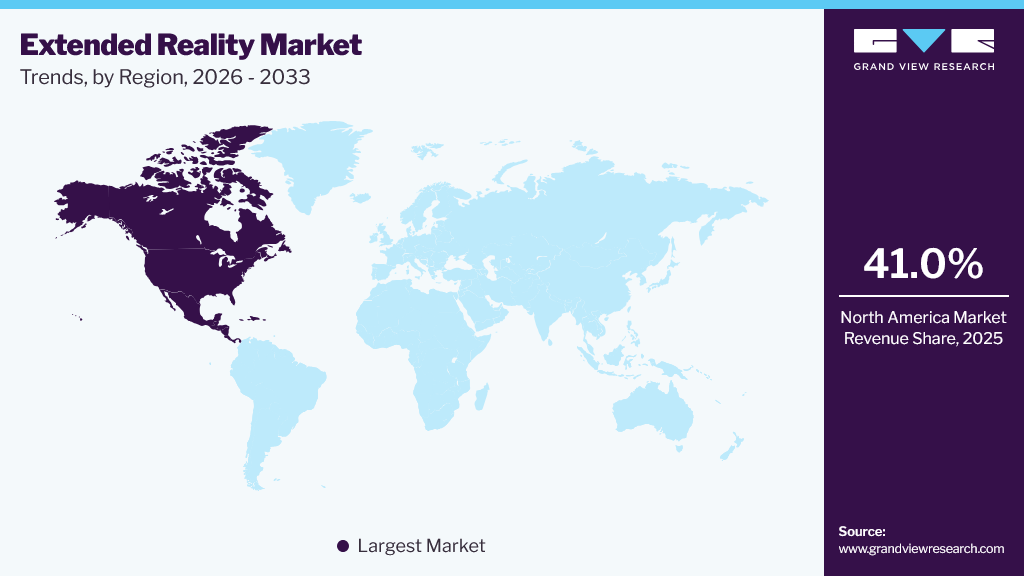
The North America extended reality industry dominated with a revenue share of approximately 41.0% in 2025, supported by strong investments in immersive technologies, advanced digital infrastructure, and the presence of leading XR hardware and software developers. Continuous innovation across spatial computing, artificial intelligence, and enterprise XR platforms is accelerating commercial adoption. For instance, in December 2024, Google, in collaboration with Qualcomm Technologies and Samsung, announced the Android XR platform, introducing a dedicated operating system for headsets and smart glasses powered by Gemini AI. The platform provides developers with a unified ecosystem for building immersive XR applications and is expected to accelerate the commercialization and adoption of XR devices across North America.
 To learn more about this report, Download Free Sample Report
U.S. Extended Reality Market Trends
The extended reality industry in the U.S. accounted for a significant share in 2025, as the region maintains advanced infrastructure for XR development and adoption, with major technology companies investing heavily in XR hardware and software and a booming startup ecosystem driving market growth. The country's innovation ecosystem continues to strengthen through advancements in spatial computing technologies. For instance, in April 2025, Niantic Spatial introduced its Spatial Platform at GDC 2025, enabling developers to build real world augmented reality applications using Visual Positioning System (VPS), geospatial artificial intelligence, and large-scale 3D mapping technologies. The platform enhances the development of enterprise and consumer XR applications, reinforcing the U.S., leadership in immersive technology innovation.
Asia Pacific Extended Reality Market Trends
The extended reality industry in the Asia Pacific is expected to grow at a significant CAGR during the forecast period. Many countries in the region are undergoing rapid urbanization and industrialization, driving demand for XR solutions in various industries. Emerging economies such as China, India, and Southeast Asia are witnessing significant infrastructure development, manufacturing, and construction investments. XR technologies are increasingly utilized for architectural visualization, urban planning, and industrial training, catering to rapidly growing urban populations and expanding industries.
The China extended reality industry is expected to grow at the fastest CAGR over the forecast period, as it is a major hardware manufacturer with a strong ecosystem of electronics suppliers, component manufacturers, and assembly factories. This strong manufacturing base enables Chinese companies to produce XR hardware at scale and competitive prices. Domestic XR hardware manufacturers use China's manufacturing capabilities to produce high quality VR headsets and accessories for domestic and international markets, driving adoption and market growth. For instance, in January 2025, XREAL introduced the XREAL One Pro and XREAL One Series at CES 2025, featuring the company's self-developed X1 spatial computing chip, an expanded field of view, and modular optics designed to enhance immersive experiences. The launch highlights China's continued innovation in XR hardware and strengthens its position as a global supplier of advanced augmented reality devices.
India extended reality industry is expected to witness strong growth owing to increasing investments in immersive technology startups, enterprise digital transformation, and expanding developer capabilities. Growing adoption of XR across education, manufacturing, healthcare, and industrial training is encouraging technology providers to develop localized XR applications and enterprise solutions.
Middle East & Africa Extended Reality Market
The extended reality industry in the Middle East & Africa is expected to grow at the fastest CAGR over the forecast period, due to rapid digitization and modernization efforts across various regional industries. XR technologies are offering innovative solutions for training, simulation, visualization, and remote collaboration. Industries such as oil and gas, construction, healthcare, and education are embracing XR to improve operational processes, optimize resource utilization, and deliver immersive experiences to employees and customers.
Key Extended Reality Company Insights
The extended reality industry is highly competitive, with leading technology companies focusing on hardware innovation, software platform development, strategic collaborations, developer ecosystem expansion, and enterprise solution deployment. Companies continue to strengthen their market position through investments in artificial intelligence, spatial computing, cloud infrastructure, and next-generation XR devices while expanding partnerships across gaming, healthcare, manufacturing, retail, and industrial sectors.
Key Extended Reality Companies:
The following key companies have been profiled for this study on the extended reality market:
-
Accenture
-
Apple Inc.
-
Google
-
HTC Corporation
-
Meta Platforms, Inc.
-
Microsoft
-
Northern Digital Inc.
-
PTC Inc.
-
Qualcomm Technologies Inc.
-
Samsung Electronics Co., Ltd.
-
Seiko Epson Corporation
-
SoftServe Inc.
-
Sony Group Corporation
-
SphereGen Technologies LLC
Recent Developments
-
In June 2025, Apple Inc. announced visionOS 26 for Apple Vision Pro, introducing features such as spatial widgets, enhanced Personas, enterprise APIs, Logitech Muse support, and native compatibility with Sony PlayStation VR2 Sense controllers. The update expands the platform's capabilities for enterprise collaboration, productivity, and immersive spatial computing across the Apple extended reality ecosystem.
-
In January 2024, Qualcomm launched the Snapdragon XR2+ Gen 2 Platform, designed to support next generation augmented, virtual, and mixed reality devices. The platform delivers enhanced graphics performance, low-latency processing, and on-device AI capabilities, enabling the development of advanced AR smart glasses and immersive XR applications across enterprise and consumer markets.
Extended Reality Market Report Scope
Report Attribute
Details
Market size in 2025
USD 257.8 billion
Estimated market size in 2026
USD 342.7 billion
Projected market size by 2033
USD 2,509.1 billion
Growth rate
CAGR of 32.9% from 2026 to 2033
Base year for estimation
2025
Actual data
2021 – 2024
Forecast period
2026 – 2033
Quantitative units
Revenue in USD billion and CAGR from 2026 to 2033
Report coverage
Revenue forecast, company ranking, competitive landscape, growth factors, and trends
Segments covered
Component, application, industry vertical, enterprise size, region
Regional Scope
North America; Europe; Asia Pacific; Central & South America; Middle East & Africa
Country Scope
U.S.; Canada; Mexico; UK; Germany; France; Italy; Spain; China; India; Japan; Australia & New Zealand, South Korea; Brazil; Argentina, South Africa, UAE
Key companies profiled
Accenture; Apple Inc.; Google; HTC Corporation; Meta Platforms, Inc.; Microsoft; Northern Digital Inc.; PTC Inc.; Qualcomm Technologies Inc.; Samsung Electronics Co., Ltd.; Seiko Epson Corporation; SoftServe Inc.; Sony Group Corporation; SphereGen Technologies LLC
Customization scope
Free report customization (equivalent up to 8 analysts working days) with purchase. Addition or alteration to country, regional & segment scope.
Pricing and purchase options
Avail of customized purchase options to meet your exact research needs. Explore purchase options
Global Extended Reality Market Report Segmentation
This report forecasts revenue growth at global, regional, and country levels and provides an analysis of the latest industry trends and opportunities in each of the sub-segments from 2021 to 2033. For this study, Grand View Research has segmented the global extended reality market report based on component, application, industry vertical, enterprise size, and region:
-
Component Outlook (Revenue, USD Billion, 2021 - 2033)
-
Hardware
-
Software
-
Services
-
-
Application Outlook (Revenue, USD Billion, 2021 - 2033)
-
Augmented Reality (AR)
-
Virtual Reality (VR)
-
Mixed Reality (MR)
-
-
Industry Vertical Outlook (Revenue, USD Billion, 2021 - 2033)
-
Aerospace & Defense
-
Manufacturing
-
Automotive
-
Education
-
Media & Entertainment
-
Gaming
-
Healthcare
-
Retail & E-commerce
-
-
Enterprise Size Outlook (Revenue, USD Billion, 2021 - 2033)
-
Large Enterprises
-
Small & Medium Enterprises
-
-
Regional Outlook (Revenue, USD Billion, 2021 - 2033)
-
North America
-
U.S.
-
Canada
-
-
Europe
-
UK
-
Germany
-
Italy
-
France
-
-
Asia Pacific
-
China
-
India
-
Japan
-
South Korea
-
Australia
-
-
Latin America
-
Brazil
-
Mexico
-
Argentina
-
-
Middle East & Africa
-
UAE
-
Saudi Arabia
-
South Africa
-
-
Frequently Asked Questions About This Report
North America dominated with a 41.0% revenue share in 2025.
The global extended reality market size was valued at USD 257.8 billion in 2025 and is estimated at USD 342.7 billion for 2026.
The hardware extended reality segment accounted for the largest revenue share of around 65.0% in 2025.
The global extended reality market is expected to grow at a CAGR of 32.9% from 2026 to 2033, reaching USD 2,509.1 billion by 2033.
Some key players operating in the extended reality market include Accenture Plc, Apple Inc., Google LLC, HTC Corporation, Meta Platforms, Inc., Microsoft, Northern Digital Inc., PTC Inc., Qualcomm Technologies Inc., Samsung Electronics Co., Ltd., Seiko Epson Corporation, SoftServe Inc., Sony Group Corporation, SphereGen Technologies LLC, and others.
About the Author(s)
Next Generation Technologies Research Team
Technology · Next Generation TechnologiesThis report was authored by the next generation technologies research team at Grand View Research - comprising two research analysts, one senior research analyst, and one industry expert - with specialized expertise in the next generation technologies segment of the technology industry. All findings are based on proprietary technology databases, executive interviews, and regulatory analysis, subject to internal peer review prior to publication.
Last Updated:
Speak to Analyst

Customize this report to your needs - add regions, segments, or data points, with 20% free customization.
Or view our licence options:


ISO 9001:2015 & 27001:2022 Certified
We are GDPR and CCPA compliant! Your transaction & personal information is safe and secure. For more details, please read our privacy policy.


