
- Home
- »
- Consumer Goods
- »
-
France Cosmetics Market Size & Share Report, 2027-2035GVR Report cover

France Cosmetics Market (2027 - 2035)
Size, Share & Trends Analysis Report By Product (Skin Care, Hair Care), By End-use (Women, Men), By Distribution Channel (Hypermarkets & Supermarkets, Specialty Beauty Stores, Online/E-commerce), And Segment Forecasts
Market Size, 2026
$17.4BMarket Estimate, 2027
$18.6BMarket Forecast, 2035
$29.7BCAGR, 2027–2035
6.0%France Cosmetics Market Summary
The France cosmetics market size was valued at USD 17.4 billion in 2026 and is projected to grow from USD 18.6 billion in 2027 to USD 29.7 billion by 2035, at a CAGR of 6.0% from 2027 to 2035. Market growth is supported by France's established beauty and personal care industry, strong consumer preference for skincare and fragrances, and the continued popularity of premium and luxury cosmetic products. Increasing interest in ingredient transparency, natural and organic formulations, and dermatologically tested products is influencing purchasing decisions.
Key Market Trends & Insights
- By product: Skin care segment accounted for the largest revenue share of 38.6% in 2026.
- By end use: Women segment accounted for the largest revenue share of 69.2% in 2026.
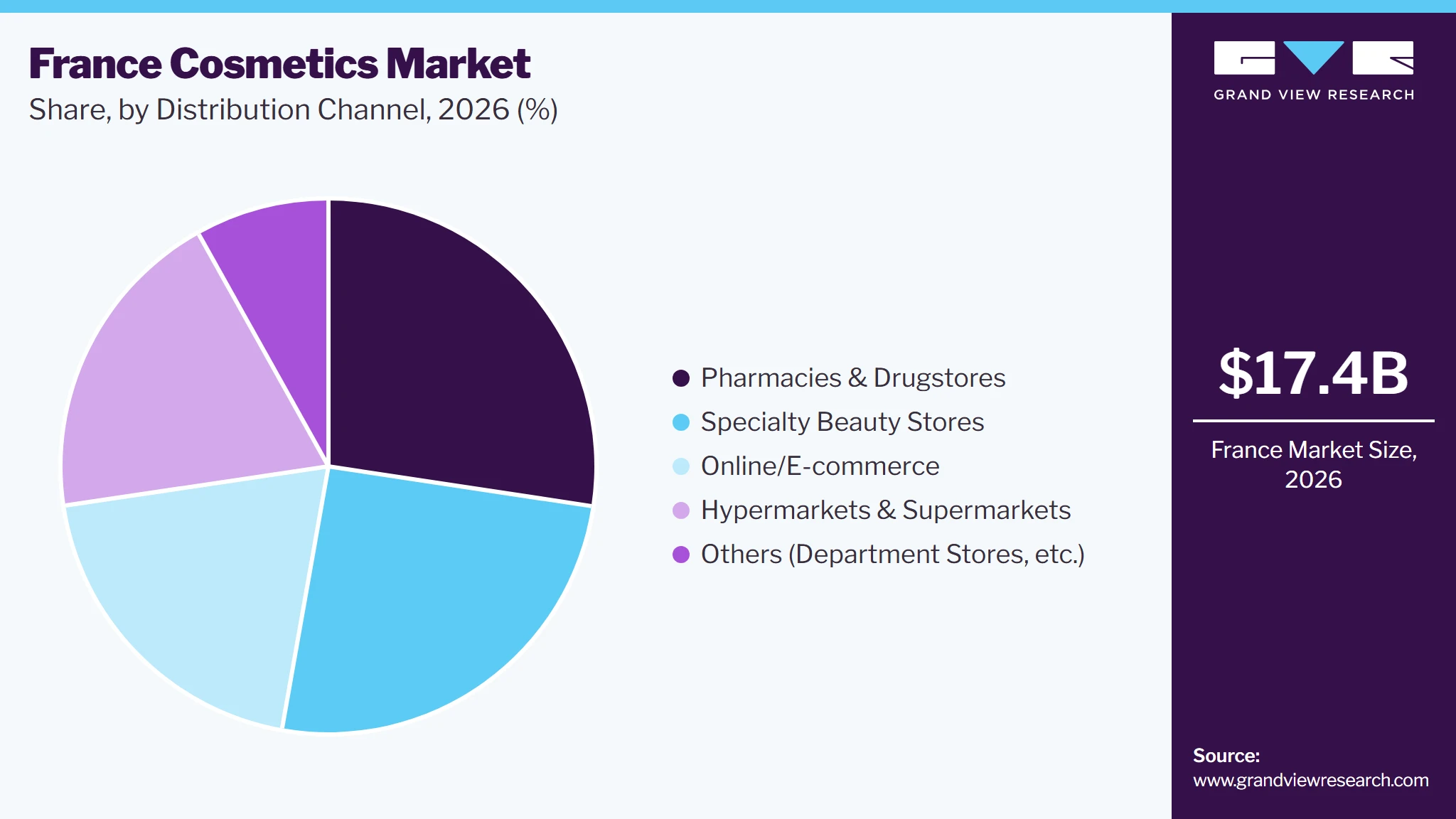
- By distribution channel: Pharmacies & drugstores accounted for the largest revenue share of 27.4% in 2026.
Market Size & Forecast
- Market Size in 2026: USD 17.4 Billion
- Estimated Market Size in 2027: USD 18.6 Billion
- Projected Market Size by 2035: USD 29.7 Billion
- CAGR (2027-2035): 6.0%
Prism AI by Grand View Research Free to tryAsk a question about the france cosmetics marketTry asking✓Every figure cited from GVR research Prefer the report? Download free sample →Increasing awareness of skin health, personal grooming, and preventive skincare is supporting the demand for cosmetics products in France. Consumers are incorporating facial cleansers, moisturizers, serums, sunscreens, and anti-aging treatments into their daily routines to address concerns related to hydration, skin sensitivity, pigmentation, and premature aging. According to the 2026 Skin Barometer conducted by Typology in collaboration with Ifop, 84% of French consumers use facial skincare products, with consumers using an average of three to four products daily. Furthermore, 46% of consumers aged 35-59 reported concerns related to wrinkles and fine lines, indicating demand for anti-aging creams, targeted serums, and specialized skincare treatments. These evolving consumer habits are encouraging manufacturers to expand their skincare portfolios with targeted formulations that address specific skin concerns and daily beauty requirements.
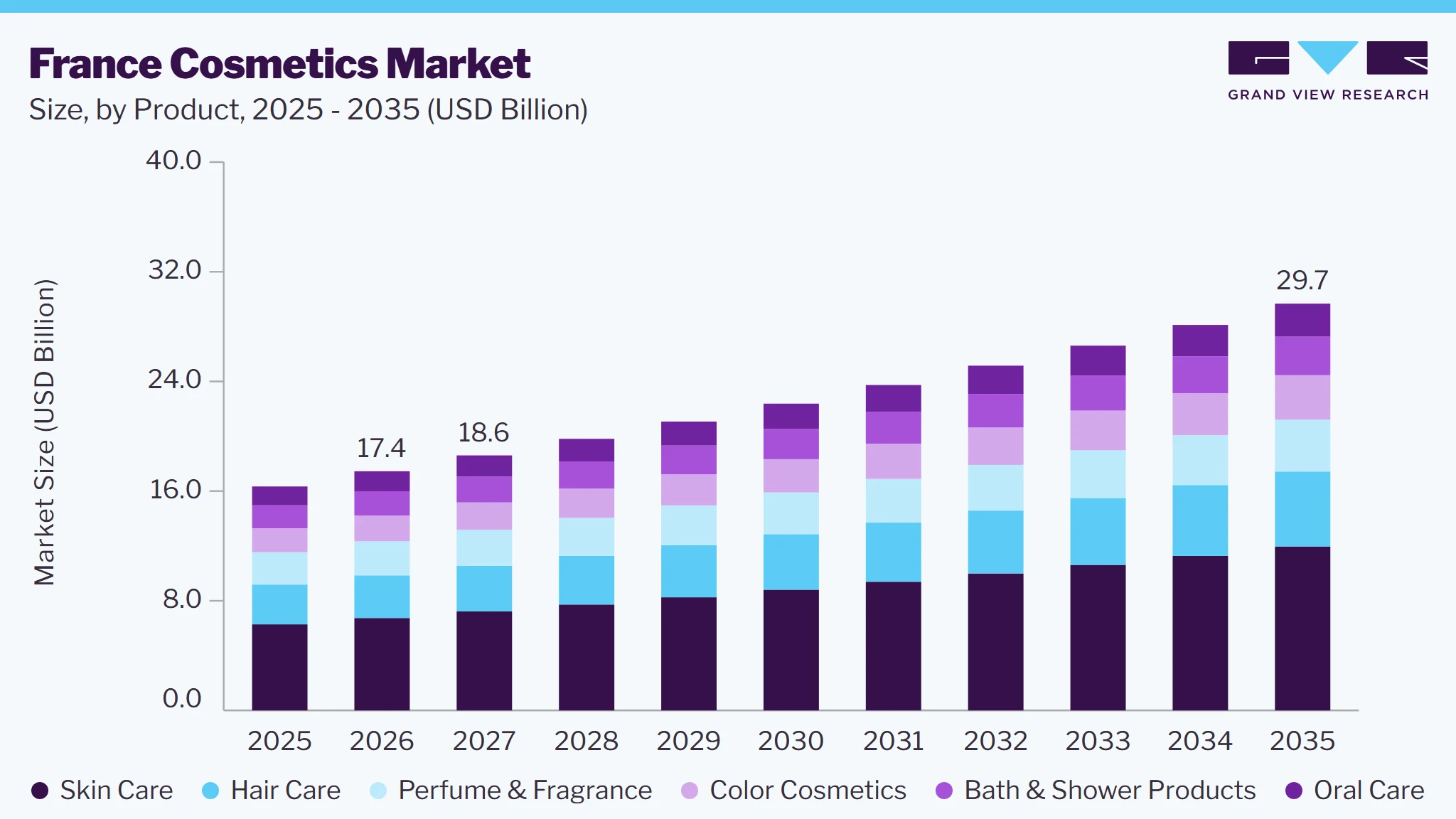 Source: Grand View Research, IR Documents, Primary Interviews, Paid DatabasesTo learn more about this report,
 Download Free Sample Report
Growing consumer attention toward ingredient transparency, product safety, and environmental sustainability is encouraging demand for natural and organic cosmetics in France. Consumers are increasingly considering botanical extracts, plant-derived ingredients, naturally sourced oils, and environmentally responsible formulations when selecting beauty products. According to the 2026 Typology × Ifop Skin Barometer, 45% of facial skincare users prefer natural ingredients. Additionally, a 2025 study conducted by the Green Impact Index Consortium in collaboration with Verian found that 64% of French consumers were willing to switch brands based on a product's environmental score, while 78% indicated that clear environmental and social impact labeling could influence their purchasing decisions. These preferences are encouraging cosmetics manufacturers to introduce naturally derived formulations, recyclable packaging, refillable product formats, and transparent ingredient disclosures, strengthening the demand for sustainable beauty offerings.
Market Dynamics
France's strong association with luxury, fashion, perfumery, and high-end beauty is supporting demand for premium cosmetic products. Consumers are interested in sophisticated skincare formulations, high-performance beauty treatments, luxury fragrances, and premium makeup products that offer differentiated quality and brand value. The presence of internationally recognized French beauty houses and established luxury brands strengthens consumer exposure to premium offerings. In addition, manufacturers are investing in advanced formulations, exclusive product ranges, refined packaging, and limited-edition collections to attract consumers seeking elevated beauty experiences. This trend is creating opportunities for premium skincare, fragrances, and color cosmetics across the French market. In January 2026, French luxury beauty brand Guerlain expanded its ultra-premium Orchidée Impériale Gold Nobile skincare range with the launch of Goldessence, a new activating lotion developed to complement its existing skincare portfolio. The product features a patented two-part formulation containing nourishing spheres infused with orchid oil extract, designed to improve skin hydration, radiance, smoothness, and texture. Developed over three years, the formulation reflects the brand's focus on advanced skincare technology and premium beauty experiences.
Increasing regulatory scrutiny of cosmetic ingredients is creating formulation and product development challenges for manufacturers operating in France. European restrictions on specific chemical substances, preservatives, UV filters, and intentionally added microplastics require companies to continuously assess ingredient compliance and modify product compositions where necessary. For instance, France has introduced restrictions on intentionally added microplastics in certain cosmetic products, including rinse-off exfoliating and cleansing products containing solid plastic particles. Such requirements can necessitate investment in alternative ingredients, formulation testing, product safety assessments, and manufacturing adjustments. Smaller manufacturers may face greater difficulties in absorbing these additional expenses, while reformulation activities can also affect product performance, stability, and commercialization timelines.
Advancements in artificial intelligence, digital skin assessment, and beauty recommendation technologies are creating opportunities for cosmetics companies to deliver more personalized consumer experiences in France. Consumers increasingly seek products suited to their individual skin types, concerns, ingredient preferences, and beauty routines. Manufacturers and retailers can leverage digital skin analysis, virtual product trials, AI-powered beauty consultations, and customized product recommendations to improve product discovery and purchasing confidence. These technologies also provide opportunities to strengthen online engagement, collect consumer preference insights, and introduce targeted skincare and makeup offerings. Furthermore, integrating digital consultation tools with e-commerce platforms and physical beauty retail stores can help brands improve customer retention and differentiate themselves in the competitive French cosmetics industry.
Analyst Perspective
The industry benefits from the country's strong heritage in perfumery, luxury beauty, and skincare innovation. Consumer purchasing patterns are influenced by brand reputation, product formulation, ingredient quality, and the appeal of French beauty expertise. Demand for dermocosmetics, botanical-based skincare, sophisticated fragrances, and premium makeup is creating opportunities for both established beauty houses and emerging brands. The presence of globally recognized cosmetics manufacturers, specialized pharmacy retailers, and established beauty distribution networks is shaping competitive strategies. Companies are focusing on refillable packaging, sustainable product formulations, advanced skincare technologies, and exclusive product collections to strengthen brand differentiation and attract consumers seeking distinctive beauty offerings.
Consumer Insights
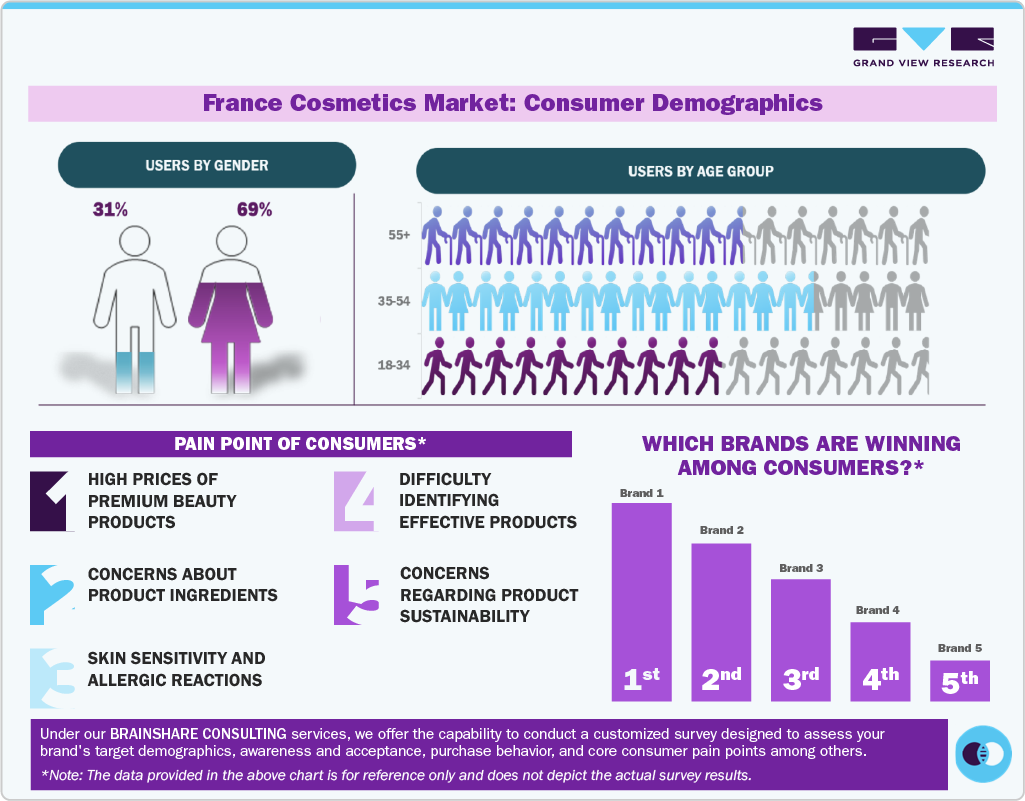
Consumer demand in the French cosmetic products market is influenced by factors such as gender, age, skin type, lifestyle, personal grooming preferences, and interest in product quality, ingredient safety, and sustainability. Purchasing decisions are shaped by brand reputation, product formulations, skin compatibility, pricing, product effectiveness, and the availability of skincare, haircare, fragrances, and color cosmetics across retail channels.
 To learn more about this report, Download Free Sample Report
Users by gender
-
Male consumers account for an estimated 31% of France's cosmetics market users, with demand supported by increasing interest in personal grooming, skincare, haircare, fragrances, deodorants, and specialized facial care products. Growing awareness of skin health and the availability of targeted grooming and skincare formulations are encouraging greater male participation in cosmetics consumption.
-
Female consumers account for an estimated 69% of users, supported by established demand for skincare, color cosmetics, haircare, fragrances, and personal care products. Preferences for facial treatments, moisturizers, anti-aging solutions, makeup, and specialized beauty formulations contribute to higher female participation in the market.
Users by age group
Consumers aged 18-34 demonstrate interest in cosmetics through evolving beauty trends, skincare experimentation, social media influence, and demand for innovative formulations. Consumers aged 35-54 represent the largest user group in the provided demographic illustration, supported by established purchasing preferences for skincare, anti-aging products, haircare, fragrances, and premium beauty solutions. Meanwhile, consumers aged 55 and above contribute to demand through interest in age-specific skincare, moisturizing treatments, haircare, and products addressing concerns such as wrinkles, skin dryness, and loss of firmness.
Consumers encounter several challenges when selecting and purchasing cosmetic products, particularly regarding affordability, ingredient transparency, product effectiveness, skin compatibility, and environmental considerations.
-
High Prices of Premium Beauty Products: Premium skincare, luxury fragrances, specialized treatments, and branded cosmetics often involve higher purchase costs. These prices can limit accessibility for price-conscious consumers and encourage comparisons between premium and mass-market alternatives.
-
Concerns About Product Ingredients: Consumers examine ingredient lists and product formulations when purchasing cosmetics. Concerns about certain synthetic ingredients, preservatives, fragrances, and potentially irritating substances can create uncertainty about product suitability and safety.
-
Skin Sensitivity and Allergic Reactions: Consumers with sensitive skin and specific dermatological concerns may experience difficulties identifying suitable cosmetic formulations. Certain fragrances, preservatives, and active ingredients can cause irritation, redness, or allergic reactions, increasing demand for skin-compatible products.
-
Difficulty Identifying Effective Products: The extensive availability of cosmetics across different brands, formulations, and price categories makes product selection challenging. Consumers may struggle to identify products that deliver expected results for their specific skincare, haircare, and beauty requirements.
-
Concerns Regarding Product Sustainability: Growing environmental awareness is increasing consumer attention toward cosmetic packaging, ingredient sourcing, and manufacturing practices. Limited availability of refillable packaging, recyclable materials, and transparent sustainability information can influence purchasing decisions.
Product Insights
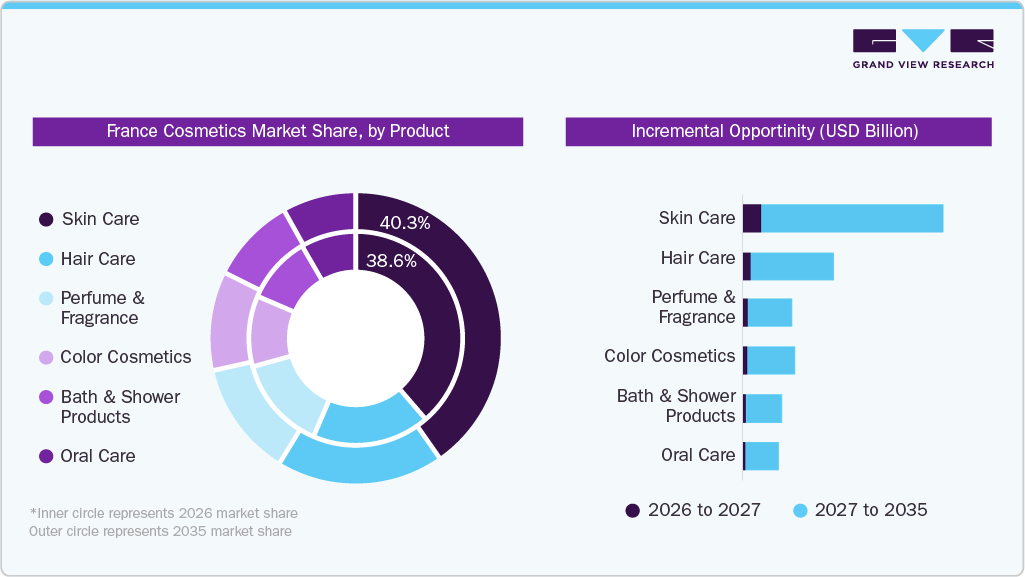
The skin care segment accounted for the largest revenue share of 38.6% in 2026, supported by increasing consumer awareness of skin health, preventive skincare, and specialized beauty treatments. French consumers are increasingly incorporating facial cleansers, moisturizers, serums, anti-aging creams, sunscreens, and targeted skincare products into their daily routines to address concerns related to hydration, skin sensitivity, pigmentation, acne, and premature aging. In July 2025, CHANEL introduced LA MOUSSE, a cream-to-foam facial cleanser designed to remove makeup, excess sebum, pollution particles, and UV filters while maintaining the skin barrier. The formulation transforms into a rich foam upon contact with water, offering effective cleansing while addressing consumer preferences for gentle and premium skincare products.
 To learn more about this report, Download Free Sample Report
The hair care segment is projected to grow at a CAGR of 6.4% from 2027 to 2035. French consumers are extending skincare-inspired routines to hair care, with growing attention to scalp hydration, sensitivity, dandruff management, and hair loss prevention. This is encouraging demand for scalp exfoliators, leave-in treatments, hair growth serums, and targeted shampoos. In March 2025, Yves Rocher launched its Balance Scalp Serum, expanding its hair care portfolio with a treatment designed to balance the scalp and reduce feelings of discomfort. The pre-shampoo serum can be used as a treatment or maintenance product and contains 96% organic-certified ingredients of natural origin. Developed through nine years of research and supported by two patents, the launch reflects the growing focus on scalp health, plant-based formulations, and skincare-inspired hair care solutions in France.
End Use Insights
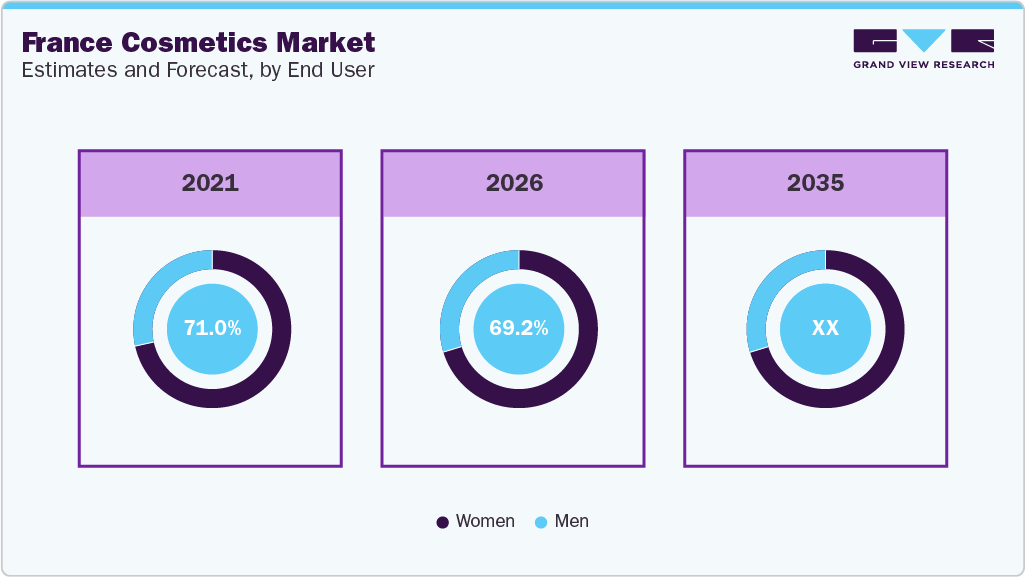
The women segment accounted for the largest revenue share of 69.2% in 2026, reflecting their significant contribution to overall product consumption. In France, demand within this end-user group is influenced by evolving beauty trends, fashion preferences, social media exposure, and the availability of products across mass-market, premium, and luxury price categories. Women consumers increasingly explore diverse makeup styles, seasonal color trends, and products suited to professional, casual, and special-occasion use. Demand for inclusive shade ranges, convenient application formats, and long-lasting formulations also influences purchasing decisions. In January 2026, Yves Saint Laurent Beauty introduced the limited-edition Nude Hours palette in France, featuring nine nude shades with matte, satin, metallic, and shimmer finishes. The palette is designed to create versatile everyday eye makeup looks.
 To learn more about this report, Download Free Sample Report
The men segment is projected to grow at a CAGR of 7.2% from 2027 to 2035. Growth is supported by increasing acceptance of skincare and personal grooming routines among male consumers in France. Demand extends beyond traditional shaving and fragrance products to facial cleansers, moisturizers, sunscreens, anti-aging creams, beard care products, and hair styling solutions. Men are exploring products that offer convenience, easy application, and targeted benefits for concerns such as dryness, excess oil, skin irritation, and signs of aging. The growing availability of gender-neutral beauty ranges and specialized men's grooming collections is also broadening product choices. Cosmetic brands are responding by introducing simplified skincare routines, multifunctional formulations, and dedicated grooming products that cater to evolving male beauty preferences.
Distribution Channel Insights
The pharmacies & drugstores segment accounted for the largest revenue share of 27.4% in 2026, reflecting the importance of pharmacy-led retail in cosmetic product sales. In France, this channel benefits from an established network of neighborhood pharmacies and drugstores offering convenient access to skincare, haircare, body care, fragrances, and selected color cosmetics. Consumers value the accessibility of these outlets, product variety, competitive pricing, and availability of established domestic and international beauty brands. Pharmacies are also expanding their cosmetic assortments to include everyday makeup essentials, lip care products, sunscreens, and multifunctional beauty formulations. In addition, loyalty schemes, in-store promotions, and online ordering services are helping retailers strengthen customer engagement and encourage repeat purchases. For instance, French organic skincare brand PATYKA introduced its Hydra collection to strengthen its presence in the French pharmacy channel. The six-product range includes a mask, serum, creams, eye care, and lip care products, with a focus on intensive hydration. The collection is positioned at accessible premium price points, with several products priced below EUR 30.
 To learn more about this report, Download Free Sample Report
The online/e-commerce segment is projected to grow at a CAGR of 8.2% from 2027 to 2035, reflecting increasing adoption of digital platforms for cosmetic product discovery and purchase in France. Consumers use brand websites, online beauty retailers, marketplaces, and pharmacy e-commerce platforms to explore product ranges, compare prices, and read customer reviews before making purchase decisions. Social media platforms, beauty influencers, and digital tutorials are also influencing product awareness and encouraging consumers to experiment with new brands and beauty trends. Features such as virtual makeup try-ons, personalized product recommendations, promotional discounts, and convenient home delivery are enhancing the online shopping experience. Beauty brand Rhode expanded into France through Sephora's online platform in September 2026, as part of its European retail expansion. The assortment includes skincare products, pigmented blushes, and the Pocket Bronze and Highlight Milk collections, combining skincare and makeup offerings.
Key France Cosmetics Company Insights
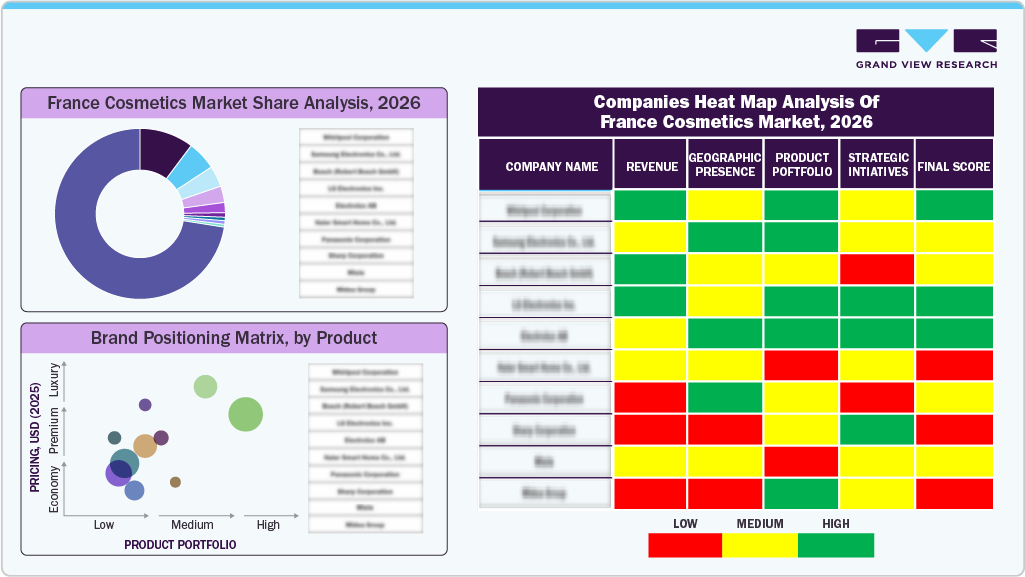
The France cosmetics market is characterized by competition among diversified beauty and personal care manufacturers, luxury beauty houses, premium skincare brands, and specialized dermocosmetic companies. Competitive positioning is influenced by brand heritage, product quality, formulation innovation, pricing strategies, consumer loyalty, and distribution reach across pharmacies, specialty beauty stores, department stores, and online platforms. L’Oréal S.A. maintains a prominent position through its broad portfolio spanning mass-market, premium, luxury, and dermatological beauty categories.
-
Diversified Beauty and Personal Care Manufacturers: L’Oréal S.A. maintains a strong competitive position in France through an extensive portfolio spanning skincare, haircare, color cosmetics, fragrances, and professional beauty products. Its brands, including L’Oréal Paris, Garnier, Maybelline New York, Lancôme, and Kérastase, cater to consumers across mass-market and premium categories. The company's competitive strategy emphasizes research and development, advanced formulations, product innovation, and a broad distribution network. Shiseido Company, Limited, also competes through skincare, makeup, and fragrance brands, focusing on formulation technology, premium positioning, and products tailored to diverse consumer needs.
-
Luxury Cosmetics and Prestige Beauty Manufacturers: LVMH Moët Hennessy Louis Vuitton SE and Chanel Limited maintain competitive positions through premium skincare, color cosmetics, and fragrance portfolios. LVMH strengthens its presence through brands such as Dior, Guerlain, and Givenchy, supported by luxury positioning, product innovation, and exclusive retail experiences. Chanel competes through its established fragrance, makeup, and skincare collections, emphasizing brand heritage, product quality, and distinctive packaging. The Estée Lauder Companies Inc. also participates in the prestige beauty category through brands such as Estée Lauder, MAC Cosmetics, Clinique, and Bobbi Brown, targeting consumers seeking premium skincare and makeup products.
-
Premium Skincare and Dermocosmetic Manufacturers: Groupe Clarins S.A., Beiersdorf AG, and Pierre Fabre S.A. strengthen competition through specialized skincare, body care, sun protection, and dermatological beauty products. Clarins maintains its presence through premium skincare, makeup, and body care offerings, with an emphasis on plant-based ingredients and targeted formulations. Beiersdorf competes through brands such as NIVEA, Eucerin, and Labello, covering everyday skincare, dermocosmetics, and lip care. Pierre Fabre strengthens its position through brands such as Eau Thermale Avène, Ducray, and A-Derma, focusing on dermatological skincare, sensitive skin, and specialized skin treatments. Their strategies emphasize product efficacy, research, skin compatibility, and consumer trust.
 To learn more about this report, Download Free Sample Report
Key France Cosmetics Companies
-
L’Oréal S.A.
-
LVMH Moët Hennessy Louis Vuitton SE
-
Chanel Limited
-
Groupe Clarins S.A.
-
Coty Inc.
-
Beiersdorf AG
-
Pierre Fabre S.A.
-
The Estée Lauder Companies Inc.
-
Groupe Rocher (Yves Rocher)
-
Shiseido Company, Limited
Competitive Benchmarking
Category
Operating Strategies
Competitive Edge
Key Challenges
Personal Care Players: L’Oréal S.A.; Coty Inc.; Shiseido Company, Limited
- These companies focus on maintaining broad product portfolios across skincare, haircare, color cosmetics, fragrances, and personal grooming. Their strategies emphasize continuous product innovation, advanced formulations, premium and mass-market product development, and expansion across online and offline distribution channels. They also invest in marketing campaigns, brand collaborations, and digital beauty technologies to strengthen consumer engagement in France.
- Strong international brand recognition, diversified product portfolios, established retail partnerships, and significant research and development capabilities provide competitive advantages. Their presence across multiple beauty categories and price points enables them to reach diverse consumer groups in the French market.
- These companies face intense competition from international and domestic beauty brands, changing consumer preferences, pricing pressures, and increasing expectations for sustainable formulations and packaging. Maintaining brand differentiation while meeting evolving regulatory requirements and investing in product innovation also requires continuous expenditure.
Luxury and Prestige Beauty Players: LVMH Moët Hennessy Louis Vuitton SE; Chanel Limited; The Estée Lauder Companies Inc.
- These companies concentrate on premium and luxury skincare, color cosmetics, and fragrances. Their operating strategies emphasize exclusive product launches, distinctive formulations, premium packaging, brand heritage, and high-end retail experiences. They also strengthen their market presence through selective distribution, flagship stores, department store partnerships, and digital engagement initiatives.
- Established luxury positioning, strong brand loyalty, premium product quality, and extensive fragrance and beauty portfolios provide competitive advantages. Their ability to leverage brand heritage, exclusivity, and differentiated consumer experiences supports their positioning in France's premium beauty market.
- Key challenges include changing luxury consumption patterns, competition from niche and emerging prestige brands, premium pricing pressures, and the need to maintain exclusivity across distribution channels. These companies must also respond to increasing demand for sustainable packaging, ingredient transparency, and responsible sourcing.
Recent Developments
-
In January 2026, Luxéol launched its new Bond Repair range in France, targeting damaged, weakened, and bleached hair through a three-step hair repair protocol comprising shampoo, mask, and serum. The range is formulated with chia seed extract to strengthen the internal hair structure, improve resistance to breakage, and maintain moisture, while pine bark extract helps protect hair fibers against oxidative damage caused by UV exposure, pollution, and heat. The Bond Repair Shampoo smooths and coats the hair fiber while improving flexibility and strength. The accompanying mask provides conditioning and detangling benefits, while the serum helps reduce frizz and breakage and moisturizes hair. The formulations are free from silicones and sulphated surfactants and are made in France.
-
In November 2026, Japanese haircare brand &honey entered the French market, expanding its international presence with a portfolio of honey-based haircare products, including shampoos, conditioners, and hair oils. The brand introduced its Deep Moist, Melty, and Deep Moist Sakura ranges to address hair dryness, dehydration, and frizz. The Deep Moist range combines manuka, acacia, and raw honey with hyaluronic acid and royal jelly to improve hair hydration, while the Melty range incorporates keratin to enhance smoothness, softness, and manageability.
France Cosmetics Market Report Scope
Report Attribute
Details
Market size in 2026
USD 17.4 billion
Estimated market size in 2027
USD 18.6 billion
Projected market size by 2035
USD 29.7 billion
Growth rate
CAGR of 6.0% from 2027 to 2035
Base Year
2026
Actuals
2023 - 2025
Forecast period
2027 - 2035
Quantitative units
Revenue in USD billion and CAGR from 2027 to 2035
Report coverage
Revenue forecast, company ranking, competitive landscape, growth factors, and trends
Segments covered
Product, end use, distribution channel
Key companies profiled
L’Oréal S.A.; LVMH Moët Hennessy Louis Vuitton SE; Chanel Limited; Groupe Clarins S.A.; Coty Inc.; Beiersdorf AG; Pierre Fabre S.A.; The Estée Lauder Companies Inc.; Groupe Rocher (Yves Rocher); Shiseido Company, Limited.
Customization scope
Free report customization (equivalent up to 8 analysts’ working days) with purchase. Addition or alteration to country, regional & segment scope.
Pricing and purchase options
Avail customized purchase options to meet your exact research needs. Explore purchase options
France Cosmetics Market Report Segmentation
This report forecasts revenue growth at the country level and provides an analysis of the latest trends and opportunities in each of the sub-segments from 2023 to 2035. For this study, Grand View Research has segmented the France cosmetics market report based on product, end use, and distribution channel.
-
Product Outlook (Revenue, USD Billion, 2023 - 2035)
-
Skin Care
-
Face Skin Care
-
Lotions, Face Creams, & Moisturizers
-
Cleansers & Face Wash
-
Facial Serums
-
Sunscreen/Sun Care
-
Sheet Face Masks
-
Others
-
-
Body Skin Care
-
Hair Removal Products
-
Lotions, Creams, & Moisturizers
-
Body Sunscreen/Sun Care
-
Body Scrub
-
Others
-
-
-
Hair Care
-
Shampoo
-
Conditioner
-
Oils
-
Colorants
-
Serums
-
Others
-
-
Oral Care
-
General Purpose Products
-
Toothpaste
-
Toothbrush
-
Mouthwashes/Rinses
-
Dental Floss
-
Others
-
-
Color Cosmetics
-
Face Color Cosmetics
-
Foundation
-
Concealer
-
Blush and Bronzer
-
Powder
-
Others
-
-
Lip Color Cosmetics
-
Lipstick
-
Lip Liner
-
Lip Gloss
-
Lip Tint
-
Others
-
-
Eye Color Cosmetics
-
Eye Shadow
-
Eye Liner
-
Mascara
-
Eye Pencil
-
Others
-
-
Nail Color Cosmetics
-
-
Bath & Shower Products
-
Bar Soap
-
Body Wash & Shower Gel
-
Body Scrubs & Exfoliators
-
Others
-
-
Perfume & Fragrance
-
Fine Fragrances (EDP, EDT, EDC)
-
Body Mists & Body Sprays
-
Deodorants
-
Attars & Non-alcoholic Perfume Oils
-
Others
-
-
End Use Outlook (Revenue, USD Billion, 2023 - 2035)
-
Men
-
Women
-
-
Distribution Channel Outlook (Revenue, USD Billion, 2023 - 2035)
-
Hypermarkets & Supermarkets
-
Specialty Beauty Stores
-
Pharmacies & Drugstores
-
Online/E-commerce
-
Others (Department Stores, etc.)
-
-
Research Methodology
The France cosmetics market figures in this report are based on a proven research process that combines executive interviews with secondary research from proprietary databases, company filings, and recognized regulatory and institutional sources. Market size is built through value-chain sizing - reconciling supply-side and demand-side estimates - and triangulated with bottom-up and top-down approaches. Every estimate passes multiple levels of expert validation before publication, with each France cosmetics segment quantified using the revenue-capture definitions in the table below.
Segment Definition
Segment - Product
Revenue capture definition
Skin Care
Revenue generated from cosmetic products designed to cleanse, moisturize, protect, and improve the appearance and condition of facial and body skin. Includes facial cleansers, moisturizers, face creams, serums, toners, sunscreens, exfoliators, face masks, body lotions, and other specialized skin treatment products. Revenue is captured from products sold through pharmacies, drugstores, supermarkets, beauty specialty retailers, department stores, brand-owned stores, and online platforms.
Hair Care
Revenue generated from cosmetic products formulated to cleanse, condition, nourish, protect, and style hair and scalp. Includes shampoos, conditioners, hair masks, hair oils, serums, styling gels, sprays, hair creams, hair colorants, and other hair treatment products. Revenue is captured from products sold through drugstores, supermarkets, pharmacies, beauty specialty stores, salons, brand-owned stores, and online platforms.
Oral Care
Revenue generated from consumer products designed to maintain oral hygiene, clean teeth, protect gums, and support overall dental health. Includes toothpaste, toothbrushes, mouthwashes, dental floss, interdental brushes, teeth-whitening products, and other oral hygiene solutions. Revenue is captured from products sold through pharmacies, drugstores, supermarkets, discount retailers, specialty stores, and online platforms.
Color Cosmetics
Revenue generated from cosmetic products intended to enhance, define, and modify facial, eye, lip, and nail appearance through decorative applications. Includes foundations, concealers, face powders, blushes, highlighters, primers, mascaras, eyeliners, eyeshadows, lipsticks, lip glosses, lip liners, nail polishes, and other makeup products. Revenue is captured from products sold through drugstores, pharmacies, supermarkets, beauty specialty retailers, department stores, brand-owned stores, and online platforms.
Bath & Shower Products
Revenue generated from personal cleansing and bathing products, including body washes, shower gels, soaps, bath foams, bath salts, and other bath additives. Includes products formulated for cleansing, moisturizing, exfoliating, and nourishing the skin during bathing or showering. Revenue is captured from sales through supermarkets, hypermarkets, specialty stores, pharmacies, department stores, and online retail platforms.
Perfume & Fragrance
Revenue generated from fragrance products designed to provide personal scent, including perfumes, eau de parfum, eau de toilette, eau de cologne, body mists, and fragrance sprays. Includes premium and mass-market fragrance formulations across different concentrations, scent profiles, and packaging formats. Revenue is captured from sales through brand-owned stores, specialty fragrance retailers, department stores, beauty stores, and online platforms.
Estimation Model
Layer
Category
Key Question
Description
01
Consumer Base Layer
Who uses cosmetics?
Identifies the population across France that uses or purchases cosmetic products. Includes consumers across relevant age groups and genders, considering their use of skincare, haircare, color cosmetics, fragrances, body care, and other products included in the defined market scope.
02
Product Demand Layer
Which consumers purchase each product category?
Segments cosmetic demand by product category, including skincare, haircare, color cosmetics, fragrances, body care, and nail products. Considers consumer preferences, purchasing frequency, product usage occasions, and demand for mass-market, premium, and luxury beauty products across France.
03
Purchase & Distribution Layer
Where and how are cosmetics purchased?
Evaluates cosmetic purchases through specialty beauty stores, hypermarkets and supermarkets, pharmacies and drugstores, department stores, brand-owned retail outlets, and online/e-commerce platforms. Accounts for purchasing frequency, average spending, price tiers, and differences in consumer purchasing behavior across French retail channels.
04
Monetization Layer
How much revenue is generated?
Converts estimated product purchases into market revenue using average selling prices, purchase frequency, and expenditure by product category and distribution channel. Aggregates the results across France and applies consistent retail or manufacturer revenue accounting to estimate the total France cosmetics market size.
Delivered Customizations
This report has been delivered with the following In-depth customizations
Client Request
Customization Delivered
Value Adds
Market Entry & Distribution Prioritization
Developed a comprehensive assessment of the France cosmetics market across key product categories, including skincare, color cosmetics, haircare, fragrances, body care, and other personal care products. Evaluated regional consumer preferences, competitive positioning, retail infrastructure, and distribution channels, including pharmacies and drugstores, specialty beauty retailers, department stores, supermarkets, and e-commerce platforms.
Helps identify high-potential product categories and distribution opportunities, understand regional consumer preferences, and determine suitable market entry strategies for strengthening brand visibility and expanding market presence across France.
Product Portfolio & Segment Assessment
Assessed product-level opportunities by analyzing consumer demand across skincare, color cosmetics, haircare, fragrances, and body care, including specialized skincare formulations, premium beauty products, natural and organic cosmetics, multifunctional beauty solutions, and ingredient-focused formulations. Evaluated consumer preferences for different product types, formulations, product applications, and price categories.
Helps identify attractive product segments, understand evolving consumer preferences, assess opportunities across mass-market and premium beauty categories, and support product portfolio optimization, formulation strategies, and new product development.
Premiumization & Revenue Diversification Strategy
Evaluated premiumization opportunities through an assessment of luxury skincare, prestige fragrances, premium color cosmetics, specialized haircare, and high-performance body care products. Analyzed brand positioning, pricing strategies, consumer purchasing behaviour, and opportunities for expanding premium and specialized beauty offerings across online and offline retail channels.
Helps identify opportunities for premium product development, pricing optimization, brand differentiation, and revenue diversification. Enables companies to strengthen brand positioning, target higher-value consumer segments, and expand their presence across the France cosmetics market.
About the Author(s)
Consumer Goods Research Team
Industry · Consumer GoodsThis report was authored by the consumer goods research team at Grand View Research - comprising two research analysts, one senior research analyst, and one industry expert - with specialized expertise in the consumer goods segment of the industry industry. All findings are based on proprietary industry databases, executive interviews, and regulatory analysis, subject to internal peer review prior to publication.
Last Updated:
Speak to Analyst

Customize this report to your needs - add regions, segments, or data points, with 20% free customization.
Or view our licence options:


ISO 9001:2015 & 27001:2022 Certified
We are GDPR and CCPA compliant! Your transaction & personal information is safe and secure. For more details, please read our privacy policy.


