
- Home
- »
- Plastics, Polymers & Resins
- »
-
Glass Cosmetic Bottle Market Size, Share Report, 2026-2033GVR Report cover

Glass Cosmetic Bottle Market (2026 - 2033)
Size, Share & Trends Analysis Report By Product Type (Dropper Bottles, Pump Bottles, Spray Bottles, Roll-on Bottles, Jars / Wide Mouth), By Application, By Capacity, By Region, And Segment Forecasts
Market Size, 2025
$3.3BMarket Estimate, 2026
$3.5BMarket Forecast, 2033
$4.7BCAGR, 2026–2033
4.3%Glass Cosmetic Bottle Market Summary
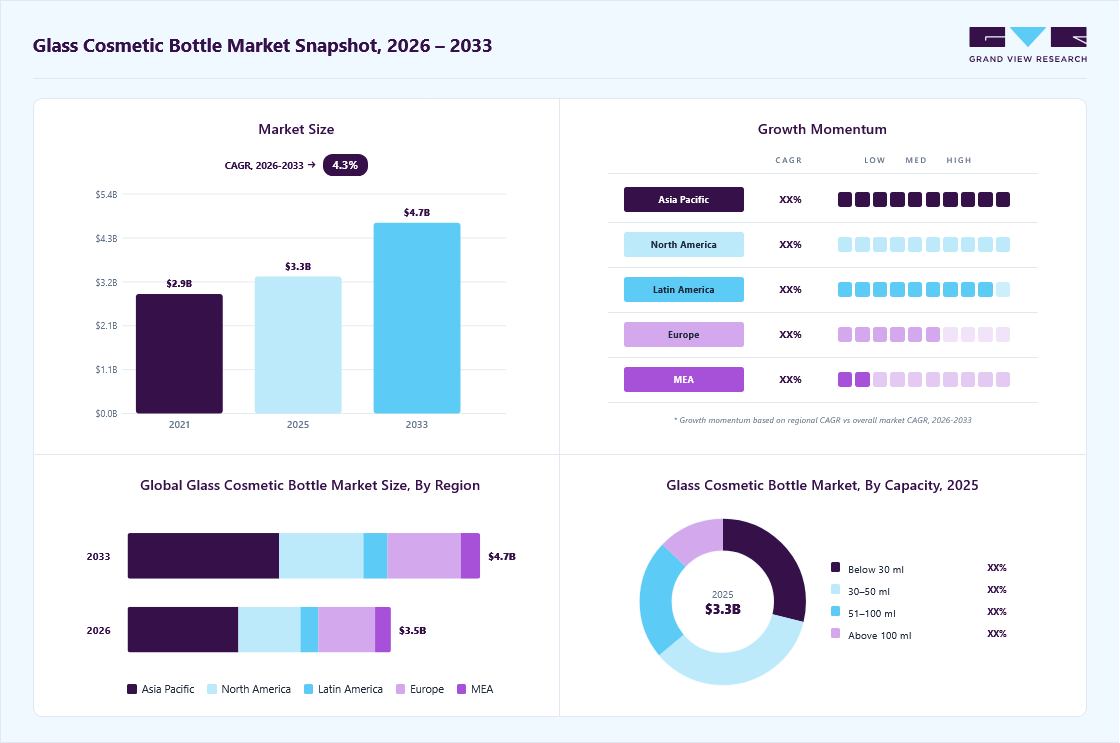
The global glass cosmetic bottle market size was valued at USD 3.3 billion in 2025 and is projected to grow from USD 3.5 billion in 2026 to USD 4.7 billion by 2033, at a CAGR of 4.3% from 2026 to 2033. The market in Asia Pacific dominated with a revenue share of 42.0% in 2025. Premiumization in beauty and personal care is a major driver for the glass cosmetic bottle industry, as brands prefer glass for its luxurious appearance, product integrity, and ability to enhance shelf appeal in perfumes, serums, and skincare products.
 Source: Grand View Research, IR Documents, Primary Interviews, Paid DatabasesTo learn more about this report,
 Download Free Sample Report
 Key Market Trends & Insights
- By product type: Dropper bottles segment held the largest market share of 37.1% in 2025.
- By capacity: 30-50 ml segment held the largest market share of 34.9% in 2025.
- By application: Skincare segment held the largest market share of 46.1% in 2025.
Regional Highlights
- Largest regional market: Asia Pacific (42.0% revenue share, 2025)
- By country: U.S. held the largest market share in 2025
Market Size & Forecast
- Market size in 2025: USD 3.3 Billion
- Estimated market size in 2026: USD 3.5 Billion
- Projected market size by 2033: USD 4.7 Billion
- CAGR (2026-2033): 4.3%
Three ways to get this report
Buy it, customize it, or ask a question.Ask an Analyst
Analyst response in 1 business day
- AccessReport author, directly
- Reply timeWithin 1 working day
- No sales callDirect answer only
- FormatEmail reply
- CostFree, no cost
Get the Full Report
What the study covers
- FormatsPDF · Excel · Dashboard
- Timeline2026–2033 annual, 2025 base
- Coverage20+ countries, 5 regions
- Companies10+ key players profiled
Customize the Report
20% free customization
- IncludeCountries, segments, points
- TailorTo your product definition
- ExtendDeeper competitor detail
- OrA fully bespoke study
- Turnaround5–10 working days
Rising consumer demand for sustainable and recyclable packaging is further accelerating adoption, since glass is reusable, infinitely recyclable, and aligns with eco-conscious brand positioning. Glass is widely associated with elegance, purity, and superior quality, making it a preferred packaging material for perfumes, serums, essential oils, and prestige skincare products. Beauty brands increasingly use thick-base bottles, custom shapes, embossing, and decorative finishes to enhance shelf appeal and differentiate their products. As consumers continue to associate sophisticated packaging with higher-value formulations, demand for glass cosmetic bottles is expanding across global luxury brands and emerging beauty companies.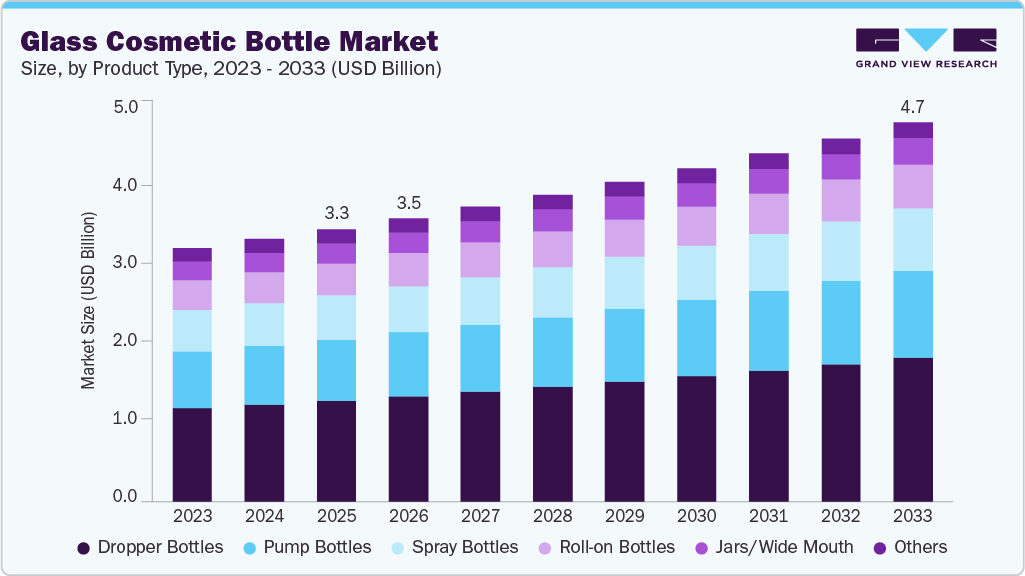 To learn more about this report, Download Free Sample Report
 Additionally, the global transition toward sustainable packaging solutions is also driving the growth of the market. Glass is fully recyclable, reusable, and chemically inert, making it an attractive alternative to plastic formats facing increasing scrutiny over waste generation and environmental impact. Cosmetic companies are adopting refillable glass jars and bottles, lightweight recycled glass content, and circular packaging models to meet ESG objectives and regulatory expectations. Consumers, particularly younger demographics, are increasingly favoring brands that demonstrate environmental responsibility, accelerating the shift toward glass packaging in skincare, fragrance, and wellness categories.
Rapid expansion of skincare, clean beauty, and natural formulations is also supporting industry growth. Many active ingredients, botanical extracts, essential oils, and sensitive formulations require packaging that provides strong barrier protection and chemical stability. Glass does not react with contents, helping preserve fragrance integrity, formulation efficacy, and shelf life better than many substitute materials. This makes glass highly suitable for premium serums, facial oils, ampoules, and organic cosmetic products where purity and performance are core purchasing factors. As ingredient-focused beauty segments continue to grow, demand for high-performance glass containers is increasing accordingly.
The expansion of e-commerce and direct-to-consumer beauty sales is further stimulating demand. Online beauty brands increasingly require visually distinctive packaging that enhances the customer unboxing experience and strengthens digital brand identity. Advances in lightweight, strengthened glass technologies, protective coatings, and transit packaging have reduced concerns about breakage during distribution. In parallel, digital printing and flexible decoration technologies enable low-volume customized production, allowing niche and emerging brands to launch differentiated packaging with lower entry barriers.
Market Concentration & Characteristics
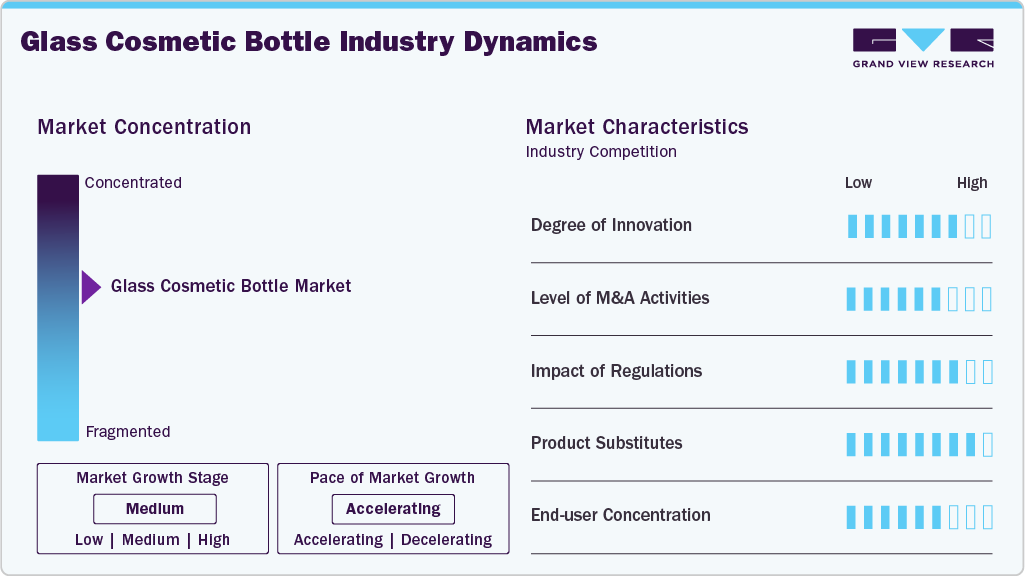
The glass cosmetic bottle industry is characterized by a strong emphasis on design, branding, and product aesthetics, as packaging serves as a key differentiator in the highly competitive beauty and personal care market. Manufacturers compete through custom bottle shapes, decorative finishes, embossing, color variations, and premium closures that enhance shelf presence and communicate brand value. High-end cosmetic and fragrance brands, in particular, rely on visually distinctive glass packaging to strengthen consumer perception and justify premium pricing.
The industry is moderately capital-intensive, requiring significant investment in furnaces, molding equipment, forming lines, annealing systems, and decoration technologies. Glass bottle production also involves high energy consumption and strict process control to ensure dimensional accuracy, clarity, durability, and defect-free output. As a result, established players with scale advantages, advanced manufacturing capabilities, and integrated operations often maintain stronger market positions than smaller entrants.
 To learn more about this report, Download Free Sample Report
 The industry also operates with high customization and relatively short product development cycles, particularly for premium and seasonal cosmetic launches. Brand owners frequently request bespoke packaging designs, limited-edition collections, and rapid prototyping to support marketing campaigns. This creates demand for agile manufacturing, mold development expertise, and flexible decoration capabilities such as screen printing, hot stamping, frosting, and coating. Suppliers that can combine speed, quality, and innovation gain a competitive advantage.
Product Type Insights
The dropper bottles segment dominated the glass cosmetic bottle market in 2025, accounting for 37.1% of revenue share, primarily due to strong demand for serums, facial oils, essential oils, and active skincare products that require precise and hygienic dispensing. Their premium appearance, dosage control, and compatibility with high-value formulations make dropper bottles the preferred packaging format for skincare and wellness brands.
The pump bottles segment is gaining strong traction in the glass cosmetic bottle market due to rising demand for lotions, liquid foundations, hand care, hair care, and premium skincare products that require controlled and convenient dispensing. Pump mechanisms enhance hygiene, minimize product wastage, and improve user experience, making them highly preferred by both consumers and beauty brands.
Capacity Insights
The 30-50 ml segment accounted for 34.9% of the glass cosmetic bottle market in 2025, driven by its ideal suitability for serums, facial oils, foundations, and premium skincare products, where moderate pack sizes balance value and convenience. This size range is also highly favored for travel-friendly packaging, trial purchases, and high-margin prestige beauty launches.
The below 30 ml segment is witnessing strong demand in the glass cosmetic bottle market due to its suitability for high-value serums, essential oils, eye care products, perfumes, and sample-size packaging. These compact formats support premium pricing, portability, gifting, and trial-based purchases, making them highly attractive for beauty brands and e-commerce channels.
Application Insights
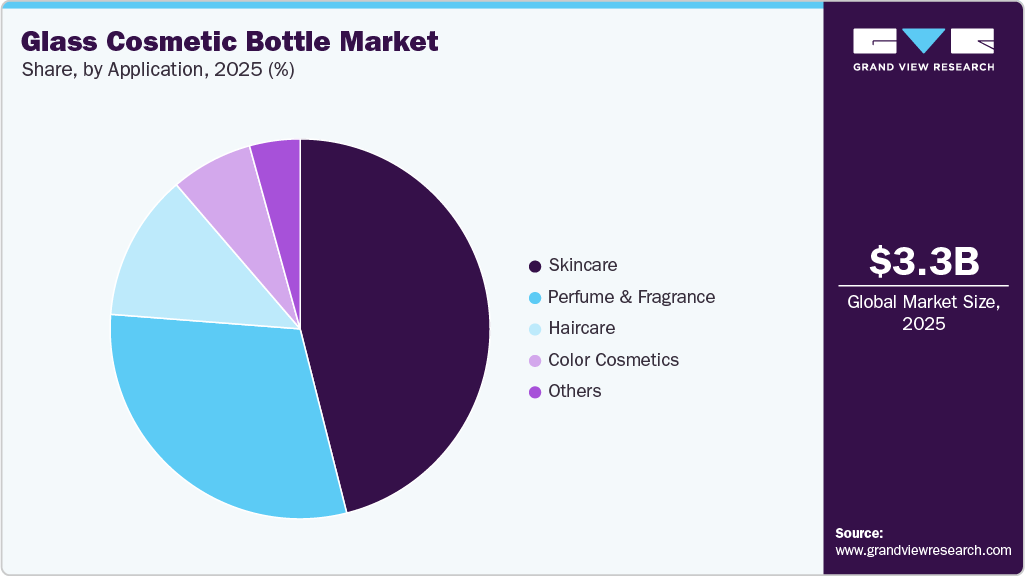
The skincare segment dominated the glass cosmetic bottle market in 2025, accounting for 46.1% of total market share, driven by strong global demand for serums, facial oils, creams, toners, and clean beauty formulations that benefit from glass packaging’s premium appeal and chemical stability. Glass is widely preferred for preserving active ingredients and supporting the high-end positioning of skincare brands.
 To learn more about this report, Download Free Sample Report
 The perfume & fragrance segment represents a key application area in the glass cosmetic bottle market, supported by strong demand for premium, visually distinctive packaging that enhances brand identity and consumer appeal. Glass is the preferred material for fragrances due to its superior clarity, inert properties, fragrance preservation, and ability to support luxury decorative designs.
Regional Insights
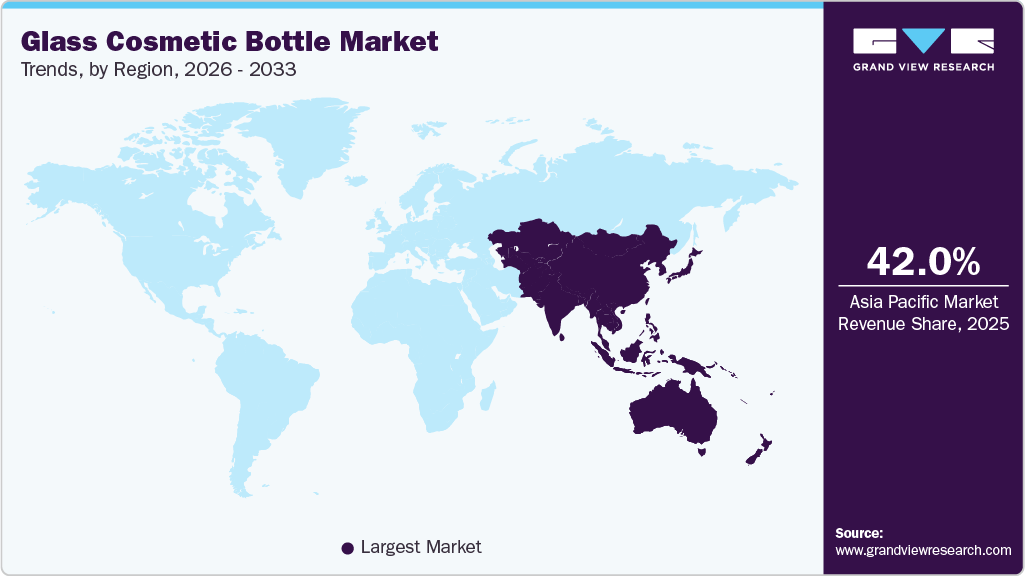
Asia Pacific dominated the glass cosmetic bottle market in 2025, accounting for 42.0% of global market share, primarily driven by its large cosmetics manufacturing base, expanding beauty consumer population, and strong presence of both multinational and domestic skincare and fragrance brands. Countries such as China, Japan, South Korea, and India are major contributors, driven by rising disposable incomes, rapid urbanization, and growing demand for premium skincare, K-beauty, J-beauty, and wellness products. The region also benefits from cost-competitive glass manufacturing capacity, integrated supply chains, and increasing investments in sustainable packaging, enabling Asia Pacific to serve both domestic consumption and export demand efficiently.
 To learn more about this report, Download Free Sample Report
 North America Glass Cosmetic Bottle Market Trends
North America is a significant market for glass cosmetic bottles, supported by high consumer spending on premium skincare, fragrance, and clean beauty products, as well as strong demand for sustainable packaging solutions. The U.S. leads regional growth due to the presence of major beauty brands, expanding indie cosmetics companies, and a mature e-commerce ecosystem that favors visually premium packaging. Increasing adoption of refillable formats, luxury fragrances, and ingredient-focused skincare products continues to strengthen demand for glass cosmetic bottles across the region.
U.S Glass Cosmetic Bottle Market Trends
The U.S. is the largest contributor to the North American glass cosmetic bottle market, driven by strong demand for premium skincare, prestige fragrances, and clean beauty products. Leading brands such as Estee Lauder Companies, Coty Inc., e.l.f. Beauty and Glossier increasingly use glass packaging for serums, perfumes, and high-end skincare to reinforce brand value and sustainability positioning. The growth of direct-to-consumer sales, refillable packaging concepts, and rising consumer preference for recyclable premium containers further strengthen U.S. market demand.
Europe Glass Cosmetic Bottle Market Trends
Europe is a mature, high-value market for glass cosmetic bottles, driven by strong demand for luxury fragrances, premium skincare, and sustainable packaging solutions. Countries such as France, Germany, Italy, and UK lead regional demand due to the presence of globally recognized beauty houses such as L'Oréal, LVMH, and Beiersdorf. The region also benefits from advanced glass packaging manufacturing, strong recycling infrastructure, and strict environmental regulations that encourage the adoption of refillable and recyclable cosmetic containers.
Key Glass Cosmetic Bottle Company Insights
The competitive environment of the glass perfume bottle market is moderately consolidated at the global level, with competition centered on design capability, premium decoration, manufacturing precision, and long-term relationships with fragrance brands. Key players compete through custom bottle development, advanced molding technologies, engraving, coating, metallization, and sustainable lightweight glass solutions to serve luxury and prestige segments.
European manufacturers hold a strong position due to their heritage in fragrance packaging, while Asian suppliers compete aggressively on cost efficiency, scalability, and faster production turnaround. Brand owners increasingly seek differentiated packaging, limited-edition launches, and eco-friendly formats, intensifying competition on innovation, speed to market, and customization. Price competition remains stronger in standard bottle formats, whereas margins are higher in bespoke premium designs requiring technical expertise and high aesthetic standards.
-
In March 2026, Baralan, an Italian primary‑packaging supplier for cosmetics, launched DEA 2.0, an upgraded glass‑based airless dispensing container designed to meet rising brand demand for sustainable, premium‑looking packaging and for upcoming EU packaging regulations such as the PPWR. The system uses a soda‑lime glass barrel made in Europe, which is fully compatible with standard recycling streams and offers good formulation compatibility while eliminating an internal plastic reservoir, so the cosmetic product is in direct contact with glass.
-
In November 2025, Bormioli Luigi launched Edge, a standard-format glass bottle for beauty and fragrance brands within its ready-to-go stock range. Featuring a sharp square silhouette and premium light-enhancing glass design, the 100 ml bottle includes an SNI 15 screw neck that supports recyclability and refillability.
Key Glass Cosmetic Bottle Companies:
The following key companies have been profiled for this study on the glass cosmetic bottle market.
- PGP Glass
- Gerresheimer AG
- Stoelzle Glass Group
- Jarsking Packaging
- Coverpla
- VERESCENCE
- Bormioli Luigi
- Calaso BV
- Evergreen Resources
- Virospack
Glass Cosmetic Bottle Market Report Scope
Report Attribute
Details
Market size in 2025
USD 3.3 billion
Estimated market size in 2026
USD 3.5 billion
Projected market size by 2033
USD 4.7 billion
Growth rate
CAGR of 4.3% from 2026 to 2033
Base year for estimation
2025
Historical data
2021 - 2024
Forecast period
2026 - 2033
Quantitative units
Revenue in USD million and CAGR from 2026 to 2033
Report coverage
Revenue forecast, company ranking, competitive landscape, growth factors, and trends
Segments covered
Product type, capacity, application, region
Regional scope
North America; Europe; Asia Pacific; Latin America; Middle East & Africa
Country scope
U.S.; Canada; Mexico; Europe; Germany; France; UK; Italy; Spain; China; India; Japan; South Korea; Australia; Brazil; Argentina; UAE; Saudi Arabia; South Africa
Key companies profiled
PGP Glass; Gerresheimer AG; Stoelzle Glass Group; Jarsking Packaging; Coverpla; VERESCENCE; Bormioli Luigi; Calaso BV; Evergreen Resources; Virospacks
Customization scope
Free report customization (equivalent up to 8 analysts working days) with purchase. Addition or alteration to country, regional & segment scope.
Pricing and purchase options
Avail of customized purchase options to meet your exact research needs. Explore purchase options
Global Glass Cosmetic Bottle Market Report Segmentation
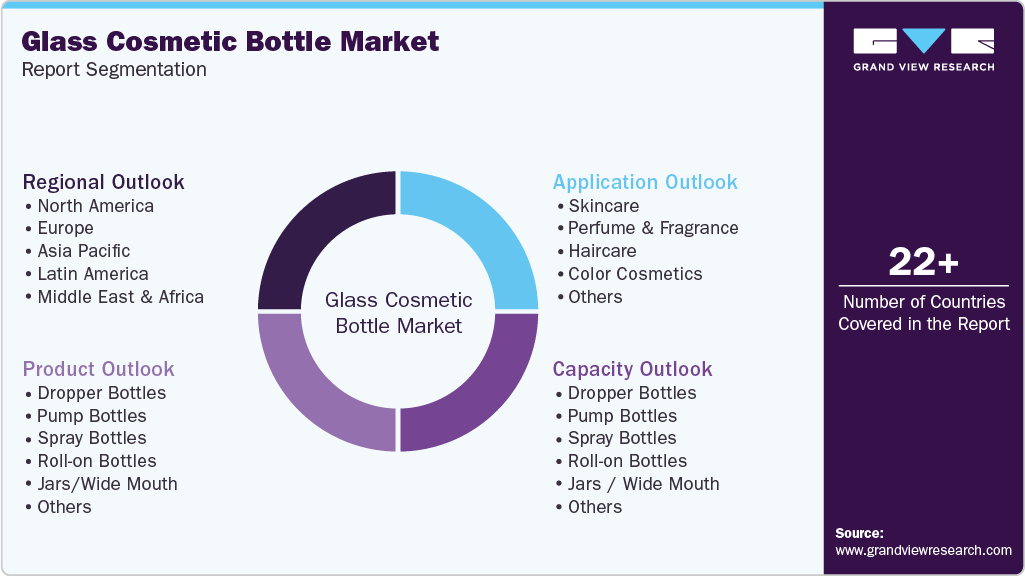
This report forecasts revenue growth at the regional, and country levels and provides an analysis on the latest industry trends and opportunities in each of the sub-segments from 2021 to 2033. For the purpose of this study, Grand View Research has segmented the global glass cosmetic bottle market report on the basis of product type, capacity, application, and region:
 To learn more about this report, Download Free Sample Report
 -
Product Type Outlook (Revenue, USD Million, 2021 - 2033)
-
Dropper Bottles
-
Pump Bottles
-
Spray Bottles
-
Roll-on Bottles
-
Jars / Wide Mouth
-
Others
-
-
Capacity Outlook (Revenue, USD Million, 2021 - 2033)
-
Dropper Bottles
-
Pump Bottles
-
Spray Bottles
-
Roll-on Bottles
-
Jars / Wide Mouth
-
Others
-
-
Application Outlook (Revenue, USD Million, 2021 - 2033)
-
Skincare
-
Perfume & Fragrance
-
Haircare
-
Color Cosmetics
-
Others
-
-
Regional Outlook (Revenue, USD Million, 2021 - 2033)
-
North America
-
U.S.
-
Canada
-
Mexico
-
-
Europe
-
Germany
-
France
-
UK
-
Italy
-
Spain
-
-
Asia Pacific
-
China
-
India
-
Japan
-
South Korea
-
Australia
-
-
Latin America
-
Brazil
-
Argentina
-
-
Middle East & Africa
-
Saudi Arabia
-
UAE
-
South Africa
-
-
Frequently Asked Questions About This Report
The dropper bottles segment led with a 37.1% revenue share in 2025.
The 30-50 ml segment led with a 34.9% revenue share in 2025.
The skincare segment led with a 46.1% revenue share in 2025.
The global glass cosmetic bottle market size was valued at USD 3.3 billion in 2025 and is estimated at USD 3.5 billion for 2026.
The global glass cosmetic bottle market is expected to grow at a CAGR of 4.3% from 2026 to 2033, reaching USD 4.7 billion by 2033.
Asia Pacific dominated with a 42.0% revenue share in 2025.
Key players include PGP Glass; Gerresheimer AG; Stoelzle Glass Group; Jarsking Packaging; Coverpla; VERESCENCE; Bormioli Luigi; Calaso BV; Evergreen Resources; Virospacks
Premiumization in beauty and personal care is driving the glass cosmetic bottle industry, as brands favor glass for its premium look, product protection, and strong shelf appeal in perfumes, serums, and skincare products.
About the Author(s)
Plastics, Polymers & Resins Research Team
Bulk Chemicals · Plastics, Polymers & ResinsThis report was authored by the plastics, polymers & resins research team at Grand View Research - comprising two research analysts, one senior research analyst, and one industry expert - with specialized expertise in the plastics, polymers & resins segment of the bulk chemicals industry. All findings are based on proprietary bulk chemicals databases, executive interviews, and regulatory analysis, subject to internal peer review prior to publication.
Last Updated:
Speak to Analyst

Customize this report to your needs - add regions, segments, or data points, with 20% free customization.
Or view our licence options:


ISO 9001:2015 & 27001:2022 Certified
We are GDPR and CCPA compliant! Your transaction & personal information is safe and secure. For more details, please read our privacy policy.


