
- Home
- »
- Plastics, Polymers & Resins
- »
-
Glass Packaging For Cosmetic Market Size Report, 2035GVR Report cover

Glass Packaging For Cosmetic Market (2027 - 2035)
Size, Share & Trends Analysis Report By Capacity (Below 30 ml, 30-50 ml, Above 50-100 ml), By Packaging Type, By Glass Color (Clear Glass, Colored Glass), By Application, By Region, And Segment Forecasts
Market Size, 2026
$1.5BMarket Estimate, 2027
$1.6BMarket Forecast, 2035
$2.4BCAGR, 2027–2035
5.5%Glass Packaging For Cosmetic Market Summary
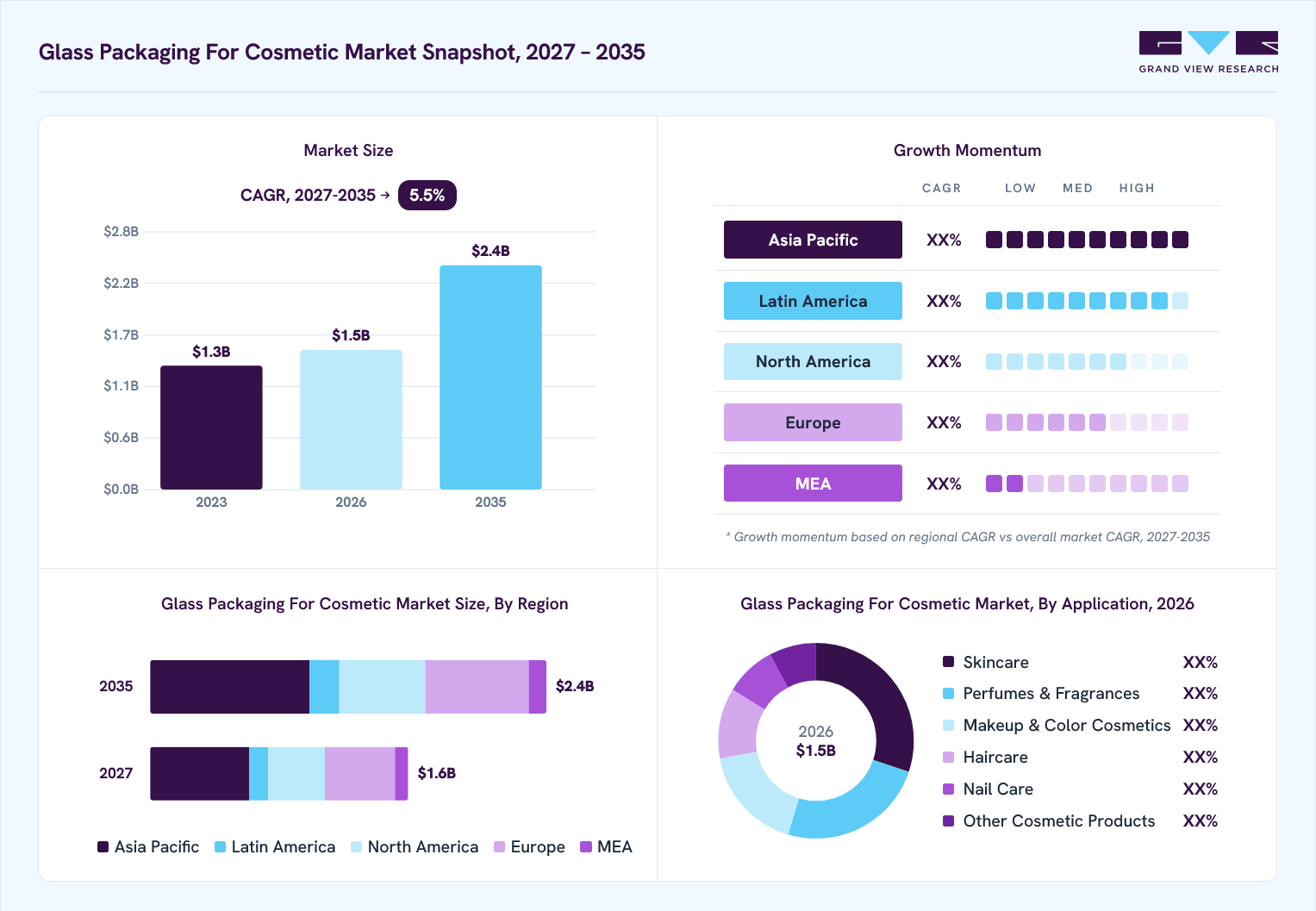
The global glass packaging for cosmetic market size was valued at USD 1.5 billion in 2026 and is projected to grow from USD 1.6 billion in 2027 to USD 2.4 billion by 2035, at a CAGR of 5.5% from 2027 to 2035. Asia Pacific dominated the market, accounted for a revenue share of 38.1% in 2026. The market is primarily driven by increasing demand for premium beauty and personal care products, rising adoption of glass packaging for fragrances, skincare, and cosmetics, and growing consumer preference for recyclable, reusable, and sustainable packaging materials.
 Source: Grand View Research, IR Documents, Primary Interviews, Paid DatabasesTo learn more about this report,
 Download Free Sample Report
Key Market Trends & Insights
- By capacity: Below 30 ml segment dominated the market, accounting for the largest revenue share of 33.5% in 2026.
- By packaging type: the standard glass bottles segment dominated the market with the revenue share of 36.0% in 2026.
- By glass color: Clear glass segment dominated the market with the largest revenue share of 43.5% in 2026.
- By application: Skincare segment held the dominant position in the global market, contributing the highest revenue share of 30.1% in 2026.
Regional Highlights
- Largest Region: Asia Pacific (38.1% revenue share, 2026)
- Fastest-growing region: Asia Pacific (fastest CAGR, 2027-2035)
- By country: China held the largest market share in 2026.
Market Size & Forecast
- Market Size in 2026: USD 1.5 Billion
- Estimated market size in 2027: USD 1.6 Billion
- Projected Market Size by 2035: USD 2.4 Billion
- CAGR (2027-2035): 5.5%
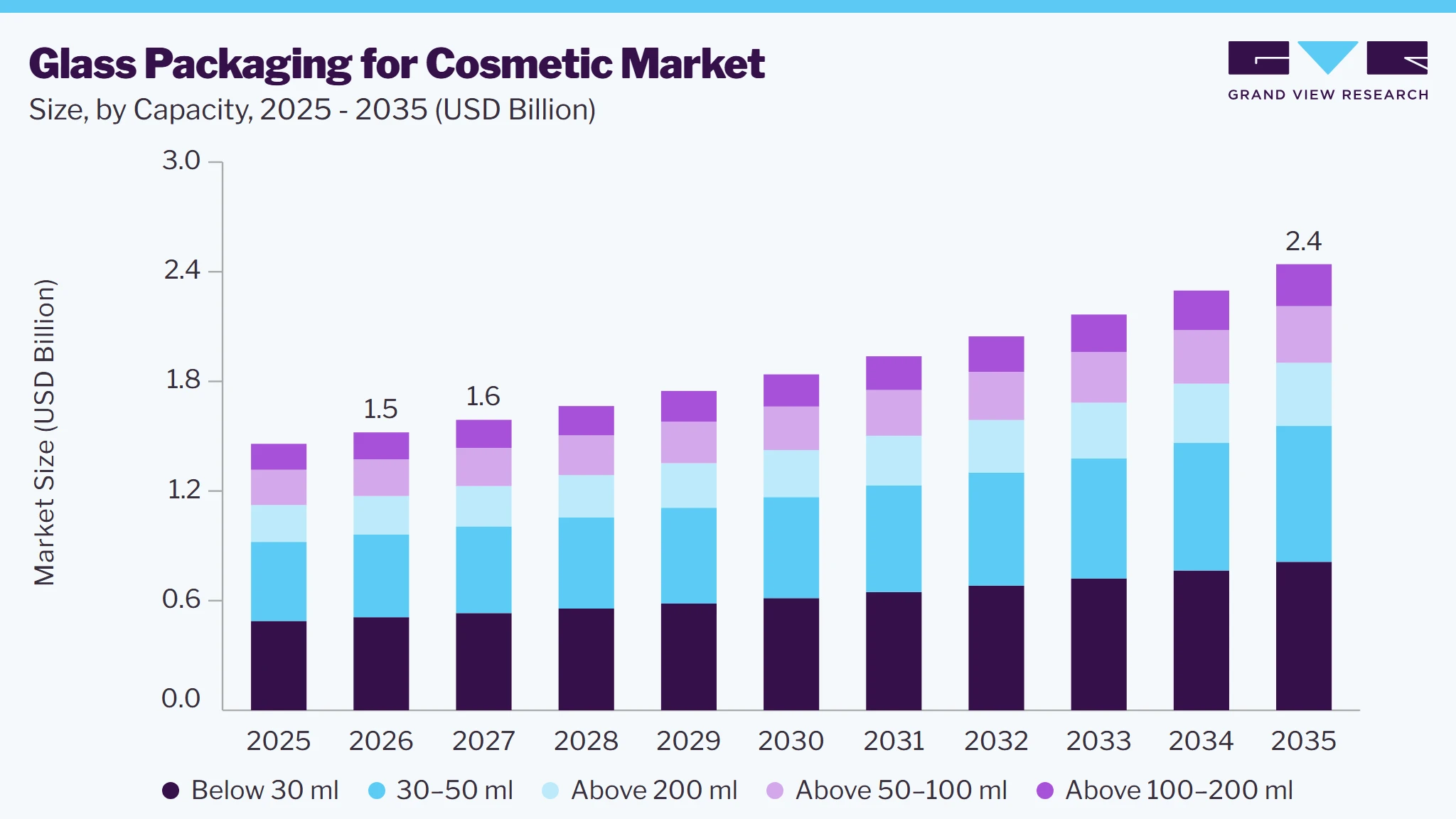
Prism AI by Grand View Research Free to tryAsk a question about the glass packaging for cosmetic marketTry asking✓Every figure cited from GVR research Prefer the report? Download free sample →The global glass packaging for cosmetic market is driven by the growing demand for premium skincare, fragrance, and beauty products, where packaging plays an important role in product positioning and brand differentiation. Cosmetic brands are increasingly adopting glass containers for serums, facial oils, creams, perfumes, and other formulations because of their premium appearance, chemical stability, and ability to preserve product quality. Smaller capacity formats, particularly below 30 ml and 30-50 ml, are widely used for concentrated skincare products, serums, and travel-size cosmetics. The rising popularity of premium skincare routines, product sampling, and compact beauty formats is further supporting demand for specialized glass packaging across the cosmetics industry.
 To learn more about this report, Download Free Sample Report
Increasing consumer preference for high-quality, safe, and aesthetically appealing packaging is expected to support market growth in the coming years. Glass offers strong compatibility with a wide range of cosmetic formulations and provides an effective barrier against moisture and external contaminants. Its suitability for sensitive ingredients, including essential oils, active skincare formulations, and fragrances, makes it a preferred material for premium cosmetic applications. In addition, packaging formats such as dropper bottles, spray and atomizer bottles, and glass jars are gaining importance as brands introduce products requiring controlled dispensing, product protection, and convenient application. The growing emphasis on packaging functionality and product differentiation is encouraging manufacturers to develop customized glass containers in different capacities, shapes, and finishes.
Sustainability initiatives and the growing focus on recyclable packaging are also contributing to market growth. A defining trend in the glass packaging for cosmetics industry is the increasing adoption of reusable, recyclable, and lightweight glass containers, as cosmetic brands seek to strengthen their sustainability positioning and reduce packaging waste. Manufacturers are focusing on improving production efficiency, incorporating recycled glass (cullet), and developing distinctive colored and specialty glass designs to combine environmental considerations with premium aesthetics. The rising demand for colored glass, which is projected to register the fastest growth among glass color segments, also reflects the importance of packaging differentiation and product presentation in the cosmetics industry. Such developments are expected to support the wider adoption of glass packaging across skincare, fragrance, and other cosmetic applications.
Market Dynamics
The glass packaging for cosmetic industry is witnessing steady growth, supported by increasing demand for premium beauty products, expanding skincare and fragrance consumption, and the growing importance of packaging aesthetics in brand differentiation. Cosmetic manufacturers are adopting glass containers to enhance product presentation, protect sensitive formulations, and strengthen premium product positioning. Demand for varied container capacities, customized designs, and functional dispensing formats is further shaping product development. In addition, rising interest in recyclable packaging and premium beauty experiences is supporting the adoption of glass across skincare, makeup, haircare, and fragrance applications.
The rising consumption of premium skincare, fragrances, and beauty products is a key driver of the glass packaging for cosmetic market. Consumers are increasingly purchasing specialized formulations such as facial serums, essential oils, anti-aging products, and high-end fragrances, creating demand for packaging that complements product quality and brand positioning. Glass containers offer a premium appearance, design flexibility, and compatibility with a wide range of cosmetic formulations, making them suitable for brands targeting the prestige and luxury beauty segments.
The expansion of premium skincare portfolios is also increasing demand for specialized packaging formats, including dropper bottles, jars, and compact glass containers. The 30-50 ml capacity segment is projected to register the fastest growth, reflecting demand for packaging suited to concentrated skincare formulations and convenient product usage. Similarly, dropper bottles are expected to record the fastest growth among packaging types, supported by their suitability for controlled dispensing of serums and facial oils. These product requirements are encouraging manufacturers to develop differentiated glass packaging solutions with customized shapes, finishes, and dispensing systems.
High manufacturing and transportation costs remain a key restraint for the glass packaging for cosmetic market. Glass production involves energy-intensive melting and forming processes, while customized shapes, surface treatments, and decorative finishes can further increase manufacturing expenses. Moreover, glass containers are heavier and more fragile than plastic alternatives, resulting in higher transportation costs, additional protective packaging requirements, and potential breakage during handling and distribution. These factors can increase the overall packaging costs for cosmetic brands, particularly mass-market manufacturers and smaller businesses with limited production volumes, potentially restricting wider adoption in price-sensitive product categories.
The growing emphasis on circular packaging and sustainable beauty products presents a significant opportunity for the glass packaging for cosmetic market. Glass containers offer recyclability and suitability for refill-based packaging models, encouraging cosmetic brands to introduce reusable perfume bottles, skincare jars, and serum containers. Manufacturers can capitalize on this trend by developing durable, refill-compatible designs, incorporating recycled glass content, and offering standardized containers that support replacement and refill systems. As beauty brands increasingly integrate packaging sustainability into their product strategies, demand for recyclable and refill-ready glass solutions is expected to create opportunities across premium skincare, fragrances, and other cosmetic applications.
Market Concentration & Characteristics
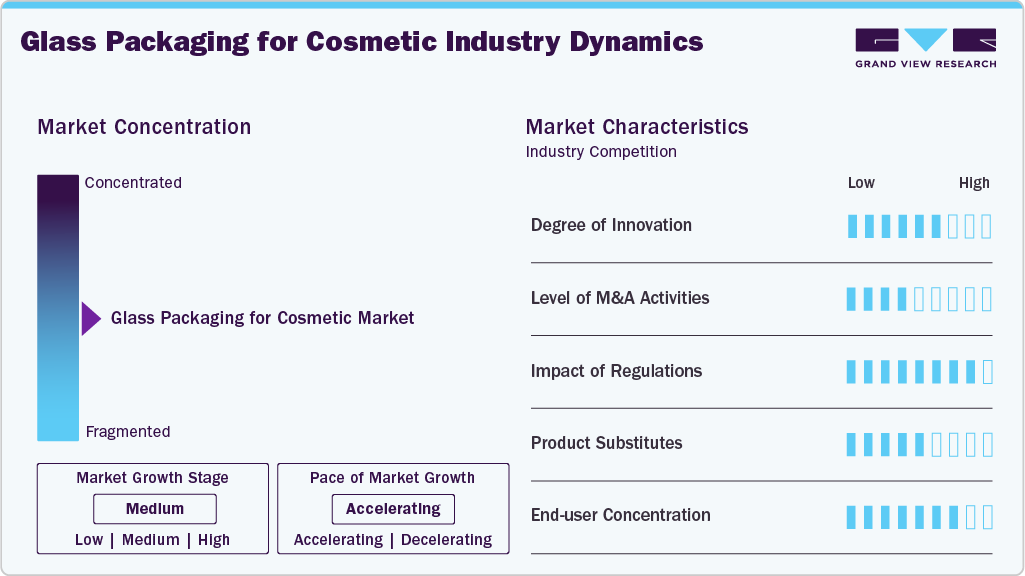
The glass packaging for cosmetic market is characterized by premium product positioning, customized designs, and specialized manufacturing processes. The industry caters to skincare, perfumes and fragrances, makeup, haircare, and nail care applications through packaging formats such as standard glass bottles, dropper bottles, spray and atomizer bottles, and glass jars. Manufacturers focus on distinctive shapes, surface decoration, glass coloration, and precision finishing to support brand differentiation and enhance product presentation. Leading companies such as Verescence, Groupe Pochet, Bormioli Luigi, HEINZ-GLAS, Stoelzle Glass Group, and Zignago Vetro emphasize design innovation, product quality, and customized packaging solutions for cosmetic brands.
 To learn more about this report, Download Free Sample Report
A defining feature of the industry is its reliance on glass properties such as chemical resistance, transparency, and compatibility with cosmetic formulations. Clear glass is widely used to showcase product appearance, while colored and specialty glass supports premium aesthetics and packaging differentiation. Sustainability is also shaping the industry, with manufacturers increasingly focusing on recycled glass content, energy-efficient production, lightweight designs, and refill-compatible containers. However, balancing sustainability objectives with manufacturing costs, container durability, and design requirements remains an important consideration across the value chain.
Analyst Perspective
The global glass packaging for cosmetic market has evolved from conventional glass containers into a premium, design-oriented packaging industry, driven by the need for product protection, visual appeal, and brand differentiation. Earlier, glass was primarily preferred for its chemical stability and suitability for perfumes and skincare formulations, while current demand is increasingly influenced by luxury beauty consumption, customized packaging, and sustainable material choices. Going forward, the market is expected to witness steady growth as cosmetic brands increasingly adopt lightweight, recyclable, and refill-compatible glass containers. Innovation in bottle design, decorative finishes, dispensing systems, and recycled glass content will shape product development, while expanding beauty markets in Asia Pacific will provide significant growth opportunities.
Capacity Insights
Based on capacity, the below 30 ml segment dominated the market, accounting for the largest revenue share of 33.5% in 2026. This segment is widely used for packaging premium skincare products, including facial serums, essential oils, eye creams, and concentrated treatment formulations. Smaller glass containers are preferred for products requiring controlled usage, high-value formulations, and convenient application. Their suitability for product sampling, travel-size offerings, and premium skincare ranges further supports demand. The segment's leading position is driven by the expanding use of specialized skincare formulations and the preference for compact glass packaging that combines product protection with an upscale appearance.
The 30-50 ml segment is expected to grow at the fastest CAGR of 5.8% during the forecast period. This capacity range is particularly suitable for facial serums, moisturizers, facial oils, and premium skincare treatments that require moderate product volumes and convenient dispensing. It offers a balance between product quantity, portability, and packaging functionality, making it attractive to cosmetic brands targeting daily-use and premium skincare categories. Increasing demand for concentrated beauty formulations, along with the adoption of dropper bottles and compact glass containers, is expected to support the segment's growth.
Packaging Type Insights
Based on packaging type, the standard glass bottles segment dominated the market, accounting for the largest revenue share of 36.0% in 2026. Standard glass bottles are widely used across skincare, perfumes, fragrances, and other cosmetic applications due to their versatility, durability, and premium appearance. They accommodate different product formulations and are available in varied shapes, capacities, and finishes, allowing brands to maintain consistent packaging aesthetics across product lines. Their suitability for lotions, toners, facial oils, and fragrance products, along with their compatibility with different closure and dispensing systems, supports their leading market position.
The dropper bottles segment is expected to grow at the fastest CAGR of 6.1% during the forecast period. Glass dropper bottles are increasingly used for packaging concentrated skincare formulations, including facial serums, essential oils, vitamin-based treatments, and facial oils, where precise and controlled dispensing is important. Their ability to support measured application, minimize product wastage, and provide a premium presentation makes them attractive to skincare brands. Growing demand for specialized skincare products, active-ingredient formulations, and premium beauty routines is expected to accelerate the adoption of dropper-based glass packaging.
Glass Color Insights
Based on glass color, the clear glass segment dominated the market with the largest revenue share of 43.5% in 2026. Clear glass is widely used in cosmetic packaging due to its transparency, premium appearance, and ability to showcase the product's color, texture, and formulation. It is particularly suitable for perfumes, skincare serums, essential oils, and other beauty products where visual presentation influences purchasing decisions. Its versatility also allows brands to incorporate customized bottle shapes, decorative finishes, labels, and closures while maintaining product visibility. The segment's leading position is supported by its broad application across premium and mass-market cosmetic product categories.
The colored glass segment is expected to grow at the fastest CAGR of 5.9% during the forecast period. Colored glass is increasingly preferred by cosmetic brands seeking distinctive packaging aesthetics, stronger shelf appeal, and product differentiation. Amber, green, blue, and other tinted glass formats are used for skincare oils, serums, fragrances, and specialized cosmetic formulations. Certain colored glass variants, particularly amber, can also help reduce exposure to light-sensitive ingredients, depending on the glass composition and tint. Growing demand for premium beauty products, distinctive brand identities, and packaging that combines visual appeal with functional benefits is expected to accelerate adoption of colored glass containers.
Application Insights
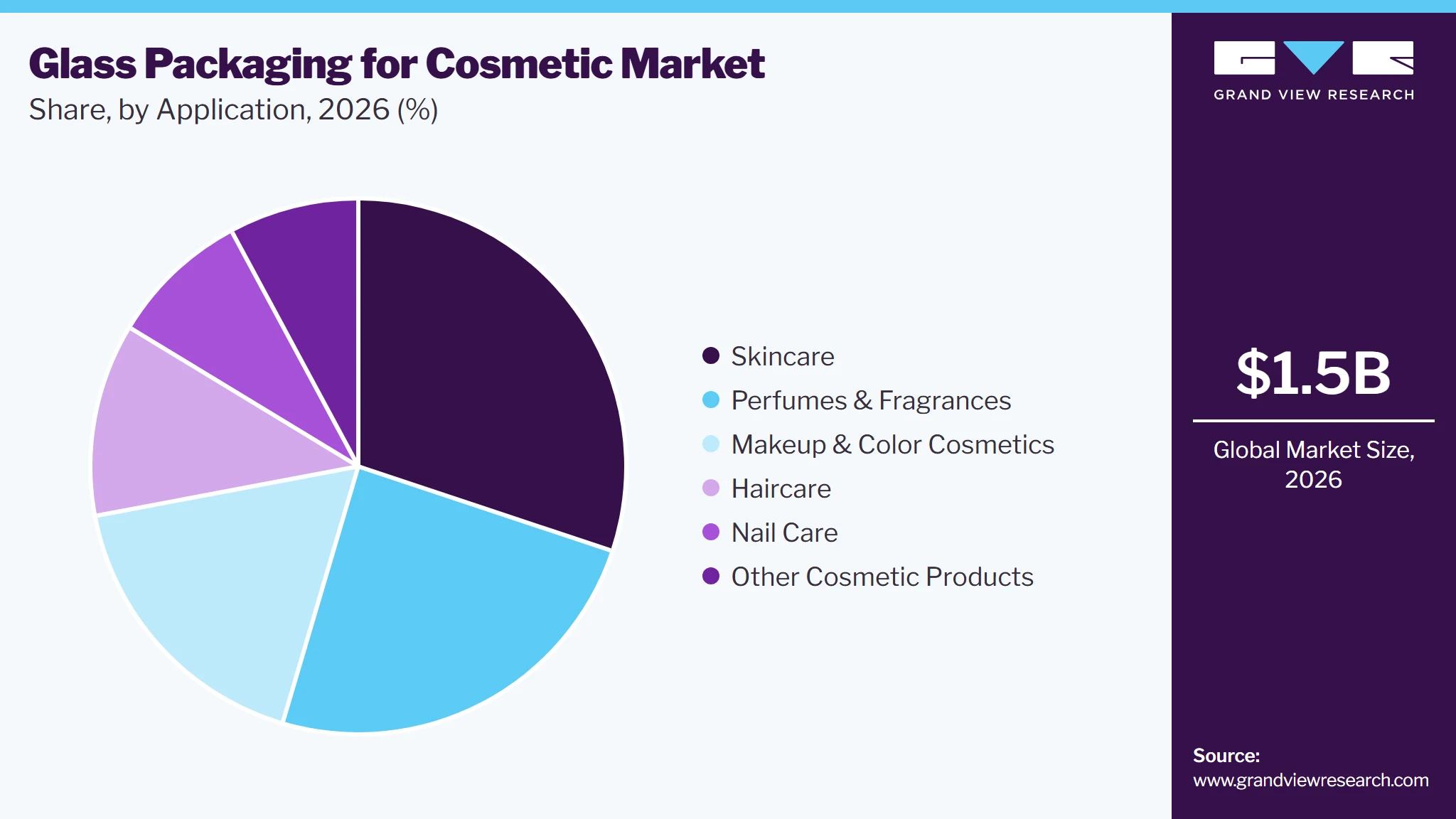
The skincare segment held the dominant position in the global market, contributing the highest revenue share of 30.1% in 2026. Glass packaging has strong relevance in skincare products such as facial serums, moisturizers, cleansing oils, creams, and specialized treatment formulations. Its chemical stability, premium finish, and compatibility with diverse cosmetic formulations make it a preferred choice for brands positioning products in the premium and luxury categories. Growing consumer interest in advanced skincare routines and ingredient-focused beauty products continues to sustain demand for glass bottles, jars, and dropper containers. The segment's leading share reflects the extensive use of glass across both everyday skincare products and high-value formulations.
 To learn more about this report, Download Free Sample Report
The nail care segment is projected to register the fastest CAGR of 6.1% during the forecast period. Glass containers are widely used for nail polishes, nail treatments, cuticle oils, and strengthening formulations, offering transparency that allows consumers to view product shades and quantities. Their compatibility with specialized brush applicators and secure closures also supports convenient product dispensing and storage. Increasing demand for diverse nail color collections, at-home manicure products, and premium nail treatment formulations is creating additional demand for differentiated glass packaging. This expansion in nail care product offerings is expected to strengthen the segment's growth over the forecast period.
Regional Insights
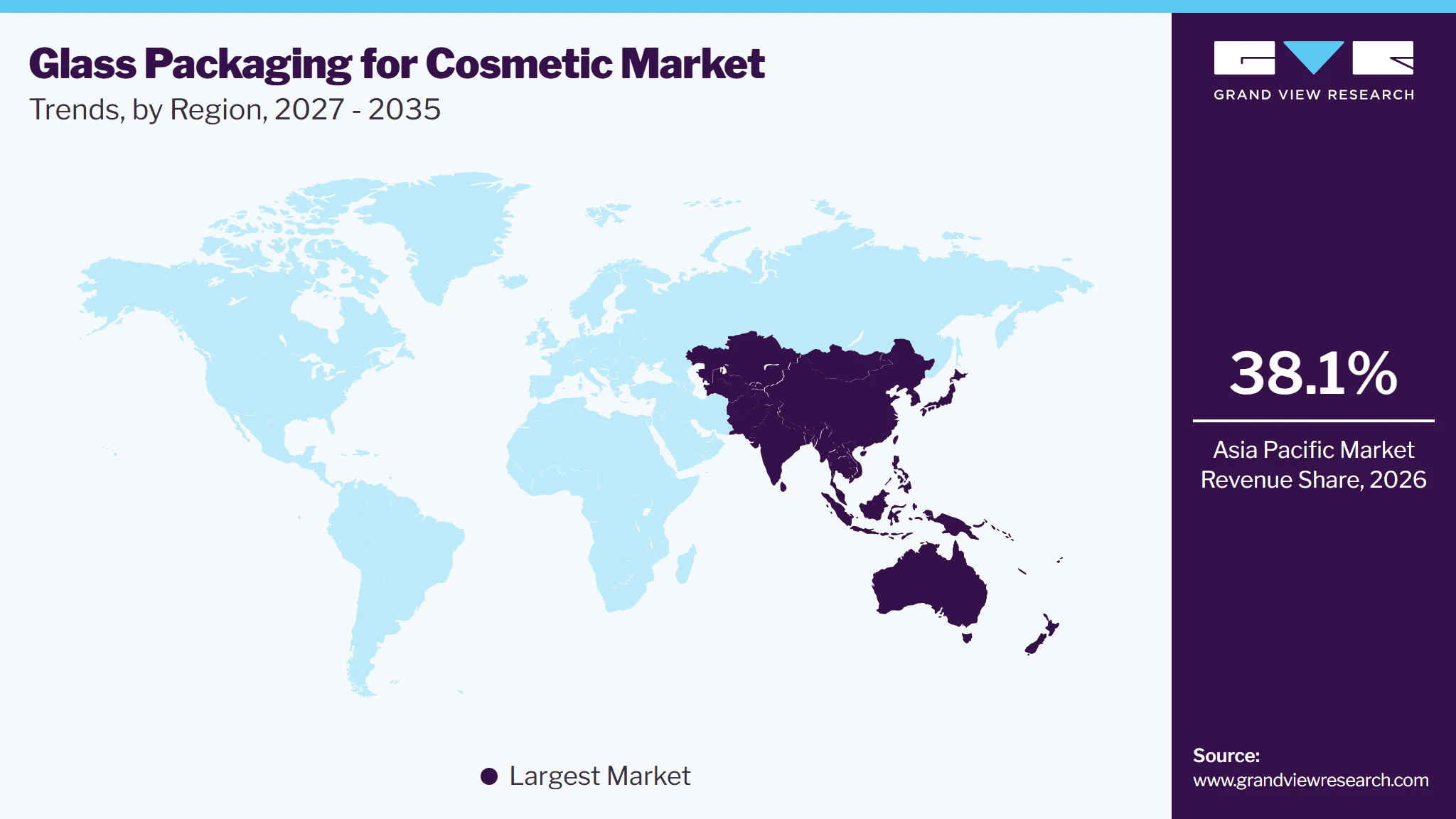
Asia Pacific dominated the global glass packaging for cosmetic market, accounting for the largest revenue share of 38.1% in 2026. The region is also projected to register the fastest CAGR of 6.1% from 2027 to 2035. Its leadership reflects the rapid expansion of the beauty and personal care industry, rising disposable incomes, and increasing consumption of premium skincare and fragrance products. Strong manufacturing capabilities across countries such as China, India, Japan, and South Korea further support regional demand. The growing popularity of ingredient-focused skincare, premium beauty brands, and locally developed cosmetic products is creating opportunities for glass bottles, jars, and specialized dispensing containers.
 To learn more about this report, Download Free Sample Report
China Glass Packaging for Cosmetic Market Trends
China represents a major contributor to the Asia Pacific market, supported by its extensive cosmetics manufacturing ecosystem and large consumer base. Rising demand for premium skincare, facial serums, fragrances, and color cosmetics is encouraging the use of glass packaging across different product categories. Domestic beauty brand expansion and investments in packaging customization are also supporting demand for specialized containers, including dropper bottles and decorative glass formats.
India glass packaging for cosmetic market is expected to benefit from the expanding beauty and personal care industry, increasing purchasing power, and growing preference for premium skincare and fragrance products. The emergence of domestic beauty brands, expansion of organized retail, and wider availability of specialized formulations are creating demand for varied glass packaging formats. Growing interest in sustainable packaging and premium product presentation is likely to support further adoption of glass bottles, jars, and dropper containers.
North America Glass Packaging for Cosmetic Market Trends
The North America glass packaging for cosmetic market is anticipated to experience consistent growth during the forecast period, supported by established beauty and personal care industries and sustained demand for premium skincare and fragrance products. Cosmetic brands across the region are increasingly using glass containers to strengthen product positioning, improve packaging aesthetics, and support sustainability initiatives. Demand for customized bottles, jars, and dispensing formats is also contributing to market development, particularly across prestige beauty and specialized skincare categories.
The U.S. glass packaging for cosmetic market is expected to maintain steady expansion, driven by the strong presence of established beauty brands and increasing consumer interest in premium skincare, fragrances, and specialized cosmetic formulations. Manufacturers are focusing on distinctive bottle designs, advanced dispensing systems, and recyclable packaging formats to differentiate their product portfolios. The growing popularity of serums, facial oils, and high-value beauty treatments is also supporting demand for dropper bottles, jars, and smaller-capacity glass containers.
Europe Glass Packaging for Cosmetic Market Trends
Europerepresented a significant regional market in 2026, accounting for 27.3% of global revenue. Regional demand is supported by the presence of established fragrance houses, premium cosmetics manufacturers, and specialized glass packaging producers. The region's strong luxury beauty industry encourages the use of customized glass containers, decorative finishes, and high-quality packaging formats. Furthermore, increasing attention to packaging recyclability, recycled glass content, and refillable cosmetic containers is influencing product development and procurement strategies across European markets.
Germany glass packaging for cosmetic market benefits from its established glass manufacturing capabilities and strong industrial base. Demand is supported by cosmetic, skincare, and fragrance manufacturers seeking durable, precisely manufactured containers with consistent quality and finishing. Investments in production efficiency, glass decoration, and sustainable manufacturing processes are expected to contribute to market development.
UK glass packaging for cosmetic market is expected to grow steadily, supported by demand for premium skincare, fragrance, and beauty products. The expansion of independent beauty brands and specialized cosmetic ranges is creating opportunities for differentiated packaging, including compact bottles, jars, and customized containers. Growing interest in refillable beauty products and recyclable packaging is also encouraging brands to consider glass-based solutions.
Latin America Glass Packaging for Cosmetic Market Trends
The Latin America glass packaging for cosmetic market is projected to record steady growth at a CAGR of 5.8%. Market development is supported by expanding beauty and personal care consumption, increasing availability of premium cosmetic products, and demand for attractive packaging across skincare and fragrance categories. Manufacturers and brands are also exploring customized glass containers to improve shelf appeal and strengthen product differentiation in competitive beauty markets.
Brazil accounts for a significant portion of regional demand due to its large beauty and personal care industry and established consumer market for skincare, fragrances, and cosmetics. The presence of domestic beauty brands and strong demand for product differentiation supports the use of decorative glass bottles, jars, and perfume containers. Continued development of premium beauty offerings is expected to create additional opportunities for glass packaging suppliers.
Middle East & Africa Glass Packaging for Cosmetic Market Trends
The Middle East & Africa glass packaging for cosmetic market is expected to witness moderate growth, with its market value projected to rise from USD 78.8 million in 2026 to USD 109.2 million by 2035, registering a CAGR of 3.8%. Demand is supported by the established fragrance culture in parts of the Middle East, increasing consumption of premium beauty products, and the gradual expansion of modern retail and personal care markets. Glass packaging remains relevant for perfumes, concentrated fragrance oils, and luxury skincare products, where container appearance and product presentation are important purchasing considerations. However, the region's comparatively slower growth reflects differences in market maturity, manufacturing capabilities, and the pace of cosmetics industry expansion across individual countries.
Key Glass Packaging For Cosmetics Company Insights
Some key companies operating in the glass packaging for Cosmetic Market include Verescence, Groupe Pochet, HEINZ-GLAS GmbH & Co. KGaA, Stoelzle Perfumery & Cosmetics, Gerresheimer AG, Bormioli Luigi S.p.A., ZIGNAGO VETRO S.p.A., PGP Glass, Baralan International S.p.A., LUMSON S.p.A., VETROelite S.r.l., and HALDYN HEINZ FINE GLASS PVT. LTD. The market is characterized by premium glass manufacturing, customized container design, advanced decoration technologies, and increasing emphasis on sustainable packaging solutions. Key participants focus on developing lightweight, recyclable, refill-compatible, and visually differentiated glass containers to meet the packaging requirements of skincare, fragrances, makeup, and other personal care products. Product innovation, design capabilities, manufacturing quality, and collaborations with cosmetic brands remain important competitive factors.
-
Verescence is a specialized glass packaging manufacturer serving the luxury perfumery and cosmetics industries. The company offers glass bottles and containers with customized shapes, colors, and decorative finishes, supporting premium fragrance and skincare brands. Its focus on glass innovation, recycled glass integration, and sustainable manufacturing strengthens its position in high-end cosmetic packaging.
-
Groupe Pochet provides premium packaging solutions for the fragrance and beauty industries, with expertise in glass manufacturing, design, and decoration. Its portfolio includes customized glass bottles for perfumes and cosmetic products, enabling brands to differentiate their offerings through distinctive shapes, surface treatments, and finishing techniques.
Key Glass Packaging For Cosmetics Companies
The following key companies have been profiled for this study on the glass packaging for cosmetic market.
-
Verescence
-
Groupe Pochet
-
HEINZ-GLAS GmbH & Co. KGaA
-
Stoelzle Perfumery & Cosmetics
-
Gerresheimer AG
-
Bormioli Luigi S.p.A.
-
ZIGNAGO VETRO S.p.A
-
PGP Glass
-
Baralan International S.p.a.
-
LUMSON S.p.A
-
VETROelite S.r.l.
-
HALDYN HEINZ FINE GLASS PVT.LTD.
Competitive Benchmarking
Category
Operating Strategies
Competitive Edge
Weakness
Established Players (Verescence; Groupe Pochet; HEINZ-GLAS; Stoelzle Perfumery & Cosmetics; Gerresheimer AG; Bormioli Luigi; ZIGNAGO VETRO)
Focus on premium glass bottles, jars, fragrance packaging, customized designs, decorative finishes, and lightweighting. Invest in advanced glass manufacturing, recycled glass content, production efficiency, and collaborations with global beauty brands.
Strong manufacturing capabilities, established cosmetic brand relationships, advanced glass-forming technologies, broad product portfolios, and expertise in premium packaging customization.
High energy and manufacturing costs, capital-intensive production, exposure to raw-material and energy price fluctuations, and challenges associated with lightweighting and sustainable production.
Emerging Players (PGP Glass; Baralan International; LUMSON; VETROelite; HALDYN HEINZ FINE GLASS)
Emphasize customized cosmetic bottles, skincare jars, dropper containers, perfume packaging, and integrated dispensing solutions. Focus on design flexibility, product differentiation, regional expansion, and partnerships with beauty and personal care brands.
Specialized cosmetic packaging portfolios, flexibility in customized designs, decorative capabilities, and expertise in niche formats such as dropper bottles and premium fragrance containers.
Comparatively smaller global reach for some players, dependence on specific customer segments, competition from established manufacturers, and limitations in production scale or international distribution.
Recent Development
-
In October 2026, Verescence developed a double-opening glass bottle for Jean Paul Gaultier’s La Favorite fragrance, representing a new technical achievement in luxury fragrance packaging. The bottle features an innovative base-opening design while retaining a standard fragrance neck finish and incorporates 20% post-consumer recycled (PCR) glass, combining specialized glass-forming capabilities with sustainable material use.
-
In September 2026, Bormioli Luigi introduced INDUE, a dual-compartment glass bottle developed in collaboration with Aptar Beauty. The packaging is designed to keep cosmetic formulations separate until application, addressing demand for innovative containers suited to advanced beauty formulations.
Glass Packaging for Cosmetic Market Report Scope
Report Attribute
Details
Market size in 2026
USD 1.5 billion
Estimated market size in 2027
USD 1.6 billion
Projected market size by 2035
USD 2.4 billion
Growth rate
CAGR of 5.5% from 2027 to 2035
Base year for estimation
2026
Historical data
2023 - 2025
Forecast period
2027 - 2035
Quantitative units
Revenue in USD million/billion and CAGR from 2027 to 2035
Report coverage
Revenue forecast, company ranking, competitive landscape, growth factors, and trends
Segments covered
Capacity, packaging type, glass color, application, region
Regional scope
North America; Europe; Asia Pacific; Latin America; Middle East & Africa
Country scope
U.S.; Canada; Mexico; Germany; France; UK; Italy; Spain; China; India; Japan; South Korea; Australia; Brazil; Argentina; Saudi Arabia; UAE; South Africa
Key companies profiled
Verescence; Groupe Pochet; HEINZ-GLAS GmbH & Co. KGaA; Stoelzle Perfumery & Cosmetics; Gerresheimer AG; Bormioli Luigi S.p.A.; ZIGNAGO VETRO S.p.A; PGP Glass; Baralan International S.p.a.; LUMSON S.p.A; VETROelite S.r.l.; HALDYN HEINZ FINE GLASS PVT.LTD.
Customization scope
Free report customization (equivalent up to 8 analysts working days) with purchase. Addition or alteration to country, regional & segment scope.
Pricing and purchase options
Avail of customized purchase options to meet your exact research needs. Explore purchase options
Glass Packaging For Cosmetic Market Report Segmentation
This report forecasts revenue growth at the regional, and country levels and provides an analysis on the latest industry trends and opportunities in each of the sub-segments from 2023 to 2035. For this study, Grand View Research has segmented the global glass packaging for cosmetic market report on the basis of capacity, packaging type, glass color, application, and region:
-
Capacity Outlook (Revenue, USD Million, 2023 - 2035)
-
Below 30 ml
-
30-50 ml
-
Above 50-100 ml
-
Above 100-200 ml
-
Above 200 ml
-
-
Packaging Type Outlook (Revenue, USD Million, 2023 - 2035)
-
Standard Glass Bottles
-
Dropper Bottles
-
Spray & Atomizer Bottles
-
Glass Jars
-
Glass Vials & Sample Containers
-
Glass Roll-On Containers
-
Other Glass Packaging
-
-
Glass Color Outlook (Revenue, USD Million, 2023 - 2035)
-
Clear Glass
-
Colored Glass
-
Specialty / Opaque Glass
-
-
Application Outlook (Revenue, USD Million, 2023 - 2035)
-
Skincare
-
Perfumes & Fragrances
-
Makeup & Color Cosmetics
-
Haircare
-
Nail Care
-
Other Cosmetic Products
-
-
Regional Outlook (Revenue, USD Million, 2023 - 2035)
-
North America
-
U.S.
-
Canada
-
Mexico
-
-
Europe
-
Germany
-
France
-
UK
-
Italy
-
Spain
-
-
Asia Pacific
-
China
-
India
-
Japan
-
South Korea
-
Australia
-
-
Latin America
-
Brazil
-
Argentina
-
-
Middle East & Africa
-
Saudi Arabia
-
UAE
-
South Africa
-
-
Research Methodology
The glass packaging for cosmetic market figures in this report are based on a proven research process that combines executive interviews with secondary research from proprietary databases, company filings, and recognized regulatory and institutional sources. Market size is built through value-chain sizing-reconciling supply-side and demand-side estimates-and triangulated with bottom-up and top-down approaches. Every estimate passes multiple levels of expert validation before publication, with each glass packaging for cosmetic segment quantified using the revenue-capture definitions in the table below.
Segment Definition
Segment - Capacity Type
Revenue capture definition
Below 30 ml
Revenue generated from glass bottles, vials, and jars below 30 ml used for serums, essential oils, eye creams, perfume samples, and travel-size cosmetics.
30-50 ml
Revenue generated from 30-50 ml glass bottles, dropper containers, and jars used for facial serums, moisturizers, facial oils, and premium fragrances.
Above 50-100 ml
Revenue generated from glass bottles, spray containers, and jars above 50 ml and up to 100 ml used for perfumes, toners, skincare lotions, and makeup removers.
Above 100-200 ml
Revenue generated from glass bottles and jars above 100 ml and up to 200 ml used for body lotions, cleansing products, haircare formulations, and skincare products.
Above 200 ml
Revenue generated from large-capacity glass bottles and jars above 200 ml used for shampoos, conditioners, body care products, bath formulations, and bulk cosmetic products.
Segment - Packaging Type
Revenue capture definition
Standard Glass Bottles
Revenue generated from standard glass bottles used for skincare lotions, toners, perfumes, oils, and other cosmetic formulations.
Dropper Bottles
Revenue generated from glass dropper bottles used for facial serums, essential oils, facial oils, and concentrated skincare treatments requiring controlled dispensing.
Spray & Atomizer Bottles
Revenue generated from glass spray and atomizer bottles used for perfumes, body mists, facial sprays, and liquid cosmetic formulations.
Glass Jars
Revenue generated from glass jars used for face creams, moisturizers, masks, balms, gels, and other skincare and beauty products.
Glass Vials &
Sample Containers
Revenue generated from small glass vials and sample containers used for perfume samples, cosmetic trials, concentrated treatments, and promotional product formats.
Glass Roll-On Containers
Revenue generated from glass roll-on bottles used for essential oils, deodorants, fragrance oils, and targeted skincare applications.
Other Glass Packaging
Revenue generated from other specialized glass containers and customized packaging formats used for makeup, nail care, haircare, and niche cosmetic applications.
Segment - Glass Color
Revenue capture definition
Clear Glass
Revenue generated from transparent glass bottles, jars, and containers used for skincare, perfumes, serums, and other cosmetic products.
Colored Glass
Revenue generated from tinted glass containers, including amber, green, blue, and other colored bottles and jars used for fragrances, oils, serums, and skincare products.
Specialty / Opaque Glass
Revenue generated from specialty and opaque glass containers featuring frosted, coated, opaque, or decorative finishes used for premium cosmetics, fragrances, and specialized beauty formulations.
Segment - Application
Revenue capture definition
Skincare
Revenue generated from glass bottles, jars, and dropper containers used for serums, moisturizers, creams, facial oils, and skincare treatments.
Perfumes & Fragrances
Revenue generated from glass perfume bottles, flacons, and atomizers used for perfumes, body mists, fragrance oils, and other fragrance products.
Makeup & Color Cosmetics
Revenue generated from glass containers used for foundations, lip products, makeup removers, and other color cosmetic formulations.
Haircare
Revenue generated from glass bottles and containers used for hair oils, serums, treatments, and specialized haircare formulations.
Nail Care
Revenue generated from glass bottles and containers used for nail polishes, nail treatments, cuticle oils, and nail strengthening products.
Other Cosmetic Products
Revenue generated from glass packaging used for deodorants, body care products, bath formulations, and other specialized beauty and personal care products.
Estimation Model
Layer Name
Key Question
Description
Cosmetic Industry Demand Layer
What drives packaging demand?
Estimate demand based on the production and consumption of skincare, perfumes, makeup, haircare, nail care, and other cosmetic products across key regions.
Packaging Format Assessment Layer
Which glass formats are preferred?
Evaluate demand for standard bottles, dropper bottles, spray and atomizer bottles, glass jars, vials, roll-on containers, and other specialized formats according to cosmetic product requirements.
Glass Container Specification Layer
What container characteristics influence demand?
Assess glass packaging consumption by capacity, glass color, design, and functional attributes, including below 30 ml, 30-50 ml, above 50-100 ml, above 100-200 ml, and above 200 ml formats.
Market Revenue Estimation Layer
How is market revenue captured?
Calculate revenue generated from the sale of glass bottles, jars, vials, and specialized cosmetic containers, considering product mix, manufacturing volumes, average selling prices, and regional demand.
Delivered Customizations
This report has been delivered with the following In-depth customizations
Client Request
Customization Delivered
Value Adds
Competitive Benchmarking
Comparative assessment of key glass cosmetic packaging manufacturers based on product portfolios, manufacturing capabilities, capacity ranges, glass quality, customization and decoration technologies, recycled glass initiatives, geographic presence, and strategic developments.
Helps evaluate competitor positioning, identify product portfolio gaps, benchmark innovation capabilities, and develop effective differentiation and expansion strategies.
Cross-Segmentation Analysis
Comprehensive analysis across packaging type (standard bottles, dropper bottles, spray and atomizer bottles, jars, vials, roll-on containers, and others), glass color, capacity, application, and regional markets.
Enables identification of high-demand product combinations, emerging packaging preferences, and attractive segment opportunities to support product development and market targeting.
Opportunity Assessment
Evaluation of growth opportunities arising from premium skincare and fragrance demand, refillable and recyclable glass packaging, lightweight container development, customized designs, advanced dispensing systems, and expanding Cosmetic Markets across emerging economies.
Supports investment prioritization, identification of high-growth applications, sustainable product development, and strategic decisions regarding capacity expansion and new market entry.
About the Author(s)
Plastics, Polymers & Resins Research Team
Bulk Chemicals · Plastics, Polymers & ResinsThis report was authored by the plastics, polymers & resins research team at Grand View Research - comprising two research analysts, one senior research analyst, and one industry expert - with specialized expertise in the plastics, polymers & resins segment of the bulk chemicals industry. All findings are based on proprietary bulk chemicals databases, executive interviews, and regulatory analysis, subject to internal peer review prior to publication.
Last Updated:
Speak to Analyst

Customize this report to your needs - add regions, segments, or data points, with 20% free customization.
Or view our licence options:


ISO 9001:2015 & 27001:2022 Certified
We are GDPR and CCPA compliant! Your transaction & personal information is safe and secure. For more details, please read our privacy policy.


