
- Home
- »
- Advanced Interior Materials
- »
-
Graphene-enhanced Textiles Market Size Report, 2026-2033GVR Report cover
![Graphene-enhanced Textiles Market (2026 - 2033)Report]()
Graphene-enhanced Textiles Market (2026 - 2033)
Size, Share & Trends Analysis Report By Graphene Form (Graphene Oxide (GO), Reduced Graphene Oxide (rGO), Graphene Nanoplatelets (GNPs)), By Textile Material (Cotton, Polyester, Nylon), By End Use, By Region, And Segment Forecasts
Market Size, 2025
$346.5MMarket Estimate, 2026
$402.7MMarket Forecast, 2033
$1,154.8MCAGR, 2026–2033
16.2%Graphene-enhanced Textiles Market Summary
The global graphene-enhanced textiles market size was valued at USD 346.5 million in 2025 and is projected to grow from USD 402.7 million in 2026 to USD 1,154.8 million by 2033, at a CAGR of 16.2% from 2026 to 2033. The market in Asia Pacific dominated with a revenue share of 39.3% in 2025. Graphene-enhanced textiles are gaining attention as advanced functional materials because graphene can impart electrical conductivity, thermal management, mechanical reinforcement, electromagnetic shielding, and sensing capabilities to conventional fabrics.

Key Market Trends & Insights
- By textile material: Cotton segment held the largest market share of 40.9% in 2025.
- By graphene form: Graphene oxide (GO) segment held the largest market share of 34.5% in 2025.
- By end use: Healthcare segment held the largest market share of 29.5% in 2025.
Regional Highlights
- Largest regional market: Asia Pacific (39.3% revenue share, 2025)
- By country: China held the largest market share in 2025
Market Size & Forecast
- Market size in 2025: USD 346.5 Million
- Estimated market size in 2026: USD 402.7 Million
- Projected market size by 2033: USD 1,154.8 Million
- CAGR (2026-2033): 16.2%
The integration of graphene and its derivatives into cotton, polyester, nylon, silk, and other textile substrates enables manufacturers to develop smart, multifunctional fabrics without fundamentally altering existing textile structures. Research has demonstrated scalable coating approaches such as pad-dry processes for producing conductive and washable graphene-based e-textiles.A major driver for the graphene-enhanced textiles market is the rapid development of wearable electronics and smart textile systems. Graphene-coated fabrics can function as conductive pathways, sensors, heating elements, antennas, and other electronic components while retaining textile flexibility and comfort. Universities and research organizations have demonstrated graphene-based fabrics for activity monitoring, motion sensing, strain detection, and wearable electronic applications. Graphene can further enhance mechanical strength and thermal performance, thereby increasing the functional value of conventional textile materials.

Technological innovation is shifting the market from laboratory-scale graphene textiles toward scalable functional textile production. Key developments include graphene nanoplatelet coatings, graphene oxide and reduced graphene oxide treatments, graphene-based conductive inks, fiber-level graphene functionalization, and printing technologies. Researchers have also demonstrated graphene textiles capable of maintaining conductivity after repeated washing, addressing one of the major barriers to commercialization. Emerging applications include flexible sensors, thermoregulating clothing, electromagnetic-shielding fabrics, conductive garments, wearable communication systems, and healthcare-monitoring textiles.
Market Dynamics
The graphene-enhanced textiles market is being driven by the growing integration of advanced materials with conventional textile structures to provide electrical conductivity, thermal regulation, sensing, electromagnetic shielding, antimicrobial functionality, and improved mechanical performance. Graphene can be incorporated into textiles through coating, printing, dispersion, and composite formation, enabling conventional fibers and fabrics to acquire multifunctional properties. Increasing adoption of smart textiles, wearable electronics, performance apparel, healthcare monitoring, and protective clothing is creating new application opportunities.
The increasing adoption of smart textiles and wearable electronics is a major driver of the graphene-enhanced textiles market. Graphene's electrical conductivity and flexibility allow textile materials to function as conductive pathways, sensors, heaters, antennas, and other electronic components while maintaining the flexibility of fabrics. Graphene-based textile systems are being investigated for biosignal monitoring, motion sensing, energy storage, thermal regulation, and human-machine interfaces. This is driving increased interest among sportswear, healthcare, consumer electronics, defense, and industrial textile manufacturers seeking lightweight, flexible alternatives to conventional electronic components.
Graphene also provides multiple functionalities within a single textile platform, increasing its attractiveness compared with materials designed primarily for one function. Graphene-enhanced fabrics can provide combinations of conductivity, mechanical reinforcement, thermal stability, electromagnetic shielding, hydrophobicity, and antibacterial performance. Research into graphene-based soft antennas, conductive fibers, and wearable electronic systems is further expanding the potential application base. These developments are encouraging manufacturers to investigate graphene not only as a finishing material but also as an integral component of advanced yarns, fabrics, and electronic textile structures.
High production costs and difficulties in achieving consistent large-scale manufacturing remain major restraints for the graphene-enhanced textiles market. Achieving uniform graphene distribution, strong adhesion to textile fibers, stable electrical performance, and durability after repeated bending and laundering can require specialized processing and additional treatment steps. Research has identified scalable production, coating durability, and environmentally compatible reduction and binding methods as continuing challenges. In addition, graphene quality and processing consistency can vary according to production method and material grade, creating challenges for standardized commercial textile manufacturing. These factors can limit adoption in price-sensitive mass-market textile applications.
The development of scalable, cost-effective, and environmentally compatible graphene functionalization technologies presents a significant opportunity for market expansion. Advances in coating, printing, composite formation, and water-based graphene formulations can enable manufacturers to integrate graphene into existing textile-processing operations rather than developing entirely new manufacturing systems. Research into graphene-based conductive fibers and printed textile electronics is also creating opportunities for smart garments capable of sensing, heating, communication, and energy-related functions.
Market Concentration & Characteristics
The graphene-enhanced textiles market is fragmented, with activities distributed across graphene material producers, nanotechnology companies, textile manufacturers, specialty coating developers, research institutions, and smart-textile technology companies. The market remains technology-oriented, with various companies and research groups pursuing coating, printing, fiber modification, yarn integration, and composite approaches. This creates differentiation based on graphene quality, conductivity, durability, washability, processing compatibility, and cost. The absence of a universally dominant integration technology allows multiple technology approaches to coexist.
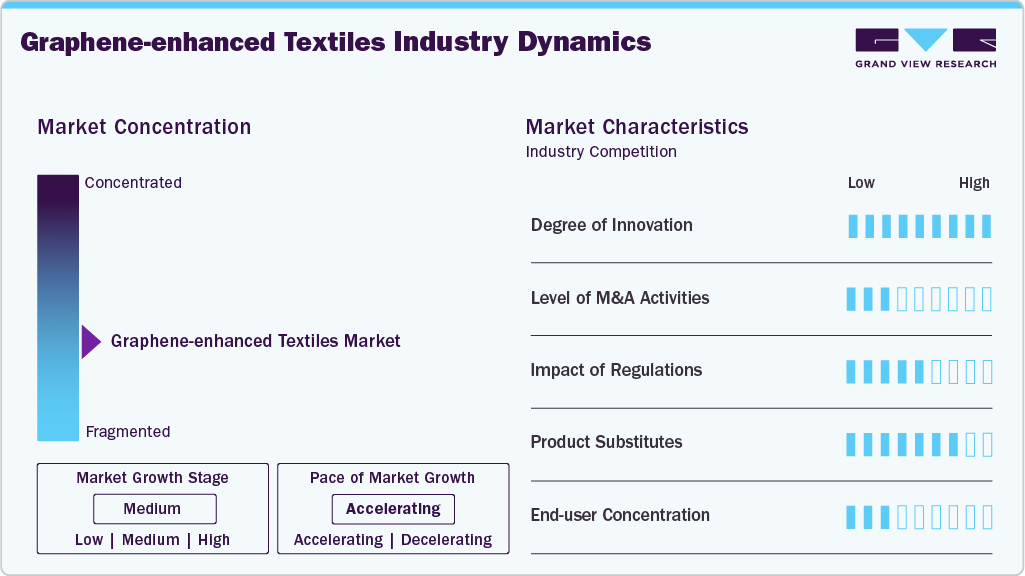
The threat of product substitutes is moderate to high because graphene-enhanced textiles compete with several alternative conductive and functional textile materials. Metallic fibers and coatings, conductive polymers, carbon nanotubes, carbon black, MXenes, silver-based materials, and other nanomaterials can provide conductivity, sensing, electromagnetic shielding, or heating capabilities. Conventional electronic components can also substitute for graphene textile technologies in applications where textile integration is not essential.
Analyst Perspective
The graphene-enhanced textiles market is positioned at the intersection of advanced materials, technical textiles, and smart electronics, with the strongest potential in applications that require multiple functionalities from a single flexible textile platform. Graphene's electrical conductivity, thermal properties, mechanical characteristics, and compatibility with various textile substrates provide a differentiated technological proposition. However, commercialization will depend on improving production scalability, washability, durability, material consistency, and overall cost. The market is therefore expected to develop initially through high-value applications such as wearable electronics, healthcare monitoring, thermal-management clothing, protective textiles, and conductive fabrics before potentially expanding toward broader apparel applications.
Graphene Form Insights
The graphene oxide (GO) segment dominated the graphene-enhanced textiles market, accounting for the largest revenue share of 34.5% in 2025. This can be attributed to its strong compatibility with textile substrates and relatively easy functionalization compared with other graphene forms. GO contains oxygen-containing functional groups that improve its dispersion and interaction with textile fibers, making it suitable for coating, printing, and surface modification processes. Its ability to impart conductivity, thermal management, antimicrobial properties, and sensing functionality has supported adoption across smart and functional textile applications.
The graphene nanoplatelets (GNPs) segment is expected to grow at a CAGR of 17.4% over the forecast period, as manufacturers increasingly seek scalable graphene materials for functional textile coatings, composites, and conductive applications. GNPs offer a combination of electrical and thermal conductivity, mechanical reinforcement, lightweight characteristics, and relatively straightforward incorporation into polymer and textile systems. Their suitability for coatings, fibers, yarns, and composite structures creates opportunities across performance apparel, protective textiles, sportswear, and industrial fabrics. Improvements in dispersion technologies and manufacturing processes are expected to further support their adoption.
Textile Material Insights
The cotton segment dominated the graphene-enhanced textiles industry, accounting for the largest revenue share of 40.9% in 2025. This can be attributed to the widespread use of cotton in apparel and its suitability for surface functionalization. Graphene-based coatings and treatments can enhance cotton fabrics with electrical conductivity, thermal regulation, antimicrobial performance, sensing capabilities, and other functional properties while retaining the basic characteristics of the textile substrate. The extensive availability of cotton and established processing infrastructure also supports its use in graphene-enhanced textile development.
The nylon segment is expected to grow at a CAGR of 16.8% over the forecast period, as manufacturers increasingly develop high-performance and smart textiles requiring strength, flexibility, durability, and functional performance. Nylon provides a suitable substrate for integrating graphene through coatings, composites, and fiber-level technologies, enabling applications such as conductive fabrics, wearable sensors, protective textiles, and performance apparel. Its established use in sportswear, activewear, industrial textiles, and technical fabrics provides a broad application base.
End Use Insights
The healthcare segment dominated the graphene-enhanced textiles market, accounting for the largest revenue share of 29.5% in 2025, driven by the growing use of functional textiles in wearable health monitoring, biosensing, rehabilitation, and patient care applications. Graphene's conductivity, flexibility, sensitivity, and compatibility with textile structures make it well-suited to developing wearable sensors that monitor physiological and physical parameters. Graphene-enhanced fabrics can enable more comfortable and flexible wearable devices compared with rigid electronic components.

The sports & fitness segment is expected to grow at a CAGR of 16.5% over the forecast period, as athletes and consumers increasingly adopt wearable technologies and performance-oriented clothing. Graphene-enhanced textiles can provide thermal regulation, moisture management, conductivity, sensing, lightweight performance, and other functional benefits relevant to sportswear. Conductive graphene fabrics can also be incorporated into wearable sensors for monitoring movement and physiological activity.
Regional Insights
Asia Pacific dominated the global graphene-enhanced textiles market, accounting for the largest revenue share of 39.3% in 2025, driven by its large textile manufacturing base, expanding electronics industry, and strong capabilities in advanced materials research. Countries across the region have established textile supply chains capable of supporting the development and commercialization of functional fabrics. China, Japan, South Korea, and India are particularly relevant because of their textile production, nanotechnology research, and growing smart-textile capabilities. The region is expected to witness demand from smart apparel, sportswear, healthcare textiles, electronics, automotive, and protective clothing.

The China graphene-enhanced textiles market is important due to its extensive textile manufacturing ecosystem and growing capabilities in graphene and nanomaterials. The country's large apparel, technical textile, electronics, and industrial manufacturing industries provide a broad downstream base for graphene-enhanced fabrics. Research is being conducted on graphene-integrated fibers, conductive fabrics, smart clothing, wearable sensors, and functional silk and synthetic textile systems. China's large-scale textile manufacturing capabilities can also support the transition of graphene technologies from laboratory development toward commercial production.
North America Graphene-enhanced Textiles Market Trends
The North America graphene-enhanced textiles industry is expected to experience increasing demand for graphene-enhanced textiles due to its advanced wearable electronics, healthcare technology, defense, sportswear, and technical textile industries. The region's strong research ecosystem supports the development of graphene-based sensors, conductive textiles, flexible electronics, and thermal-management systems. Healthcare and fitness applications are particularly important because graphene fabrics can be integrated into wearable systems to monitor physiological and physical activity.
U.S. Graphene-enhanced Textiles Market Trends
The United States is a major innovation center for graphene-enhanced textiles, owing to its strong capabilities in nanotechnology, flexible electronics, wearable technology, healthcare devices, and advanced materials. Demand is expected from smart clothing, medical monitoring, sports performance systems, protective garments, and defense applications. Graphene's ability to serve as a conductive and sensing material offers opportunities to integrate electronic functions directly into fabrics. Research into graphene-enabled textile electronics and flexible devices is supporting the development of advanced wearable systems.
Europe Graphene-enhanced Textiles Market Trends
The Europe graphene-enhanced textiles industry is expected to witness growing adoption due to its strong advanced-materials research ecosystem, technical textile industry, and focus on sustainable and high-performance textile technologies. European research has demonstrated graphene-based textile electronics, conductive fabrics, adaptive thermal textiles, and wearable sensing technologies. Graphene can also support the development of multifunctional fabrics that combine several performance characteristics within a single textile structure.
The Germany graphene-enhanced textiles market is important, due to its advanced technical textile, automotive, industrial manufacturing, electronics, and engineering sectors. Graphene-enhanced textiles can be utilized in automotive interiors, electromagnetic shielding, conductive components, industrial sensors, protective clothing, and high-performance fabrics. The country's strong industrial research capabilities provide opportunities to transfer graphene technologies from laboratory development to commercial applications.
Latin America Graphene-enhanced Textiles Market Trends
The Latin America graphene-enhanced textiles industry is expected to experience gradual adoption of graphene-enhanced textiles as advanced textile technologies become more commercially accessible. Brazil and Mexico offer significant opportunities due to their textile, apparel, automotive, and industrial manufacturing sectors. Initial demand is likely to remain concentrated in specialized applications such as sportswear, protective clothing, healthcare textiles, and technical fabrics rather than mainstream apparel. The relatively high cost and technological complexity of graphene functionalization can limit rapid mass-market penetration.
Middle East & Africa Graphene-enhanced Textiles Market Trends
The Middle East & Africa graphene-enhanced textiles industry is expected to develop primarily through specialized applications requiring advanced thermal, conductive, protective, and sensing capabilities. Graphene-enhanced textiles can offer opportunities in protective clothing, healthcare, defense, industrial workwear, and thermal-management applications. The region's climatic conditions create particular interest in technologies capable of supporting personal thermal management and temperature regulation. Adoption will depend on the availability and cost of graphene materials, local textile manufacturing capabilities, technology transfer, and investment in advanced materials.
Key Graphene-enhanced Textiles Company Insights
Some of the key players operating in the market include Directa Plus S.p.A. and Versarien plc
-
Directa Plus S.p.A. is a graphene technology company specializing in G+ Graphene Plus, its proprietary graphene nanoplatelet material. The company develops graphene solutions for multiple industries, including textiles, where G+ can be incorporated through printing, coating, impregnation, and membrane lamination to provide thermal, antibacterial, and antistatic functionality.
-
Versarien plc is a UK advanced-materials company known for developing graphene-enhanced technologies and applications. Its textile activities have included Graphene-Wear, targeting performance apparel and functional textile applications, positioning graphene as a material for improving properties such as thermal and moisture management.
HoneyCombX and Nanoloom are some of the emerging participants in the graphene-enhanced textiles market.
-
HoneyCombX is a graphene textile technology platform focused specifically on performance apparel, sportswear, and functional textiles. Its patented platform integrates graphene into formats such as filaments, padding, membranes, and prints, with applications targeting thermal regulation, durability, and antibacterial performance.
-
Nanoloom is a London-based textile technology company developing graphene-based fibers and fabrics designed to provide high performance while reducing the environmental impact associated with conventional synthetic fibers.
Key Graphene-enhanced Textiles Companies
The following key companies have been profiled for this study of the graphene-enhanced textiles market.
-
Directa Plus S.p.A.
-
Versarien plc
-
Grafren AB
-
Kyorene
-
Graphene-X
-
BeDimensional S.p.A.
-
Haydale Graphene Industries
-
HoneyCombX
-
Vollebak
-
Nanoloom
Competitive Benchmarking
Category
Operating Strategies
Competitive Edge
Weakness
Established Players (Directa Plus S.p.A., Versarien plc, Grafren AB, Kyorene, Graphene-X, BeDimensional S.p.A.)
- Invest in graphene production, functionalization, coating, and textile-integration technologies to develop conductive, thermal-regulating, antibacterial, protective, and high-performance fabrics.
- Expand commercialization through partnerships with textile manufacturers, apparel brands, sportswear companies, electronics developers, and technical-textile producers.
- Strengthen product portfolios by developing graphene-enhanced fibers, yarns, coatings, fabrics, and finished textile solutions for smart textiles, performance apparel, healthcare, and industrial applications.
- Strong expertise in graphene materials, functionalization, coatings, conductive technologies, and advanced textile applications supports differentiated product development.
- Established technology platforms and relationships with textile, apparel, materials, and industrial partners support commercialization and market access.
- Significant investment in R&D and proprietary graphene technologies provides advantages in conductivity, thermal management, mechanical performance, sensing, and multifunctional textile applications.
- High costs associated with high-quality graphene production, functionalization, and integration into textile manufacturing processes.
- Maintaining consistent graphene dispersion, adhesion, conductivity, durability, and washability across large textile volumes remains technically challenging.
- Dependence on broader smart-textile adoption, textile manufacturer acceptance, and cost reduction may constrain penetration into mass-market apparel applications.
Emerging Players (Haydale Graphene Industries, HoneyCombX, Vollebak, Nanoloom)
- Focus on commercializing specialized graphene-enhanced textile technologies for performance apparel, sportswear, smart textiles, thermal management, conductive fabrics, and next-generation fibers.
- Expand market presence through collaborations with apparel brands, textile manufacturers, technology companies, research institutions, and strategic industry partners.
- Develop proprietary graphene textile platforms that improve functional performance while maintaining compatibility with existing textile manufacturing, spinning, knitting, weaving, coating, and finishing processes.
- Strong specialization in functionalized graphene, graphene-integrated textiles, performance apparel, graphene fibers, and specialized textile applications enables rapid product innovation.
- Greater operational flexibility allows emerging companies to focus on niche applications and respond quickly to demand for smart, functional, and high-performance textile products.
- Well-positioned to benefit from increasing demand for wearable electronics, thermal-regulating clothing, conductive textiles, sustainable advanced fibers, and multifunctional apparel.
- Limited production scale and commercial reach compared with larger established graphene and textile-material companies.
- Dependence on partnerships, financing, textile manufacturing capabilities, and customer adoption can affect commercialization timelines.
- Emerging graphene textile technologies face challenges related to production cost, scalability, wash durability, standardization, technology validation, and widespread adoption in conventional textile manufacturing.
Recent Developments
-
In July 2025, BeDimensional launched an innovative graphene-based electrically heated paint, designed to generate heat when supplied with electricity. The technology demonstrates the company's expansion into graphene-based thermal-management solutions for heated surfaces and potential smart-textile applications.
Graphene-enhanced Textiles Market Report Scope
Report Attribute
Details
Market size in 2025
USD 346.5 million
Estimated market size in 2026
USD 402.7 million
Projected market size by 2033
USD 1,154.8 million
Growth rate
CAGR of 16.2% from 2026 to 2033
Base year for estimation
2025
Actual estimates/Historical data
2021 - 2024
Forecast period
2026 - 2033
Quantitative units
Revenue in USD million and CAGR from 2026 to 2033
Report coverage
Revenue forecast, company ranking, competitive landscape, growth factors, and trends
Segments covered
Graphene form, textile material, end use, and region
Regional scope
North America; Europe; Asia Pacific; Latin America; Middle East & Africa
Country scope
U.S.; Canada; Mexico; Germany; UK; France; Italy; Spain; China; Japan; India; South Korea; Brazil; Saudi Arabia
Key companies profiled
Directa Plus S.p.A.; Versarien plc; Grafren AB; Kyorene; Graphene-X; BeDimensional S.p.A.; Haydale Graphene Industries; HoneyCombX; Vollebak; Nanoloom
Customization scope
Free report customization (equivalent up to 8 analysts working days) with purchase. Addition or alteration to country, regional & segment scope.
Pricing and purchase options
Avail customized purchase options to meet your exact research needs. Explore purchase options
Global Graphene-enhanced Textiles Market Report Segmentation
This report forecasts revenue growth at the global, regional & country levels and provides an analysis of the industry trends in each of the sub-segments from 2021 to 2033. For this study, Grand View Research has segmented the graphene-enhanced textiles market report based on graphene form, textile material, end use, and region:

-
Graphene Form Outlook (Revenue, USD Million, 2021 - 2033)
-
Graphene Oxide (GO)
-
Reduced Graphene Oxide (rGO)
-
Graphene Nanoplatelets (GNPs)
-
Others
-
-
Textile Material Outlook (Revenue, USD Million, 2021 - 2033)
-
Cotton
-
Polyester
-
Nylon
-
Others
-
-
End Use Outlook (Revenue, USD Million, 2021 - 2033)
-
Healthcare
-
Sports & Fitness
-
Military & Defense
-
Fashion & Lifestyle
-
Others
-
-
Regional Outlook (Revenue, USD Million, 2021 - 2033)
-
North America
-
U.S.
-
Canada
-
Mexico
-
-
Europe
-
UK
-
Germany
-
France
-
Italy
-
Spain
-
-
Asia Pacific
-
China
-
Japan
-
India
-
South Korea
-
-
Latin America
-
Brazil
-
-
Middle East & Africa
-
Saudi Arabia
-
-
Research Methodology
The graphene-enhanced textiles market figures in this report are based on a proven research process that combines executive interviews with secondary research from proprietary databases, company filings, and recognized regulatory and institutional sources. Market size is built through value-chain sizing-reconciling supply-side and demand-side estimates-and triangulated with bottom-up and top-down approaches. Every estimate passes multiple levels of expert validation before publication, with each graphene-enhanced textiles segment quantified using the revenue-capture definitions in the table below.
Segment Definition
Graphene Form
Revenue capture definition
Graphene Oxide (GO)
Revenue generated from graphene-enhanced textiles incorporating graphene oxide (GO) through coatings, treatments, composites, fibers, yarns, or other textile-processing methods. This includes GO-functionalized fabrics used in smart textiles, healthcare, protective clothing, sportswear, and other technical textile applications.
Reduced Graphene Oxide (rGO)
Revenue generated from textiles incorporating reduced graphene oxide (rGO) to provide electrical conductivity, sensing, thermal management, electromagnetic shielding, or other functional properties. This includes rGO-treated fibers, yarns, fabrics, coatings, and textile-based electronic applications.
Graphene Nanoplatelets (GNPs)
Revenue generated from graphene-enhanced textiles incorporating graphene nanoplatelets (GNPs) in fibers, yarns, coatings, composites, inks, or fabrics. This includes products developed for conductive, thermal, mechanical, protective, and other high-performance textile applications.
Others
Revenue generated from graphene-enhanced textiles incorporating other graphene forms, including pristine graphene, few-layer graphene, graphene-based composites, and other graphene derivatives not classified under GO, rGO, or GNPs.
Textile Material
Revenue capture definition
Cotton
Revenue generated from graphene-enhanced cotton textiles, including graphene-coated, treated, printed, or composite cotton fibers, yarns, fabrics, and finished products used in apparel, healthcare, sportswear, and other functional textile applications.
Polyester
Revenue generated from graphene-enhanced polyester textiles incorporating graphene through coatings, blends, composites, fibers, yarns, or finishing processes. This includes polyester-based fabrics used in sportswear, smart textiles, protective clothing, industrial textiles, and other performance applications.
Nylon
Revenue generated from graphene-enhanced nylon textiles, including graphene-functionalized nylon fibers, yarns, fabrics, coatings, and composite materials used in sportswear, protective clothing, technical textiles, smart textiles, and other high-performance applications.
Others
Revenue generated from graphene-enhanced textiles based on textile materials other than cotton, polyester, and nylon, including viscose, wool, silk, polypropylene, acrylic, flax, hemp, and other natural, regenerated, or synthetic fibers.
End Use
Revenue capture definition
Healthcare
Revenue generated from graphene-enhanced textiles used in healthcare and medical applications, including wearable sensors, health-monitoring garments, conductive fabrics, therapeutic textiles, antimicrobial textiles, rehabilitation products, and other textile-based healthcare technologies.
Sports & Fitness
Revenue generated from graphene-enhanced textiles used in sports and fitness applications, including performance apparel, activewear, thermal-regulating clothing, wearable sensors, sports monitoring garments, and other functional sports textiles.
Military & Defense
Revenue generated from graphene-enhanced textiles used in military, defense, and protective applications, including ballistic and protective clothing, electromagnetic shielding fabrics, conductive textiles, thermal-management garments, camouflage systems, and other defense-related textile products.
Fashion & Lifestyle
Revenue generated from graphene-enhanced textiles incorporated into fashion, casualwear, lifestyle apparel, footwear, accessories, and other consumer-oriented textile products offering properties such as thermal regulation, odor management, durability, antimicrobial performance, or other functional benefits.
Others
Revenue generated from graphene-enhanced textiles used in applications outside healthcare, sports & fitness, military & defense, and fashion & lifestyle, including automotive, aerospace, industrial, home textiles, electronics, protective workwear, and other technical textile applications.
Estimation Model
Layer Name
Key Question
Description
Parent Market Analysis
What is the overall size and growth outlook of the global textile fibers, technical textiles, smart textiles, and advanced textile materials market?
The estimation begins by evaluating the broader textile fibers, technical textiles, smart textiles, and advanced functional materials market. Global textile production, fiber consumption, technical textile demand, smart textile adoption, wearable electronics development, and investments in advanced textile technologies are analyzed to establish the total addressable market for graphene-enhanced textiles.
Graphene Textile Penetration Analysis
What proportion of the overall textile and smart textile market is represented by graphene-enhanced textiles across different textile types and integration technologies?
This layer estimates the penetration of graphene-enhanced textiles across graphene coatings, graphene oxide and reduced graphene oxide treatments, graphene-based inks, graphene fibers and yarns, and composite textile technologies. Adoption is assessed across conductive fabrics, smart fabrics, performance textiles, and functional textile structures to determine the contribution of graphene-enhanced technologies to the overall market.
Regional & End Use Demand Assessment
Which regions and end-use industries contribute the highest demand for graphene-enhanced textiles?
Market demand is evaluated across major regions based on textile manufacturing capacity, smart textile adoption, advanced-materials research, wearable electronics penetration, technical textile production, and investments in graphene technologies. Demand is further assessed across apparel and sportswear, healthcare and medical textiles, electronics and wearable devices, automotive, aerospace and defense, protective clothing, and industrial textiles.
Company Revenue Validation & Market Forecasting
How is the final market size validated and forecast?
Final estimates are validated using company revenues, graphene production and processing capabilities, graphene-enhanced textile product portfolios, manufacturing capacities, technology commercialization, strategic partnerships, product launches, investments, and secondary research. Bottom-up and top-down approaches are triangulated to generate reliable market estimates and forecasts for graphene-enhanced textiles.
Delivered Customizations
We have successfully delivered the following deep-dive customizations
Client Request
Customization Delivered
Value Adds
Regional Demand Assessment
Detailed evaluation of regional demand across major regions based on textile manufacturing capacity, smart-textile adoption, graphene production capabilities, advanced-materials research, wearable electronics penetration, technical textile demand, and investment in functional textile technologies. The analysis also identifies high-potential countries and emerging commercialization hotspots for graphene-enhanced textiles.
Helps clients prioritize target markets, develop regional expansion strategies, identify high-potential countries, optimize resource allocation, and assess commercialization opportunities across advanced textile and wearable technology markets.
Graphene Technology & Textile Integration Analysis
Assessment of graphene nanoplatelets, graphene oxide, reduced graphene oxide, graphene-based coatings, conductive inks, graphene fibers, yarn integration, textile printing, coating, finishing, and composite technologies based on technology maturity, conductivity, flexibility, durability, washability, scalability, processing compatibility, and cost efficiency.
Enables clients to benchmark graphene integration technologies, evaluate technology readiness, identify commercially viable approaches, select suitable textile-processing methods, and prioritize investments in scalable graphene-enhanced textile technologies.
Competitive & Substitute Technology Benchmarking
Comparative assessment of graphene-enhanced textile companies and competing functional-material technologies, including conductive polymers, metallic fibers, carbon nanotubes, carbon-based materials, MXenes, and other nanomaterials. Benchmarking covers product capabilities, technology differentiation, application portfolio, scalability, partnerships, and commercialization strategy.
Enables clients to understand competitive positioning, identify technology gaps, evaluate substitute threats, benchmark product performance, and develop strategies for differentiation and market entry.
Frequently Asked Questions About This Report
The cotton segment accounted for the highest revenue share of 40.9% in 2025, driven by its widespread use in apparel and its suitability for graphene functionalization and smart textile applications.
Asia Pacific held the highest revenue market share of 39.3% in 2025, driven by its large textile manufacturing base, growing smart-textile adoption, and expanding graphene and advanced-materials industries.
The graphene oxide (GO) segment accounted for the largest revenue share of 34.5% in 2025, driven by its strong dispersibility, functionalization capabilities, and suitability for textile coatings and surface treatments.
The healthcare segment led with a 29.5% revenue share in 2025.
The global graphene-enhanced textiles market size was valued at USD 346.5 million in 2025 and is estimated at USD 402.7 million for 2026.
The global graphene-enhanced textiles market is expected to grow at a CAGR of 16.2% from 2026 to 2033, reaching USD 1,154.8 million by 2033.
Key factors driving the graphene-enhanced textiles market include rising adoption of smart and wearable textiles, growing demand for thermal-regulating and conductive fabrics, and increasing use of textile-based healthcare sensors.
Some key players in the graphene-enhanced textiles market include Directa Plus S.p.A., Versarien plc, Grafren AB, Kyorene, Graphene-X, BeDimensional S.p.A., Haydale Graphene Industries, HoneyCombX, Nanoloom, and Vollebak.
The healthcare segment is the fastest-growing end use in the graphene-enhanced textiles market.
About the Author(s)
Advanced Interior Materials Research Team
Advanced Materials · Advanced Interior MaterialsThis report was authored by the advanced interior materials research team at Grand View Research - comprising two research analysts, one senior research analyst, and one industry expert - with specialized expertise in the advanced interior materials segment of the advanced materials industry. All findings are based on proprietary advanced materials databases, executive interviews, and regulatory analysis, subject to internal peer review prior to publication.
Last Updated:
Speak to Analyst


Customize this report to your needs — add regions, segments, or data points, with 20% free customization.
Or view our licence options:


ISO 9001:2015 & 27001:2022 Certified
We are GDPR and CCPA compliant! Your transaction & personal information is safe and secure. For more details, please read our privacy policy.


