
- Home
- »
- Power Generation & Storage
- »
-
Grid Forming Inverter Market Size & Share Report, 2033GVR Report cover
![Grid Forming Inverter Market (2026 - 2033)Report]()
Grid Forming Inverter Market (2026 - 2033)
Size, Share & Trends Analysis Report By Type (Micro Inverter, String Inverter), By Application (Solar PV Plants, Wind Power Plants), By Voltage (100-300 V, 300-500 V), By Power Rating (Below 50 KW, 50-100 KW), By Region, And Segment Forecasts
Market Size, 2025
$718.6MMarket Estimate, 2026
$763.5MMarket Forecast, 2033
$1,381.7MCAGR, 2026–2033
8.8%Grid Forming Inverter Market Summary
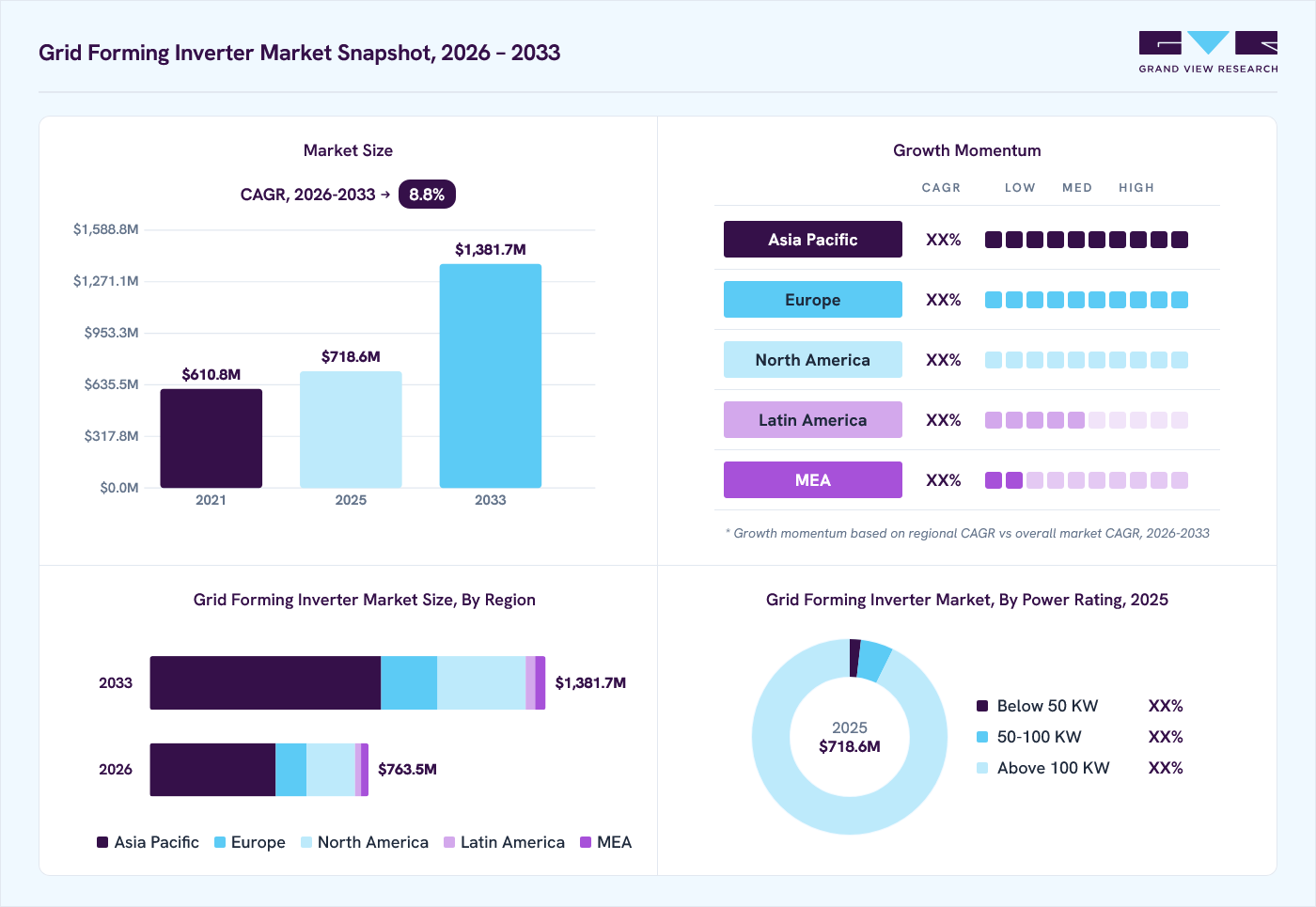
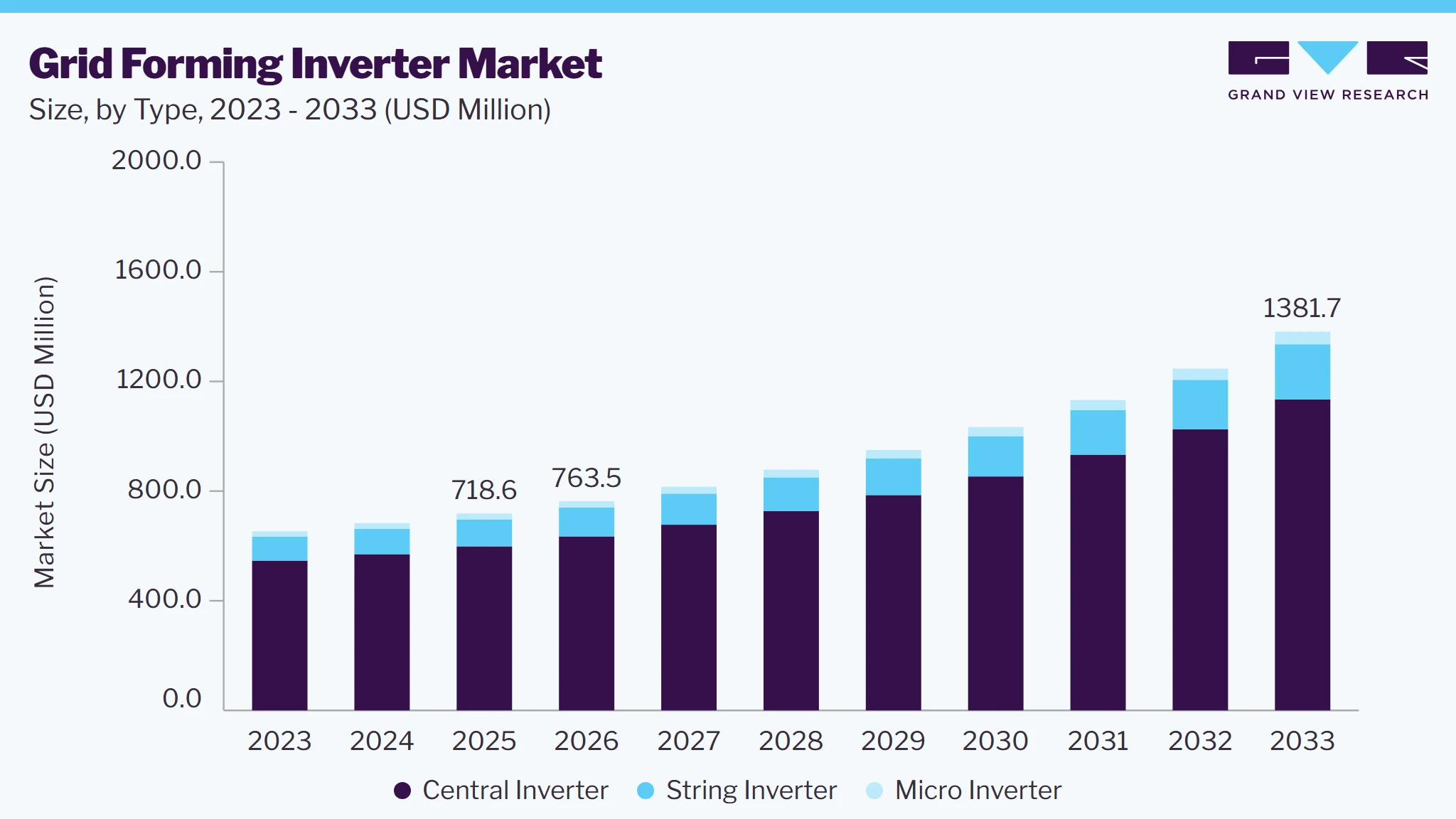
The global grid forming inverter market size was valued at USD 718.6 million in 2025 and is projected to grow from USD 763.5 million in 2026 to USD 1,381.7 million by 2033, at a CAGR of 8.8% from 2026 to 2033. Asia Pacific dominated the market, accounting for a revenue share of 57.5% in 2025. The market is driven by the growing integration of renewable energy sources and the increasing need to maintain grid stability in low inertia power systems.
Key Market Trends & Insights
- By type: Central inverter held the largest revenue share of 83.3% in 2025.
- By application: Energy storage systems held the largest revenue share of 70.7% in 2025.
- By voltage: Above 500 V held the largest revenue share of 85.4% in 2025.
- By power rating: Above 100 KW held the largest revenue share of 92.7% in 2025.
Regional Highlights
- Largest regional market: Asia Pacific (57.5% revenue share in 2025)
- By country: China held the largest market share in 2025.
Market Size & Forecast
- Market Size in 2025: USD 718.6 Million
- Estimated market size in 2026: USD 763.5 Million
- Projected Market Size by 2033: USD 1,381.7 Million
- CAGR (2026-2033): 8.8%
Three ways to get this report
Buy it, customize it, or ask a question.Get the Full Report
What the study covers
- FormatsPDF · Excel · Dashboard
- Timeline2026–2033 annual, 2025 base
- Coverage20+ countries, 5 regions
- Companies10+ key players profiled
Customize the Report
20% free customization
- IncludeCountries, segments, points
- TailorTo your product definition
- ExtendDeeper competitor detail
- OrA fully bespoke study
- Turnaround5–10 working days
Ask an Analyst
A direct answer, usually in 1 working day
- AccessReport author, directly
- Reply timeWithin 1 working day
- No sales callDirect answer only
- FormatEmail reply
- CostFree, no cost
As solar, wind, and battery energy storage systems continue to replace conventional synchronous generators, power grids face challenges related to frequency regulation, voltage control, and system resilience.
Market Dynamics
The grid-forming inverter market is evolving alongside the transition toward more flexible, decentralized, and inverter-based power systems. Increasing deployment of renewable generation and battery storage is accelerating interest in advanced inverter controls capable of supporting complex power system operations. Utilities are assessing grid forming technology for applications such as utility scale energy storage, microgrids, remote power systems, and renewable power plants. Market development is also influenced by evolving grid codes, technology standardization, interoperability requirements, and the need to demonstrate reliable performance at larger grid scales.
The increasing penetration of solar and wind generation is transforming power system operations and creating new technical requirements for grid-connected resources. Unlike conventional synchronous generators, inverter-based renewable assets contribute limited inherent inertia, making voltage regulation, frequency management, and fault response more challenging as renewable shares increase. As a result, utilities and grid operators are adopting advanced inverter technologies capable of supporting stable grid operation under changing system conditions.
Commercial deployment is gradually moving beyond pilot projects. In 2025, the 185 MW/370 MWh Koorangie Battery Energy Storage System in Victoria, Australia utilized grid-forming inverter technology to support system strength and renewable energy integration. Such projects demonstrate the growing role of grid-forming inverters in enabling higher renewable penetration while maintaining reliable power system performance.
The higher upfront cost of grid forming inverters compared with conventional grid following systems can limit adoption, particularly in cost sensitive renewable energy and energy storage projects. Advanced control systems, specialized power electronics, system engineering, and additional grid compliance requirements can increase the overall project cost. This can make developers and utilities more cautious about adopting the technology when grid forming functionality is not mandatory or when its financial benefits are difficult to quantify.
The ongoing retirement of coal- and gas-fired power plants is creating a structural opportunity for grid-forming inverter technologies. Conventional synchronous generators have historically provided essential services such as inertia, voltage support, and fault current contribution. As these assets are phased out, utilities are seeking alternative technologies capable of delivering comparable grid-support functions without relying on fossil-fuel generation. Grid-forming inverters integrated with battery energy storage systems are increasingly being evaluated as a solution to address this requirement. Their ability to establish voltage and frequency references enables storage systems to contribute to system strength and operational reliability. Projects such as RWE’s Moerdijk battery energy storage deployment highlight the growing interest in using advanced inverter-based resources to support power systems undergoing rapid energy transition.
Analyst Perspective
The grid-forming inverter market is progressing from an early-stage technology segment toward broader commercial deployment. Industry participants are increasingly focusing on performance validation, interoperability, and compliance with evolving grid codes as utilities seek standardized solutions for inverter-dominated power systems. This shift is encouraging manufacturers to enhance control architectures, testing capabilities, and system integration expertise. Market growth is expected to be supported by the expansion of large-scale battery energy storage projects, increasing utility investment in grid modernization, and the emergence of stricter technical requirements for renewable energy interconnections. As deployment experience grows and industry standards mature, grid-forming inverters are likely to become an increasingly important component of future power system infrastructure.
Type Insights
The central inverter segment held the largest revenue share of 83.3% in 2025 due to its suitability for utility-scale renewable energy and battery energy storage projects where grid-forming functionality is increasingly required. These systems can provide voltage and frequency reference capabilities at high power levels, making them suitable for large-scale grid-support applications. Growing deployment of utility-scale solar, wind, and battery storage projects is supporting demand for high-capacity grid-forming central inverter solutions.
The micro inverter segment is expected to register the fastest CAGR of 10.1% from 2026 to 2033. Growth is supported by increasing interest in distributed energy systems, residential energy storage, and decentralized grid-support architectures. Advancements in inverter control technologies are expanding the potential role of microinverters in applications requiring enhanced grid interaction and resilience. Continued innovation in distributed energy management and behind-the-meter storage systems is expected to support future segment growth.
Application Insights
The energy storage systems segment dominated the market with a revenue share of 70.7% in 2025. This dominance is supported by the increasing deployment of battery energy storage systems, growing integration of renewable energy sources, and rising demand for grid stability and reliable power supply. Energy storage systems help balance fluctuations in renewable generation and provide essential grid services such as frequency regulation and voltage support. Declining battery costs, expanding utility-scale storage projects, and increasing investments in grid modernization are strengthening demand for grid-forming inverter solutions.
The electrical vehicle segment is anticipated to register the fastest CAGR of 9.6% during the forecast period. This growth is driven by the rising adoption of electric vehicles and expansion of EV charging infrastructure. Increasing investments in fast-charging networks are creating demand for advanced power conversion and grid-support technologies. Grid-forming inverters can help maintain voltage and frequency stability during the integration of high-power EV charging loads. Growing electrification of transportation and the integration of renewable energy with charging infrastructure are expected to further support segment growth.
Voltage Insights
The above 500 V segment held the largest revenue share of 85.4% in 2025. This is supported by the growing deployment of high-capacity battery energy storage systems, utility-scale renewable energy projects, and large industrial power applications. Higher-voltage systems enable efficient power transfer while reducing transmission losses and improving overall system performance. The increasing need for grid stability and reliable integration of variable renewable generation is also supporting demand for high-voltage grid-forming inverters. Investments in large-scale energy storage and grid modernization are expected to strengthen segment growth.
The 100-300 V segment is expected to register the fastest CAGR of 9.7% over the forecast period. This is due to the growing adoption of distributed energy resources, residential and commercial energy storage systems, and small- to medium-scale renewable energy installations. The voltage range is well suited for battery-based applications and decentralized power systems that require flexible and efficient grid support. Increasing deployment of rooftop solar and behind-the-meter storage is further creating demand for these inverters. Rising electrification and the need for reliable power quality in commercial and industrial facilities are expected to support segment growth.
Power Rating Insights
The above 100 KW segment dominated the global market with a revenue share of 92.7% in 2025, supported by the widespread deployment of high-capacity renewable energy projects, utility-scale battery energy storage systems, and grid-support applications. These systems require higher-power inverters to manage large electricity loads and maintain grid stability. Growing investments in solar and wind power projects are further increasing demand for high-capacity grid-forming solutions. In addition, the need for reliable frequency and voltage regulation across large power networks is supporting adoption.
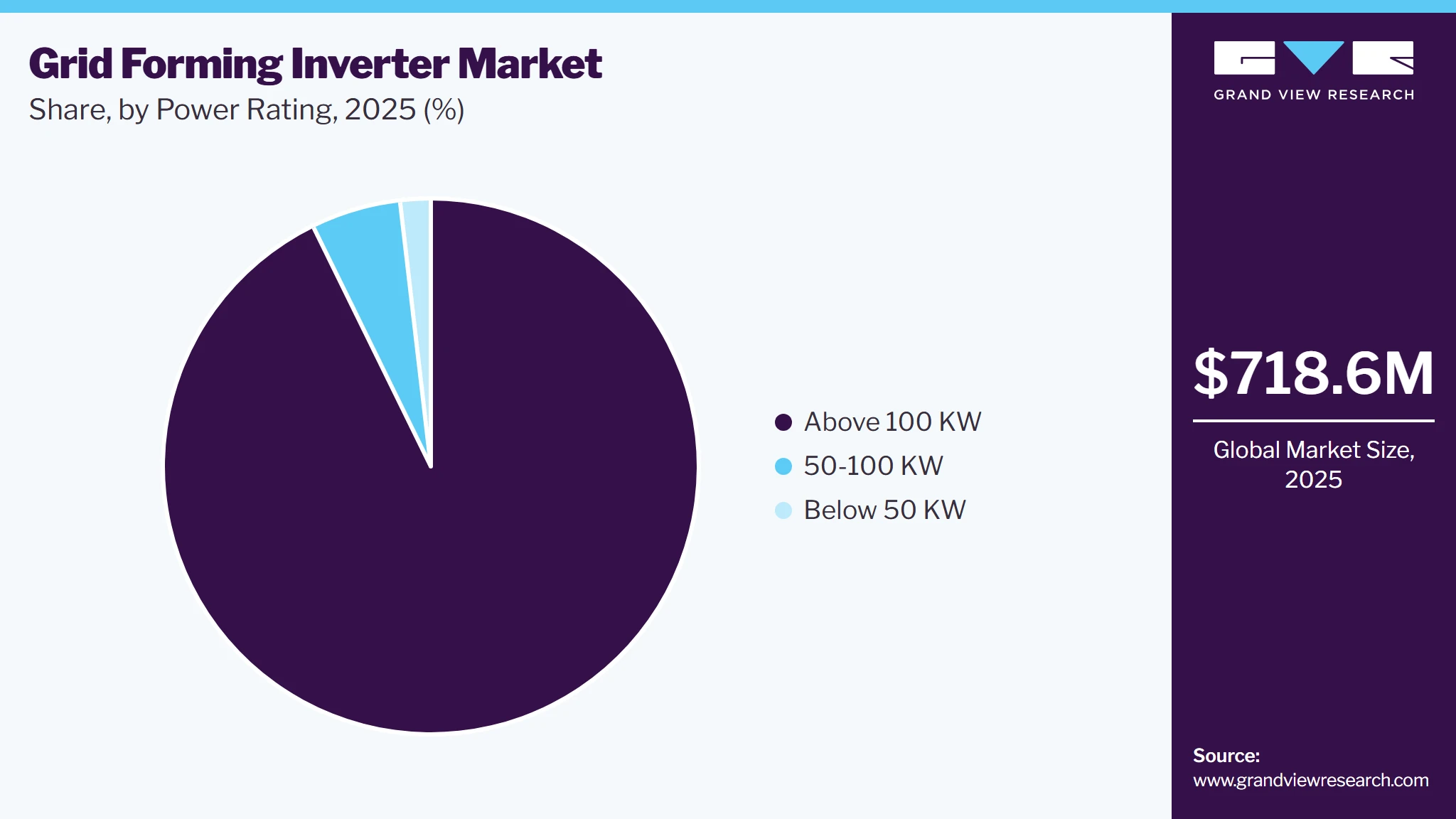
The below 50 KW segment is expected to register the fastest CAGR of 9.2% during the forecast period. This growth is driven by the increasing adoption of distributed energy systems, residential and small-scale commercial energy storage, and rooftop solar installations. Lower-capacity grid-forming inverters are well suited for decentralized power applications due to their compact design, flexibility, and relatively lower installation costs. Growing demand for backup power and improved power quality is further supporting adoption. In addition, the expansion of distributed renewable generation and electrification across residential and commercial applications is expected to drive segment growth.
Regional Insights
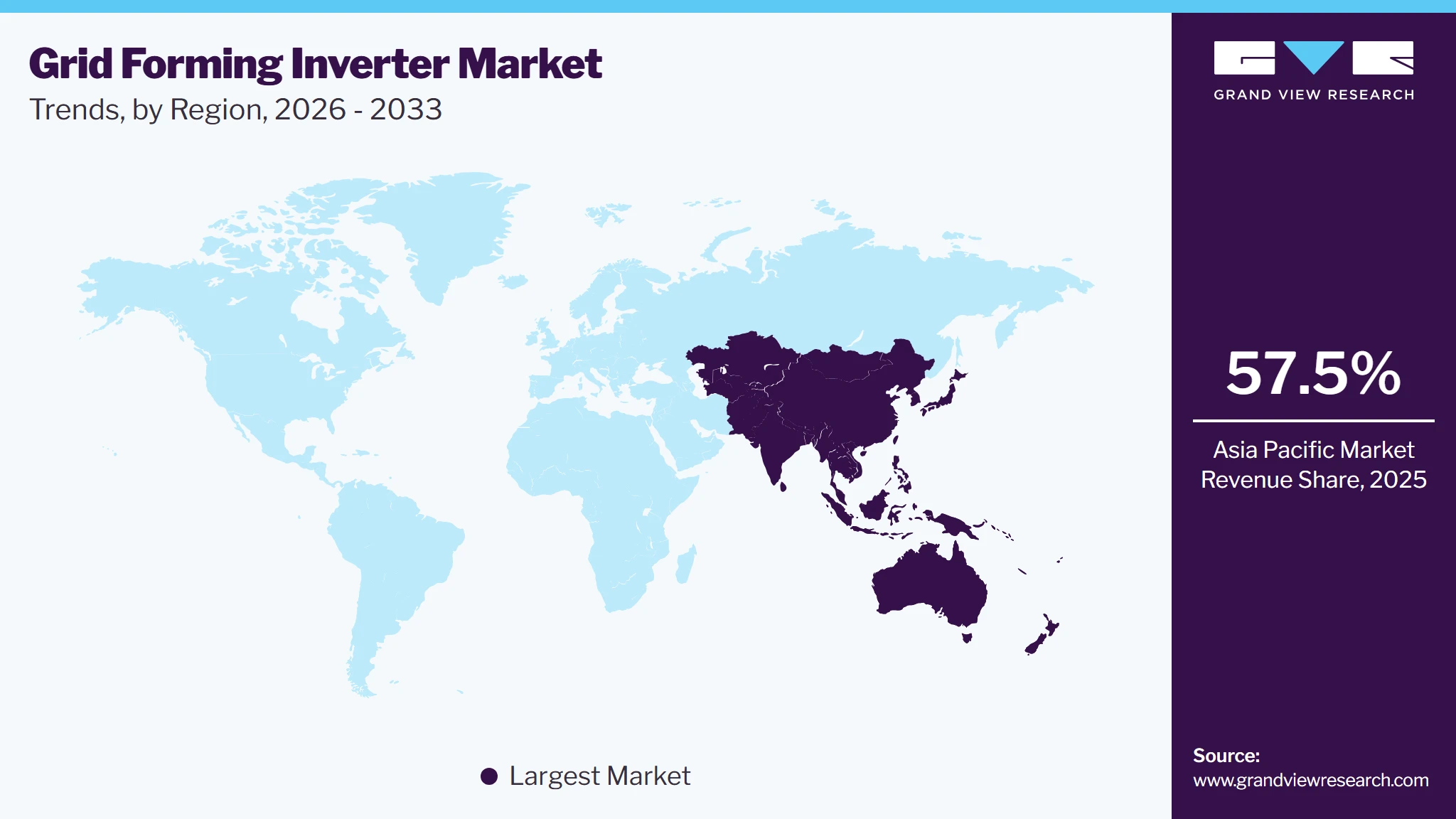
Asia Pacific dominated the market with a revenue share of 57.5% in 2025. The region benefits from a combination of large-scale renewable energy deployment, substantial battery storage investment, and a strong manufacturing base for power electronics equipment. Australia remains one of the most advanced commercial markets for grid-forming technology, while China continues to scale deployment through utility-scale storage and renewable energy projects. This combination of deployment experience and manufacturing capacity positions Asia Pacific as a key center for technology development and commercialization.
China Grid Forming Inverter Market Trends
China's market is closely linked to its large scale renewable, storage, and transmission infrastructure buildout, creating opportunities to deploy GFM at a scale that is difficult to replicate in smaller markets. Projects are increasingly testing GFM BESS for applications associated with large renewable bases and remote generation locations. The presence of major domestic inverter and power electronics manufacturers, including Huawei, Sungrow, and NR Electric, also supports rapid technology development and domestic supply. A 295 MW GFM BESS project in Ningxia is listed among the projects targeted for 2025 deployment, highlighting the movement toward utility scale applications.
Europe Grid Forming Inverter Market Trends
Europe is expected to register the second-fastest CAGR of 9.0% from 2026 to 2033. The region is moving toward a more standardized and regulation-led adoption environment for grid-forming technology. Transmission system operators are increasingly defining technical requirements for inverter-based resources, which is helping convert GFM from a demonstration technology into a grid connection consideration. The region is also seeing greater interest in GFM capabilities for offshore wind integration, cross-border power systems, and battery storage. The development of common testing and compliance procedures is likely to improve project bankability and support wider commercial deployment.
North America Grid Forming Inverter Market Trends
North America presents a market where utility procurement requirements, grid reliability objectives, and large-scale energy storage investments are shaping adoption. Developers are increasingly incorporating advanced inverter capabilities into renewable and storage projects to satisfy interconnection requirements and enhance operational flexibility. Growing investment in domestic energy infrastructure and modernization of aging transmission networks is also supporting demand for advanced grid-support technologies.
The U.S. grid forming inverter market is developing around large scale storage, grid reliability requirements, and increasing power demand from new loads. Texas, California, Hawaii, and western states provide distinct use cases because of their high renewable and inverter based resource penetration. The market is also likely to see greater emphasis on cybersecurity and supply chain localization, particularly following increased scrutiny of foreign manufactured inverters in 2026. This could reshape supplier competition by favoring vendors able to provide secure, domestically supported inverter platforms.
Latin America Grid Forming Inverter Market Trends
Latin America remains an emerging GFM market, with adoption concentrated around countries facing rapid changes in their generation mix and challenging grid conditions. Chile stands out because of its large solar and wind pipeline and growing need to manage variable generation and transmission constraints. The region also offers opportunities for GFM in isolated systems, mining operations, and renewable plus storage projects where conventional grid support may be limited. Recent industry assessments identify Chile alongside Saudi Arabia as a newer GFM market with potential for relatively rapid penetration as large storage projects come online.
Middle East & Africa Grid Forming Inverter Market Trends
The Middle East & Africa market is developing through large, centralized renewable and storage projects, rather than the smaller distributed deployments seen in some mature markets. Saudi Arabia is particularly notable, with large scale GFM BESS projects being developed to support the country's rapidly expanding renewable power infrastructure. A three site project totaling 7.8 GWh is being supplied by Sungrow, illustrating the scale at which GFM technology can enter emerging power markets. In Africa, the technology also has potential in renewable powered industrial facilities, isolated grids, and hybrid energy systems where grid strength and reliability are key considerations.
Key Grid Forming Inverter Company Insights
Some of the key players operating in the global grid forming inverter market include EPC Power Corp. and Fuji Electric Co., Ltd., among others.
-
EPC Power Corp. focuses on utility scale power conversion for energy storage and grid support applications, with its M System platform designed to operate across a range of grid conditions. Its technology incorporates Agile Grid Forming, enabling the inverter to establish grid voltage and frequency while supporting functions such as fast frequency response and system strength. The company has also expanded its focus toward high power applications beyond conventional renewable projects, including data center and other critical power infrastructure. This focus gives EPC Power a specialized position in the U.S. market, particularly as large scale BESS projects require advanced grid support capabilities.
-
Fuji Electric Co., Ltd. is developing grid forming capabilities around its established power conditioning system and power electronics expertise, with a focus on improving the stability of battery storage systems during grid disturbances. Its development work addresses key technical challenges such as fault ride through, overcurrent control, and maintaining stable inverter operation under changing voltage and frequency conditions. The company has been conducting equipment combination testing to validate these functions under practical operating conditions. This development positions Fuji Electric to leverage its existing power conversion expertise as utilities and storage developers increasingly require inverters capable of operating effectively in more complex grid environments.
Key Grid Forming Inverter Companies
The following key companies have been profiled for this study on the grid forming inverter market.
-
EPC Power Corp.
-
Fuji Electric Co., Ltd.
-
GE Vernova
-
Hitachi Energy Ltd
-
Huawei Technologies Co., Ltd.
-
Sensata Technologies, Inc.
-
Siemens Energy
-
SINENG
-
SMA Solar Technology AG
-
SUNGROW
Competitive Benchmarking
Category
Operating Strategies
Competitive Edge
Weakness
Established Players (Fuji Electric Co., Ltd., GE Vernova, Hitachi Energy Ltd, Huawei Technologies Co., Ltd., Sensata Technologies, Inc., Siemens Energy, SMA Solar Technology AG)
- Leverage broad power electronics portfolios to integrate GFM capabilities across BESS, renewable generation, STATCOM, HVDC, and grid support applications.
- Target utility scale projects where proven performance, grid compliance, and long term service capabilities are important purchasing criteria.
- Expand through strategic partnerships and project deployments to build operating references across major renewable markets.
- Strong installed base and utility relationships provide easier access to large scale projects.
- Extensive grid engineering expertise enables integration of GFM technology with HVDC, STATCOM, BESS, and renewable generation.
- Proven project references reduce technology adoption risk for utilities and transmission operators.
- Higher organizational and product complexity can make customization slower than for specialized inverter companies.
- Large established portfolios can increase solution costs, particularly for projects requiring only basic inverter functionality.
- Longer qualification and engineering cycles can limit flexibility in rapidly developing GFM applications.
Emerging Players (EPC Power Corp., SINENG, SUNGROW)
- Focus on specialized power conversion applications where advanced GFM performance provides a clear technical advantage.
- Target specific high growth niches, such as utility scale BESS, weak grids, microgrids, and high power industrial applications.
- Develop differentiated control architectures rather than competing solely on inverter capacity or price.
- Greater specialization allows faster development of application specific GFM solutions.
- More flexible product architectures can support customized requirements from storage developers and grid operators.
- Agile technology development enables these companies to respond quickly to emerging GFM standards and applications.
- Limited GFM project references compared with established global suppliers can create adoption barriers.
- Smaller global service and support networks may restrict participation in large multinational utility projects.
- Lower brand recognition among transmission and distribution utilities can increase qualification requirements.
Recent Developments
- In September 2026, WattPower launched its 506KTL Grid Forming Utility Scale Inverter, a 506 kW, 1,000 V AC smart string inverter designed to support utility scale solar projects under weak grid conditions. The inverter incorporates AI enabled monitoring and plant optimization capabilities, along with a hybrid cooling system, anti-icing fan, and SSLD2 protection technology. The higher capacity design can reduce the number of inverters required and associated balance of system costs while supporting grid code compliance, improving plant stability, and reducing the risk of solar curtailment. The development highlights the increasing integration of grid forming capabilities and intelligent monitoring technologies into utility scale solar inverters.
Grid Forming Inverter Market Report Scope
Report Attribute
Details
Market Definition
The grid forming inverter market comprises revenue from the sales of grid forming inverters that are installed across solar PV plants, wind power plants, energy storage systems, electric vehicles, and other applications.
Market size in 2025
USD 718.6 million
Estimated market size in 2026
USD 763.5 million
Projected market size by 2033
USD 1,381.7 million
Growth rate
CAGR of 8.8% from 2026 to 2033
Base year for estimation
2025
Historical data
2021 - 2024
Forecast period
2026 - 2033
Quantitative units
Revenue in USD million and CAGR from 2026 to 2033
Report coverage
Revenue forecast, competitive landscape, growth factors, and trends
Segments covered
Type, application, voltage, power rating, and region
Regional scope
North America; Europe; Asia Pacific; Latin America; Middle East & Africa
Country scope
U.S.; Canada; Mexico; Germany; UK; France; Italy; Spain; China; India; Japan; South Korea; Brazil; Argentina; UAE; Saudi Arabia; South Africa
Key companies profiled
EPC Power Corp.; Fuji Electric Co., Ltd.; GE Vernova; Hitachi Energy Ltd; Huawei Technologies Co., Ltd.; Sensata Technologies, Inc.; Siemens Energy; SINENG; SMA Solar Technology AG; SUNGROW
Customization scope
Free report customization (equivalent up to 8 analysts working days) with purchase. Addition or alteration to country, regional & segment scope.
Pricing and purchase options
Avail customized purchase options to meet your exact research needs. Explore purchase options
Global Grid Forming Inverter Market Report Segmentation
This report forecasts revenue growth at global, regional, and country levels and provides an analysis of the latest industry trends in each of the sub-segments from 2021 to 2033. For this study, Grand View Research has segmented the global grid forming inverter market report on the basis of type, application, voltage, power rating, and region.
-
Type Outlook (Revenue, USD Million, 2021 - 2033)
-
Micro Inverter
-
String Inverter
-
Central Inverter
-
-
Application Outlook (Revenue, USD Million, 2021 - 2033)
-
Solar PV Plants
-
Wind Power Plants
-
Energy Storage Systems
-
Electric Vehicle
-
Other Applications
-
-
Voltage Outlook (Revenue, USD Million, 2021 - 2033)
-
100-300 V
-
300-500 V
-
Above 500 V
-
-
Power Rating Outlook (Revenue, USD Million, 2021 - 2033)
-
Below 50 KW
-
50-100 KW
-
Above 100 KW
-
-
Regional Outlook (Revenue, USD Million, 2021 - 2033)
- North America
-
U.S.
-
Canada
-
Mexico
-
Europe
-
Germany
-
UK
-
France
-
Italy
-
Spain
-
-
Asia Pacific
-
China
-
India
-
Japan
-
South Korea
-
-
Latin America
-
Brazil
-
Argentina
-
-
Middle East & Africa
-
Saudi Arabia
-
UAE
-
South Africa
-
Research Methodology
The grid forming inverter market figures in this report are based on a proven research process that combines executive interviews with secondary research from proprietary databases, company filings, and recognized regulatory and institutional sources. Market size is built through value-chain sizing-reconciling supply-side and demand-side estimates-and triangulated with bottom-up and top-down approaches. Every estimate passes multiple levels of expert validation before publication, with each grid forming inverter segment quantified using the revenue-capture definitions in the table below.
Segment Definition
Segment - Type
Revenue capture definition
Micro Inverter
Comprises revenue generated from sales of grid forming micro inverters deployed at the individual module or panel level.
String Inverter
Revenue generated from sales of grid forming string inverters designed to manage multiple interconnected solar modules or energy assets.
Central Inverter
Includes revenue derived from sales of grid forming central inverters used in large scale renewable energy and energy storage projects.
Segment - Application
Revenue capture definition
Solar PV Plants
Consists of revenue generated from sales of grid forming inverters installed in solar photovoltaic power plants.
Wind Power Plants
Includes revenue earned from sales of grid forming inverters used in wind energy generation facilities.
Energy Storage Systems
Revenue generated from sales of grid forming inverters integrated with battery energy storage and other storage technologies.
Electric Vehicle
Comprises revenue derived from sales of grid forming inverters supporting EV charging infrastructure and vehicle to grid applications.
Other Applications
Consists of revenue generated from sales of grid forming inverters used in microgrids, industrial facilities, data centers, and other applications.
Segment - Voltage
Revenue capture definition
100-300 V
Includes revenue from sales of grid forming inverters operating within the 100-300 V voltage range.
300-500 V
Revenue generated through sales of grid forming inverters operating within the 300-500 V voltage range.
Above 500 V
Comprises revenue earned from sales of grid forming inverters operating above 500 V.
Segment - Application
Revenue capture definition
Below 50 KW
Consists of revenue generated from sales of grid forming inverters with power ratings below 50 kW.
50-100 KW
Includes revenue derived from sales of grid forming inverters rated between 50 kW and 100 kW.
Above 100 KW
Revenue generated from sales of grid forming inverters with power ratings exceeding 100 kW.
Estimation Model
Layer Name
Key Question
Description
Demand Layer
Which factors generate demand for grid forming inverters?
Assess demand driven by increasing renewable energy penetration, growth of battery energy storage systems, expansion of microgrids, grid modernization initiatives, rising electric vehicle infrastructure deployment, and the need for grid stability in systems with high shares of inverter based resources.
Technology Layer
Which inverter technologies generate market revenue?
Evaluate revenue across micro inverters, string inverters, and central inverters based on their technical architecture, grid support capabilities, and deployment across renewable energy, storage, and distributed power systems.
Application Layer
Which voltage ranges, power ratings, and applications generate market revenue?
Assess revenue across voltage ranges including 100-300 V, 300-500 V, and above 500 V, and power ratings including below 50 kW, 50-100 kW, and above 100 kW. Revenue is further analyzed across solar PV plants, wind power plants, energy storage systems, electric vehicle infrastructure, and other applications.
Revenue Layer
How is market revenue generated?
Market revenue is quantified through the sales of grid forming inverters. Revenue varies based on inverter type, application, voltage range, power rating, grid support functionality, and project scale across utility, commercial, industrial, and distributed energy installations.
Delivered Customizations
We have successfully delivered the following deep-dive customizations:
Client Request
Customization Delivered
Value Adds
Competitive Benchmarking
Conducted a detailed assessment of established and emerging grid forming inverter providers based on inverter type, product portfolio, power rating, voltage range, grid forming capabilities, applications, geographic presence, partnerships, and overall market positioning.
Helps the client understand competitive strengths, identify product and technology gaps, and benchmark its positioning against key market participants.
Cross segmentation Analysis
Analyzed micro, string, and central grid forming inverters across solar PV plants, wind power plants, energy storage systems, electric vehicle infrastructure, and other applications to assess product adoption, technical suitability, and market opportunities.
Enables the client to identify the most suitable inverter types for each application, understand cross application demand patterns, and prioritize high potential product and application combinations.
Regional Opportunity Assessment
Evaluated grid forming inverter market potential across key geographic markets by analyzing renewable energy deployment, energy storage capacity, grid modernization investments, grid code requirements, EV infrastructure development, and adoption of inverter based power systems.
Enables identification of high potential markets, key demand drivers, and priority regions for expansion and investment.
About the Author(s)
Power Generation & Storage Research Team
Energy & Power · Power Generation & StorageThis report was authored by the power generation & storage research team at Grand View Research - comprising two research analysts, one senior research analyst, and one industry expert - with specialized expertise in the power generation & storage segment of the energy & power industry. All findings are based on proprietary energy & power databases, executive interviews, and regulatory analysis, subject to internal peer review prior to publication.
Last Updated:
Speak to Analyst


Customize this report to your needs - add regions, segments, or data points, with 20% free customization.
Or view our licence options:


ISO 9001:2015 & 27001:2022 Certified
We are GDPR and CCPA compliant! Your transaction & personal information is safe and secure. For more details, please read our privacy policy.


