
- Home
- »
- Homecare & Decor
- »
-
Homeware Market Size, Share & Growth Report, 2026-2033GVR Report cover

Homeware Market (2026 - 2033)
Size, Share & Trends Analysis Report By Product (Kitchen & Dining, Home Décor, Home Textiles, Storage & Organization, Bathroom Accessories, Cleaning & Household Utility), By Distribution Channel (Offline, Online), By Region, And Segment Forecasts
Market Size, 2025
$243.9BMarket Estimate, 2026
$261.2BMarket Forecast, 2033
$425.6BCAGR, 2026–2033
7.2%Homeware Market Summary
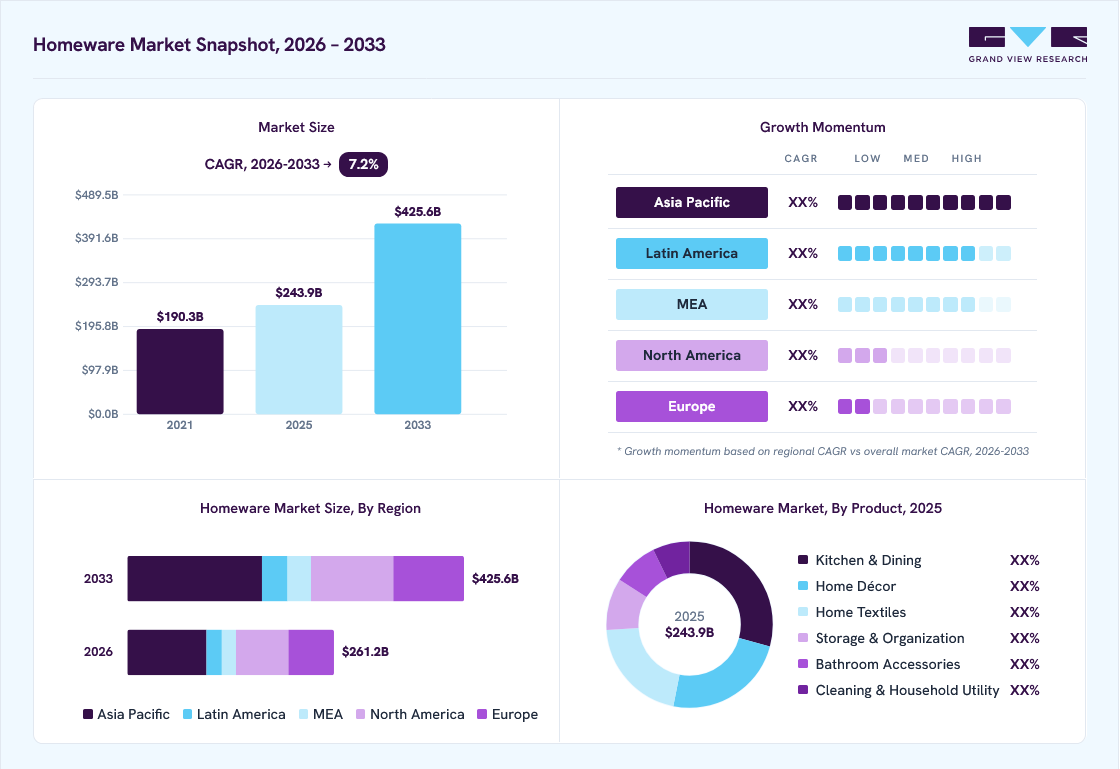
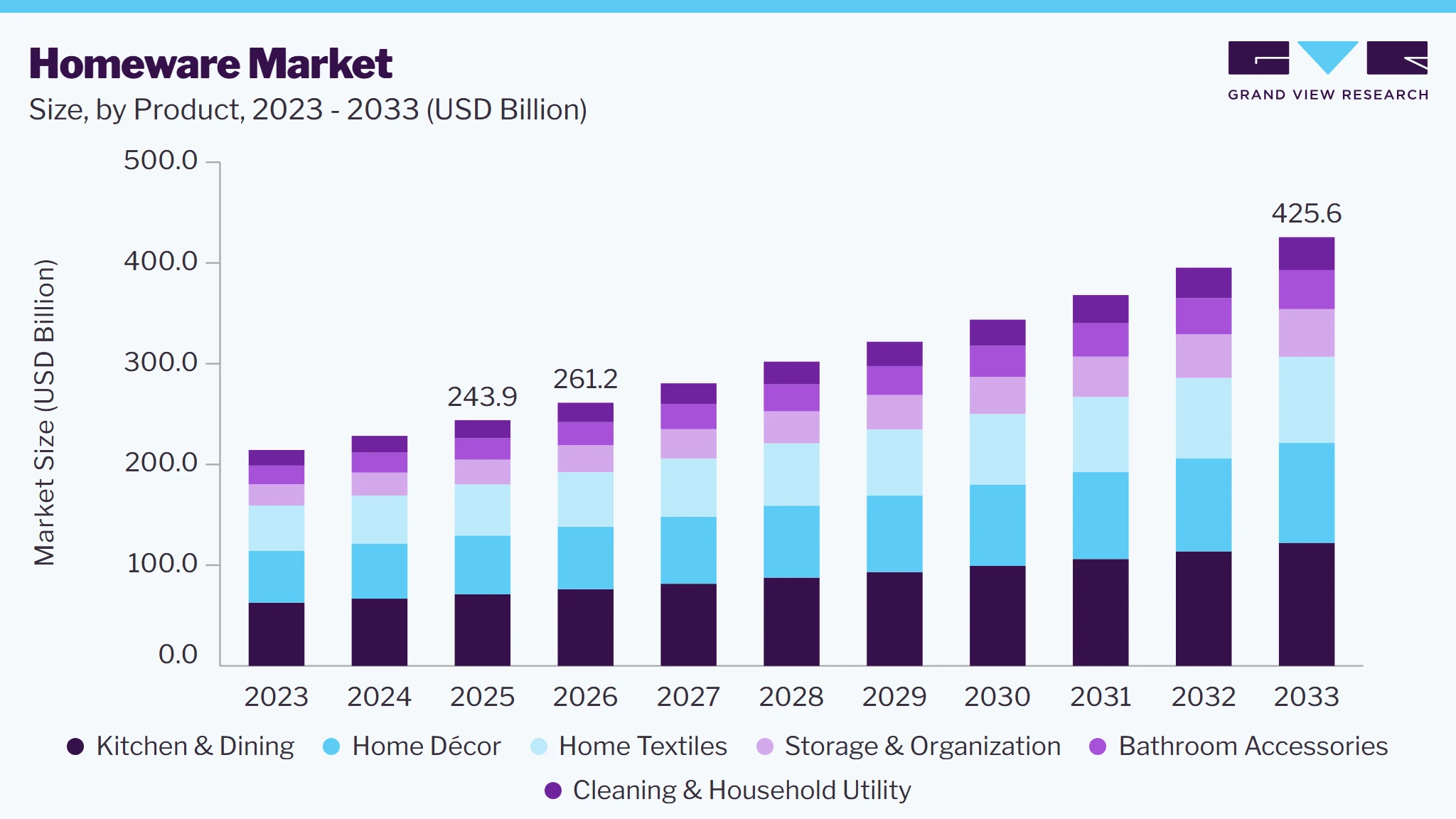
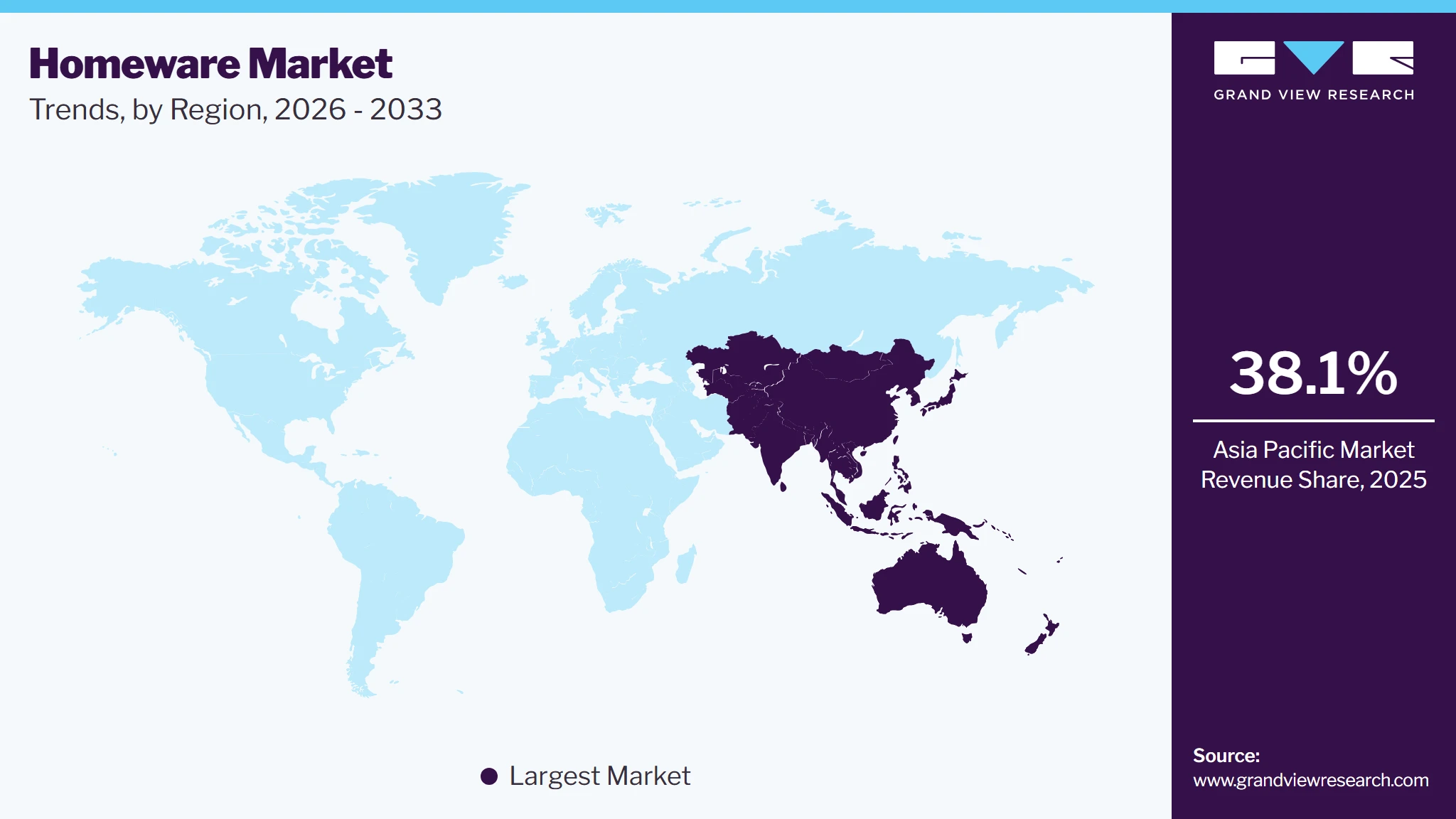
The global homeware market size was valued at USD 243.9 billion in 2025 and is projected to grow from USD 261.2 billion in 2026 to USD 425.6 billion by 2033, at a CAGR of 7.2% from 2026 to 2033. Asia Pacific dominated the market, accounting for the largest revenue share of 38.1% in 2025. Increasing urbanization and demand for space-efficient household solutions are supporting the global homeware market.
 Source: Grand View Research, IR Documents, Primary Interviews, Paid DatabasesTo learn more about this report,
 Download Free Sample Report
Key Market Trends & Insights
- By product: Kitchen & dining accounted for a market share of 29.2% in 2025.
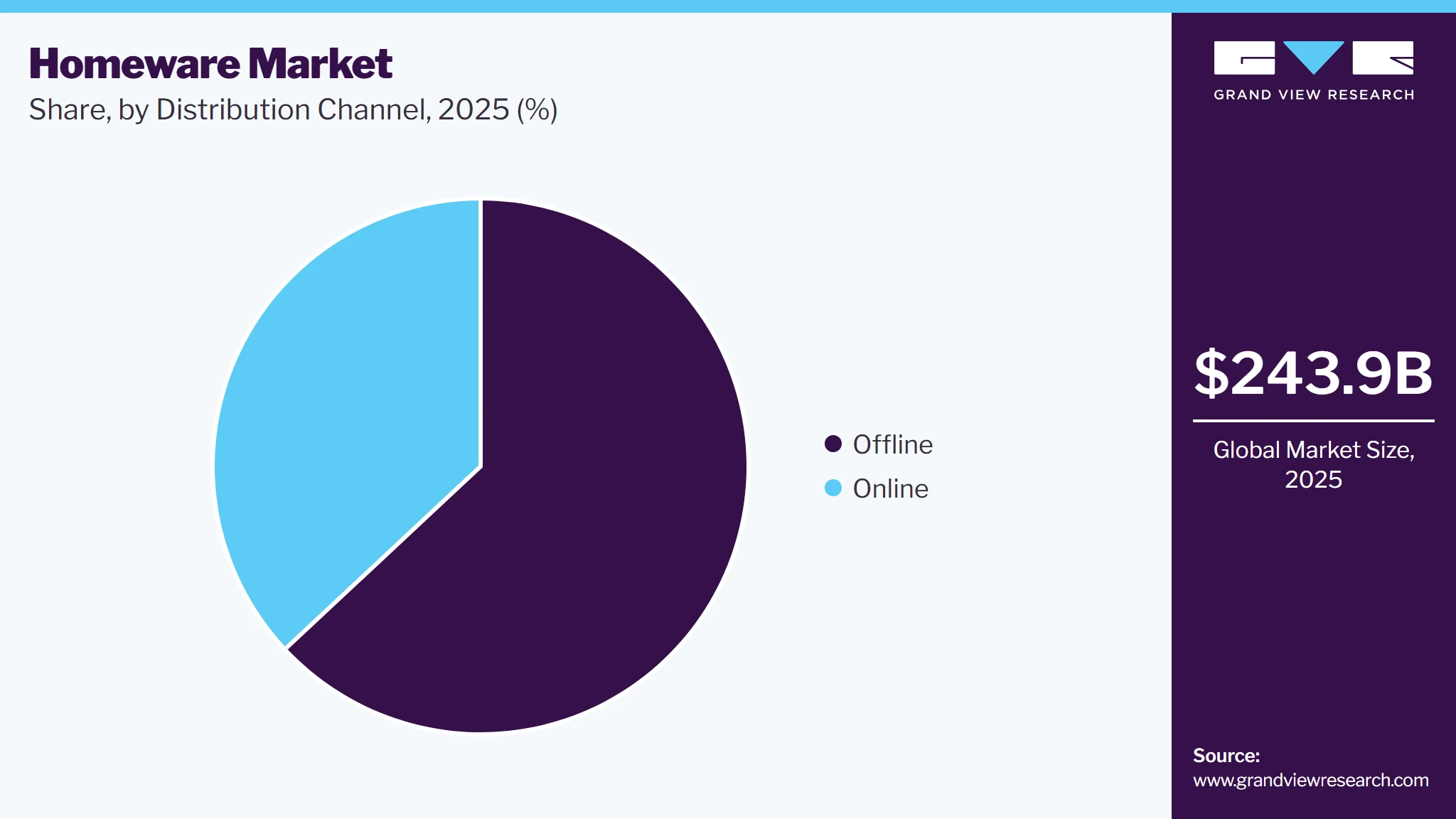
- By distribution channel: Offline channels accounted for a market share of 63.0% in 2025.
Regional Highlights
- Largest regional market: Asia Pacific (38.1% revenue share, 2025)
- By country: China held the largest share in 2025
Market Size & Forecast
- Market size in 2025: USD 243.9 Billion
- Estimated market size in 2026: USD 261.2 Billion
- Projected market size by 2033: USD 425.6 Billion
- CAGR (2026-2033): 7.2%
Prism AI by Grand View Research Free to tryAsk a question about the homeware marketTry asking✓Every figure cited from GVR research Prefer the report? Download free sample →According to the United Nations Department of Economic and Social Affairs’ World Urbanization Prospects 2025, cities accounted for 45% of the global population of 8.2 billion in 2025, while two-thirds of global population growth through 2050 is projected to occur in cities. The concentration of populations in urban environments and relatively constrained residential spaces is increasing the relevance of space-efficient storage and organization products, compact kitchen and dining items, bathroom organizers, multifunctional household products, and other homeware solutions that help consumers optimize available living space. Continued urbanization is a structural driver of demand for functional, space-conscious homeware products.
 To learn more about this report, Download Free Sample Report
Product-level developments from major global retailers also indicate sustained consumer interest in functional homeware categories. IKEA reported that furniture sales were strongest in storage solutions and kitchens during FY2025, while the company identified kitchen and dining products as a key focus for FY2026, including the launch of its lower-priced KNOXHULT kitchen series. This emphasis reflects continued consumer demand for products that improve household functionality while remaining accessible across different price levels. Storage products are particularly relevant in urban households where consumers seek to maximize available space, while kitchen and dining products benefit from their combination of everyday utility, replacement demand, and home-upgrade applications. The continued portfolio development by large international retailers, therefore, supports demand across kitchen & dining and storage & organization, and reinforces the broader shift toward practical, affordable, and multifunctional homeware.
The expansion of international home-furnishing and homeware retail networks is increasing product accessibility, which, in turn, is supporting homeware purchasing across global markets. In September 2026, JYSK reported 12.9% growth in turnover in fiscal 2025/26, alongside the opening of 168 new stores and the addition of more than 14 million customers across its network of over 3,700 stores and webshops in 49 countries. The expansion of physical stores increases consumers' access to home-related products, particularly by bringing products closer to households and providing opportunities to physically evaluate product quality, materials, sizes, and designs before purchase. At the same time, the presence of webshops enables consumers to browse and purchase products beyond the geographic reach of individual stores, thereby reducing channel-related purchasing barriers.
This shift toward integrated physical and digital retail is also evident at IKEA, which generated 28% of its sales online and approximately 915 million store visits during the year. The combination of extensive store networks and online purchasing gives consumers multiple points of access to products across categories such as kitchen and dining, storage and organization, home décor, textiles, and household utility. As accessibility improves, consumers can more easily compare products, prices, designs, and functionality across channels, increasing purchase opportunities and supporting both planned and replacement purchases. The expansion of international retailers and their omnichannel networks is strengthening the global homeware market by expanding consumer reach, increasing product discovery, facilitating online-to-offline purchasing, and making homeware products more accessible across different geographic markets and consumer segments.
Market Dynamics
Rising consumer focus on home comfort, organization, and functionality is supporting demand for homeware products that improve the usability and appearance of living spaces. IKEA's Life at Home Report 2026 found that 86% of consumers globally considered comfort at home important, while 43% identified having a tidy and organized home as a key driver of comfort. This preference is encouraging consumers to address clutter, improve space utilization, and make everyday household activities more convenient through incremental purchases of storage, organization, kitchen, bathroom, textile, décor, and household utility products. In August 2026, IKEA's global Store & Organize Report further found that 37% of respondents planned to update their storage within the following six months, highlighting continued consumer intent to invest in organization solutions. As these purchases can be made independently of major renovations and at relatively accessible price points, the shift toward more comfortable, organized, and functional homes is expanding recurring and discretionary demand across the global homeware market.
Longer replacement cycles for durable homeware products can restrain recurring demand across the global homeware market. Products such as cookware, tableware, storage containers, bathroom accessories, racks, and household utility items can remain functional for extended periods when they are made from durable materials and properly maintained. Long product lifespans reduce the immediate need for replacement, thereby lowering purchase frequency and limiting recurring sales volume. As consumers continue to use existing products rather than replace them, manufacturers and retailers become increasingly dependent on new household formation, renovation, personalization, gifting, product upgrades, and design-led purchases to generate additional demand. This effect is particularly relevant in mature markets, where household penetration of basic homeware products is already high. While durable construction can support product value and consumer satisfaction, it can also lengthen repurchase intervals and constrain volume-driven growth, requiring companies to stimulate demand through innovation, improved functionality and aesthetics, and premium or multifunctional product offerings.
Increasing urbanization, smaller residential spaces, and the need for efficient space utilization are creating opportunities for multifunctional and space-saving homeware products. Consumers are increasingly seeking solutions that combine multiple functions, offer flexible configurations, or provide additional storage without occupying substantial floor space. This is supporting demand for compact organizers, stackable storage solutions, trolleys, under-bed storage, foldable products, and multipurpose kitchen and bathroom accessories. The growing storage challenges associated with smaller apartments promote solutions that utilize underused areas, including spaces beneath beds and existing furniture, as well as modular storage systems and trolleys. As consumers seek to maximize functionality within limited living spaces, manufacturers have opportunities to develop compact, modular, multifunctional, and easily reconfigurable homeware that combines storage, organization, and everyday utility.
Analyst Perspective
The global homeware market is being shaped by changing lifestyles, urban living, home improvement, convenience, organization, and personalization. Growing consumer emphasis on comfortable and well-organized living spaces is supporting demand for both functional and decorative products across household utility. At the same time, smaller living spaces and evolving household needs are increasing interest in multifunctional, compact, space-saving, and easily reconfigurable products that improve everyday usability without requiring major changes to the home. The expansion of e-commerce, DTC platforms, marketplaces, and omnichannel retail is improving product accessibility and enabling consumers to compare prices, designs, features, and reviews across a wider assortment. Sustainability is also influencing product development, encouraging the use of recycled, renewable, reusable, and longer-lasting materials.
Companies are increasingly using product innovation to address changing household needs and strengthen their competitive positioning. In September 2025, IKEA launched a global Cooking & Eating initiative and expanded its assortment with more than 200 new products spanning cookware, smart storage, waste-management solutions, and other kitchen products. The portfolio was developed around consumer needs, including limited storage, organization, convenience, affordability, and sustainability. This approach enables extending its presence across multiple homeware categories while differentiating products through functionality and consumer-oriented design.
Consumer Insights
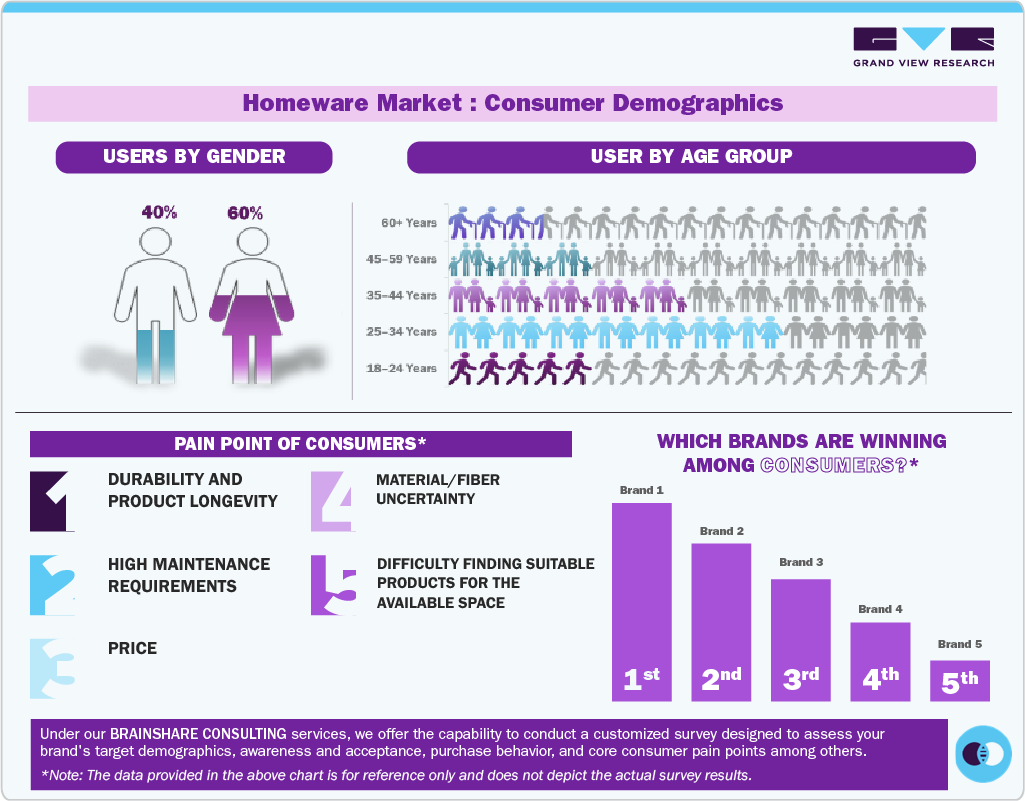
Consumer preferences in the homeware market are increasingly shifting toward quality, design, personalization, and value rather than price alone. Deloitte's 2026 study found that price influenced only one in four home-related purchase decisions, while consumers increasingly considered quality, sustainability, and the overall purchase experience. In addition, 35% of consumers aged 18-28 associated home improvement with self-expression, highlighting the growing role of home products in reflecting individual lifestyles and preferences.
 To learn more about this report, Download Free Sample Report
Digital discovery is also becoming influential, with nearly 80% of home shoppers discovering products through social media and younger consumers showing particularly strong engagement with creators and influencers. Consumers are increasingly receptive to design-led, personalized, premium, sustainable, and visually distinctive homeware, creating opportunities for brands to differentiate beyond basic functionality and compete through product quality, aesthetics, experience, and digital engagement.
Product Insights
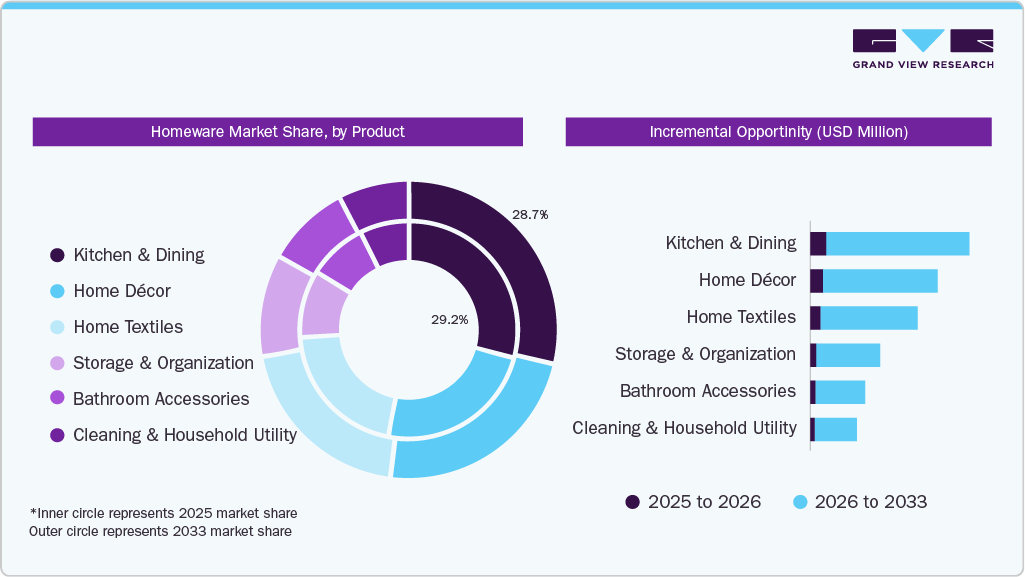
The home kitchen & dining market segment accounted for the largest market share of 29.2% in 2025, supported by its broad product coverage across cookware, bakeware, tableware, drinkware, lunch boxes, and serving products, as well as the recurring nature of replacement purchases. Consumer demand is also supported by continued investment in cooking and dining at home. Recent product launches further demonstrate innovation within the kitchen & dining segment. In September 2026, SharkNinja launched Ninja NeverQuit Cookware, a new range of nonstick ceramic-coated pots and pans designed for long-lasting everyday performance. The cookware is dishwasher and metal-utensil-safe, oven-safe up to 550°F, and features a nesting design for compact storage. The launch addresses consumer demand for durable, convenient, easy-to-clean, and space-efficient cookware. Such product innovation can encourage replacement and upgrade purchases while supporting value growth within the kitchen & dining segment.
 To learn more about this report, Download Free Sample Report
Home storage & organization market is anticipated to grow at a CAGR of 8.5% from 2026 to 2033, supported by rising demand for practical, space-efficient, and adaptable household organization products. Consumer needs are increasingly shifting from basic decluttering toward solutions that improve accessibility and maximize available space. For instance, in March 2026, YouCopia introduced a new range of space-smart organizers, including rectangular turntables, two-tier organizers, removable-bin turntables, and expandable drawer organizers designed to improve the usability of cabinets and deep drawers. These developments demonstrate how manufacturers are combining compact designs, multifunctionality, and flexible storage to address space constraints. As households seek to maximize usable space without adding bulky furniture, demand for modular, compact, and multifunctional organization products is expected to create further opportunities for storage and organization manufacturers.Distribution Channel Insights
The sales of homeware through offline channels accounted for the largest market share of 63.0% in 2025, supported by consumers’ continued preference for physical stores when purchasing homeware products that benefit from direct inspection, comparison, and tactile evaluation. Recent expansion by home-focused retailers further demonstrates continued investment in brick-and-mortar distribution. In March 2026, IKEA opened its first city store in Pune, India, spanning approximately 32,000 sq. ft. and offering more than 1,900 products for customers to explore and purchase in-store, including solutions for different areas of the home. In addition, TJX increased its store count by 129 locations during fiscal 2026, reaching 5,214 stores, including 963 HomeGoods and 79 Homesense. These developments indicate that physical retail remains an important route for product discovery, assortment access, and in-person purchasing, supporting the offline channel's substantial share of the global homeware market.
 To learn more about this report, Download Free Sample Report
The sales of homeware through online channels are anticipated to grow at a CAGR of 7.6% from 2026 to 2033, supported by broader e-commerce adoption, expanding digital assortments, convenient delivery, and increasingly personalized online shopping experiences. Recent activity by home retailers demonstrates continued investment in digital-first formats. In April 2026, Williams-Sonoma, Inc. launched Dormify, its tenth brand, through a dedicated website targeting students and young consumers living in dormitories and compact spaces. The platform allows customers to explore curated home products, create personalized wish lists, access design inspiration, and receive shopping and design guidance. The launch expands digital access to space-efficient home furnishings while targeting a younger, digitally oriented consumer base. Such digital-first brand expansion, combined with personalized discovery and convenient online purchasing, is expected to broaden consumer access to homeware products and support the continued growth of the online distribution channel.
Regional Insights
The Asia Pacific homeware industry accounted for a revenue share of around 38.1% in the year 2025. The expansion of homeware retail networks across the Asia Pacific is improving consumer access to household products and supporting regional market development. In 2025, Japan-based Nitori continued expanding its presence across Asia, opening its fourth store in Vietnam as a global flagship in April and its fifth Singapore store as a global flagship in August. The Singapore flagship offered a broad assortment, including furniture, home textiles, tableware, and lifestyle products, while the Vietnam expansions increased the availability of Nitori’s home-furnishing and household product portfolio. As retailers expand into new Asian markets, consumers gain greater access to organized homeware assortments and physical product experiences, which can encourage household purchases and strengthen demand across categories such as kitchen and dining, home textiles, décor, storage, and household utility. Continued regional retail expansion is expected to broaden distribution coverage and support the growth of the Asia Pacific homeware market.
 To learn more about this report, Download Free Sample Report
China Homeware Market Trends
China homeware industry accounted for a revenue share of around 28.7% in the year 2025. China’s large consumer base and rising household spending continue to support demand for homeware products. In 2025, China’s per-capita household consumption expenditure on household facilities, articles, and services increased by 7.7% year over year. In the same year, retail sales of furniture increased 14.6%, while sales of daily necessities rose 6.3%. These developments indicate stronger consumer spending on household-related products and furnishings, creating opportunities for manufacturers and retailers across home décor, kitchen and dining, textiles, bathroom accessories, and household utility categories. Growing household expenditure and furniture-related retail activity, therefore, provide a positive demand environment for China’s homeware market.
The India homeware industry is projected to grow at a CAGR of 7.5 % from 2026 to 2033, supported by rising household consumption, urbanization, expanding organized retail, and increasing spending on home improvement and household products. Recent consumer activity indicates growing interest in upgrading residential spaces. In July 2026, Borosil launched its first exclusive brand stores in Pune and Gurugram, offering kitchen, dining, home, and lifestyle products under one roof. The company stated that it plans to expand the exclusive-store format across additional Indian markets through a franchise-led model. This expansion improves physical access to Borosil’s homeware portfolio and gives consumers an opportunity to directly experience and compare products, supporting wider adoption of organized homeware retail.
North America Homeware Market Trends
The homeware industry in North America held 25.5% of the global revenue in 2025. Rising investment in home renovation and personalization is creating a favorable demand environment for the U.S. homeware market. In 2024, 54% of U.S. homeowners undertook renovation projects, while another 54% undertook decorating projects, according to Houzz’s 2025 U.S. Houzz & Home Study covering nearly 22,000 respondents. The high level of renovation and decoration activity is driving demand for homeware products as homeowners seek to upgrade, coordinate, and personalize their living spaces. Renovation projects create requirements for complementary products such as kitchen and dining items, bathroom accessories, storage and organization products, and cleaning and household utility products, while decorating projects stimulate purchases of home décor and home textiles, including curtains, cushions, and other decorative furnishings. As homeowners increasingly invest in improving existing residential spaces rather than only purchasing new homes, renovation and decoration spending creates recurring replacement and discretionary demand for homeware products, thereby supporting market growth.
The homeware industry in the U.S. accounted for a revenue share of 78.5% in the year 2025. Recent product launches demonstrate continued innovation and expansion across the U.S. homeware market. In March 2026, Lifetime Brands introduced two new KitchenAid food storage collections designed around freshness, organization, and everyday convenience. The collections feature modular and stackable containers for refrigerators, cabinets, and pantries, with products supporting meal preparation, storage, and reheating. The launch combines functionality, organization, and accessible pricing. Such product innovation encourages replacement and upgrade purchases while expanding consumer choice across kitchen and household storage products, supporting continued demand within the U.S. homeware industry.
The Mexico homeware industry is projected to grow at a CAGR of 7.1% from 2026 to 2033, supported by increasing consumer spending on home improvement, renovation, organization, and household upgrades. Recent expansion by The Home Depot México further demonstrates the strengthening of retail infrastructure for home-related products. In March 2026, the company announced an MXN 4.788 billion investment plan for Mexico, including three new stores, expanded logistics capacity, and improvements to its digital and omnichannel platforms. The company also reported more than 50,000 active SKUs online, providing consumers with broader access to products for home improvement and maintenance. Such investments expand product availability and distribution coverage while making household improvement and organization products more accessible to Mexican consumers, supporting continued demand across the homeware industry.
Europe Homeware Market Trends
The Europe homeware industry accounted for a revenue share of around 22.2% in the year 2025, supported by established household-goods retail networks, high consumer spending on home improvement, and demand for functional and decorative products. The region benefits from a mature replacement market in which consumers regularly purchase kitchen and dining products, home décor, textiles, storage solutions, bathroom accessories, and household utility products. Recent retail expansion also highlights continued investment in the European home-furnishing market. In FY2025/26, JYSK increased its turnover by 12.9% and opened 168 new stores, bringing its network to more than 3,700 stores and webshops across 49 countries. This expansion improves consumer access to home-related products across both established and developing European markets. The combination of broad retail coverage, recurring replacement demand, home improvement activity, and growing omnichannel accessibility provides a strong foundation for continued homeware consumption across Europe.
The Germany homeware industry accounted for a revenue share of around 24.6% in the year 2025 and is supported by established physical and digital retail networks that provide consumers with convenient access to household products. In August 2026, Mömax launched a nationwide partnership with Wolt in Germany, initially making around 4,500 home-and-living products available through the Wolt platform. The assortment includes kitchen products, tableware, home accessories, storage solutions, décor, and household products, with the rollout initially covering eight Mömax stores and planned expansion to 27 locations. The partnership combines physical retail infrastructure with rapid digital delivery, improving accessibility and convenience for consumers purchasing everyday homeware products. This expansion of omnichannel distribution is expected to support replacement, impulse, and convenience-driven purchases across Germany's homeware market.
The Spain homeware industry is projected to grow at a CAGR of 6.8 % from 2026 to 2033, supported by established home-retail networks, continued household spending, and increasing accessibility through omnichannel channels. In September 2026, IKEA Spain announced a EUR 53.4 million investment to reduce prices on 397 products, including BESTÅ storage solutions, as part of a broader effort to make home products more affordable for Spanish households. The company also highlighted its continued development of omnichannel retail, following the expansion of physical formats, online sales, digital processes, and logistics capacity in Spain. These initiatives can improve affordability and accessibility for consumers while supporting purchases across storage and organization, home décor, kitchen and dining, and other household product categories. Greater price accessibility and an expanding omnichannel retail network are expected to support continued homeware demand in Spain.
Central & South America Homeware Market Trends
The Central & South America homeware industry is projected to grow at a CAGR of 7.6% from 2026 to 2033, supported by product innovation focused on functionality, organization, and convenience. In February 2026, Brazilian homeware brand Ou launched its Liv line, a collection of products designed to improve organization and functionality around the kitchen sink. The line focuses on keeping the sink area organized and facilitating daily washing and cleaning routines through practical, minimalist designs. These launches demonstrate manufacturers' focus on practical solutions across kitchen, bathroom, storage, and cleaning applications. The introduction of multifunctional and organization-oriented products can encourage replacement and incremental purchases while addressing consumers' demand for greater convenience and efficient use of household space.
The Brazil homeware industry is projected to grow at a CAGR of 7.8% from 2026 to 2033, supported by expanding product portfolios and innovation focused on functionality, organization, and affordability. In July 2026, Brazilian plastics manufacturer NTC launched Udê, a new brand dedicated to household utility products. The initial portfolio includes products for the kitchen, organization, storage, bathroom, and other household applications, with an emphasis on functional, durable, and accessible solutions for everyday use. The launch represents NTC's expansion into the household-utilities market, leveraging its existing product-development, plastic injection, and manufacturing capabilities. By introducing a dedicated portfolio across multiple household applications, the company is expanding consumer choice while addressing demand for practical and affordable homeware products. Such product diversification and innovation can support replacement and incremental purchases across Brazil's homeware market.
Middle East & Africa Homeware Market Trends
The Middle East & Africa homeware industry is projected to grow at a CAGR of 7.5% from 2026 to 2033, supported by expanding organized retail networks and improvements in consumer access to home-related products. In June 2026, IKEA UAE, operated by Al-Futtaim, expanded its New Market Hall at Dubai Festival City by 1,000 square meters to 6,100 square meters. The redesigned space introduced curated displays, immersive “Microworlds,” and interactive digital solutions, including an AI-powered “Ask IKEA” tool that provides product recommendations and comparisons. The expansion is designed to make product discovery easier and create a more personalized shopping journey across different areas of the home. Such investments in physical retail experience and digital integration can improve product accessibility, encourage consumers to explore homeware solutions, and support replacement and upgrade purchases across the Middle East homeware market.
The South Africa homeware industry is projected to grow at a CAGR of 7.2% from 2026 to 2033, supported by increasing household demand for functional, affordable, and lifestyle-oriented products. Demand spans kitchen and dining products, home décor, textiles, storage and organization, bathroom accessories, and cleaning and household utility products. The expansion of organized retail and omnichannel shopping is improving consumer access to a wider range of homeware products across price points. In addition, household renovations, space organization, product replacement, and growing interest in improving home functionality and aesthetics are creating recurring purchasing opportunities. Continued product innovation and broader retail availability are therefore expected to support the development of the South African homeware market.
Key Homeware Company Insights
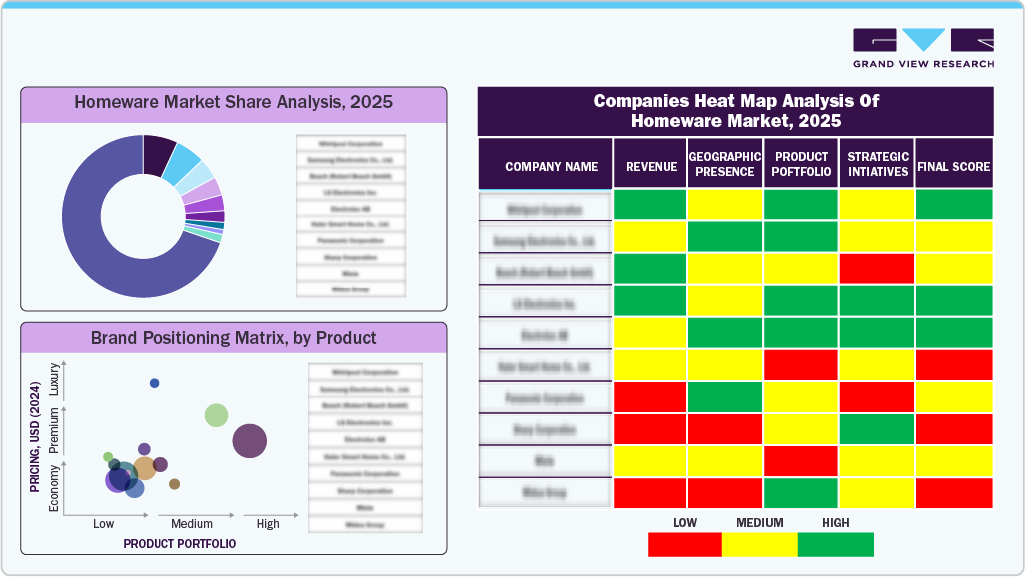
The global homeware industry is characterized by competition across kitchenware, tableware, drinkware, home décor, and household utility products, with companies increasingly expanding assortments through new designs, categories, and functional products. Lifetime Brands continues to develop kitchenware and home solutions across brands, including Farberware, KitchenAid, Mikasa, and BUILT NY, supported by its innovation programs. Fiskars Group expanded Iittala’s portfolio with the Solare collection, adding tableware, glass art, accessories, and textiles, while Wedgwood introduced giftable Florentine Colors additions, including scented candles.
 To learn more about this report, Download Free Sample Report
Key Homeware Companies
The following key companies have been profiled for this study on the homeware market.
-
Lifetime Brands
-
Newell Brands
-
Fiskars Group
-
Villeroy & Boch
-
Portmeirion Group
-
Borosil Ltd
-
La Opala RG
-
Cello World
-
Williams-Sonoma
-
Wayfair
-
Zwilling J.A. Henckels
-
Tramontina
-
Le Creuset
-
Duralex
-
Bodum
Competitive Benchmarking
Category
Operating Strategies
Competitive Edge
Weakness
Established Players (Lifetime Brands; Newell Brands; Fiskars Group; Villeroy & Boch; Williams-Sonoma; Wayfair; Cello World; Zwilling J.A. Henckels; Tramontina; Duralex; Bodum)
- Focus on broadening product portfolios across kitchenware, tableware, drinkware, storage, décor, and household utility while strengthening omnichannel distribution. Companies are investing in new product collections, brand extensions, collaborations, digital commerce, and retail partnerships.
- Broad product portfolios enable cross-selling across multiple homeware categories and consumer occasions. Strong brand recognition, established retail relationships, global distribution networks, and omnichannel capabilities provide access to both physical and digital consumers.
- Broad product portfolios increase supply-chain, inventory, manufacturing, and product-development complexity. Premium-oriented companies can face price sensitivity during periods of weaker discretionary spending, while companies dependent on specific categories such as tableware or glassware remain exposed to changes in consumer preferences and raw-material costs. Digital-focused retailers also face fulfillment, logistics, and customer-acquisition costs
Emerging (Portmeirion Group; Borosil Ltd; La Opala RG;)
- Focus on specialized categories such as premium tableware, glassware, home décor, and dining products. Strategies emphasize design differentiation, heritage brands, material expertise, collection expansion, and premium positioning.
- Strong category specialization establishes brand identity, product design expertise, and differentiated materials provide opportunities to build customer loyalty and command premium positioning. Specialized portfolios also allow companies to develop products targeted at specific dining, gifting, hospitality, and household applications.
- Narrower product portfolios can limit cross-category selling opportunities compared with diversified homeware companies. Greater exposure to discretionary purchases, premium pricing, category-specific demand, and fluctuations in glass, ceramic, packaging, and other raw-material costs can affect performance.
Recent Developments
-
In April 2026, AELGA introduced a new range of kitchen storage and dispensing products ahead of the 139th Canton Fair, including airtight and leak-proof glass food storage containers, customizable glass oil and vinegar dispensers, spice jars and canisters, drinkware, and kitchen organization solutions. The products combine durable glass materials, food-safety features, practical functionality, and modern aesthetics, while being designed for retail, e-commerce, and international distribution. The launch reflects growing demand for functional, durable, and organization-focused kitchenware that improves food storage and everyday kitchen efficiency.
-
In July 2026, Kreate launched the HDX Vista Stack and HDX Defender storage collections with The Home Depot, featuring clear, stackable bins designed to improve visibility, space utilization, and organization. The Vista Stack collection offers multiple sizes for closets, pantries, bedrooms, and laundry areas, while Defender provides durable storage with heavy-duty latches and integrated gaskets for garages, basements, and workshops. The collections were launched through The Home Depot’s U.S. stores and online channels.
-
In March 2026, YouCopia launched new organization products, including MagicTrack rectangle turntables, two-tier turntables with removable bins, and expandable deep-drawer organizers. The products were designed to improve cabinet and drawer space utilization while keeping household items visible and accessible. The launch reflects growing demand for space-efficient, flexible, and easy-to-use storage solutions that help consumers organize kitchens and other areas of the home more effectively.
Homeware Market Report Scope
Report Attribute
Details
Market size in 2025
243.9 billion
Estimated market size in 2026
USD 261.2 billion
Projected market size by 2033
USD 425.6 billion
Growth Rate
CAGR of 7.2% from 2026 to 2033
Base year for estimation
2025
Historical data
2021 - 2025
Forecast period
2026 - 2033
Quantitative units
Revenue in USD million/billion and CAGR from 2026 to 2033
Report coverage
Revenue forecast, company ranking, competitive landscape, growth factors, and trends
Segments covered
Product, distribution channel, region
Regional scope
North America; Europe; Asia Pacific; Central & South America; Middle East & Africa;
Country scope
U.S.; Canada; Mexico; UK; Germany; France; Italy; Spain; China; India; Japan; South Korea; Australia & New Zealand; Brazil; and South Africa
Key companies profiled
Lifetime Brands; Newell Brands; Fiskars Group; Villeroy & Boch; Portmeirion Group; Borosil Ltd; La Opala RG; Cello World; Williams-Sonoma; Wayfair; Zwilling J.A. Henckels; Tramontina; Le Creuset; Duralex; Bodum
Customization scope
Free report customization (equivalent up to 8 analysts working days) with purchase. Addition or alteration to country, regional & segment scope.
Pricing and purchase options
Avail customized purchase options to meet your exact research needs. Explore purchase options
Global Homeware Market Report Segmentation
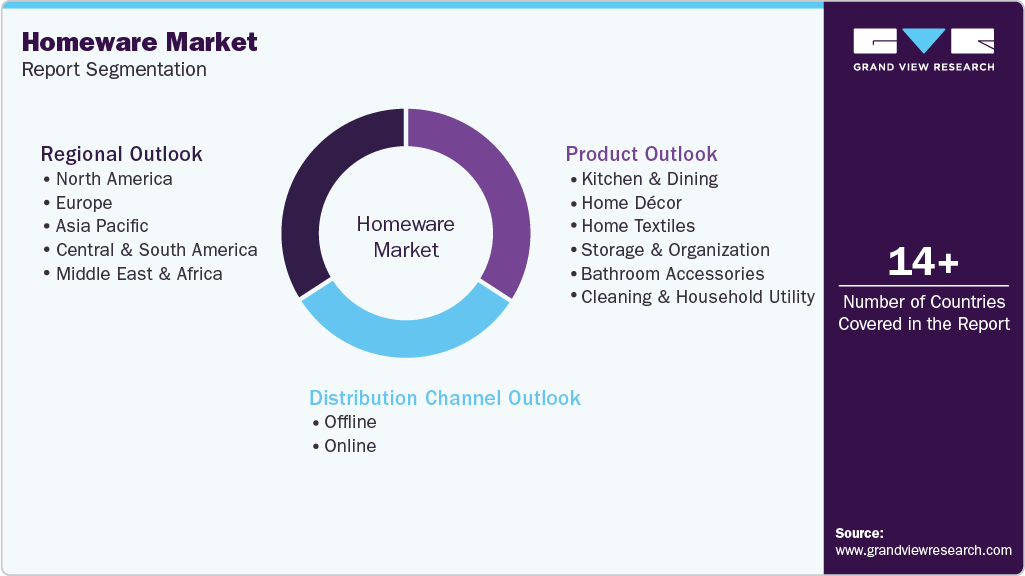
This report forecasts revenue growth at regional & country levels and provides an analysis of the latest trends and opportunities in each of the sub-segments from 2021 to 2033. For this study, Grand View Research has segmented the global homeware market report based on product, distribution channel, and region:
 To learn more about this report, Download Free Sample Report
-
Product Outlook (Revenue, USD Billion, 2021 - 2033)
-
Kitchen & Dining
-
Cookware
-
Bakeware
-
Tableware
-
Drinkware
-
Others (Lunch boxes, serving trays)
-
-
Home Décor
-
Wall décor
-
Vases
-
Decorative mirrors
-
Artificial plants
-
Others (Sculptures, Photo Frames, Decorative Clocks)
-
-
Home Textiles
-
Mats
-
Curtains
-
Kitchen & dining linen
-
Bath & hand towels
-
Decorative pillows
-
Others
-
-
Storage & Organization
-
Storage boxes, bins & baskets
-
Drawer & Shoe Organization
-
Racks & Hooks
-
Shelving & wall storage
-
Others
-
-
Bathroom Accessories
-
Bathroom organizers & trays
-
Soap dispensers
-
Holders
-
Others (Towel rack/ring)
-
-
Cleaning & Household Utility
-
Floor cleaning tools
-
Cleaning & utility containers
-
Laundry & drying accessories
-
Ironing accessories
-
Others
-
-
-
Distribution Channel Outlook (Revenue, USD Billion, 2021 - 2033)
-
Offline
-
Online
-
-
Regional Outlook (Revenue, USD Billion, 2021 - 2033)
-
North America
-
U.S.
-
Canada
-
Mexico
-
-
Europe
-
UK
-
Germany
-
France
-
Italy
-
Spain
-
-
Asia Pacific
-
China
-
India
-
Japan
-
South Korea
-
Australia & New Zealand
-
-
Central & South America
-
Brazil
-
-
Middle East & Africa
-
South Africa
-
-
Research Methodology
The homeware marketfigures in this report are based on a proven research process that combines executive interviews with secondary research from proprietary databases, company filings, and recognized regulatory and institutional sources. Market size is built through value-chain sizing-reconciling supply-side and demand-side estimates-and triangulated with bottom-up and top-down approaches. Every estimate passes multiple levels of expert validation before publication, with each homeware segment quantified using the revenue-capture definitions in the table below.
Segment Definition
Segment - Product
Revenue capture definition
Kitchen & Dining
This segment includes homeware products used for food preparation, cooking, baking, serving, dining, and beverage consumption within residential settings. It includes cookware, bakeware, tableware, drinkware, and other products such as lunch boxes and serving trays.
Home Décor
This segment includes decorative homeware products primarily used to enhance the visual appearance, ambiance, and personalization of interior spaces. It includes wall décor, vases, decorative mirrors, artificial plants, sculptures, photo frames, and decorative clocks.
Home Textiles
This segment includes textile-based homeware products used for decoration, comfort, surface covering, and everyday household functions. It includes mats, curtains, kitchen and dining linen, bath and hand towels, decorative pillows, and other household textile products.
Storage & Organization
This segment includes homeware products designed to store, organize, arrange, or optimize household belongings and available space without constituting furniture. It includes storage boxes, bins and baskets, drawer and shoe organizers, racks and hooks, and shelving and wall-storage products.
Bathroom Accessories
This segment includes products used to organize, accessorize, and improve the functionality and convenience of bathroom spaces. It includes bathroom organizers and trays, soap dispensers, holders, towel racks and rings, and other bathroom accessories.
Cleaning & Household Utility
This segment includes household utility products used for cleaning, maintaining, drying, laundering, and performing routine domestic tasks. It includes floor-cleaning tools, cleaning and utility containers, laundry and drying accessories, ironing accessories, and other related household utility products.
Estimation Model
Stage
Key Question
Description
Consumer Need & Target Base Layer
Who has a need or interest in homeware products?
Begin with the global household and consumer population requiring products for cooking, dining, decorating, organizing, bathroom use, cleaning, and routine household maintenance. The target base includes consumers living across cities, towns, and rural areas, as well as households purchasing homeware for new homes, relocation, renovation, gifting, entertaining, replacement, and everyday use.
Product Accessibility & Distribution Layer
Who has access to homeware products?
Filter the global consumer base based on access to homeware products through online and offline channels, including supermarkets and hypermarkets, specialty stores, department stores, home-improvement and home-furnishing stores, warehouse clubs, DTC websites, marketplaces, and online retailers.
Active Purchasing & Engagement Layer
Who actively purchases and uses homeware products?
Apply purchase intent, replacement requirements, willingness to pay, household formation, renovation and home-improvement activity, entertaining, gifting, and product-use frequency to identify active homeware purchasers. Consider consumer preferences for functionality, convenience, aesthetics, organization, durability, quality, personalization, sustainability, promotions, reviews, and ease of use.
Monetisation Layer
How much revenue is generated?
Multiply the estimated number of active homeware purchasers by average selling price, annual purchase frequency, replacement rates, and upgrade or premiumization rates to estimate revenue. Calculate revenue across Kitchen & Dining, Home Décor, Home Textiles, Storage & Organization, Bathroom Accessories, and Cleaning & Household Utility.
Delivered Customizations
This report has been delivered with the following In-depth customizations
CLIENT REQUEST
CUSTOMIZATION DELIVERED
VALUE ADDS
Global Homeware Market & Product Trend Analysis
Conducted an in-depth analysis of the global homeware market across six major categories, assessing product formats, materials, functionality, pricing, consumer applications, product launches, innovations, and category-level developments across key regions and markets.
Enables stakeholders to identify attractive category opportunities, evaluate evolving consumer preferences, and understand demand for multifunctional, space-efficient, durable, sustainable, aesthetically driven, and value-oriented homeware products.
Global Consumer & Distribution Channel Analysis
Assessed consumer purchasing patterns and distribution channels across online and offline formats, including DTC platforms, marketplaces, online retailers, and home-furnishing retailers, and warehouse clubs. Regional differences in accessibility, purchase intent, replacement demand, price sensitivity, and willingness to pay were also evaluated.
Provides a clear understanding of channel opportunities, purchasing behavior, price sensitivity, and the changing contribution of e-commerce and physical retail. Supports channel expansion, pricing, retail-format selection, and consumer-targeting decisions across global markets.
Technology, Distribution & Competitive Landscape Assessment
Evaluated global innovation across smart and multifunctional homeware, space-saving organization, innovative materials, sustainable and reusable formats, and digitally enabled retail. The assessment also examined company strategies, product launches, portfolio expansion, retail footprint, and omnichannel initiatives.
Helps identify emerging product concepts, technology and design differentiators, material innovations, pricing opportunities, distribution approaches, and consumer-led innovation areas, supporting product development and competitive-positioning strategies
Frequently Asked Questions About This Report
Kitchen & Dining segment led the market with the largest revenue share of 29.2% in 2025.
Asia Pacific dominated, with a revenue share of 38.1% in 2025.
Rising consumer focus on home comfort, organization, and functionality is supporting demand for homeware products that improve the usability and appearance of living spaces.
The global homeware market size was valued at USD 243.9 billion in 2025 and is estimated at USD 261.2 billion for 2026.
The global homeware market is expected to grow at a CAGR of 7.2% from 2026 to 2033, reaching USD 425.6 billion by 2033.
Key players in homeware market, Lifetime Brands; Newell Brands; Fiskars Group; Villeroy & Boch; Portmeirion Group; Borosil Ltd; La Opala RG; Cello World; Williams-Sonoma; Wayfair; Zwilling J.A. Henckels; Tramontina; Le Creuset; Duralex; Bodum
Offline dominated, with a revenue share of 63.0% in 2025.
About the Author(s)
Homecare & Decor Research Team
Consumer Goods · Homecare & DecorThis report was authored by the homecare & decor research team at Grand View Research - comprising two research analysts, one senior research analyst, and one industry expert - with specialized expertise in the homecare & decor segment of the consumer goods industry. All findings are based on proprietary consumer goods databases, executive interviews, and regulatory analysis, subject to internal peer review prior to publication.
Last Updated:
Speak to Analyst

Customize this report to your needs - add regions, segments, or data points, with 20% free customization.
Or view our licence options:


ISO 9001:2015 & 27001:2022 Certified
We are GDPR and CCPA compliant! Your transaction & personal information is safe and secure. For more details, please read our privacy policy.


