
- Home
- »
- Plastics, Polymers & Resins
- »
-
Honeycomb Packaging Market Share Report, 2026-2033GVR Report cover
![Honeycomb Packaging Market (2026 - 2033)Report]()
Honeycomb Packaging Market (2026 - 2033)
Size, Share & Trends Analysis Report By Material (Paper/Paperboard, Plastic/Polymer, Aluminum/Composite), By End Use (Consumer Goods, Furniture, Industrial Goods, Automotive), By Region, And Segment Forecasts
Market Size, 2025
$11.4BMarket Estimate, 2026
$12.1BMarket Forecast, 2033
$18.4BCAGR, 2026–2033
6.2%Honeycomb Packaging Market Summary
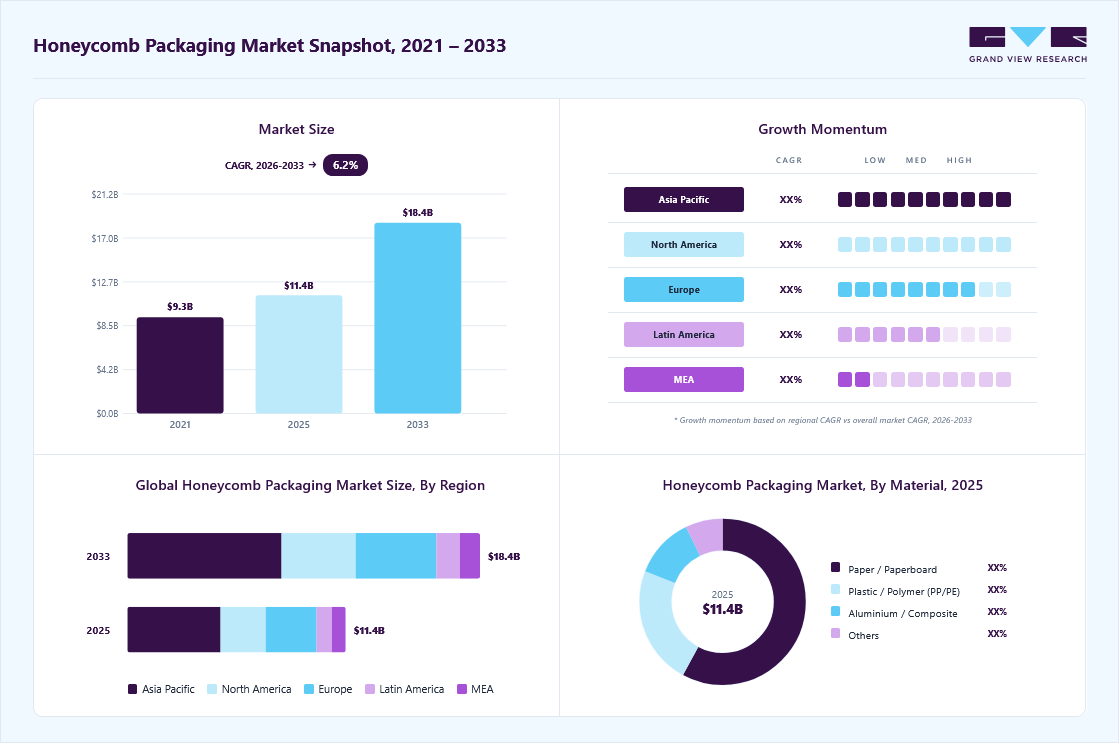
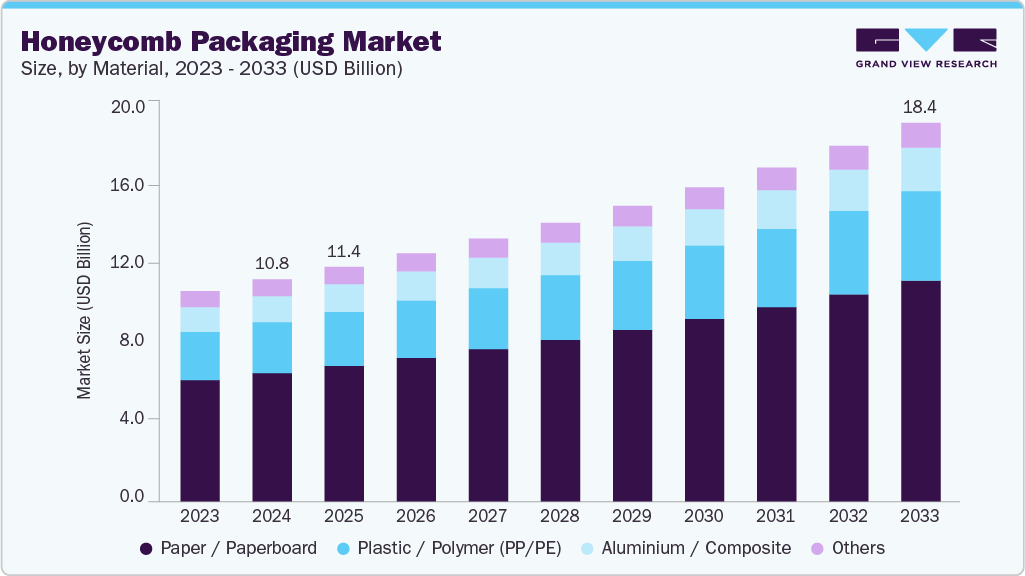
The global honeycomb packaging market size was valued at USD 11.4 billion in 2025 and is projected to grow from USD 12.1 billion in 2026 to USD 18.4 billion by 2033, at a CAGR of 6.2% from 2026 to 2033. The Asia Pacific held the largest share of 42.7% of the global market in 2025. Rising demand for sustainable, lightweight, and recyclable packaging solutions across e-commerce, automotive, and industrial sectors is driving the market.
Key Market Trends & Insights
- By material: Paper/paperboard segment held the largest market share of 57.8% in 2025.
- By end use: Consumer goods segment held the largest market share of 29.5% in 2025.
Regional Highlights
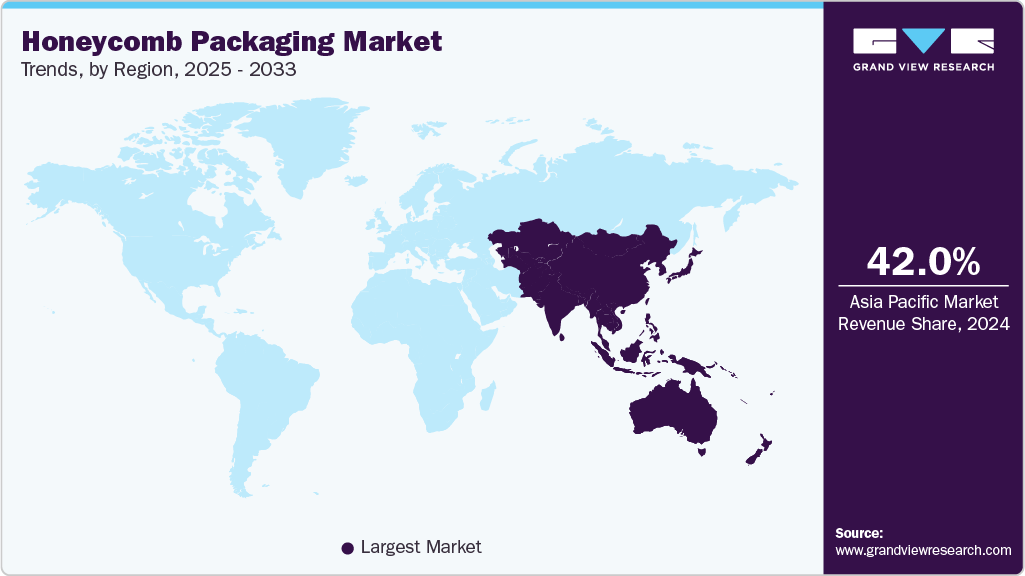
- Largest regional market: Asia Pacific (42.7% revenue share, 2025)
- By country: China held the largest market share in Asia Pacific in 2025.
Market Size & Forecast
- Market size in 2025: USD 11.4 Billion
- Estimated market size in 2026: USD 12.1 Billion
- Projected market size by 2033: USD 18.4 Billion
- CAGR (2026-2033): 6.2%
In addition, its superior cushioning and load-bearing properties reduce transportation damage and logistics costs, supporting market growth. Honeycomb packaging is made from recyclable kraft paper and offers a strong alternative to plastic-based cushioning materials such as EPS foam and bubble wrap. As environmental regulations tighten, particularly in North America and Europe, manufacturers across industries are actively shifting toward biodegradable solutions. For example, global companies in e-commerce and furniture packaging are adopting honeycomb boards and paper wraps to meet sustainability commitments and reduce carbon emissions. This shift not only enhances brand perception but also supports circular economy initiatives.Rising applications across high-impact industries are boosting adoption of honeycomb packaging. The automotive, electronics, aerospace, and heavy goods sectors require protective packaging that can withstand compression, shock, and vibration during transport. Honeycomb structures provide high strength-to-weight ratio, making them ideal for packaging sensitive components such as vehicle parts, large glass sheets, and industrial machinery. Moreover, the growing global industrial logistics sector is accelerating demand for secondary and tertiary packaging solutions that ensure product safety while optimizing transportation efficiency.
Growth of e-commerce and the need for cost-effective protective packaging further propel market expansion. Online retail drives higher parcel shipping volumes, increasing the need for lightweight yet durable material to reduce freight costs. Honeycomb packaging is cost-efficient due to low raw material cost and provides customization flexibility for various product shapes and sizes. Companies are increasingly implementing honeycomb pallets, edge protectors, and mailer inserts to reduce damage rates in last-mile delivery. In addition, the rise of furniture e-commerce players such as IKEA and Wayfair has expanded the usage of honeycomb cores in both protective packaging and as lightweight structural components in ready-to-assemble products.
Market Dynamics
The global honeycomb packaging market is witnessing strong growth due to the rising demand for lightweight, durable, and environmentally sustainable protective packaging solutions across industries such as automotive, furniture, consumer electronics, e-commerce, industrial machinery, and logistics. Honeycomb packaging structures provide excellent cushioning strength, shock absorption, and load-bearing capacity while using comparatively less raw material than traditional protective packaging formats. This combination of strength and lightweight performance helps reduce transportation costs, improve handling efficiency, and minimize product damage during shipping and storage. As global trade activities and e-commerce shipments continue to increase, businesses are increasingly adopting honeycomb packaging solutions for safe and cost-efficient product transportation.
Another major factor driving market growth is the increasing global emphasis on sustainable packaging and plastic waste reduction. Honeycomb packaging is primarily manufactured using recyclable kraft paper and paperboard materials, making it an eco-friendly alternative to plastic-based protective packaging such as foam and bubble wrap. Governments, retailers, and manufacturers are actively encouraging the adoption of recyclable and biodegradable packaging materials to support sustainability targets and circular economy initiatives. In addition, advancements in paper processing technologies and customized honeycomb design solutions are expanding the application scope of honeycomb packaging across heavy-duty industrial packaging, pallet systems, protective panels, and interior protective structures. Growing investments in green packaging technologies and sustainable supply chains are further supporting the expansion of the honeycomb packaging market globally.
One of the major restraints affecting the honeycomb packaging market is the limited moisture resistance and durability of paper-based honeycomb materials under certain environmental conditions. Exposure to excessive humidity, water, or harsh handling conditions can reduce the structural integrity and protective performance of honeycomb packaging, limiting its suitability for some heavy-duty or long-distance transportation applications. In industries requiring high moisture resistance or extreme durability, companies may continue relying on plastic, metal, or foam-based protective packaging alternatives.
A major challenge in the honeycomb packaging market is balancing lightweight design, structural strength, customization capabilities, and sustainability requirements. End-use industries increasingly demand packaging solutions that offer superior protective performance while reducing material usage and environmental impact. Manufacturers must continuously develop honeycomb packaging structures capable of handling varying product weights, transportation conditions, and storage requirements without compromising recyclability or cost efficiency..
Market Concentration & Characteristics
The honeycomb packaging industry is shaped by its strong focus on sustainability and material optimization. As global demand increases for environmentally responsible packaging, honeycomb solutions offer a recyclable and biodegradable alternative to plastics and foam-based cushioning. The manufacturing process is cost-efficient due to the use of widely available kraft paper and carton board, supporting circular economy practices and helping end users comply with environmental regulations and corporate sustainability targets.
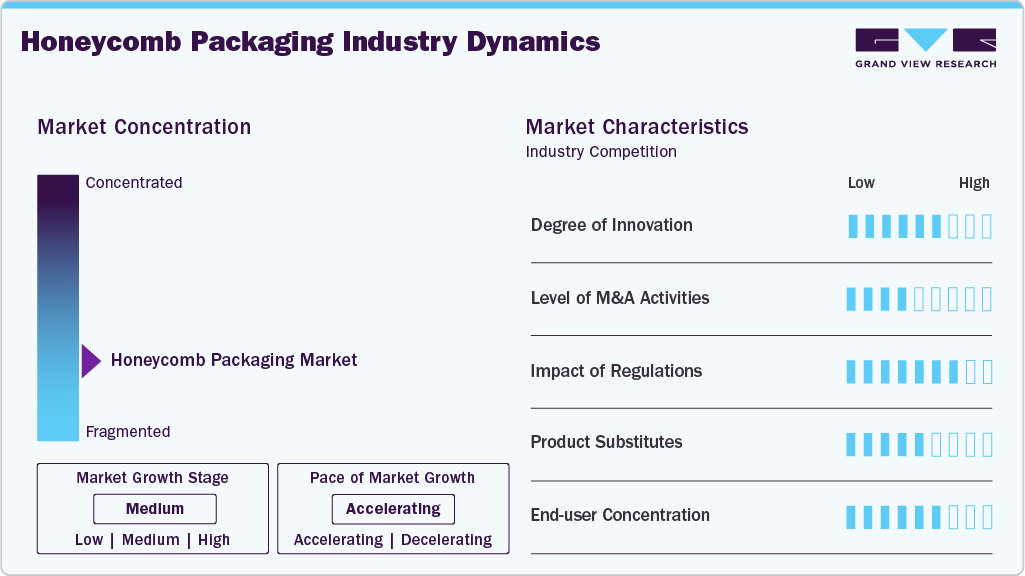
The market is moderately fragmented with a mix of global suppliers and regional manufacturers providing tailored solutions. Supply chain reliability, design expertise, and localized service are competitive differentiators as end users seek speed, cost efficiency, and reduced product damage during logistics. Continuous innovation, including automated production technologies and improved digital design tools, is enhancing product performance and operational productivity. The industry is highly solution-driven, with vendors working closely with clients to develop packaging systems that meet specific load-bearing, vibration resistance and shipping requirements.
Material Insights
The paper/paperboard segment recorded the largest market revenue share of over 57.8% in 2025.Paper and paperboard are the most widely used materials for honeycomb packaging due to their lightweight structure, environmental compatibility, and superior cushioning properties. They are typically manufactured using kraft paper or recycled fibers, making them economical and sustainable. These materials are extensively used for protective packaging, edge protectors, pallets, and filler structures across industries such as furniture, automotive, appliances, and e-commerce.
The plastic / polymer (PP/PE) segment is expected to grow at the fastest CAGR of 6.5% during the forecast period. PP and PE-based honeycomb structures are used in applications requiring enhanced moisture resistance, durability, and reusability. These plastic honeycomb sheets demonstrate high tensile strength, chemical resistance, and stability across temperature variations, making them suitable for automotive trunk liners, industrial reusable packaging, aviation interiors, and sports equipment.
End-use Insights
The consumer goods segment recorded the largest market share of over 29.5% in 2025 and is projected to grow at a significant CAGR of 6.5% during the forecast period.Consumer goods manufacturers increasingly adopt honeycomb packaging due to its lightweight structure, cushioning performance, and cost efficiency. It is widely used for packaging electronics, small appliances, ceramics, cosmetics, and personal care products where impact resistance and surface protection are critical. Honeycomb boards and wraps provide sustainable solutions by replacing expanded foam and rigid plastics in retail and e-commerce shipments.
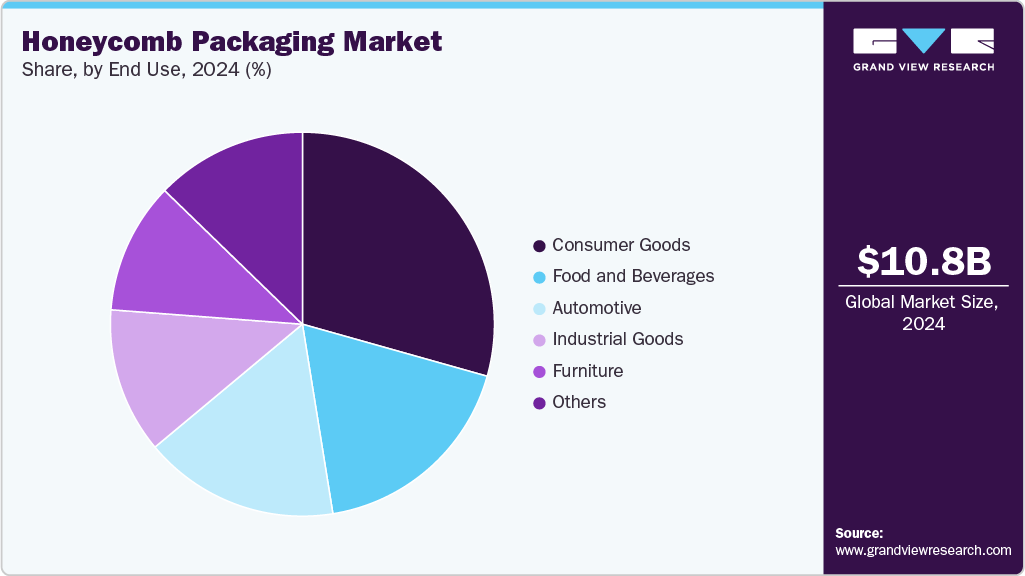
Honeycomb packaging is used in bulk food handling, protective transport of beverage bottles, and secondary packaging for processed foods. Pallet skirts, separators, and dividers made from honeycomb boards prevent breakage and ensure stability during warehousing and distribution. In beverage logistics, honeycomb trays effectively protect glass bottles and can replace molded pulp or corrugated partitions. The growing cold-chain supply network also benefits from moisture-resistant and high-strength honeycomb inserts. Rising consumption of packaged food & beverages, increasing grocery e-commerce, and regulatory pressure to reduce single-use plastics are pushing manufacturers to adopt sustainable protective packaging.
Regional Insights
Asia Pacific honeycomb packaging industry dominated the market and accounted for the largest revenue share of over 42.7% in 2025 and is witnessing strong growth as it is expected to grow at the fastest CAGR of 6.5% during the forecast period. The region dominates the market due to rapid industrial expansion and increasing demand for sustainable packaging solutions. Growth in e-commerce, consumer goods, and electronics manufacturing fuels strong consumption of protective packaging in China, India, South Korea, and Southeast Asia. The region’s competitive manufacturing base and cost-effective paper production support large-scale honeycomb core output at lower prices. In addition, government initiatives promoting reduction of plastics and increased recycling are propelling adoption of paper-based honeycomb structures.
China Honeycomb Packaging Market Trends
The honeycomb packaging market in China is expected to grow at a substantial CAGR of 6.9% from 2026 to 2033. China is the largest producer and consumer of honeycomb packaging in Asia, supported by abundant paper supply, economies of scale in paper processing, and low-cost manufacturing capabilities. Growth in exports of electronics, furniture, and consumer goods drives high-volume usage of protective honeycomb inserts, corner boards, and pallets for safe shipment.
North America Honeycomb Packaging Market Trends
North America honeycomb packaging market is driven by high emphasis on product protection and logistics cost optimization in retail, automotive, and industrial equipment supply chains. Adoption of lightweight and fully recyclable honeycomb solutions has grown significantly with rising e-commerce parcel volume. Manufacturers in the region are investing in automated production technology to provide customized, performance-driven honeycomb structures for specialized industries such as aerospace and electronics. Sustainability is a key factor contributing to expansion in the region. U.S.-based customers increasingly prefer packaging formats that reduce foam and plastic usage while complying with corporate sustainability goals.
The U.S. honeycomb packaging market drives the North America market based on strong industrial logistics networks and high-performance functional packaging requirements. Major end users such as automotive, aerospace, industrial machinery, and household goods rely on honeycomb because of its exceptional compression resistance and lightweight transport benefits. The country also has a mature supply chain with major corporate customers willing to adopt premium sustainable solutions.
Europe Honeycomb Packaging Market Trends
Europe honeycomb packaging market leads in regulatory enforcement focused on circular economy requirements and packaging waste reduction. Strong policy support in the European Union accelerates the shift from traditional cushioning to paper-based engineered packaging. In addition, Europe has a strong industrial base across automotive manufacturing, machinery exports, and high-end furniture production, all of which require durable protective packaging solutions. Major manufacturers such as DS Smith and Smurfit Kappa drive innovation with lightweight paper honeycomb systems tailored for heavy-duty transport. Design-driven sustainability initiatives in Germany, the Nordics, and Benelux further strengthen regional leadership.
Key Honeycomb Packaging Company Insights
The competitive environment of the honeycomb packaging industry is moderately fragmented, with a mix of global packaging leaders and regional specialists competing through cost efficiency, product customization, and sustainability performance. Companies differentiate by enhancing structural strength, expanding automated production capabilities, and offering tailored solutions for high-volume industries such as furniture, automotive, and industrial logistics.
Strategic partnerships, regional capacity expansions, and selective mergers support efforts to improve market presence and supply chain reach. Competitive pressure is heightened by substitute materials such as corrugated boards and foam, pushing suppliers to focus on innovation, lightweighting, cost optimization, and environmental compliance to secure long-term demand.
-
In September 2024, DS Smith announced a significant investment of USD 19.57 million in its packaging facility located in Korinthos, Greece. This investment aims to drive sustainable packaging innovation and increase the facility's production capacity by 30%.
-
In July 2023, Orora, an Australia-based packaging group, signed a partnership to become the exclusive North American distributor of a patented honeycomb fiber-protective packaging system developed by Flexi‑Hex. This shows increasing focus on distribution alliances in North America for sustainable honeycomb solutions.
Key Honeycomb Packaging Companies:
The following key companies have been profiled for this study on the honeycomb packaging market.
- Smurfit Westrock
- Signode Industrial Group LLC
- Packaging Corporation of America
- DS Smith
- Axxor
- Ficus Pax Pvt. Ltd.
- BENZ Packaging
- Coastal Container
- Sonoco Products Company
- Cascades Inc.
- Rebul
Competitive Benchmarking
Operating Strategies
Competitive Edge
Weakness
Mature Players: Smurfit Westrock, Packaging Corporation of America, DS Smith, Sonoco Products Company, Cascades Inc.
- Mature companies are expanding sustainable protective packaging portfolios with recyclable honeycomb boards, pallet systems, cushioning structures, and heavy-duty transit packaging solutions.
- Significant investments are being made in automated production systems, lightweight material innovation, and customized industrial packaging solutions.
- Established companies benefit from extensive manufacturing infrastructure, strong raw material sourcing capabilities, and global distribution networks.
- Advanced engineering expertise and large-scale production capacity support high-volume customized packaging solutions.
- Large operational structures can lead to higher fixed costs and slower responsiveness to niche customer customization requirements.
- Dependence on paper-based raw materials exposes companies to fluctuations in kraft paper pricing and supply chain disruptions.
Emerging Players: Axxor, Ficus Pax Pvt. Ltd., BENZ Packaging, Coastal Container, Rebul
- Emerging companies focus on customized honeycomb packaging systems, export packaging solutions, and application-specific protective designs for industrial and logistics sectors.
- Many players are investing in lightweight packaging innovation, sustainable material development, and regional manufacturing expansion to strengthen customer engagement.
- Emerging players are generally more adaptable to customized packaging requirements and regional market demands.
- Specialized expertise in niche industrial packaging applications supports strong customer relationships and targeted market penetration.
- Limited production scale and narrower geographic reach may reduce competitiveness against multinational packaging manufacturers.
- Rising raw material costs, customization expenses, and capital investment requirements for advanced machinery can impact profitability and scalability.
Honeycomb Packaging Market Report Scope
Report Attribute
Details
Market size in 2025
USD 11.4 billion
Estimated market size in 2026
USD 12.1 billion
Projected market size by 2033
USD 18.4 billion
Growth rate
CAGR of 6.2% from 2026 to 2033
Historical data
2021 - 2024
Forecast period
2026 - 2033
Quantitative units
Revenue in USD million and CAGR from 2026 to 2033
Report coverage
Revenue forecast, competitive landscape, growth factors, and trends
Segments covered
Material, end-use, region
States scope
North America; Europe; Asia Pacific; Latin America; Middle East & Africa
Country scope
U.S.; Canada; Mexico; Germany; France; UK; Italy; Spain; China; India; Japan; Australia; Brazil; Argentina; Saudi Arabia; South Africa; UAE
Key companies profiled
Smurfit Westrock; Signode Industrial Group LLC; Packaging Corporation of America; DS Smith; Axxor; Ficus Pax Pvt. Ltd.; BENZ Packaging; Coastal Container; Sonoco Products Company; Cascades Inc.; Rebul
Customization scope
Free report customization (equivalent up to 8 analyst’s working days) with purchase. Addition or alteration to country, regional, and segment scope.
Pricing and purchase options
Avail customized purchase options to meet your exact research needs. Explore purchase options
Global Honeycomb Packaging Market Report Segmentation
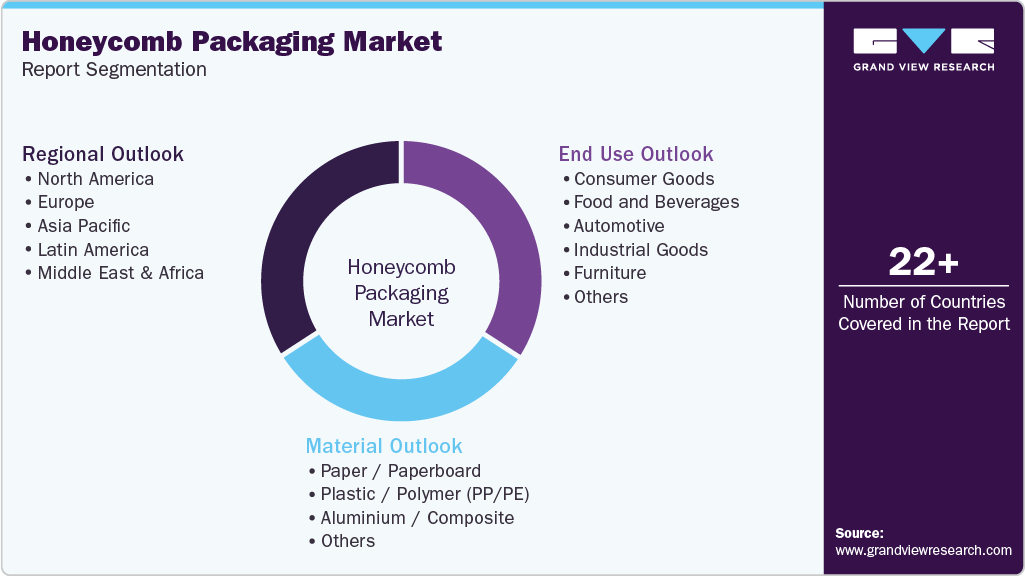
This report forecasts revenue growth at a global level and provides an analysis of the latest industry trends in each of the sub-segments from 2021 to 2033. For this study, Grand View Research has segmented the global honeycomb packaging market report based on material, end-use, and region:
-
Material Outlook (Revenue, USD Million, 2021 - 2033)
-
Paper / Paperboard
-
Plastic / Polymer (PP/PE)
-
Aluminum / Composite
-
Others
-
-
End-use Outlook (Revenue, USD Million, 2021 - 2033)
-
Consumer Goods
-
Food and Beverages
-
Automotive
-
Industrial Goods
-
Furniture
-
Others
-
-
Regional Outlook (Revenue, USD Million, 2021 - 2033)
-
North America
-
U.S.
-
Canada
-
Mexico
-
-
Europe
-
Germany
-
France
-
UK
-
Italy
-
Spain
-
-
Asia Pacific
-
China
-
India
-
Japan
-
Australia
-
South Korea
-
-
Latin America
-
Brazil
-
Argentina
-
-
Middle East & Africa
-
South Africa
-
Saudi Arabia
-
UAE
-
-
Delivered Customizations
This report has been delivered with the following In-depth customizations
Client Request
Customization Delivered
Value Adds
Regional Segmentation
Comprehensive assessment of the global honeycomb packaging market across North America, Europe, Asia Pacific, Latin America, and Middle East & Africa, including country-wise industrial packaging demand, manufacturing activity, e-commerce logistics growth, sustainability initiatives, raw material availability, and regional consumption trends.
Assist in identifying high-potential growth regions, emerging industrial packaging clusters, and regional expansion opportunities. Support operational planning by analyzing sustainability adoption, logistics infrastructure, and competitive positioning across major markets.
Cross-Segmentation
In-depth segmentation analysis based on material type, product format, end-use industry, application area, packaging configuration, and distribution channel, including both value and volume assessment across key global markets. The study further evaluates demand patterns for protective boards, pallets, cushioning systems, and customized honeycomb packaging applications.
Enable strategic identification of profitable product categories and fast-growing industrial applications. Support portfolio optimization, product innovation planning, and customer-targeting strategies by understanding evolving packaging demand across sectors.
Trade Assessment
Detailed analysis of international trade patterns, kraft paper supply trends, import-export movements, tariff impacts, regional sourcing dynamics, and logistics dependencies affecting the honeycomb packaging industry. The assessment also includes evaluation of manufacturing shifts, supply chain disruptions, and raw material procurement trends.
Support informed sourcing and procurement decisions by identifying key supplier regions, trade risks, and supply chain vulnerabilities. Help businesses strengthen international expansion strategies, optimize supplier diversification, and improve long-term operational resilience.
Frequently Asked Questions About This Report
The paper/paperboard segment led with a 57.8% revenue share in 2025, while the plastic/polymer (PP/PE) segment is expected to grow at the fastest CAGR during the forecast period.
The consumer goods segment held the largest revenue share of 29.5% in 2025 and is projected to grow at a significant CAGR during the forecast period.
Asia Pacific dominated with a 42.7% revenue share in 2025.
Asia Pacific is the fastest-growing regional market over the forecast period.
The global honeycomb packaging market size was valued at USD 11.4 billion in 2025 and is estimated at USD 12.1 billion for 2026.
The global honeycomb packaging market is expected to grow at a CAGR of 6.2% from 2026 to 2033, reaching USD 18.4 billion by 2033.
Some of the key players operating in the honeycomb packaging market include Smurfit Westrock, Signode Industrial Group LLC, Packaging Corporation of America, DS Smith, Axxor, Ficus Pax Pvt. Ltd., BENZ Packaging, Coastal Container, Sonoco Products Company, Cascades Inc., and Rebul.
Key factors driving the honeycomb packaging market include rising demand for sustainable, lightweight, and recyclable packaging solutions, increasing adoption across e-commerce, automotive, electronics, aerospace, and industrial sectors, growing emphasis on reducing plastic waste, expansion of global logistics and e-commerce activities, and increasing demand for cost-effective protective packaging solutions.
About the Author(s)
Plastics, Polymers & Resins Research Team
Bulk Chemicals · Plastics, Polymers & ResinsThis report was authored by the plastics, polymers & resins research team at Grand View Research - comprising two research analysts, one senior research analyst, and one industry expert - with specialized expertise in the plastics, polymers & resins segment of the bulk chemicals industry. All findings are based on proprietary bulk chemicals databases, executive interviews, and regulatory analysis, subject to internal peer review prior to publication.
Last Updated:
Speak to Analyst


Customize this report to your needs — add regions, segments, or data points, with 20% free customization.
Or view our licence options:


ISO 9001:2015 & 27001:2022 Certified
We are GDPR and CCPA compliant! Your transaction & personal information is safe and secure. For more details, please read our privacy policy.


