
- Home
- »
- Plastics, Polymers & Resins
- »
-
India Elastomers Market Size & Share Report, 2026-2033GVR Report cover

India Elastomers Market (2026 - 2033)
Size, Share & Trends Analysis Report By Material (Silicone Sealing, Non-Silicone Elastomer Sealing), By Application (Automotive & Transportation, Data Center, Healthcare, Food & Beverage), By Region, And Segment Forecasts
Market Size, 2025
$5.1BMarket Estimate, 2026
$5.4BMarket Forecast, 2033
$8.4BCAGR, 2026–2033
6.5%India Elastomers Market Summary
The India elastomers market size was valued at USD 5.1 billion in 2025 and is projected to grow from USD 5.4 billion in 2026 to USD 8.4 billion by 2033, at a CAGR of 6.5% from 2026 to 2033. West India dominated the market with the largest revenue share of 34.5% in 2025. Rising demand from the automotive, industrial, healthcare, and electrical & electronics sectors is driving market growth by increasing consumption of high-performance sealing, insulation, and vibration-control materials.
Key Market Trends & Insights
- By material: Non-silicone elastomer sealing materials dominated the segment in 2025, with a revenue share of 45.1%.
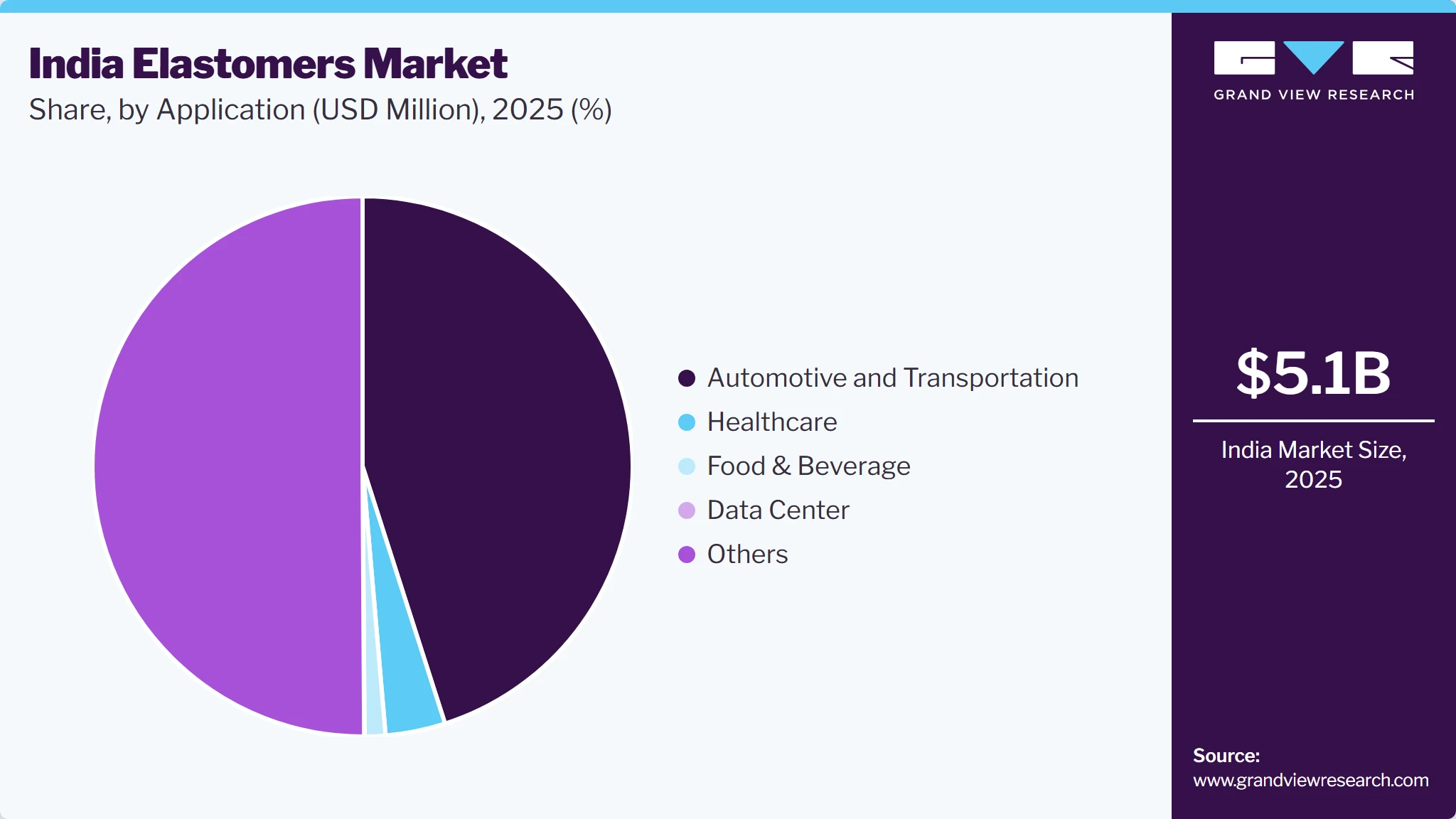
- By application: Automotive and transportation segment accounted for a significant market revenue share of 45.1% in 2025.
Market Size & Forecast
- Market size in 2025: USD 5.1 Billion
- Estimated market size in 2026: USD 5.4 Billion
- Projected market size by 2033: USD 8.4 Billion
- CAGR (2026-2033): 6.5%
Three ways to get this report
Buy it, customize it, or ask a question.Ask an Analyst
A direct answer, usually in 1 working day
- AccessReport author, directly
- Reply timeWithin 1 working day
- No sales callDirect answer only
- FormatEmail reply
- CostFree, no cost
Get the Full Report
What the study covers
- FormatsPDF · Excel · Dashboard
- Timeline2026–2033 annual, 2025 base
- Coverage20+ countries, 5 regions
- Companies10+ key players profiled
Customize the Report
20% free customization
- IncludeCountries, segments, points
- TailorTo your product definition
- ExtendDeeper competitor detail
- OrA fully bespoke study
- Turnaround5–10 working days
The Indian sealing materials market is divided into three main categories, including non-silicone elastomer sealing materials, silicone sealing materials, and non-elastomeric dynamic sealing and wear materials, each tailored to specific performance needs across various end-use sectors. Material selection is primarily driven by operating temperature, chemical compatibility, pressure conditions, durability, and cost, with applications spanning automotive, industrial machinery, oil & gas, chemicals, construction, electronics, and healthcare.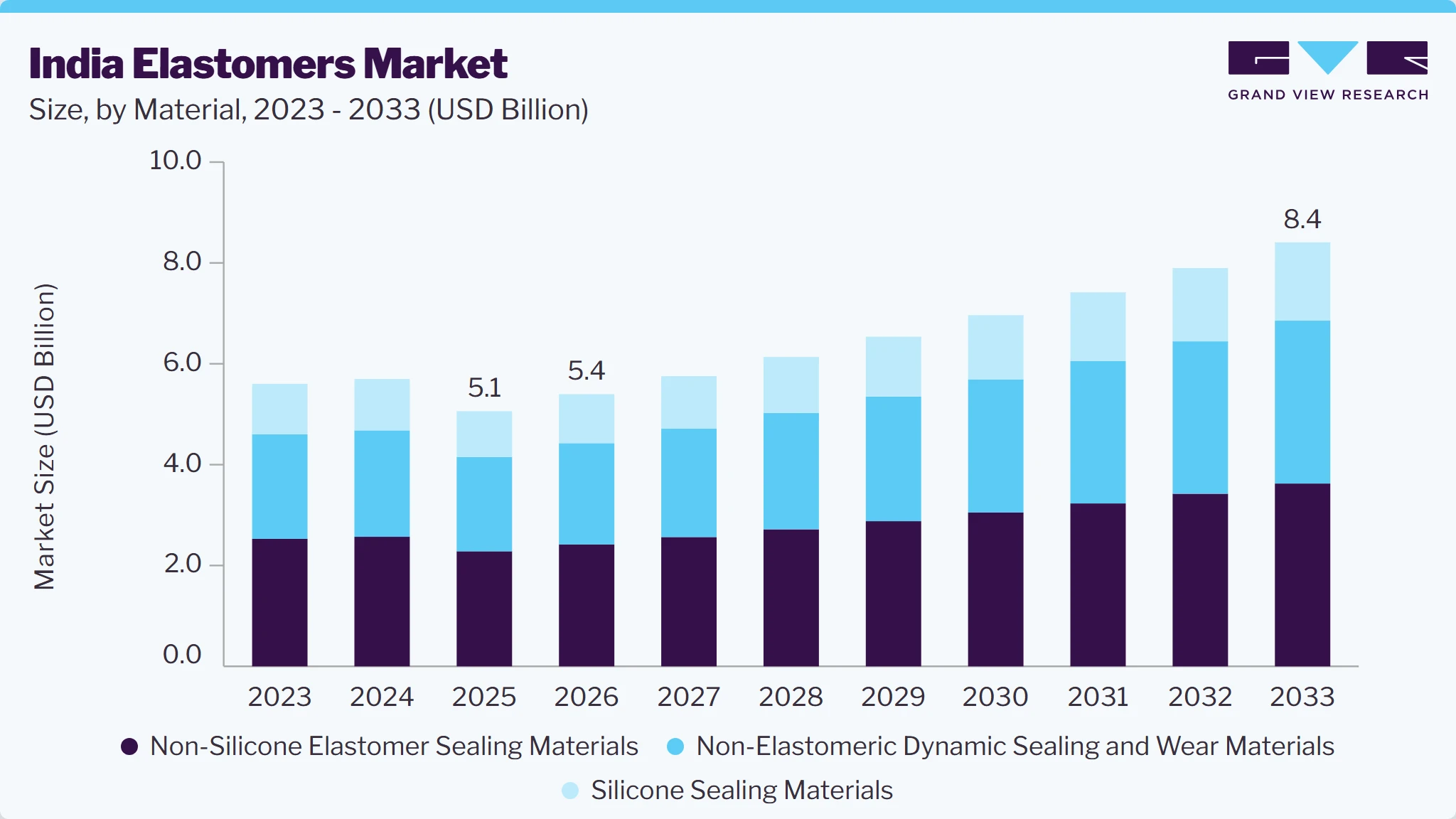 Source: Grand View Research, IR Documents, Primary Interviews, Paid DatabasesTo learn more about this report,
 Download Free Sample Report
 Non-silicone elastomer sealing materials are widely used for various sealing tasks, while silicone sealing materials are preferred when thermal stability, electrical insulation, and biocompatibility are critical. Non-elastomeric dynamic sealing and wear materials, including high-performance engineering polymers, are used in applications that demand low friction, outstanding wear resistance, and chemical inertness, particularly in pumps, valves, compressors, and precision machinery. Collectively, these categories of materials address a wide array of sealing needs in India’s growing manufacturing and process industries.
Market Dynamics
Rapid expansion of data center infrastructure is becoming a significant driver of demand for the Indian elastomers industry because each new facility requires a large amount of sealing, insulation, protection, and vibration-control materials at the component level. Elastomers are used in cable entry seals, enclosure gaskets, rack sealing systems, vibration isolation mounts, and protective interfaces for UPS and electrical equipment, so the material intensity rises with every additional megawatt of installed IT load. India’s data center market is already in a strong expansion phase, with inventory reaching 1,123 MW of IT load capacity in H1 2025, and is expected to continue scaling quickly. This creates sustained pull for silicone, EPDM, TPV, and specialty rubber compounds that can support tight sealing, thermal stability, and long service life.
The market's technology profile is also improving, making the elastomer content more specialized rather than purely volumetric. Higher rack densities, AI-led workloads, adoption of liquid cooling, and stricter uptime requirements are increasing the need for materials that can perform under heat, continuous compression, and electrical exposure. This is not only expanding the use of higher-grade elastomers but also raising the technical bar for compound consistency, flame performance, low compression set, and durability in critical infrastructure. In effect, the data center buildout is shifting elastomer demand away from basic industrial grades and toward engineered materials that fit mission-critical operating conditions.
India’s structural dependence on imported petrochemical intermediates directly affects elastomer feedstock availability and pricing. The government has stated that India still depends on imports for around 45% of petrochemical intermediates, and this is important for elastomers because the sector relies on monomers and derivatives such as butadiene, styrene, propylene-based chains, and polyurethane inputs. In practical terms, this means domestic manufacturers remain exposed to global freight, currency movement, and overseas supply disruptions even when end-market demand is healthy. The restraint is therefore not only about cost, but also about planning uncertainty since raw material availability can move faster than domestic demand cycles.
The growing focus on equipment reliability, operational efficiency, and longer service life is boosting the demand for high-performance sealing materials across various sectors in India, including automotive, industrial machinery, oil and gas, chemical processing, electronics, and renewable energy. As the demands of operating environments increase, manufacturers are turning to sealing materials that offer improved thermal stability, chemical resistance, wear resistance, and low-friction characteristics to enhance component performance and minimize maintenance needs. This movement is creating opportunities for advanced silicone elastomers and engineering materials such as PTFE, PEEK, and specialized fluoroelastomers, especially in applications requiring exceptional durability and performance under extreme operating conditions. Ongoing investments in domestic manufacturing and advanced industrial technologies are anticipated to further facilitate the acceptance of high-performance sealing solutions in the Indian market.
Market Concentration & Characteristics
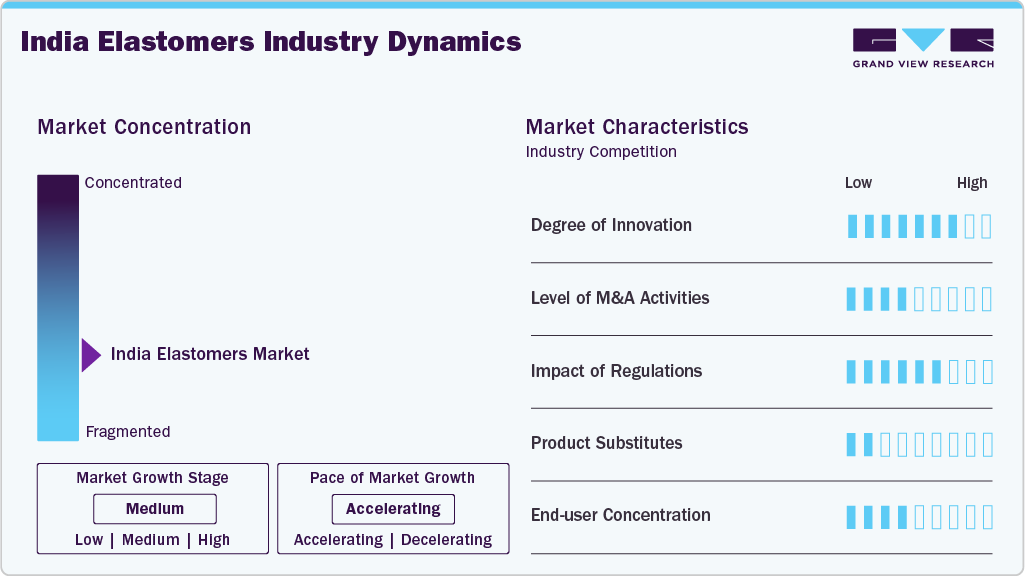
The India elastomers industry is marked by moderate to high levels of innovation, fueled by rising demand for materials offering improved heat resistance, chemical compatibility, durability, and sustainability. Producers are focusing on developing specialty elastomers, lightweight formulations, and compounds tailored to specific applications to meet the evolving needs of sectors such as automotive, industrial, electronics, healthcare, and energy. Although there have been fewer mergers and acquisitions than in more developed global markets, strategies such as collaborations, technology licensing agreements, capacity enhancements, and joint ventures continue to be the preferred methods for bolstering product offerings, increasing manufacturing capabilities, and enhancing regional market presence.
Regulatory changes concerning vehicle emissions, industrial safety, environmental standards, and product quality are impacting the choice of materials used in sealing applications. A growing focus on energy efficiency, reliability of equipment, and lower maintenance needs is driving the move toward the use of advanced elastomers and engineering polymers. The substitution of materials is mainly based on performance, with silicone elastomers taking the place of traditional rubbers in high-temperature settings, while engineering materials such as PTFE and PEEK are increasingly favored for applications that demand excellent chemical resistance, minimal friction, and longer service life. Nevertheless, considerations of cost and the specific performance needs of applications remain key factors in selecting sealing materials.
 To learn more about this report, Download Free Sample Report
 The demand for elastomer sealing materials in India spans a wide range of end-use industries, including automotive, industrial machinery, construction, oil & gas, chemical processing, electrical & electronics, and healthcare, which are the main consumer sectors. The automotive sector is a major consumer, largely due to the significant use of sealing components in powertrain, braking, HVAC, fluid handling, and weather sealing applications, whereas industrial equipment and processing industries create steady demand for both static and dynamic sealing solutions. The existence of numerous high-volume end-use sectors lessens reliance on a single industry and fosters stable long-term demand for a diverse array of elastomeric and high-performance sealing materials.
Analyst Perspective
India’s elastomers market is expected to move over the next 5 to 10 years from a largely conventional, price-sensitive base toward a more value-led and application-specific market, supported by strong automotive output, continuing infrastructure build-out, and deeper localization in electronics manufacturing. Demand will remain strongest in tires, hoses, seals, vibration-control parts, industrial components, and electrical applications, while growth opportunities should expand in specialty compounds, high-performance grades, and recyclable or lower-emission formulations. Regulatory expectations are also tightening, with India strengthening circular-economy and EPR frameworks for tyres and other waste streams, which will push suppliers toward better traceability, end-of-life compliance, and sustainability-led product design. At the same time, domestic natural rubber consumption continues to exceed production, keeping the market exposed to import dependence and raw-material volatility. Market leaders will be differentiated by feedstock security, compounding depth, application engineering, geographic proximity, and credible sustainability execution, while profitability will remain constrained by pricing pressure, substitution risk, and supply chain disruption.
Material Insights
The non-silicone elastomer sealing materials segment held the highest revenue share of 45.11% in 2025. They are widely used in automotive, industrial machinery, construction, water infrastructure, oil and gas, and electrical equipment due to their excellent sealing efficiency, chemical and abrasion resistance, thermal stability, long service life, and cost competitiveness. Rising vehicle production, manufacturing expansion, infrastructure development, and localization of automotive components are increasing demand for gaskets, O-rings, weather seals, hydraulic seals, pipe joints, and industrial enclosures.
The segment is advancing through continuous improvements in elastomer compounding, material engineering, precision molding, and polymer processing technologies. Manufacturers are developing customized formulations with enhanced resistance to fuels, oils, ozone, heat, and aggressive chemicals, while improving compression set, dimensional stability, fuel compatibility, and durability. These innovations enable application-specific sealing solutions for electric vehicles, industrial automation, water management, and energy infrastructure.
The non-elastomeric dynamic sealing and wear materials segment is expected to grow at the fastest CAGR of 7.0% over the forecast period. Non-elastomeric dynamic sealing and wear materials are gaining significant adoption across the market due to rising demand for high-durability sealing solutions in automotive, industrial machinery, aerospace, and process equipment. Materials such as polytetrafluoroethylene (PTFE), ultra-high molecular weight polyethylene (UHMWPE), polyether ether ketone (PEEK), and engineered thermoplastics offer excellent wear resistance, low friction, chemical stability, and dimensional accuracy under continuous motion.
Application Insights
The automotive and transportation segment held the revenue share of 45.06% in 2025, supported by expanding vehicle production, increasing localization of component manufacturing, and rising demand for durable, lightweight, and high-performance materials. Elastomers are widely used in seals, gaskets, hoses, weatherstrips, engine mounts, suspension bushings, vibration dampers, tires, and electric vehicle battery sealing systems due to their excellent elasticity, heat and chemical resistance, and long service life. The growing production of passenger, commercial, and electric vehicles continues to strengthen elastomer consumption across OEM and aftermarket applications.
 To learn more about this report, Download Free Sample Report
 The data center application segment is expected to grow at the fastest CAGR of 12.3% over the forecast period. The data center segment is emerging as a strategic application area for India's market, supported by the rapid expansion of hyperscale facilities, cloud computing infrastructure, and artificial intelligence workloads. Elastomers are widely used in cable insulation, sealing systems, vibration-isolation mounts, HVAC gaskets, expansion joints, and liquid-cooling assemblies due to their superior thermal stability, electrical insulation, flexibility, and long service life. Rising investments in high-density computing infrastructure and demand for uninterrupted operations are accelerating the adoption of high-performance elastomer materials across mission-critical data center facilities.
Regional Insights
West India dominated the India elastomers market, accounting for the largest revenue share of 34.5% in 2025. The region includes Gujarat, Maharashtra, Goa, and Dadra & Nagar Haveli and Daman & Diu. Maharashtra and Gujarat account for the largest share of automotive, petrochemical, engineering, and pharmaceutical production in the country. They also host major industrial parks and polymer manufacturing facilities, creating sustained demand for sealing materials across automotive, industrial equipment, process industries, and general manufacturing. This combination makes West India the country's largest hub for elastomer production and consumption.
North India Elastomers Market Trends
The India elastomers market in North India serves primarily as a large consumption and manufacturing hub rather than a producer of base polymers. The region includes Delhi, Haryana, Punjab, Himachal Pradesh, Uttar Pradesh, Uttarakhand, Rajasthan, Jammu & Kashmir, Madhya Pradesh, Ladakh, and Chandigarh. Most synthetic elastomer raw materials, such as NBR, FKM, and PEEK, are sourced from West India, while regional manufacturers focus on compounding and conversion. Faridabad and Ghaziabad are well-established centers for EPDM profiles and general rubber products serving automotive, construction, and industrial applications.
South India Elastomers Market Trends
The India elastomers market in South India is the second-largest regional market in India, supported by its strong automotive, healthcare, electronics, and precision manufacturing sectors. The region includes Andhra Pradesh, Karnataka, Kerala, Tamil Nadu, Telangana, Puducherry, Lakshadweep, and the Andaman & Nicobar Islands. Unlike West India, South India does not produce the base polymers covered in this market; most raw materials are imported and processed locally. Companies such as Vikas Elastochem supply FKM pre-compounds and PTFE micropowder, reinforcing the region's role as a major compounding and conversion hub for high-performance elastomer materials.
East India Elastomers Market Trends
The India elastomers market in East India has a relatively selective demand profile compared with the other regions. The region includes West Bengal, Bihar, Jharkhand, Odisha, Chhattisgarh, Assam, Arunachal Pradesh, Manipur, Meghalaya, Mizoram, Nagaland, Tripura, and Sikkim. Although it has a broad industrial base, it is not part of India's main automotive manufacturing corridor. Most demand comes from mining, metals, power generation, utilities, and public sector industries. However, West Bengal is home to Wacker Metroark's silicone elastomer manufacturing facilities, making the region India's primary production base for HCR and LSR silicone rubber.
Key India Elastomers Company Insights
Some of the key players operating in the market include NOK-Freudenberg India and SKF India.
-
NOK-Freudenberg India is a leading manufacturer of precision elastomer and sealing solutions in India. Its portfolio includes elastomeric seals, O-rings, gaskets, oil seals, diaphragms, rubber-to-metal bonded components, and custom-engineered sealing systems for automotive and industrial applications. The company specializes in high-performance synthetic rubber and composite materials designed to withstand extreme temperatures, pressure, chemicals, and demanding operating conditions. Backed by advanced manufacturing facilities, engineering expertise, and stringent quality systems, Freudenberg-NOK serves OEMs and industrial customers across India with reliable, durable, and application-specific sealing solutions.
-
SKF India manufactures engineered automotive and industrial components, including bearings, elastomer-based seals, lubrication systems, condition monitoring solutions, and maintenance services, serving passenger vehicles, commercial vehicles, industrial equipment, and aftermarket needs. The company emphasizes research-driven engineering, precision manufacturing, energy-efficient and sustainable technologies, and customized solutions that reduce friction and enhance equipment reliability, durability, and performance, while maintaining rigorous quality standards.
Cooper Standard Automotive India and Anand Motor Products (AMP) are among the emerging market participants.
-
Cooper Standard is a global manufacturer of elastomer-based sealing systems and fluid handling components for the automotive industry, producing weather seals, fuel and brake lines, fluid transfer systems, and engineered rubber and plastic products. Its Indian subsidiary, based in Pune, Maharashtra, manufactures these sealing and fluid system components for major OEMs, serving passenger and commercial vehicles across domestic and international markets, including industrial transportation applications. The company operates within a global manufacturing network and emphasizes advanced material engineering, manufacturing efficiency, integrated production capabilities, and stringent quality standards, supporting product reliability, vehicle performance, durability, and lightweight design through continuous engineering innovation.
-
Anand Motor Products is an Indian company that makes rubber-to-metal bonded parts used to reduce vibration in vehicles. It runs three factories and manufactures engine mounts, bushings, isolators, torque rods, strut mounts, and microcellular polyurethane jounce bumpers for cars, trucks, trailers, and off-highway vehicles, serving customers both in India and internationally. The company focuses on strong engineering skills, precise manufacturing, dependable products, and thorough quality checks. It also runs integrated factories and a global supply network that supports both vehicle makers (OEMs) and the spare-parts market.
Key India Elastomers Companies
-
Freudenberg Sealing Technologies
-
NOK-Freudenberg India
-
Hutchinson India
-
SKF India
-
ElringKlinger India
-
Cooper Standard Automotive India
-
Motherson Group
-
Anand Motor Products (AMP)
-
Perfect Seals
-
Uno Mindas
Company Categorization
Operating Strategies
Competitive Edge
Weakness
Mature Players: Freudenberg Sealing Technologies, Cooper Standard Automotive India, Motherson Group, Uno Minda, Hutchinson India, SKF India
- Expand manufacturing capacity and local production.
- Strengthen partnerships with automotive OEMs and industrial customers.
- Diversify elastomer portfolios across sealing, fluid-handling, vibration-control, and engineered-rubber products.
- Broad product portfolios serving multiple industries.
- Advanced engineering, R&D, and manufacturing capabilities.
- Global supply chains with consistent quality standards.
- High exposure to automotive production cycles.
- Dependence on synthetic rubber and petrochemical raw material prices.
Emerging Players: Anand Motor Products (AMP), Perfect Seals, ElringKlinger India,
- Focus on customized elastomer and sealing solutions for niche applications.
- Expand regional distribution and customer relationships.
- High flexibility in customized product development.
- Strong focus on niche sealing and industrial applications.
- Limited manufacturing scale and geographic reach.
- Lower investment capacity for advanced R&D and automation.
- Smaller customer base compared with established competitors.
Recent Developments
-
In April 2026, GoldSeal SaarGummi expanded its manufacturing capabilities with the inauguration of a new 65,000 sq ft production facility in Chennai. The expansion is intended to scale up the production of advanced EPDM and TPV elastomer sealing systems for automotive applications. By enhancing manufacturing capacity, the company aims to strengthen its regional presence, broaden its elastomer product portfolio, improve supply capabilities, and address the increasing demand for high-performance sealing solutions in the market.
India Elastomers Market Report Scope
Report Attribute
Details
Market size in 2025
USD 5.1 billion
Estimated market size in 2026
USD 5.4 billion
Projected market size by 2033
USD 8.4 billion
Growth rate
CAGR of 6.5% from 2026 to 2033
Actual data
2021 - 2025
Forecast period
2026 - 2033
Quantitative units
Revenue in USD billion, volume in kilotons and CAGR from 2026 to 2033
Report coverage
Revenue and volume forecast, company ranking, competitive landscape, growth factors, and trends
Segments covered
Material, application, region
Regional scope
India
Country scope
North India; South India; West India; East India
Key companies profiled
Freudenberg Sealing Technologies; NOK-Freudenberg India; Hutchinson India; SKF India; ElringKlinger India; Cooper Standard Automotive India; Motherson Group; Anand Motor Products (AMP); Perfect Seals; Uno Mindas
Customization scope
Free report customization (equivalent to up to 8 analysts working days) with purchase. Addition or alteration to country, regional & segment scope.
Pricing and purchase options
Avail customized purchase options to meet your exact research needs. Explore purchase options
India Elastomers Market Report Segmentation
This report forecasts revenue & volume growth at the regional & country levels and provides an analysis of the industry trends in each of the sub-segments from 2021 to 2033. For this study, Grand View Research has segmented the India elastomers market based on type, application, and region:
-
Material Outlook (Volume, Kilotons; Revenue, USD Billion, 2021 - 2033)
-
Silicone Sealing Materials
-
LSR
-
HCR
-
Other specialty silicones
-
-
Non-Silicone Elastomer Sealing Materials
-
EPDM
-
FKM
-
AEM/ACM
-
HNBR
-
NBR
-
Others
-
-
Non-Elastomeric Dynamic Sealing and Wear Materials
-
PTFE
-
PFA
-
PEEK
-
PAI
-
Others
-
-
-
Application Outlook (Volume, Kilotons; Revenue, USD Billion, 2021 - 2033)
-
Automotive and Transportation
-
Passenger Vehicles
-
Commercial Vehicles
-
2/3-Wheelers
-
Specialized Vehicles
-
Railway Vehicles
-
-
Data Center
-
Enterprise Data Centers
-
Colocation Data Centers
-
Hyperscale Data Centers
-
-
Healthcare
-
Food & Beverage
-
Others
-
-
Regional Outlook (Volume, Kilotons; Revenue, USD Billion, 2021 - 2033)
-
North India
-
South India
-
East India
-
West India
-
Research Methodology
The India elastomers market figures in this report are based on a proven research process that combines executive interviews with secondary research from proprietary databases, company filings, and recognized regulatory and institutional sources. Market size is built through value-chain sizing-reconciling supply-side and demand-side estimates-and triangulated with bottom-up and top-down approaches. Every estimate passes multiple levels of expert validation before publication, with each India elastomers segment quantified using the revenue-capture definitions in the table below.
Segment Definition
Segment - Material
Revenue capture definition
Silicone Sealing Materials
Revenue is generated through the supply of silicone sealing materials, including Liquid Silicone Rubber (LSR), High Consistency Rubber (HCR), and other specialty silicone grades, used in applications requiring excellent thermal stability, chemical resistance, electrical insulation, and long-term sealing performance. These materials are widely utilized in automotive, electronics, healthcare, food processing, industrial equipment, and electrical applications, where reliability under extreme temperatures, environmental exposure, and demanding operating conditions are the primary value drivers.
Non-Silicone Elastomer Sealing Materials
Revenue is generated through the supply of non-silicone elastomer sealing materials, including EPDM, FKM, AEM/ACM, HNBR, NBR, and other elastomer grades, used in sealing applications requiring mechanical strength, flexibility, abrasion resistance, and compatibility with oils, fuels, chemicals, and varying operating temperatures. These materials are extensively used in automotive systems, industrial machinery, fluid-handling equipment, construction, oil & gas, and general engineering applications, where durability, cost-efficiency, and application-specific performance are the primary value drivers.
Non-Elastomeric Dynamic Sealing and Wear Materials
Revenue is generated through the supply of non-elastomeric dynamic sealing and wear materials, including PTFE, PFA, PEEK, PAI, and other high-performance engineering materials, used in dynamic sealing, bearing, wear, and sliding applications requiring exceptional chemical resistance, low friction, dimensional stability, and high-temperature performance. These materials are widely utilized in pumps, valves, compressors, process equipment, automotive systems, aerospace, electronics, and chemical processing industries, where extended service life, reduced maintenance, and reliable performance under demanding operating conditions are the primary value drivers.
Segment-Application
Revenue capture definition
Automotive and Transportation
Revenue is generated through the use of sealing materials in engines, transmissions, braking systems, battery packs, HVAC systems, fuel systems, and body sealing applications across passenger vehicles, commercial vehicles, railways, and off-highway equipment. Demand is driven by the need for thermal stability, fluid compatibility, vibration resistance, and long service life, with material selection varying according to operating temperatures, chemical exposure, and performance requirements.
Data Center
Revenue is generated through sealing solutions used in liquid cooling systems, pumps, valves, piping networks, electrical enclosures, cable management systems, and HVAC equipment within data centers. The increasing deployment of high-density computing infrastructure is driving demand for materials offering superior thermal resistance, chemical compatibility, moisture protection, and long-term operational reliability.
Healthcare
Revenue is generated through sealing materials used in medical devices, diagnostic equipment, pharmaceutical processing systems, fluid transfer assemblies, and laboratory instruments. These applications require materials with high purity, biocompatibility, sterilization resistance, and consistent sealing performance to ensure patient safety, regulatory compliance, and equipment reliability.
Food & Beverage
Revenue is generated through sealing materials used in food processing equipment, beverage production systems, filling lines, pumps, valves, piping, and packaging machinery. Demand is driven by the need for food-grade materials that provide excellent chemical resistance, hygiene, and thermal stability, and that comply with food safety regulations while maintaining reliable sealing performance during continuous processing operations.
Others
Revenue is generated through sealing materials used across industrial machinery, chemical processing, oil & gas, power generation, water treatment, electronics, aerospace, marine, and construction applications. These industries require sealing solutions capable of withstanding demanding operating conditions, including high pressures, aggressive chemicals, abrasive environments, and fluctuating temperatures, thereby supporting reliable equipment operation and extended service life.
Estimation Model
Layer Name
Key Question
Description
End-Use Industry Assessment
Where is elastomer demand generated?
Identifies demand across major end-use industries such as automotive & transportation, healthcare, food & beverage, data centers, industrial machinery, oil & gas, construction, and other industrial applications. Industry production volumes, installed equipment base, and manufacturing output are evaluated to estimate potential consumption of sealing materials.
Application & Material Mapping
Which sealing materials are used in each application?
Maps sealing applications within each industry to the appropriate material categories, including silicone sealing materials, non-silicone elastomer sealing materials, and non-elastomeric dynamic sealing and wear materials. Material selection is assessed based on operating conditions, performance requirements, regulatory compliance, and replacement trends.
Market Size Validation
What is the total market demand and value?
Aggregates material consumption across all applications and validates estimates using domestic production, imports, exports, manufacturer capacities, trade statistics, and industry interviews. Final market estimates are cross-verified through supply-side and demand-side analysis to derive the overall market size and segment shares.
Delivered Customizations
We have successfully delivered the following deep-dive customizations
Client Request
Customization Delivered
Value Adds
Data Center: Pipeline Capacities Analysis
Comprehensive assessment of India's upcoming data center pipeline, covering projects by operator, location, planned IT load (MW), development status (announced, under construction, operational), and facility type. The analysis further evaluates the impact of upcoming capacity additions on demand for sealing materials used in liquid cooling systems, HVAC equipment, pumps, valves, piping networks, and critical infrastructure.
Enables clients to identify future demand hotspots, align sales and capacity expansion strategies with upcoming projects, prioritize key customers and EPC contractors, and quantify opportunities arising from India's expanding digital infrastructure.
Application Mapping
Detailed mapping of elastomer applications by component/system, identifying the specific sealing application, commonly used elastomer materials (EPDM, NBR, FKM, HNBR, silicone, PTFE, PEEK, etc.), and the primary function of each material within the application. The assessment also highlights material selection criteria based on operating conditions, performance requirements, and industry specifications.
Helps clients understand material substitution opportunities, identify high-value applications, optimize product portfolios, and support product development and customer engagement through application-specific insights.
Regional Demand Analysis
Detailed assessment of the market across the North, East, West, and South regions, including regional demand patterns, manufacturing clusters, end-use industry concentration, production capacities, industrial infrastructure, and consumption trends. The study further evaluates the influence of automotive manufacturing, industrial machinery, electronics, healthcare, chemicals, oil & gas, and infrastructure development on regional elastomer demand.
Helps clients identify high-growth regions, prioritize market expansion strategies, optimize distribution and supply chain networks, allocate sales resources effectively, and evaluate region-specific demand drivers, competitive intensity, and investment opportunities.
Frequently Asked Questions About This Report
India elastomers market was valued at USD 5.1 billion in 2025 and is estimated at USD 5.4 billion in 2026.
West India accounted for the largest revenue share, 34.5% of the India elastomers market in 2025. The strong presence of automotive manufacturing, petrochemical production, and industrial hubs in Maharashtra and Gujarat is driving elastomer demand across automotive, industrial, and infrastructure applications in West India.
Expansion of domestic manufacturing under the Make in India initiative is increasing the demand for elastomers across automotive, industrial, electrical, and consumer goods applications.
Some key players operating in the India elastomers include Freudenberg Sealing Technologies, NOK-Freudenberg India, Hutchinson India, SKF India, ElringKlinger India, Cooper Standard Automotive India, Motherson Group, Anand Motor Products (AMP), Perfect Seals, and Uno Minda.
Automotive and transportation segment held the revenue share of 45.06% in 2025, while data center application segment is the fastest growing application.
India elastomers market is expected to witness high revenue growth of 6.5% from 2026 to 2033 to reach USD 8.4 billion by 2033 due to the rising demand from the automotive, industrial, healthcare, and electrical & electronics sectors.
Non-silicone elastomer sealing materials dominated the segment in 2025, with a revenue share of 45.1%, while non-elastomeric dynamic sealing and wear materials segment is fastest growing material.
About the Author(s)
Plastics, Polymers & Resins Research Team
Bulk Chemicals · Plastics, Polymers & ResinsThis report was authored by the plastics, polymers & resins research team at Grand View Research - comprising two research analysts, one senior research analyst, and one industry expert - with specialized expertise in the plastics, polymers & resins segment of the bulk chemicals industry. All findings are based on proprietary bulk chemicals databases, executive interviews, and regulatory analysis, subject to internal peer review prior to publication.
Last Updated:
Speak to Analyst

Customize this report to your needs - add regions, segments, or data points, with 20% free customization.
Or view our licence options:


ISO 9001:2015 & 27001:2022 Certified
We are GDPR and CCPA compliant! Your transaction & personal information is safe and secure. For more details, please read our privacy policy.


