
- Home
- »
- Next Generation Technologies
- »
-
Industrial Automation & Control Systems Market Report, 2026-2033GVR Report cover

Industrial Automation And Control Systems Market (2026 - 2033)
Size, Share & Trends Analysis Report By Component (HMI, Industrial Robots, Control Valves), By Control System (DCS, PLC, SCADA), By Industry Vertical, By Region, And Segment Forecasts
Market Size, 2025
$226.8BMarket Estimate, 2026
$250.3BMarket Forecast, 2033
$504.4BCAGR, 2026–2033
10.5%Industrial Automation And Control Systems Market Summary
The global industrial automation and control systems market size was valued at USD 226.8 billion in 2025 and is projected to grow from USD 250.3 billion in 2026 to USD 504.4 billion by 2033, at a CAGR of 10.5% from 2026 to 2033. The market in Asia Pacific dominated with a revenue share of 38% in 2025. The market growth is driven by the rising adoption of AI-powered industrial automation platforms, the increasing demand for real-time predictive maintenance, and the growing deployment of Industrial IoT (IIoT)-enabled smart manufacturing systems.
 Source: Grand View Research, IR Documents, Primary Interviews, Paid DatabasesTo learn more about this report,
 Download Free Sample Report
 Key Market Trends & Insights
- By component: Control valves segment held the largest market share of 24% in 2025.
- By control system: DCS segment held the largest market share in 2025.
- By industry vertical: Manufacturing segment held the largest market share in 2025.
Regional Highlights
- Largest regional market: Asia Pacific (38% revenue share, 2025)
- By country: China held the largest market share in 2025
Market Size & Forecast
- Market size in 2025: USD 226.8 Billion
- Estimated market size in 2026: USD 250.3 Billion
- Projected market size by 2033: USD 504.4 Billion
- CAGR (2026-2033): 10.5%
Three ways to get this report
Buy it, customize it, or ask a question.Ask an Analyst
Analyst response in 1 business day
- AccessReport author, directly
- Reply timeWithin 1 working day
- No sales callDirect answer only
- FormatEmail reply
- CostFree, no cost
Get the Full Report
What the study covers
- FormatsPDF · Excel · Dashboard
- Timeline2026–2033 annual, 2025 base
- Coverage20+ countries, 5 regions
- Companies10+ key players profiled
Customize the Report
20% free customization
- IncludeCountries, segments, points
- TailorTo your product definition
- ExtendDeeper competitor detail
- OrA fully bespoke study
- Turnaround5–10 working days
The growth of the industrial automation and control systems market is driven by the increasing demand for smart manufacturing, the rising adoption of AI-enabled predictive maintenance, and the growing need to improve production efficiency, asset reliability, and industrial safety. Industries are increasingly investing in cloud-based SCADA systems, digital twins, autonomous robotics, and advanced process automation technologies to optimize production workflows, reduce operational downtime, and enhance decision-making capabilities. The growing emphasis on operational technology (OT), cybersecurity, industrial sustainability initiatives, and AI-powered factory intelligence is driving investments in secure, intelligent automation infrastructure across the automotive, semiconductor, energy, pharmaceutical, and process industries worldwide.The rapid expansion of smart manufacturing initiatives, the growing adoption of Industrial IoT (IIoT) technologies, and the increasing adoption of AI-driven production systems are accelerating market growth. Industries are increasingly deploying connected sensors, industrial robotics, digital twins, and cloud-based SCADA platforms to improve operational efficiency, reduce production downtime, and enhance real-time process visibility across manufacturing facilities. This growing reliance on intelligent automation ecosystems and data-driven manufacturing operations is significantly strengthening demand for Industrial Automation and Control Systems across automotive, semiconductor, electronics, and process industries worldwide.
 To learn more about this report, Download Free Sample Report
 The increasing focus on operational efficiency, energy optimization, and sustainable industrial production is driving widespread adoption of advanced automation technologies. Industrial enterprises are leveraging AI-enabled process automation, smart control valves, energy management systems, and predictive asset monitoring platforms to minimize energy consumption, reduce material waste, and improve resource utilization. The integration of industrial digital twins, autonomous robotics, and real-time operational analytics enables manufacturers to optimize factory performance, improve production flexibility, and enhance supply chain resilience. This rising emphasis on carbon reduction initiatives and intelligent process control is accelerating investments in advanced industrial automation solutions.
Moreover, the growing complexity of industrial operations and the increasing demand for high-precision manufacturing are significantly driving the adoption of intelligent industrial control systems. Manufacturers are increasingly implementing PLCs, DCS, machine vision technologies, and AI-powered quality inspection platforms to enhance production accuracy, reduce human intervention, and maintain consistent operational performance. This evolution toward highly connected and autonomous factory ecosystems is reinforcing the importance of the industrial automation and control systems industry in next-generation industrial transformation strategies.
Furthermore, the increasing emphasis on industrial cybersecurity, operational resilience, and digital infrastructure protection is accelerating the deployment of secure industrial automation and control systems. The growing implementation of cloud-connected automation platforms, AI-driven anomaly detection systems, and cybersecurity frameworks for operational technology (OT) environments enables enterprises to protect industrial assets, maintain business continuity, and improve real-time threat monitoring capabilities. This increasing alignment with Industry 4.0 strategies, digital governance initiatives, and intelligent factory modernization programs is driving investments in the industrial automation and control systems industry.
Market Dynamics
The rapid adoption of smart manufacturing technologies is significantly driving the growth of the global industrial automation and control systems industry. Manufacturers are increasingly implementing Industrial IoT (IIoT) platforms, AI-enabled automation systems, industrial robotics, and cloud-connected control architectures to improve operational efficiency, reduce production downtime, and enhance real-time process visibility. The integration of digital twins, predictive maintenance technologies, and advanced industrial analytics enabling intelligent decision-making, autonomous production optimization, and seamless machine-to-machine communication within smart factory environments.
The growing demand for energy-efficient manufacturing, flexible production systems, and data-driven industrial operations is accelerating investments in programmable logic controllers (PLCs), distributed control systems (DCS), and SCADA platforms. The rising adoption of edge computing, software-defined automation, and connected industrial ecosystems is further strengthening the deployment of advanced automation infrastructures across automotive, electronics, pharmaceutical, semiconductor, and process manufacturing industries worldwide.
The increasing exposure of connected industrial environments to cyberattacks, ransomware incidents, and operational technology (OT) breaches is emerging as a major restraint for the market. As industries increasingly adopt Industrial IoT (IIoT), cloud-based SCADA platforms, remote monitoring systems, and AI-enabled automation technologies, industrial networks are becoming more vulnerable to unauthorized access, data theft, and production disruptions. These growing concerns about operational downtime, critical infrastructure security, and industrial data protection are prompting several organizations to adopt a cautious approach to large-scale automation deployment.
The rising complexity of connected factory ecosystems and the lack of standardized industrial cybersecurity frameworks are further limiting market expansion. High implementation costs associated with industrial cybersecurity solutions and limited technical expertise among small and mid-sized enterprises create barriers to the secure adoption of automation. The increasing frequency of cyber threats targeting energy, oil & gas, manufacturing, and transportation industries continues to impact confidence in advanced industrial automation and control systems worldwide.
The growing demand for advanced human-machine interface (HMI) solutions is creating significant market opportunities. Industries are increasingly adopting touchscreen-based control panels, AI-enabled visualization platforms, and remote monitoring dashboards to improve operational visibility, enhance worker productivity, and simplify machine interactions across smart manufacturing environments. The rising demand for user-friendly automation platforms and connected factory ecosystems is further accelerating investments in intelligent HMI technologies across automotive, electronics, pharmaceuticals, and process industries.
The increasing adoption of cloud-connected manufacturing systems and software-defined automation architectures is expanding opportunities for next-generation HMI innovations. The growing focus on reducing operator errors, improving industrial safety, and enhancing production flexibility is driving demand for customizable and cybersecurity-enabled HMI solutions. Advancements in edge computing, machine learning, and immersive visualization technologies are transforming HMI systems into intelligent operational hubs capable of supporting autonomous and data-driven industrial environments, thereby strengthening future market growth opportunities.
Market Concentration & Characteristics
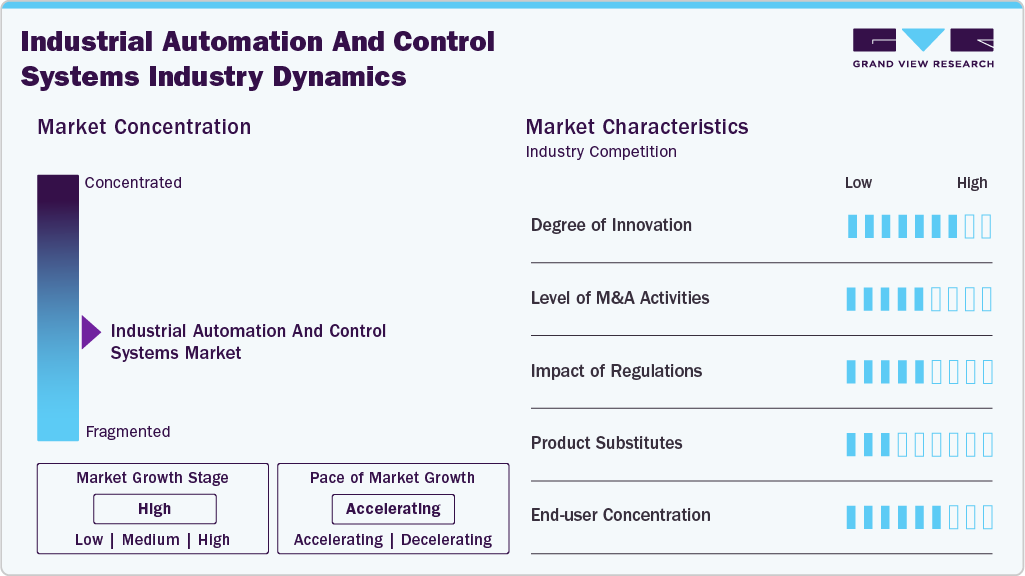
The industrial automation and control systems market is moderately concentrated, with global automation leaders, industrial software providers, robotics manufacturers, and emerging AI-driven automation technology. The market is witnessing accelerated growth driven by the rapid adoption of Industry 4.0 technologies, the increasing deployment of Industrial IoT (IIoT) platforms, and the rising demand for intelligent manufacturing systems. Strategic collaborations, industrial software partnerships, and smart factory integration initiatives are becoming increasingly common as companies aim to expand connected automation ecosystems and strengthen digital manufacturing capabilities. Continuous investments in AI-powered predictive maintenance, industrial robotics, and edge computing technologies are emerging as core competitive strategies among major market participants.
 To learn more about this report, Download Free Sample Report
 The market is characterized by a high degree of innovation, supported by rapid advancements in AI-enabled industrial analytics, autonomous robotics, and real-time industrial control technologies. The industry is witnessing moderate merger and acquisition activities as automation providers seek to expand industrial software capabilities and enhance smart manufacturing solutions. Competition from low-cost automation equipment providers and conventional semi-automated industrial systems remains moderate, particularly across price-sensitive manufacturing sectors. The growing adoption of cloud-connected industrial platforms, collaborative robots, and intelligent process optimization solutions is expected to further accelerate the expansion of the industrial automation and control systems market.
Component Insights
The control valves segment accounted for the largest market share of over 24% in 2025, driven by the rising demand for precise flow regulation, pressure optimization, and automated process control across oil & gas, chemicals, power generation, and water treatment industries. Manufacturers are increasingly deploying smart control valves integrated with Industrial IoT (IIoT), predictive maintenance platforms, and AI-enabled monitoring systems to improve operational efficiency, reduce energy losses, and enhance process reliability. The growing adoption of intelligent process automation infrastructure continues to strengthen the segment’s dominant market position.
The industrial robots segment is expected to witness the highest CAGR of over 12% from 2026 to 2033. The segment growth is driven by increasing investments in smart factories, rapid deployment of AI-powered robotic automation systems, and rising demand for autonomous manufacturing operations. Manufacturers are increasingly adopting collaborative robots, machine vision systems, and cloud-connected robotics platforms to improve production flexibility, reduce labor dependency, and accelerate high-precision manufacturing capabilities, thereby supporting strong segment expansion in the industrial automation and control systems market.
Control System Insights
The DCS segment accounted for the largest market share in 2025, driven by the increasing demand for centralized process automation, real-time operational monitoring, and high-reliability control systems. Industries are increasingly deploying AI-enabled distributed control systems integrated with Industrial IoT (IIoT), predictive maintenance platforms, and advanced process analytics to improve production efficiency and operational safety. The growing need for continuous process management and secure industrial operations continues to strengthen the segment’s dominant position in the market.
 To learn more about this report, Download Free Sample Report
 The SCADA segment is expected to witness the highest CAGR from 2026 to 2033, owing to rising demand for remote industrial monitoring, cloud-connected operational management, and intelligent infrastructure automation. Industries are increasingly adopting cloud-based SCADA platforms integrated with AI, edge computing, and Industrial IoT to improve asset visibility, reduce downtime, and enable centralized, real-time decision-making. The growing transition toward connected, data-driven industrial ecosystems is expected to accelerate the rapid expansion of the SCADA segment.
Industry Vertical Insights
The manufacturing segment accounted for the largest market share in 2025, owing to the rapid adoption of smart factory technologies, industrial robotics, and AI-enabled production automation. Manufacturers are increasingly deploying Industrial IoT (IIoT), digital twins, predictive maintenance platforms, and advanced control systems to improve operational efficiency, reduce downtime, and enhance production flexibility. The growing focus on connected manufacturing ecosystems and energy-efficient industrial operations continues to strengthen the manufacturing segment's position in the market.
The healthcare segment is expected to witness the highest CAGR from 2026 to 2033. This growth is driven by the increasing demand for intelligent pharmaceutical manufacturing systems and advanced laboratory process control technologies. Healthcare manufacturers are increasingly adopting AI-powered automation platforms, robotics, industrial sensors, and cloud-based monitoring systems to improve product quality and regulatory compliance. The rising expansion of biologics production, personalized medicine manufacturing, and smart healthcare infrastructure is expected to accelerate the strong growth of the healthcare automation segment in the market.
Regional Insights
North America Industrial Automation And Control Systems Market Trends
North America industrial automation and control systems market held a significant share of over 29% in 2025, driven by the rapid adoption of smart manufacturing technologies, increasing investments in Industrial IoT (IIoT) infrastructure, and strong deployment of AI-enabled automation systems. The region is witnessing growing demand for industrial robotics, cloud-based SCADA platforms, predictive maintenance solutions, and digital twin technologies to improve operational efficiency and production flexibility. The increasing integration of edge computing, machine learning analytics, and cybersecurity-enabled operational technology (OT) frameworks is accelerating the deployment of advanced industrial automation systems across manufacturing and critical infrastructure sectors.
U.S. Industrial Automation And Control Systems Market Trends
The U.S. industrial automation and control systems industry dominated the North America market with a share of over 80% in 2025, fueled by the strong presence of advanced manufacturing industries, rising investments in smart factories, and rapid expansion of AI-powered industrial automation technologies. The increasing adoption of collaborative robots, autonomous material handling systems, and cloud-connected industrial control platforms is enabling manufacturers to improve productivity and reduce operational downtime. In addition, growing investments in EV manufacturing facilities, semiconductor fabrication plants, and industrial cybersecurity infrastructure are accelerating demand for intelligent process automation and real-time industrial analytics solutions across the country.
Europe Industrial Automation And Control Systems Market Trends
Europe industrial automation and control systems market is expected to grow at a CAGR of over 6.9% from 2026 to 2033. The market growth is driven by stringent industrial sustainability regulations, increasing investments in energy-efficient manufacturing infrastructure, and growing adoption of Industry 4.0 technologies across automotive, pharmaceutical, and industrial equipment sectors. The region is experiencing strong demand for AI-driven process automation, industrial robotics, and advanced control systems to improve operational efficiency and reduce carbon emissions. The integration of digital twins, predictive maintenance platforms, and smart energy management systems is further strengthening industrial automation deployment across European manufacturing ecosystems.
The UK industrial automation and control systems market is expected to grow significantly in the coming years, driven by increasing investments in smart manufacturing initiatives, rising adoption of cloud-based industrial automation platforms, and a growing focus on enhancing industrial productivity. The country is increasingly deploying intelligent factory analytics and Industrial IoT-connected production infrastructure to modernize manufacturing operations. The growing emphasis on sustainable industrial operations and digital transformation strategies is boosting demand for advanced industrial control systems across the country's manufacturing and logistics industries.
The Germany industrial automation and control systems market is fueled by the country’s strong industrial manufacturing base, increasing deployment of advanced robotics systems, and growing emphasis on precision engineering. The country is witnessing increased adoption of machine vision inspection systems and smart factory technologies across the automotive, machinery, and industrial equipment manufacturing sectors. Strong government support for Industry 4.0 initiatives, industrial digitalization programs, and energy-efficient manufacturing strategies is encouraging the deployment of integrated automation and industrial control infrastructures across the market.
Asia Pacific Industrial Automation And Control Systems Market Trends
The Asia-Pacific industrial automation and control systems market is expected to grow at the highest CAGR of over 13% from 2026 to 2033, driven by rapid industrialization, expanding smart factory investments, and increasing adoption of Industrial IoT and AI-enabled manufacturing technologies. The region is experiencing strong demand for industrial robotics, programmable logic controllers (PLCs), cloud-based SCADA systems, and intelligent process automation solutions to improve production scalability and manufacturing efficiency. The growing expansion of electronics manufacturing, EV production, semiconductor fabrication, and industrial digitalization initiatives is accelerating demand for advanced industrial automation solutions across the region.
 To learn more about this report, Download Free Sample Report
 The Japan industrial automation and control systems market is gaining traction owing to the increasing adoption of advanced robotics technologies and growing investments in AI-driven factory automation systems. The country is focusing on integrating collaborative robots, intelligent motion control systems, and Industrial IoT-enabled production platforms into automotive, electronics, and semiconductor manufacturing operations. The growing emphasis on addressing labor shortages, improving operational efficiency, and enhancing high-precision industrial production is driving investments in reliable, high-performance automation and industrial control technologies in Japan.
The China industrial automation and control systems market is rapidly expanding, driven by strong government support, rising deployment of smart manufacturing technologies, and the rapid expansion of electronics and semiconductor production industries. The country is witnessing growing adoption of AI-powered industrial robotics, cloud-connected manufacturing platforms, and intelligent process control systems to improve factory productivity and reduce dependence on manual labor. The expansion of smart factory infrastructure and domestic semiconductor manufacturing capabilities is accelerating the adoption of advanced industrial automation and control technologies across China.
Key Industrial Automation And Control Systems Company Insights
Some of the key players operating in the market are Siemens AG, Schneider Electric, and ABB, among others.
-
Siemens AG is a global technology and engineering company providing a comprehensive portfolio of industrial automation and control systems, including programmable logic controllers (PLCs), distributed control systems (DCS), industrial software, digital twin platforms, and smart factory solutions. The company serves a wide range of industries such as automotive, electronics, chemicals, energy, and pharmaceuticals, making it a key player in the global industrial automation and control systems industry.
-
Schneider Electric is an energy management and industrial automation solutions provider, offering advanced control systems, industrial IoT platforms, SCADA software, and smart manufacturing technologies. The company focuses on integrating digital technologies, cloud connectivity, and AI-driven analytics to enable efficient, safe, and sustainable industrial operations. Schneider Electric caters to industries including manufacturing, utilities, oil & gas, data centers, and infrastructure, with a strong global presence and extensive partner ecosystem.
Rockwell Automation, Inc. and OMRON Corporation are some of the emerging market participants in the industrial automation and control systems market.
-
Rockwell Automation, Inc. is emerging as a strong innovator in smart manufacturing and connected industrial operations through its focus on Industrial IoT (IIoT), AI-driven analytics, cloud-based automation platforms, and digital twin technologies. The company is rapidly expanding its FactoryTalk software ecosystem, autonomous operations capabilities, and cybersecurity-enabled industrial automation solutions to support Industry 4.0 transformation. Its increasing investments in software-defined automation and intelligent production systems are strengthening its position in the markets.
-
OMRON Corporation is gaining strong momentum in the industrial automation market through its advancements in AI-enabled sensing technologies, collaborative robotics, machine vision systems, and autonomous inspection platforms. The company is increasingly focusing on flexible manufacturing, predictive maintenance, and intelligent human-machine collaboration technologies. Its growing investments in edge computing, industrial AI, and integrated automation ecosystems are positioning OMRON as a rapidly evolving player in the advanced industrial automation and control systems industry.
Key Industrial Automation And Control Systems Companies:
The following key companies have been profiled for this study on the industrial automation and control systems market.
-
ABB Ltd.
-
Emerson Electric Co.
-
Honeywell International, Inc.
-
Kawasaki Heavy Industries, Ltd.
-
Mitsubishi Electric Corporation
-
OMRON Corporation
-
Rockwell Automation, Inc.
-
Schneider Electric
-
Siemens AG
-
Yokogawa Electric Corporation
Competitive Benchmarking
Operating Strategies
Competitive Edge
Weaknesses
Mature Players: Schneider Electric, Siemens AG, Honeywell International, Inc.
- Focus on expanding AI-enabled smart factory ecosystems through industrial software and robotics partnerships.
- Invest heavily in Industrial IoT, digital twins, and cloud-connected automation infrastructure development.
- Strong global industrial presence and diversified automation portfolio support long-term market leadership.
- Advanced expertise in robotics, process automation, and AI-driven manufacturing optimization strengthens competitiveness.
- Dependence on legacy industrial systems can slow transition toward software-defined automation environments.
- Large organizational structures may limit rapid innovation and flexibility against emerging automation startups.
Emerging Players: Rockwell Automation, Inc., OMRON Corporation
- Emerging players focus on expanding AI-driven robotics, machine vision, and intelligent sensing technology capabilities.
- Invest in flexible automation platforms and cloud-connected smart manufacturing ecosystem development.
- Strong specialization in collaborative robotics and AI-enabled industrial sensing supports rapid market expansion.
- Agile innovation capabilities enable faster deployment of smart factory and automation technologies.
- Limited global industrial footprint compared to multinational automation and process control competitors.
- Lower financial resources may restrict large-scale industrial infrastructure and advanced R&D investments.
Recent Developments
-
In May 2026, Emerson Electric Co. introduced a new Industrial AI Platform (AspenTech AVA) designed to enable enterprise-scale artificial intelligence across industrial operations, integrating generative AI with domain-specific industrial models and real-time operational data. This development highlights the growing integration of AI-driven operational intelligence and predictive analytics within modern industrial automation ecosystems.
-
In April 2026, ABB Ltd. partnered with NVIDIA to develop AI-enabled autonomous industrial robots using ABB robotics software and NVIDIA Omniverse simulation technologies. The collaboration enables robots to be trained in realistic virtual factory environments before real-world deployment, thereby improving efficiency, accuracy, and scalability in industrial automation. Such strategic collaborations are expected to accelerate the adoption of AI-powered robotics and digital twin technologies across next-generation smart factories.
-
In February 2026, Schneider Electric introduced EcoStruxure Foxboro Software Defined Automation (SDA), a next-generation software-defined Distributed Control System (DCS) designed to modernize industrial automation by decoupling control software from underlying hardware. This innovation reflects the increasing industry shift toward flexible, software-defined automation architectures capable of supporting scalable, interoperable, and highly adaptive industrial operations across connected manufacturing environments.
Industrial Automation And Control Systems Market Report Scope
Report Attribute
Details
Market size in 2025
USD 226.8 billion
Estimated market size in 2026
USD 250.3 billion
Projected market size by 2033
USD 504.4 billion
Growth rate
CAGR of 10.5% from 2026 to 2033
Base year for estimation
2025
Historical data
2021 - 2024
Forecast period
2026 - 2033
Quantitative units
Revenue in USD billion and CAGR from 2026 to 2033
Report Product
Revenue forecast, company ranking, competitive landscape, growth factors, and trends
Segments covered
Component, control system, industry vertical, and region
Region scope
North America; Europe; Asia Pacific; Latin America; Middle East & Africa
Country scope
U.S.; Canada; Mexico; UK; Germany; France; China; Japan; India; South Korea; Australia; Brazil; Saudi Arabia; UAE; South Africa
Key companies profiled
ABB Ltd.; Emerson Electric Co.; Honeywell International, Inc.; Kawasaki Heavy Industries, Ltd.; Mitsubishi Electric Corporation; OMRON Corporation; Rockwell Automation, Inc.; Schneider Electric; Siemens AG; Yokogawa Electric Corporation
Customization scope
Free report customization (equivalent to up to 8 analyst’s working days) with purchase. Addition or alteration to country, regional & segment scope.
Pricing and purchase options
Avail customized purchase options to meet you exact research needs. Explore purchase options
Global Industrial Automation And Control Systems Market Report Segmentation
This report forecasts revenue growth at global, regional, and country levels and provides an analysis of the latest technological trends in each of the sub-segments from 2021 to 2033. For this study, Grand View Research has segmented the industrial automation and control systems market report based on component, control system, industry vertical, and region:
 To learn more about this report, Download Free Sample Report
 -
Component Outlook (Revenue, USD Billion, 2021 - 2033)
-
HMI
-
Industrial Robots
-
Control Valves
-
Sensors
-
Others
-
-
Control System Outlook (Revenue, USD Billion, 2021- 2033)
-
DCS
-
PLC
-
SCADA
-
Others
-
-
Industry Vertical Outlook (Revenue, USD Billion, 2021 - 2033)
-
Aerospace & Defense
-
Automotive
-
Chemical
-
Energy & Utilities
-
Food & Beverage
-
Healthcare
-
Manufacturing
-
Mining & Metal
-
Oil & Gas
-
Transportation
-
Others
-
-
Regional Outlook (Revenue, USD Billion, 2021 - 2033)
-
North America
-
U.S.
-
Canada
-
Mexico
-
-
Europe
-
UK
-
Germany
-
France
-
-
Asia Pacific
-
China
-
Japan
-
India
-
South Korea
-
Australia
-
-
Latin America
-
Brazil
-
-
Middle East and Africa (MEA)
-
Saudi Arabia
-
UAE
-
South Africa
-
-
Delivered Customizations
This report has been delivered with the following In-depth customizations
Client Objective
Custom Research Modules Delivered
Strategic Value / Business Impact
Market Entry & Expansion Assessment
- Regional demand sizing and forecasting
- Customer segmentation and buying behavior analysis
- Competitive landscape benchmarking
- Regulatory and distribution channel assessment
- Identified high-growth market opportunities Supported go-to-market strategy development
- Highlighted investment priorities and risks
- Enabled data-driven expansion planning
Customer & End-User Insights Study
- Consumer awareness and adoption analysis
- Purchase decision journey mapping
- Satisfaction and loyalty assessment
- Usage pattern and pain-point evaluation
- Revealed key adoption drivers and barriers
- Supported customer-centric product development
- Improved targeting and engagement strategy
- Identified opportunities for retention and upselling
Frequently Asked Questions About This Report
The global industrial automation and control systems market size was valued at USD 226.8 billion in 2025 and is estimated at USD 250.3 billion for 2026.
The global industrial automation and control systems market is expected to grow at a CAGR of 10.5% from 2026 to 2033, reaching USD 504.4 billion by 2033.
Asia Pacific dominated with a 38% revenue share in 2025.
Key players include ABB Ltd.; Emerson Electric Co.; Honeywell International, Inc.; Kawasaki Heavy Industries, Ltd.; Mitsubishi Electric Corporation; OMRON Corporation; Rockwell Automation, Inc.; Schneider Electric; Siemens AG; Yokogawa Electric Corporation
Key factors that are driving the market growth is driven by the rising adoption of AI-powered industrial automation platforms, the increasing demand for real-time predictive maintenance, and the growing deployment of Industrial IoT (IIoT)-enabled smart manufacturing systems.
The control valves segment led with a 24% revenue share in 2025, while the industrial robots segment is the fastest-growing.
The DCS segment held the largest revenue share in 2025, while the SCADA segment is the fastest-growing.
The manufacturing segment held the largest revenue share in 2025, while the healthcare segment is the fastest-growing.
About the Author(s)
Next Generation Technologies Research Team
Technology · Next Generation TechnologiesThis report was authored by the next generation technologies research team at Grand View Research - comprising two research analysts, one senior research analyst, and one industry expert - with specialized expertise in the next generation technologies segment of the technology industry. All findings are based on proprietary technology databases, executive interviews, and regulatory analysis, subject to internal peer review prior to publication.
Last Updated:
Speak to Analyst

Customize this report to your needs - add regions, segments, or data points, with 20% free customization.
Or view our licence options:


ISO 9001:2015 & 27001:2022 Certified
We are GDPR and CCPA compliant! Your transaction & personal information is safe and secure. For more details, please read our privacy policy.


