
- Home
- »
- Distribution & Utilities
- »
-
Industrial Batteries Market Size And Share Report, 2026-2033GVR Report cover

Industrial Batteries Market (2026 - 2033)
Size, Share & Trends Analysis Report By Type (Lead-Acid, Lithium-Based), By Application (Motive Power, Telecom & Data Communication, Uninterruptible Power Supply/Backup, Grid-Level Energy Storage), By Region, And Segment Forecasts
Market Size, 2025
$23.9BMarket Estimate, 2026
$25.6BMarket Forecast, 2033
$44.9BCAGR, 2026–2033
8.4%Industrial Batteries Market Summary
The global industrial batteries market size was valued at USD 23.9 billion in 2025 and is projected to grow from USD 25.6 billion in 2026 to USD 44.9 billion by 2033, growing at a CAGR of 8.4% from 2026 to 2033. Asia Pacific dominated the industrial batteries industry with the largest share of 35.9% in 2025. The market is growing due to rising demand for reliable power storage in industrial applications.
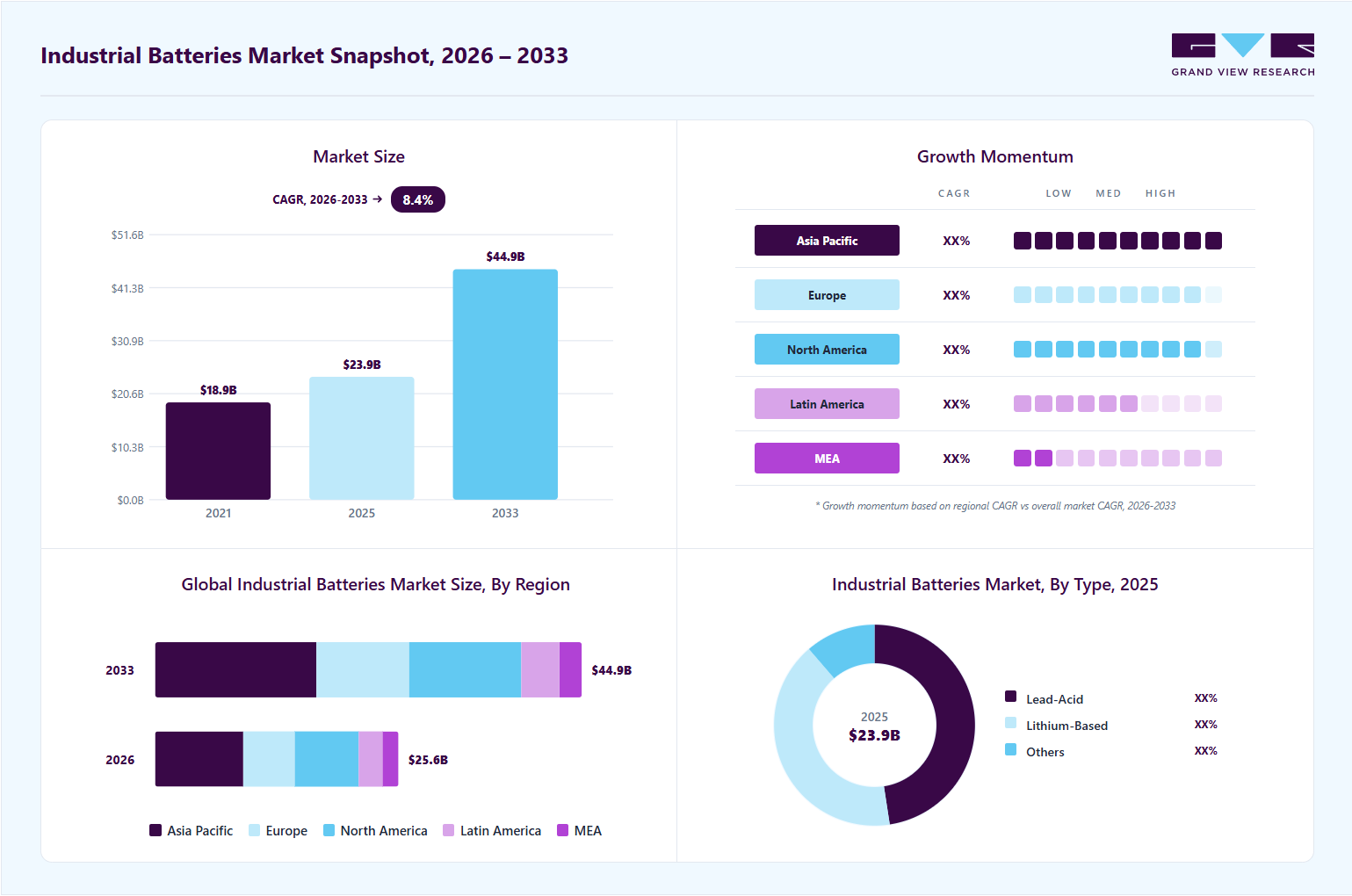 Source: Grand View Research, IR Documents, Primary Interviews, Paid DatabasesTo learn more about this report,
 Download Free Sample Report
Key Market Trends & Insights
- By application: Motive power segment held the largest revenue share of 32.5% in 2025.
- By type: Lead acid batteries accounted for the largest revenue share of 47.6% in 2025.
Regional Highlights
- Largest regional market: Asia Pacific (35.9% revenue share, 2025)
- By country: The China held the largest market share in 2025.
Market Size & Forecast
- Market size in 2025: USD 23.9 Billion
- Estimated market size in 2026: USD 25.6 Billion
- Projected market size by 2033: USD 44.9 Billion
- CAGR (2026-2033): 8.4%
Three ways to get this report
Buy it, customize it, or ask a question.Ask an Analyst
Analyst response in 1 business day
- AccessReport author, directly
- Reply timeWithin 1 working day
- No sales callDirect answer only
- FormatEmail reply
- CostFree, no cost
Get the Full Report
What the study covers
- FormatsPDF · Excel · Dashboard
- Timeline2026–2033 annual, 2025 base
- Coverage20+ countries, 5 regions
- Companies10+ key players profiled
Customize the Report
20% free customization
- IncludeCountries, segments, points
- TailorTo your product definition
- ExtendDeeper competitor detail
- OrA fully bespoke study
- Turnaround5–10 working days
More industries are adopting renewable energy, which is increasing the need for efficient energy storage solutions. There is also a growing requirement for backup and uninterrupted power supply in industrial facilities. Supportive government policies focused on clean energy transition are encouraging market growth. The market is experiencing strong growth as industries increasingly prioritize reliable, efficient, and low-carbon energy systems. The rising electrification of industrial operations and the expansion of renewable energy generation are increasing the need for advanced battery storage solutions. Organizations are focusing on improving power reliability and reducing operational disruptions, which further supports demand for industrial battery systems.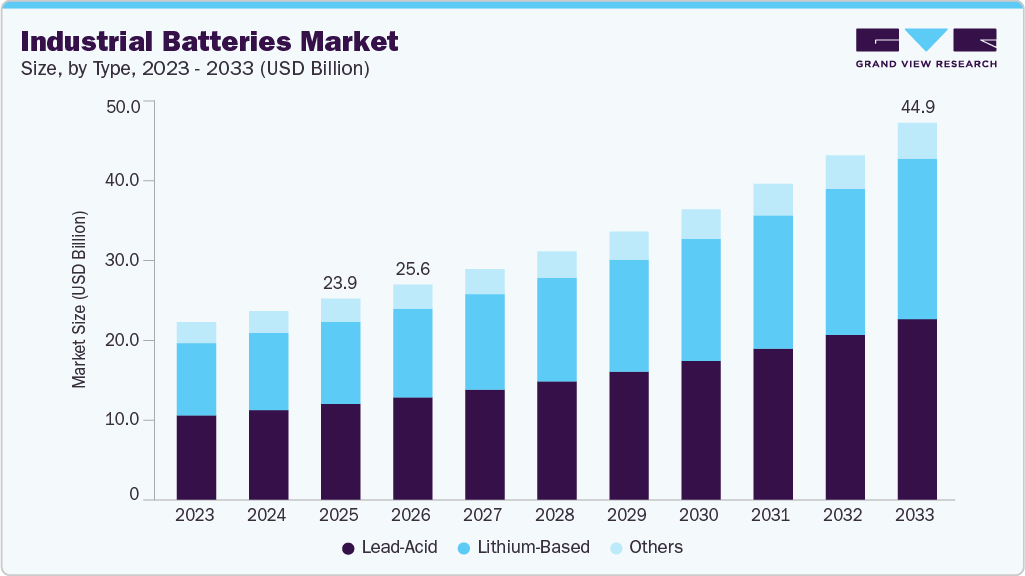 To learn more about this report, Download Free Sample Report
Governments across major economies are also strengthening support for energy storage development. For instance, in 2025, the IEA highlighted that countries are introducing policies and financial incentives to accelerate battery manufacturing and deployment as part of broader clean energy transition strategies and supply chain diversification efforts. Falling battery costs, improved lithium-ion and LFP technologies, and rapid expansion of grid-scale and industrial storage projects are making industrial batteries more accessible and widely deployed across manufacturing, utilities, and commercial sectors.
Market Dynamics
The telecom and data center sector is a key driver of the industrial batteries market, as it relies heavily on an uninterrupted power supply. Telecom networks and digital infrastructure require continuous backup power to ensure smooth operations during grid failures or voltage fluctuations. Batteries, especially in UPS systems, play a critical role in maintaining network uptime and protecting sensitive equipment from power disruptions. The expansion of digital infrastructure and the growing demand for renewable-linked storage are driving the demand for large-scale battery systems.
According to the Government of India’s Ministry of Power, energy storage systems, including battery energy storage, are being actively promoted to ensure grid stability and a reliable power supply, particularly as renewable energy penetration increases and demand from critical infrastructure such as telecom and data centers rises. Similarly, global official energy analysis highlights that battery-based UPS systems used in data centers are growing rapidly as digital workloads and cloud services expand, making them an essential part of modern power infrastructure.
The industrial batteries industry faces a major restraint due to raw material price volatility and supply chain instability. Critical inputs such as lithium, cobalt, nickel, and graphite are highly exposed to supply concentration and geopolitical risks, which lead to frequent price fluctuations and cost uncertainty for manufacturers. This directly strains profit margins and complicates long-term procurement planning, especially for battery producers dependent on imported raw materials.
According to the IEA, Global Critical Minerals Outlook 2025, lithium demand increased by nearly 30% in 2024 alone, while nickel, cobalt, and graphite demand grew by 6-8%, driven by rapid expansion in clean energy technologies. However, the report also highlights that supply growth and market concentration issues continue to create price instability, with recycling currently able to offset only about 20% of lithium demand and 40%+ of nickel and cobalt recovery potential in limited cases, indicating persistent dependence on mined supply and reinforcing ongoing cost volatility risks in the battery value chain.
Type Insights
The lead-acid segment dominated the industrial batteries market, accounting for the largest revenue share of 47.6% in 2025, primarily due to its low cost, wide availability, and proven reliability in backup power applications. It is extensively used in industries such as telecom, data centers, utilities, and manufacturing for uninterruptible power supply (UPS) systems and emergency power backup. Its established recycling infrastructure and ease of maintenance further support its continued dominance in cost-sensitive and short-duration energy storage applications.
The lithium-based segment is expected to grow at the fastest CAGR of 8.8% from 2026 to 2033. This growth is driven by rising demand for high-energy-density batteries. Lithium batteries offer longer life and better efficiency. They are increasingly used in industrial energy storage systems. Their adoption is also growing in renewable energy projects and data centers. Falling lithium battery costs are also supporting market growth. Their faster charging capability is making them more suitable for modern industrial applications.
Application Insights
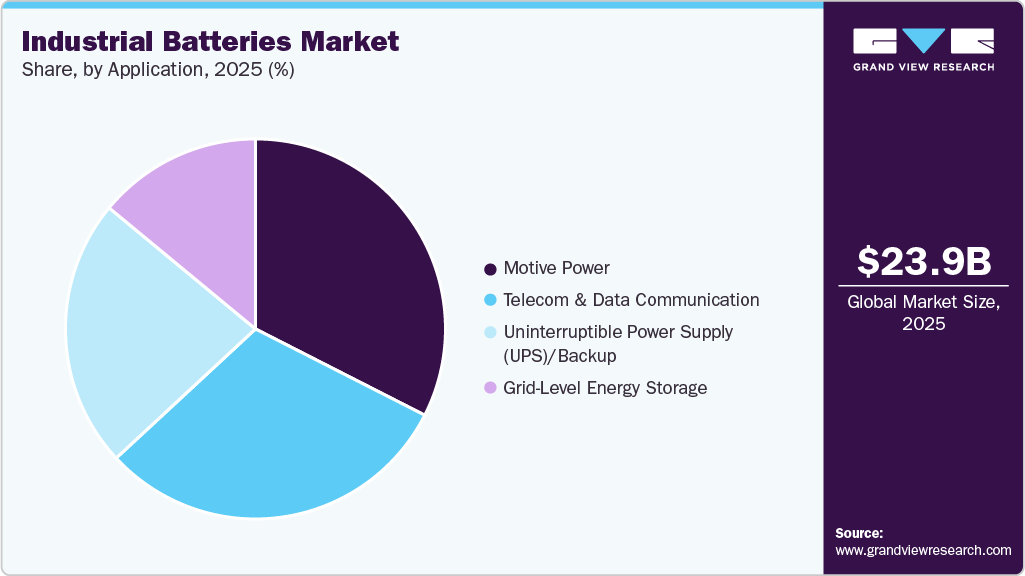
The motive power segment dominated the industrial batteries industry, accounting for the largest revenue share of 32.5% in 2025. The rapid growth of e-commerce and warehouse automation drives this segment. The expansion of logistics and distribution networks has increased the use of electric material-handling equipment, especially forklifts. These operations require reliable and long-lasting batteries for continuous usage. The growing focus on efficiency, reduced operational downtime, and the increasing shift toward electric forklifts are also supporting demand for motive power batteries.
 To learn more about this report, Download Free Sample Report
The telecom & data communication segment is projected to grow at the second-fastest CAGR of 8.7% over the forecast period, driven by the rapid expansion of telecom networks, data communication systems, and cloud computing infrastructure. The rising adoption of AI computing, edge computing, and 5G/6G technologies is driving overall power demand. These facilities require continuous and reliable backup power to avoid downtime. Industrial batteries are widely used in telecom towers and data centers to ensure uninterrupted operations. This is pushing companies to invest in advanced battery backup systems.
Regional Insights
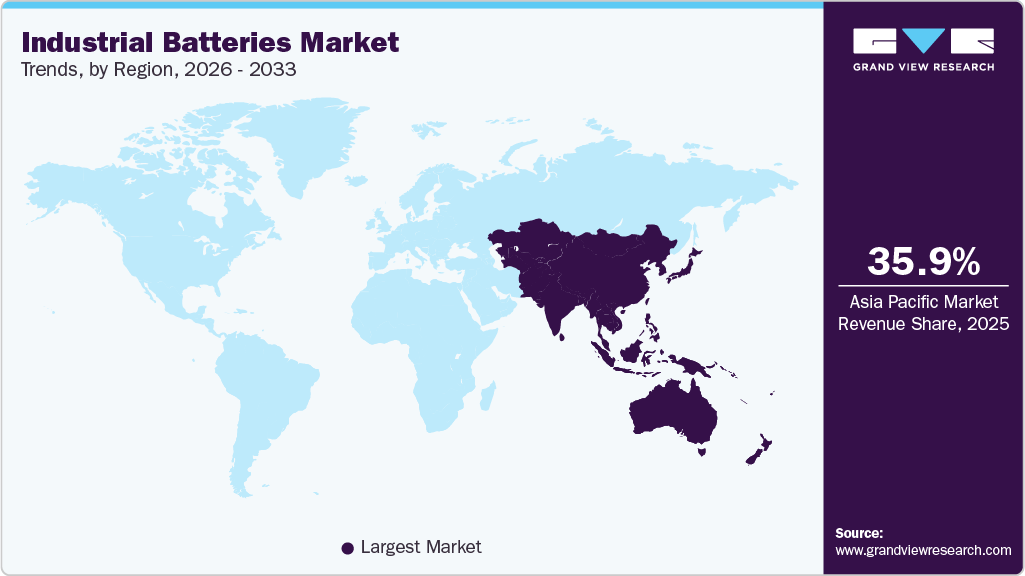
Asia Pacific dominated the industrial batteries market, accounting for the largest revenue share of 35.9% in 2025, driven by rapid industrialization and increasing demand for reliable power backup across the manufacturing, telecom, and data center sectors. The region’s strong push toward electrification and digital infrastructure is further accelerating battery adoption across industries. According to the IEA Global Energy Review 2026, China led global battery deployment in 2025, accounting for around 60% of total additions, while global battery-based UPS capacity additions rose by 30% to 45 GW, driven mainly by data center expansion. India and Australia are scaling large energy storage targets, reinforcing Asia Pacific’s dominance in industrial battery deployment across grid and commercial applications.
 To learn more about this report, Download Free Sample Report
China Industrial Batteries Market Trends
China’s industrial batteries market is being shaped by rapid growth in Battery Energy Storage Systems (BESS). These systems are being deployed to support renewable energy integration and improve grid stability. A strong government focus on clean energy transition is further boosting adoption across industrial sectors. According to the International Energy Agency (IEA), China led global battery deployment in 2025 and is expected to remain the largest market for energy storage. The country’s BESS installations are projected to exceed 300 GWh by 2030, driven by expanding solar and wind capacity and rising demand for reliable power management.
Europe Industrial Batteries Market Trends
The Europe region’s industrial batteries industry is expected to grow at the second-fastest CAGR of 8.7%, driven by strong growth in large-scale energy storage deployment and supportive policy frameworks aimed at strengthening energy security and decarbonization. According to the European Parliament Research Service and Solar Power Europe, the EU installed 27.1 GWh of new battery storage capacity in 2025, with 55% coming from utility-scale systems, reflecting strong industrial demand. The EU’s target of 550 GWh battery manufacturing capacity by 2030 under the Net-Zero Industry Act is further accelerating investments and expansion in the industrial batteries value chain.
North America Industrial Batteries Market Trends
The North America industrial batteries industry is being driven by supply chain localization and strong efforts to expand domestic manufacturing capabilities, as governments and companies focus on reducing import dependence and strengthening energy security. This has led to significant investments in battery production infrastructure and industrial capacity expansion across the region. According to the CSIS, total US battery production increased by nearly 140% between 2020 and 2025, with over 180 new primary component facilities commissioned across 38 states since 2019. Battery Council International’s 2025 report highlights strong end-use demand growth, including a 20.8% rise in UPS applications and 25% growth in lithium motive batteries in 2025, reflecting the increasing role of industrial batteries in backup power and material handling systems.
The U.S. industrial batteries industry is driven by the rapid expansion of renewable energy integration, increasing demand for reliable backup power, and strong growth in industrial automation and electrification. Rising adoption of battery energy storage systems to support grid stability and manage peak electricity demand is further boosting market growth. The expansion of data centers, telecom infrastructure, and e-commerce-driven warehouse operations is increasing the need for uninterrupted power supply systems. Supportive government policies promoting domestic battery manufacturing and energy independence are also strengthening market development across the country.
Latin America Industrial Batteries Market Trends
The industrial batteries industry in Latin America is driven by increasing demand for reliable power supply, frequent grid instability, and growing investment in renewable energy projects across the region. Expanding mining, oil & gas, and industrial sectors are also boosting the need for backup and off-grid power solutions. The rising adoption of solar and wind energy systems in countries such as Brazil and Chile is increasing the need for battery energy storage systems to ensure a consistent electricity supply. Government initiatives focused on energy diversification and rural electrification are further supporting market growth.
Middle East & Africa Industrial Batteries Market Trends
The Middle East & Africa industrial batteries industry is supported by increasing electrification efforts and strong government initiatives focused on decarbonization and energy diversification. The growing adoption of EVs and the expansion of charging infrastructure are further boosting demand for industrial batteries across the region. Rising investment in renewable energy projects such as solar and wind, especially in Gulf countries and parts of Africa, is increasing the need for energy storage systems to ensure grid stability. Expanding industrialization, telecom network growth, and demand for reliable backup power in areas with unstable grids are also supporting market expansion.
Key Industrial Batteries Company Insights
Some of the key players operating in the global industrial batteries market include EnerSys and EXIDE INDUSTRIES LTD., among others.
-
EnerSys is a leading participant in the industrial batteries industry, known for its strong portfolio of reserve power, motive power, and energy storage solutions. The company focuses on providing advanced battery systems for applications such as telecom, data centers, utilities, and industrial operations. Its offerings include lead-acid and lithium-ion technologies designed for backup power, material handling equipment, and grid-support applications. EnerSys emphasizes innovation in energy storage efficiency, longer battery life, and integrated power management solutions. The company also supports the transition toward cleaner energy systems through its growing focus on lithium-based technologies and hybrid energy storage solutions.
-
Exide Industries is a major player in the industrial batteries market, recognized for its extensive manufacturing capabilities and strong presence in lead-acid battery technologies. The company serves a wide range of sectors, including automotive, telecom, railways, power utilities, and industrial backup systems. Exide Industries focuses on delivering cost-effective and reliable energy storage solutions for uninterrupted power supply and motive power applications. Its strategy emphasizes expanding production capacity, improving energy efficiency, and strengthening its presence in industrial and grid-scale storage markets. The company is also gradually expanding into advanced battery technologies, including lithium-ion systems, to align with evolving energy transition trends.
Key Industrial Batteries Companies
The following key companies have been profiled for this study on the industrial batteries market.
-
Robert Bosch GmbH
Competitive Benchmarking
Operating Strategies
Competitive Edge
Weaknesses
Mature Players: C&D Technologies, Inc.; East Penn Manufacturing Company; EnerSys; EXIDE INDUSTRIES LTD.; GS Yuasa International Ltd.; Robert Bosch GmbH; Schneider Electric; TotalEnergies
- Mature companies focus on expanding production capacity, strengthening global distribution networks, and maintaining long-term contracts with telecom, utility, data center, and industrial customers.
- They also invest in improving battery efficiency, recycling infrastructure, and gradual transition toward lithium-ion and advanced storage technologies.
- Strong brand recognition, large installed customer base, established supply chains, broad product portfolios, and extensive service networks provide mature players with high market stability and customer trust.
- Their financial strength also supports large-scale manufacturing and R&D investments.
- Many mature players still rely heavily on traditional lead-acid technologies, which may limit growth potential in advanced energy storage segments.
- High operational costs, slower innovation cycles, and exposure to raw material price volatility can also affect competitiveness against newer lithium-focused companies.
Emerging Players: DuPont; EVE Energy Co., Ltd.
- Emerging companies focus on rapid expansion in lithium-ion manufacturing, advanced battery chemistries, and energy storage innovations.
- They emphasize strategic partnerships, technology development, and expansion into fast-growing sectors such as EV infrastructure, renewable energy storage, and smart grid applications.
- A strong focus on innovation, advanced lithium-based technologies, faster adoption of new manufacturing processes, and flexibility in targeting high-growth markets provides emerging players with significant growth opportunities.
- Many also benefit from government incentives supporting local battery manufacturing.
- Emerging players often face challenges related to limited global presence, smaller distribution networks, high capital investment requirements, and dependence on external raw material supply chains.
- They may also experience profitability pressure due to intense competition and rapidly changing technology standards.
Recent Developments
-
In October 2025, Schneider Electric launched Schneider Boost Pro, a scalable battery energy storage solution for commercial and industrial facilities. The system is designed to support peak demand management, improve energy efficiency, and strengthen business continuity through advanced energy management capabilities. The launch is expected to help organizations optimize electricity consumption and support decarbonization initiatives across industrial operations.
Industrial Batteries Market Report Scope
Report Attribute
Details
Market Definition
The global industrial batteries market size represents the revenue generated from the sale of industrial battery systems used for energy storage, backup power, and motive power applications across multiple industries.
Market size in 2025
USD 23.9 billion
Estimated Market size in 2026
USD 25.6 billion
Projected Market size by 2033
USD 44.9 billion
Growth rate
CAGR of 8.4% from 2026 to 2033
Base year for estimation
2025
Historical data
2021 - 2024
Forecast period
2026 - 2033
Quantitative Units
Revenue in USD million/billion, and CAGR from 2026 to 2033
Report coverage
Revenue forecast, competitive landscape, growth factors, and trends
Segments covered
Type, application, and region
Regional scope
North America; Europe; Asia Pacific; Latin America; Middle East & Africa
Country scope
U.S.; Canada; Mexico; Germany; UK; France; Russia; China; India; Japan; South Korea; Brazil; Argentina; Saudi Arabia; UAE
Key companies profiled
C&D Technologies, Inc.; DuPont; East Penn Manufacturing Company; EnerSys; EVE Energy Co., Ltd.; EXIDE INDUSTRIES LTD.; GS Yuasa International Ltd.; Robert Bosch GmbH; Schneider Electric; TotalEnergies
Customization scope
Free report customization (equivalent up to 8 analysts working days) with purchase. Addition or alteration to country, regional & segment scope.
Pricing and purchase options
Avail customized purchase options to meet your exact research needs. Explore purchase options
Global Industrial Batteries Market Report - Table of Contents
Chapter 1. Methodology and Scope
1.1. Market Segmentation & Scope
1.2. Market Definition
1.3. Information Procurement
1.3.1. Information Analysis
1.3.2. Market Formulation & Data Visualization
1.3.3. Data Validation & Publishing
1.4. Research Scope and Assumptions
1.4.1. List of Data Sources
Chapter 2. Executive Summary
2.1. Market Snapshot
2.2. Segmental Outlook
2.3. Competitive Outlook
Chapter 3. Market Variables, Trends, and Scope
3.1. Global Industrial Batteries Market Outlook
3.2. Value Chain Analysis
3.3. Regulatory Framework
3.3.1. Standards & Compliance
3.3.2. Regulatory Impact Analysis
3.4. Market Dynamics
3.4.1. Market Driver Analysis
3.4.2. Market Restraint Analysis
3.4.3. Industry Trends
3.5. Porter’s Five Forces Analysis
3.5.1. Bargaining Power of Suppliers
3.5.2. Bargaining Power of Buyers
3.5.3. Threat of Substitution
3.5.4. Threat of New Entrants
3.5.5. Competitive Rivalry
3.6. PESTLE Analysis
3.6.1. Political
3.6.2. Economic
3.6.3. Social Landscape
3.6.4. Technological
3.6.5. Environmental
3.6.6. Legal
Chapter 4. Industrial Batteries Market: Type Estimates & Trend Analysis
4.1. Industrial Batteries Market: Type Movement Analysis, 2025 & 2033
4.2. Lead-Acid
4.2.1. Market estimates and forecasts, 2021 - 2033 (USD Million/Billion)
4.3. Lithium-Based
4.3.1. Market estimates and forecasts, 2021 - 2033 (USD Million/Billion)
4.4. Other Types
4.4.1. Market estimates and forecasts, 2021 - 2033 (USD Million/Billion)
Chapter 5. Industrial Batteries Market: Application Estimates & Trend Analysis
5.1. Industrial Batteries Market: Application Movement Analysis, 2025 & 2033
5.2. Motive Power
5.2.1. Market estimates and forecasts, 2021 - 2033 (USD Million/Billion)
5.3. Telecom & Data Communication
5.3.1. Market estimates and forecasts, 2021 - 2033 (USD Million/Billion)
5.4. Uninterruptible Power Supply (UPS)/Backup
5.4.1. Market estimates and forecasts, 2021 - 2033 (USD Million/Billion)
5.5. Grid-Level Energy Storage
5.5.1. Market estimates and forecasts, 2021 - 2033 (USD Million/Billion)
Chapter 6. Industrial Batteries Market: Regional Estimates & Trend Analysis
6.1. Regional Analysis, 2025 & 2033
6.2. North America
6.2.1. Market estimates and forecasts, 2021 - 2033 (USD Million/Billion)
6.2.2. Market estimates and forecasts, by type, 2021 - 2033 (USD Million/Billion)
6.2.3. Market estimates and forecasts, by application, 2021 - 2033 (USD Million/Billion)
6.2.4. U.S.
6.2.4.1. Market estimates and forecasts, 2021 - 2033 (USD Million/Billion)
6.2.4.2. Market estimates and forecasts, by type, 2021 - 2033 (USD Million/Billion)
6.2.4.3. Market estimates and forecasts, by application, 2021 - 2033 (USD Million/Billion)
6.2.5. Canada
6.2.5.1. Market estimates and forecasts, 2021 - 2033 (USD Million/Billion)
6.2.5.2. Market estimates and forecasts, by type, 2021 - 2033 (USD Million/Billion)
6.2.5.3. Market estimates and forecasts, by application, 2021 - 2033 (USD Million/Billion)
6.2.6. Mexico
6.2.6.1. Market estimates and forecasts, 2021 - 2033 (USD Million/Billion)
6.2.6.2. Market estimates and forecasts, by type, 2021 - 2033 (USD Million/Billion)
6.2.6.3. Market estimates and forecasts, by application, 2021 - 2033 (USD Million/Billion)
6.3. Europe
6.3.1. Market estimates and forecasts, 2021 - 2033 (USD Million/Billion)
6.3.2. Market estimates and forecasts, by type, 2021 - 2033 (USD Million/Billion)
6.3.3. Market estimates and forecasts, by application, 2021 - 2033 (USD Million/Billion)
6.3.4. Germany
6.3.4.1. Market estimates and forecasts, 2021 - 2033 (USD Million/Billion)
6.3.4.2. Market estimates and forecasts, by type, 2021 - 2033 (USD Million/Billion)
6.3.4.3. Market estimates and forecasts, by application, 2021 - 2033 (USD Million/Billion)
6.3.5. UK
6.3.5.1. Market estimates and forecasts, 2021 - 2033 (USD Million/Billion)
6.3.5.2. Market estimates and forecasts, by type, 2021 - 2033 (USD Million/Billion)
6.3.5.3. Market estimates and forecasts, by application, 2021 - 2033 (USD Million/Billion)
6.3.6. France
6.3.6.1. Market estimates and forecasts, 2021 - 2033 (USD Million/Billion)
6.3.6.2. Market estimates and forecasts, by type, 2021 - 2033 (USD Million/Billion)
6.3.6.3. Market estimates and forecasts, by application, 2021 - 2033 (USD Million/Billion)
6.3.7. Russia
6.3.7.1. Market estimates and forecasts, 2021 - 2033 (USD Million/Billion)
6.3.7.2. Market estimates and forecasts, by type, 2021 - 2033 (USD Million/Billion)
6.3.7.3. Market estimates and forecasts, by application, 2021 - 2033 (USD Million/Billion)
6.4. Asia Pacific
6.4.1. Market estimates and forecasts, 2021 - 2033 (USD Million/Billion)
6.4.2. Market estimates and forecasts, by type, 2021 - 2033 (USD Million/Billion)
6.4.3. Market estimates and forecasts, by application, 2021 - 2033 (USD Million/Billion)
6.4.4. China
6.4.4.1. Market estimates and forecasts, 2021 - 2033 (USD Million/Billion)
6.4.4.2. Market estimates and forecasts, by type, 2021 - 2033 (USD Million/Billion)
6.4.4.3. Market estimates and forecasts, by application, 2021 - 2033 (USD Million/Billion)
6.4.5. India
6.4.5.1. Market estimates and forecasts, 2021 - 2033 (USD Million/Billion)
6.4.5.2. Market estimates and forecasts, by type, 2021 - 2033 (USD Million/Billion)
6.4.5.3. Market estimates and forecasts, by application, 2021 - 2033 (USD Million/Billion)
6.4.6. Japan
6.4.6.1. Market estimates and forecasts, 2021 - 2033 (USD Million/Billion)
6.4.6.2. Market estimates and forecasts, by type, 2021 - 2033 (USD Million/Billion)
6.4.6.3. Market estimates and forecasts, by application, 2021 - 2033 (USD Million/Billion)
6.4.7. South Korea
6.4.7.1. Market estimates and forecasts, 2021 - 2033 (USD Million/Billion)
6.4.7.2. Market estimates and forecasts, by type, 2021 - 2033 (USD Million/Billion)
6.4.7.3. Market estimates and forecasts, by application, 2021 - 2033 (USD Million/Billion)
6.5. Latin America
6.5.1. Market estimates and forecasts, 2021 - 2033 (USD Million/Billion)
6.5.2. Market estimates and forecasts, by type, 2021 - 2033 (USD Million/Billion)
6.5.3. Market estimates and forecasts, by application, 2021 - 2033 (USD Million/Billion)
6.5.4. Brazil
6.5.4.1. Market estimates and forecasts, 2021 - 2033 (USD Million/Billion)
6.5.4.2. Market estimates and forecasts, by type, 2021 - 2033 (USD Million/Billion)
6.5.4.3. Market estimates and forecasts, by application, 2021 - 2033 (USD Million/Billion)
6.5.5. Argentina
6.5.5.1. Market estimates and forecasts, 2021 - 2033 (USD Million/Billion)
6.5.5.2. Market estimates and forecasts, by type, 2021 - 2033 (USD Million/Billion)
6.5.5.3. Market estimates and forecasts, by application, 2021 - 2033 (USD Million/Billion)
6.6. Middle East & Africa
6.6.1. Market estimates and forecasts, 2021 - 2033 (USD Million/Billion)
6.6.2. Market estimates and forecasts, by type, 2021 - 2033 (USD Million/Billion)
6.6.3. Market estimates and forecasts, by application, 2021 - 2033 (USD Million/Billion)
6.6.4. Saudi Arabia
6.6.4.1. Market estimates and forecasts, 2021 - 2033 (USD Million/Billion)
6.6.4.2. Market estimates and forecasts, by type, 2021 - 2033 (USD Million/Billion)
6.6.4.3. Market estimates and forecasts, by application, 2021 - 2033 (USD Million/Billion)
6.6.5. UAE
6.6.5.1. Market estimates and forecasts, 2021 - 2033 (USD Million/Billion)
6.6.5.2. Market estimates and forecasts, by type, 2021 - 2033 (USD Million/Billion)
6.6.5.3. Market estimates and forecasts, by application, 2021 - 2033 (USD Million/Billion)
Chapter 7. Competitive Landscape
7.1. Recent Developments By Key Market Participants
7.2. Kraljic Matrix
7.3. Company Categorization
7.4. Company Market Share & Positioning Analysis, 2025
7.5. Heat Map Analysis
7.6. Vendor Landscape
7.6.1. List of Raw Material Suppliers
7.6.2. List of Key Technology Suppliers & Channel Partners
7.6.3. List of Other Prominent Service Providers
7.7. List of Prospective Manufacturers
7.8. Strategy Mapping
7.9. Company Profiles/Listing
7.9.1. C&D Technologies, Inc.
7.9.1.1. Company Overview
7.9.1.2. Financial Performance
7.9.1.3. Product Benchmarking
7.9.2. DuPont
7.9.2.1. Company Overview
7.9.2.2. Financial Performance
7.9.2.3. Product Benchmarking
7.9.3. East Penn Manufacturing Company
7.9.3.1. Company Overview
7.9.3.2. Financial Performance
7.9.3.3. Product Benchmarking
7.9.4. EnerSys
7.9.4.1. Company Overview
7.9.4.2. Financial Performance
7.9.4.3. Product Benchmarking
7.9.5. EVE Energy Co., Ltd.
7.9.5.1. Company Overview
7.9.5.2. Financial Performance
7.9.5.3. Product Benchmarking
7.9.6. EXIDE INDUSTRIES LTD.
7.9.6.1. Company Overview
7.9.6.2. Financial Performance
7.9.6.3. Product Benchmarking
7.9.7. GS Yuasa International Ltd.
7.9.7.1. Company Overview
7.9.7.2. Financial Performance
7.9.7.3. Product Benchmarking
7.9.8. Robert Bosch GmbH
7.9.8.1. Company Overview
7.9.8.2. Financial Performance
7.9.8.3. Product Benchmarking
7.9.9. TotalEnergies
7.9.9.1. Company Overview
7.9.9.2. Financial Performance
7.9.9.3. Product Benchmarking
7.9.10. Schneider Electric
7.9.10.1. Company Overview
7.9.10.2. Financial Performance
7.9.10.3. Product BenchmarkingList of Tables
Table 1 Industrial batteries market estimates & forecasts, 2021 - 2033 (USD Million/Billion)
Table 2 Industrial batteries market estimates & forecasts, by lead-acid, 2021 - 2033 (USD Million/Billion)
Table 3 Industrial batteries market estimates & forecasts, by lithium-based, 2021 - 2033 (USD Million/Billion)
Table 4 Industrial batteries market estimates & forecasts, by other types, 2021 - 2033 (USD Million/Billion)
Table 5 Industrial batteries market estimates & forecasts, in motive power, 2021 - 2033 (USD Million/Billion)
Table 6 Industrial batteries market estimates & forecasts, in telecom & data communication, 2021 - 2033 (USD Million/Billion)
Table 7 Industrial batteries market estimates & forecasts, in Uninterruptible Power Supply (UPS)/ backup, 2021 - 2033 (USD Million/Billion)
Table 8 Industrial batteries market estimates & forecasts, in grid-level energy storage, 2021 - 2033 (USD Million/Billion)
Table 9 North America Industrial batteries market estimates & forecast, 2021 - 2033 (USD Million/Billion)
Table 10 North America Industrial batteries market estimates & forecasts by type, 2021 - 2033 (USD Million/Billion)
Table 11 North America Industrial batteries market estimates & forecasts by application, 2021 - 2033 (USD Million/Billion)
Table 12 U.S. Industrial batteries market estimates & forecasts, 2021 - 2033 (USD Million/Billion)
Table 13 U.S. Industrial batteries market estimates & forecasts by type, 2021 - 2033 (USD Million/Billion)
Table 14 U.S. Industrial batteries market estimates & forecasts by application, 2021 - 2033 (USD Million/Billion)
Table 15 Canada Industrial batteries market estimates & forecasts, 2021 - 2033 (USD Million/Billion)
Table 16 Canada Industrial batteries market estimates & forecasts by type, 2021 - 2033 (USD Million/Billion)
Table 17 Canada Industrial batteries market estimates & forecasts by application, 2021 - 2033 (USD Million/Billion)
Table 18 Mexico Industrial batteries market estimates & forecasts, 2021 - 2033 (USD Million/Billion)
Table 19 Mexico Industrial batteries market estimates & forecasts by type, 2021 - 2033 (USD Million/Billion)
Table 20 Mexico Industrial batteries market estimates & forecasts by application, 2021 - 2033 (USD Million/Billion)
Table 21 Europe Industrial batteries market estimates & forecasts, 2021 - 2033 (USD Million/Billion)
Table 22 Europe Industrial batteries market estimates & forecasts by type, 2021 - 2033 (USD Million/Billion)
Table 23 Europe Industrial batteries market estimates & forecasts by application, 2021 - 2033 (USD Million/Billion)
Table 24 Germany Industrial batteries market estimates & forecasts, 2021 - 2033 (USD Million/Billion)
Table 25 Germany Industrial batteries market estimates & forecasts by type, 2021 - 2033 (USD Million/Billion)
Table 26 Germany Industrial batteries market estimates & forecasts by application, 2021 - 2033 (USD Million/Billion)
Table 27 France Industrial batteries market estimates & forecasts, 2021 - 2033 (USD Million/Billion)
Table 28 France Industrial batteries market estimates & forecasts by type, 2021 - 2033 (USD Million/Billion)
Table 29 France Industrial batteries market estimates & forecasts by application, 2021 - 2033 (USD Million/Billion)
Table 30 UK Industrial batteries market estimates & forecast, 2021 - 2033 (USD Million/Billion)
Table 31 UK Industrial batteries market estimates & forecasts by type, 2021 - 2033 (USD Million/Billion)
Table 32 UK Industrial batteries market estimates & forecasts by application, 2021 - 2033 (USD Million/Billion)
Table 33 Russia Industrial batteries market estimates & forecast, 2021 - 2033 (USD Million/Billion)
Table 34 Russia Industrial batteries market estimates & forecasts by type, 2021 - 2033 (USD Million/Billion)
Table 35 Russia Industrial batteries market estimates & forecasts by application, 2021 - 2033 (USD Million/Billion)
Table 36 Asia Pacific Industrial batteries market estimates & forecast, 2021 - 2033 (USD Million/Billion)
Table 37 Asia Pacific Industrial batteries market estimates & forecasts by type, 2021 - 2033 (USD Million/Billion)
Table 38 Asia Pacific Industrial batteries market estimates & forecasts by application, 2021 - 2033 (USD Million/Billion)
Table 39 China Industrial batteries market estimates & forecast, 2021 - 2033 (USD Million/Billion)
Table 40 China Industrial batteries market estimates & forecasts by type, 2021 - 2033 (USD Million/Billion)
Table 41 China Industrial batteries market estimates & forecasts by application, 2021 - 2033 (USD Million/Billion)
Table 42 India Industrial batteries market estimates & forecast, 2021 - 2033 (USD Million/Billion)
Table 43 India Industrial batteries market estimates & forecasts by type, 2021 - 2033 (USD Million/Billion)
Table 44 India Industrial batteries market estimates & forecasts by application, 2021 - 2033 (USD Million/Billion)
Table 45 Japan Industrial batteries market estimates & forecast, 2021 - 2033 (USD Million/Billion)
Table 46 Japan Industrial batteries market estimates & forecasts by type, 2021 - 2033 (USD Million/Billion)
Table 47 Japan Industrial batteries market estimates & forecasts by application, 2021 - 2033 (USD Million/Billion)
Table 48 South Korea Industrial batteries market estimates & forecast, 2021 - 2033 (USD Million/Billion)
Table 49 South Korea Industrial batteries market estimates & forecasts by type, 2021 - 2033 (USD Million/Billion)
Table 50 South Korea Industrial batteries market estimates & forecasts by application, 2021 - 2033 (USD Million/Billion)
Table 51 Latin America Industrial batteries market Estimates & forecasts, 2021 - 2033 (USD Million/Billion)
Table 52 Latin America Industrial batteries market estimates & forecasts by type, 2021 - 2033 (USD Million/Billion)
Table 53 Latin America Industrial batteries market estimates & forecasts by application, 2021 - 2033 (USD Million/Billion)
Table 54 Brazil Industrial batteries market estimates & forecasts, 2021 - 2033 (USD Million/Billion)
Table 55 Brazil Industrial batteries market estimates & forecasts by type, 2021 - 2033 (USD Million/Billion)
Table 56 Brazil Industrial batteries market estimates & forecasts by application, 2021 - 2033 (USD Million/Billion)
Table 57 Argentina Industrial batteries market estimates & forecasts, 2021 - 2033 (USD Million/Billion)
Table 58 Argentina Industrial batteries market estimates & forecasts by type, 2021 - 2033 (USD Million/Billion)
Table 59 Argentina Industrial batteries market estimates & forecasts by application, 2021 - 2033 (USD Million/Billion)
Table 60 Middle East & Africa Industrial batteries market estimates & forecast, 2021 - 2033 (USD Million/Billion)
Table 61 Middle East & Africa Industrial batteries market estimates & forecasts by type, 2021 - 2033 (USD Million/Billion)
Table 62 Middle East & Africa Industrial batteries market estimates & forecasts by application, 2021 - 2033 (USD Million/Billion)
Table 63 Saudi Arabia Industrial batteries market estimates & forecast, 2021 - 2033 (USD Million/Billion)
Table 64 Saudi Arabia Industrial batteries market estimates & forecasts by type, 2021 - 2033 (USD Million/Billion)
Table 65 Saudi Arabia Industrial batteries market estimates & forecasts by application, 2021 - 2033 (USD Million/Billion)
Table 66 UAE Industrial batteries market estimates & forecast, 2021 - 2033 (USD Million/Billion)
Table 67 UAE Industrial batteries market estimates & forecasts by type, 2021 - 2033 (USD Million/Billion)
Table 68 UAE Industrial batteries market estimates & forecasts by application, 2021 - 2033 (USD Million/Billion)List of Figures
Fig. 1 Market segmentation
Fig. 2 Information procurement
Fig. 3 Data analysis models
Fig. 4 Market formulation and validation
Fig. 5 Data validating & publishing
Fig. 6 Market snapshot
Fig. 7 Segmental Outlook - Type, Application, and Region
Fig. 8 Competitive Outlook
Fig. 9 Industrial batteries market outlook, 2021 - 2033 (USD Million/Billion)
Fig. 10 Value chain analysis
Fig. 11 Market dynamics
Fig. 12 Porter’s Analysis
Fig. 13 PESTEL Analysis
Fig. 14 Industrial batteries market, by type: Key takeaways
Fig. 15 Industrial batteries market, by type: Market share, 2025 & 2033
Fig. 16 Industrial batteries market, by application: Key takeaways
Fig. 17 Industrial batteries market, by application: Market share, 2025 & 2033
Fig. 18 Industrial batteries market: regional analysis, 2025 & 2033
Fig. 19 Industrial batteries market, by region: Key takeawaysDelivered Customizations
This report has been delivered with the following In-depth customizations
Client Request
Customization Delivered
Value Adds
Regional Opportunity Assessment
Country-level analysis was conducted to evaluate industrial batteries market trends based on industrialization growth, renewable energy integration, expansion of telecom and data center infrastructure, demand for backup power systems, and investments in energy storage and grid modernization projects.
Identified high-potential countries with strong demand outlook for industrial batteries supported by increasing investments in energy storage systems, expansion of digital and industrial infrastructure, and growing focus on reliable and efficient power supply solutions.
Cross-Segmentation Analysis
Cross-segment analysis was conducted across the lead-acid and lithium-based battery segments to evaluate deployment trends in motive power and telecom & data communication applications.
Helped identify the most attractive industrial battery segments with strong growth potential, supporting strategic expansion, technology adoption, product positioning, and investment planning across key application sectors.
Company Profiling
Apart from the companies profiled in the standard report, additional companies were analyzed. Each profile covered company overview, battery technology portfolio, product innovations, manufacturing capabilities, regional presence, strategic partnerships, and competitive positioning in the industrial batteries market.
Helped benchmark key market participants and evaluate strategies related to advanced battery technologies, energy storage expansion, manufacturing scale-up, backup power solutions, and industrial energy management applications.
Frequently Asked Questions About This Report
The global industrial batteries market was estimated at USD 23.9 billion in 2025 and is expected to reach USD 25.6 billion in 2026.
The global industrial batteries market is expected to grow at a CAGR of 8.4% from 2026 to 2033 to reach USD 44.9 billion by 2033.
Asia Pacific dominated with a 35.9% revenue share in 2025.
Some of the key participants in the global industrial batteries market include C&D Technologies, Inc.; DuPont; East Penn Manufacturing Company; EnerSys; EVE Energy Co., Ltd.; EXIDE INDUSTRIES LTD.; GS Yuasa International Ltd.; Robert Bosch GmbH; Schneider Electric; TotalEnergies; among others.
Key factors include rising demand for reliable backup power systems, increasing adoption of renewable energy and energy storage solutions, rapid expansion of telecom and data center infrastructure, and growing industrial automation.
The motive power segment held the highest market share of 32.5% in 2025.
The lead-acid segment held the largest revenue share of 47.6% in 2025.
About the Author(s)
Distribution & Utilities Research Team
Energy & Power · Distribution & UtilitiesThis report was authored by the distribution & utilities research team at Grand View Research - comprising two research analysts, one senior research analyst, and one industry expert - with specialized expertise in the distribution & utilities segment of the energy & power industry. All findings are based on proprietary energy & power databases, executive interviews, and regulatory analysis, subject to internal peer review prior to publication.
Last Updated:
Speak to Analyst

Customize this report to your needs - add regions, segments, or data points, with 20% free customization.
Or view our licence options:


ISO 9001:2015 & 27001:2022 Certified
We are GDPR and CCPA compliant! Your transaction & personal information is safe and secure. For more details, please read our privacy policy.


