
- Home
- »
- Electronic Security
- »
-
Industrial Cyber Security Market Size Report, 2026-2033GVR Report cover

Industrial Cyber Security Market (2026 - 2033)
Size, Share & Trends Analysis Report By Component (Hardware, Software, Services), By Solution (SCADA, DDoS), By Security (Data Security), By Deployment, By Enterprise Size, By End-use, By Region, And Segment Forecasts
Market Size, 2025
$52.9BMarket Estimate, 2026
$57.2BMarket Forecast, 2033
$112.7BCAGR, 2026–2033
10.2%Industrial Cyber Security Market Summary
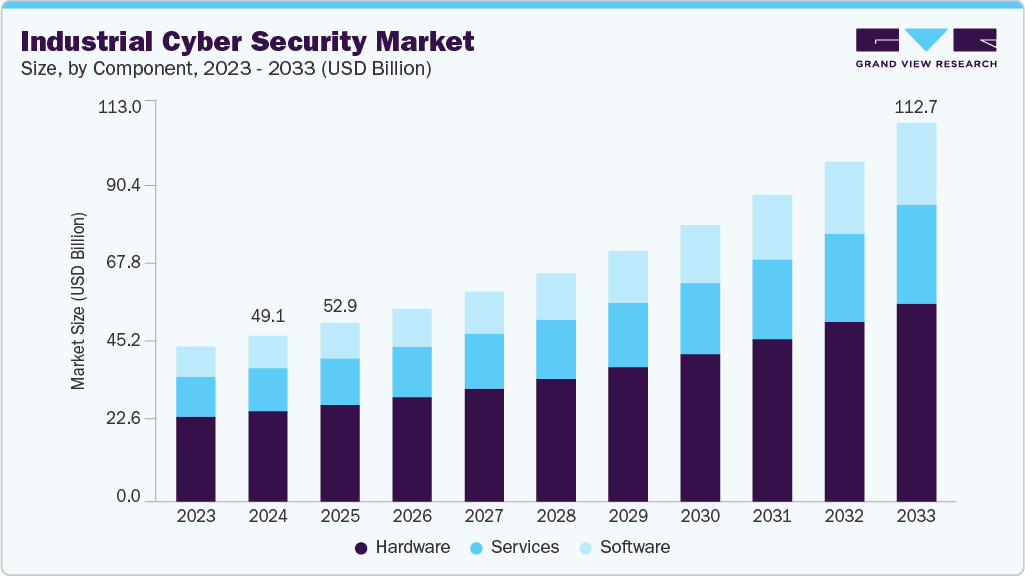
The global industrial cyber security market size was valued at USD 52.9 billion in 2025 and is projected to grow from USD 57.2 billion in 2026 to USD 112.7 billion by 2033, at a CAGR of 10.2% from 2026 to 2033. The North America market dominated, with a revenue share of 37.2% in 2025. The convergence of operational technology (OT) and information technology (IT) across critical infrastructure and industrial environments is accelerating the growth of the industrial cybersecurity market.
 Source: Grand View Research, IR Documents, Primary Interviews, Paid DatabasesTo learn more about this report,
 Download Free Sample Report
Key Market Trends & Insights
- By component: Software segment dominated the market, with a revenue share of 46.9% in 2025.
- By solution type: SCADA segment dominated the market, with a revenue share of 23.7% in 2025.
- By security type: Infrastructure protection segment held the largest market share in 2025.
- By deployment: On-premises segment held the largest market share in 2025.
- By enterprise size: Large-sized enterprises segment held the largest market share in 2025.
- By end use: Manufacturing segment held the largest market share in 2025.
Regional Highlights
- Largest regional market: North America (37.2% revenue share, 2025)
- Fastest-growing regional market: Asia Pacific (highest CAGR, 2026-2033)
- By country: The U.S. held the largest market share in 2025
Market Size & Forecasts
- Market size in 2025: USD 52.9 billion
- Estimated market size in 2026: USD 57.2 billion
- Projected market size by 2033: USD 112.7 billion
- CAGR (2026-2033): 10.2%
Three ways to get this report
Buy it, customize it, or ask a question.Ask an Analyst
Analyst response in 1 business day
- AccessReport author, directly
- Reply timeWithin 1 working day
- No sales callDirect answer only
- FormatEmail reply
- CostFree, no cost
Get the Full Report
What the study covers
- FormatsPDF · Excel · Dashboard
- Timeline2026–2033 annual, 2025 base
- Coverage20+ countries, 5 regions
- Companies10+ key players profiled
Customize the Report
20% free customization
- IncludeCountries, segments, points
- TailorTo your product definition
- ExtendDeeper competitor detail
- OrA fully bespoke study
- Turnaround5–10 working days
The increasing adoption of Industrial Internet of Things (IIoT) devices and cloud-based platforms is enhancing real-time monitoring and predictive maintenance while creating new cybersecurity risks. As a result, industries are investing in advanced cybersecurity solutions, including device authentication, encrypted communication, and AI-driven threat detection, to secure connected industrial ecosystems. Manufacturing, energy and utilities, transportation, and other critical infrastructure operators are increasingly prioritizing continuous visibility across industrial assets, network monitoring, vulnerability management, and incident response.
AI-driven cybersecurity and threat detection are emerging as important areas of investment. Organizations are increasingly deploying AI and machine learning to identify abnormal behavior, analyze network traffic, prioritize vulnerabilities, and accelerate incident response across complex OT environments. At the same time, AI is being incorporated into offensive activities, enabling attackers to automate reconnaissance, identify vulnerabilities, and improve social-engineering campaigns. This is encouraging industrial organizations to combine AI-enabled detection with human oversight, explainability, and stronger OT-specific security controls.
 To learn more about this report, Download Free Sample Report
Another major trend is the shift toward zero-trust, secure remote access, and continuous monitoring as industrial facilities become more interconnected with enterprise networks, cloud platforms, suppliers, and remote operations. Asset discovery and centralized visibility are becoming fundamental requirements, particularly for organizations operating heterogeneous and legacy equipment. In parallel, ransomware and OT-aware attacks are increasing pressure on manufacturers and critical infrastructure operators to strengthen segmentation, backup and recovery capabilities, identity controls, and incident-response mechanisms.
Regulatory requirements, critical-infrastructure protection, and cyber resilience are further supporting market growth. Energy, water, manufacturing, transportation, and other essential services are facing greater pressure to demonstrate operational resilience and manage cybersecurity risks across increasingly connected supply chains. Recent attacks on energy and water infrastructure illustrate the potential operational consequences of compromised OT systems, while initiatives focused on secure-by-design practices, software supply chain security, vulnerability management, and industry-specific cybersecurity frameworks are encouraging organizations to increase spending on industrial cybersecurity.
Market Dynamics
The increasing digitalization of industrial operations, coupled with the widespread adoption of Industrial Internet of Things (IIoT), cloud computing, and smart manufacturing technologies, is significantly driving demand for industrial cybersecurity solutions. As organizations integrate connected devices, automation systems, and advanced analytics into their operations, the risk of cyber threats targeting operational technology (OT) environments has increased. Rising incidents of ransomware attacks, supply chain vulnerabilities, and disruptions to critical infrastructure are encouraging industries to adopt advanced security frameworks, including zero-trust architecture, network segmentation, and continuous threat monitoring. Furthermore, regulatory mandates and cybersecurity standards for critical infrastructure are compelling organizations to strengthen their security posture and invest in comprehensive OT security solutions.
The market is also witnessing a shift toward AI-driven cybersecurity, managed security services, and integrated IT-OT security platforms. Artificial intelligence and machine learning are being increasingly deployed for real-time threat detection, anomaly identification, and automated incident response, enabling faster mitigation of sophisticated cyberattacks. Additionally, the expansion of edge computing, 5G connectivity, and cloud-based industrial platforms is creating new security requirements across distributed industrial environments. However, challenges such as legacy industrial systems, limited cybersecurity expertise, and high implementation costs continue to hinder adoption, particularly among small and medium-sized industrial enterprises. Despite these challenges, growing awareness of cyber resilience and the need to protect mission-critical operations are expected to sustain market growth over the forecast period.
The rapid adoption of Industrial Internet of Things (IIoT), automation, and connected industrial systems is a major factor driving the growth of the industrial cybersecurity market. Industries are increasingly deploying smart sensors, connected machinery, cloud platforms, and edge computing solutions to improve operational efficiency, enable real-time monitoring, and support predictive maintenance. However, the growing number of connected assets has expanded the industrial attack surface, increasing the risk of cyber threats such as ransomware, malware, and unauthorized access. This has accelerated the demand for advanced cybersecurity solutions capable of protecting both operational technology (OT) and information technology (IT) environments.
Furthermore, the convergence of IT and OT networks is encouraging organizations to adopt integrated security frameworks that provide continuous monitoring, threat detection, and incident response capabilities. Industrial sectors such as manufacturing, energy, utilities, and transportation are investing in solutions including network security, endpoint protection, identity management, and AI-powered threat analytics to safeguard critical operations. As digital transformation initiatives continue to expand globally, the need to secure increasingly connected industrial ecosystems is expected to remain a key growth driver for the market.
The presence of legacy OT infrastructure remains a significant challenge limiting the adoption of advanced industrial cybersecurity solutions. Many industrial facilities continue to operate with aging control systems, programmable logic controllers (PLCs), and supervisory control and data acquisition (SCADA) systems that were not originally designed with cybersecurity capabilities. Integrating modern security solutions with these legacy environments can be complex, as organizations must ensure protection without disrupting critical industrial processes and operational continuity.
Additionally, the high costs associated with deploying, maintaining, and upgrading industrial cybersecurity infrastructure can restrict adoption, particularly among small and medium-sized enterprises. Investments in specialized security tools, skilled cybersecurity professionals, and continuous monitoring services require significant financial resources. The shortage of professionals with expertise in both cybersecurity and industrial operations further complicates implementation, slowing the adoption of comprehensive security measures across industrial environments.
The increasing complexity and sophistication of cyber threats targeting industrial environments are creating significant opportunities for AI-powered cybersecurity solutions. Artificial intelligence and machine learning technologies enable organizations to detect abnormal behavior, identify potential threats in real time, and automate response processes across large-scale industrial networks. The integration of AI-driven analytics with industrial cybersecurity platforms is helping enterprises improve threat visibility, reduce response times, and enhance overall cyber resilience.
Moreover, the growing adoption of managed security services (MSS), security operations centers (SOCs), and cloud-based cybersecurity platforms presents new growth opportunities for market players. Many industrial organizations are outsourcing cybersecurity operations to specialized providers due to the shortage of skilled professionals and the need for continuous threat monitoring. As industries increasingly prioritize proactive security strategies and regulatory compliance, demand for scalable, AI-enabled, and managed cybersecurity solutions is expected to create new opportunities in the industrial cybersecurity market.
Market Concentration & Characteristics
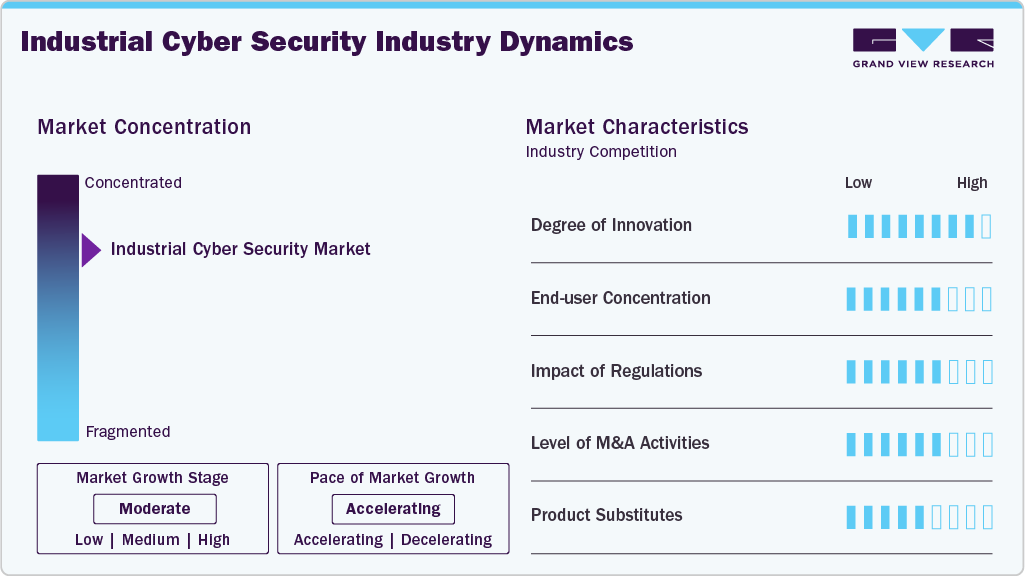
The global industrial cyber security market is moderately concentrated, with participation from established cybersecurity, industrial automation, networking, and technology providers. Leading players such as Siemens, Schneider Electric, Honeywell, Rockwell Automation, ABB, Fortinet, Palo Alto Networks, Cisco Systems, IBM, and specialized OT cybersecurity providers such as Claroty, Dragos, and Nozomi Networks are strengthening their presence through OT/ICS security, network monitoring, intrusion detection, asset visibility, vulnerability management, secure remote access, and managed security solutions. The competitive landscape includes both diversified cybersecurity vendors and industrial technology companies that leverage their installed base and knowledge of industrial environments to offer integrated cybersecurity capabilities.
 To learn more about this report, Download Free Sample Report
The market is witnessing increasing technological development focused on continuous OT monitoring, threat detection, asset discovery, vulnerability management, and secure connectivity across increasingly converged IT and OT environments. Vendors are integrating industrial asset visibility, network traffic analysis, behavioral analytics, threat intelligence, identity and access management, and incident response into unified platforms. Growing adoption of cloud connectivity, and digital transformation is increasing the requirement for cybersecurity solutions that can protect legacy and modern industrial systems without disrupting operational continuity. At the same time, AI and machine learning, zero-trust architectures, secure remote access, behavioral anomaly detection, and automated threat response are becoming important areas of product development. Increasing cybersecurity requirements for critical infrastructure and industrial facilities are further encouraging organizations to adopt integrated end uses.
Analyst Perspective
The industrial cybersecurity market is undergoing rapid transformation as industrial organizations accelerate digitalization initiatives and expand the use of connected technologies across operational environments. The convergence of information technology (IT) and operational technology (OT), combined with the increasing deployment of Industrial Internet of Things (IIoT) devices, cloud platforms, and remote monitoring systems, has significantly expanded the cyberattack surface across critical infrastructure sectors. As cyber threats targeting industrial control systems become more sophisticated and disruptive, organizations are shifting from traditional perimeter-based security approaches toward integrated cybersecurity frameworks that provide real-time visibility, continuous monitoring, threat intelligence, and proactive risk management across industrial networks.
Component Insights
Based on the component, the software segment led the market with the largest revenue share of 46.9% in 2025, as industrial organizations increasingly require real-time asset visibility and continuous monitoring across increasingly connected OT environments. The growing complexity of legacy industrial systems and the rising frequency of cyber threats are driving demand for software platforms specifically designed to identify and manage cybersecurity risks across diverse OT environments. For instance, in November 2025, Rockwell Automation launched its SecureOT solution suite, combining a purpose-built OT cybersecurity platform with professional and managed security services to provide real-time asset visibility, risk prioritization, and vulnerability management across diverse industrial ecosystems. Such developments are expected to strengthen the adoption of industrial cybersecurity software as manufacturers and critical infrastructure operators increasingly prioritize proactive risk management and continuous protection of OT environments.
The services segment is projected to grow at a significant CAGR during the forecast period, driven by the increasing need for specialized expertise to assess, deploy, monitor, and maintain cybersecurity across complex OT and ICS environments. Industrial organizations are increasingly relying on cybersecurity consulting, risk assessments, security architecture, deployment and integration, managed security services, continuous monitoring, incident response, and technical support to address evolving threats while minimizing disruption to critical operations. The growing shortage of specialized OT cybersecurity professionals and the complexity of securing geographically distributed and legacy industrial assets are further encouraging organizations to engage third-party providers. In addition, the expansion of managed OT security services and the demand for continuous threat monitoring are expected to support sustained growth in the services segment over the forecast period.
Solution Insights
Based on solution type, the SCADA segment led the market with the largest revenue share of 23.7% in 2025, driven by the increasing frequency of attacks targeting the real-time operational visibility and control layers of critical infrastructure. Rising state-sponsored and foreign-affiliated threat activity against internet-exposed programmable logic controllers is pushing operators to prioritize dedicated SCADA-layer defenses over generic IT security tools. For instance, in April 2026, the FBI, CISA, NSA, EPA, DOE, and U.S. Cyber Command jointly warned that foreign-affiliated actors were actively targeting internet-exposed PLCs across U.S. critical infrastructure, with the intent to manipulate project files and alter what operators saw on HMI and SCADA displays. Such incidents underscore why enterprises across energy, water, and manufacturing sectors continue to allocate the largest share of their cybersecurity budgets toward securing SCADA environments, reinforcing the segment's leading position in the market.
The identity and access management (IAM) segment is expected to grow at the fastest CAGR during the forecast period, driven by the growing need to control and continuously verify access to increasingly connected OT environments, including industrial control systems, remote access platforms, engineering workstations, and privileged accounts. The expansion of remote operations, IT-OT convergence, and third-party access is increasing the risk of unauthorized credentials and excessive privileges, prompting industrial organizations to strengthen authentication, authorization, privileged access management, and role-based access controls. Adoption of zero-trust security architectures is further increasing demand for identity-centric security across industrial networks, while the need to protect legacy systems alongside modern connected assets is creating opportunities for IAM solutions specifically designed for OT environments.
Security Insights
Based on the security type, the infrastructure protection segment led the market with the largest revenue share of 25.7% in 2025, driven by the increasing need to protect critical infrastructure and essential services from increasingly sophisticated cyber threats. The growing complexity of critical infrastructure environments and limited cybersecurity resources are encouraging organizations to strengthen risk detection, prioritization, remediation, and overall cyber resilience. For instance, in September 2026, the Center for Internet Security (CIS), in collaboration with OpenAI, launched an AI Cyber Defense Pilot to help U.S. state, local, tribal, and territorial governments and critical infrastructure organizations detect risks faster, prioritize security actions, and strengthen cyber resilience. Such initiatives are expected to reinforce investments in infrastructure protection as critical infrastructure operators increasingly adopt advanced technologies to safeguard essential systems and services.
The cloud security segment is projected to grow at the fastest CAGR during the forecast period, as manufacturers and critical infrastructure operators increasingly shift workloads, monitoring capabilities, and industrial applications toward cloud-connected environments. This transition is creating a greater need for cybersecurity capabilities that extend visibility and protection beyond traditional on-premises OT networks and support distributed operations. For instance, in September 2026, Yokogawa launched its Industrial Cyber Resilience Center in Singapore to strengthen OT cybersecurity readiness across Southeast Asia, Oceania, and Taiwan through training, solutions, and services. Yokogawa announcement The expansion of such capabilities reflects the broader shift toward scalable and remotely accessible cybersecurity infrastructure, supporting greater adoption of cloud-based security solutions across industrial environments.
Deployment Insights
Based on the deployment, the on-premises segment led the market with the largest revenue share of 66.1% in 2025, supported by the need among critical infrastructure operators and industrial organizations to retain direct control over sensitive operational data and security infrastructure. Concerns about data sovereignty, regulatory compliance, exposure of OT information to external environments, and reliance on third-party cloud providers continue to favor on-premises deployment, particularly in highly regulated and mission-critical industries. For instance, in July 2026, InfraShield introduced NullCloud.ai, a secure on-premises AI appliance designed for nuclear facilities, utilities, and other critical infrastructure organizations, enabling AI workloads and sensitive OT information to remain within operator-controlled environments. Consequently, the continued preference for locally deployed security and technology infrastructure, where operational control, data protection, and regulatory compliance are critical considerations.
The cloud segment is predicted to grow at a significant CAGR during the forecast period, driven by the increasing integration of cloud-native security platforms into industrial OT environments and the growing need for centralized visibility across distributed assets. The shift toward remote management and connected industrial infrastructure is encouraging organizations to adopt scalable security architectures that can correlate OT telemetry with broader IT security data. For instance, in August 2026, Nozomi Networks and Sophos announced an integration between Nozomi Networks Vantage, a cloud-native, AI-powered OT security platform, and Sophos Fusion, combining OT telemetry, asset intelligence, and threat data with IT security information for unified threat investigation and response. Such integrations indicate growing acceptance of cloud-native approaches in industrial cybersecurity and are expected to accelerate the adoption of cloud-based security solutions across connected OT environments.
Enterprise Size Insights
Based on the enterprise size, the large-size enterprises segment led the market with the largest revenue share of 70.8% in 2025, primarily due to the extensive and complex OT environments operated by large industrial organizations and their greater need for comprehensive cybersecurity capabilities. These organizations typically manage multiple facilities, interconnected industrial control systems, and critical assets, increasing the requirement for continuous monitoring, advanced threat detection, and vulnerability management. For instance, in June 2026, Honeywell strengthened its OT cybersecurity suite to help industrial organizations improve resilience against next-generation cyber threats, expanding cybersecurity capabilities across complex operational technology environments. Such investments by major industrial technology providers highlight the growing emphasis among large enterprises on integrated OT cybersecurity solutions to protect critical operations, minimize disruption, and strengthen resilience against evolving cyber threats.
The small and medium-sized enterprise segment is anticipated to grow at the fastest CAGR during the forecast period, as rising cyber threats, regulatory requirements, and limited in-house cybersecurity capabilities are prompting SMEs to adopt specialized cybersecurity solutions and services. Unlike large enterprises, many SMEs have fewer dedicated security resources and require cost-effective tools that can simplify compliance, and risk assessment. For instance, in September 2026, the Eclipse Foundation released a free open-source toolkit to help SMEs prepare for the European Union’s Cyber Resilience Act, providing capabilities for readiness assessment, software component identification, and compliance documentation. The growing availability of accessible cybersecurity tools and the increasing regulatory pressure on smaller organizations are expected to accelerate cybersecurity adoption among SMEs over the forecast period.
End-use Insights
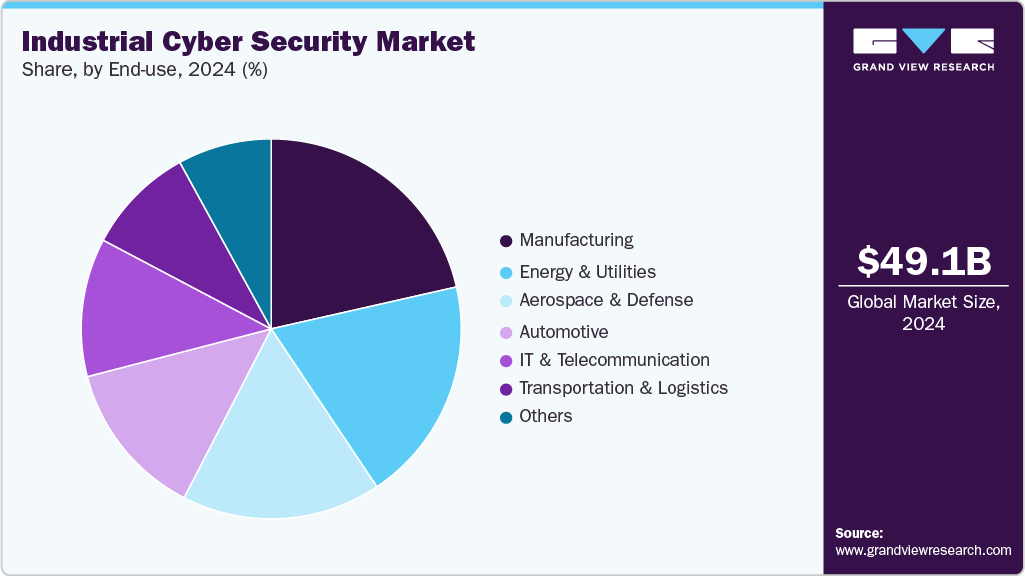
Based on the end use, the manufacturing segment led the market with the largest revenue share of 31.3% in 2025, supported by the extensive adoption of connected machinery, industrial control systems, robotics, and IIoT technologies across production environments. The increasing convergence of IT and OT networks has expanded the attack surface for manufacturers, while cyber incidents can result in production downtime, equipment disruption, safety risks, and financial losses. The growing adoption of smart manufacturing and Industry 4.0 technologies is expected to further strengthen cybersecurity requirements across manufacturing facilities.
 To learn more about this report, Download Free Sample Report
The IT & telecommunications segment is projected to grow at the fastest CAGR during the forecast period, supported by the increasing reliance on connected networks, digital infrastructure, cloud environments, and IT-OT integration, which is expanding the cybersecurity requirements of technology and communications organizations. The growing complexity of digital environments is encouraging these organizations to adopt integrated cybersecurity capabilities that combine risk assessment, security services, continuous protection, and incident preparedness. For instance, in September 2026, Meara Belkin Tech Holdings launched HALO Cyber, a platform integrating cybersecurity, IT services, and cyber insurance to help businesses identify cyber risks, address security gaps, and verify their protections. The growing adoption of integrated cybersecurity platforms and services is expected to support higher cybersecurity spending across IT and telecommunications environments as organizations seek to strengthen resilience against evolving digital threats.
Regional Insights
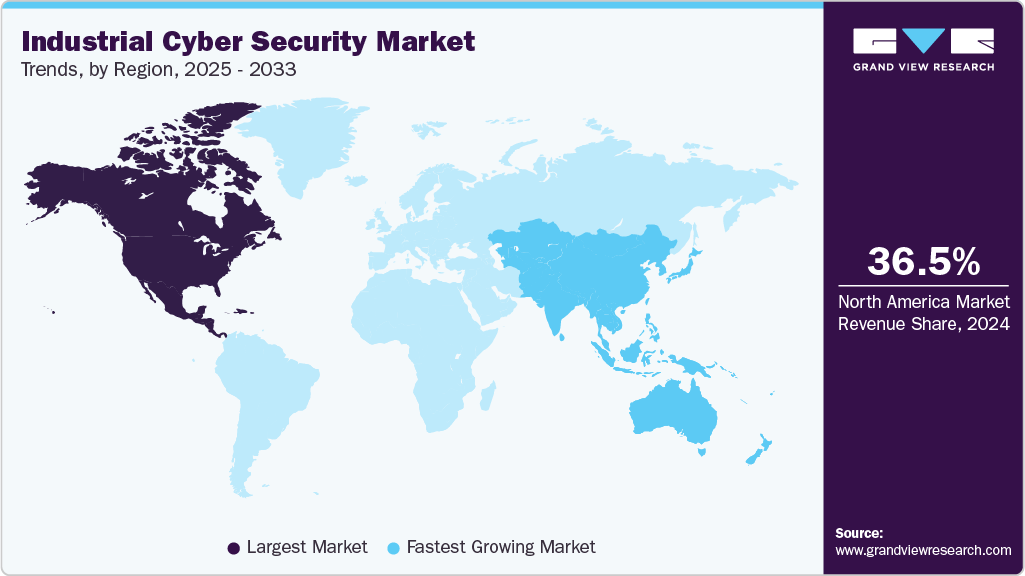
North America dominated the global industrial cyber security market, with the largest revenue share of 37.2% in 2025, supported by an advanced industrial base, early adoption of connected technologies, and mature critical infrastructure that demands continuous protection. The region's growth is closely tied to escalating OT-targeted threats, with U.S. federal agencies such as CISA, the FBI, and the NSA actively documenting and warning against attacks on exposed PLCs and SCADA/HMI systems, pushing utilities, oil & gas, and manufacturing firms to adopt structured frameworks like IEC 62443 and NERC CIP. This threat environment has also fueled significant consolidation among vendors, exemplified by Accenture's multi-billion-dollar majority stake in Dragos alongside its acquisitions of runZero and NetRise, aimed at building an integrated OT/industrial cybersecurity platform for the region. Together, these dynamics reinforce North America's position as the dominant and most mature regional market for industrial cybersecurity.
 To learn more about this report, Download Free Sample Report
U.S. Industrial Cyber Security Market Trends
The industrial cyber security market in the U.S. held the largest share of the North American market in 2025, driven by intensifying regulatory pressure and a wave of high-value platform consolidation aimed at securing operational technology across critical sectors. Mounting compliance deadlines, such as the Cyber Incident Reporting for Critical Infrastructure Act's 72-hour notification requirement, are pushing energy, water, and manufacturing operators to formalize OT-specific detection and reporting capabilities rather than treat cybersecurity as a discretionary spend. For instance, in June 2026, Accenture announced it was building on its USD 10 billion cybersecurity business by acquiring a majority stake in Dragos, along with the full acquisitions of runZero and NetRise, aiming to deliver end-to-end OT security for the power grids, pipelines, manufacturing, and distribution facilities underpinning U.S. critical infrastructure. Such large-scale investments reflect growing confidence among major players that demand for integrated, compliance-ready industrial security platforms will continue to expand, reinforcing the U.S. market's strong growth trajectory through 2033.
Asia Pacific Industrial Cyber Security Market Trends
The industrial cyber security market in the Asia Pacific is anticipated to grow at the fastest CAGR during the forecast period, fueled by rapid Industry 4.0 adoption and accelerating IT/OT convergence across manufacturing-heavy economies such as China, India, Japan, and South Korea. China continues to anchor regional demand, given its manufacturing scale and domestic hardware push under compliance regimes such as the Multi-Level Protection Scheme (MLPS) 2.0, while India is expanding on the back of growing manufacturing and energy infrastructure investment. A defining trend across the region is localization, with global vendors partnering with domestic industrial players to address legacy-heavy OT environments and region-specific compliance needs; for instance, Mitsubishi Electric launched its "Factory Security Total Solution" in April 2024, integrating OT-specific threat intelligence with real-time monitoring for manufacturing environments across Southeast Asia. Rising foreign direct investment in regional manufacturing is further accelerating cybersecurity adoption, as multinational operators bring established security standards into new facilities across the industrializing region.
The China industrial cyber security market held a significant market share in the Asia Pacific in 2025, underpinned by the country's vast manufacturing base, an aggressive push toward domestic substitution, and an intensifying regulatory framework governing critical information infrastructure (CII). Growth is being driven by tightening compliance obligations under the Cybersecurity Law and the accompanying CIIO Regulation, which mandate strict risk assessment, security management, and incident reporting for operators in power, manufacturing, transport, and finance. For instance, in January 2026, China's amended Cybersecurity Law took effect, raising penalty ceilings, introducing personal liability for responsible officers, and broadening enforcement to overseas conduct that endangers the country's critical infrastructure, marking the most significant regulatory update since the law's original 2017 enactment. This heightened enforcement environment, combined with continued state-backed investment in domestic cybersecurity products under the "Xinchuang" substitution wave, is reinforcing sustained demand for industrial cybersecurity solutions, positioning China to retain its leading share within the Asia Pacific market through the forecast period.
The industrial cybersecurity market in Japan is experiencing strong growth, driven by government-led initiatives to secure critical infrastructure and reduce reliance on foreign security solutions, as well as a national push toward Zero Trust architecture across essential sectors. Regulatory momentum is a key catalyst, with the Active Cyber Defense framework and METI's supply chain security assessments placing energy, telecommunications, transportation, and manufacturing operators under heightened scrutiny while extending compliance obligations to SME vendors. For instance, in December 2025, Japan adopted a new multi-year cybersecurity strategy to strengthen national cyber defense, resilience, and industrial competitiveness, explicitly linking cybersecurity to public procurement, supply chain risk management, and strategic technology development. This policy direction, combined with the expansion of smart grids, automated rail systems, and industrial IoT, is expected to sustain robust demand for identity-based security, micro-segmentation, and continuous monitoring solutions across Japan's industrial base through the forecast period.
The India industrial cybersecurity market is experiencing strong growth, driven by the widespread adoption of advanced security solutions across critical infrastructure sectors and tightening regulatory compliance mandates governing data protection. Energy and utilities operators are increasingly investing to defend their operational technology (OT) environments, while government-backed digitization programs and CERT-In directives push both public and private entities toward proactive, rather than reactive, cyber resilience. For instance, in the Union Budget 2025-26, the Indian government allocated ₹782 crores specifically for cybersecurity, directly supporting the development of secure digital infrastructure and national defense architecture for critical sectors. This sustained public investment, combined with rising threat activity, including a reported 47.0% increase in Advanced Persistent Threat targeting seen in mid-2026, is expected to keep demand elevated for industrial cybersecurity solutions across India's manufacturing, energy, and BFSI sectors through the forecast period.
Europe Industrial Cyber Security Market Trends
The industrial cyber security market in Europe is being reshaped by the most consequential regulatory shift, the entry into force of the EU Cyber Resilience Act (CRA) alongside the phased transposition of the NIS2 Directive, which together impose legally binding obligations on plant operators, machine manufacturers, system integrators, and technology vendors alike. Germany, France, and the UK anchor regional demand, with Germany's strong industrial base driving a particular need for OT and ICS security professionals across the automotive, manufacturing, and energy sectors. Rising geopolitical risk is compounding this regulatory pressure, as the Russia-Ukraine conflict has fueled a notable rise in ransomware incidents, and OT-specific threats have grown to represent a meaningful share of all identified threat categories in 2026, signaling a systemic shift toward targeting industrial control systems. For instance, the EU Cyber Resilience Act entered into force in December 2024, and its compliance deadlines through 2026 are already driving adoption of AI/ML-powered OT security platforms that can establish behavioral baselines for industrial processes. As vendor consolidation intensifies to meet these compliance demands, Europe's industrial cybersecurity market is expected to sustain double-digit growth, with OT/ICS security emerging as one of its fastest-expanding segments.
Key Industrial Cyber Security Company Insights
Key players operating in the industrial cyber security industry include ABB Ltd.; Check Point Software Technologies Ltd.; Cisco Systems, Inc.; Claroty Ltd.; Dragos, Inc.; Fortinet, Inc.; among others. These companies are some of the leading participants in the global market. Market participants are focusing on strengthening their cybersecurity portfolios through advanced threat detection and security solutions tailored to OT environments. Competitive strategies also include product innovation, strategic partnerships, acquisitions, and expanded service capabilities to address the evolving cybersecurity requirements of industrial organizations.
Key Industrial Cyber Security Companies
The following key companies have been profiled for this study on the industrial cyber security market.
-
ABB Ltd.
-
Check Point Software Technologies Ltd.
-
Cisco Systems, Inc.
-
Claroty Ltd.
-
Dragos, Inc.
-
Fortinet, Inc.
-
GE Vernova Inc.
-
Honeywell International Inc.
-
IBM Corporation
-
Nozomi Networks Inc.
-
Palo Alto Networks, Inc.
-
Rockwell Automation, Inc.
-
Schneider Electric SE
-
Siemens AG
-
Tenable, Inc.
Competitive Benchmarking
Category
Operating Strategies
Competitive Edge
Weakness
Mature Players (Cisco Systems, Fortinet, Palo Alto Networks, Siemens, Claroty, Dragos, Darktrace, Fortra, Industrial Defender, Tufin)
- Offer comprehensive industrial cybersecurity solutions spanning OT security, ICS/SCADA protection, industrial network security, asset visibility, threat detection, vulnerability management, network segmentation, and incident response. These companies focus on securing critical infrastructure and industrial environments through integrated IT-OT security platforms, strategic partnerships, and industry-specific solutions.
- Strong industry expertise, extensive customer base, global presence, established relationships with critical infrastructure operators, broad product portfolios, and advanced OT threat intelligence capabilities. Many possess deep knowledge of industrial protocols and operational environments, enabling effective protection of complex industrial systems.
- Higher implementation and maintenance costs, integration challenges with legacy industrial systems, lengthy deployment cycles, and greater complexity in managing large-scale OT security architectures.
Emerging Players (Arctic Wolf Networks, CrowdStrike, Huntress, Rapid7, Red Canary)
- Focus on cloud-native cybersecurity, managed detection and response (MDR), extended detection and response (XDR), AI-driven threat analytics, security operations automation, and continuous threat monitoring. These companies increasingly extend their capabilities into industrial and OT environments through platform innovation and strategic partnerships.
- Faster innovation cycles, scalable SaaS-based platforms, simplified deployment, advanced AI and behavioral analytics, strong managed security capabilities, and reduced operational burden for customers with limited cybersecurity resources.
- Comparatively limited OT-specific product portfolios, lower penetration in highly regulated industrial sectors, dependence on partnerships for certain industrial security functions, and less extensive industrial ecosystem experience than established OT cybersecurity vendors.
Recent Development
-
In September 2026, BitSight introduced a unified intelligence platform that brings risk and security leaders together to improve visibility into cyber risks, particularly those arising from supply-chain vulnerabilities. The platform is intended to support better risk assessment, prioritization, and coordinated cybersecurity decision-making.
-
In July 2026, the White House launched the Gold Eagle Initiative, bringing together government agencies, AI developers, and essential-service providers to identify, share, and coordinate responses to cybersecurity vulnerabilities discovered by advanced AI systems. The initiative aims to accelerate vulnerability remediation and strengthen the protection of critical infrastructure.
-
In February 2026, ABB introduced Automation Extended, a structured approach to modernizing industrial automation systems while maintaining operational continuity and protecting existing investments. It enables industries to gradually upgrade automation technologies, integrate new digital capabilities, and reduce disruption during modernization.
Industrial Cyber Security Market Report Scope
Report Attribute
Details
Market size in 2025
USD 52.9 billion
Estimated market size in 2026
USD 57.2 billion
Projected market size by 2033
USD 112.7 billion
Growth rate
CAGR of 10.2% from 2026 to 2033
Base year for estimation
2025
Historical data
2021 - 2024
Forecasts period
2026 - 2033
Quantitative units
Revenue in USD billion/billion and CAGR from 2026 to 2033
Report coverage
Revenue forecasts, company market share analysis, competitive landscape, growth factors, and trends
Segments covered
Component, Solution Type, Security Type, Deployment, Enterprise Size, End Use, and Region
Regional scope
North America; Europe; Asia Pacific; Latin America; MEA
Country scope
U.S.; Canada; Mexico; Germany; UK; France; Italy; Spain; China; Japan; India; South Korea; Australia; Brazil; Saudi Arabia; South Africa; UAE
Key companies profiled
Arctic Wolf Networks Inc.; Cisco Systems, Inc.; Claroty; CrowdStrike; DARKTRACE; Dragos; Fortinet, Inc.; Fortra, LLC; Huntress; Industrial Defender; Palo Alto Networks; Rapid7; Red Canary; Siemens; Tufin
Customization scope
Free report customization (equivalent to up to 8 analysts' working days) with purchase. Addition or alteration to country, regional & segment scope.
Pricing and purchase options
Avail customized purchase options to meet your exact research needs. Explore purchase options
Global Industrial Cyber Security Market Report Segmentation
This report forecasts revenue growth at global, regional, and country levels and provides an analysis of the latest industry trends in each of the sub-segments from 2021 to 2033. For this study, Grand View Research has segmented the global industrial cyber security market report based on component, solution, security, deployment, enterprise size, end-use, and region:
-
Component Outlook (Revenue, USD Billion, 2021 - 2033)
-
Hardware
-
Software
-
Services
-
-
Solution Outlook (Revenue, USD Billion, 2021 - 2033)
-
SCADA
-
Intrusion Detection System/Intrusion Prevention System (IDS/IPS)
-
Identity and Access Management (IAM)
-
Security Information and Event Management (SIEM)
-
Unified Threat Management (UTM)
-
Data Loss Prevention (DLP)
-
DDoS
-
Others
-
-
Security Outlook (Revenue, USD Billion, 2021 - 2033)
-
Infrastructure Protection
-
Network Security
-
Endpoint Security
-
Data Security
-
Application Security
-
Cloud Security
-
Others
-
-
Deployment Outlook (Revenue, USD Billion, 2021 - 2033)
-
Cloud
-
On-Premises
-
-
Enterprise Size Outlook (Revenue, USD Billion, 2021 - 2033)
-
Large Size Enterprises
-
Small and Medium Sized Enterprise
-
-
End-use Outlook (Revenue, USD Billion, 2021 - 2033)
-
Manufacturing
-
Energy & Utilities
-
Aerospace & Defense
-
Automotive
-
IT & Telecommunication
-
Transportation & Logistics
-
Others
-
-
Regional Outlook (Revenue, USD Billion, 2021 - 2033)
-
North America
-
U.S.
-
Canada
-
Mexico
-
-
Europe
-
UK
-
Germany
-
France
-
-
Asia Pacific
-
China
-
Japan
-
India
-
South Korea
-
Australia
-
-
Latin America
-
Brazil
-
-
Middle East and Africa
-
UAE
-
KSA
-
South Africa
-
-
Research Methodology
The industrial cyber security market figures in this report are based on a proven research process that combines executive interviews with secondary research from proprietary databases, company filings, and recognized regulatory and institutional sources. Market size is built through value-chain sizing - reconciling supply-side and demand-side estimates - and triangulated with bottom-up and top-down approaches. Every estimate passes multiple levels of expert validation before publication, with each industrial cyber security segment quantified using the revenue-capture definitions in the table below.
Segment Definition
Segment - Component
Revenue Capture Definition
Hardware
Revenue generated from industrial cybersecurity hardware deployed to secure operational technology (OT) and industrial control system (ICS) environments. Includes industrial firewalls, secure gateways, network security appliances, industrial switches with embedded security features, hardware security modules (HSMs), secure remote access devices, and OT monitoring equipment used across critical infrastructure and industrial facilities.
Software
Revenue generated from industrial cybersecurity software solutions designed to protect industrial networks, ICS, SCADA systems, distributed control systems (DCS), programmable logic controllers (PLCs), IIoT devices, and connected OT assets. Includes threat detection, vulnerability management, network monitoring, SIEM, IAM, endpoint security, asset discovery, industrial risk management, and OT security platforms.
Services
Revenue generated from professional and managed services supporting industrial cybersecurity deployment, operation, and maintenance. Includes consulting, risk assessments, security audits, managed security services, incident response, OT security monitoring, compliance management, training, implementation, system integration, support, and maintenance services.
Segment - Solution Type
Revenue Capture Definition
SCADA Security
Revenue generated from solutions designed to secure Supervisory Control and Data Acquisition (SCADA) systems against cyber threats. Includes monitoring, threat detection, access control, protocol security, and SCADA network protection solutions.
Intrusion Detection System/Intrusion Prevention System (IDS/IPS)
Revenue generated from solutions that monitor industrial networks and OT environments for malicious activities, unauthorized access attempts, and cyber threats while enabling automated prevention and response mechanisms.
Identity and Access Management (IAM)
Revenue generated from solutions that manage user identities, authentication, privileged access, and authorization controls across industrial systems, OT assets, and critical infrastructure environments.
Security Information and Event Management (SIEM)
Revenue generated from platforms that collect, correlate, analyze, and monitor security events across industrial networks, OT environments, and enterprise systems to improve threat visibility and incident response.
Unified Threat Management (UTM)
Revenue generated from integrated security platforms that combine firewall, intrusion prevention, content filtering, VPN, and threat management capabilities to protect industrial networks and connected assets.
Data Loss Prevention (DLP)
Revenue generated from solutions designed to prevent unauthorized access, transfer, leakage, or loss of sensitive industrial, operational, and intellectual property data across OT and IT environments.
DDoS Protection
Revenue generated from solutions that detect, mitigate, and prevent distributed denial-of-service (DDoS) attacks targeting industrial operations, connected infrastructure, and critical services.
Others
Revenue generated from additional industrial cybersecurity solutions, including asset visibility, network segmentation, threat intelligence, vulnerability management, endpoint detection and response (EDR), zero-trust security, secure remote access, and industrial anomaly detection platforms.
Segment - Security Type
Revenue Capture Definition
Infrastructure Protection
Revenue generated from solutions that secure critical industrial infrastructure, control systems, production assets, and operational environments against cyber threats, disruptions, and unauthorized access.
Network Security
Revenue generated from solutions designed to protect industrial networks, OT communication channels, and connected devices from cyberattacks, malware, intrusions, and network-based threats. Includes industrial firewalls, network segmentation, IDS/IPS, and secure communication solutions.
Endpoint Security
Revenue generated from solutions protecting industrial endpoints, engineering workstations, servers, HMIs, PLCs, IIoT devices, and connected assets from malware, ransomware, and unauthorized access.
Data Security
Revenue generated from solutions that secure operational data, industrial intellectual property, process information, and sensitive organizational data through encryption, monitoring, access controls, and data protection mechanisms.
Application Security
Revenue generated from solutions designed to secure industrial applications, manufacturing execution systems (MES), asset management platforms, and OT software environments against vulnerabilities and cyber threats.
Cloud Security
Revenue generated from solutions protecting cloud-connected industrial systems, IIoT platforms, remote monitoring environments, cloud workloads, and industrial data stored or processed in cloud infrastructures.
Others
Revenue generated from additional security technologies, including threat intelligence, security analytics, risk management, compliance monitoring, and cyber resilience solutions for industrial environments.
Segment - Deployment
Revenue Capture Definition
Cloud
Revenue generated from industrial cybersecurity solutions delivered through cloud-based deployment models. Includes cloud-hosted OT security platforms, threat intelligence services, asset monitoring, SIEM, managed detection and response (MDR), and cybersecurity analytics solutions accessible through subscription-based models.
On-Premises
Revenue generated from industrial cybersecurity solutions deployed within customer-owned infrastructure and industrial facilities. Includes locally installed OT security software, network monitoring systems, industrial firewalls, security appliances, and on-site cybersecurity management platforms.
Segment - Enterprise Size
Revenue Capture Definition
Large Size Enterprises
Revenue generated from industrial cybersecurity solutions adopted by large organizations operating extensive industrial facilities, critical infrastructure, multiple production sites, and complex OT environments. Includes enterprise-wide OT security platforms, managed security operations, advanced threat detection, and compliance management solutions.
Small and Medium Sized Enterprises (SMEs)
Revenue generated from industrial cybersecurity solutions adopted by SMEs seeking scalable and cost-effective protection for manufacturing plants, industrial operations, and connected OT environments. Includes managed security services, cloud-based security platforms, endpoint protection, and industrial network security solutions.
Segment - End Use
Revenue Capture Definition
Manufacturing
Revenue generated from industrial cybersecurity solutions deployed by manufacturers to secure production systems, industrial control systems, robotics, IIoT devices, supply chains, and intellectual property against cyber threats.
Energy & Utilities
Revenue generated from cybersecurity solutions used by power generation facilities, electric utilities, renewable energy operators, water treatment facilities, and utility networks to protect critical infrastructure and OT environments.
Aerospace & Defense
Revenue generated from industrial cybersecurity solutions protecting defense manufacturing facilities, aerospace production systems, mission-critical operations, defense infrastructure, and sensitive operational data.
Automotive
Revenue generated from cybersecurity solutions deployed across automotive manufacturing facilities, connected production lines, robotics systems, smart factories, and automotive supply chain operations.
IT & Telecommunication
Revenue generated from industrial cybersecurity solutions used by telecom operators, data centers, network infrastructure providers, and technology companies operating critical industrial and communication infrastructure.
Transportation & Logistics
Revenue generated from cybersecurity solutions protecting rail networks, ports, airports, logistics hubs, fleet management systems, traffic control systems, and other transportation-related critical infrastructure.
Others
Revenue generated from industrial cybersecurity solutions adopted across industries including mining, chemicals, pharmaceuticals, food & beverage, oil & gas, marine, construction, and other critical industrial sectors.
Estimation Model
Layer
Question
Analysis
Industrial Infrastructure & OT Exposure Layer (TAM)
Who might require industrial cybersecurity solutions?
All organizations operating industrial control systems (ICS), supervisory control and data acquisition (SCADA) systems, distributed control systems (DCS), programmable logic controllers (PLCs), and connected operational technology (OT) environments. This includes manufacturing facilities, energy & utilities, oil & gas, chemicals, mining, transportation, water & wastewater, pharmaceuticals, food & beverage, and other critical infrastructure sectors exposed to cyber risks.
Connected Industrial Environment Adoption Layer (SAM)
Who can technically adopt industrial cyber security solutions?
Organizations that have implemented industrial automation, Industrial Internet of Things (IIoT), smart manufacturing, Industry 4.0 technologies, remote asset monitoring, cloud-connected OT systems, and IT-OT convergence initiatives. These organizations require industrial network security, endpoint protection, OT visibility, access control, threat detection, and risk management solutions to secure connected industrial operations.
Active Industrial Cyber Security Deployment Layer (SOM)
Who actively deploys industrial cyber security solutions today?
Organizations actively implementing OT security platforms, ICS/SCADA security solutions, industrial firewalls, network segmentation, Security Information and Event Management (SIEM), Security Operations Centers (SOC), Managed Detection and Response (MDR), threat intelligence, vulnerability management, zero-trust architectures, and industrial asset monitoring solutions to protect critical operational environments.
Revenue Realization Layer
How is revenue generated?
Revenue is generated through the sale and subscription of industrial cybersecurity software, OT security platforms, industrial network security solutions, endpoint and application security tools, threat detection and monitoring services, managed security services, consulting, risk assessment, incident response, system integration, training, support, and maintenance contracts.
Delivered Customizations
This report has been delivered with the following in-depth customizations
Client Request
Customization Delivered
Value Adds
Industrial OT/ICS cybersecurity architecture review
Evaluated cybersecurity architectures across Operational Technology (OT) environments, including Industrial Control Systems (ICS), SCADA systems, Distributed Control Systems (DCS), Programmable Logic Controllers (PLCs), industrial networks, IIoT devices, remote access infrastructure, and IT-OT integrated environments across manufacturing and critical infrastructure facilities.
Provides insights into OT security posture, identifies vulnerabilities across industrial environments, enhances operational resilience, and supports the development of robust cybersecurity strategies for critical industrial assets.
AI-driven industrial threat detection and cyber resilience assessment
Analyzed the adoption of artificial intelligence, machine learning, behavioral analytics, industrial threat intelligence, anomaly detection, extended detection and response (XDR), security information and event management (SIEM), and automated incident response solutions designed for OT and industrial environments.
Helps organizations strengthen cyber resilience, improve visibility into industrial threats, accelerate incident detection and response, reduce operational downtime, and enhance protection against sophisticated cyberattacks targeting industrial systems.
Industry-specific industrial cybersecurity risk and adoption assessment
Evaluated cybersecurity risks, OT security maturity, regulatory compliance requirements, industrial cybersecurity adoption trends, and critical asset protection strategies across key industries including manufacturing, energy & utilities, oil & gas, chemicals, mining, transportation, water & wastewater, pharmaceuticals, and food & beverage sectors.
Provides industry-specific insights into cyber risk exposure, supports cybersecurity investment prioritization, enables regulatory compliance planning, and helps organizations implement tailored OT security strategies aligned with operational requirements.
Frequently Asked Questions About This Report
The global industrial cyber security market size was valued at USD 52.9 billion in 2025 and is estimated at USD 57.3 billion in 2026.
Key players include ABB Ltd.; Check Point Software Technologies Ltd.; Cisco Systems, Inc.; Claroty Ltd.; Dragos, Inc.; Fortinet, Inc.; GE Vernova Inc.; Honeywell International Inc.; IBM Corporation; Nozomi Networks Inc.; Palo Alto Networks, Inc.; Rockwell Automation, Inc.; Schneider Electric SE; Siemens AG; Tenable, Inc.
North America dominated the market, accounting for the revenue share of 37.2% in 2025.
Factors such the growing convergence of operational technology (OT) and information technology (IT) systems across critical infrastructure and manufacturing environments and the increasing frequency and sophistication of cyberattacks targeting industrial operations is driving the industrial cyber security market.
The global industrial cyber security market is expected to grow at a CAGR of 10.2% from 2026 to 2033 to reach USD 112.7 billion by 2033.
The software segment led the market with the largest revenue share of 46.9% in 2025 and is also the fastest-growing segment.
Asia Pacific is the fastest-growing region over the forecast period.
The SCADA segment led the market with the largest revenue share of 23.7% in 2025, while identity and access management (IAM) segment is the fastest-growing segment.
The infrastructure protection segment dominated the market with the largest revenue share of 25.7% in 2025, while cloud security is the fastest-growing segment.
About the Author(s)
Electronic Security Research Team
Semiconductors & Electronics · Electronic SecurityThis report was authored by the electronic security research team at Grand View Research - comprising two research analysts, one senior research analyst, and one industry expert - with specialized expertise in the electronic security segment of the semiconductors & electronics industry. All findings are based on proprietary semiconductors & electronics databases, executive interviews, and regulatory analysis, subject to internal peer review prior to publication.
Last Updated:
Speak to Analyst

Customize this report to your needs - add regions, segments, or data points, with 20% free customization.
Or view our licence options:


ISO 9001:2015 & 27001:2022 Certified
We are GDPR and CCPA compliant! Your transaction & personal information is safe and secure. For more details, please read our privacy policy.


