
- Home
- »
- Advanced Interior Materials
- »
-
Industrial Springs Market Size, Share & Trends Report, 2033GVR Report cover

Industrial Springs Market (2026 - 2033)
Size, Share & Trends Analysis Report By Product Type (Compression Springs, Extension Springs, Torsion Springs, Flat Springs), By End-use (Manufacturing, Automotive & Transportation, Construction), By Region, And Segment Forecasts
Market Size, 2025
$5.1BMarket Estimate, 2026
$5.3BMarket Forecast, 2033
$7.1BCAGR, 2026–2033
4.2%Industrial Springs Market Summary
The global industrial springs market size was valued at USD 5.1 billion in 2025 and is projected to grow from USD 5.3 billion in 2026 to USD 7.1 billion by 2033, at a CAGR of 4.2% from 2026 to 2033. Asia Pacific dominated the market, accounting for a revenue share of 33.5% in 2025. Springs are essential components in machinery, engines, and suspension systems, ensuring operational stability and mechanical precision.
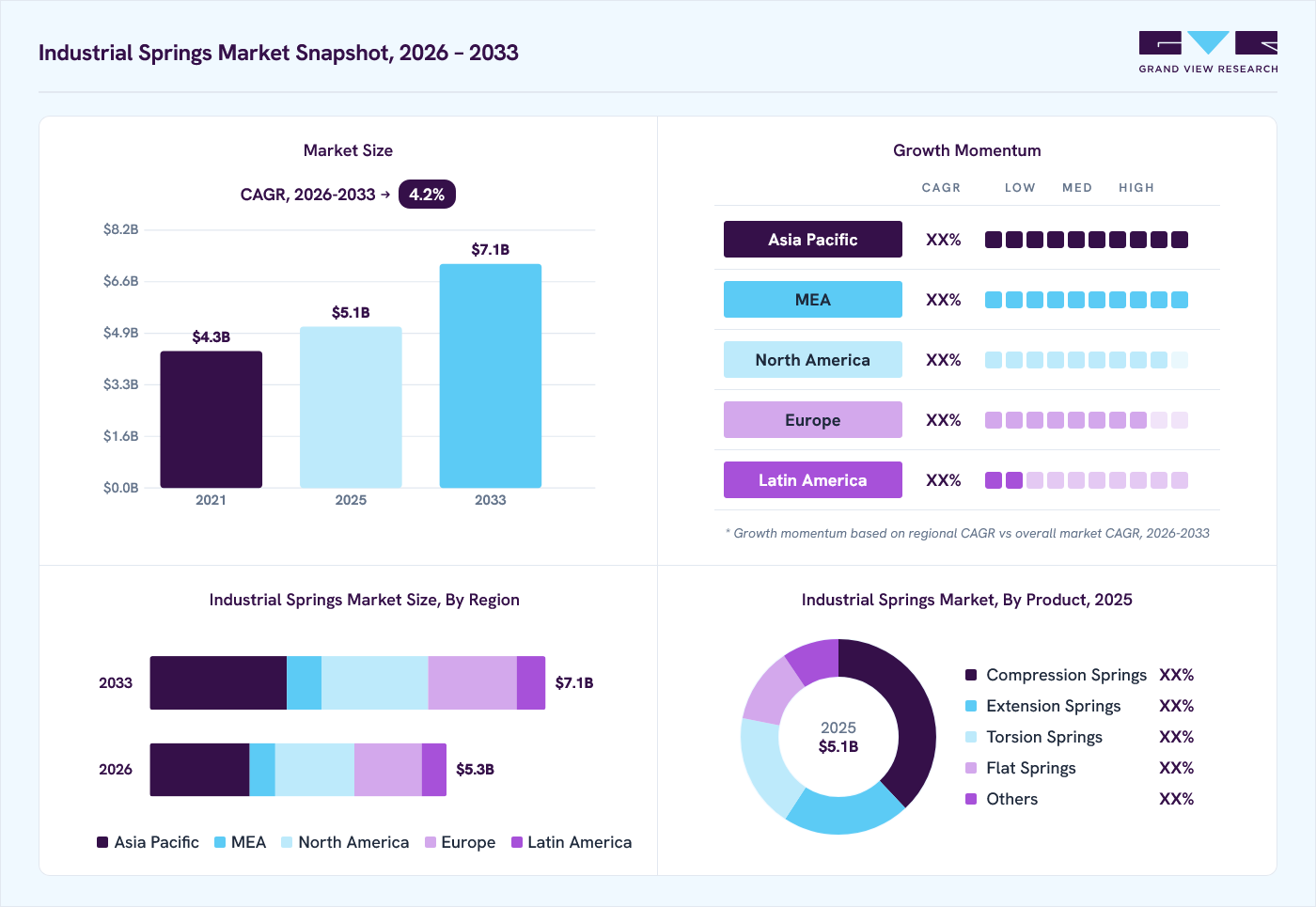 Source: Grand View Research, IR Documents, Primary Interviews, Paid DatabasesTo learn more about this report,
 Download Free Sample Report
Key Market Trends & Insights
- By product: The compression Springs segment led the market with the largest revenue share of 38.0% in 2025.
- By end use: The automotive & transportation segment led the market with the largest revenue share of 37.1% in 2025
Regional Highlights
- Largest regional market: Asia Pacific (33.5% revenue share, 2025)
- By country: China held the largest market share in 2025.
Market Size & Forecast
- Market size in 2025: USD 5.1 Billion
- Estimated market size in 2026: USD 5.3 Billion
- Projected market size by 2033: USD 7.1 Billion
- CAGR (2026-2033): 4.2%
Prism AI by Grand View Research Free to tryAsk a question about the industrial springs marketTry asking✓Every figure cited from GVR research Prefer the report? Download free sample →
The growth of electric and hybrid vehicles has further increased demand for lightweight and high-performance spring materials. In addition, continuous industrial automation and the rising adoption of robotics in production lines are creating a strong need for customized spring solutions. These factors collectively enhance market growth across both developed and emerging economies.The increasing investments in infrastructure development and construction projects worldwide are significantly contributing to the growth of the industrial springs industry. Springs are widely used in heavy machinery, elevators, cranes, and vibration isolation systems, supporting large-scale engineering operations. The modernization of public transportation systems, including railways and metros, further amplifies demand for durable and high-load capacity springs. Moreover, the emphasis on efficient, long-lasting, and corrosion-resistant components is encouraging manufacturers to innovate and adopt advanced alloys and composite materials in spring production.
 To learn more about this report, Download Free Sample Report
The aerospace and defense industries are emerging as key drivers of the industrial springs industry due to the growing demand for precision-engineered components capable of withstanding extreme conditions. Springs are integral to landing gear systems, actuators, and control mechanisms in aircraft and military vehicles. Increasing global defense budgets and the rise in commercial aircraft production are boosting the adoption of high-strength, fatigue-resistant springs. In addition, advancements in material science, including titanium and nickel-based alloys, are enabling the development of lightweight springs with superior performance characteristics. This trend is expected to strengthen market growth in high-technology sectors.
Market Dynamics
The industrial springs market is driven by growing demand from the automotive, industrial machinery, aerospace, construction, and medical equipment industries, where springs are essential for load management, vibration control, and mechanical performance. Rising production of electric vehicles, factory automation equipment, and precision machinery is increasing the need for durable and application-specific spring solutions. However, volatility in steel and specialty alloy prices, coupled with stringent manufacturing and quality requirements, continues to pressure production costs and profit margins. At the same time, advancements in material engineering, precision forming technologies, and automated manufacturing are enabling the development of lightweight, corrosion-resistant, and longer-lasting springs, while expanding applications in robotics, renewable energy systems, and semiconductor equipment are creating new growth opportunities for manufacturers.
The industrial springs market is driven by growing production of automobiles, industrial machinery, and automated equipment, where springs are essential for load support, shock absorption, vibration control, and motion transfer. Expanding adoption of electric vehicles, robotics, and advanced manufacturing systems is further increasing demand for durable, high-performance spring solutions with enhanced reliability and longer service life. In addition, increasing investments in transportation infrastructure, construction equipment, and material handling systems are broadening the application scope of industrial springs.
Volatility in the prices of steel, stainless steel, and specialty alloys remains a significant restraint for the industrial springs market, as raw materials account for a substantial portion of manufacturing costs. In addition, stringent quality standards, precision engineering requirements, and heat-treatment processes increase production complexity and capital investment, particularly for customized and high-performance springs. Intense price competition from low-cost manufacturers further limits profit margins for established companies. Supply chain disruptions and fluctuations in energy costs can also affect production schedules and overall manufacturing efficiency.
Increasing investments in industrial automation, electric vehicles, renewable energy systems, medical devices, and aerospace manufacturing are creating opportunities for advanced spring solutions. The use of lightweight alloys, corrosion-resistant materials, and precision manufacturing technologies is enabling the development of longer-lasting, application-specific springs that meet evolving performance requirements across high-growth industries. Growing demand for miniaturized components in electronics and medical equipment is opening new application areas for precision springs.
Market Concentration & Characteristics
The global industrial springs industry exhibits a moderate to high degree of innovation, driven by the growing need for enhanced material strength, precision, and performance across industrial applications. Manufacturers are focusing on developing springs made from advanced alloys, composites, and corrosion-resistant materials to improve load-bearing capacity and longevity. The market has witnessed a moderate level of mergers and acquisitions as companies seek to expand production capabilities, enter new regional markets, and diversify product portfolios. Continuous investment in automation, computer-aided design, and customized production technologies has further enhanced competitiveness and innovation within the sector.
Regulatory standards related to product safety, material quality, and environmental sustainability significantly influence the industrial springs market. Compliance with international standards such as ISO and ASTM ensures consistent performance, reliability, and adherence to sustainability norms. The threat of service substitutes remains relatively low since springs play a unique mechanical role in energy absorption and load management, though pneumatic or hydraulic systems may act as limited alternatives in certain applications.
 To learn more about this report, Download Free Sample Report
End-user concentration is high in sectors such as automotive, aerospace, construction, and manufacturing, which account for the majority of global demand. These industries’ emphasis on durability, energy efficiency, and performance optimization continues to shape market development and technological advancements.
Analyst Perspective
The industrial springs market is experiencing steady growth as manufacturers increasingly demand durable, high-performance mechanical components for precision motion control, vibration isolation, and load-bearing applications. Expanding production across the automotive, industrial machinery, aerospace, construction, and manufacturing sectors is driving the need for reliable spring solutions capable of operating under demanding conditions. In addition, the growing adoption of automation, robotics, and advanced manufacturing equipment is increasing demand for precision-engineered springs with enhanced fatigue strength, corrosion resistance, and dimensional accuracy. Manufacturers are also investing in advanced materials, customized designs, and automated production technologies to improve product performance and manufacturing efficiency. As industrial production continues to expand and equipment reliability remains a priority, suppliers offering high-quality, application-specific industrial springs are expected to benefit from sustained long-term market growth.
Product Type Insights
Based on product type, the compression Springs segment led the market with the largest revenue share of 38.0% in 2025, driven by the growing demand for durable and high-performance components across industrial machinery and automotive applications. These springs are widely utilized in engines, suspension systems, and heavy-duty equipment for their ability to absorb shock and maintain force consistency. The increasing focus on energy efficiency and operational reliability in mechanical systems has accelerated their adoption. Moreover, advancements in spring materials such as stainless steel and alloy steels enhance fatigue resistance and lifespan.
The flat springs segment is expected to grow at the fastest CAGR of 4.8% over the forecast period, driven by the rising use of compact and lightweight components in automotive electronics, appliances, and medical devices. Their flexibility, compact design, and high strength-to-weight ratio make them ideal for applications requiring limited space and high mechanical precision. The surge in electric vehicles (EVs) and miniaturized electronic devices has amplified demand for customized flat springs. Manufacturers are increasingly investing in advanced forming and coating technologies to improve performance and corrosion resistance.
End Use Insights
Based on end use, the automotive & transportation segment led the market with the largest revenue share of 37.1% in 2025, driven by the growing production of vehicles and the increasing focus on enhanced ride comfort and safety. Springs play a vital role in suspension, braking, and clutch systems, contributing to vehicle stability and performance. The rapid adoption of electric and hybrid vehicles has created new opportunities for lightweight, high-strength spring solutions. Additionally, stringent emission regulations are encouraging automakers to use advanced spring materials that reduce overall vehicle weight and improve fuel efficiency.
 To learn more about this report, Download Free Sample Report
The aerospace & defense segment is expected to grow at the fastest CAGR of 4.8% over the forecast period, driven by the demand for high-precision and lightweight spring components that can withstand extreme operating conditions. Springs are critical in aircraft landing gear, actuation systems, and defense machinery, where reliability and performance are non-negotiable. The increasing investment in aircraft modernization and space exploration programs has boosted the need for advanced spring technologies.
Regional Insights
The industrial springs market in North America is driven by a strong industrial base, including automotive, aerospace, and manufacturing sectors that rely heavily on precision spring components. The growing adoption of automation and robotics in manufacturing operations is increasing demand for high-performance springs. Rising investments in renewable energy and transportation infrastructure further support market growth. In addition, technological advancements in spring materials and designs, focusing on durability and load efficiency, are enhancing product adoption. The presence of established manufacturers and continuous R&D efforts contributes to steady regional market expansion.
U.S. Industrial Springs Market Trends
The industrial springs market in the U.S. benefits from a mature automotive and aerospace sector, where springs are critical for suspension systems, engine components, and control mechanisms. Increasing investments in smart manufacturing and Industry 4.0 practices are driving demand for precision-engineered springs. The rise in electric and hybrid vehicle production is creating a need for lightweight, high-strength spring materials. Furthermore, government initiatives supporting infrastructure modernization and industrial efficiency improvements are fostering market growth. Advanced material innovations, such as corrosion-resistant alloys and composite springs, are further enhancing adoption.
Asia Pacific Industrial Springs Market Trends
Asia Pacific dominated the industrial springs market with the largest revenue share of 33.5% in 2025, experiencing rapid growth due to industrialization, infrastructure development, and increasing manufacturing activity in emerging economies. Countries such as India, Japan are investing heavily in automotive, construction, and heavy machinery sectors, boosting demand for durable spring components. The rising adoption of automated production lines and robotics is also increasing the need for precision springs. Additionally, favorable government policies supporting industrial expansion and foreign direct investment are strengthening the regional market. Cost advantages in raw materials and labor further drive production and adoption in the region.
 To learn more about this report, Download Free Sample Report
The industrial springs market in China held the largest share in the Asia Pacific region in 2025. The China industrial springs market is fueled by its large-scale manufacturing base, rapid urbanization, and infrastructure expansion. The country’s automotive, rail, and renewable energy sectors are major consumers of high-performance springs. Increasing automation and electric vehicle production are creating demand for lightweight and fatigue-resistant springs. Domestic manufacturers are also focusing on advanced materials and standardized production to meet international quality benchmarks. Government initiatives promoting smart manufacturing and technological innovation further support market growth. Rising export opportunities for precision-engineered springs enhance China’s role as a regional market leader.
Europe Industrial Springs Market Trends
The industrial springs market in Europe is driven by high technological standards and a strong emphasis on precision engineering across automotive, aerospace, and machinery manufacturing. Environmental regulations and sustainability initiatives are encouraging the use of corrosion-resistant and recyclable spring materials. Infrastructure upgrades, modernization of transportation systems, and industrial automation are further boosting demand. European manufacturers focus on high-performance, fatigue-resistant springs with long service life. In addition, the region benefits from a robust R&D ecosystem, fostering continuous innovation and integration of advanced materials and design technologies.
The Germany industrial springs market is propelled by its advanced engineering and industrial expertise, particularly in automotive, machinery, and renewable energy sectors. The country’s strong focus on high-precision manufacturing and Industry 4.0 practices drives demand for reliable, high-quality springs. German manufacturers prioritize innovation in materials, such as high-strength alloys and composites, ensuring durability and energy efficiency. Increasing adoption of electric and hybrid vehicles, along with smart industrial equipment, further fuels market growth. Strong export capabilities and stringent adherence to international standards consolidate Germany’s market leadership in Europe.
Latin America Industrial Springs Market Trends
The industrial springs market in Latin America is growing steadily due to expanding industrial, automotive, and construction sectors in countries such as Brazil and Mexico. Rising infrastructure projects and modernization of public transport systems are driving demand for durable, high-performance springs. The adoption of automation technologies and industrial upgrades is further boosting market growth. Price-sensitive yet quality-focused consumers are encouraging manufacturers to provide cost-effective and long-lasting solutions. Strategic partnerships with global suppliers are enhancing technology transfer and regional availability of advanced spring products.
Middle East & Africa Industrial Springs Market Trends
The industrial springs market in the Middle East & Africa is driven by rapid industrialization, infrastructure development, and the growth of oil & gas, energy, and construction industries. Heavy machinery, elevators, and transport systems in large-scale projects rely on high-performance spring components. Government initiatives aimed at economic diversification and modernization of production facilities are creating additional demand. The adoption of durable and maintenance-free springs in mining and industrial operations supports operational efficiency. Increasing focus on renewable energy projects and sustainable industrial practices is further contributing to market expansion in the region.
Key Industrial Springs Company Insights
Some of the key players operating in the market include Lee Spring, Century Spring Corp.
-
Lee Spring, headquartered in the United States, is a leading manufacturer of industrial springs and wire forms. The company offers a comprehensive portfolio, including compression, extension, torsion, and custom springs. Lee Spring focuses on high-quality materials, precision engineering, and durable designs for automotive, aerospace, and industrial applications.
-
Century Spring Corp., based in the U.S., specializes in the production of high-performance springs for industrial and commercial use. Their offerings include extension, compression, torsion, and die springs engineered for heavy-duty applications. Century Spring emphasizes quality control, custom solutions, and rapid delivery to meet diverse customer requirements.
Lesjöfors AB, Diego Spring Company are some of the emerging market participants in industrial springs industry.
-
Lesjöfors AB, headquartered in Sweden, is a global supplier of industrial springs and wire forms. The company provides compression, extension, torsion, and disc springs, catering to automotive, medical, and machinery industries. Lesjöfors is recognized for innovative design, material optimization, and high-precision manufacturing.
-
Diego Spring Company, based in the U.S., manufactures a wide range of industrial springs including compression, extension, and torsion types. The company serves sectors such as aerospace, automotive, and industrial machinery, emphasizing custom engineering and quality assurance. Their products are known for durability, precision, and consistent performance.
Key Industrial Springs Companies
The following key companies have been profiled for this study on the industrial springs market.
-
Lee Spring
-
Century Spring Corp.
-
Lesjöfors AB
-
Diego Spring Company
-
The Spring Store
-
W.B. Jones Spring Company
-
Associated Spring Raymond
-
MW Industries, Inc.
-
Kamakura Seisakusho Co., Ltd.
Competitive Benchmarking
Category
Operating Strategies
Competitive Edge
Weakness
Established Players (e.g., Lee Spring, Lesjöfors AB, MW Industries, Inc., Associated Spring Raymond, NHK Spring Co., Ltd., Sogefi S.p.A.)
- Focus on expanding standard and custom spring portfolios for automotive, industrial machinery, aerospace, and medical applications.
- Invest in advanced wire forming, heat treatment technologies, material innovation, manufacturing automation, and strategic acquisitions to strengthen global production capabilities and customer reach.
- Broad product portfolios, strong engineering expertise, global manufacturing footprint, and long-term relationships with OEMs.
- Ability to deliver high-volume production, custom-engineered spring solutions, and products that meet stringent industry quality and performance standards.
- High dependence on steel and specialty alloy prices, significant capital
- investment for precision manufacturing equipment, and exposure to fluctuations in automotive and industrial production cycles.
Emerging & Regional Players (e.g., Century Spring Corp., W.B. Jones Spring Company, Kamakura Seisakusho Co., Ltd., Diego Spring Company)
- Focus on custom spring manufacturing, rapid prototyping, short production runs, and application-specific solutions for regional industrial customers.
- Emphasize responsive customer service, flexible manufacturing, and niche market specialization to compete with larger manufacturers.
- Greater flexibility in serving low- to medium-volume orders, shorter lead times, customized product development, and close customer collaboration for specialized industrial applications.
- Strong responsiveness to niche customer requirements and specialized projects.
- Limited global presence, smaller production capacity, and lower investment in automation and advanced manufacturing technologies compared with multinational competitors.
- Dependence on regional demand may also constrain long-term growth.
Recent Developments
-
In April 2025, Dieco announced the launch of its new eCommerce platform dedicated to die springs, accessories, and compression springs. The platform aims to streamline product accessibility, offering customers a comprehensive digital catalog with advanced search and customization features. This strategic move enhances Dieco’s global reach and supports efficient procurement for industrial and manufacturing clients.
Industrial Springs Market Report Scope
Report Attribute
Details
Market size in 2025
USD 5.1 billion
Estimated market size in 2026
USD 5.3 billion
Projected market size by 2033
USD 7.1 billion
Growth rate
CAGR of 4.2% from 2026 to 2033
Base year for estimation
2025
Historical data
2021 - 2024
Forecast period
2026 - 2033
Quantitative units
Revenue in USD billion and CAGR from 2026 to 2033
Report coverage
Revenue forecast, company ranking, competitive landscape, growth factors, and trends
Segments covered
Product type, end use, region
Regional scope
North America; Europe; Asia Pacific; Latin America; Middle East & Africa
Country scope
U.S.; Canada; Mexico; UK; Germany; France; Italy; Spain; China; India; Japan
Key companies profiled
Lee Spring; Lesjöfors AB; MW Industries, Inc.; Associated Spring Raymond; NHK Spring Co., Ltd.; Sogefi S.p.A.; Century Spring Corp.; W.B. Jones Spring Company; Kamakura Seisakusho Co., Ltd.; Diego Spring Company.
Customization scope
Free report customization (equivalent up to 8 analysts' working days) with purchase. Addition or alteration to country, regional & segment scope.
Pricing and purchase options
Avail customized purchase options to meet your exact research needs. Explore purchase options
Global Industrial Springs Market Report Segmentation
This report forecasts revenue growth at global, regional, and country levels and provides an analysis of the latest industry trends in each of the sub-segments from 2021 to 2033. For this study, Grand View Research has segmented the global industrial springs market report based on product type, end use, and region:
 To learn more about this report, Download Free Sample Report
-
Product Type Outlook (Revenue, USD Million, 2021 - 2033)
-
Compression Springs
-
Extension Springs
-
Torsion Springs
-
Flat Springs
-
Others
-
-
End Use Outlook (Revenue, USD Million, 2021 - 2033)
-
Manufacturing
-
Automotive & Transportation
-
Aerospace & Defense
-
Construction
-
Others
-
-
Regional Outlook (Revenue, USD Million, 2021 - 2033)
-
North America
-
U.S.
-
Canada
-
Mexico
-
-
Europe
-
Germany
-
UK
-
France
-
Italy
-
Spain
-
-
Asia Pacific
-
China
-
Japan
-
India
-
-
Latin America
-
Middle East & Africa
-
Research Methodology
The Industrial Springs market figures in this report are based on a proven research process that combines executive interviews with secondary research from proprietary databases, company filings, and recognized regulatory and institutional sources. Market size is built through value-chain sizing - reconciling supply-side and demand-side estimates - and triangulated with bottom-up and top-down approaches. Every estimate passes multiple levels of expert validation before publication, with each Industrial Springs segment quantified using the revenue-capture definitions in the table below.
Segment Definition
Segment - Product Type
Revenue Capture Definition
Compression Springs
Revenue generated from the sale of compression springs designed to resist compressive forces. This includes standard and custom springs supplied for automotive, industrial machinery, construction equipment, aerospace, and general engineering applications.
Extension Springs
Revenue generated from the sale of extension springs that store energy under tensile loads. The segment includes standard and custom extension springs used in industrial equipment, transportation systems, agricultural machinery, and mechanical assemblies.
Torsion Springs
Revenue generated from the sale of torsion springs that provide rotational force through twisting. This includes springs supplied for automotive components, industrial machinery, aerospace equipment, medical devices, and other engineered applications.
Flat Springs
Revenue generated from the sale of flat springs manufactured from strip or sheet metal, including leaf springs, spiral springs, and stamped flat springs used in industrial equipment, electrical systems, transportation, and precision engineering applications.
Others
Revenue generated from the sale of other industrial spring types, including wave springs, disc (Belleville) springs, die springs, constant force springs, gas springs, and custom-engineered springs not classified under the above categories.
Compression Springs
Revenue generated from the sale of compression springs designed to resist compressive forces. This includes standard and custom springs supplied for automotive, industrial machinery, construction equipment, aerospace, and general engineering applications.
Segment - End Use
Revenue Capture Definition
Manufacturing
Revenue generated from the sale of industrial springs used in manufacturing equipment, machine tools, automation systems, and material handling equipment.
Automotive & Transportation
Revenue generated from the sale of industrial springs used in passenger vehicles, commercial vehicles, railways, and other transportation equipment.
Aerospace & Defense
Revenue generated from the sale of industrial springs used in aircraft, spacecraft, military equipment, and defense systems.
Construction
Revenue generated from the sale of industrial springs used in construction machinery, heavy equipment, HVAC systems, elevators, and building hardware.
Others
Revenue is generated from the sale of industrial springs used in medical devices, energy, agriculture, marine, mining, electronics, and other industrial applications.
Estimation Model
Layer Name
Key Question
Description
Industrial Component Demand Layer
Where are industrial springs required?
Analyze demand across manufacturing, automotive & transportation, aerospace & defense, construction, industrial machinery, electrical equipment, agriculture, and other industrial sectors. Assess production volumes of machinery and equipment, replacement requirements, and component usage to establish the addressable demand for industrial springs.
Manufacturing & Industrial Investment Layer
Where is new equipment demand being created?
Evaluate investments in industrial manufacturing, automotive production, aerospace programs, infrastructure development, and machinery manufacturing. Assess greenfield projects, production capacity expansions, industrial automation, and equipment modernization initiatives that drive procurement of new industrial springs.
Product Adoption Layer
Which industrial spring products are being deployed?
Segment demand by product type (compression, extension, torsion, flat, and others), material, manufacturing process, end use, and distribution channel. Apply adoption rates based on load capacity, fatigue resistance, corrosion resistance, dimensional accuracy, and application-specific performance requirements. Assess the increasing adoption of high-strength alloy, stainless steel, and precision-engineered springs for demanding industrial applications.
Revenue Generation Layer
How much market revenue is generated?
Estimate annual shipments of industrial springs by product type, material, end-use industry, and region. Quantify revenues generated exclusively from the sale of new industrial springs supplied to OEMs, industrial equipment manufacturers, distributors, and maintenance providers. The scope excludes custom spring design services, installation, maintenance, refurbishment, replacement services, and aftermarket labor.
Delivered Customizations
This report has been delivered with the following In-depth customizations
Client Request
Customization Delivered
Value Adds
Competitive Benchmarking
A competitive benchmarking analysis was conducted by evaluating leading industrial spring manufacturers based on product portfolio, spring manufacturing capabilities, material expertise, production capacity, geographic presence, strategic initiatives, innovation, and competitive positioning within the industrial springs market.
This benchmarking enabled stakeholders to assess competitive strengths, identify product and manufacturing differentiation opportunities, understand evolving competitive strategies, and develop informed market positioning and growth plans.
Regional Segmentation
A comprehensive regional analysis was provided across major markets, highlighting industrial spring demand, manufacturing hubs, end-use industry trends, supply chain dynamics, raw material availability, regulatory standards, and country-level market contributions.
The regional assessment helped stakeholders identify high-growth markets, optimize manufacturing and distribution strategies, strengthen regional supply chains, and align business expansion with local industry demand.
Opportunity Assessment
A detailed opportunity assessment was conducted by evaluating emerging demand for precision-engineered springs, advancements in spring materials and manufacturing technologies, evolving OEM requirements, and expanding applications across automotive, industrial machinery, aerospace, medical devices, and renewable energy equipment.
This assessment enabled stakeholders to prioritize high-growth application areas, align product development with evolving industry requirements, identify investment opportunities, and capitalize on increasing demand for lightweight, durable, and customized industrial spring solutions.
Frequently Asked Questions About This Report
Asia Pacific dominated the industrial springs market with the largest revenue share of 33.5% in 2025.
Some of key players in the industrial springs market include Lee Spring, Century Spring Corp., Lesjöfors AB, Diego Spring Company, The Spring Store, W.B. Jones Spring Company, Associated Spring Raymond, MW Industries, Inc., and Kamakura Seisakusho Co., Ltd.
Key factors include increasing demand from the automotive and transportation sectors, growing industrial automation, expanding manufacturing activities, and rising investments in machinery, aerospace, and heavy equipment industries.
The global industrial springs market size was estimated at USD 5.1 billion in 2025 and is expected to be USD 5.3 billion in 2026.
The global industrial springs market, in terms of revenue, is expected to grow at a compound annual growth rate of 4.2% from 2026 to 2033 to reach USD 7.1 billion by 2033.
Asia Pacific is anticipated to be one of the fastest-growing regional markets over the forecast period, driven by rapid industrialization, increasing automotive production, expanding manufacturing capabilities, and growing infrastructure investments.
The compression springs segment led the market with the largest revenue share of 38.0% in 2025.
The automotive & transportation segment accounted for the largest revenue share of 37.1% in 2025.
About the Author(s)
Advanced Interior Materials Research Team
Advanced Materials · Advanced Interior MaterialsThis report was authored by the advanced interior materials research team at Grand View Research - comprising two research analysts, one senior research analyst, and one industry expert - with specialized expertise in the advanced interior materials segment of the advanced materials industry. All findings are based on proprietary advanced materials databases, executive interviews, and regulatory analysis, subject to internal peer review prior to publication.
Last Updated:
Speak to Analyst

Customize this report to your needs - add regions, segments, or data points, with 20% free customization.
Or view our licence options:


ISO 9001:2015 & 27001:2022 Certified
We are GDPR and CCPA compliant! Your transaction & personal information is safe and secure. For more details, please read our privacy policy.


