
- Home
- »
- Next Generation Technologies
- »
-
Intelligent Network Market Size & Share Report, 2024-2030GVR Report cover

Intelligent Network Market (2024 - 2030)
Size, Share & Trends Analysis Report By Enterprise Size (Small & Medium Sized Enterprises, Large Enterprises), By Application (Telecom Service Provider, Cloud Service Provider), By End-use, By Region, And Segment Forecasts
Market Size, 2023
$4.2BMarket Estimate, 2026
$7.8BMarket Forecast, 2030
$20.7BCAGR, 2024–2030
26.2%Intelligent Network Market Summary
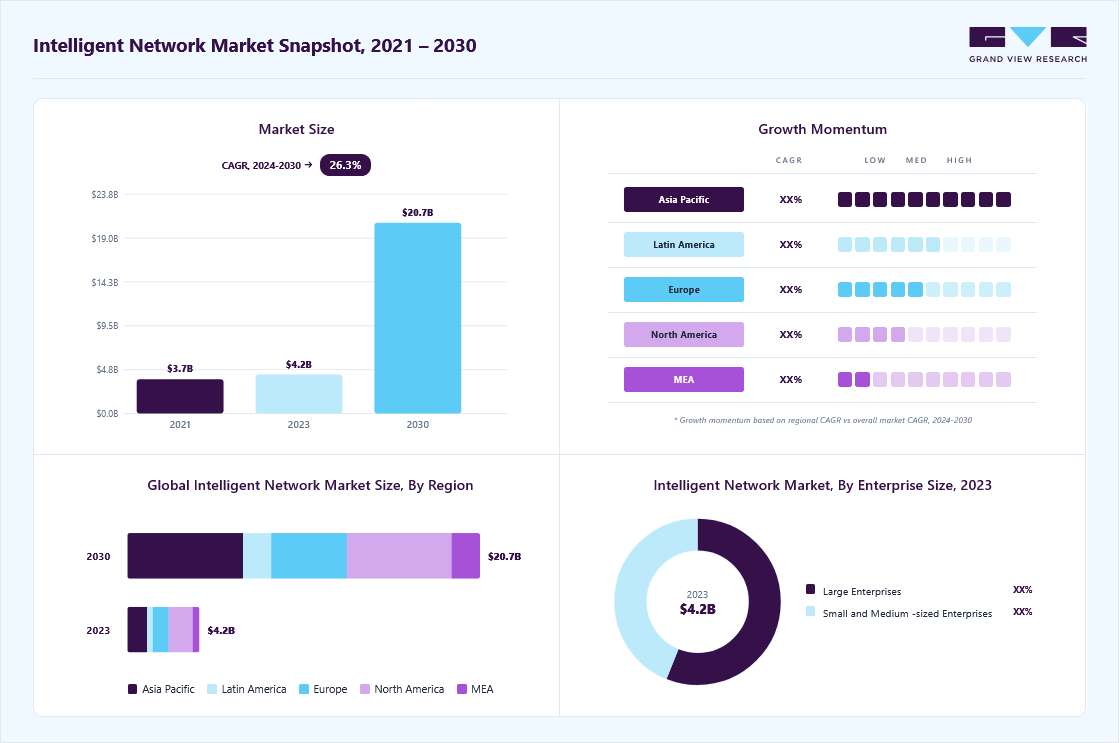
The global intelligent network market size was valued at USD 4.2 billion in 2023 and is projected to grow from USD 7.8 billion in 2026 to USD 20.7 billion by 2030, at a CAGR of 26.2% from 2024 to 2030. The market in North America dominated with a revenue share of 33.0% in 2023. The growth is driven by the telecom industry, which is experiencing significant increases in both interest and adoption of Artificial Intelligence (AI) and Machine Learning (ML) technologies.
 Source: Grand View Research, IR Documents, Primary Interviews, Paid DatabasesTo learn more about this report,
 Download Free Sample Report
 Key Market Trends & Insights
- The intelligent network market in North America held a significant share of a 33.0% share in 2023.
- The U.S. Intelligent Network market accounting for a substantial portion of the market share.
- By enterprise size, the large enterprises segment led the market, accounting for 56.0% of the global revenue in 2023.
- By application, the information cognition segment led the market and accounted for highest revenue of the global revenue in 2023.
- By end use, the cloud service provider segment led the market and accounted for highest revenue of the global revenue in 2023.
Market Size & Forecast
- 2023 Market Size: USD 4.24 Billion
- 2030 Projected Market Size: USD 20.69 Billion
- CAGR (2024-2030): 26.2%
- Asia Pacific: Largest market in 2023
Three ways to get this report
Buy it, customize it, or ask a question.Ask an Analyst
A direct answer, usually in 1 working day
- AccessReport author, directly
- Reply timeWithin 1 working day
- No sales callDirect answer only
- FormatEmail reply
- CostFree, no cost
Get the Full Report
What the study covers
- FormatsPDF · Excel · Dashboard
- Timeline2024–2030 annual, 2023 base
- Coverage20+ countries, 5 regions
- Companies10+ key players profiled
Customize the Report
20% free customization
- IncludeCountries, segments, points
- TailorTo your product definition
- ExtendDeeper competitor detail
- OrA fully bespoke study
- Turnaround5–10 working days
Although still in the early stages, the industry has moved beyond initial trials and lab testing, which were once considered cutting-edge. Intelligent networking is becoming mainstream as telecom companies increasingly utilize it for operational support, whether through deploying intelligence in next-generation networks or automating network management tasks like ticket correlation and predictive maintenance.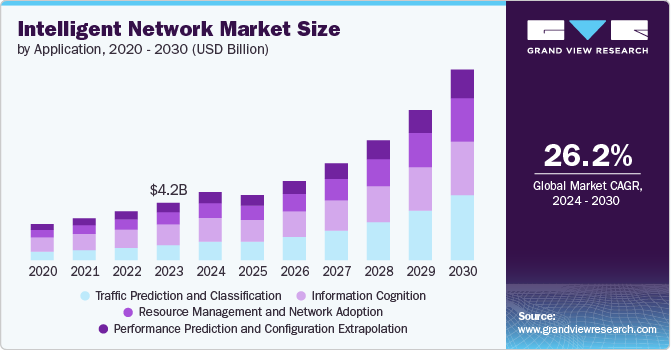 To learn more about this report, Download Free Sample Report
 The adoption of intelligent networks in telecommunications is propelling the growth of the intelligent network market. These networks enable automation of numerous functions, such as call routing and management, allowing operators to swiftly introduce new services to customers. Additionally, intelligent networks offer real-time network information, aiding in the diagnosis and resolution of network issues, enhancing performance, and reducing downtime. Advances in artificial intelligence and machine learning, along with the rising demand for cloud-based services, are further boosting market growth. Despite these positive factors, high deployment costs, cybersecurity issues, and complex integration are hindering the market's expansion. Conversely, the widespread deployment of 5G networks is expected to create significant opportunities for the growth of the intelligent network industry.
Enterprise Size Insights
The large enterprises segment led the market, accounting for 56.0%% of the global revenue in 2023. Large enterprises are experiencing significant growth in the market due to the advancement of technologies like artificial intelligence and machine learning, as these innovations enable real-time network data analysis, improved problem identification and resolution, enhanced network performance, and reduced downtime. The large-scale implementation of 5G networks presents a major opportunity for intelligent network growth in large enterprises, as it offers faster speeds, lower latency, and support for advanced services and applications like IoT and virtual reality. Large enterprises are increasingly disseminating their data and applications across multiple data centers, clouds, and edge environments, necessitating new networking architectures that are cloud-ready, meet application connectivity requirements, and maintain technical and operational consistency across sites.
The Small and Medium-sized Enterprises (SMEs) segment is estimated to grow significantly over the forecast period. The growth is attributed to digitalization, as with digital maturity and the adoption of digital technologies positively impacting SMEs' development and competitiveness in the rapidly evolving business landscape. Digitalization has enabled the shift towards software-defined networking, which centralizes management and provides a comprehensive platform for uniform policy application and enforcement throughout the network. This allows for more flexible, scalable, and efficient network operations. Moreover, the development of human capital, particularly in terms of digital skills and training, is crucial for SMEs to fully leverage technological advancements and drive growth. Finally, supportive public institutions and policies that facilitate SME development, such as those promoting digital transformation and providing access to resources, contribute significantly to the growth potential of SMEs in intelligent networks.
Application Insights
The information cognition segment led the market and accounted for highest revenue of the global revenue in 2023. The market for information cognition within intelligent networking is showing strong growth potential. It is expected to have a larger market share during the forecast period compared to other applications in the intelligent network market. This growth is driven by the increasing need for information cognition in accumulating network operational data, including network characteristics, trace routes, traffic matrices, and other data functionalities. Moreover, As networks continue to evolve and become more complex, the importance of information cognition in intelligent networking is likely to grow further. It will play a crucial role in enabling self-optimizing and self-healing networks, improving network agility, and supporting the delivery of innovative services to customers
Traffic prediction and classification are accounted to hold highest revenue growth over forecast period. Traffic prediction in intelligent networks has become increasingly sophisticated, leveraging various AI techniques to improve accuracy and efficiency. Long Short-Term Memory (LSTM) networks, have shown promising results in predicting network traffic patterns. These models can capture the temporal dependencies in network traffic data, allowing for more accurate forecasts. The integration of prior knowledge into prediction models is enhancing their performance and interpretability. For instance, incorporating the self-similarity of network traffic as prior knowledge into LSTM networks has improved prediction accuracy and provided more interpretable results. This approach addresses the limitations of traditional statistical models in extracting traffic features from inadequate sample data.
End-use Insights
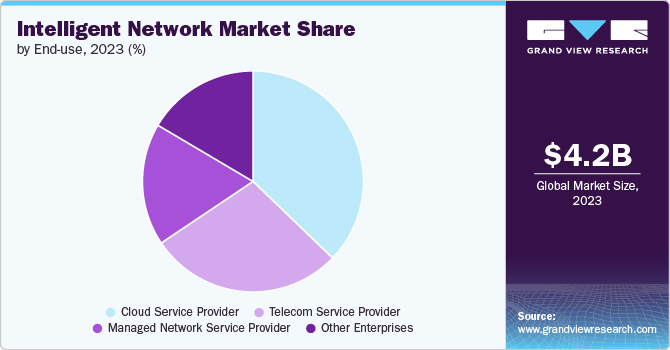
The cloud service provider segment led the market and accounted for highest revenue of the global revenue in 2023. Cloud Service Providers (CSPs) play a crucial role in enabling intelligent networks by offering scalable, on-demand computing resources and advanced services over the internet. In the context of intelligent networks, cloud service provider offers the infrastructure and platforms necessary for implementing sophisticated networking solutions that leverage artificial intelligence, machine learning, and automation. Moreover, These providers offer a range of services, including Infrastructure as a Service (IaaS), Platform as a Service (PaaS), and Software as a Service (SaaS), which form the foundation for building and deploying intelligent network applications. By utilizing cloud-based resources, organizations can implement advanced network management tools, analytics platforms, and AI-driven services that enhance network performance, security, and efficiency.
 To learn more about this report, Download Free Sample Report
 Telecom Service Provider is accounted to hold highest revenue growth over forecast period. The advent of 5G networks is anticipated to transform various broadband services and enhance connectivity across multiple end use sectors. Key factors driving market growth include the rise in mobile subscriptions, increased enterprise usage, online video streaming, the development of 5G infrastructure, and diverse IoT applications leveraging 5G. moreover, Telecom providers leverage IN to deliver services like prepaid calling, virtual private networks, and universal personal telecommunications, enhancing the customer experience and operational efficiency. The use of protocols like Signaling System #7 (SS7) supports communication between network nodes, ensuring seamless service delivery across different network segments
Regional Insight
Theintelligent network market in North Americaheld a significant share of a 33.0% share in 2023. The North American region is anticipated to hold a substantial market share during the forecast period. This is largely due to the rising adoption of intelligent networking solutions, fueled by the advancement of technologies like analytics, deep learning, and network virtualization. Moreover, the demand for advanced technologies such as machine-to-machine communication, connected cars, and artificial intelligence is higher in this region compared to others. Consequently, it is expected to present significant opportunities for the 5G network, thereby driving market growth.
U.S. Intelligent Network Market Trends
The U.S. Intelligent Network market in North America accounting for a substantial portion of the market share. The U.S. market is driven by the growth of advanced technologies such as analytics, deep learning, and network virtualization. There's also increasing demand for machine-to-machine communication, connected cars, and artificial intelligence, which are fueling the need for intelligent networks.
Europe Intelligent Network Market Trends
Intelligent networking in Europe is poised for significant growth, driven by technological advancements, the rollout of 5G, and a strong focus on digital transformation and smart solutions. Europe leads in adopting AI, ML, and IoT, supported by proactive regulatory frameworks and substantial investments. The widespread deployment of 5G networks acts as a major catalyst, requiring sophisticated network management and optimization provided by intelligent networks. Key applications include smart cities, connected and autonomous vehicles, Industry 4.0, and healthcare, all of which benefit from the enhanced efficiency and reliability of intelligent networking.
Asia Pacific Intelligent Network Market Trends
Asia Pacific intelligent networkingis anticipated to witness the highest growth during the forecast period, Countries like China, South Korea, and Japan are leading the way in 5G implementation, necessitating sophisticated network management and optimization. The region's significant advancements in AI, ML, and IoT are being integrated into network systems to provide real-time monitoring and predictive maintenance. Key applications include telecommunications, manufacturing, healthcare, and retail, where intelligent networks enhance efficiency and customer experience.
Key Intelligent Network Companies Insights
Prominent firms have used product launches and developments, followed by expansions, mergers and acquisitions, partnerships, and collaborations contracts, agreements, as their primary business strategy to increase their market share. The companies have used various techniques to enhance market penetration and boost their position in the competitive industry. For instance, In July 2024, Nokia Corporation announced new partnership with telecom Egypt to bring 5G technology to Egypt for the first time. This new agreement with Nokia further strengthens telecom Egypt’s strong partnership, reaffirms telecom Egypt commitment to providing cutting-edge digital services, and positions the company at the forefront of the 5G revolution.
Key Intelligent Network Companies:
The following are the leading companies in the intelligent network market. These companies collectively hold the largest market share and dictate industry trends.
- Cisco Systems
- Aruba Networks
- Huawei Technologies
- Nokia Corporation
- Juniper Networks
- Colt Technology Services
- Netcracker Inc.
- Snadvine
- Loom Systems
- Aricent Inc.
- Aria Networks
- APCON Inc.
Recent Developments
-
In June 2023, Nokia has globally introduced new products to strengthen its AirScale baseband portfolio, renowned for its exceptional performance, capacity, and energy efficiency. Among the innovations are two advanced 5G baseband capacity cards named Levante and Lodos. Additionally, Nokia has unveiled Ponente, a new high-performance baseband control card boasting unprecedented throughput capacity.
-
In November 2023, Huawei has introduced the 5.5G Intelligent Core Network Solution, designed to enable a broader range of new business opportunities. This solution leverages native intelligence, enhancing capabilities in service intelligence, network intelligence, and operational management (O&M) intelligence. These advancements aim to support a diverse array of new business ventures and contribute to creating a smarter, more interconnected world.
Intelligent Network Market Report Scope
Report Attribute
Details
Market size in 2023
USD 4.2 billion
Estimated market size in 2026
USD 7.8 billion
Projected market size by 2030
USD 20.7 billion
Growth rate
CAGR of 26.2% from 2024 to 2030
Base year for estimation
2023
Historical data
2018 - 2022
Forecast period
2024 - 2030
Quantitative units
Revenue in USD million/billion and CAGR from 2024 to 2030
Report coverage
Revenue forecast, company ranking, competitive landscape, growth factors, and trends
Segments covered
Enterprise size, application, end-use, region
Regional scope
North America; Europe; Asia Pacific; Latin America; MEA
Country scope
U.S.; Canada; UK; Germany; France; China; Japan; India; South Korea; Australia; Brazil; Mexico; Kingdom of Saudi Arabia (KSA); UAE; South Africa
Key companies profiled
Cisco Systems; Aruba Networks; Huawei Technologies; Nokia Corporation; Juniper Networks; Colt Technology Services; Netcracker Inc.; Snadvine; Loom Systems; Aricent Inc.; Aria Networks; APCON Inc.
Customization scope
Free report customization (equivalent up to 8 analysts working days) with purchase. Addition or alteration to country, regional & segment scope.
Pricing and purchase options
Avail customized purchase options to meet your exact research needs. Explore purchase options
Global Intelligent Network Market Report Segmentation
This report forecasts revenue growth at global, regional, and country levels and provides an analysis of the latest industry trends in each of the sub-segments from 2018 to 2030. For this study, Grand View Research has segmented the global intelligent network market report based on enterprise size, application, end-use and region:
-
Enterprise Size Outlook (Revenue, USD Billion, 2018 - 2030)
-
Small and Medium-Sized Enterprises
-
Large Enterprises
-
-
Application Outlook (Revenue, USD Billion, 2018 - 2030)
-
Information Cognition
-
Traffic Prediction and Classification
-
Resource Management and Network Adoption
-
Performance Prediction and Configuration Extrapolation
-
-
End-use Outlook (Revenue, USD Billion, 2018 - 2030)
-
Telecom Service Provider
-
Cloud Service Provider
-
Managed Network Service Provider
-
Other Enterprises
-
-
Regional Outlook (Revenue, USD Billion, 2018 - 2030)
-
North America
-
U.S.
-
Canada
-
-
Europe
-
Germany
-
UK
-
France
-
-
Asia Pacific
-
China
-
Japan
-
India
-
South Korea
-
Australia
-
-
Latin America
-
Brazil
-
Mexico
-
-
Middle East and Africa (MEA)
-
Kingdom of Saudi Arabia
-
UAE
-
South Africa
-
-
Frequently Asked Questions About This Report
The global intelligent network market size was valued at USD 4.2 billion in 2023 and is estimated at USD 7.8 billion for 2026.
The global intelligent network market is expected to grow at a CAGR of 26.2% from 2024 to 2030, reaching USD 20.7 billion by 2030.
North America dominated the Intelligent Network market with a share of 33.0% in 2023. The North American region is anticipated to hold a substantial market share during the forecast period. This is largely due to the rising adoption of intelligent networking solutions, fueled by the advancement of technologies like analytics, deep learning, and network virtualization.
Some key players operating in the Intelligent Network market include Cisco Systems, Aruba Networks, Huawei Technologies, Nokia Corporation, Juniper Networks, Colt Technology Services, Netcracker Inc., Snadvine, Loom Systems, Aricent Inc., Aria Networks, APCON Inc.
Key factors that are driving the market growth include The adoption of intelligent networks in telecommunications is propelling the growth of the intelligent network market. These networks enable automation of numerous functions, such as call routing and management, allowing operators to swiftly introduce new services to customers.
About the Author(s)
Next Generation Technologies Research Team
Technology · Next Generation TechnologiesThis report was authored by the next generation technologies research team at Grand View Research - comprising two research analysts, one senior research analyst, and one industry expert - with specialized expertise in the next generation technologies segment of the technology industry. All findings are based on proprietary technology databases, executive interviews, and regulatory analysis, subject to internal peer review prior to publication.
Last Updated:
Speak to Analyst

Customize this report to your needs - add regions, segments, or data points, with 20% free customization.
Or view our licence options:


ISO 9001:2015 & 27001:2022 Certified
We are GDPR and CCPA compliant! Your transaction & personal information is safe and secure. For more details, please read our privacy policy.


