
- Home
- »
- Next Generation Technologies
- »
-
Internet of Things Analytics Market Size, Growth Report, 2026-2033GVR Report cover

Internet Of Things Analytics Market (2026 - 2033)
Size, Share & Trends Analysis Report By Component, By Organization Size, By Deployment, By Type, By Application, By End Use, By Region, And Segment Forecasts
Market Size, 2023
$42.6BMarket Estimate, 2026
$53.1BMarket Forecast, 2030
$305.8BCAGR, 2024–2030
28.3%Internet of Things Analytics Market Summary
The global Internet of Things analytics market size was valued at USD 42.6 billion in 2025 and is projected to grow from USD 53.1 billion in 2026 to USD 305.8 billion in 2033, at a CAGR of 28.3% from 2026 to 2033. North America dominated the market, accounting for a revenue share of 30.0% in 2025. Key factors driving market growth include extensive data generation from the rising adoption of Internet of Things (IoT)-enabled devices, a growing inclination towards automating multiple business processes, and increasing demand for advanced analytics across numerous industries.
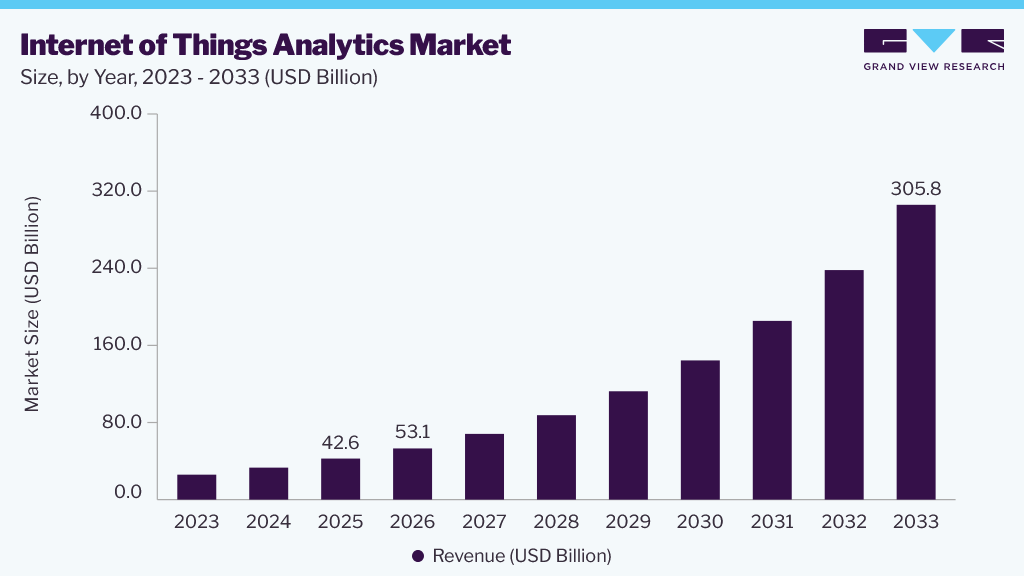 Source: Grand View Research, IR Documents, Primary Interviews, Paid DatabasesTo learn more about this report,
 Download Free Sample Report
Key Market Trends & Insights
- By component, the solutions segment dominated the market and accounted for a revenue share of around 70.0% in 2025.
- By organization size, the small and medium-sized enterprises (SMEs) segment held the largest revenue share in 2025.
- By deployment, the cloud deployment segment accounted for the largest market revenue share in 2025.
- By type, the descriptive analytics segment dominated the global industry in 2025.
- By end-use, the manufacturing sector segment dominated the global industry in 2025.
Regional Highlights
- Largest regional market: North America (30.0% revenue share, 2025)
- Fastest-growing regional market: Asia Pacific (highest CAGR, 2026-2033)
Market Size & Forecast
- Market size in 2025: USD 42.6 Billion
- Estimated market size in 2026: USD 53.1 Billion
- Projected market size by 2033: USD 305.8 Billion
- CAGR (2026-2033): 28.3%
Three ways to get this report
Buy it, customize it, or ask a question.Ask an Analyst
Analyst response in 1 business day
- AccessReport author, directly
- Reply timeWithin 1 working day
- No sales callDirect answer only
- FormatEmail reply
- CostFree, no cost
Get the Full Report
What the study covers
- FormatsPDF · Excel · Dashboard
- Timeline2024–2030 annual, 2023 base
- Coverage20+ countries, 5 regions
- Companies10+ key players profiled
Customize the Report
20% free customization
- IncludeCountries, segments, points
- TailorTo your product definition
- ExtendDeeper competitor detail
- OrA fully bespoke study
- Turnaround5–10 working days
Internet of Things analytics is widely adopted by organizations to design advanced products and services that meet changing consumer demands. IoT data analytics is used to detect anomalies and potential security vulnerabilities. Its ability to manage the diversity and scalability of data generated by numerous devices provides valuable assistance to a wide range of application industries. Rising automation and the adoption of robotic systems by several manufacturing businesses have created a growing need for Internet of Things data analytics solutions across multiple sectors. These solutions help users gain a deeper understanding of business functions and receive detailed insights, thereby improving operational, product, time, and marketing decisions.
Predictive analytics has become a vital feature of the modern business world. For instance, autonomous vehicles used for package delivery rely on the Global Positioning System (GPS) to ensure timely delivery via the most efficient route. GPS utilizes a predictive vehicle control algorithm to select the most efficient route. Future outcomes are predicted using predictive measurements, past information, statistical techniques, and machine learning, leveraging Internet of Things data analysis.
Analyst Perspective
The global Internet of Things (IoT) Analytics market is evolving from a data-monitoring solution to a critical enabler of intelligent, data-driven business operations. The rapid expansion of connected devices fuels this growth, along with the increasing adoption of Industry 4.0 and the rising demand for real-time insights that improve operational efficiency, enable predictive maintenance, and enhance customer experiences. To capitalize on this momentum, leading technology providers are expanding their portfolios with AI-powered analytics, cloud-native platforms, edge computing capabilities, and industry-specific IoT solutions to enable faster, more informed decision-making. However, the market continues to face challenges related to data security, interoperability across diverse IoT ecosystems, and the complexity of managing massive volumes of data from connected devices. Companies that invest in scalable cloud infrastructure, advanced AI and machine learning capabilities, and robust cybersecurity frameworks while ensuring seamless integration across enterprise systems will be best positioned to strengthen their competitive advantage in the rapidly evolving IoT analytics landscape.
Component Insights
The solutions segment dominated the market, accounting for around 70.0% of revenue in 2025. This growth is attributed to the increasing demand for automation, the rising need for efficient solutions to analyze the enormous amounts of data generated by IoT devices, and improved operational efficiency. These software solutions are essential for storing, collecting, and processing IoT data. Some IoT analytics solutions include AWS IoT Analytics, SAP Analytics Cloud, Oracle Stream Analytics, and Oracle Edge Analytics.
The services segment is expected to experience the fastest CAGR during the forecast period. IoT analytics services include predictive analytics, diagnostic analytics, predictive maintenance, data visualization and reporting, IoT data management, and so on. These services help reduce operational expenses by implementing automation, optimizing resource use, and generating additional revenue by addressing issues and obstacles. Moreover, these services offer greater precision in identifying problems, leading to more practical problem-solving and quicker resolutions.
Organization Size Insights
The small and medium-sized enterprises (SMEs) segment accounted for the largest revenue share in 2025. IoT analytics empowers SMEs with tailored approaches to deliver effective solutions and optimize processes. According to the U.S. Small Business Administration Office of Advocacy, nearly 33,185,550 SMEs operate in the U.S., and approximately 38% of small businesses utilize specialized software in routine business operations. Cloud IoT solutions designed for SMEs help companies reduce costs by eliminating the need for in-house software and hardware. These solutions improve productivity and efficiency. In addition, SMEs can use big data analytics to forecast buyers' perspectives using historical data. These aspects are expected to drive an upsurge in demand for this segment.
The large enterprise segment is expected to experience significant growth during the forecast period. Large enterprises have enormous resources and various operating procedures, enabling them to adopt Internet of Things analytics solutions easily. The resources at hand, large amounts of raw data, and the availability of multiple solutions and services are expected to generate greater growth for this segment in the coming years.
Deployment Insights
The cloud deployment segment accounted for the largest market revenue share in 2025. Cloud-based computing and data analytics have increased the need for data management and analysis. The cloud environment enables organizations without the infrastructure and expertise to implement robust resource and cost allocation across numerous use cases. Cloud services' ability, flexibility, and affordability enable companies to adopt cloud IoT solutions. For instance, in April 2025, Capgemini expanded its strategic partnership with Google Cloud to deliver industry-specific agentic AI and cloud-based analytics solutions, enabling enterprises to process, analyze, and optimize IoT data through scalable cloud deployments across the manufacturing, retail, and energy sectors.
The on-premise deployment segment is projected to experience a significant CAGR during the forecast period. This segment is driven by application industries that prefer complete control over data accessibility and analytics. Often, large enterprises and medium-scale businesses choose to deploy on-premise solutions. Alarming data security incidents and rising data loss cases are driving growth in this segment.
Type Insights
The descriptive analytics segment dominated the global industry in 2025. Descriptive analytics help businesses interpret and comprehend the real-time data generated by IoT-connected devices. This form of analytics helps identify irregularities, identify an organization's areas for improvement, understand the performance of a specific function or operational element, grasp usage patterns of a device by users or internally, and so on. For instance, in May 2025, Hitachi Digital Services launched the Industrial AI and IoT Center of Excellence (CoE) to help enterprises leverage IoT data through real-time dashboards, asset monitoring, and operational performance reporting, strengthening descriptive analytics for connected industrial environments.
The prescriptive analytics segment is anticipated to experience the fastest CAGR over the forecast period. It is one of the more advanced capabilities in analytics. Prescriptive analytics provides additional insights on potential actions that can influence outcomes from other types, such as descriptive, diagnostic, or predictive analytics. It helps organizations better understand failure prevention and enhance efficiency.
End Use Insights
The manufacturing sector accounted for the largest share of revenue in 2025. IoT analytics applications in manufacturing businesses improve customer service, enhance product quality, and increase production efficiency. Industrial companies must test and monitor products in a virtual environment, enabling them to detect and resolve potential problems before introducing them to the market. Companies gain deeper insights into the performance of their existing manufacturing practices and identify opportunities to enhance productivity through intelligent manufacturing technologies. Increased inclination towards automation, the growing need for reliable data analytics solutions, expansions in manufacturing capacity across multiple businesses, and the need for accuracy in production have driven this segment. For instance, in May 2026, Siemens launched Industrial AI Agents for the Industrial Copilot ecosystem, enabling autonomous analysis of IoT-generated industrial data, predictive maintenance, and real-time operational optimization across manufacturing environments, strengthening industrial IoT analytics capabilities.
The healthcare & life sciences segment is anticipated to experience the fastest CAGR over the forecast period. The application of IoT analytics in the healthcare industry is driving a shift towards a patient-focused, comprehensive service approach, enabled by its valuable insights. Medical professionals have gained greater insight into their patients' health through innovative healthcare apps integrated with smartphones and connected medical devices, such as wearables and intelligent hospital beds. Additional patient insights reveal potential risks and help healthcare providers take early action in treating patients.
Regional Insights
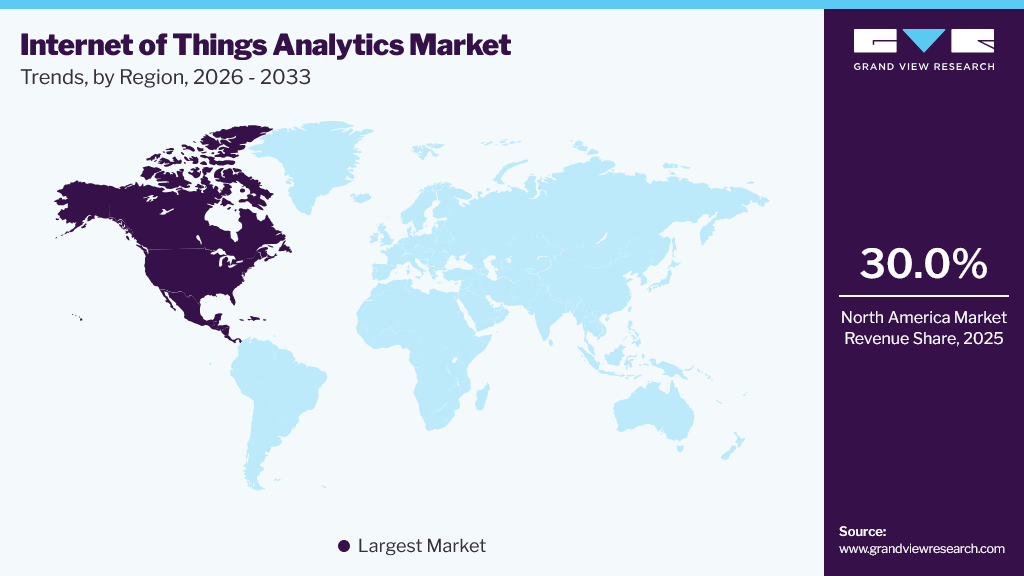
North America Internet of Things analytics market dominated the market, accounting for a revenue share of 30.0% in 2025. Early adoption trends in the region, the presence of multiple large enterprises and SMEs that have implemented IoT analytics, growing demand for data management, the availability of numerous service providers in the industry, and a significant number of opportunities developed by the ever-increasing retail businesses are expected to assist this regional industry in attaining higher growth in the coming years.
 To learn more about this report, Download Free Sample Report
The U.S. Internet of Things analytics market accounted for the largest revenue share of the regional industry in 2025. The presence of several large manufacturing enterprises, the increased availability of raw data generated across different channels, devices, processes, and systems, the growing dependence of multiple business functions on data interpretation, and ease of access are among the critical growth drivers for this market.
The Asia Pacific Internet of Things analytics market is anticipated to experience the fastest growth during the forecast period. Rising Internet and social media usage in this region has been contributing to the growth of this regional industry. The proliferation of connected devices and the Internet of Things (IoT) powered devices in the region has amplified the need for robust IoT analytics solutions to secure the vast amount of data generated by these devices. For instance, in April 2024, XL Axiata collaborated with Cisco to launch the IoT Connectivity+ Product, a cloud-based IoT Connectivity Management Platform, to help Indonesian customers securely expand and advance their IoT enterprises.
The China Internet of Things market accounted for a substantial share of total revenue in 2025. As Chinese enterprises embrace digital transformation, they generate and handle vast amounts of data, necessitating IoT solutions. This trend is further accelerated by the proliferation of mobile devices, wearables, IoT (Internet of Things) deployments, social media platforms, and the expansion of online services, increasing the surface area for vast amounts of data.
Key Internet of Things Analytics Market Company Insights
The Internet of Things analytics industry features a range of global, regional, and local players, making it a competitive market. The world’s leading companies are using partnerships, collaborations, acquisitions, mergers, and agreements as strategies to withstand the intense competition and increase their market share. Internet of Things analytics product manufacturers are investing heavily in product enhancements and new product development. As competition in the market intensifies, key market participants are adopting strategies such as innovation, enhanced research & development, collaborations, new product launches, service differentiation, and geographic expansion.
Key Internet of Things Analytics Companies
The following key companies have been profiled for this study on the Internet of Things analytics market:
-
Accenture plc
-
Aeris Communications, Inc.
-
Amazon Web Services, Inc.
-
Cisco Systems, Inc.
-
Dell Technologies Inc.
-
Hewlett Packard Enterprise Company
-
Google LLC
-
OpenText Corporation
-
Microsoft Corporation
-
Oracle Corporation
-
PTC Inc.
-
Salesforce, Inc.
-
SAP SE
-
SAS Institute Inc.
-
Software AG
-
Teradata Corporation
Recent Developments
-
In April 2025, PTC Inc. introduced Codebeamer AI, bringing generative AI capabilities to application lifecycle management for connected products. The solution enhances IoT analytics by enabling faster requirements analysis, intelligent engineering workflows, and improved decision-making across connected device ecosystems.
-
In March 2025, Cisco Systems, Inc. launched Provider Connectivity Assurance, an AI-powered analytics solution under its Agile Services Networking portfolio at MWC 2025. The platform enables communication service providers to optimize mobile and IoT network performance through real-time analytics, predictive insights, and automated assurance.
Internet of Things Analytics Market Report Scope
Report Attribute
Details
Market size in 2025
USD 42.6 billion
Estimated market size in 2026
USD 53.1 billion
Projected market size by 2033
USD 305.8 billion
Growth rate
CAGR of 28.3% from 2026 to 2033
Base year for estimation
2025
Historical data
2021 – 2024
Forecast period
2026 – 2033
Quantitative units
Revenue in USD billion/million, and CAGR from 2026 to 2033
Report coverage
Revenue forecast, company ranking, competitive landscape, growth factors, and trends
Segments covered
Component, organization size, deployment, type, application, end use, and region
Regional scope
North America; Europe; Asia Pacific; Latin America; MEA
Country scope
U.S.; Canada; Mexico; Germany; UK; France; China; Japan; India; South Korea; Australia; Brazil; South Arabia; UAE; South Africa
Key companies profiled
Accenture plc; Aeris Communications, Inc.; Amazon Web Services, Inc.; Cisco Systems, Inc.; Dell Technologies Inc.; Hewlett Packard Enterprise Company; Google LLC; OpenText Corporation; Microsoft Corporation; Oracle Corporation; PTC Inc.; Salesforce, Inc.; SAP SE; SAS Institute Inc.; Software AG; Teradata Corporation
Customization scope
Free report customization (equivalent up to 8 analysts working days) with purchase. Addition or alteration to country, regional & segment scope.
Pricing and purchase options
Avail of customized purchase options to meet your exact research needs. Explore purchase options
Global Internet of Things Analytics Market Report Segmentation
This report forecasts revenue growth at global, regional, and country levels and provides an analysis of the latest industry trends and opportunities in each of the sub-segments from 2021 to 2033. For this study, Grand View Research has segmented the global Internet of Things analytics market report based on component, organization size, deployment, application, type, end use, and region:
-
Component Outlook (Revenue, USD Million, 2021 - 2033)
-
Solution
-
Services
-
-
Organization Size Outlook (Revenue, USD Million, 2021 - 2033)
-
Small & Medium Enterprises (SMEs)
-
Large Enterprises
-
-
Deployment Outlook (Revenue, USD Million, 2021 - 2033)
-
On-Premises
-
Cloud
-
-
Application Outlook (Revenue, USD Million, 2021 - 2033)
-
Energy Management
-
Predictive Maintenance
-
Asset Management
-
Inventory Management
-
Remote Monitoring
-
Others
-
-
Type Outlook (Revenue, USD Million, 2021 - 2033)
-
Descriptive Analytics
-
Diagnostic Analytics
-
Predictive Analytics
-
Prescriptive Analytics
-
-
End Use Outlook (Revenue, USD Million, 2021 - 2033)
-
-
Manufacturing
-
Energy & Utilities
-
Retail & E-commerce
-
Healthcare & Life Sciences
-
Transportation & Logistics
-
IT & Telecom
-
Others
-
-
Regional Outlook (Revenue, USD Million, 2021 - 2033)
-
North America
-
U.S.
-
Canada
-
Mexico
-
-
Europe
-
Germany
-
UK
-
France
-
-
Asia Pacific
-
China
-
Japan
-
India
-
South Korea
-
Australia
-
-
Latin America
-
Brazil
-
-
Middle East and Africa (MEA)
-
South Arabia
-
UAE
-
South Africa
-
-
-
Frequently Asked Questions About This Report
The global Internet of Things analytics market size was valued at USD 42.6 billion in 2025 and is estimated at USD 53.1 billion for 2026
The global Internet of Things analytics market is expected to grow at a CAGR of 28.3% from 2026 to 2033, reaching USD 305.8 billion.
North America dominated with an over 30.0% revenue share in 2025.
Key players in the market include Accenture plc; Aeris Communications, Inc.; Amazon Web Services, Inc.; Cisco Systems, Inc.; Dell Technologies Inc.; Hewlett Packard Enterprise Company; Google LLC; OpenText Corporation; Microsoft Corporation; Oracle Corporation; PTC Inc.; Salesforce, Inc.; SAP SE; SAS Institute Inc.; Software AG; Teradata Corporation, and others.
The solutions segment accounted for the largest revenue share of approximately 70.0% in 2025
About the Author(s)
Next Generation Technologies Research Team
Technology · Next Generation TechnologiesThis report was authored by the next generation technologies research team at Grand View Research - comprising two research analysts, one senior research analyst, and one industry expert - with specialized expertise in the next generation technologies segment of the technology industry. All findings are based on proprietary technology databases, executive interviews, and regulatory analysis, subject to internal peer review prior to publication.
Last Updated:
Speak to Analyst

Customize this report to your needs - add regions, segments, or data points, with 20% free customization.
Or view our licence options:


ISO 9001:2015 & 27001:2022 Certified
We are GDPR and CCPA compliant! Your transaction & personal information is safe and secure. For more details, please read our privacy policy.


