
- Home
- »
- Network Security
- »
-
IoT Identity and Access Management Market Report, 2033GVR Report cover
![IoT Identity and Access Management Market (2026 - 2033)Report]()
IoT Identity and Access Management Market (2026 - 2033)
Size, Share, & Trends Analysis Report By Component, By Authentication Type, By Deployment, By Organization Size, By End User, By Region, And Segment Forecasts
Market Size, 2025
$6.2BMarket Estimate, 2026
$7.2BMarket Forecast, 2033
$23.5BCAGR, 2026–2033
18.4%IoT Identity and Access Management Market Summary
The global IoT identity and access management market size was valued at USD 6.2 billion in 2025 and is projected to grow from USD 7.2 billion in 2026 to USD 23.5 billion by 2033, at a CAGR of 18.4% from 2026 to 2033. The market in North America dominated with a revenue share of 38.5% in 2025. The market is evolving from traditional device authentication toward comprehensive management of non-human identities, including sensors, gateways, connected machines, vehicles, applications, APIs, and autonomous machine agents.

Key Market Trends & Insights
- By component: Solutions segment held the largest market share of 69.0% in 2025.
- By authentication type: Multi-factor authentication (MFA) segment held the largest market share of 31.7% in 2025.
- By deployment: Cloud segment held the largest market share in 2025.
- By organization size: Large enterprises segment held the largest market share in 2025.
- By end user: Manufacturing segment held the largest market share in 2025.
Regional Highlights
- Largest regional market: North America (38.5% revenue share, 2025)
- Fastest-growing regional market: Asia Pacific (highest CAGR, 2026-2033)
- By country: The U.S. held the largest market share in 2025
Market Size & Forecast
- Market size in 2025: USD 6.2 Billion
- Estimated market size in 2026: USD 7.2 Billion
- Projected market size by 2033: USD 23.5 Billion
- CAGR (2026-2033): 18.4%
The rapid expansion of heterogeneous IoT ecosystems is increasing the need to uniquely identify devices, control their permissions, monitor their activities, and manage credentials throughout their lifecycle. Zero Trust is becoming a central architecture for IoT IAM, replacing implicit network-based trust with continuous verification of devices, users, applications, and data flows. Organizations are increasingly adopting least-privilege access, micro-segmentation, continuous authentication, device posture assessment, and risk-based authorization to prevent compromised IoT devices from moving laterally across networks. Recent research specifically identifies Zero Trust as increasingly important for securing resource-constrained IoT environments and managing non-human identities.
Another important trend is the growing adoption of certificate- and PKI-based device identity management. As organizations manage increasingly large and geographically distributed device fleets, manually provisioning and rotating credentials becomes impractical. Automated onboarding, certificate issuance, renewal, rotation, and revocation are therefore becoming critical capabilities. In November 2025, NIST released updated guidance focused specifically on secure IoT device onboarding and lifecycle credential management, reinforcing the shift toward scalable, automated device identity processes.
Cloud and edge computing are also reshaping IoT IAM architectures. Cloud-based platforms provide centralized visibility and policy management across large device fleets, while edge environments require lightweight and distributed identity and access controls capable of operating with low latency and intermittent connectivity. At the same time, the convergence of IT, OT, and IoT is encouraging organizations to integrate IAM with endpoint security, network security, SIEM, and broader security operations platforms rather than managing device identities in isolation.
Market Dynamics
The IoT identity & access management market is primarily driven by the rapid proliferation of connected devices and the growing cybersecurity risks associated with unmanaged device identities. As enterprises deploy larger fleets of sensors, industrial controllers, connected vehicles, medical devices, and edge devices, conventional identity-management approaches are increasingly inadequate for managing machine identities at scale. Rising cyberattacks targeting IoT environments, stricter security requirements, and the adoption of Zero Trust architectures are further encouraging organizations to implement continuous authentication, least-privilege access, device posture verification, and automated credential management. Recent NIST guidance also emphasizes trusted, automated IoT onboarding and lifecycle management as important mechanisms for preventing unauthorized devices from accessing networks.
However, high implementation complexity, fragmented IoT ecosystems, legacy infrastructure, and interoperability challenges can restrain adoption, particularly among organizations operating heterogeneous devices and resource-constrained endpoints. IoT IAM solutions must support diverse protocols, hardware capabilities, operating environments, and cloud/edge architectures while maintaining low latency and operational continuity. At the same time, these challenges are creating opportunities for cloud-based IAM, PKI and certificate lifecycle management, passwordless authentication, AI-driven access control, and managed IoT security services. The increasing convergence of IT, OT, and IoT, along with the emergence of AI-enabled connected systems, is expected to further expand the role of IAM from basic authentication toward continuous, risk-based identity governance.
The rapid deployment of IoT devices across manufacturing, healthcare, energy & utilities, automotive, smart infrastructure, and enterprise environments is significantly increasing the number of machine identities that organizations need to authenticate and manage. Unlike conventional users, IoT devices often operate continuously and communicate autonomously with other devices, applications, and cloud platforms, creating a need for dedicated identity provisioning, authentication, authorization, and credential lifecycle management. The increasing focus on trusted device onboarding is further strengthening demand, with NIST emphasizing device identity and posture verification before network credentials are provisioned.
IoT ecosystems consist of devices with different operating systems, hardware capabilities, communication protocols, security mechanisms, and lifecycle requirements. Integrating IAM solutions across legacy equipment, cloud platforms, edge environments, and IT/OT networks can therefore require substantial configuration and integration efforts. Resource-constrained IoT devices may also have limited processing power or storage for sophisticated authentication mechanisms, while inconsistent identity standards across vendors can make centralized policy enforcement difficult. These factors can increase implementation costs and discourage smaller organizations from deploying comprehensive IoT IAM solutions.
The growing need to securely onboard and continuously manage large device fleets is creating opportunities for IAM vendors to provide automated, scalable identity lifecycle capabilities. Solutions that can automatically authenticate devices, provision unique credentials, assess device posture, rotate or revoke credentials, and adjust access privileges throughout the device lifecycle can reduce manual intervention while improving security. NIST's 2025 guidance specifically promotes scalable and automated trusted IoT onboarding and lifecycle management, highlighting the increasing importance of automated identity processes as IoT deployments expand.
Market Concentration & Characteristics
The global IoT identity & access management market is moderately concentrated, with participation from established identity and cybersecurity vendors, cloud and enterprise technology providers, IoT security specialists, and companies offering device identity and authentication solutions. Leading players such as Microsoft, IBM, Cisco, Okta, Thales, Entrust, HID Global, and DigiCert are strengthening their market presence through device identity management, authentication, authorization, certificate management, and identity lifecycle solutions designed for enterprise, industrial, healthcare, automotive, and critical infrastructure environments. Alongside established vendors, specialized providers are expanding their portfolios with IoT device identity platforms, PKI-based authentication, certificate lifecycle management, zero-trust access controls, and machine identity solutions tailored to diverse IoT ecosystems. The competitive landscape is also influenced by vendors' ability to integrate IoT IAM with existing IAM, PKI, SIEM, endpoint security, cloud security, and OT security environments, while supporting large-scale and heterogeneous connected-device deployments.
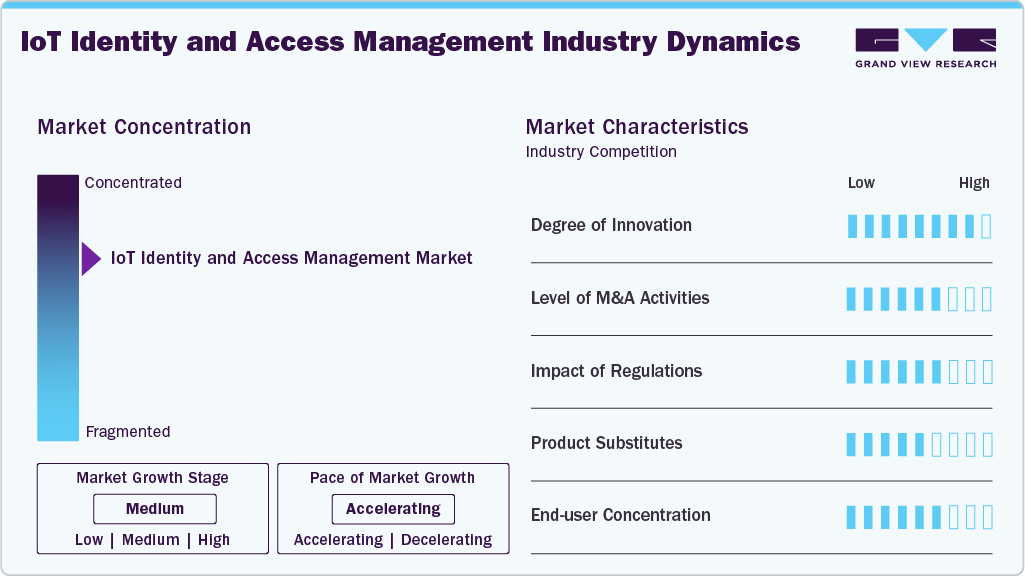
The IoT identity & access management market is characterized by increasing technological development focused on improving authentication security, scalability, interoperability, automation, and lifecycle management of connected-device identities. Vendors are developing solutions capable of managing millions of device identities while providing continuous authentication, granular authorization, credential rotation, and real-time access control across cloud, edge, and on-premises environments. Growing demand for protection against compromised IoT devices is encouraging the integration of IoT IAM with Zero Trust architectures, behavioral analytics, network segmentation, security monitoring, and automated threat detection platforms. The market is also witnessing increased adoption of PKI and certificate-based authentication, passwordless authentication, multi-factor authentication, and automated device onboarding to address the limitations of conventional credentials. Furthermore, rising cybersecurity regulations, increasing IT-OT convergence, proliferation of machine identities, and the emergence of AI-enabled connected devices are encouraging organizations to incorporate IoT IAM into broader identity security and defense-in-depth strategies.
Analyst Perspective
The IoT Identity and Access Management market is transitioning from basic device authentication toward continuous, machine-centric identity governance, driven by the rapid expansion of connected devices and increasingly distributed IoT environments. Vendors are increasingly differentiating through Zero Trust, automated device onboarding, certificate lifecycle management, passwordless authentication, and risk-based access controls. Cloud-based platforms are gaining traction for scalability, while specialized capabilities remain important for industrial, healthcare, and other sensitive environments. Overall, vendors that combine scalable IAM platforms with strong IoT device identity, automation, and interoperability are likely to gain a competitive advantage.
Component Insights
The solutions segment accounts for the largest share of 69.0% in 2025 in the IoT identity and access management market, driven by the growing need for scalable device identity, authentication, authorization, credential management, and access-control capabilities across rapidly expanding IoT ecosystems. The increasing focus on identifying and addressing vulnerabilities across connected devices is further encouraging organizations to adopt dedicated IoT security and identity solutions, particularly as weak authentication mechanisms and insecure device configurations can expose broader enterprise networks to unauthorized access. For instance, in April 2024, GuidePoint Security introduced its IoT Security Assessment, which evaluates IoT device hardware, firmware, networking, and supporting infrastructure to identify security weaknesses and help organizations prevent unauthorized access to their IoT ecosystems. Consequently, rising IoT security risks and the need for purpose-built identity and access controls are expected to sustain the dominance of the solutions segment throughout the forecast period.
The services segment is expected to witness significant CAGR from 2026 to 2033 in the IoT identity and access management market due to the increasing complexity of deploying, integrating, and managing identity solutions across heterogeneous IoT environments. Organizations increasingly require specialized consulting, implementation and integration, managed services, and support and maintenance to connect IoT IAM platforms with existing IT, OT, cloud, and security infrastructures. The need for continuous credential management, device onboarding, access-policy configuration, and lifecycle management is further increasing demand for external expertise.
Authentication Type Insights
The Multi-factor Authentication (MFA) segment accounts for the largest share by authentication type in 2025 in the IoT Identity and Access Management market, driven by the increasing need for stronger authentication mechanisms to protect connected devices, users, and machine identities against credential theft, phishing, and unauthorized access. The growing adoption of risk-aware and phishing-resistant MFA is further supporting segment growth as organizations seek authentication that can continuously adapt to changing security conditions. For instance, in March 2026, CrowdStrike announced the general availability of FalconID, which extends its identity security platform with risk-aware, phishing-resistant MFA and continuously evaluates identity, device, endpoint, and behavioral risk signals to determine whether access should be permitted. Consequently, the shift toward adaptive and risk-based authentication is expected to reinforce MFA's leading position in IoT IAM.
The blockchain segment is predicted to register the fastest CAGR during the upcoming years in the IoT Identity and Access Management market, driven by the growing need for decentralized, tamper-resistant, and transparent identity and access-control mechanisms for large and distributed IoT ecosystems. The increasing limitations of centralized identity architectures, including single points of failure, identity spoofing, and scalability challenges, are encouraging organizations to explore blockchain-based decentralized identity, smart contracts, and distributed authentication for connected devices. For instance, in August 2026, researchers published a blockchain-based decentralized IoT access-control framework that uses a permissioned blockchain as a distributed trust anchor and enables fine-grained authorization across multiple administrative domains, highlighting the increasing development of blockchain-enabled approaches for scalable and interoperable IoT access management. Consequently, growing demand for decentralized trust, secure device authentication, and automated access governance is expected to accelerate adoption of blockchain-based IoT IAM solutions.
Deployment Insights
The cloud segment dominated the IoT Identity and Access Management market by deployment in 2025 due to the scalability, flexibility, and cost efficiency offered by cloud-based IAM platforms for managing large and geographically distributed IoT device ecosystems. Cloud deployment enables centralized identity management, real-time policy updates, remote device authentication, and seamless integration with IoT platforms without requiring organizations to maintain extensive on-premises infrastructure. The growing adoption of cloud-based IoT environments and the need to rapidly scale identity controls as connected-device fleets expand are further supporting cloud adoption. Consequently, the ability of cloud-based IAM to provide centralized, scalable, and continuously managed identity controls is expected to sustain its dominance.
The on-premises segment is projected to witness notable growth during the forecast period in the IoT Identity and Access Management market due to the increasing need for greater control over sensitive device identities, authentication credentials, and access policies, particularly across critical infrastructure, industrial, government, and highly regulated environments. Organizations operating air-gapped or latency-sensitive IoT and OT environments often prefer locally deployed IAM infrastructure to maintain data sovereignty, minimize dependence on external connectivity, and integrate identity controls with existing on-premises security architectures. For instance, Armis offers an on-premises OT/IoT security deployment specifically for organizations requiring full control over data and infrastructure, including environments subject to strict data-residency requirements and air-gapped networks. Consequently, the need for localized identity management, data sovereignty, and secure operation of isolated IoT environments is expected to sustain demand for on-premises IoT IAM deployments.
Organization Size Insights
The large enterprises segment held the largest revenue share by organization size in 2025 in the IoT Identity and Access Management market, driven by the large-scale deployment of connected devices, greater cybersecurity requirements, and higher investments in identity security infrastructure among enterprises managing complex IoT ecosystems. Large organizations typically operate extensive fleets of industrial equipment, sensors, connected vehicles, medical devices, and edge systems, creating a greater need for centralized device identity, authentication, authorization, and lifecycle management. The growing focus on securing non-human identities is further strengthening adoption among large enterprises, as organizations increasingly need to manage machine identities alongside human users across distributed IT, OT, cloud, and edge environments. Consequently, the scale and complexity of enterprise IoT environments are expected to sustain large enterprises as the leading customer segment.
The SMEs segment is expected to grow at the fastest CAGR from 2026 to 2033 in the IoT Identity and Access Management market due to the increasing availability of affordable, cloud-based, and subscription-driven IAM solutions that reduce the upfront infrastructure and technical expertise required for deployment. As SMEs increasingly adopt connected devices across manufacturing, retail, healthcare, logistics, and other applications, their exposure to device-related cyber risks is growing, encouraging investments in authentication, device identity, and access controls. The availability of managed services and simplified IAM platforms is also enabling SMEs to implement capabilities that were previously concentrated among large enterprises. Consequently, the combination of rising IoT adoption, increasing cybersecurity requirements, and lower-cost cloud-based IAM offerings is expected to accelerate SME adoption throughout the forecast period.
End User Insights
The manufacturing segment accounted for the largest share by end user in 2025 in the IoT Identity and Access Management market, driven by the rapid adoption of Industry 4.0 technologies and the growing deployment of connected machines, PLCs, robots, sensors, industrial gateways, and other IoT-enabled assets across production environments. As manufacturers increasingly connect operational technology (OT) with enterprise IT and cloud platforms, the number of machine and device identities requiring secure authentication, authorization, and lifecycle management is expanding significantly. The increasing focus on preventing unauthorized access and lateral movement across interconnected production networks is further strengthening demand for IoT IAM solutions. Consequently, continued industrial digitalization and the convergence of IT, OT, and IoT environments are expected to sustain manufacturing's leading position in the market.

The healthcare segment is expected to grow at a significant CAGR in the IoT identity and access management market, driven by the rapid proliferation of connected medical devices and the increasing need to secure device identities, patient data, and access to connected healthcare systems. Hospitals and healthcare providers are increasingly deploying connected infusion pumps, patient-monitoring systems, imaging equipment, wearable devices, and remote patient-monitoring platforms, creating a large and complex ecosystem of non-human identities that require continuous authentication and authorization. In addition, stringent requirements for patient data protection and medical device cybersecurity are encouraging healthcare organizations to strengthen identity-based security controls. Consequently, the expanding IoMT ecosystem and growing emphasis on patient safety and cybersecurity are expected to accelerate adoption of IoT IAM solutions across healthcare environments.
Regional Insights
The North America IoT identity and access management market held the largest global revenue share of 38.5% in 2025, due to increasing adoption of automated IoT device onboarding and machine-identity lifecycle management, with organizations moving toward unique device credentials, continuous device verification, and automated credential rotation. The region is also seeing stronger integration of IoT IAM with Zero Trust and IT/OT security architectures, particularly across manufacturing, energy, healthcare, and critical infrastructure. Additionally, growing edge computing deployments are driving demand for decentralized and low-latency identity controls that can authenticate devices closer to the network edge while maintaining centralized policy management.

U.S. IoT Identity and Access Management Market Trends
The IoT identity and access management industry in the U.S. is expected to grow significantly from 2026 to 2033, driven by the rapid expansion of connected devices across enterprise, industrial, healthcare, and critical infrastructure environments, alongside increasing demand for secure device authentication and lifecycle management. The growing emphasis on trusted device onboarding, unique device credentials, continuous verification, and automated identity management is further supporting adoption. For instance, in November 2025, NIST finalized guidance for trusted IoT device network-layer onboarding and lifecycle management, emphasizing scalable and automated mechanisms for establishing device trust, provisioning credentials, and maintaining secure device posture throughout the lifecycle. Consequently, rising IoT deployment and stronger U.S. focus on device-level cybersecurity are expected to accelerate demand for IoT IAM solutions during the forecast period.
Asia Pacific IoT Identity and Access Management Market Trends
The Asia Pacific region is expected to grow at the fastest CAGR during the forecast period in the IoT identity and access management market, driven by the rapid expansion of industrial IoT, smart manufacturing, 5G-connected infrastructure, and smart-city deployments across China, India, Japan, South Korea, and Southeast Asia, which is creating a rapidly expanding base of connected devices and machine identities requiring secure authentication and access control. The region's strong electronics manufacturing and telecom ecosystems are also increasing the need for device identity, certificate management, and secure supply-chain access. India's accelerating digitalization and cybersecurity investments, together with China's large-scale industrial and smart-city deployments, are further strengthening regional demand for scalable IoT IAM solutions. Consequently, the combination of rapid IoT adoption, expanding digital infrastructure, and increasing cybersecurity requirements is expected to make Asia Pacific the fastest-growing regional market.
The China IoT identity and access management market held a significant share in 2025, owing to the rapid proliferation of IoT devices across manufacturing, smart-city infrastructure, consumer electronics, and industrial environments, coupled with increasing government emphasis on cybersecurity and data protection. China's position as a major global IoT and electronics manufacturing hub is creating a large base of connected devices that require secure authentication, identity lifecycle management, and access control. In addition, the adoption of 5G, industrial IoT, edge computing, and AI-enabled connected systems is increasing the complexity of device identities and strengthening demand for IoT IAM solutions. Consequently, China's large connected-device ecosystem, industrial digitalization, and evolving cybersecurity requirements are supporting its significant position in the Asia Pacific IoT IAM market.
The IoT identity and access management market in Japan is witnessing strong expansion driven by the rapid adoption of connected devices across manufacturing, healthcare, retail, and other digitally enabled industries, coupled with increasing emphasis on IoT product security and device-level identity management. Japan's launch of the JC-STAR IoT security labeling scheme in March 2025 is strengthening focus on standardized security requirements for connected products, while government procurement requirements for labeled IoT products are encouraging manufacturers to improve security capabilities. In addition, METI released dedicated OT security guidelines for semiconductor factories in October 2025, highlighting the need to protect connected industrial control environments against increasingly sophisticated cyberattacks. Consequently, increasing IoT adoption, stronger product-security requirements, and growing protection of connected manufacturing infrastructure are expected to support demand for IoT IAM solutions in Japan.
The India IoT identity and access management marketis experiencing strong growth, driven by the rapid expansion of connected devices across smart cities, manufacturing, healthcare, energy, and digital infrastructure, creating greater demand for device authentication, access control, and identity lifecycle management. India’s increasing focus on IoT cybersecurity is further supporting adoption; CERT-In released Cyber Security Guidelines for Smart City Infrastructure in February 2025, while its broader cybersecurity initiatives emphasize the vulnerabilities associated with IoT devices and the need for stronger security controls. In addition, India's growing adoption of Zero Trust, cloud-based security, and edge-native security is encouraging organizations to strengthen identity-based controls for distributed IoT environments. Consequently, accelerating IoT deployment and increasing government and enterprise emphasis on device-level cybersecurity are expected to drive sustained demand for IoT IAM solutions in India.
Europe IoT Identity and Access Management Market Trends
The Europe IoT identity and access management industry is growing at a significant CAGR from 2026 to 2033 due to the strengthening of regulatory requirements for cybersecurity, increasing adoption of connected devices across critical sectors, and growing emphasis on secure-by-design IoT products. The EU’s NIS2 Directive expands cybersecurity risk-management requirements across sectors including energy, transport, healthcare, finance, manufacturing, and digital infrastructure, increasing the need for stronger access-control and identity-management capabilities. In addition, the Cyber Resilience Act, which entered into force in December 2024, establishes cybersecurity requirements throughout the lifecycle of products with digital elements, including connected devices. Consequently, regulatory pressure, expanding IoT deployments, and the increasing focus on device-level cybersecurity are expected to accelerate adoption of IoT IAM solutions across Europe.
The IoT identity and access management market in the UK is witnessing strong growth due to the increasing focus on securing enterprise and consumer connected devices, alongside strengthening cybersecurity regulations and greater adoption of IoT across smart infrastructure, manufacturing, healthcare, and commercial environments. The UK government has expanded its enterprise connected device security initiatives, recognizing that vulnerable connected devices can provide attackers with access to wider organizational networks, while the PSTI security regime continues to enforce baseline cybersecurity requirements for consumer connectable products. Consequently, rising regulatory emphasis on secure device authentication, identity management, and lifecycle security is expected to accelerate the adoption of IoT IAM solutions across the UK market.
Germany IoT identity and access management market held a significant market share in 2025, supported by the country’s strong industrial IoT and Industry 4.0 ecosystem, extensive deployment of connected manufacturing infrastructure, and stringent cybersecurity requirements for connected products and industrial systems. Germany’s BSI highlights identity and access management as a key mechanism for protecting IoT products against unauthorized access, while the EU Cyber Resilience Act (CRA) is strengthening requirements for secure-by-default configurations, access control, authentication, cryptography, and lifecycle vulnerability management for connected hardware and software. Consequently, Germany’s highly digitized manufacturing base and increasing emphasis on secure device identities and access controls are supporting strong adoption of IoT IAM solutions.
Key IoT Identity and Access Management Company Insights
Some of the key companies operating in the market include Amazon Web Services (AWS), Broadcom, Cisco Systems, CyberArk, DigiCert, among others. These companies are some of the leading participants in the IoT identity and access management market.
-
In March 2025, CyberArk, Device Authority, and Microsoft collaborated to deliver a secure device-authentication solution for manufacturers using Device Authority KeyScaler, Microsoft Azure IoT, and Defender for IoT.
-
In September 2024, CyberArk integrated with Device Authority KeyScaler to provide Enterprise IoT Access Management at scale, combining privileged access management with IoT device identity capabilities.
Key IoT Identity and Access Management Companies
The following key companies have been profiled for this study on the IoT identity and access management market.
-
Amazon Web Services (AWS)
-
Broadcom
-
Cisco Systems
-
CyberArk
-
DigiCert
-
Entrust
-
Google
-
HID Global
-
IBM
-
Microsoft
-
Okta
-
Oracle
-
Thales
-
Ping Identity
Competitive Benchmarking
Operating Strategies
Competitive Edge
Weaknesses
Mature Players: Amazon Web Services (AWS); Cisco Systems; CyberArk; DigiCert; Entrust; HID Global; IBM; Keyfactor; Microsoft; Okta; Oracle; Thales
- Developing and expanding comprehensive IoT IAM portfolios covering device identity, authentication, authorization, PKI, certificate lifecycle management, access governance, and machine identity management.
- Increasing integration of IoT IAM with Zero Trust, cloud security, endpoint security, SIEM, OT security, and broader cybersecurity platforms.
- Strong global customer bases, established cybersecurity portfolios, and extensive technology ecosystems provide significant competitive advantages.
- Ability to integrate IoT IAM with cloud platforms, PKI infrastructure, enterprise IAM, security operations, and IoT management platforms, enabling end-to-end identity and security management.
- Broad enterprise-focused portfolios can result in complex implementation and integration requirements, particularly for highly heterogeneous IoT and legacy OT environments.
- Premium enterprise solutions may involve higher licensing, deployment, and integration costs, potentially limiting adoption among SMEs and cost-sensitive IoT deployments.
Emerging Players: Device Authority; Keyfactor; Venafi; Claroty; Armis; Nozomi Networks; WISeKey
- Developing specialized IoT device identity, machine identity, certificate management, and IoT security platforms targeting connected-device and industrial environments.
- Focusing on automated device onboarding, PKI-based authentication, credential lifecycle management, Zero Trust access, and identity-aware IoT security.
- Greater specialization in IoT and machine identities enables emerging vendors to address device lifecycle, certificate management, and heterogeneous IoT environments more specifically than general-purpose IAM providers.
- Agile product development enables faster adaptation to emerging requirements such as Identity of Things (IoT), Zero Trust, automated provisioning, and certificate automation.
- Smaller installed customer bases and comparatively limited global distribution networks can restrict access to large multinational deployments.
- Greater dependence on partnerships and integration with cloud, IoT platform, and enterprise security vendors can increase ecosystem complexity.
IoT Identity and Access Management Market Report Scope
Report Attribute
Details
Market size in 2025
USD 6.2 billion
Estimated market size in 2026
USD 7.2 billion
Projected market size by 2033
USD 23.5 billion
Growth rate
CAGR of 18.4% from 2026 to 2033
Actual data
2021 - 2025
Forecast period
2026 - 2033
Quantitative units
Revenue in USD million/billion and CAGR from 2026 to 2033
Report coverage
Revenue forecast, company share, competitive landscape, growth factors, and trends
Segments covered
Component, authentication type, deployment, organization size, end user, and region
Regional scope
North America; Europe; Asia Pacific; Latin America; MEA
Country scope
U.S.; Canada; Mexico UK; Germany; France; China; India; Japan; Australia; South Korea; Brazil; UAE; Saudi Arabia; South Africa
Key companies profiled
Amazon Web Services (AWS); Broadcom; Cisco Systems; CyberArk; DigiCert; Entrust; Google; HID Global; IBM; Microsoft; Okta; Oracle; Thales; Ping Identity
Customization scope
Free report customization (equivalent to 8 analysts working days) with purchase. Addition or alteration to country, regional & segment scope.
Pricing and purchase options
Avail customized purchase options to meet your exact research needs. Explore purchase options
Global IoT Identity and Access Management Market Report Segmentation
This report forecasts revenue growth at global, regional, and country levels and provides an analysis of the latest trends in each of the sub-segments from 2021 to 2033. For this study, Grand View Research has segmented the IoT identity and access management market report based on component, authentication type, deployment, organization size, end user, and region.
-
Component Outlook (Revenue, USD Million, 2021 - 2033)
-
Solutions
-
Services
-
-
Authentication Type Outlook (Revenue, USD Million, 2021 - 2033)
-
Multi-factor Authentication (MFA)
-
Public Key Infrastructure (PKI) Certificates
-
Token
-
Biometric
-
Password
-
Blockchain
-
-
Deployment Outlook (Revenue, USD Million, 2021 - 2033)
-
On-Premises
-
Cloud
-
-
Organization Size Outlook (Revenue, USD Million, 2021 - 2033)
-
Large Enterprises
-
SMEs
-
-
End User Outlook (Revenue, USD Million, 2021 - 2033)
-
Government & Defense
-
Energy & Utilities
-
Manufacturing
-
Healthcare
-
BFSI
-
IT & Telecom
-
Automotive & BFSI
-
Retail
-
Others
-
-
Regional Outlook (Revenue, USD Million, 2021 - 2033)
-
North America
-
U.S.
-
Canada
-
Mexico
-
-
Europe
-
Germany
-
UK
-
France
-
-
Asia Pacific
-
China
-
India
-
Japan
-
South Korea
-
Australia
-
Southeast Asia
-
-
Latin America
-
Brazil
-
-
Middle East & Africa
-
UAE
-
Saudi Arabia
-
South Africa
-
-
Research Methodology
The IoT identity and access management market figures in this report are based on a proven research process that combines executive interviews with secondary research from proprietary databases, company filings, and recognized regulatory and institutional sources. Market size is built through value-chain sizing-reconciling supply-side and demand-side estimates-and triangulated with bottom-up and top-down approaches. Every estimate passes multiple levels of expert validation before publication, with each IoT identity and access management segment quantified using the revenue-capture definitions in the table below.
Segment Definition
Component
Revenue Capture Definition
Solutions
Revenue generated from IoT Identity & Access Management solutions that provide capabilities for identifying, authenticating, authorizing, and managing identities of connected devices, machines, applications, and other non-human entities. Includes device identity management, access control, authentication platforms, credential management, policy enforcement, identity lifecycle management, and IoT-focused IAM software and platforms.
Services
Revenue generated from professional and managed services associated with the implementation, integration, operation, and maintenance of IoT Identity & Access Management solutions. Includes consulting, deployment and integration, identity lifecycle management, managed IAM, security assessment, configuration, technical support, and maintenance services.
Authentication Type
Revenue Capture Definition
Multi-factor Authentication (MFA)
Revenue generated from IoT IAM solutions that require two or more independent authentication factors to verify the identity of users, devices, or applications before granting access. Includes combinations of passwords, tokens, biometrics, certificates, and other authentication factors used to strengthen access security across IoT environments.
Public Key Infrastructure (PKI) Certificates
Revenue generated from IoT IAM solutions that use digital certificates and PKI-based cryptographic mechanisms to establish, verify, and manage the identities of connected devices and systems. Includes certificate issuance, provisioning, authentication, renewal, rotation, and revocation for device-to-device, device-to-cloud, and device-to-network communications.
Token
Revenue generated from IoT IAM solutions that use digitally generated tokens or token-based credentials to authenticate and authorize users, devices, applications, or APIs accessing IoT resources. Includes access tokens, bearer tokens, JSON Web Tokens (JWTs), OAuth-based authentication, and other token-based mechanisms.
Biometric
Revenue generated from IoT IAM solutions that authenticate individuals using unique biological or behavioral characteristics to establish access to IoT-enabled devices, applications, systems, or facilities. Includes fingerprint, facial, iris, voice, and other biometric authentication technologies.
Password
Revenue generated from IoT IAM solutions that authenticate users or authorized entities using password- or passphrase-based credentials to access IoT devices, applications, platforms, or associated systems. Includes conventional passwords, PINs, passphrases, and password-management capabilities used within IoT environments.
Blockchain
Revenue generated from IoT IAM solutions that use blockchain or distributed-ledger technologies to establish, verify, and manage decentralized identities and access rights for connected devices and users. Includes blockchain-based device authentication, decentralized identity, distributed access control, and smart-contract-enabled authorization mechanisms.
Deployment
Revenue Capture Definition
On-Premises
Revenue generated from IoT IAM solutions that use blockchain or distributed-ledger technologies to establish, verify, and manage decentralized identities and access rights for connected devices and users. Includes blockchain-based device authentication, decentralized identity, distributed access control, and smart-contract-enabled authorization mechanisms.
Cloud
Revenue generated from IoT Identity & Access Management solutions delivered through public, private, or hybrid cloud environments. Includes cloud-native IAM platforms, SaaS-based device identity management, cloud-hosted authentication and authorization services, centralized identity management, and subscription-based IoT IAM offerings supporting distributed device ecosystems.
Organization Size
Revenue Capture Definition
Large Enterprises
Revenue generated from IoT Identity & Access Management solutions and services adopted by organizations with large-scale operations, extensive connected-device deployments, complex IT/OT environments, and dedicated cybersecurity or IT teams. Includes multinational corporations, large industrial organizations, large healthcare providers, financial institutions, telecom operators, utilities, and other enterprises requiring centralized management of large volumes of device and machine identities.
SMEs
Revenue generated from IoT Identity & Access Management solutions and services adopted by small and medium-sized organizations with comparatively smaller IoT deployments, IT environments, and cybersecurity teams. Includes cloud-based, subscription-based, managed, and simplified IAM offerings designed to reduce implementation complexity and infrastructure requirements for smaller organizations.
End User
Revenue Capture Definition
Government & Defense
Revenue generated from IoT Identity & Access Management solutions deployed by government agencies, defense organizations, military installations, intelligence agencies, and public-sector institutions to authenticate and control access to connected devices, secure systems, surveillance infrastructure, communication networks, and mission-critical IoT environments.
Energy & Utilities
Revenue generated from IoT Identity & Access Management solutions adopted by power generation and distribution companies, utilities, renewable energy operators, water utilities, and other energy infrastructure providers to manage identities and access associated with smart meters, grid devices, sensors, substations, distributed energy assets, and other connected operational infrastructure.
Manufacturing
Revenue generated from IoT Identity & Access Management solutions deployed by manufacturing organizations to authenticate and manage connected machines, industrial robots, PLCs, sensors, gateways, production equipment, and other industrial IoT assets. Includes solutions securing access across connected production, automation, OT, and IT environments.
Healthcare
Revenue generated from IoT Identity & Access Management solutions adopted by hospitals, healthcare providers, medical-device manufacturers, laboratories, and other healthcare organizations to manage identities and access associated with connected medical devices, patient-monitoring systems, wearables, imaging equipment, healthcare applications, and other IoT-enabled infrastructure.
BFSI
Revenue generated from IoT Identity & Access Management solutions deployed by banks, insurance companies, financial institutions, fintech organizations, and other financial-service providers to authenticate and manage connected devices and systems, including ATMs, payment terminals, branch infrastructure, surveillance systems, and other IoT-enabled assets.
IT & Telecom
Revenue generated from IoT Identity & Access Management solutions adopted by IT service providers, cloud providers, telecommunications operators, data centers, and technology companies to manage identities and access for connected network equipment, edge devices, IoT platforms, gateways, servers, and other distributed infrastructure.
Automotive & BFSI
Revenue generated from IoT Identity & Access Management solutions used by automotive manufacturers, suppliers, fleet operators, railways, airlines, airports, logistics providers, ports, and other BFSI organizations to authenticate and manage connected vehicles, fleet systems, telematics devices, BFSI infrastructure, and other connected assets.
Retail
Revenue generated from IoT Identity & Access Management solutions deployed by retailers, e-commerce companies, warehouses, and distribution organizations to manage identities and access for connected point-of-sale systems, RFID devices, smart shelves, inventory sensors, surveillance systems, digital signage, and other retail IoT infrastructure.
Others
Revenue generated from IoT Identity & Access Management solutions adopted across other end-user industries and organizations, including agriculture, hospitality, education, construction, mining, media and entertainment, and other sectors deploying connected devices that require identity, authentication, and access-management capabilities.
Estimation Model
Layer
Question
Analysis
Connected Device & Digital Infrastructure Layer (TAM)
Who might require IoT Identity & Access Management solutions?
Organizations operating connected devices, machines, sensors, applications, and digital infrastructure that require secure device identification, authentication, authorization, and access control. This includes enterprises across manufacturing, healthcare, energy & utilities, government & defense, IT & telecom, BFSI, automotive & BFSI, retail, and other IoT-intensive sectors.
IoT Identity Security Requirement Layer (SAM)
Who can technically adopt IoT Identity & Access Management solutions?
Organizations managing IoT environments where device identities, machine-to-machine communication, user access, and connected-system interactions require authentication and authorization. This includes environments requiring PKI certificates, MFA, token-based authentication, biometric authentication, password-based controls, or blockchain-based identity management across cloud, on-premises, and edge environments.
Active IoT IAM Adoption Layer (SOM)
Who actively deploys IoT Identity & Access Management solutions today?
Organizations actively deploying dedicated IoT IAM platforms and services to manage device identities, authenticate connected assets, enforce access policies, and manage identity lifecycles. Adoption is particularly relevant among large enterprises and organizations with extensive connected-device fleets, stringent cybersecurity requirements, and complex IT, OT, cloud, and edge environments.
Revenue Realization Layer
How is revenue generated?
Revenue is generated through the sale, licensing, subscription, and deployment of IoT IAM solutions, including device identity management, authentication, authorization, credential management, access control, and identity lifecycle platforms. Additional revenue is generated through consulting, implementation and integration, managed IAM, configuration, technical support, maintenance, and other services directly associated with IoT IAM deployments.
Delivered Customizations
This report has been delivered with the following In-depth customizations
Client Request
Customization Delivered
Value Adds
IoT Identity and Access Management strategy and device identity assessment for an enterprise with large connected-device infrastructure
Assessment of IoT, IT, OT, cloud, and edge environments to identify device identity and access-control requirements.
Evaluation of authentication, authorization, credential management, and device lifecycle requirements.
Developed an IoT IAM strategy and deployment roadmap.
Recommended identity controls to reduce unauthorized device access and strengthen device-level security.
IoT Identity and Access Management technology and vendor benchmarking
Comparative assessment of IAM platforms based on authentication methods, PKI, device onboarding, credential lifecycle management, deployment model, scalability, and interoperability.
Benchmarking of leading vendors across major IoT end users.
Delivered a structured vendor evaluation framework for technology selection.
Identified suitable solutions based on device volumes, security requirements, and existing IT/cloud infrastructure.
IoT IAM use-case, cybersecurity risk, and device identity assessment
Assessment of risks including compromised device credentials, unauthorized access, device spoofing, credential theft, and insecure machine-to-machine communication.
Evaluation of IAM use cases across manufacturing, healthcare, energy, BFSI, automotive, telecom, retail, and government.
Provided actionable recommendations for authentication, access control, and identity lifecycle management.
Identified high-priority IoT IAM deployment opportunities based on device criticality, security requirements, and organizational maturity.
Frequently Asked Questions About This Report
The global IoT identity and access management market size was valued at USD 6.2 billion in 2025 and is estimated at USD 7.2 billion for 2026.
The global IoT identity and access management market is expected to grow at a CAGR of 18.4% from 2026 to 2033, reaching USD 23.5 billion by 2033.
Asia Pacific is the fastest-growing region over the forecast period.
North America dominated with 38.5% revenue share in 2025.
Key factors include growing shift toward comprehensive management of non-human identities, including sensors, gateways, connected machines, vehicles, applications, APIs, and autonomous machine agents.
Key players operating in the IoT identity and access management market include Amazon Web Services (AWS), Broadcom, Cisco Systems, CyberArk, DigiCert, Entrust, Google, HID Global, IBM, Microsoft, Okta, Oracle, Thales, Ping Identity, and Others.
The solutions segment led with a 69.0% revenue share in 2025, while services segment is the fastest-growing segment.
The Multi-factor Authentication (MFA) segment led with a 31.7% revenue share in 2025, while blockchain segment is the fastest-growing segment.
The cloud segment led with a 67.1% revenue share in 2025 and is also the fastest-growing segment.
About the Author(s)
Network Security Research Team
Technology · Network SecurityThis report was authored by the network security research team at Grand View Research - comprising two research analysts, one senior research analyst, and one industry expert - with specialized expertise in the network security segment of the technology industry. All findings are based on proprietary technology databases, executive interviews, and regulatory analysis, subject to internal peer review prior to publication.
Last Updated:
Speak to Analyst


Customize this report to your needs — add regions, segments, or data points, with 20% free customization.
Or view our licence options:


ISO 9001:2015 & 27001:2022 Certified
We are GDPR and CCPA compliant! Your transaction & personal information is safe and secure. For more details, please read our privacy policy.


