
- Home
- »
- IT Services & Applications
- »
-
Legal Technology Market Size And Share Report, 2026-2033GVR Report cover

Legal Technology Market (2026 - 2033)
Size, Share & Trends Analysis Report By Solution (Software, Services), By Type (Contract Lifecycle Management, Analytics), By End User (Law Firms, Corporate Legal Departments), By Region, And Segment Forecasts
Market Size, 2025
$28.7BMarket Estimate, 2026
$31.1BMarket Forecast, 2033
$69.7BCAGR, 2026–2033
12.2%Legal Technology Market Summary
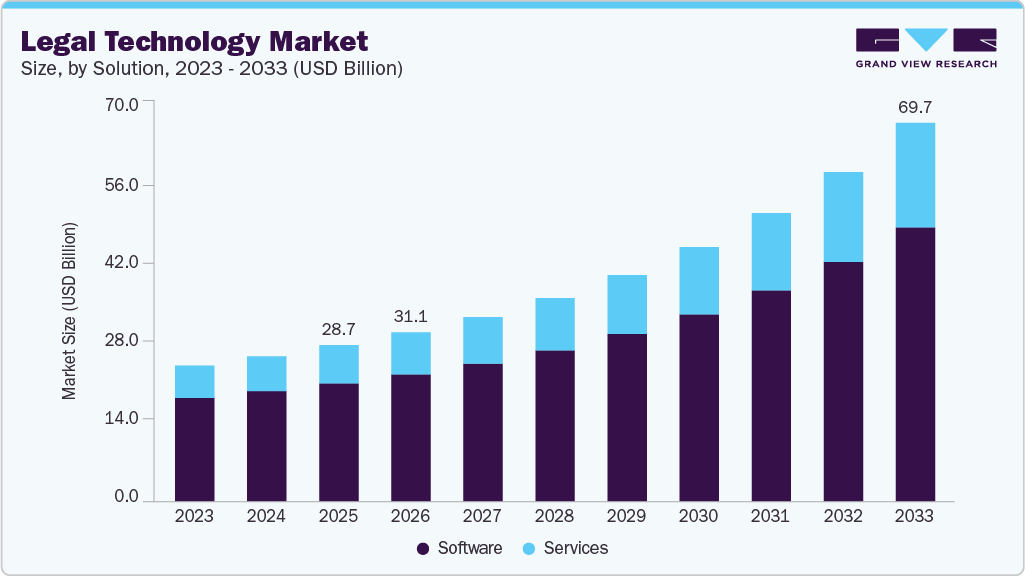
The global legal technology market size was valued at USD 28.7 billion in 2025 and is projected to grow from USD 31.1 billion in 2026 to USD 69.7 billion by 2033, at a CAGR of 12.2% from 2026 to 2033. The market in North America dominated with a revenue share of 49.0% in 2025. The market growth is driven by the rising importance of legal technology, the increasing complexity and volume of legal data, and shifting expectations from clients and organizational leadership within the legal services landscape.
 Source: Grand View Research, IR Documents, Primary Interviews, Paid DatabasesTo learn more about this report,
 Download Free Sample Report
 Key Market Trends & Insights
- By solution: Software segment held the largest market share of 75.5% in 2025.
- By type: Contract lifecycle management (CLM) segment held the largest market share of 25.6% in 2025.
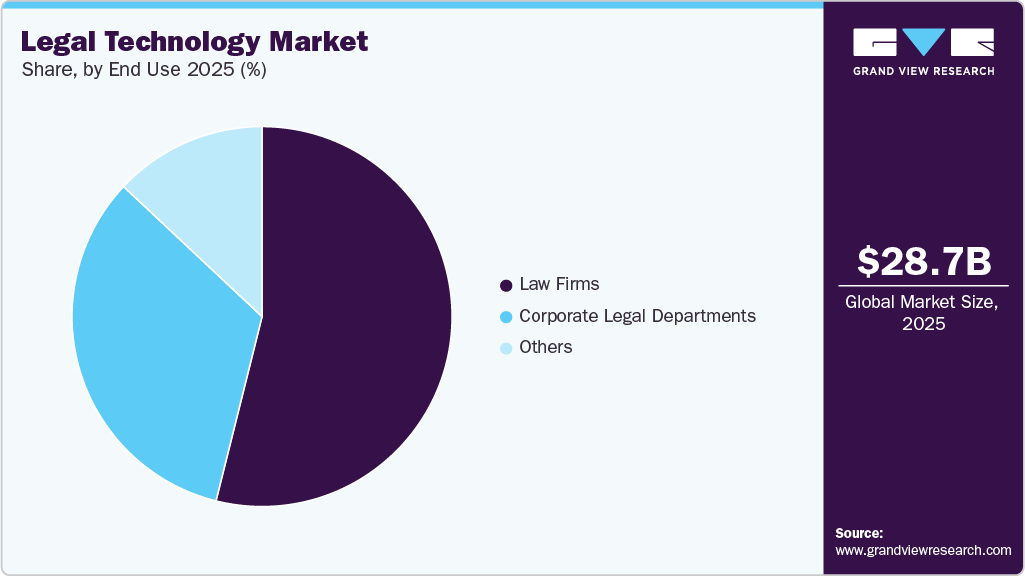
- By end use: Law firms segment held the largest market share of 53.9% in 2025.
Regional Highlights
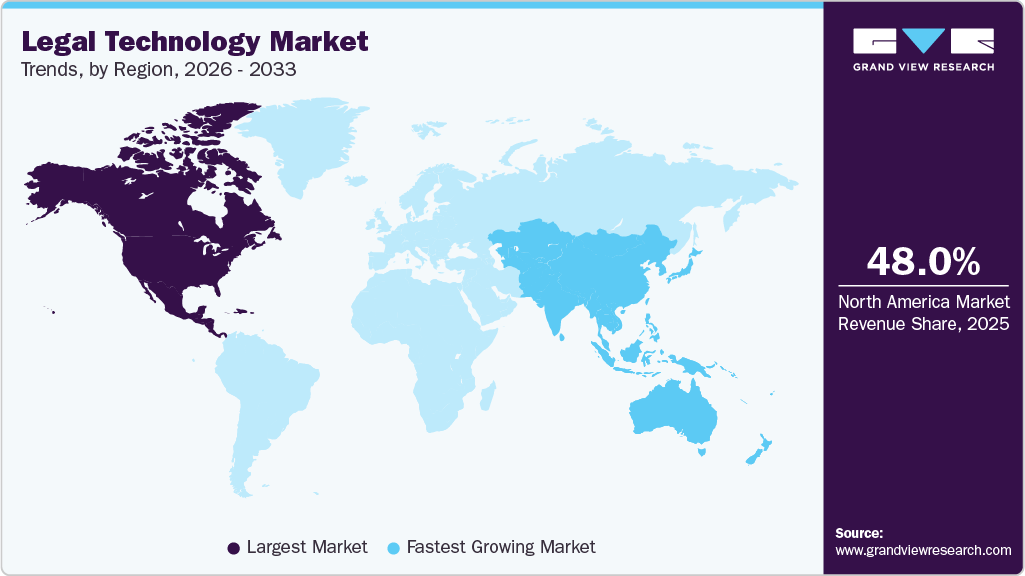
- Largest regional market: North America (49.0% revenue share, 2025)
- Fastest-growing regional market: Asia Pacific (highest CAGR, 2026-2033)
- By country: The U.S. held the largest market share in 2025
Market Size & Forecast
- Market size in 2025: USD 28.7 Billion
- Estimated market size in 2026: USD 31.1 Billion
- Projected market size by 2033: USD 69.7 Billion
- CAGR (2026-2033): 12.2%
Three ways to get this report
Buy it, customize it, or ask a question.Ask an Analyst
Analyst response in 1 business day
- AccessReport author, directly
- Reply timeWithin 1 working day
- No sales callDirect answer only
- FormatEmail reply
- CostFree, no cost
Get the Full Report
What the study covers
- FormatsPDF · Excel · Dashboard
- Timeline2026–2033 annual, 2025 base
- Coverage20+ countries, 5 regions
- Companies10+ key players profiled
Customize the Report
20% free customization
- IncludeCountries, segments, points
- TailorTo your product definition
- ExtendDeeper competitor detail
- OrA fully bespoke study
- Turnaround5–10 working days
The key stakeholders in the global legal technology market, such as law societies, judiciaries, corporate legal departments (public and private sectors), private law firms, developers of legal products, legal aid service providers, and the overall legal systems, are continuously seeking to leverage advanced legal technologies to deliver effective legal services, thereby accelerating the legal technology industry growth.A key trend in the legal technology market is the growing adoption of online legal marketplaces that connect clients with legal professionals for on-demand services such as document review, contract drafting, and legal advice. These platforms are democratizing access to legal support, particularly for small businesses and individuals, by offering flexible engagement models and transparent pricing without long-term commitments. Leading players such as UpCounsel and LegalZoom are driving this shift, contributing to greater accessibility, affordability, and overall growth in the legal technology industry.
 To learn more about this report, Download Free Sample Report
 In addition, legal technology industry is increasingly being driven by advancements in Artificial Intelligence (AI) and blockchain. Advancements in artificial intelligence and machine learning enable predictive analytics, contract analysis, and automated document review, significantly boosting productivity in legal operations. Cloud-based platforms provide scalability, cost reduction, and remote access to case files, accelerating adoption among law firms and corporate departments. These technologies address the exponential growth of digital data and e-discovery needs, transforming manual processes into efficient workflows.
Furthermore, the rise of smart contracts and blockchain-based solutions is enabling law firms and legal departments to store and manage data with enhanced security and immutability. These decentralized technologies automate contract execution through self-executing code on blockchain networks, reducing disputes over terms and minimizing reliance on intermediaries, which cuts transaction costs by up to 30% in some implementations. Moreover, sectors such as real estate and finance benefit from tokenized assets and faster transactions. These factors are expected to play a pivotal role in accelerating the legal technology industry.
Moreover, LegalTech platforms are becoming increasingly client-centric, focusing on improving the client experience through self-service portals, online case tracking, and transparent pricing models. Clients expect more from their legal service providers in terms of responsiveness, efficiency, and communication. To meet these demands, law firms are adopting client management platforms that allow clients to interact with their legal teams, access documents, and monitor the progress of their cases in real-time. This shift towards more transparent, customer-focused legal services is helping law firms improve client satisfaction and loyalty.
Solution Insights
The software segment accounted for the largest share of 75.5% in 2025, driven by a significant shift towards integrated platforms that offer comprehensive tools for legal management. Solutions such as case management software, document automation, and e-billing systems are increasingly being consolidated into all-in-one platforms, enabling law firms to streamline operations and reduce administrative overhead. This trend is driven by the demand for greater efficiency and productivity, allowing legal professionals to handle a wide range of tasks from client intake to legal research within a unified system. In addition, AI-driven legal research tools and predictive analytics are becoming essential features, helping firms make data-backed decisions faster. Cloud-based solutions dominate the landscape, as firms seek scalability, remote accessibility, and enhanced security features to manage sensitive legal data.
The services segment is expected to grow at the highest CAGR of 13.9% from 2026 to 2033, driven by the growing demand for managed legal services and outsourcing solutions. Law firms and corporate legal departments are increasingly turning to external providers for services such as e-discovery, legal research, and compliance management to reduce costs and improve operational efficiency. Consulting services that focus on implementing and optimizing legal tech tools are also in high demand, helping firms navigate the complexity of new technologies such as AI and automation. In addition, cybersecurity services are becoming critical as firms need to ensure that their digital infrastructure complies with data privacy regulations and is protected from cyber threats.
Type Insights
The contract lifecycle management (CLM) segment accounted for the largest market revenue share of 25.6% in 2025. CLM platforms are increasingly using AI and machine learning to automate contract drafting, review, and approval processes, reducing manual effort and speeding up contract execution times. Companies are adopting CLM tools to enhance compliance, minimize risk, and improve visibility across the entire contract lifecycle. In addition, cloud-based CLM solutions are gaining popularity, owing to their scalability, remote accessibility, and ability to store contracts securely while ensuring collaboration across legal and business teams.
The analytics segment is expected to grow at the highest CAGR from 2026 to 2033, driven by the growing adoption of predictive analytics, which is transforming legal decision-making and strategy. Law firms and corporate legal departments are leveraging data analytics tools to analyze past cases, assess behavior, and track litigation trends, enabling more informed predictions of case outcomes. This data-driven approach is improving efficiency, helping legal professionals allocate resources better, and developing stronger, evidence-backed strategies.
End Use Insights
The law firms segment accounted for the largest market share of 53.9% in 2025, driven by a strong shift towards digital transformation to enhance operational efficiency and client service. Law firms are increasingly adopting cloud-based practice management software, allowing them to manage cases, documents, and communications remotely, which has become essential in a post-pandemic, hybrid work environment. In addition, law firms are integrating AI-driven legal research and analytics tools to gain insights, streamline decision-making, and offer more data-driven legal advice. A growing focus on cybersecurity is also emerging as firms prioritize safeguarding sensitive client data from cyber threats and ensuring compliance with privacy regulations.
 To learn more about this report, Download Free Sample Report
 The corporate legal department’s segment is anticipated to exhibit a significant CAGR in the coming years. Increased focus toward digitization, coupled with rising complexities and compliance risks, is fueling the adoption of legal technology software in corporate legal departments. In addition, the incorporation of legal technology solutions enables companies to automate numerous legal tasks, conduct risk assessments and analyses, and support legal research. Furthermore, the rising incorporation of the latest technologies, such as machine learning and artificial intelligence, is anticipated to offer lucrative growth opportunities for the segment.
Regional Insights
North America dominated with a revenue share of 49.0% in 2025, driven by the rise of legal process outsourcing (LPO) and managed legal services, allowing law firms to reduce costs and improve focus on core legal work. There is also significant demand for predictive analytics and AI-based solutions, helping firms make data-driven decisions and improve case outcomes. The region is experiencing an increase in regtech solutions as financial and legal sectors adapt to complex regulatory environments.
 To learn more about this report, Download Free Sample Report
 U.S. Legal Technology Market Trends
The U.S. legal technology market is accounted for the largest market share of over 67% in 2025, driven by the increasing adoption of AI and automation in legal processes such as contract management, e-discovery, and legal research. Law firms and corporate legal departments are heavily investing in cloud-based solutions to improve efficiency and enable remote work. In addition, there is a strong emphasis on cybersecurity and data privacy compliance, driven by stringent regulations such as the California Consumer Privacy Act (CCPA).
Europe Legal Technology Market Trends
Europe legal technology market accounted for a significant share of 26% in 2025, supported by GDPR and stringent data privacy regulations, driving the adoption of compliance management and cybersecurity solutions. European law firms are increasingly using AI-driven contract lifecycle management (CLM) tools to automate contract creation and negotiation. In addition, legal analytics and e-discovery tools are gaining popularity as firms seek more efficient ways to handle cross-border legal matters and litigation.
The UK legal technology market is expected to grow rapidly in the coming years, driven by record levels of private capital and structured government investment. Funding activity continues to accelerate solutions centered on document automation, contract lifecycle management, and enterprise-wide risk and compliance tools. Investors are particularly focused on platforms that streamline workflows and integrate caseload and matter management into unified digital environments for law firms and corporate legal departments.
The Germany legal technology market is driven by the increasing digitalization of legal services, growing demand for contract automation and document management solutions, and the rising adoption of artificial intelligence (AI) for legal research, compliance monitoring, and case analysis. Additionally, evolving data protection regulations, growing demand for e-discovery solutions, and the expansion of legal analytics platforms are further accelerating market growth across Germany.
Asia Pacific Legal Technology Market Trends
The Asia Pacific legal technology market is anticipated to register the fastest CAGR of over 14% from 2026 to 2033, owing to the region's increasing digital transformation, particularly in countries such as India, Singapore, and Australia. Cloud-based legal platforms are being widely adopted to manage cases and collaborate across geographically dispersed teams, driven by the need for greater accessibility and cost-efficiency. There is also rising interest in legal automation and AI tools, as law firms look to streamline document review, contract management, and compliance tasks in a highly competitive and regulatory-driven environment.
The Japan legal technology market is gaining momentum, as the country advances a service-sector export strategy that promotes digitized legal processes to support cross-border commerce. A key priority is the development of multilingual contract automation tools, reflecting Japan’s expanding trade footprint across Asia, North America, and Europe.
The legal technology market in China is witnessing robust expansion, driven from government-backed Smart Court initiatives that integrate blockchain for evidence management and live-stream trials to enhance judicial transparency. Entrepreneurial lawyers develop integrated platforms beyond SaaS, addressing complex regulatory compliance needs in this region, which is expected to drive the market growth in coming years.
Key Legal Technology Company Insights
Some of the key players operating in the market are DocuSign, Inc., and LexisNexis Legal & Professional Company (RELX PLC), among others.
-
LexisNexis Legal & Professional (RELX PLC) is a legal technology and information analytics provider offering digital research, legal intelligence, compliance, and risk management solutions. Its platforms integrate AI-powered legal research, case law databases, regulatory monitoring, and litigation analytics to support informed legal decision-making. LexisNexis serves law firms, corporations, courts, government institutions, and academic organizations across the legal ecosystem.
-
DocuSign, Inc. is a digital transaction management and electronic signature solutions provider supporting secure digital agreements and contract execution. Its platform enables legally compliant e-signatures, identity verification, audit trails, and contract lifecycle integration. DocuSign helps legal teams accelerate deal cycles, reduce paperwork, and maintain regulatory compliance across jurisdictions. The company serves legal, financial services, real estate, healthcare, government, and technology sectors.
Some of the emerging players operating in the market are Icertis, Inc., and Filevine, among others.
-
Icertis, Inc. is an enterprise software company specializing in contract lifecycle management (CLM) solutions for large organizations. Its AI-powered platform helps legal teams manage contract creation, negotiation, compliance, and performance tracking while reducing legal risk and improving operational efficiency. Icertis supports advanced capabilities such as automated clause extraction, regulatory compliance monitoring, and contract analytics. The company serves industries including manufacturing, healthcare, technology, financial services, pharmaceuticals, and energy.
-
Filevine Inc. is a legal technology company providing cloud-based case and legal practice management software designed to streamline workflows for law firms and legal departments. Its platform centralizes case data, document management, task automation, and client communication, enabling higher productivity and transparency across legal operations. Filevine also integrates reporting, collaboration tools, and customizable workflow automation. The company primarily serves personal injury, litigation, immigration, and mid-sized law firms.
Key Legal Technology Companies:
The following key companies have been profiled for this study on the legal technology market.
- Icertis, Inc.
- Filevine Inc.
- DocuSign, Inc.
- Casetext Inc.
- ProfitSolv, LLC
- Knovos, LLC
- Mystacks, Inc.
- Practice Insight Pty Ltd (WiseTime)
- TimeSolv Corporation
- Themis Solutions Inc. (Clio)
- Everlaw, Inc.
- LexisNexis Legal & Professional Company
Recent Developments
-
In December 2025, DocuSign, Inc. announced a Euro 4.5 million investment to expand its AI Centre of Excellence in Dublin, Ireland, increasing its European R&D footprint and engineering team to drive AI-led contract analytics and compliance solutions across EMEA. This expansion strengthens DocuSign’s presence in the European legal tech market and accelerates local innovation in AI-powered agreement management.
-
In September 2025, Icertis, Inc. partnered with Thomson Reuters and Accenture to integrate CoCounsel’s generative AI assistant with Icertis Contract Intelligence, streamlining contract review, compliance, and collaboration across legal, procurement, and business units. This strategic alliance amplifies Icertis’s legal tech value by embedding trusted legal content and AI, driving broader enterprise adoption of automated contract insight solutions.
-
In September 2025, Filevine Inc. raised USD 400 million in equity financing to scale its AI-driven legal practice management solutions, reflecting strategic expansion of its product capabilities and future market growth initiatives. This major funding boost signals strong investor confidence and accelerates Filevine’s expansion in the legal tech sector.
Legal Technology Market Report Scope
Report Attribute
Details
Market size in 2025
USD 28.7 billion
Estimated market size in 2026
USD 31.1 billion
Projected market size by 2033
USD 69.7 billion
Growth rate
CAGR of 12.2% from 2026 to 2033
Base year for estimation
2025
Historical data
2021 - 2024
Forecast period
2026 - 2033
Quantitative units
Revenue in USD million/billion, and CAGR from 2026 to 2033
Report product
Revenue forecast, company ranking, competitive landscape, growth factors, and trends
Segments covered
Solution, type, end use, region
Regional scope
North America; Europe; Asia Pacific; Latin America; MEA
Country scope
U.S.; Canada; Mexico; UK; Germany; France; China; Japan; India; South Korea; Australia; Brazil; UAE; Saudi Arabia; South Africa
Key companies profiled
Icertis, Inc.; Filevine Inc.; DocuSign, Inc.; Casetext Inc.; ProfitSolv, LLC; Knovos, LLC; Mystacks, Inc.; Practice Insight Pty Ltd (WiseTime); TimeSolv Corporation; Themis Solutions Inc. (Clio); Everlaw, Inc.; LexisNexis Legal & Professional Company
Customization scope
Free report customization (equivalent to up to 8 analyst’s working days) with purchase. Addition or alteration to country, regional & segment scope.
Pricing and purchase options
Avail customized purchase options to meet you exact research needs. Explore purchase options
Global Legal Technology Market Report Segmentation
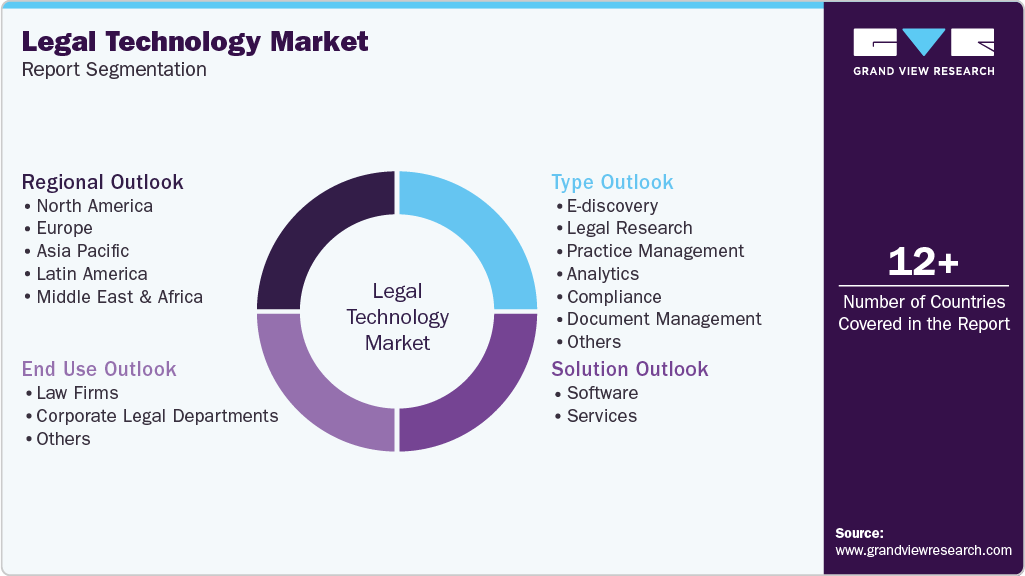
This report forecasts revenue growth at the global, regional, and country levels and provides an analysis of the latest industry trends across sub-segments from 2021 to 2033. For this study, Grand View Research has segmented the global legal technology market based on solution, type, end use, and region.
 To learn more about this report, Download Free Sample Report
 -
Solution Outlook (Revenue, USD Million, 2021 - 2033)
-
Software
-
Cloud-based
-
On-Premises
-
-
Services
-
Consulting Services
-
Support Services
-
Others
-
-
-
Type Outlook (Revenue, USD Million, 2021 - 2033)
-
E-discovery
-
Legal Research
-
Practice Management
-
Analytics
-
Compliance
-
Document Management
-
Contract Lifecycle Management
-
Time-Tracking & Billing
-
Others
-
-
End User Outlook (Revenue, USD Million, 2021 - 2033)
-
Law Firms
-
Corporate Legal Departments
-
Others
-
-
Regional Outlook (Revenue, USD Million, 2021 - 2033)
-
North America
-
U.S.
-
Canada
-
Mexico
-
-
Europe
-
UK
-
Germany
-
France
-
-
Asia Pacific
-
China
-
India
-
Japan
-
Australia
-
South Korea
-
-
Latin America
-
Brazil
-
-
MEA
-
UAE
-
South Africa
-
Kingdom of Saudi Arabia (KSA)
-
-
Frequently Asked Questions About This Report
The software segment led with a 75.5% revenue share in 2025.
Contract lifecycle management (CLM) held the largest revenue share 25.6% in 2025.
Law firms held the largest share (over 53.9%) in 2025.
North America dominated with a 49.0% revenue share in 2025.
The global legal technology market is expected to grow at a compound annual growth rate of 12.2% from 2026 to 2033 to reach USD 69.7 billion by 2033.
The global legal technology market size was estimated at USD 28.7 billion in 2025 and is expected to reach USD 31.1 billion in 2026.
Some key players operating in the legal technology market include Icertis, Inc., Filevine Inc., DocuSign, Inc., Casetext Inc., ProfitSolv, LLC, Knovos, LLC, Mystacks, Inc., Practice Insight Pty Ltd (WiseTime), TimeSolv Corporation, Themis Solutions Inc. (Clio), Everlaw, Inc., and LexisNexis Legal & Professional Company.
The market growth is driven by the rising importance of legal technology, the increasing complexity and volume of legal data, and shifting expectations from clients and organizational leadership within the legal services landscape.
About the Author(s)
IT Services & Applications Research Team
Technology · IT Services & ApplicationsThis report was authored by the it services & applications research team at Grand View Research - comprising two research analysts, one senior research analyst, and one industry expert - with specialized expertise in the it services & applications segment of the technology industry. All findings are based on proprietary technology databases, executive interviews, and regulatory analysis, subject to internal peer review prior to publication.
Last Updated:
Speak to Analyst

Customize this report to your needs - add regions, segments, or data points, with 20% free customization.
Or view our licence options:


ISO 9001:2015 & 27001:2022 Certified
We are GDPR and CCPA compliant! Your transaction & personal information is safe and secure. For more details, please read our privacy policy.


