
- Home
- »
- Advanced Interior Materials
- »
-
Liquid Handling System Market Size, Share Report 2026-2033GVR Report cover

Liquid Handling System Market (2026 - 2033) Size, Share & Trends Analysis Report By Type (Manual Liquid Handling, Semi-automated Liquid Handling, Automated Liquid Handling), By Product (Pipettes, Burettes, Workstations), By Application, By Region, And Segment Forecasts
Market Size, 2025
$4.9BMarket Estimate, 2026
$5.2BMarket Forecast, 2033
$9.0BCAGR, 2026–2033
8.0%Liquid Handling System Market Summary
The global liquid handling system market size was valued at USD 4.9 billion in 2025 and is projected to grow from USD 5.2 billion in 2026 to USD 9.0 billion by 2033, at a CAGR of 8.0% from 2026 to 2033. The North America market held the largest share of 43.1% of the global market in 2025. The liquid handling system industry is driven mainly by the rapid growth of pharmaceutical and biotechnology research.
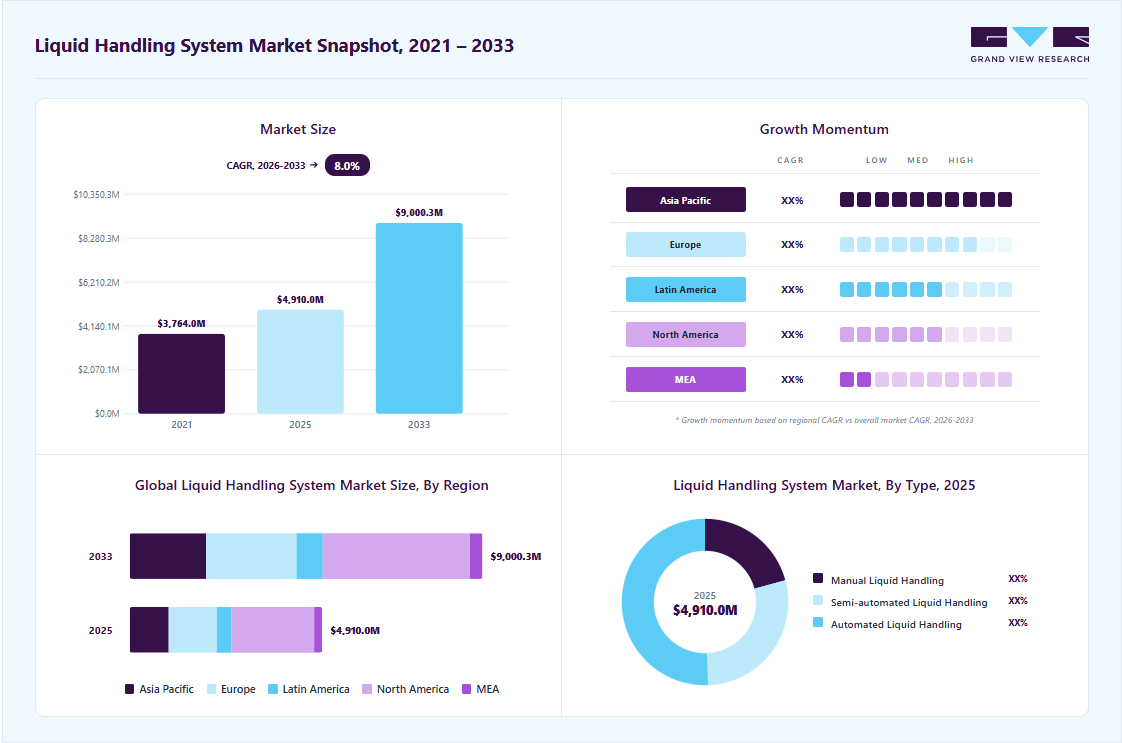 Source: Grand View Research, IR Documents, Primary Interviews, Paid DatabasesTo learn more about this report,
 Download Free Sample Report
 Key Market Trends & Insights
- By type: The automated liquid handling segment led the market with the largest revenue share of 50.6% in 2025.
- By product: The workstations segment led the market with the largest revenue share of 38.4% in 2025.
- By application: The drug discovery segment led the market with the largest revenue share of40.4% in 2025.
Regional Highlights
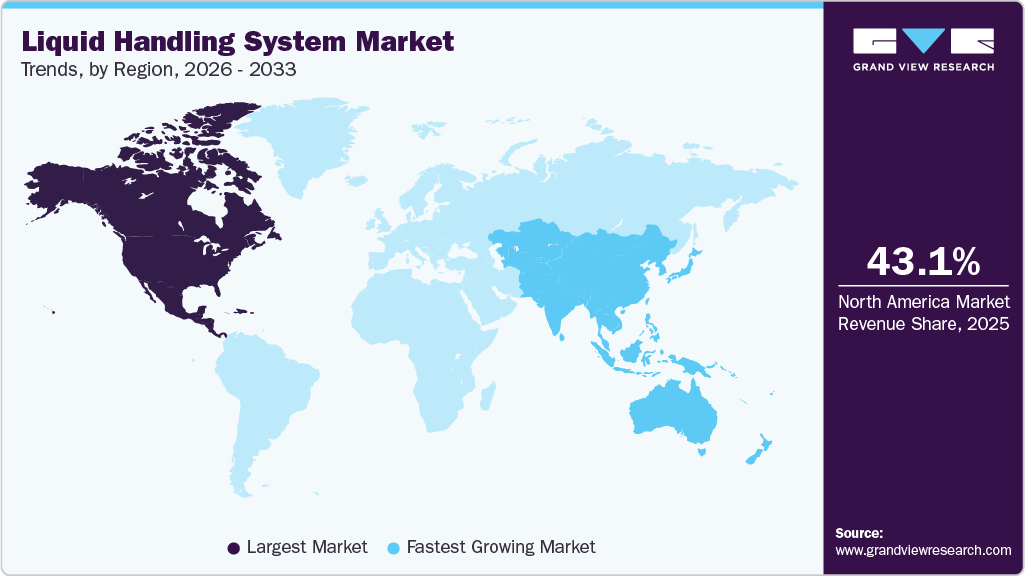
- Largest regional market: North America (43.1% revenue share, 2025)
- Fastest-growing regional market: Asia Pacific (highest CAGR, 2026-2033)
- By country: The U.S. held the largest market share in 2025.
Market Size & Forecast
- Market size in 2025: USD 4.9 Billion
- Estimated market size in 2026: USD 5.2 Billion
- Projected market size by 2033: USD 9.0 Billion
- CAGR (2026-2033): 8.0%
Three ways to get this report
Buy it, customize it, or ask a question.Ask an Analyst
Analyst response in 1 business day
- AccessReport author, directly
- Reply timeWithin 1 working day
- No sales callDirect answer only
- FormatEmail reply
- CostFree, no cost
Get the Full Report
What the study covers
- FormatsPDF · Excel · Dashboard
- Timeline2026–2033 annual, 2025 base
- Coverage20+ countries, 5 regions
- Companies10+ key players profiled
Customize the Report
20% free customization
- IncludeCountries, segments, points
- TailorTo your product definition
- ExtendDeeper competitor detail
- OrA fully bespoke study
- Turnaround5–10 working days
Increasing drug discovery activities, high-throughput screening, and rising R&D spending are driving labs to adopt faster, more accurate liquid-handling solutions. Automation helps reduce human error and improves reproducibility, which is critical for complex experiments.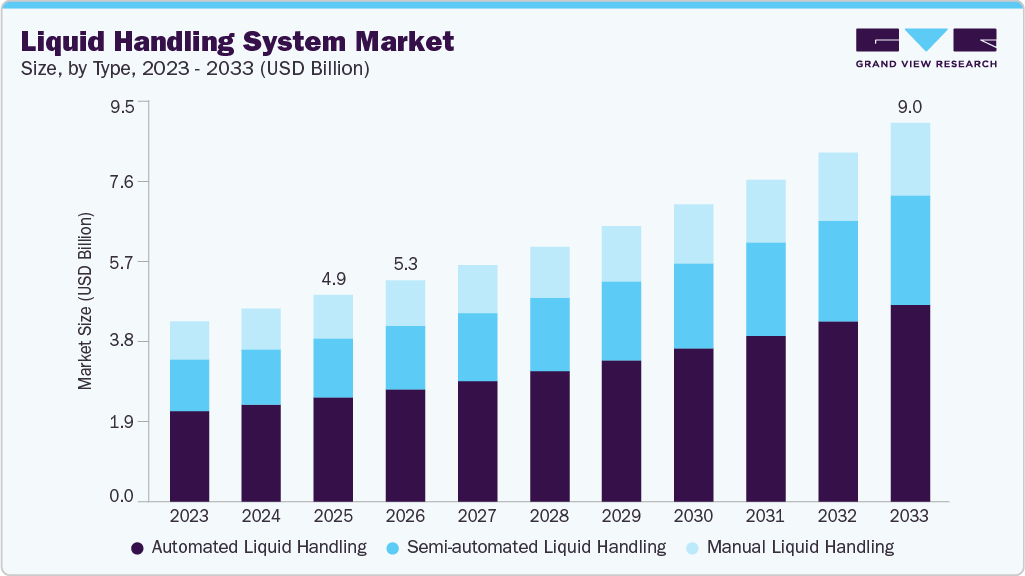 To learn more about this report, Download Free Sample Report
 Another key driver is the rising demand from clinical diagnostics and advanced therapies. Growing test volumes, precision medicine, and cell & gene therapy manufacturing require consistent and contamination-free liquid handling. Labs are also under pressure to improve efficiency and turnaround times, which is encouraging investment in automated systems. In addition, recurring demand for consumables provides stable, long-term revenue growth for market players.
Market Dynamics
Pharmaceutical and biotechnology companies extensively use liquid handling systems during drug discovery, assay preparation, compound screening, and molecular biology workflows. The rising number of drug development programs, particularly in biologics, personalized medicine, and vaccine development is significantly driving market demand. Automated systems allow researchers to conduct thousands of experiments simultaneously while maintaining accuracy and consistency.
Increasing investments in biotechnology research and genomic studies are supporting the adoption of advanced liquid handling platforms. Technologies such as PCR testing, next-generation sequencing (NGS), and cell-based assays require highly accurate liquid transfer processes, making automation critical for research laboratories. The continuous expansion of biopharmaceutical pipelines is expected to create long-term growth opportunities for the market.
One of the major restraints affecting market growth is the high installation and maintenance cost associated with automated liquid handling systems. Advanced robotic workstations require significant capital investment, software integration, regular calibration, and skilled personnel for operation and maintenance. Small laboratories, academic institutes, and healthcare facilities with limited budgets often face challenges in adopting fully automated platforms due to cost constraints.
Market Concentration & Characteristics
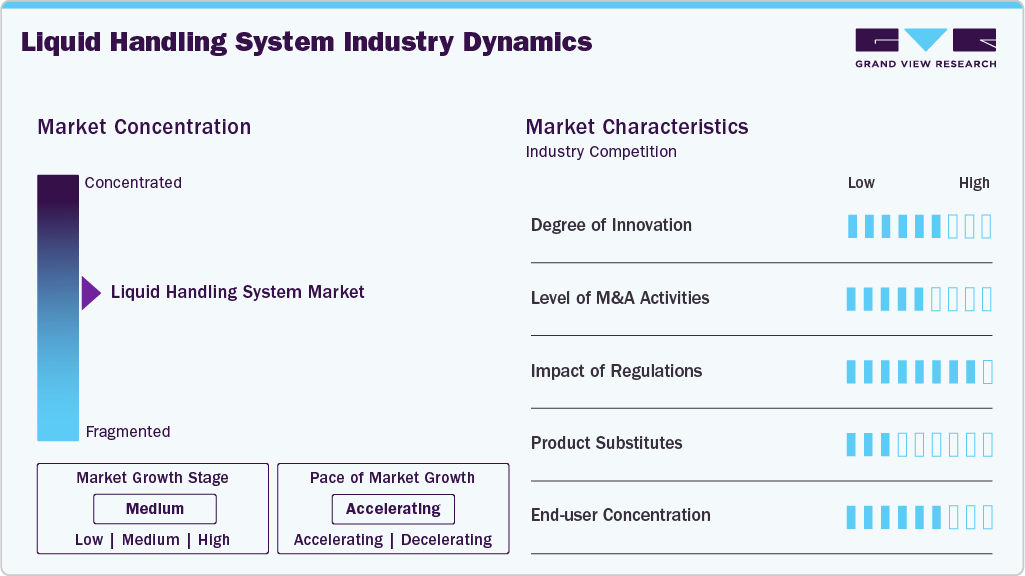
The liquid handling systems industry is moderately concentrated, with a small group of global players holding a significant share through strong product portfolios and established customer bases. Leading companies benefit from economies of scale, integrated automation platforms, and long-term relationships with pharmaceutical, biotech, and diagnostic labs. However, the market is not fully consolidated, as several mid-sized and niche players continue to compete in specific product categories and regional markets.
The liquid handling systems industry is highly innovative, driven by demand for automation, accuracy, and reproducibility in laboratory workflows. Companies continuously develop advanced robotic platforms, software integration, and miniaturized dispensing technologies. Innovations also focus on reducing sample contamination and improving throughput for complex applications like genomics and cell therapy. As a result, product differentiation through technology remains a key competitive factor.
 To learn more about this report, Download Free Sample Report
 Regulatory requirements strongly influence the market, especially in pharmaceutical manufacturing and clinical diagnostics. Systems must comply with quality, safety, and data-integrity standards, pushing manufacturers to design compliant, validated solutions. Regulatory pressure increases development costs but also raises entry barriers for new players. At the same time, compliance-driven upgrades encourage labs to replace older equipment with modern systems.
End-user demand is moderately concentrated, with pharmaceutical and biotechnology companies accounting for a large share of total consumption. Clinical diagnostic laboratories and research institutes also represent significant user groups, but with more fragmented purchasing patterns. Large pharma and contract research organizations often place bulk orders for automated systems. Smaller academic and testing labs contribute steady volume through manual tools and consumables.
Type Insights
The automated liquid handling segment led the market with the largest revenue share of 50.6% in 2025, due to its ability to deliver high accuracy, consistency, and throughput. Large pharmaceutical, biotechnology, and diagnostic laboratories preferred automated systems to manage complex and repetitive workflows. These systems reduced manual errors and improved data reliability, which was critical in regulated environments. Continuous advancements in robotics and software strengthened their leading market position.
The semi-automated liquid handling segment is anticipated to grow at the fastest CAGR during the forecast period, as laboratories sought a balance between cost and efficiency. These systems appealed to mid-sized labs that wanted higher productivity without full automation. They reduced manual effort while preserving workflow flexibility. Increasing upgrades from manual tools to semi-automated solutions supported strong segment growth.
Product Insights
The workstations segment led the market with the largest revenue share of 38.4% in 2025, as they supported fully automated, high-throughput laboratory workflows. Large pharmaceutical and biotechnology laboratories adopted these systems to improve efficiency and reduce processing time. Integrated software and robotics enabled consistent, reproducible liquid handling across experiments. Their ability to handle complex applications strengthened their leading market share.
The consumables segment is anticipated to grow at the fastest CAGR during the forecast period, driven by their repeated, continuous use in daily laboratory operations. Tips, plates, and other disposable items were required for every liquid handling task, driving steady demand. Growth in diagnostic testing and research activities increased overall consumption volumes. Their recurring nature made consumables a fast-growing and reliable revenue segment.
Application Insights
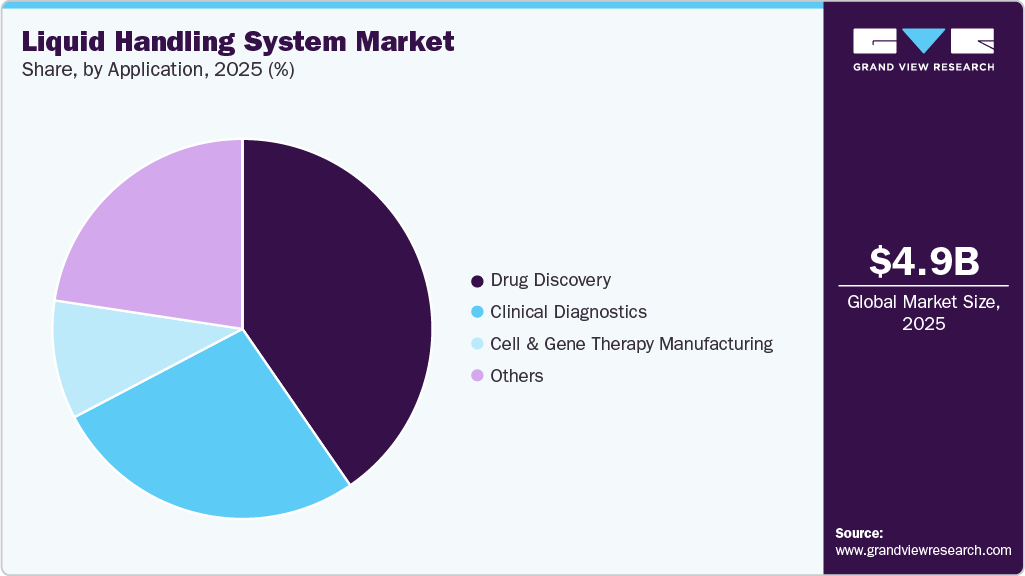
The drug discovery segment led the market with the largest revenue share of40.4% in 2025, driven by the extensive use of liquid handling systems in screening and assay development. Pharmaceutical companies relied on automated platforms to manage large sample volumes with high precision. The need for faster timelines and reproducible results supported strong adoption. Continuous investment in R&D kept this application segment at the forefront.
 To learn more about this report, Download Free Sample Report
 The cell and gene therapy manufacturing segment is anticipated to grow at the fastest CAGR during the forecast period. These workflows required highly precise, contamination-free liquid-handling processes. Growing clinical trials and the commercialization of advanced therapies have increased demand for specialized systems. Scaling up production further accelerated the adoption of automated and semi-automated solutions.
Regional Insights
North America dominated the global liquid handling system market with the largest revenue share of 43.1% in 2025, due to strong pharmaceutical and biotechnology research activity. The presence of major industry players and advanced laboratory infrastructure supported high adoption. Significant R&D investments and early uptake of automation strengthened regional leadership. High demand from drug discovery and diagnostics further sustained market dominance.
 To learn more about this report, Download Free Sample Report
 U.S. Liquid Handling System Market Trends
The liquid handling system market in the U.S. accounted for the largest market revenue share in North America in 2025, due to strong pharmaceutical and biotechnology research activity. The presence of leading market players and advanced laboratory infrastructure supported high adoption rates. Large investments in drug discovery, genomics, and clinical diagnostics drove demand. Early adoption of automation further strengthened the country’s market leadership.
The Canada liquid handling system market showed steady growth, supported by expanding biotechnology research and academic laboratories. Increasing government funding for life sciences and healthcare research encouraged equipment upgrades. Clinical diagnostics and biopharmaceutical manufacturing contributed to rising demand. Gradual adoption of automated and semi-automated systems supported market growth.
Europe Liquid Handling System Market Trends
The liquid handling system market in Europe continued to grow steadily, supported by strong academic research and the pharmaceutical industry. Strict regulatory standards encouraged the adoption of advanced, compliant liquid-handling systems. Increasing focus on precision medicine and biotechnology research contributed to demand. Continuous technology upgrades supported stable regional growth.
The Germany liquid handling system market dominated the European region, due to its strong pharmaceutical, biotechnology, and industrial research base. The country hosted several leading manufacturers of laboratory equipment and advanced research institutions. A strong focus on automation and quality compliance helped drive widespread adoption. Continuous investment in R&D strengthened Germany’s leading position.
The liquid handling system market in France is growing, supported by expanding pharmaceutical research and clinical testing activities. Increased government and private investment in life sciences encouraged the adoption of modern laboratory technologies. Growth in biotech startups and academic research labs supported demand. Rising focus on automation and efficiency contributed to steady market expansion.
Asia Pacific Liquid Handling System Market Trends
The liquid handling system market in the Asia Pacific is anticipated to grow at the fastest CAGR of 9.0% over the forecast period, driven by expanding biotech and pharmaceutical manufacturing. Rising healthcare spending and increased research funding supported market growth. Countries in the region invested heavily in modern laboratory infrastructure. Growing adoption of automated systems accelerated regional expansion.
The China liquid handling system marketdominated the Asia Pacific region, due to rapid expansion of pharmaceutical and biotechnology manufacturing. Strong government support for life sciences research increased the adoption of automated laboratory technologies. Large-scale drug discovery and diagnostics activities drove high equipment demand. Continuous investment in modern lab infrastructure reinforced China’s market leadership.
The liquid handling system market in India showed strong growth, supported by rising pharmaceutical production and contract research activities. Increasing investments in biotechnology, diagnostics, and academic research boosted demand for liquid handling systems. Cost-effective, semi-automated solutions gained greater adoption among mid-sized laboratories. Further expansion of the healthcare infrastructure further supported market growth.
Middle East & Africa Liquid Handling System Market Trends
The liquid handling system market in the Middle East and Africa region experienced gradual growth, driven by improvements in healthcare facilities and research capabilities. Investments in diagnostic laboratories and life sciences research supported demand. Adoption remained higher in developed countries within the region. Growing awareness of automation contributed to steady market development.
The Saudi Arabia liquid handling system market showed growing demand in the Middle East & Africa region, driven by expanding healthcare and life sciences investments. Government initiatives to strengthen biotechnology, diagnostics, and research infrastructure support the adoption of equipment. New laboratories and research centers have increased demand for modern liquid handling solutions. Gradual adoption of automation contributed to steady market growth.
Latin America Liquid Handling System Market Trends
The liquid handling system market in Latin America showed growing demand as laboratory and healthcare infrastructure improved. Increasing diagnostic testing and pharmaceutical activities supported market expansion. Government initiatives to strengthen healthcare systems encouraged the adoption of equipment. Cost-effective, semi-automated solutions gained greater traction in the region.
The Brazil liquid handling system market experienced strong demand, supported by expanding pharmaceutical and biotechnology activities. Increased diagnostic testing and public healthcare investments boosted the adoption of laboratory equipment. Research institutions and contract labs showed rising use of semi-automated solutions. Improving lab infrastructure supported steady market growth.
Key Liquid Handling System Company Insights
Some of the key players operating in the market include Thermo Fisher Scientific Inc., Danaher Corporation, and PerkinElmer.
-
Thermo Fisher Scientific plays a major role in the liquid handling systems industry through its wide range of manual, electronic, and automated solutions. The company supports drug discovery and clinical diagnostics through integrated liquid-handling workstations. It focuses on automation, software integration, and workflow efficiency to meet laboratory needs. Its strong consumables portfolio ensures recurring demand across end users. Deep presence in pharma and biotech labs strengthens its market position.
-
Danaher Corporation is an important participant in the market, mainly through its Beckman Coulter Life Sciences business. The company addresses demand for automated and semi-automated liquid handling in genomics and diagnostics. It emphasizes precision, reproducibility, and scalable platforms for regulated lab environments. Its systems support high-volume and complex workflows. Ongoing product improvements strengthen its competitive position.
Key Liquid Handling System Companies:
The following key companies have been profiled for this study on the liquid handling system market.
- Thermo Fisher Scientific Inc.
- Danaher Corporation
- PerkinElmer
- Mettler-Toledo International Inc.
- QIAGEN
- Corning Incorporated
- Sartorius AG
- Lonza
- Tecan Trading AG
- Eppendorf SE
- Beckman Coulter
- Agilent Technologies
- Aurora Biomed Ltd.
- Gilson Inc.
- BRAND GmbH + Co. KG
Competitive Benchmarking
Operating Strategies
Competitive Edge
Weaknesses
Mature Players: Thermo Fisher Scientific; Danaher Corporation; PerkinElmer; Mettler-Toledo International Inc.; QIAGEN; Corning Incorporated
- Focus on developing fully automated laboratory workflows that improve efficiency, accuracy, and throughput across pharmaceutical, biotechnology, and diagnostic applications.
- Invest significantly in research & development, software integration, and strategic acquisitions to strengthen laboratory automation capabilities and expand product portfolios.
- Strong global brand recognition, diversified product portfolios, and established customer relationships across life sciences and healthcare industries.
- Advanced robotic liquid handling platforms offering high precision, scalability, contamination control, and integration with digital laboratory systems.
- High financial strength and technological expertise enable continuous innovation and rapid adoption of advanced automation technologies.
- High installation, maintenance, and operational costs can limit adoption among small and medium-sized laboratories.
- Integration of complex automated systems often requires skilled professionals, extensive validation, and infrastructure upgrades.
Emerging Players: Aurora Biomed; Gilson; BRAND GmbH + Co. KG; Lonza; Tecan Group; Eppendorf SE; Beckman Coulter
- Develop cost-effective and user-friendly systems targeting small and mid-sized laboratories with moderate automation requirements.
- Expand regional presence through partnerships, distributor networks, and product innovation aimed at specialized laboratory workflows.
- Greater flexibility in product customization and ability to quickly respond to changing customer requirements and emerging laboratory trends.
- Competitive pricing strategies help attract budget-sensitive laboratories and academic research institutions.
- Strong emphasis on innovation in compact, modular, and easy-to-operate liquid handling technologies designed for specific laboratory applications.
- Limited global reach, smaller distribution networks, and lower market visibility compared to established multinational competitors.
- Relatively lower R&D investments and financial resources may restrict large-scale product development and international expansion.
Recent Developments
-
In December 2025, Beckman Coulter Life Sciences launches the Biomek i3 benchtop liquid handler to support automated laboratory workflows. The system targets low to medium-throughput applications such as genomics and drug discovery. Its compact design and flexible deck layout make automation accessible for space-limited labs. User-friendly software helps reduce manual handling and improves overall workflow efficiency.
-
In August 2025, Thermo Fisher Scientific Inc. opens a new manufacturing center of excellence in North Carolina to expand its consumables production capacity. The facility focuses on high-volume manufacturing of pipette tips to support research, diagnostics, and pharmaceutical applications. It uses advanced automation to improve the efficiency and reliability of supply. The site also strengthens local manufacturing capabilities and supports long-term market demand.
Liquid Handling System Market Report Scope
Report Attribute
Details
Market size in 2025
USD 4.9 Billion
Estimated market size in 2026
USD 5.2 Billion
Projected market size by 2033
USD 9.0 Billion
Growth rate
CAGR of 8.0% from 2026 to 2033
Base year for estimation
2025
Historical data
2021 - 2024
Forecast period
2026 - 2033
Quantitative units
Revenue in USD million/billion, and CAGR from 2026 to 2033
Report coverage
Revenue forecast, company ranking, competitive landscape, growth factors, and trends
Segments covered
Type, product, application, region.
Regional scope
North America; Europe; Asia Pacific; Latin America; Middle East & Africa
Country scope
U.S.; Canada; Mexico; UK; Germany; France; Spain; Italy; China; Japan; India; Australia; South Korea; Brazil; Argentina; Saudi Arabia; UAE; South Africa
Key companies profiled
Thermo Fisher Scientific Inc.; Danaher Corporation; PerkinElmer; Mettler-Toledo International Inc.; QIAGEN; Corning Incorporated; Sartorius AG; Lonza; Tecan Trading AG; Eppendorf SE; Beckman Coulter; Agilent Technologies; Aurora Biomed Ltd.; Gilson Inc.; BRAND GmbH + Co. KG
Customization scope
Free report customization (equivalent up to 8 analysts working days) with purchase. Addition or alteration to country, regional & segment scope.
Pricing and purchase options
Avail customized purchase options to meet your exact research needs. Explore purchase options
Global Liquid Handling System Market Report Segmentation
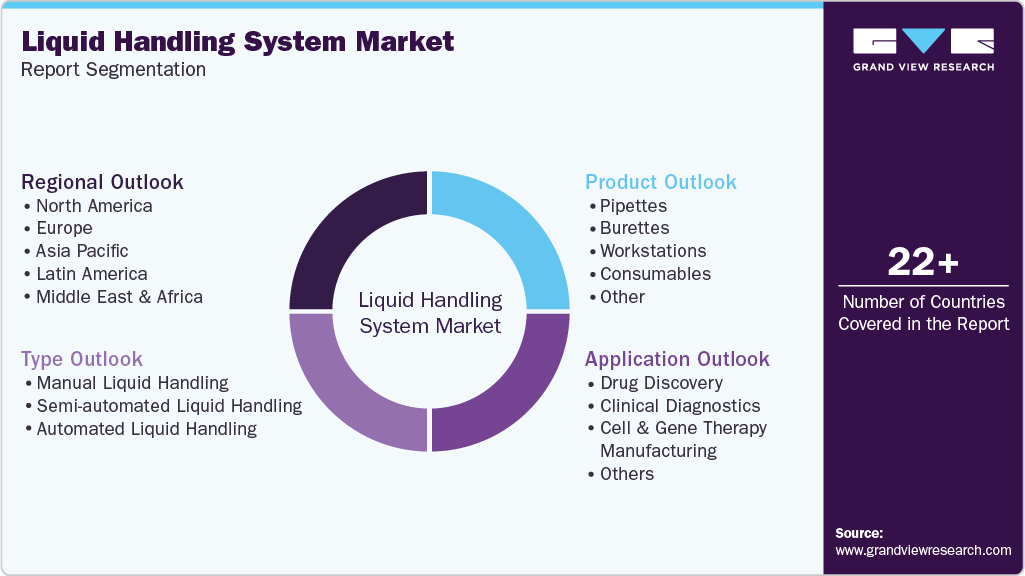
This report forecasts revenue growth at global, regional, and country levels and provides an analysis of the latest industry trends in each of the sub-segments from 2021 to 2033. For this study, Grand View Research has segmented the global liquid handling system market report based on type,product, application and region.
 To learn more about this report, Download Free Sample Report
 -
Type Outlook (Revenue, USD Million, 2021 - 2033)
-
Manual Liquid Handling
-
Semi-automated Liquid Handling
-
Automated Liquid Handling
-
-
Product Outlook (Revenue, USD Million, 2021 - 2033)
-
Pipettes
-
Burettes
-
Workstations
-
Consumables
-
Other
-
-
Application Outlook (Revenue, USD Million, 2021 - 2033)
-
Drug Discovery
-
Clinical Diagnostics
-
Cell & Gene Therapy Manufacturing
-
Others
-
-
Regional Outlook (Revenue, USD Million, 2021 - 2033)
-
North America
-
U.S.
-
Canada
-
Mexico
-
-
Europe
-
Germany
-
France
-
Italy
-
Spain
-
UK
-
-
Asia Pacific
-
China
-
India
-
Japan
-
South Korea
-
Australia
-
-
Latin America
-
Brazil
-
Argentina
-
-
Middle East and Africa
-
Saudi Arabia
-
UAE
-
South Africa
-
-
Delivered Customizations
This report has been delivered with the following In-depth customizations
Client Request
Customization Delivered
Value Adds
Regional Segmentation
Detailed regional analysis was provided covering North America, Europe, Asia Pacific, Latin America, and Middle East & Africa, with country-level demand assessment, growth trends, and key market opportunities for liquid handling systems.
Helped identify high-growth regional markets, investment hotspots, and expansion opportunities for manufacturers and distributors.
Opportunity Assessment
Identification of emerging opportunities driven by growth in drug discovery, precision medicine, laboratory automation, genomics research, and high-throughput screening applications. Assessment of opportunities in emerging biotechnology hubs and diagnostic laboratories.
Prioritize high-growth investment areas and innovation opportunities. Support long-term strategic planning and R&D roadmap development.
Competitive benchmarking
In-depth benchmarking analysis was conducted comparing leading and emerging players based on product portfolio, automation capabilities, innovation focus, regional presence, and strategic developments.
Assisted in evaluating competitive positioning, identifying market gaps, and understanding strategic advantages of key industry participants.
Frequently Asked Questions About This Report
The automated liquid handling segment led with a 50.6% revenue share in 2025, while semi-automated liquid handling is the fastest-growing segment.
The workstations held the largest revenue share of 38.4% in 2025, while consumables is the fastest-growing area.
The drug discovery held the largest share (over 40.4%) in 2025 and cell and gene therapy manufacturing is the fastest-growing.
Asia Pacific is the fastest-growing region over the forecast period.
The global liquid handling system market size was valued at USD 4.9 billion in 2025 and is expected to be USD 5.2 billion in 2026.
The global liquid handling system market, in terms of revenue, is expected to grow at a compound annual growth rate of 8.0% from 2026 to 2033 to reach USD 9.0 billion by 2033.
North America dominated the liquid handling systems market and accounted for 43.1% share in 2025.
Key players include Thermo Fisher Scientific Inc.; Danaher Corporation; PerkinElmer; Mettler-Toledo International Inc.; QIAGEN; Corning Incorporated; Sartorius AG; Lonza; Tecan Trading AG; Eppendorf SE; Beckman Coulter; Agilent Technologies; Aurora Biomed Ltd.; Gilson Inc.; BRAND GmbH + Co. KG.
The global liquid handling systems market is driven by rising pharmaceutical and biotechnology R&D activities and growing adoption of laboratory automation. Increasing demand from clinical diagnostics and advanced therapies supports consistent market growth. Continuous use of consumables and the need for accuracy and reproducibility further strengthen demand.
About the Author(s)
Advanced Interior Materials Research Team
Advanced Materials · Advanced Interior MaterialsThis report was authored by the advanced interior materials research team at Grand View Research - comprising two research analysts, one senior research analyst, and one industry expert - with specialized expertise in the advanced interior materials segment of the advanced materials industry. All findings are based on proprietary advanced materials databases, executive interviews, and regulatory analysis, subject to internal peer review prior to publication.
Last Updated:
Speak to Analyst

Customize this report to your needs - add regions, segments, or data points, with 20% free customization.
Or view our licence options:


ISO 9001:2015 & 27001:2022 Certified
We are GDPR and CCPA compliant! Your transaction & personal information is safe and secure. For more details, please read our privacy policy.


