
- Home
- »
- Sustainable Energy
- »
-
Liquid Hydrogen Market Size And Share Report, 2026-2033GVR Report cover

Liquid Hydrogen Market (2026 - 2033)
Size, Share & Trends Analysis Report By Production Method (Steam Methane Reforming, Electrolysis), By Distribution Method (Pipelines, Cryogenic Tanks), By Region (North America, Europe, APAC, Latin America, MEA), And Segment Forecasts
Market Size, 2025
$41.3BMarket Estimate, 2026
$43.9BMarket Forecast, 2033
$68.8BCAGR, 2026–2033
6.7%Liquid Hydrogen Market Summary
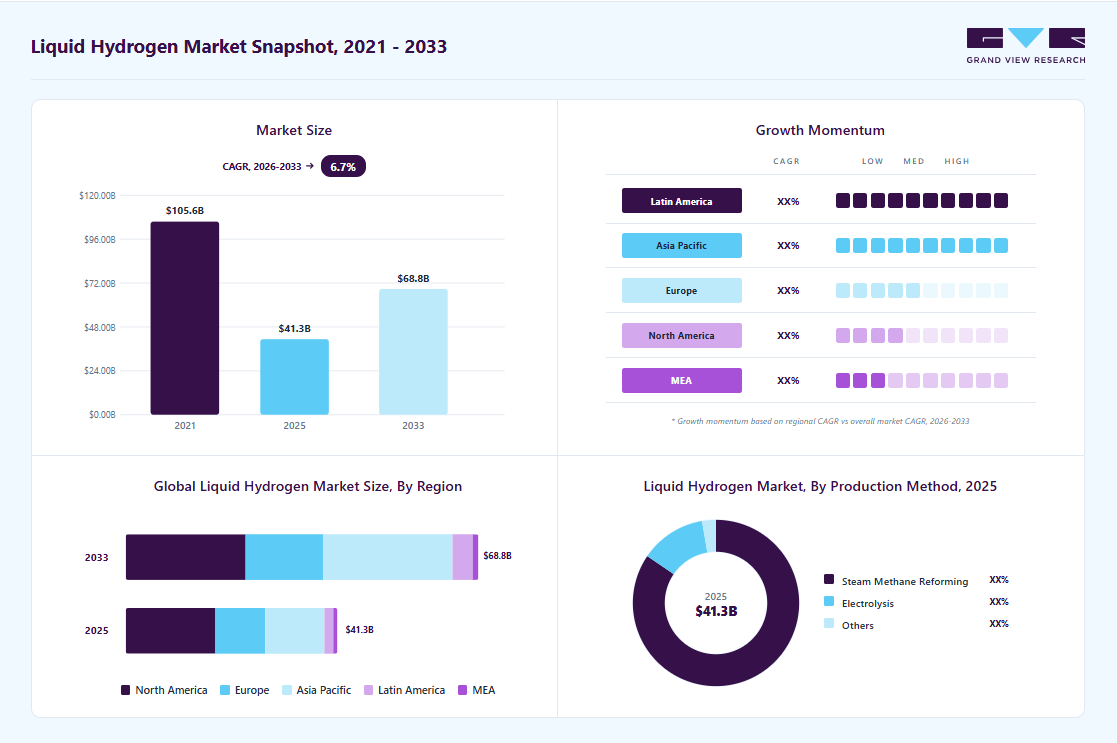
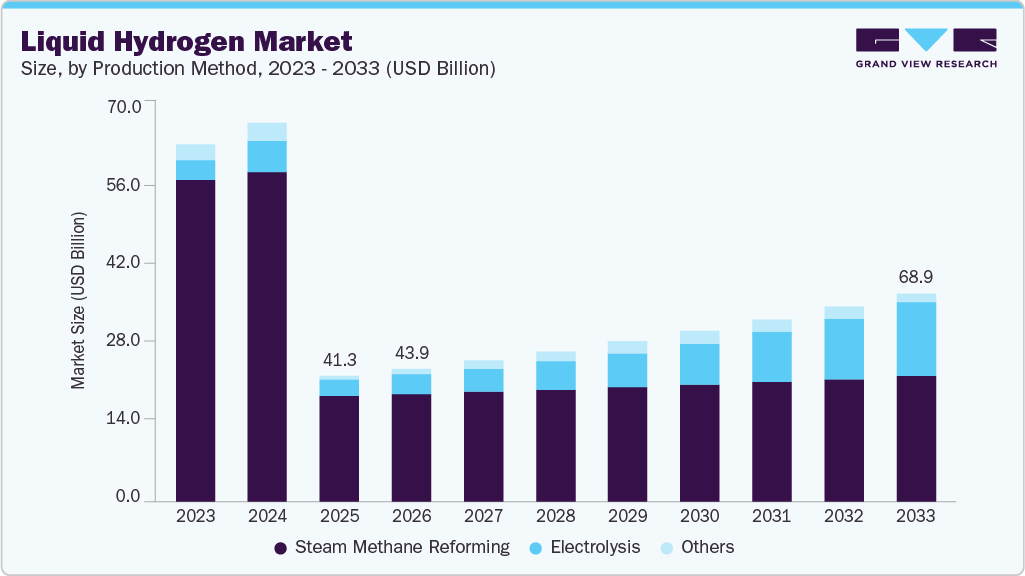
The global liquid hydrogen market size was valued at USD 41.3 billion in 2025 and is projected to grow from USD 43.9 billion in 2026 to USD 68.8 billion by 2033, at a CAGR of 6.7% from 2026 to 2033. The market in North America dominated with a revenue share of 42.2% in 2025. The market is witnessing strong momentum driven by the accelerating transition toward low-carbon energy systems and the growing demand for clean fuels across industrial, mobility, and power generation applications.
 Source: Grand View Research, IR Documents, Primary Interviews, Paid DatabasesTo learn more about this report,
 Download Free Sample Report
 Key Market Trends & Insights
- By production method: Steam methane reforming segment held the largest market share of 84.5% in 2025.
- By distribution method: Cryogenic tanks segment held the largest market share of 62.8% in 2025.
Regional Highlights
- Largest regional market: North America (42.2% revenue share, 2025)
- Fastest-growing regional market: Latin America (highest CAGR, 2026-2033)
Market Size & Forecast
- Market size in 2025: USD 41.3 Billion
- Estimated market size in 2026: USD 43.9 Billion
- Projected market size by 2033: USD 68.8 Billion
- CAGR (2026-2033): 6.7%
Three ways to get this report
Buy it, customize it, or ask a question.Ask an Analyst
Analyst response in 1 business day
- AccessReport author, directly
- Reply timeWithin 1 working day
- No sales callDirect answer only
- FormatEmail reply
- CostFree, no cost
Get the Full Report
What the study covers
- FormatsPDF · Excel · Dashboard
- Timeline2026–2033 annual, 2025 base
- Coverage20+ countries, 5 regions
- Companies10+ key players profiled
Customize the Report
20% free customization
- IncludeCountries, segments, points
- TailorTo your product definition
- ExtendDeeper competitor detail
- OrA fully bespoke study
- Turnaround5–10 working days
Liquid hydrogen, owing to its high energy density and zero-emission combustion profile, is emerging as a key enabler in decarbonizing sectors such as heavy transportation, aerospace, and refining. Increasing government support through hydrogen roadmaps, subsidies, and large-scale investments in hydrogen infrastructure is further propelling market growth.
Liquid hydrogen is produced by cooling hydrogen gas to cryogenic temperatures (-253°C), enabling efficient storage and transportation over long distances. This form of hydrogen is particularly suitable for applications that require high energy density, such as space exploration, fuel-cell electric vehicles (FCEVs), and backup power systems. Although the liquefaction process is energy-intensive, ongoing advancements in cryogenic technologies and process optimization are improving efficiency and reducing costs. The development of hydrogen liquefaction plants, storage terminals, and transportation networks is accelerating globally, especially in regions investing heavily in hydrogen economies.
 To learn more about this report, Download Free Sample Report
 The market is also benefiting from the rising integration of renewable energy with green hydrogen production via electrolysis. As countries expand solar and wind capacity, surplus renewable energy is increasingly being utilized to produce green hydrogen, which can then be liquefied for storage and export. This supports energy security and enables cross-border hydrogen trade. Furthermore, strategic collaborations among energy companies, technology providers, and governments are fostering innovation and accelerating commercialization. As the global focus on net-zero emissions intensifies, liquid hydrogen is expected to play a pivotal role in shaping the future of clean energy ecosystems across both developed and emerging economies.
Drivers, Opportunities & Restraints
The primary driver of the liquid hydrogen market is the accelerating global shift toward decarbonization and the adoption of clean energy. Governments and industries are increasingly investing in hydrogen as a zero-emission energy carrier to reduce carbon footprints across sectors such as transportation, power generation, refining, and chemicals. Liquid hydrogen, with its high energy density and suitability for long-distance transport, is gaining traction in applications like fuel cell electric vehicles (FCEVs), aerospace, and maritime fuel. Additionally, rising investments in hydrogen infrastructure, including liquefaction plants, storage facilities, and distribution networks, are supporting market expansion. The growing focus on energy security and diversification of fuel sources is further strengthening demand, particularly in regions such as North America, Europe, and the Asia Pacific.
A significant opportunity lies in the development of green liquid hydrogen produced using renewable energy sources such as solar and wind through electrolysis. As countries scale up renewable capacity, surplus electricity can be utilized to produce hydrogen, which can then be liquefied for efficient storage and export. This creates strong potential for international hydrogen trade and positions liquid hydrogen as a key component of future energy supply chains. Opportunities are also expanding in emerging applications such as aviation fuel, heavy-duty transport, and grid-scale energy storage. Technological advancements in cryogenic storage, liquefaction efficiency, and hydrogen-handling systems are improving the economic feasibility. Moreover, strategic partnerships between energy companies, governments, and technology providers are accelerating commercialization and infrastructure development globally.
However, the market faces several restraints, primarily related to high production and liquefaction costs. The process of cooling hydrogen to cryogenic temperatures (-253°C) is energy-intensive, which increases overall operational expenses and limits cost competitiveness compared to conventional fuels and even gaseous hydrogen. Additionally, challenges associated with storage, transportation, and boil-off losses create technical and logistical complexities. The lack of widespread infrastructure and standardization further restricts large-scale adoption. Safety concerns related to handling and transporting liquid hydrogen, along with regulatory uncertainties, also pose challenges. Furthermore, competition from alternative clean energy solutions such as battery storage and other hydrogen carriers (e.g., ammonia) may hinder market growth in certain applications.
Production Method Insights
Based on production method, steam methane reforming (SMR) accounted for the largest market revenue share of 84.5% in 2025, driven by its established infrastructure, cost-effectiveness, and large-scale industrial adoption. SMR remains the dominant hydrogen production method due to its ability to produce high volumes at relatively lower costs compared to alternative technologies. It is widely utilized across refineries, ammonia production, and chemical industries, where hydrogen demand is consistently high. Additionally, the integration of carbon capture, utilization, and storage (CCUS) technologies is enhancing the sustainability of SMR-based hydrogen, supporting its continued relevance in a transitioning low-carbon economy. Strong availability of natural gas resources and existing pipeline infrastructure further support the widespread deployment of SMRs for liquid hydrogen production, particularly in North America and Europe.
Electrolysis is expected to register the fastest CAGR of 21.2% over the forecast period, driven by the rising demand for green hydrogen and increasing investments in renewable energy integration. This method enables hydrogen production using electricity from renewable sources such as solar and wind, making it a zero-emission alternative to conventional processes. Declining renewable energy costs, advancements in electrolyzer technologies, and supportive government policies are significantly improving the commercial feasibility of electrolysis. As countries accelerate their decarbonization goals and expand clean energy capacity, electrolysis is gaining traction across regions such as Europe and the Asia Pacific, positioning it as a key growth segment in the liquid hydrogen market.
Distribution Method Insights
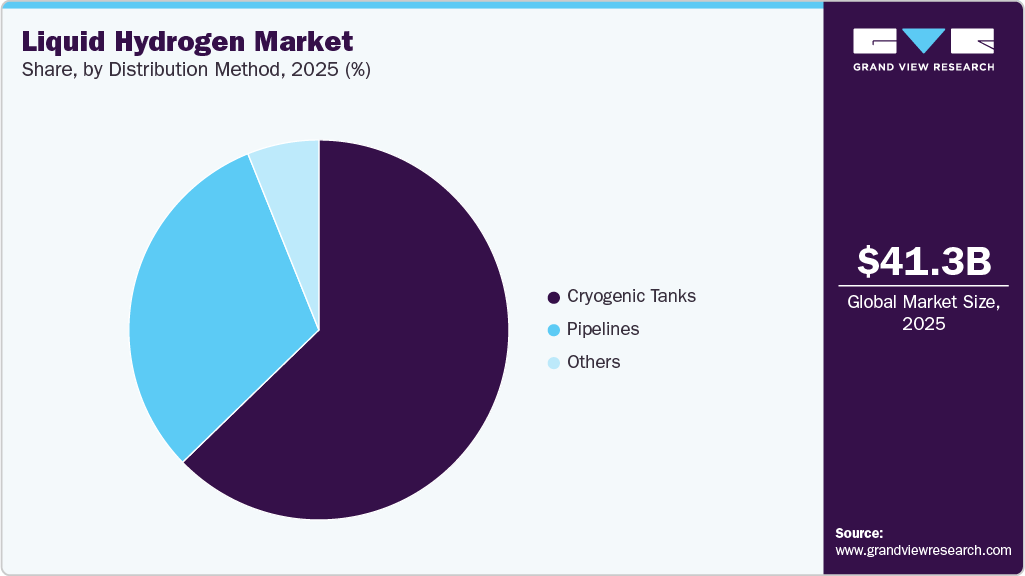
Cryogenic tanks accounted for the largest market revenue share of 62.8%, driven by their critical role in the safe storage and transportation of liquid hydrogen at extremely low temperatures (-253°C). These tanks are specifically designed to maintain hydrogen in its liquid state by minimizing heat transfer and reducing boil-off losses, making them essential for large-scale industrial applications. Their widespread use across hydrogen liquefaction plants, transportation networks, and end-use sectors such as aerospace and mobility is supporting segment dominance. Additionally, increasing investments in hydrogen infrastructure, including storage terminals and export facilities, are further strengthening the adoption of cryogenic tank systems, particularly in developed regions.
 To learn more about this report, Download Free Sample Report
 The “others” segment is expected to register the fastest CAGR of 11.0% over the forecast period, driven by the emergence of alternative and innovative hydrogen distribution methods. These include pipeline-based transport, tube trailers, and advanced material-based storage solutions that offer flexibility and cost advantages in specific use cases. The growing demand for decentralized hydrogen distribution, especially for small- to medium-scale applications and remote locations, is driving the adoption of these alternative methods. Furthermore, ongoing advancements in hydrogen storage technologies and increasing focus on optimizing last-mile delivery are expected to accelerate the growth of this segment across regions such as the Asia Pacific and Europe.
Regional Insights
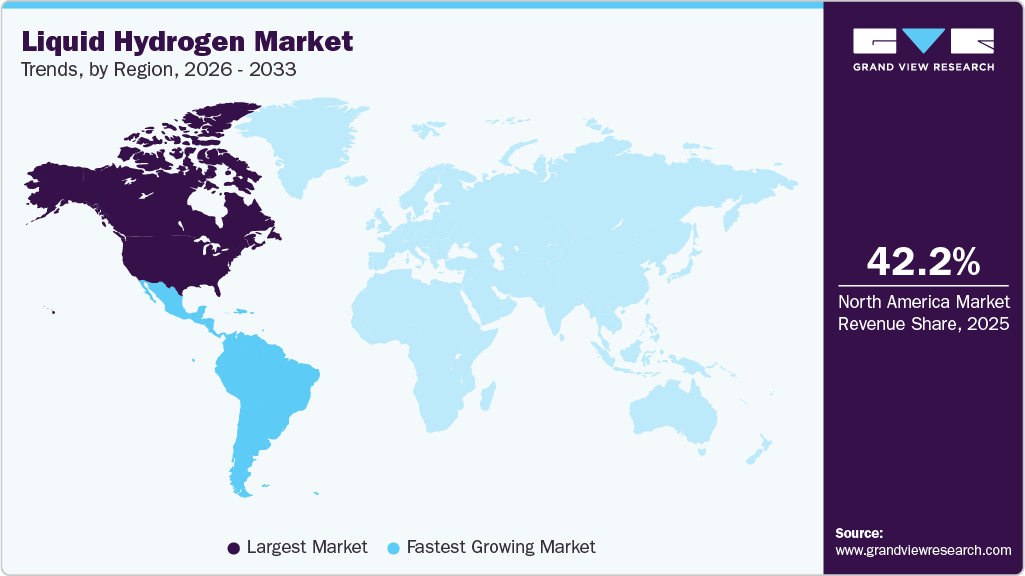
The North America liquid hydrogen market accounted for the largest revenue share of 42.2% in 2025, driven by strong investments in hydrogen infrastructure, clean energy transition, and industrial decarbonization initiatives. The region is witnessing increasing deployment of liquid hydrogen across applications such as transportation, aerospace, refining, and power generation. Favorable government policies, including hydrogen roadmaps, tax incentives, and funding programs, are accelerating the development of hydrogen production, liquefaction, and storage facilities. Additionally, the presence of established industry players, advanced R&D capabilities, and growing adoption of fuel cell technologies are further strengthening the market. The expanding network of hydrogen hubs and increasing focus on energy security are also contributing to the region’s dominance.
 To learn more about this report, Download Free Sample Report
 U.S. Liquid Hydrogen Market Trends
The liquid hydrogen industry in the U.S. represents a key contributor to the North American market, supported by substantial investments in hydrogen production and distribution infrastructure. Federal and state-level initiatives to achieve net-zero emissions and promote clean fuel adoption are driving demand for liquid hydrogen across multiple sectors. The country is witnessing strong growth in green hydrogen projects, along with advancements in liquefaction and storage technologies. Additionally, the presence of major energy companies, increasing deployment of hydrogen-powered mobility solutions, and expansion of export-oriented hydrogen supply chains are supporting market growth.
Europe Liquid Hydrogen Market Trends
The liquid hydrogen industry in Europe is experiencing significant growth, supported by ambitious climate targets and strong regulatory frameworks promoting hydrogen adoption. The region is actively investing in green hydrogen production, cross-border hydrogen trade, and infrastructure development, including liquefaction terminals and storage systems. Government-backed initiatives and funding from the European Union are accelerating innovation and commercialization. Furthermore, increasing collaboration between public and private stakeholders is fostering the development of a robust hydrogen ecosystem, positioning Europe as a key market for liquid hydrogen.
Asia Pacific Liquid Hydrogen Market Trends
The liquid hydrogen industry in the Asia Pacific is emerging as a prominent market for liquid hydrogen, driven by rapid industrialization, rising energy demand, and growing investments in clean energy technologies. Countries such as China, Japan, South Korea, and Australia are actively developing hydrogen strategies to enhance energy security and reduce carbon emissions. The region is witnessing increasing adoption of liquid hydrogen in transportation, power generation, and industrial applications. Additionally, large-scale investments in hydrogen production, liquefaction infrastructure, and export capabilities are supporting market expansion.
Latin America Liquid Hydrogen Market Trends
The liquid hydrogen industry in Latin America is expected to register the fastest CAGR of 10.7% over the forecast period, driven by increasing investments in renewable energy and green hydrogen production. Countries such as Brazil and Chile are leveraging abundant solar and wind resources to produce hydrogen for both domestic use and export markets. The growing focus on sustainable energy solutions, along with supportive government initiatives and international partnerships, is accelerating the adoption of liquid hydrogen. Furthermore, the region’s potential to become a low-cost producer of green hydrogen is expected to create significant growth opportunities.
Middle East & Africa Liquid Hydrogen Market Trends
The liquid hydrogen industry in the Middle East & Africa is witnessing steady growth, supported by efforts to diversify energy sources and establish hydrogen-based economies. The region is investing heavily in large-scale green hydrogen projects, leveraging its abundant renewable energy resources, particularly solar power. Countries such as Saudi Arabia and the UAE are focusing on becoming global hydrogen export hubs through the development of advanced liquefaction and storage infrastructure. Increasing strategic partnerships, infrastructure investments, and favorable policy support are expected to drive long-term market growth across the region.
Key Liquid Hydrogen Company Insights
Some of the key players operating in the global liquid hydrogen market include Linde plc, Air Liquide, Air Products and Chemicals, Inc., Plug Power Inc., and Kawasaki Heavy Industries, Ltd., among others. These companies are actively involved across the liquid hydrogen value chain, including production, liquefaction, cryogenic storage, transportation, and end-use applications. Their capabilities span large-scale hydrogen generation, development of liquefaction plants, and deployment of advanced storage and distribution infrastructure, supporting the growing demand for clean energy solutions.
Their strategic initiatives largely focus on expanding hydrogen production capacity, developing large-scale liquefaction facilities, and strengthening global supply chains through partnerships and joint ventures. Companies are investing in green hydrogen projects powered by renewable energy, along with advancements in cryogenic technologies to improve efficiency and reduce costs associated with liquefaction and storage. Besides, collaborations with governments, utilities, and industrial players are enabling the development of hydrogen hubs, export terminals, and fueling infrastructure. These efforts are aimed at accelerating commercialization and scaling up the adoption of liquid hydrogen across transportation, industrial, and energy sectors.
As global demand for low-carbon fuels continues to rise, these players are positioning liquid hydrogen as a critical component of the future energy mix. Increasing focus on decarbonization, energy security, and clean mobility is driving innovation and investment across the market. Furthermore, ongoing advancements in infrastructure, technology optimization, and international hydrogen trade are expected to enhance market maturity. Continued investments in large-scale projects and strategic alliances are likely to support long-term growth and strengthen the role of liquid hydrogen in the global energy transition.
Key Liquid Hydrogen Companies:
The following key companies have been profiled for this study on the liquid hydrogen market.
- Air Liquide
- Air Products and Chemicals, Inc.
- Chart Industries, Inc.
- Iwatani Corporation
- Kawasaki Heavy Industries, Ltd.
- Linde plc
- Messer Group GmbH
- Plug Power Inc.
- Shell plc
- TotalEnergies SE
Recent Developments
-
In November 2025, Air Products and Chemicals, Inc. was awarded a major contract by NASA to supply approximately 36.5 billion pounds of liquid hydrogen to multiple U.S. space centers, including the Kennedy Space Center. The contract, valued at over USD 140 billion, highlights the company’s strong position in large-scale liquid hydrogen production and its critical role in supporting aerospace and energy applications.
Liquid Hydrogen Market Report Scope
Report Attribute
Details
Market Definition
The liquid hydrogen market refers to the global revenue generated from the production, liquefaction, storage, transportation, and distribution of hydrogen in its liquid state for applications across energy, industrial, mobility, and aerospace sectors.
Market size in 2025
USD 41.3 billion
Estimated market size in 2026
USD 43.9 billion
Projected market size by 2033
USD 68.8 billion
Growth rate
CAGR of 6.7% from 2026 to 2033
Base year for estimation
2025
Historical data
2021 - 2024
Forecast period
2026 - 2033
Quantitative Units
Revenue in USD million/billion, and CAGR from 2026 to 2033
Report coverage
Revenue forecast, competitive landscape, growth factors, and trends
Segments covered
Production method, distribution method, region
Regional scope
North America; Europe; Asia Pacific; Latin America; Middle East & Africa
Country scope
U.S.; Canada; Mexico; Germany; UK; France; Italy; Spain; China; India; Japan; South Korea; Australia; Brazil; Argentina; Saudi Arabia; UAE; South Africa
Key companies profiled
Linde plc; Air Liquide; Air Products and Chemicals, Inc.; Plug Power Inc.; Kawasaki Heavy Industries, Ltd.; Iwatani Corporation; Chart Industries, Inc.; Shell plc; TotalEnergies SE; Messer Group GmbH
Customization scope
Free report customization (equivalent up to 8 analysts working days) with purchase. Addition or alteration to country, regional & segment scope.
Pricing and purchase options
Avail customized purchase options to meet your exact research needs. Explore purchase options
Global Liquid Hydrogen Market Report Segmentation
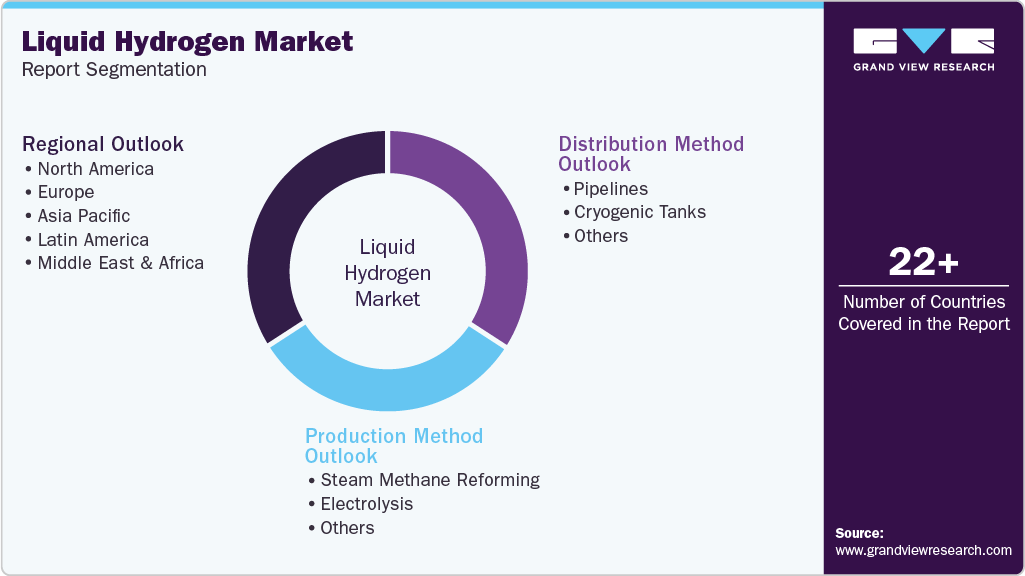
This report forecasts revenue growth at global, regional, and country levels and provides an analysis of the latest industry trends in each of the sub-segments from 2021 to 2033. For this study, Grand View Research has segmented the global liquid hydrogen market report on the basis of production method, distribution method, and region:
 To learn more about this report, Download Free Sample Report
 -
Production Method Outlook (Revenue, USD Billion, 2021 - 2033)
-
Steam Methane Reforming
-
Electrolysis
-
Others
-
-
Distribution Method Outlook (Revenue, USD Billion, 2021 - 2033)
-
Pipelines
-
Cryogenic Tanks
-
Others
-
-
Regional Outlook (Revenue, USD Billion, 2021 - 2033)
-
North America
-
U.S.
-
Canada
-
Mexico
-
-
Europe
-
Germany
-
UK
-
France
-
Italy
-
Spain
-
-
Asia Pacific
-
China
-
India
-
Japan
-
South Korea
-
Australia
-
-
Latin America
-
Brazil
-
Argentina
-
-
Middle East & Africa
-
Saudi Arabia
-
UAE
-
South Africa
-
-
Frequently Asked Questions About This Report
North America dominated with a 42.2% revenue share in 2025.
Latin America is the fastest-growing region over the forecast period.
The cryogenic tanks segment led with a 62.8% revenue share in 2025.
The global liquid hydrogen market size was estimated at USD 41.3 billion in 2025 and is expected to reach USD 43.9 billion in 2026.
The global liquid hydrogen market is expected to grow at a compound annual growth rate of 6.7% from 2026 to 2033 to reach USD 68.8 billion by 2033.
Based on the production method segment, steam methane reforming held the largest revenue share of more than 84% in 2025.
Some of the key players operating in the global liquid hydrogen market include Linde plc, Air Liquide, Air Products and Chemicals, Inc., Plug Power Inc., Kawasaki Heavy Industries, Ltd., Iwatani Corporation, Chart Industries, Inc., Shell plc, TotalEnergies SE, and Messer Group GmbH, among others.
The key factors driving the growth of the liquid hydrogen market include the increasing demand for low-carbon and clean energy solutions, rising investments in hydrogen production and liquefaction infrastructure, and the growing adoption of hydrogen across transportation, industrial, and power generation sectors.
About the Author(s)
Sustainable Energy Research Team
Energy & Power · Sustainable EnergyThis report was authored by the sustainable energy research team at Grand View Research - comprising two research analysts, one senior research analyst, and one industry expert - with specialized expertise in the sustainable energy segment of the energy & power industry. All findings are based on proprietary energy & power databases, executive interviews, and regulatory analysis, subject to internal peer review prior to publication.
Last Updated:
Speak to Analyst

Customize this report to your needs - add regions, segments, or data points, with 20% free customization.
Or view our licence options:


ISO 9001:2015 & 27001:2022 Certified
We are GDPR and CCPA compliant! Your transaction & personal information is safe and secure. For more details, please read our privacy policy.


