
- Home
- »
- Advanced Interior Materials
- »
-
Lithium Market Size, Share And Growth Report, 2026-2033GVR Report cover

Lithium Market (2026 - 2033)
Size, Share & Trends Analysis Report By Product (Carbonate, Hydroxide), By Application (Automotive, Consumer Electronics), By Region (Asia Pacific, North America, Europe, Latin America), And Segment Forecasts
Market Size, 2025
$32.4BMarket Estimate, 2026
$37.5BMarket Forecast, 2033
$96.5BCAGR, 2026–2033
14.5%Lithium Market Summary
The global lithium market size was valued at USD 32.4 billion in 2025 and is projected to grow from USD 37.5 billion in 2026 to USD 96.5 billion by 2033, at a CAGR of 14.5% from 2026 to 2033. Asia Pacific dominated the market, accounting for a revenue share of 49.2% in 2025. The growth of the market in this region is supported by its extensive battery manufacturing base, electric vehicle production, and growing investments in energy storage.
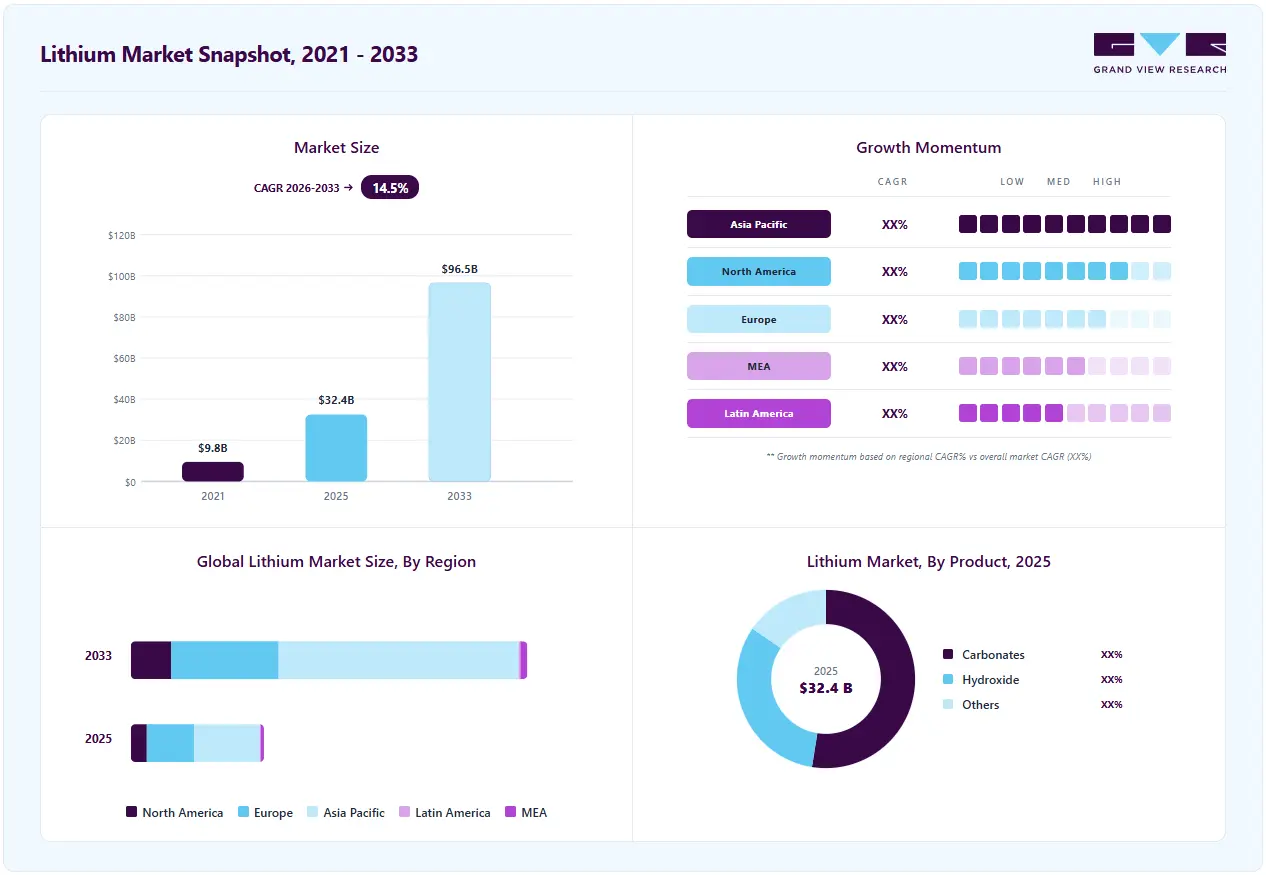 Source: Grand View Research, IR Documents, Primary Interviews, Paid DatabasesTo learn more about this report,
 Download Free Sample Report
 Key Market Trends & Insights
- By product: Carbonate segment accounted for the largest revenue share of 52.4% in 2025.
- By application: Automotive segment accounted for the largest revenue share of 41.5% in 2025.
Regional Highlights
- Largest regional market: Asia Pacific (49.2% revenue share, 2025)
- By country: China held the largest revenue share in 2025.
Market Size & Forecast
- Market size in 2025: USD 32.4 Billion
- Estimated market size in 2026: USD 37.5 Billion
- Projected market size by 2033: USD 96.5 Billion
- CAGR (2026-2033): 14.5%
Three ways to get this report
Buy it, customize it, or ask a question.Ask an Analyst
A direct answer, usually in 1 working day
- AccessReport author, directly
- Reply timeWithin 1 working day
- No sales callDirect answer only
- FormatEmail reply
- CostFree, no cost
Get the Full Report
What the study covers
- FormatsPDF · Excel · Dashboard
- Timeline2026–2033 annual, 2025 base
- Coverage20+ countries, 5 regions
- Companies10+ key players profiled
Customize the Report
20% free customization
- IncludeCountries, segments, points
- TailorTo your product definition
- ExtendDeeper competitor detail
- OrA fully bespoke study
- Turnaround5–10 working days
The increasing adoption of electric vehicles (EVs), coupled with the expansion of lithium-ion battery manufacturing capacity, is expected to remain a major factor driving the demand for lithium over the coming years. Vehicle electrification represents a key growth avenue for the lithium industry, as lithium-ion batteries are widely used in electric passenger vehicles, commercial vehicles, and two-wheelers. Governments and automakers worldwide are expanding EV production and supporting charging infrastructure as part of broader efforts to reduce transportation-related emissions. Moreover, battery manufacturers are increasing production capacity and securing long-term supplies of lithium and other critical battery materials. The expansion of battery energy storage systems for renewable power integration and grid applications is also creating an additional source of lithium-ion battery demand, broadening the market beyond transportation. To learn more about this report, Download Free Sample Report
 Technological developments across battery chemistry, lithium extraction, processing, and recycling are further shaping the market landscape. Investments in new lithium mining and refining projects are increasing as producers seek to address anticipated growth in battery-material demand and strengthen supply chains. In parallel, direct lithium extraction (DLE), improved processing technologies, and lithium-ion battery recycling are gaining attention as industry participants pursue more efficient and sustainable sources of supply. The growing deployment of renewable energy, the increasing demand for stationary energy storage, and the continued electrification of mobility are therefore expected to support sustained lithium consumption and market expansion during the forecast period.
The automotive application segment is expected to witness substantial growth as stringent government regulations aimed at reducing vehicle emissions encourage automakers to accelerate the transition from internal combustion engine (ICE) vehicles to electric vehicles (EVs). Increasing EV production is consequently driving demand for lithium-ion batteries and, in turn, lithium and its compounds. Government incentives, subsidies, and investments in EV manufacturing and battery supply chains are providing additional support for market expansion. The U.S. is a significant lithium consumer due to its growing EV and battery manufacturing industries. Although the country possesses substantial lithium resources, domestic production remains limited, creating opportunities for investment in mining, processing, and supply chain development.
 To learn more about this report, Download Free Sample Report
 The U.S. government is also supporting efforts to strengthen domestic lithium and battery-material supply chains through funding, policy initiatives, and development of new mining projects. The Department of Energy has invested in projects focused on advancing battery materials, manufacturing processes, machinery, and equipment, while lithium’s designation as a critical mineral has reinforced its strategic importance to the U.S. economy and energy security. Projects such as the Thacker Pass lithium mine in Nevada and the planned redevelopment of the Kings Mountain lithium mine in North Carolina are expected to contribute to future domestic supply. In addition, lithium-bearing resources identified in Arkansas have increased interest in developing new extraction opportunities, including emerging direct lithium extraction.
Market Dynamics
The lithium market is shaped by rising electric vehicle adoption, evolving battery technologies, and the need to strengthen supply security. Growing EV production and sales are increasing demand for lithium-ion batteries, while expanding battery manufacturing capacity is reinforcing consumption across major markets. However, lengthy project-development timelines, geographically concentrated supply chains, and complex extraction and processing requirements can constrain supply responsiveness. Advances in lithium recycling and recovery technologies are creating opportunities to supplement primary production and improve resource efficiency. Increasing investments in domestic supply chains and circular battery ecosystems are further influencing the long-term development of this market.
The rapid expansion of the global electric vehicle (EV) industry is a key factor driving the growth of the lithium market, as lithium-ion batteries remain the dominant battery technology used in electric cars. The International Energy Agency (IEA) reported that global electric car sales exceeded 20 million units in 2025, representing an increase of approximately 20% from 2024 and accounting for about one-quarter of all new cars sold worldwide. The continued expansion of EV production is increasing demand for lithium-based battery materials across passenger and commercial vehicles, as well as other electric mobility applications. In addition, the IEA highlights the continued expansion of charging infrastructure, supportive government policies, and increasing availability of EV models as factors supporting global electric-car adoption. These trends, together with expanding battery manufacturing capacity in major automotive markets, are expected to sustain lithium demand over the forecast period.
The lithium market faces supply-side challenges in developing new resources and converting them into battery-grade materials at a commercial scale. According to the U.S. Geological Survey (USGS), lithium production is derived from diverse resource types, including continental and salar brines and mineral deposits, each requiring different extraction and processing technologies. The development of new mining and processing capacity can also involve lengthy stages of exploration, permitting, financing, construction, and commissioning, limiting the speed at which supply can respond to changes in demand. The USGS further reported that lithium supply chains remain geographically concentrated, with major production coming from countries including Australia, Argentina, Chile, China, and Zimbabwe. This concentration can increase exposure to trade restrictions, logistical disruptions, policy changes, and geopolitical risks. In addition, fluctuations in lithium prices can affect the development of new projects; the USGS noted that low prices in 2024 resulted in several lithium projects being postponed or canceled.
The growing volume of end-of-life lithium-ion batteries is creating opportunities to recover lithium and other valuable battery materials, potentially providing a complementary source of supply to conventional mining. As electric vehicle adoption and battery deployment expand, the availability of spent batteries is expected to increase, supporting investments in collection, processing, and recycling infrastructure. The International Energy Agency (IEA) notes that recycling can reduce the need for new mineral supply as the stock of retired batteries increases and can help strengthen the resilience of critical mineral supply chains.
Advancements in hydrometallurgical, pyrometallurgical, and direct-recycling processes are improving the potential for recovering battery materials more efficiently. Increasing regulatory attention toward battery recycling and circular-economy practices is also encouraging manufacturers and recyclers to develop closed-loop supply chains, creating new opportunities for lithium recovery and resource efficiency.
Analyst Perspective
The global lithium market is expected to maintain strong growth, driven by transportation electrification, battery energy storage, and renewable-energy integration. Future development will increasingly depend on cost-efficient mining, refining, and battery-grade conversion capacity. Supply-chain diversification through new mining projects, direct lithium extraction, and recycling will strengthen supply resilience and resource efficiency. Asia Pacific is expected to remain a key market due to its established battery manufacturing ecosystem, while North America and Europe expand localized supply chains. Continued EV adoption, growth in stationary storage, innovations in extraction and processing, and rising supply-chain security concerns are expected to sustain the market growth.
Product Insights
Lithium carbonate accounted for the largest revenue share of 52.4% in 2025, supported by its widespread use in lithium-ion battery production and established applications across the glass, ceramics, and chemical industries. Lithium carbonate is an important precursor for producing cathode materials and can also be converted into other lithium compounds, including lithium hydroxide. According to the U.S. Geological Survey (USGS), batteries accounted for an estimated 87% of global lithium use in 2024, underscoring the importance of battery applications to product demand. Growing electric vehicle adoption and increasing deployment of energy storage systems are therefore expected to sustain demand for battery-grade lithium carbonate.
The hydroxide segment is expected to grow at the fastest CAGR of 18.0% over the forecast period. Lithium hydroxide is another important battery-grade lithium compound, particularly suited to the production of high-nickel cathode materials used in certain high-energy-density lithium-ion batteries. The International Energy Agency (IEA) notes that lithium hydroxide is expected to gain importance as battery technologies increasingly utilize high-nickel cathodes. Its demand is therefore closely linked to developments in EV battery chemistry and performance requirements. Advances in cathode formulations, increasing battery energy-density requirements, and continued investments in EV manufacturing are expected to influence the relative demand for lithium hydroxide and carbonate. Product demand will consequently remain closely tied to evolving battery chemistries and the broader transition toward electrified transportation.
This growing emphasis on securing battery-grade lithium hydroxide is also reflected in automakers’ supply-chain strategies. For instance, in 2024, BMW strengthened its EV supply chain through strategic partnerships to secure lithium supplies. A notable development was BMW's agreement with Critical Metals Corp., which included a USD 15 million pre-payment for lithium hydroxide (LiOH) from the Wolfsberg Lithium Project in Austria. This arrangement underscores BMW's commitment to ensuring a stable supply of critical materials for EV production in Europe.
Application Insights
The automotive segment dominated the lithium industry, with a revenue share of 41.5% in 2025, supported by the accelerating global transition toward electric mobility. Lithium-ion batteries remain widely used in electric vehicles because of their high energy density, rechargeability, and ability to support longer driving ranges. According to the International Energy Agency (IEA), global electric car sales exceeded 17 million units in 2024, representing over 20% of new car sales worldwide. The IEA further reported that sales exceeded 20 million units in 2025, raising the global electric-car sales share to approximately 25%. Continued EV adoption, expanding model availability, investments in battery manufacturing, and supportive emissions policies are expected to sustain automotive demand for lithium over the forecast period.
 To learn more about this report, Download Free Sample Report
 The consumer electronics application segment is anticipated to grow at the fastest CAGR of 20.4% over the forecast period. Demand for lithium in this segment is supported by the continued proliferation of smartphones, laptops, tablets, wireless earbuds, smartwatches, and other portable electronic devices that rely on rechargeable lithium-ion batteries. The U.S. Geological Survey (USGS) estimates that batteries accounted for approximately 87% of global lithium end use in 2024, with portable electronic devices representing one of the important applications alongside electric vehicles, electric tools, and energy-storage systems. Increasing demand for compact devices with longer battery life, faster charging, and higher energy density is expected to support continued lithium consumption in consumer electronics.
Regional Insights
The Asia Pacific lithium market accounted for 49.2% of global revenue in 2025 and is expected to grow at the fastest CAGR of 17.3% over the forecast period. Regional growth is supported by the concentration of EV manufacturing, battery-cell production, and battery-material processing across China, Japan, South Korea, and emerging Southeast Asian markets. Increasing investments in battery materials and localized supply chains are strengthening regional demand for lithium chemicals and concentrates. The region is also witnessing greater efforts to diversify raw-material sourcing, expand lithium conversion and refining capacity, and improve battery recycling infrastructure. Rising demand for energy storage, continued development of electrified transportation, and increasing integration of lithium-ion batteries across industrial and consumer applications are expected to sustain the region’s market growth.
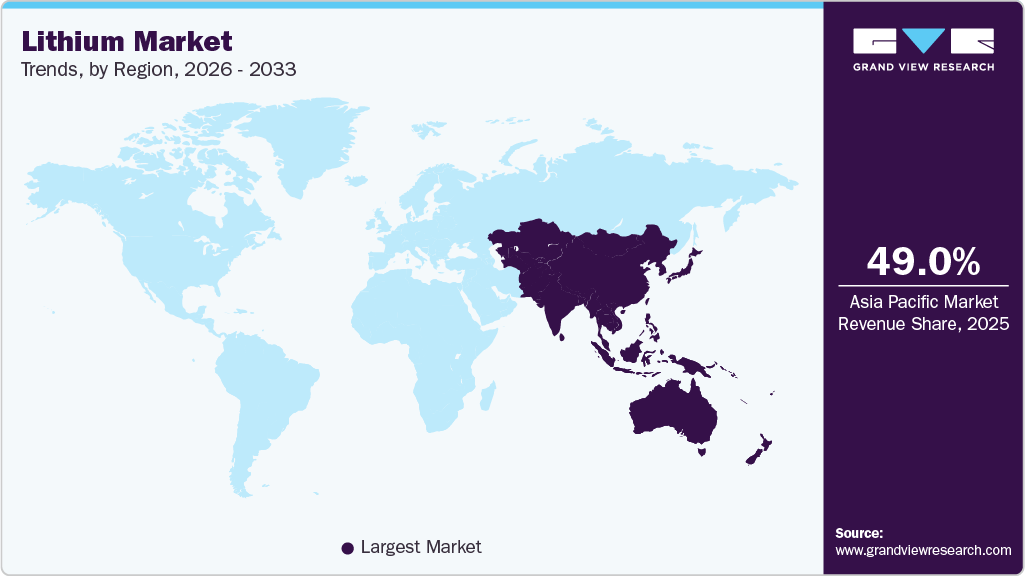 To learn more about this report, Download Free Sample Report
 The China lithium market held the largest revenue share of APAC in 2025, supported by its dominant position across the electric vehicle and battery manufacturing value chain. The country’s extensive battery production capacity, large domestic EV market, and established lithium processing infrastructure continue to generate substantial demand for lithium and its compounds. China remains the region’s dominant market, accounting for more than 80% of global battery-cell production and around 70% of electric-car production in 2025, according to the International Energy Agency (IEA). Strong domestic EV adoption, expanding battery manufacturing capacity, and increasing investments in supply-chain integration continue to support lithium demand. In addition, the IEA reports that China accounted for 60% of global EV battery deployment in 2025, while Southeast Asia is emerging as an important growth market as EV sales and local battery manufacturing expand.
North America Lithium Market Trends
The North American lithium industry is expected to grow at a CAGR of 12.3% over the forecast period, supported by expanding EV adoption, battery manufacturing investments, and efforts to strengthen regional critical-mineral supply chains. Growing investments in domestic lithium extraction, processing, and battery production are also expected to strengthen regional demand and reduce reliance on imported battery materials. In the U.S., federal policies, including incentives established under the Inflation Reduction Act (IRA), have encouraged investments across EV and battery manufacturing while supporting the development of domestic battery-material supply chains. According to the International Energy Agency (IEA), U.S. electric car sales exceeded 1 million units in 2024 and continued to expand in 2025, although growth moderated from earlier years. Increasing investments in battery plants and localized supply chains are expected to create additional demand for lithium and lithium-based battery materials across the region.
The U.S. remains the primary growth market within North America, supported by its large automotive industry and expanding domestic battery manufacturing capacity. Automakers and battery manufacturers are investing in localized production to meet rising EV demand and reduce exposure to overseas supply chains. The IEA reported that U.S. battery manufacturing capacity increased significantly in 2025, while announced projects indicate further expansion through the end of the decade. In parallel, government initiatives aimed at developing domestic sources of critical minerals are encouraging investment in lithium mining, processing, and refining. These developments are expected to strengthen the regional lithium ecosystem and support long-term demand from the automotive and energy-storage sectors.
Europe Lithium Market Trends
The Europe lithium industry accounted for a share of 35.8% in 2025. The region’s transition toward clean mobility, expanding battery manufacturing ecosystem, and efforts to strengthen domestic critical-mineral supply chains are key factors shaping market development. The European Union’s CO₂ standards for new passenger cars and vans have provided a strong regulatory signal toward vehicle electrification. The European Commission reported that zero-emission vehicles accounted for 14.5% of new car registrations and 6.4% of new van registrations in the EU, Norway, and Iceland in 2024, demonstrating the continued expansion of electrified mobility across the region. European battery manufacturers are increasingly seeking more secure and diversified sources of lithium feedstock as the region develops its domestic battery ecosystem. These developments are shifting the market from a predominantly import-dependent model toward a more integrated regional supply chain.
The region is also experiencing increasing convergence between lithium demand from electric mobility and stationary energy storage. Continued development of EV battery manufacturing is supporting demand for battery-grade lithium chemicals, while the expansion of renewable power generation is creating additional opportunities for lithium-ion battery storage. The European Commission is also emphasizing battery recycling and circular supply chains as part of its critical-material strategy. Recycling is consequently becoming an increasingly important component of Europe’s lithium ecosystem, with companies focusing on recovering battery materials from manufacturing scrap and end-of-life batteries. Together, supply-chain localization, battery manufacturing, energy storage, and recycling are expected to remain key trends shaping the Europe market.
Latin America Lithium Market Trends
The Latin American lithium industry is expected to grow at a CAGR of 8.1% over the forecast period, defined by its vast resource wealth and a pivotal strategic shift, as producing nations move beyond their traditional role as mere exporters of raw brine to capture greater value domestically. The primary growth driver is soaring global demand, but it is now increasingly mediated by assertive national industrial policies aimed at developing local battery supply chains. In Argentina, Bolivia, and Chile, governments are implementing varied models, from Argentina's more open investment approach to Chile's state-led public-private partnerships and Bolivia's fully nationalized control, to mandate on-site lithium processing and foster downstream industries like battery component manufacturing.
Key Lithium Company Insights
Some of the key players operating in the market include Albemarle, Ganfeng Lithium Co., Ltd., and Mineral Resources.
-
Albemarle Corporation operates across the lithium value chain, producing lithium carbonate, lithium hydroxide, lithium chloride, lithium metal, and specialty lithium products for battery, automotive, energy storage, and industrial applications. The company is also advancing direct lithium extraction technologies to improve resource recovery and supply efficiency.
-
Ganfeng Lithium Group Co., Ltd. operates an integrated lithium business spanning resource development, lithium compounds, lithium metal, battery manufacturing, and recycling. The company extracts lithium from hard-rock and brine resources and offers more than 40 lithium-related products serving EV, energy storage, chemical, and pharmaceutical applications.
-
Mineral Resources Limited is a major Australian hard-rock lithium producer with operations including Wodgina, Mt Marion, and Bald Hill in Western Australia. The company produces spodumene concentrate for global markets and is investing in operational expansions and project restarts to strengthen its lithium production capacity.
Key Lithium Companies
The following key companies have been profiled for this study of the lithium market.
-
Albemarle Corporation
-
Sigma Lithium
-
Ganfeng Lithium Group Co., Ltd
-
Pilbara Minerals
-
Lithium Americas Corp
-
Tianqi Lithium Energy Australia
-
Mineral Resources
-
Core Lithium
-
Rio Tinto
-
Lithium Corporation
Competitive Benchmarking
Operating Strategies
Competitive Edge
Competitive Edge
Mature Players: Albemarle Corporation; Ganfeng Lithium Group Co., Ltd.; Pilbara Minerals; Mineral Resources; Tianqi Lithium Australia
- Secure long-term supply agreements with EV manufacturers and battery gigafactories while strengthening downstream battery material integration.
- Expand spodumene mining and lithium brine extraction capacities to meet rising EV battery demand.
- High production scalability and diversified lithium sourcing across hard-rock and brine assets.
- Strong financial capabilities supporting rapid capacity expansion and processing investments.
- Environmental concerns related to water-intensive brine extraction and mining activities.
- Exposure to lithium price fluctuations and oversupply-demand imbalance risks.
Emerging Players: Sigma Lithium Corporation; Lithium Americas Corp.; Lithium Corporation
- Develop localized low-carbon lithium supply chains targeting European and North American battery manufacturers.
- Collaborate with clean energy and EV ecosystem players to commercialize sustainable lithium production technologies.
- Lower carbon footprint and reduced water usage compared to conventional lithium extraction methods.
- Increasing interest from automakers and ESG-focused investors in cleaner lithium supply sources.
- Technological and scalability risks associated with the commercialization of DLE and geothermal extraction methods.
- High capital requirements and dependence on regulatory approvals and strategic funding support.
Recent Developments
-
In March 2026, Rio Tinto secured a USD 1.175 billion financing package from four international lenders to support the development of its USD 2.5 billion Rincon lithium project in Argentina. The project is designed to produce approximately 60,000 tonnes per year of battery-grade lithium carbonate, with first production expected in 2028 and a planned mine life of 40 years.
-
In May 2026, Mineral Resources announced the restart of its 100%-owned Bald Hill lithium mine in Western Australia. The operation had previously been placed on care and maintenance due to weaker lithium market conditions. The restart represents a direct addition to potential spodumene supply and demonstrates the company’s ability to adjust production in response to lithium-market conditions.
-
In March 2025, Rio Tinto completed the acquisition of Arcadium Lithium for approximately USD 6.7 billion, strengthening its position in the global lithium industry. The acquisition added Arcadium Lithium’s operations and growth projects to Rio Tinto’s portfolio and established the company as one of the leading global lithium producers, with one of the world’s largest lithium resource bases.
Lithium Market Report Scope
Report Attribute
Details
Market size in 2025
USD 32.4 billion
Estimated market size in 2026
USD 37.5 billion
Projected market size by 2033
USD 96.5 billion
Growth rate
CAGR of 14.5% from 2026 to 2033
Base year for estimation
2025
Historical data
2021 - 2024
Forecast period
2026 - 2033
Quantitative Units
Revenue in USD million/billion, volume in kilotons, and CAGR from 2026 to 2033
Report coverage
Revenue and volume forecast, company ranking, competitive landscape, growth factors, and trends
Segments covered
Product, application, region
Regional scope
North America; Europe; Asia Pacific; Latin America; Middle East & Africa
Country scope
U.S.; Canada; Mexico; Germany; France; Italy; Spain; China; Japan; South Korea; India; Argentina; Brazil; UAE; Saudi Arabia
Key companies profiled
Albemarle Corporation; Sigma Lithium; Ganfeng Lithium Group Co., Ltd.; Pilbara Minerals; Lithium Americas Corp.; Tianqi Lithium Energy Australia; Mineral Resources; Core Lithium; Rio Tinto; Lithium Corporation
Customization scope
Free report customization (equivalent to up to 8 analysts working days) with purchase. Addition or alteration to country, regional & segment scope.
Pricing and purchase options
Avail customized purchase options to meet your exact research needs. Explore purchase options
Global Lithium Market Report Segmentation
This report forecasts revenue and volume growth at the global, regional & country levels and provides an analysis of the latest industry trends in each of the sub-segments from 2021 to 2033. For this study, Grand View Research has segmented the global lithium market report based on product, application, and region:
 To learn more about this report, Download Free Sample Report
 -
Product Outlook (Volume, Kilotons; Revenue, USD Million; 2021 - 2033)
-
Carbonates
-
Hydroxide
-
Others
-
-
Application Outlook (Volume, Kilotons; Revenue, USD Million; 2021 - 2033)
-
Automotive
-
Consumer Electronics
-
Grid Storage
-
Glass & Ceramics
-
Other
-
-
Regional Outlook (Volume, Kilotons; Revenue, USD Million; 2021 - 2033)
-
North America
-
U.S.
-
Canada
-
Mexico
-
-
Europe
-
Germany
-
France
-
UK
-
Italy
-
Spain
-
-
Asia Pacific
-
China
-
India
-
Japan
-
South Korea
-
-
Latin America
-
Argentina
-
Brazil
-
-
Middle East & Africa
-
UAE
-
Saudi Arabia
-
-
Delivered Customizations
This report has been delivered with the following In-depth customizations
Client Request
Customization Delivered
Value Adds
Enhanced Lithium Manufacturing & Technology Assessment
Detailed coverage of lithium sources, mining methods, direct lithium extraction (DLE) technologies, lithium recycling processes, conversion analysis, and comparative assessment of conventional vs. DLE extraction methods. The customization also included technology advantages, limiting factors, case studies, price trend analysis, and demand-supply assessment.
Provided deeper technical understanding of evolving lithium extraction and processing technologies, enabling evaluation of production efficiency, sustainability trends, and future commercialization opportunities across the lithium value chain.
Lithium Foil Market Assessment
Comprehensive assessment of the global lithium foil market with detailed analysis by product purity and application segments, along with global and regional price trend analysis across Europe, the U.S., and India. The study also included manufacturing process evaluation, competitive landscape analysis, key manufacturer profiling, prospective consumer mapping, and strategic developments.
Enabled detailed understanding of lithium foil manufacturing technologies, regional pricing dynamics, end-use demand trends, competitive positioning, and emerging commercial opportunities across battery, electronics, and aerospace applications.
Lithium Supply Chain & Distribution Network Assessment
Assessment of the global lithium distribution ecosystem covering raw material flow, refining hubs, battery-grade lithium supply chains, distribution channels, and regional trade movement across Asia Pacific, Europe, and North America. The study also included analysis of logistics networks, downstream battery material supply, key distributors, and strategic partnerships between lithium producers, refiners, and battery manufacturers.
Gave understanding of lithium supply chain dependencies, regional distribution dynamics, and strategic sourcing opportunities across the evolving EV battery and energy storage ecosystem
Frequently Asked Questions About This Report
Key players operating in the lithium market include Albemarle Corporation, Sigma Lithium, Ganfeng Lithium Group Co., Ltd, Pilbara Minerals, Lithium Americas Corp, Tianqi Lithium Australia, Mineral Resources, Core Lithium, Galaxy Resources Limited, Lithium Corporation.
The carbonate segment led with a 52.0% revenue share in 2025.
The automotive segment led with a 41.0% revenue share in 2025, while consumer electronics is the fastest-growing segment.
Key factors include escalating demand for lithium-ion batteries (LIBs) across various industries, increasing adoption of electric vehicles (EVs), advancements in consumer electronics, and the expansion of renewable energy storage solutions.
Asia Pacific dominated with a 49.0% revenue share in 2025.
The global lithium market size was valued at USD 32.4 billion in 2025 and is projected to reach USD 37.5 billion in 2026.
The global lithium market is expected to grow at a compound annual growth rate of 14.5% from 2026 to 2033 to reach USD 96.5 billion by 2033.
About the Author(s)
Advanced Interior Materials Research Team
Advanced Materials · Advanced Interior MaterialsThis report was authored by the advanced interior materials research team at Grand View Research - comprising two research analysts, one senior research analyst, and one industry expert - with specialized expertise in the advanced interior materials segment of the advanced materials industry. All findings are based on proprietary advanced materials databases, executive interviews, and regulatory analysis, subject to internal peer review prior to publication.
Last Updated:
Speak to Analyst

Customize this report to your needs - add regions, segments, or data points, with 20% free customization.
Or view our licence options:


ISO 9001:2015 & 27001:2022 Certified
We are GDPR and CCPA compliant! Your transaction & personal information is safe and secure. For more details, please read our privacy policy.


