
- Home
- »
- Power Generation & Storage
- »
-
Lithium Thionyl Chloride Battery Market Report, 2025-2033GVR Report cover

Lithium Thionyl Chloride Battery Market (2025 - 2033)
Size, Share & Trends Analysis Report By Type (Bobbin-Type Lithium Thionyl Chloride Batteries), By Capacity (Below 1000 mAh, 1000-5000 mAh, Above 5000 mAh), By Region, And Segment Forecasts
Market Size, 2024
$8.2BMarket Estimate, 2026
$9.3BMarket Forecast, 2033
$14.9BCAGR, 2025–2033
6.8%Lithium Thionyl Chloride Battery Market Summary
The global lithium thionyl chloride battery market size was valued at USD 8.2 billion in 2024 and is projected to grow from USD 9.3 billion in 2026 to USD 14.9 billion by 2033, at a CAGR of 6.8% from 2025 to 2033. North America dominated the market, accounting for a revenue share of 34.0% in 2024. Lithium thionyl chloride (Li-SOCl₂) batteries are widely recognized for their high energy density, long shelf life, and ability to perform reliably in extreme environmental conditions.
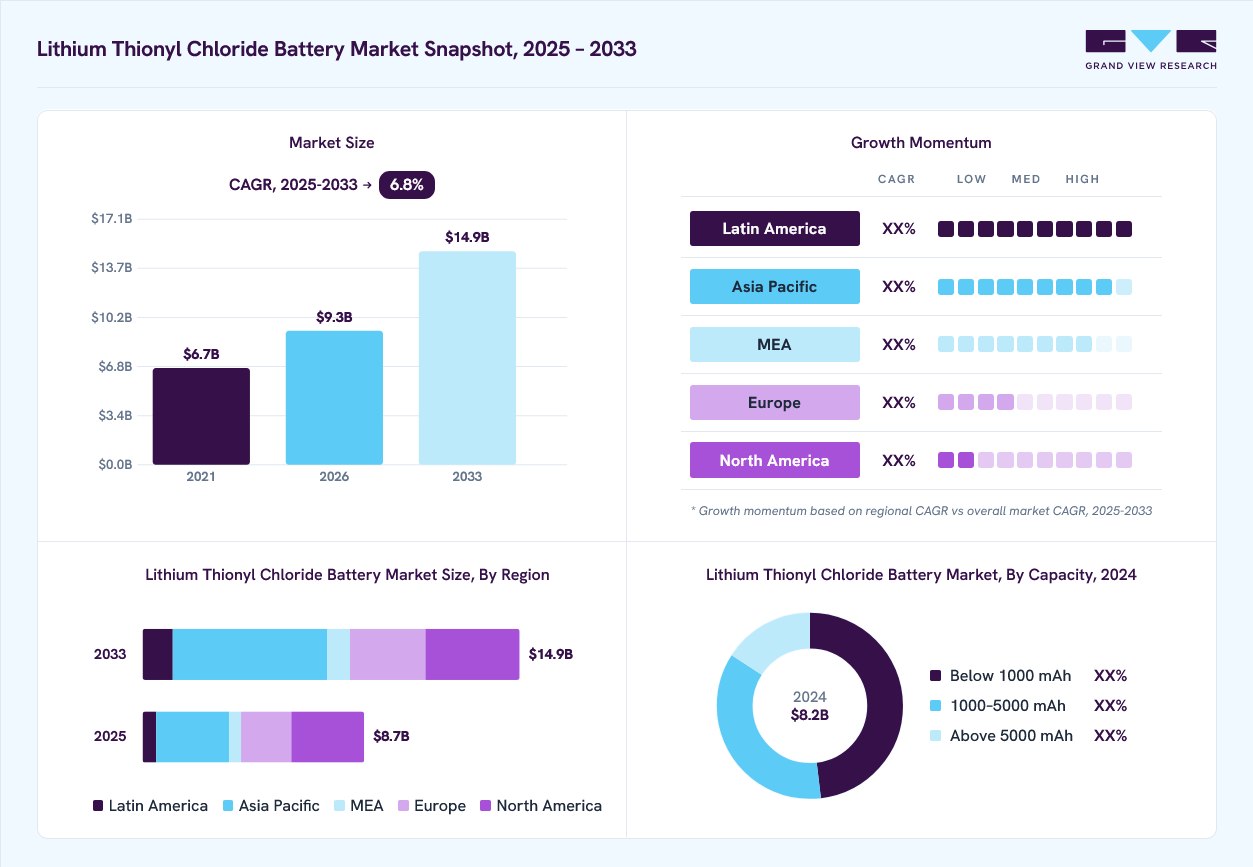 Source: Grand View Research, IR Documents, Primary Interviews, Paid DatabasesTo learn more about this report,
 Download Free Sample Report
Key Market Trends & Insights
- The lithium thionyl chloride battery market in the U.S. is expected to grow significantly over the forecast period.
- By type, the bobbin-type lithium thionyl chloride batteries segment held the highest market share of 66% in 2024.
- Based on the capacity, the below 1000 mAh segment held the highest market share in 2024.
Market Size & Forecast
- 2024 Market Size: USD 8.2 Billion
- 2033 Projected Market Size: USD 14.9 Billion
- CAGR (2025-2033): 6.8%
- North America: Largest market in 2024
- Asia Pacific: Fastest growing market
Prism AI by Grand View Research Free to tryAsk a question about the lithium thionyl chloride battery marketTry asking✓Every figure cited from GVR research Prefer the report? Download free sample →
These features make them ideally suited for long-term metering, industrial monitoring, defense electronics, and remote sensing applications. Growing adoption of smart infrastructure, rising deployment of IoT-based devices, and increasing demand for maintenance-free power sources are key drivers propelling the market. In addition, advancements in the bobbin and spiral battery configurations and a surge in demand for secure, low-drain energy storage continue to reinforce the market's growth trajectory. To learn more about this report, Download Free Sample Report
The lithium thionyl chloride (Li‑SOCl₂) battery market thrives in mission-critical niches where standard chemistries fall short, delivering unmatched energy density, ultra‑low self‑discharge, and rock‑solid reliability for smart utility metering, asset‑tracking beacons, SCADA nodes, and military‑grade electronics. Its relevance is amplified across sectors that prize longevity and fail-safe performance, energy & utilities, industrial automation, logistics, and defense, while leading economies such as the United States, Germany, Japan, and China channel investments into grid modernization, remote monitoring, and secure communications, further stoking demand. Miniaturization trends, evolving bobbin and spiral cell designs, and rapid industrial digitization, coupled with the proliferation of low‑power IoT endpoints, cement Li‑SOCl₂’s position as the go‑to maintenance‑free power source and underpin a robust growth outlook for the forecast period.
Drivers, Opportunities & Restraints
The growing demand for reliable, long-lasting, and maintenance-free power sources in critical infrastructure applications drives the U.S. and global market for lithium thionyl chloride batteries. With the rapid expansion of smart metering, industrial IoT, and defense electronics, these batteries are increasingly preferred for their high energy density, long shelf life, and superior performance in harsh environments.
In addition, the proliferation of remote monitoring devices, environmental sensors, and asset tracking systems across utilities, transportation, and oil & gas capacity is accelerating adoption. The market is further supported by rising investments in industrial automation, grid modernization, and smart city infrastructure, where dependable backup power is essential.
Opportunities in the market are expanding due to advancements in bobbin and spiral cell designs, which enable broader application in high-pulse and continuous-use scenarios. The increasing miniaturization of industrial electronics and the surge in IoT device deployments present a significant growth avenue. The rise of digital metering infrastructure, satellite communications, and precision agriculture also opens new end use segments.
However, several restraints temper the market’s growth. These include the limited rechargeability of Li-SOCl₂ batteries, environmental and disposal concerns due to toxic byproducts, and competition from emerging rechargeable chemistries in certain high-drain applications. Moreover, fluctuating lithium prices and supply chain vulnerabilities present additional challenges for sustained expansion.
Type Insights
The bobbin-type lithium thionyl chloride battery sub-segment dominated the market, accounting for a revenue share of over 66% in 2024. It is also projected to remain the largest contributor over the forecast period. Characterized by a high energy density, low self-discharge rate, and extended operational life, bobbin-type batteries are well-suited for low-drain, long-duration applications such as utility metering, environmental sensors, and asset tracking systems. Their ability to operate reliably in extreme temperatures and remote environments makes them a critical component in industries requiring uninterrupted, maintenance-free power over long cycles.
Bobbin-type lithium thionyl chloride batteries support various industrial and infrastructure applications, especially as digitization and remote monitoring become standard across sectors. The rapid rollout of smart grids, AMI systems, and industrial IoT networks further bolsters their adoption. As industries seek reliable energy solutions with minimal service needs, these batteries offer strong economic and operational value. Supported by continuous innovation in compact cell design and long-term field performance, bobbin-type batteries are poised to remain the backbone of critical backup and autonomous power systems within the market.
Capacity Insights
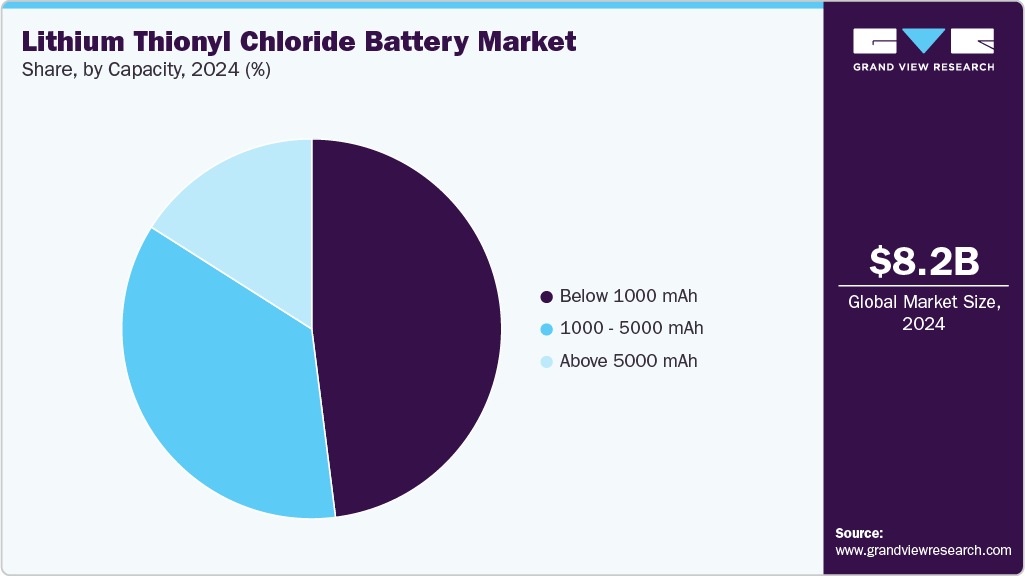
The below 1000 mAh sub-segment held the largest revenue share of approximately 48% in 2024. This dominance is attributed to the widespread use of low-capacity batteries in compact, low-power devices such as smart meters, asset tracking units, RFID tags, and environmental monitoring sensors. These applications require long-lasting, maintenance-free power solutions, making below 1000 mAh batteries an ideal choice due to their compact size, high energy density, and ability to operate reliably in remote or inaccessible locations for extended periods.
 To learn more about this report, Download Free Sample Report
As the deployment of IoT infrastructure accelerates across sectors such as utilities, logistics, and smart cities, the demand for small-form-factor lithium thionyl chloride batteries is expected to remain robust. These batteries are integral to powering billions of connected sensors and communication modules that form the backbone of data-driven industrial and municipal systems. Their affordability, reliability, and ability to function in harsh environments ensure continued preference among OEMs and system integrators. With the increasing adoption of autonomous monitoring technologies, the below 1000 mAh segment is set to maintain its leading position in the lithium thionyl chloride battery industry over the forecast period.
Regional Insights
North America lithium thionyl chloride battery industry dominates globally and holds the largest share of 34.0% in 2024. This large share is driven by its robust industrial infrastructure, advanced technological capabilities, and widespread adoption of smart utility metering and IoT-based monitoring systems. The region is witnessing a surge in demand for high-performance batteries with long operational life, high energy density, and reliability under extreme conditions. The U.S. and Canada are leading in deploying lithium thionyl chloride batteries across sectors such as utilities, defense, oil & gas, and logistics, fueled by government-supported digital transformation programs and utility modernization initiatives.
 To learn more about this report, Download Free Sample Report
Federal tax incentives, defense procurement programs, and smart grid funding mechanisms further strengthen the market outlook in North America. The increasing integration of remote sensors, AMR/AMI systems, and industrial automation has expanded the need for low-maintenance power solutions. In addition, the region's strong presence of leading battery manufacturers, such as Saft, Ultralife, and EaglePicher Technologies, enhances supply chain resilience and innovation capacity. As energy security, data infrastructure, and military modernization remain top priorities, North America will dominate the market over the forecast period.
U.S. Lithium Thionyl Chloride Battery Market Trends
The U.S. lithium thionyl chloride (Li-SOCl₂) battery market is experiencing steady growth, driven by increasing demand from industrial IoT (IIoT), smart metering, and defense applications. These batteries are favored for their high energy density, long shelf life (up to 20 years), and ability to operate in extreme temperatures (-55°C to +85°C), making them ideal for remote and harsh environments. The expansion of 5G networks and edge computing is further propelling adoption, as Li-SOCl₂ batteries power backup systems and wireless sensors. However, supply chain disruptions for raw materials (like lithium) and competition from alternative chemistries (e.g., lithium-ion) pose challenges. Regulatory pressures around lithium transportation and recycling are also influencing market dynamics.
Asia Pacific Lithium Thionyl Chloride Battery Market Trends
Asia Pacific lithium thionyl chloride battery industry remains a fast-growing regional market, supported by rapid industrialization, expanding smart metering programs, and the proliferation of IoT devices in countries like China, Japan, South Korea, and India. The region benefits from strong manufacturing ecosystems, cost-effective production capabilities, and increasing adoption of industrial automation. Government-backed digital utility reforms, smart city initiatives, and energy monitoring mandates are accelerating the use of lithium thionyl chloride batteries in long-life applications such as gas meters, tracking systems, and remote sensors.
China and Japan lead regional growth with large-scale production capacity and technological advancements in compact, high-density battery formats. Meanwhile, India and Southeast Asia are ramping up deployment in the smart infrastructure and defense sectors. As these economies shift toward connected, data-driven operations across energy, logistics, and urban services, demand for long-lasting, rugged power sources is set to rise. With an increasing focus on reliability and decentralized monitoring, Asia Pacific is expected to contribute significantly to global market expansion in the coming years.
Europe Lithium Thionyl Chloride Battery Market Trends
Europe's lithium thionyl chloride battery industry is advancing due to growing demand for secure, long-duration energy sources across industrial automation, utility metering, and defense applications. Countries like Germany, France, and the United Kingdom are actively modernizing their grid infrastructure and expanding smart metering programs in line with EU digitalization and sustainability goals. The region's focus on clean energy monitoring and high-precision asset tracking supports the widespread deployment of lithium thionyl chloride batteries in the utility and transportation sectors.
European firms benefit from well-established regulatory frameworks, technological expertise, and environmental standards that favor long-life, low-maintenance battery solutions—the emphasis on energy efficiency, cybersecurity in industrial monitoring, and emission-free infrastructure fuels market adoption. With key manufacturers like Tadiran Batteries and VARTA AG, Europe continues to play a pivotal role in product innovation and deployment across mission-critical applications.
Latin America Lithium Thionyl Chloride Battery Market Trends
Latin America's lithium thionyl chloride battery industry is growing steadily as countries invest in improving grid access, digital infrastructure, and energy reliability. Brazil, Mexico, and Chile are leading efforts to modernize metering systems and expand the use of industrial IoT technologies, creating a favorable environment for long-life battery deployment. Rising urbanization, energy access programs, and increased investment in oil & gas and mining operations drive demand for robust battery solutions that can withstand remote and challenging environments.
The region also benefits from government-backed smart infrastructure initiatives and international funding for digital utility programs. Asset tracking, remote monitoring, and pipeline safety applications increasingly rely on lithium thionyl chloride batteries for uninterrupted performance. As industries shift toward automation and data-driven systems, the demand for durable, maintenance-free batteries will accelerate across Latin America.
Middle East & Africa Lithium Thionyl Chloride Battery Market Trends
The Middle East and Africa (MEA) lithium thionyl chloride battery industry is emerging as a promising market, driven by the need for reliable energy solutions in remote, off-grid, and high-temperature environments. Countries such as Saudi Arabia, the UAE, South Africa, and Egypt are incorporating advanced metering infrastructure and defense modernization programs, creating new opportunities for battery adoption. The region's harsh climate conditions and growing reliance on long-distance asset monitoring further highlight the value of Li‑SOCl₂ batteries in the energy, security, and oil & gas sectors.
National development strategies like Vision 2030 and Net Zero by 2050 emphasize technological advancement and sustainability, boosting investments in digital and clean energy systems. In Sub-Saharan Africa, decentralized electrification efforts leverage lithium thionyl chloride batteries for rural communication, sensor networks, and low-power IoT applications. With growing interest in resilient, maintenance-free energy storage, MEA is expected to contribute increasingly to the market globally in the years ahead.
Key Lithium Thionyl Chloride Battery Company Insights
Some key players operating in the lithium thionyl chloride battery industry include Saft Groupe S.A., Tadiran Batteries GmbH, EVE Energy Co., Ltd., Ultralife Corporation, and EaglePicher Technologies LLC, among others. These companies invest in advanced battery chemistry, precision manufacturing, and high-reliability designs to support the growing demand for long-life power solutions.
Key Lithium Thionyl Chloride Battery Companies:
The following are the leading companies in the lithium thionyl chloride battery market. These companies collectively hold the largest market share and dictate industry trends.
- Saft Groupe S.A.
- Tadiran Batteries GmbH
- Energizer Holdings, Inc.
- Ultralife Corporation
- EVE Energy Co., Ltd.
- EaglePicher Technologies LLC
- Maxell Holdings Ltd.
- VARTA AG
- Panasonic Corporation
- Hitachi Maxell, Ltd.
Recent Developments
-
In February 2025, Tadiran Batteries GmbH announced the expansion of its lithium thionyl chloride battery production line at its facility in Bühl, Germany. The upgrade focuses on increasing the output of both bobbin- and spiral-type cells to meet rising global demand across utility metering, industrial IoT, and defense capacity. This strategic move aims to enhance supply chain resilience and support growing applications that require long-life, high-reliability power sources in harsh or remote environments. As industries increasingly adopt autonomous monitoring and smart infrastructure technologies, Tadiran’s investment strengthens its position in the evolving low-maintenance energy storage landscape.
Lithium Thionyl Chloride Battery Market Report Scope
Report Attribute
Details
Market size in 2024
USD 8.2 billion
Estimated market size in 2026
USD 9.3 billion
Projected market size by 2033
USD 14.9 billion
Growth Rate
CAGR of 6.8% from 2025 to 2033
Base year for estimation
2024
Historical data
2021 - 2023
Forecast period
2025 - 2033
Quantitative Units
Revenue in USD million/billion and CAGR from 2025 to 2033
Report coverage
Revenue forecast, competitive landscape, growth factors, and trends
Segments covered
Type, capacity, region
Regional scope
North America; Europe; Asia Pacific; Latin America; Middle East & Africa
Country scope
U.S.; Canada; Mexico; Germany; UK; France; China; India; Japan; South Korea; Brazil; Saudi Arabia; UAE
Key companies profiled
Saft Groupe S.A.; Tadiran Batteries GmbH; Energizer Holdings, Inc.; Ultralife Corporation; EVE Energy Co., Ltd.; EaglePicher Technologies LLC; Maxell Holdings Ltd.; VARTA AG; Panasonic Corporation; Hitachi Maxell, Ltd.
Customization scope
Free report customization (equivalent up to 8 analysts working days) with purchase. Addition or alteration to country, regional & segment scope.
Pricing and purchase options
Avail customized purchase options to meet your exact research needs. Explore purchase options
Global Lithium Thionyl Chloride Battery Market Report Segmentation
This report forecasts revenue growth at global, regional, and country levels and provides an analysis of the latest industry trends in each of the sub-segments from 2021 to 2033. For this study, Grand View Research has segmented the global lithium thionyl chloride battery market report based on type, capacity, and region:
 To learn more about this report, Download Free Sample Report
-
Type Outlook (Revenue, USD Million, 2021 - 2033)
-
Bobbin-Type Lithium Thionyl Chloride Batteries
-
Spiral-Type Lithium Thionyl Chloride Batteries
-
-
Capacity Outlook (Revenue, USD Million, 2021 - 2033)
-
Below 1000 mAh
-
1000-5000 mAh
-
Above 5000 mAh
-
-
Regional Outlook (Revenue, USD Million, 2021 - 2033)
-
North America
-
U.S.
-
Canada
-
Mexico
-
-
Europe
-
Germany
-
UK
-
France
-
-
Asia Pacific
-
China
-
India
-
Japan
-
Australia
-
South Korea
-
-
Latin America
-
Brazil
-
-
Middle East & Africa
-
Saudi Arabia
-
UAE
-
-
Frequently Asked Questions About This Report
The global lithium thionyl chloride battery market size was estimated at USD 8.2 billion in 2024 and is expected to reach USD 8.74 billion in 2025.
The global lithium thionyl chloride battery market is expected to grow at a compound annual growth rate of 6.86% from 2025 to 2033 to reach USD 14.85 billion by 2033.
Based on the type segment, Bobbin-Type Lithium Thionyl Chloride Batteries held the largest revenue share of more than 66% in 2024.
Some of the key players in the global lithium thionyl chloride battery include Saft Groupe S.A., Tadiran Batteries GmbH, EVE Energy Co., Ltd., Ultralife Corporation, and EaglePicher Technologies LLC, among others.
The key factors driving the lithium thionyl chloride battery market include the rising demand for long-lasting, maintenance-free power sources in mission-critical and remote applications. As industries and utilities increasingly deploy smart metering systems, industrial IoT devices, and remote monitoring solutions, lithium thionyl chloride batteries are favored for their high energy density, exceptional shelf life, and reliable performance under extreme environmental conditions
About the Author(s)
Power Generation & Storage Research Team
Energy & Power · Power Generation & StorageThis report was authored by the power generation & storage research team at Grand View Research - comprising two research analysts, one senior research analyst, and one industry expert - with specialized expertise in the power generation & storage segment of the energy & power industry. All findings are based on proprietary energy & power databases, executive interviews, and regulatory analysis, subject to internal peer review prior to publication.
Last Updated:
Speak to Analyst

Customize this report to your needs - add regions, segments, or data points, with 20% free customization.
Or view our licence options:


ISO 9001:2015 & 27001:2022 Certified
We are GDPR and CCPA compliant! Your transaction & personal information is safe and secure. For more details, please read our privacy policy.


