
- Home
- »
- Communications Infrastructure
- »
-
Location Analytics Market Size, Share & Trends Report, 2033GVR Report cover

Location Analytics Market (2026 - 2033)
Size, Share & Trends Analysis Report By Component, By Analytics Type, By Technology, By Location Type, By Deployment, By Enterprise Size, By End-use, And Segment Forecasts
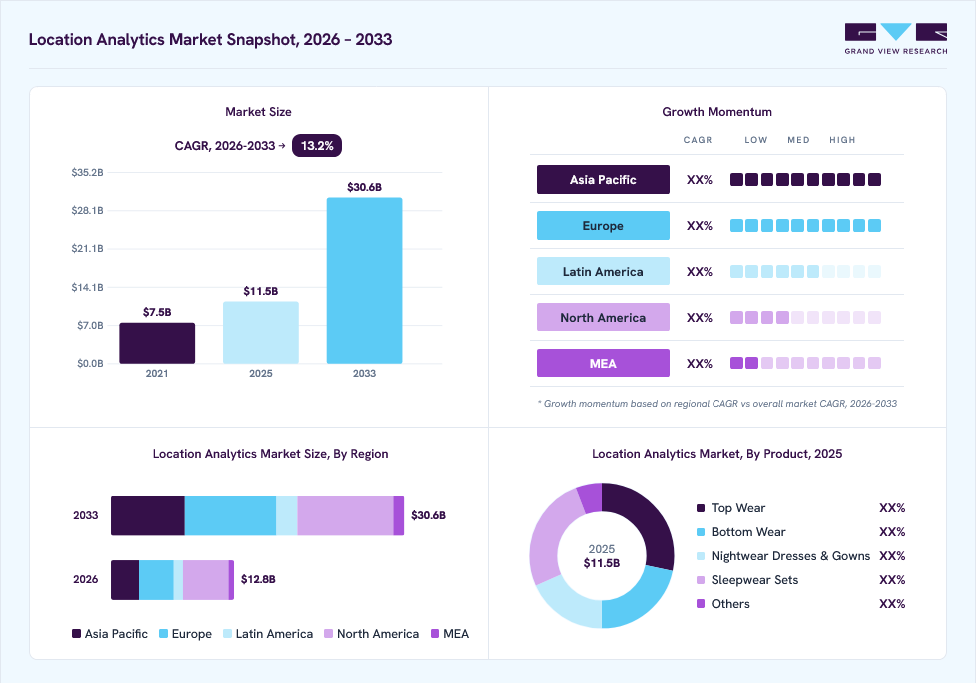
Market Size, 2025
$11.5BMarket Estimate, 2026
$12.8BMarket Forecast, 2033
$30.6BCAGR, 2026–2033
13.2%Location Analytics Market Summary
The global location analytics market size was valued at USD 11.5 billion in 2025 and is projected to grow from USD 12.8 billion in 2026 to USD 30.6 billion by 2033, at a CAGR of 13.2% from 2026 to 2033. North America dominated the market, accounting for the largest revenue share of 37.6% in 2025. Increasing use of remote sensing for crop health assessment is driving market growth.
 Source: Grand View Research, IR Documents, Primary Interviews, Paid DatabasesTo learn more about this report,
 Download Free Sample Report
Key Market Trends & Insights
- By component: The software segment held the largest market share of 76.2% in 2025
- By analytics type: The descriptive analytics segment held the largest market share of 28.3% in 2025
- By technology: The GPS and GNSS data segment held the largest market share of 33.0% in 2025
- By location type: The outdoor location analytics segment held the largest market share of 59.3% in 2025
- By deployment: The cloud segment held the largest market share of 69.0% in 2025
Regional Highlights
- Largest regional market: North America (37.6% revenue share, 2025)
- Fastest-growing regional market: Asia Pacific (highest CAGR, 2026-2033)
- By country: The U.S. dominated North America with the largest share in 2025.
Market Size & Forecast
- Market size in 2025: USD 11.5 Billion
- Estimated market size in 2026: USD 12.8 Billion
- Projected market size by 2033: USD 30.6 Billion
- CAGR (2026-2033): 13.2%
Prism AI by Grand View Research Free to tryAsk a question about the location analytics marketTry asking✓Every figure cited from GVR research Prefer the report? Download free sample →
The rapid growth of mobile devices and location-enabled applications is driving market growth across the location analytics industry by generating enormous volumes of geospatial data from smartphones, connected vehicles, wearable devices, logistics platforms, and digital services.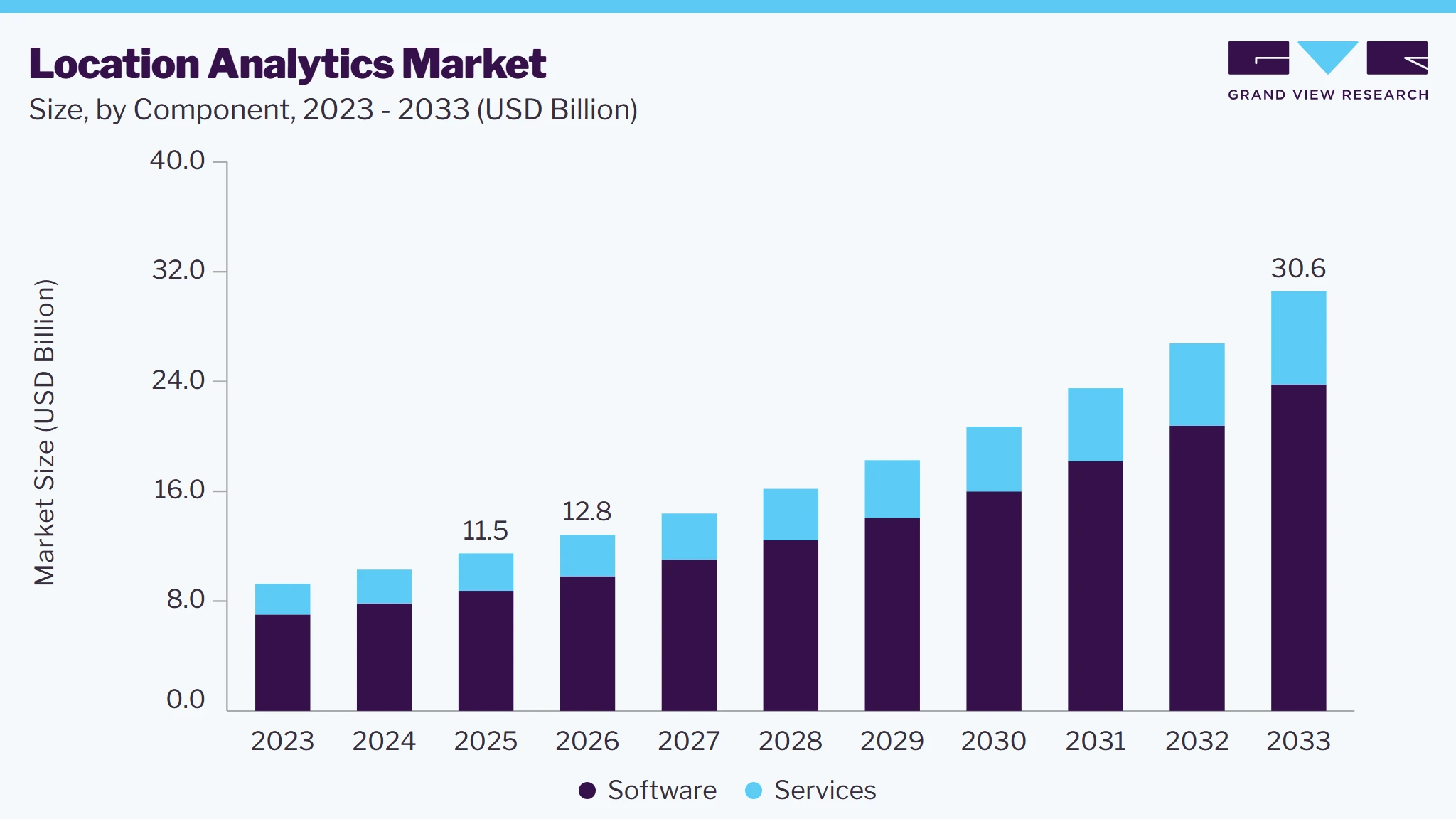 To learn more about this report, Download Free Sample Report
Businesses increasingly seek analytical platforms capable of processing movement patterns, location histories, customer mobility behavior, and real-time geographic interactions across large populations. Location analytics enables organizations to understand traffic flows, consumer visitation patterns, delivery performance, workforce mobility, and regional demand variations through continuously updated spatial datasets. Companies increasingly require scalable platforms that can transform raw location data into actionable operational intelligence across commercial and public-sector environments. The ongoing expansion of location-enabled digital ecosystems contributes to market growth for sophisticated geospatial analytics platforms.
The increasing adoption of smart cities and urban infrastructure initiatives is driving market growth within the location analytics industry. Municipal governments, transportation agencies, utilities, urban planners, and infrastructure developers are deploying geographic analytics to manage transportation networks, public safety systems, utility infrastructure, environmental monitoring, emergency response planning, and urban development programs. Location analytics platforms support spatial modeling, traffic optimization, infrastructure planning, service distribution analysis, and geographic resource management across complex urban environments. Public authorities increasingly require integrated geospatial intelligence platforms that simultaneously support long-term urban planning and real-time operational management. The continued expansion of smart infrastructure and digital urban development is propelling demand for location analytics technologies across public-sector applications.
The increasing integration of Geographic Information Systems with enterprise analytics environments is driving market growth across the global market. Organizations increasingly combine spatial data with customer information, financial records, operational metrics, asset management systems, IoT sensor networks, and enterprise resource planning platforms to generate comprehensive geographic business intelligence. Location analytics platforms provide visualization, mapping, spatial modeling, predictive geographic analysis, and location-based reporting that enhance enterprise decision-making across multiple operational functions. Businesses increasingly require integrated analytical environments that connect geographic intelligence directly with broader organizational data ecosystems. The continued convergence of GIS and enterprise analytics technologies is propelling demand for location analytics solutions across commercial, industrial, and institutional markets.
The rising demand for real-time operational visibility is driving market growth across industries, managing distributed assets and mobile operations. Telecommunications companies, utilities, transportation providers, emergency services, healthcare organizations, construction firms, and field service operators increasingly require continuous geographic visibility across personnel, equipment, vehicles, facilities, and operational activities. Location analytics platforms support real-time asset tracking, geographic performance monitoring, operational coordination, service optimization, and spatial decision support across large distributed networks. Organizations increasingly prioritize platforms that can process real-time location data and generate actionable geographic insights for operational management. The continued expansion of real-time spatial intelligence contributes to market growth for advanced location analytics technologies.
The increasing adoption of predictive spatial analytics is driving market growth by enabling organizations to forecast geographic demand, customer behavior, infrastructure utilization, environmental conditions, and operational risks across regions. Businesses increasingly use historical geographic data, mobility patterns, demographic trends, weather information, and economic indicators to predict future spatial outcomes and optimize strategic planning. Location analytics platforms support predictive site selection, demand forecasting, risk modeling, infrastructure planning, and regional investment analysis across multiple industries. Organizations increasingly seek analytical capabilities that combine predictive modeling with geographic intelligence to improve the accuracy of long-term planning. The continued expansion of predictive location-based decision-making contributes to sustained demand for advanced location analytics platforms.
Market Dynamics
The location analytics industry is expanding rapidly as organizations increasingly rely on geospatial intelligence to improve operational planning, customer targeting, logistics optimization, asset tracking, and infrastructure management. Businesses across retail, transportation, telecommunications, real estate, healthcare, and government sectors are adopting location analytics solutions to analyze spatial patterns, mobility trends, demographic data, and geographic relationships that influence strategic decision-making. The widespread availability of GPS-enabled devices, satellite imagery, IoT sensors, and real-time mapping data is significantly enhancing the accuracy and depth of location-based insights. In addition, growing investments in smart cities, connected infrastructure, and location-aware applications are accelerating demand for advanced spatial analytics capabilities across both public and private sectors.
The rising use of GPS and mobile location data is driving market growth, as businesses increasingly rely on precise geographic information to understand customer behavior, movement patterns, and operational performance across physical environments. Smartphones, navigation applications, connected vehicles, wearable devices, and mobile applications continuously generate location coordinates that can be analyzed to identify visitation trends, travel routes, dwell times, regional demand variations, and consumer mobility behavior. Location analytics platforms transform these large-scale geographic datasets into actionable business intelligence that supports retail planning, transportation optimization, infrastructure development, marketing strategy, and service delivery improvement. Organizations increasingly seek analytical systems capable of processing billions of location records while generating meaningful spatial insights across urban, suburban, and rural environments. The continued expansion of GPS-enabled digital ecosystems is propelling demand for advanced location analytics platforms across commercial and public-sector applications.
Data privacy and location-tracking concerns are constraining market growth, as organizations face increasing public sensitivity about how geographic information is collected, stored, analyzed, and shared. Consumers are becoming more aware that smartphones, mobile applications, connected vehicles, wearable devices, and digital services continuously generate detailed location histories that can reveal personal routines, travel patterns, workplace locations, residential areas, and behavioral characteristics. Businesses using location analytics platforms must implement strict consent management, anonymization techniques, encryption standards, access controls, and data governance policies before location information can be processed for commercial purposes. Many organizations hesitate to expand location-based analytics initiatives when customer trust and privacy protection become central strategic priorities across digital operations. The growing emphasis on personal data protection continues limiting broader deployment of location analytics solutions across consumer-facing industries.
The growing adoption of edge-based geospatial analytics is creating substantial opportunities in the location analytics industry by enabling geographic data processing directly at the point of data generation. Connected sensors, mobile devices, autonomous vehicles, industrial equipment, drones, surveillance systems, and IoT infrastructure increasingly produce continuous streams of location data that can be analyzed locally without relying exclusively on centralized cloud platforms. Edge-based geospatial analytics allows organizations to process spatial information with lower latency, faster decision-making, and greater operational responsiveness across transportation, logistics, manufacturing, utilities, public safety, and smart infrastructure environments. Location analytics providers can develop distributed analytics platforms that support real-time geographic intelligence across highly dynamic operational networks. The continued expansion of edge computing infrastructure is opening opportunities for next-generation location analytics architectures that operate across decentralized digital ecosystems.
Analyst Perspective
The location analytics market is evolving from traditional mapping and geographic visualization tools to a strategic decision-intelligence platform that directly influences revenue generation, operational efficiency, and risk management. Competitive advantage is increasingly determined by the ability to integrate diverse spatial and non-spatial datasets, deliver real-time analytics, and generate predictive insights that can be embedded into enterprise workflows. Vendors that can provide scalable cloud-native architectures, AI-driven spatial modeling, and industry-specific analytical capabilities are likely to strengthen their position as organizations seek location intelligence to support faster, more informed decisions. As physical and digital environments become increasingly interconnected, location analytics is expected to become a core layer of enterprise intelligence across sectors ranging from retail and logistics to urban planning and public infrastructure.
Component Insights
The software segment led the market with the largest revenue share of 76.2% in 2025 and is projected to grow at the fastest CAGR during the forecast period. The growing adoption of managed geospatial services is driving market growth in the location analytics services segment. Many organizations prefer outsourcing ongoing location analytics operations rather than maintaining dedicated internal geospatial teams responsible for software administration, spatial database management, map updates, data quality assurance, system monitoring, analytical model maintenance, and technical support. Managed service providers deliver continuous platform optimization, geographic data management, performance monitoring, security management, and operational support across enterprise location analytics environments. Businesses increasingly seek long-term service partnerships that provide scalable geospatial capabilities without extensive internal infrastructure investment. The growing preference for outsourced location intelligence operations contributes to market growth across managed and operational service offerings.
The services segment is anticipated to grow at a significant CAGR during the forecast period. The growing demand for customized spatial analytics solutions is driving market growth across location analytics consulting services. Different industries require highly specialized geographic models, predictive spatial analytics, territory optimization frameworks, infrastructure planning methodologies, transportation models, environmental analytics, and customer location intelligence capabilities that cannot always be addressed through standardized software deployments. Service providers increasingly develop industry-specific analytical frameworks tailored to logistics networks, retail expansion, healthcare accessibility, telecommunications infrastructure, financial services, energy distribution, and government planning requirements. Organizations increasingly seek consulting partners capable of designing proprietary geospatial solutions that align with unique operational challenges and regional business conditions.
Analytics Type Insights
The descriptive analytics segment led the market with the largest revenue share of 39.6% in 2025. The growing adoption of self-service geographic analytics is driving market growth across the descriptive analytics segment of the global market. Business users, regional managers, sales teams, operations personnel, marketing departments, urban planners, and government administrators increasingly require location analytics tools that allow them to generate maps, geographic summaries, territory reports, and regional performance visualizations without extensive technical training. Descriptive analytics platforms emphasize ease of use, interactive mapping, drag-and-drop reporting, dashboard customization, and intuitive geographic exploration, making spatial intelligence accessible to a broader organizational audience. Enterprises increasingly prioritize descriptive analytics solutions that democratize location intelligence across multiple departments rather than limiting geospatial analysis to specialized GIS teams.
The predictive analytics segment is expected to grow at the fastest CAGR from 2026 to 2033. The growing importance of network design and facility planning is driving market growth across the prescriptive analytics segment of the location analytics industry. Retail chains, financial institutions, healthcare providers, telecommunications companies, logistics operators, manufacturers, and infrastructure developers increasingly require geographic optimization tools to determine the best locations for stores, warehouses, distribution centers, service facilities, telecommunications towers, healthcare clinics, and public infrastructure investments. Prescriptive location analytics evaluates demographic patterns, transportation accessibility, competitive positioning, customer behavior, infrastructure availability, land characteristics, and operational costs to recommend optimal site configurations across regional markets. Businesses increasingly seek analytical platforms that improve long-term geographic investment planning through optimization-based location recommendations.
Technology Insights
The GPS and GNSS data segment led the market with the largest revenue share of 33.0% in 2025. The increasing deployment of connected vehicles and intelligent transportation systems is driving market growth within the GPS and GNSS data segment. Commercial fleets, public transportation networks, logistics providers, ride-sharing platforms, autonomous vehicle developers, and mobility service operators increasingly generate large volumes of positioning data that can be analyzed to improve transportation efficiency, route planning, fleet utilization, traffic management, and service coordination across complex transportation networks. GPS and GNSS analytics allow organizations to evaluate travel patterns, vehicle performance, delivery efficiency, congestion behavior, and regional mobility demand using continuously updated geographic information. Transportation operators increasingly seek analytical platforms that can transform positioning data into actionable operational intelligence across distributed fleets.
The RFID and IoT sensor data segment is expected to grow at the fastest CAGR from 2026 to 2033. The increasing adoption of smart warehouses and automated logistics facilities is driving market growth within the RFID and IoT sensor data segment. Warehouses, distribution centers, fulfillment facilities, and logistics hubs increasingly deploy RFID readers, IoT-enabled shelving systems, automated storage equipment, conveyor sensors, robotic platforms, and inventory-tracking devices that generate continuous location data across large operational environments. Location analytics platforms help organizations analyze inventory movement, storage utilization, material flow, equipment coordination, and operational bottlenecks using real-time sensor-generated spatial data. Logistics operators increasingly require geospatial analytics to optimize warehouse layouts, inventory positioning, fulfillment efficiency, and internal transportation workflows across automated distribution networks.
Location Type Insights
The outdoor location analytics segment led the market with the largest revenue share of 59.3% in 2025. The growing adoption of outdoor asset tracking and mobility intelligence is driving market growth across the outdoor location analytics segment of the global market. Utilities, transportation operators, field service organizations, telecommunications companies, energy providers, agriculture enterprises, and industrial operators increasingly require continuous visibility across vehicles, heavy equipment, mobile assets, field personnel, and outdoor operational resources distributed across wide geographic areas. Outdoor location analytics platforms transform GPS and GNSS positioning data into actionable geographic intelligence to support fleet optimization, maintenance planning, workforce coordination, asset utilization analysis, and operational management in outdoor environments. Organizations increasingly prioritize outdoor analytics that support geographically distributed operations with real-time spatial visibility.
The indoor location analytics segment is expected to grow at the fastest CAGR from 2026 to 2033. The growing expansion of indoor navigation and wayfinding applications is driving market growth across the indoor location analytics segment of the location analytics industry. Airports, shopping centers, transportation hubs, universities, hospitals, convention centers, museums, and large public facilities increasingly provide digital indoor navigation services that help visitors locate destinations, services, products, transportation connections, and facility resources within complex indoor environments. Indoor location analytics platforms generate detailed movement data that supports navigation optimization, congestion management, visitor flow analysis, signage planning, accessibility improvements, and service delivery coordination across large indoor facilities. Organizations increasingly seek indoor geospatial intelligence to enhance the visitor experience and improve operational management across complex indoor spaces.
Deployment Insights
The cloud segment led the market with the largest revenue share of 69.0% 2025 and is projected to grow at the fastest CAGR during the forecast period. The increasing adoption of software-as-a-service business models is driving market growth within the cloud segment of the global market. Cloud deployment allows organizations to access advanced geospatial analytics through subscription-based services that reduce upfront capital expenditure, simplify software maintenance, and accelerate implementation timelines across enterprises of different sizes. Businesses increasingly prefer cloud platforms that provide automatic updates, continuous feature enhancements, integrated security management, and flexible scaling according to changing analytical requirements. Cloud-based location analytics enables organizations to rapidly expand geographic analysis capabilities without maintaining dedicated geospatial infrastructure or large internal IT teams. The continued expansion of SaaS-based enterprise software ecosystems contributes to market growth across cloud location analytics platforms.
The on-premise segment is expected to grow at a significant CAGR from 2026 to 2033. The growing demand for high-performance geospatial computing is driving market growth in the on-premises segment. Organizations performing large-scale spatial modeling, terrain analysis, satellite image processing, transportation simulation, environmental forecasting, utility network analysis, and engineering-grade geographic computations often require dedicated computing infrastructure optimized for intensive geospatial workloads. On-premises systems allow enterprises to deploy specialized servers, high-performance storage, graphics processing units (GPUs), and optimized network architectures designed specifically for complex spatial analytics operations. Businesses increasingly seek deployment environments that deliver predictable processing performance across massive geographic datasets and computationally demanding analytical workflows.
Enterprise Size Insights
The large enterprises segment led the market with the largest revenue share of 63.8% in 2025. The increasing emphasis on market expansion and network optimization is driving market growth within the large enterprises segment. Retail chains, financial institutions, healthcare networks, telecommunications operators, hospitality companies, energy firms, and professional service organizations increasingly use location analytics to determine optimal locations for new stores, branches, offices, service centers, distribution facilities, and infrastructure investments across regional and international markets. Enterprise location analytics platforms evaluate demographic patterns, transportation accessibility, competitive landscapes, customer mobility behavior, economic indicators, and operational costs to support large-scale expansion strategies. Large organizations increasingly require sophisticated geographic decision-support systems capable of evaluating hundreds or thousands of potential locations simultaneously. The continued expansion of enterprise network planning activities contributes to market growth across advanced location analytics platforms.
The small and medium enterprises (SMEs) segment is anticipated to grow at the fastest CAGR during the forecast period. The growing adoption of location-based digital marketing is driving market growth across the SME segment. Small businesses increasingly use geospatial insights to support localized advertising, mobile marketing, customer segmentation, event targeting, neighborhood promotions, and geographically personalized customer engagement strategies across digital channels. Location analytics platforms help SMEs identify high-value customer segments, optimize advertising spend, evaluate campaign performance by geography, and improve local customer acquisition strategies using spatial data. Marketing efficiency becomes increasingly important for smaller organizations operating with limited promotional budgets and highly targeted customer bases. The continued expansion of location-aware digital marketing contributes to sustained demand for location analytics solutions among SMEs.
End-use Insights
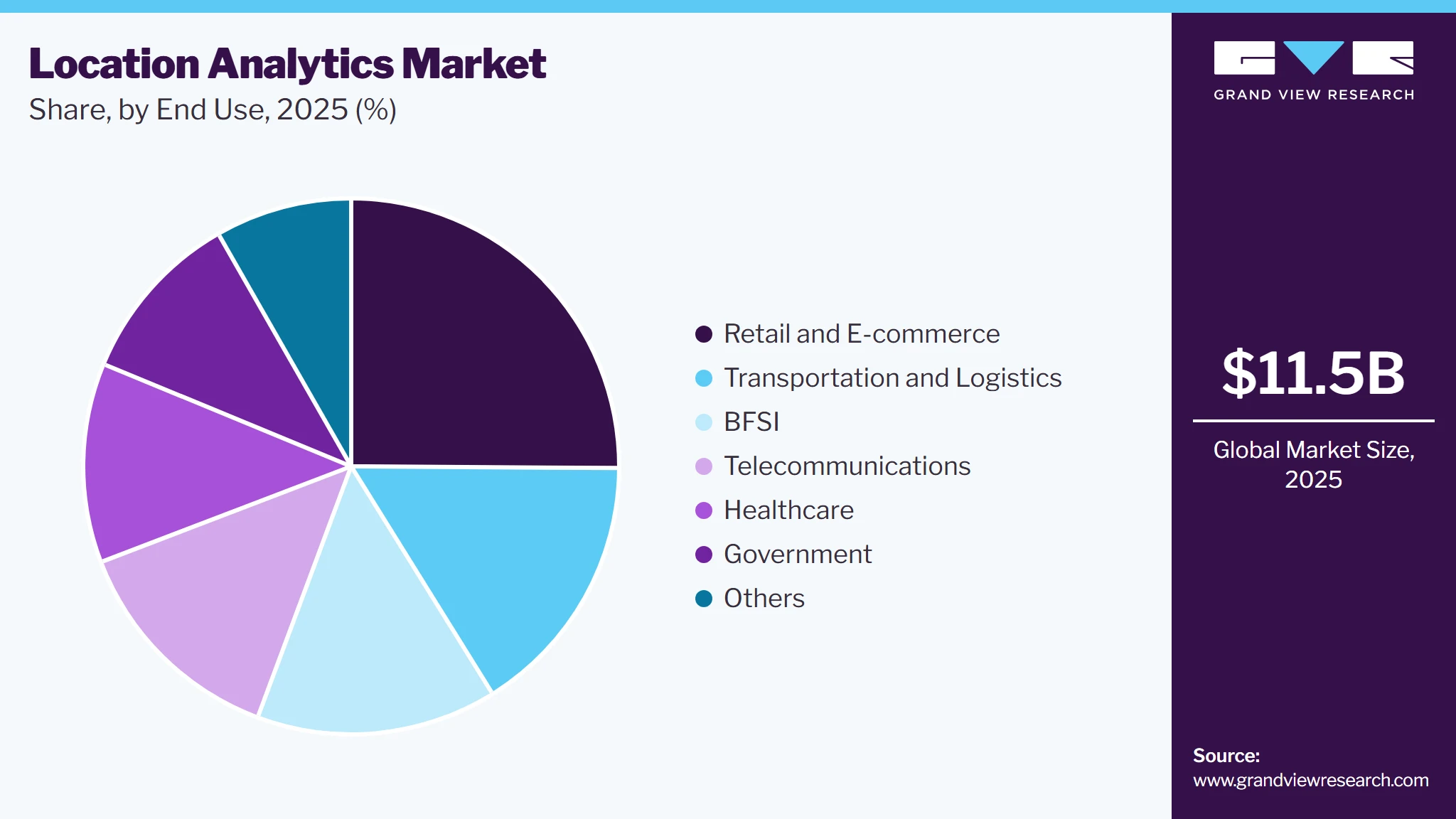
The retail and e-commerce segment led the market with the largest revenue share of 25.1% in 2025 and is projected to grow at the fastest CAGR during the forecast period. The rapid expansion of last-mile delivery and fulfillment operations is driving market growth across the retail and e-commerce segments. E-commerce companies increasingly require geographic intelligence related to warehouse placement, delivery route optimization, customer distribution, regional demand forecasting, courier deployment, and fulfillment network design across urban and suburban markets. Location analytics platforms process GPS data, transportation network data, customer addresses, traffic conditions, and delivery performance data to improve logistics efficiency and geographic resource allocation across large distribution networks. Retailers increasingly seek analytical systems capable of optimizing delivery speed, transportation costs, and service coverage across expanding e-commerce operations.
 To learn more about this report, Download Free Sample Report
The transportation and logistics segment is anticipated to grow at a significant CAGR during the forecast period. The growing adoption of connected fleet management technologies is driving market growth across the transportation and logistics segment. Commercial trucking companies, freight carriers, bus operators, rail logistics providers, shipping companies, and industrial transportation fleets increasingly generate continuous GPS and telematics data that can be analyzed to improve fleet performance, fuel efficiency, route planning, maintenance scheduling, driver management, and operational coordination across large geographic territories. Location analytics platforms transform fleet positioning data into actionable operational intelligence that supports both daily transportation management and long-term network optimization. Fleet operators increasingly require scalable geospatial analytics to monitor thousands of moving assets simultaneously across regional and international transportation networks.
Regional Insights
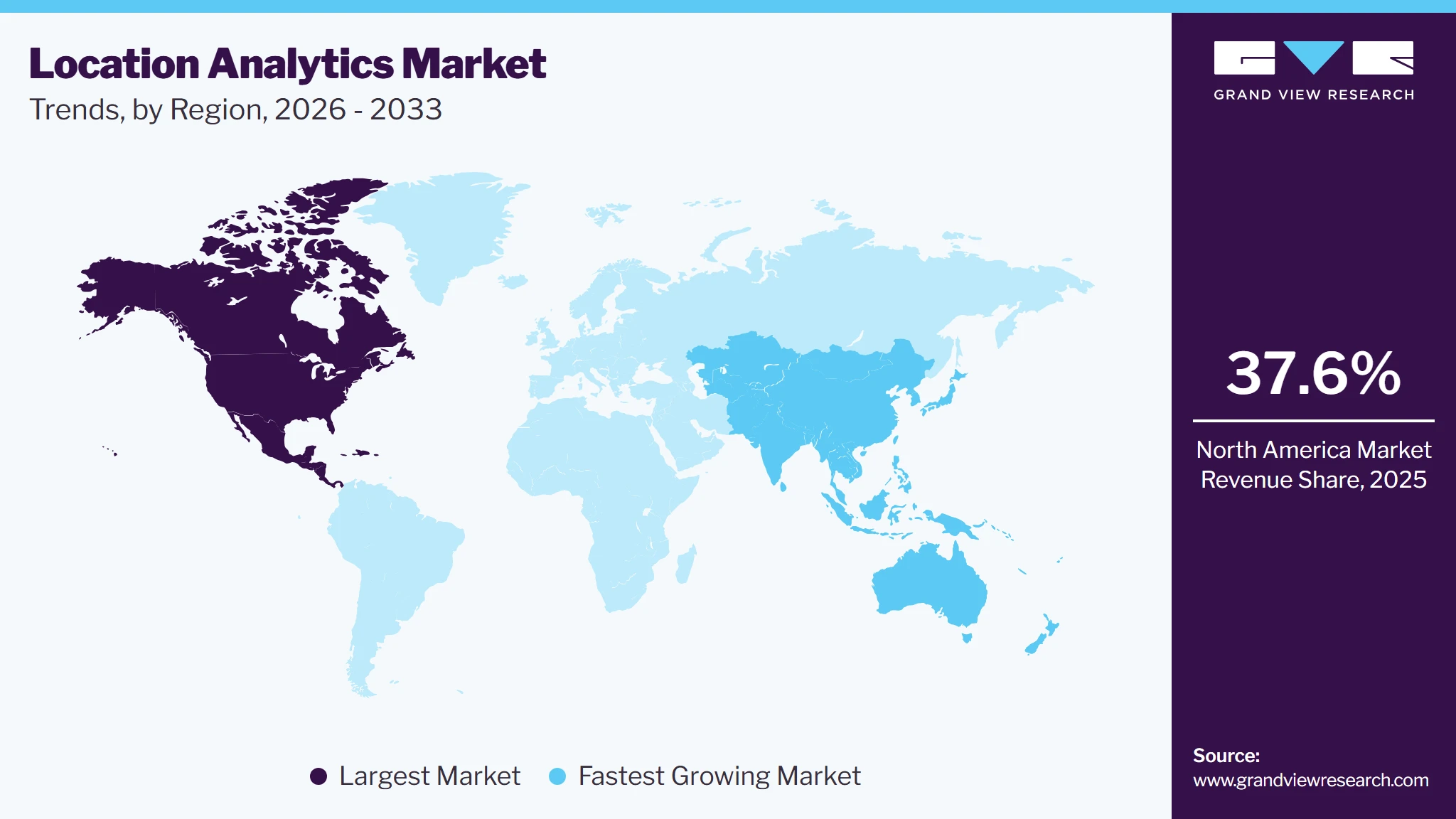
North America dominated the global location analytics market with the largest revenue share of 37.6% in 2025. The widespread digitalization of enterprise operations across North America is driving market growth as organizations increasingly integrate geospatial intelligence into decision-making across retail, logistics, healthcare, financial services, telecommunications, manufacturing, and the public sector. Enterprises across the region operate extensive networks of stores, warehouses, transportation fleets, offices, service centers, and customer locations, all of which require advanced geographic visibility and operational coordination. Location analytics platforms help businesses optimize regional performance, customer engagement, infrastructure planning, supply chain operations, and market expansion strategies using large-scale spatial data. Organizations increasingly require enterprise-grade geospatial platforms that support real-time analytics, predictive modeling, and geographically distributed operations across national and regional markets.
 To learn more about this report, Download Free Sample Report
U.S. Location Analytics Market Trends
The location analytics market in the U.S. accounted for the largest market revenue share in North America in 2025. The increasing use of location intelligence in commercial real estate and retail expansion is driving market growth within the U.S. market. Real estate developers, retail chains, financial institutions, healthcare providers, hospitality companies, and commercial property operators increasingly analyze demographic trends, consumer mobility, neighborhood growth patterns, transportation accessibility, competitor locations, and regional purchasing behavior before making expansion and investment decisions. Location analytics platforms provide trade area analysis, site selection modeling, customer catchment analysis, regional demand forecasting, and market opportunity assessment across highly competitive commercial environments.
Asia Pacific Location Analytics Market Trends
The location analytics market in the Asia Pacific is expected to grow at the fastest CAGR from 2026 to 2033. The rapid urbanization and expansion of metropolitan regions across the Asia-Pacific are driving market growth, as governments and private enterprises increasingly require geographic intelligence for urban planning, infrastructure development, transportation management, and commercial expansion. Major cities across the region continue to experience significant population growth, rising commercial activity, expanding residential development, and increasing transportation demand, all of which require advanced spatial analysis across large urban environments. Location analytics platforms help organizations evaluate traffic flows, land utilization, infrastructure placement, service accessibility, customer concentration, and regional development patterns by integrating geospatial intelligence with demographic and operational data.
The China location analytics market is projected to grow significantly during the forecast period. The growing modernization of manufacturing and industrial ecosystems is driving market growth across the China market. Industrial parks, manufacturing clusters, export-oriented production facilities, energy infrastructure, telecommunications networks, logistics hubs, and supply chain networks increasingly use geographic intelligence for asset tracking, facility planning, transportation coordination, supplier network optimization, infrastructure management, and operational analytics across geographically distributed industrial environments. Location analytics platforms help organizations improve production logistics, inventory movement, workforce deployment, infrastructure utilization, and regional manufacturing coordination using advanced spatial analysis capabilities.
The location analytics market in India is projected to grow at a substantial CAGR during the forecast period. The increasing adoption of geospatial technologies across government and public-sector programs is driving market growth across the Indian market. National and state government agencies increasingly use geographic intelligence for land management, urban planning, transportation development, agricultural monitoring, environmental assessment, disaster management, utility planning, infrastructure investment, and public service delivery across large geographic regions. Location analytics platforms support geographic visualization, spatial modeling, regional planning, infrastructure mapping, resource allocation, and operational coordination across diverse administrative and developmental initiatives.
Europe Location Analytics Market Trends
The location analytics market in Europe is anticipated to grow at a steady CAGR from 2026 to 2033. The strong presence of advanced manufacturing, industrial automation, and infrastructure modernization across Europe is driving market growth across the European market. Manufacturing clusters, industrial parks, logistics networks, energy infrastructure, utilities, telecommunications systems, and transportation corridors increasingly use geographic intelligence for asset tracking, facility planning, infrastructure maintenance, supply chain optimization, workforce coordination, and operational analytics across geographically distributed industrial environments. Location analytics platforms help organizations improve production logistics, infrastructure utilization, maintenance planning, regional resource allocation, and industrial network efficiency using advanced spatial analysis capabilities. Industrial enterprises increasingly seek integrated geospatial intelligence that supports both operational optimization and long-term infrastructure investment planning across multiple countries.
The UK location analytics market is expected to grow at a significant CAGR during the forecast period. The high concentration of financial services, insurance, and commercial analytics activity across the UK is driving market growth. Banks, insurance companies, investment firms, fintech organizations, commercial real estate operators, and professional service providers increasingly use geographic intelligence to evaluate customer distribution, branch performance, property values, regional risk exposure, market demand, and investment opportunities across urban and regional markets. Location analytics platforms support customer segmentation, branch network optimization, insurance risk assessment, commercial property analysis, and regional financial planning using advanced spatial modeling capabilities. Financial institutions increasingly require geospatial intelligence that improves both strategic investment decisions and operational performance across geographically diverse markets.
The location analytics market in Germany is expected to grow significantly during the forecast period. The growing use of location intelligence in automotive, mobility, and transportation innovation is driving market growth in the German market. Automotive manufacturers, mobility technology companies, public transportation operators, logistics providers, autonomous vehicle developers, and infrastructure managers increasingly generate continuous GPS, telematics, and mobility data that support transportation optimization, fleet management, infrastructure planning, traffic forecasting, mobility analysis, and connected transportation development across extensive road and urban transit networks. Location analytics platforms transform positioning and transportation data into operational insights that improve mobility efficiency and the allocation of geographic resources across complex transportation ecosystems.
Key Location Analytics Company Insights
Some prominent players in the location analytics industry include CARTO and Esri.
-
CARTO is a location intelligence and geospatial analytics company with operations across multiple international markets. The company specializes in helping organizations analyze, visualize, and operationalize geographic data through cloud-native spatial analytics platforms. CARTO provides a comprehensive portfolio of cloud-based products designed to transform raw spatial data into actionable business intelligence. The products enable organizations to create interactive maps, perform spatial analysis, automate geospatial workflows, access enriched location datasets, and integrate location intelligence directly within major cloud data warehouse environments.
-
Esri is a software company specializing in geographic information systems (GIS), geospatial analytics, mapping, and location intelligence solutions. Esri offers a comprehensive portfolio of GIS and spatial analytics products that enable organizations to analyze, visualize, and manage geographic information at an enterprise scale. The products support mapping, demographic analysis, site selection, trade area analysis, spatial modeling, route optimization, asset management, real-time monitoring, and large-scale geospatial analytics across cloud, desktop, and enterprise environments.
Key Location Analytics Companies
The following key companies have been profiled for this study on the location analytics market.
-
CARTO
-
Esri
-
Google Maps Platform
-
HERE Technologies
-
Hexagon AB
-
Microsoft
-
Precisely
-
SAP SE
-
TomTom International BV.
-
Unacast
Competitive Benchmarking
Operating Strategies
Competitive Edge
Weakness
Mature Players: Esri; Google; HERE Technologies; Microsoft
- Established players focus on integrating geospatial analytics, mapping technologies, mobility data, and enterprise business intelligence into unified location analytics platforms.
- They invest in cloud-based GIS capabilities, AI-driven spatial analysis, and industry-specific solutions for retail, transportation, and government applications.
- These companies benefit from extensive geospatial databases, global mapping infrastructure, and strong enterprise relationships across multiple industries.
- Their ability to combine spatial intelligence with cloud, AI, and enterprise analytics platforms enables scalable and high-accuracy location-based decision support.
- Maintaining large geospatial datasets and mapping infrastructure requires significant investment and continuous updates.
- Complex enterprise implementations and data privacy compliance requirements can also increase deployment costs and project timelines.
Emerging Players: Near; Carto; Unacast; Foursquare; Precisely
- Emerging players focus on location intelligence platforms that support real-time business decision-making.
- They emphasize flexible APIs, advanced spatial visualization, and analytics services that help organizations optimize marketing, site selection, logistics, and customer engagement strategies.
- These companies offer agile platforms, specialized mobility insights, and faster innovation in cloud-native geospatial analytics.
- Their flexible deployment models and advanced spatial data capabilities enable rapid adoption for targeted business intelligence and location intelligence applications.
- Smaller global customer bases and limited enterprise sales networks can restrict large-scale market penetration.
- Dependence on third-party data sources and evolving privacy regulations may also affect long-term growth and scalability.
Recent Developments
-
In July 2026, HERE Technologies and Esri signed a three-year agreement to co-develop advanced location-based analytics and visualization solutions designed to support emerging artificial intelligence applications. The partnership addresses increasing customer demand for AI-driven capabilities, including agentic workflows, and the need for more efficient methods to access, integrate, and analyze large volumes of location data. The collaboration will combine HERE’s extensive mapping, traffic, and mobility datasets with Esri’s ArcGIS platform to improve the accessibility of both real-time and historical geospatial information for engineering teams and AI-powered analytics workflows.
-
In July 2026, CARTO partnered with Marker to strengthen its presence across Argentina, Chile, Uruguay, and Paraguay. Through this collaboration, organizations in these markets gain access to CARTO’s comprehensive Location Intelligence and Agentic GIS platform, supported by Marker’s regional expertise and extensive experience in geolocation technologies. The partnership enables businesses and public-sector organizations to leverage advanced spatial analytics capabilities without requiring large teams of specialized geospatial professionals. By integrating regional knowledge with CARTO’s technology platform, the collaboration aims to accelerate data-driven, location-based decision-making across the Southern Cone region.
Location Analytics Market Report Scope
Report Attribute
Details
Market size in 2025
USD 11.5 billion
Estimated market size in 2026
USD 12.8 billion
Projected market size by 2033
USD 30.6 billion
Growth rate
CAGR of 13.2% from 2026 to 2033
Base year for estimation
2025
Historical data
2021 - 2024
Forecast period
2026 - 2033
Quantitative units
Revenue in USD million/billion, and CAGR from 2026 to 2033
Report coverage
Revenue forecast, company share, competitive landscape, growth factors, and trends
Segments covered
Component, analytics type, technology, location type, deployment, enterprise size, end-use, region
Regional scope
North America; Europe; Asia Pacific; Latin America; MEA
Country scope
U.S.; Canada; Mexico; UK; Germany; France; China; India; Japan; Australia; South Korea; Brazil; UAE; Saudi Arabia; South Africa
Key companies profiled
CARTO; Esri; Google Maps Platform; HERE Technologies; Hexagon AB; Microsoft; Precisely; SAP SE; TomTom International BV.; Unacast
Customization scope
Free report customization (equivalent to 8 analysts working days) with purchase. Addition or alteration to country, regional & segment scope.
Pricing and purchase options
Avail customized purchase options to meet your exact research needs. Explore purchase options
Global Location Analytics Market Report Segmentation
This report forecasts revenue growth at global, regional, and country levels and provides an analysis of the latest industry trends in each of the sub-segments from 2021 to 2033. For this study, Grand View Research has segmented the global location analytics market report based on component, analytics type, technology, location type, deployment, enterprise size, end-use, and region.
-
Component Outlook (Revenue, USD Billion, 2021 - 2033)
-
Software
-
Geocoding and Reverse Geocoding
-
Mapping and Visualization Software
-
Spatial Analytics and Geospatial Intelligence
-
Customer and Behavioral Analytics
-
Asset and Workforce Location Analytics
-
Others
-
-
Services
-
Consulting Services
-
System Integration and Implementation
-
Support and Maintenance
-
-
-
Type Outlook (Revenue, USD Billion, 2021 - 2033)
-
Descriptive Analytics
-
Diagnostic Analytics
-
Predictive Analytics
-
Prescriptive Analytics
-
Others
-
-
Technology Outlook (Revenue, USD Billion, 2021 - 2033)
-
GPS and GNSS Data
-
Mobile Network Data
-
Wi-Fi Positioning Data
-
Bluetooth Beacon Data
-
RFID and IoT Sensor Data
-
Others
-
-
Location Type Outlook (Revenue, USD Billion, 2021 - 2033)
-
Indoor Location Analytics
-
Outdoor Location Analytics
-
-
Deployment Outlook (Revenue, USD Billion, 2021 - 2033)
-
Cloud
-
On-premise
-
-
Enterprise Size Outlook (Revenue, USD Billion, 2021 - 2033)
-
Large Enterprises
-
Small and Medium Enterprises (SMEs)
-
-
End-use Outlook (Revenue, USD Billion, 2021 - 2033)
-
BFSI
-
Healthcare
-
Telecommunications
-
Retail and E-commerce
-
Transportation and Logistics
-
Government
-
Others
-
-
Regional Outlook (Revenue, USD Billion, 2021 - 2033)
-
North America
-
U.S.
-
Canada
-
Mexico
-
-
Europe
-
Germany
-
UK
-
France
-
-
Asia Pacific
-
China
-
India
-
Japan
-
South Korea
-
Australia
-
-
Latin America
-
Brazil
-
-
Middle East & Africa
-
UAE
-
Saudi Arabia
-
South Africa
-
-
Research Methodology
The location analytics marketfigures in this report are based on a proven research process that combines executive interviews with secondary research from proprietary databases, company filings, and recognized regulatory and institutional sources. Market size is built through value-chain sizing-reconciling supply-side and demand-side estimates-and triangulated with bottom-up and top-down approaches. Every estimate passes multiple levels of expert validation before publication, with eachlocation analytics segment quantified using the revenue-capture definitions in the table below.
Segment Definition
Segment - Component
Revenue capture definition
Software
The largest component segment, capturing market value through location intelligence platforms that combine geospatial visualization, spatial analytics, mobility insights, mapping, AI-driven decision support, and real-time monitoring capabilities. Vendors primarily monetize through SaaS subscriptions, enterprise software licensing, API access, and advanced analytics modules that help organizations optimize location-based operations.
Services
Commercial opportunities arise from implementation, GIS integration, data enrichment, consulting, custom analytics development, managed location intelligence, and technical support. Organizations increasingly engage service providers to integrate multiple spatial data sources and build industry-specific location analytics solutions.
Segment - Analytics Type
Revenue capture definition
Descriptive Analytics
Market value is created through dashboards, geospatial reports, heat maps, traffic visualization, and historical location intelligence that explain what has occurred across physical locations and customer movement patterns. Businesses rely on descriptive analytics to improve operational visibility and understand geographic performance trends.
Diagnostic Analytics
Commercial demand is driven by tools that identify the root causes of location-based events, including customer behavior, supply chain disruptions, store performance, and mobility anomalies. These capabilities help organizations uncover relationships between geographic factors and business outcomes.
Predictive Analytics
One of the fastest-growing analytics segments, generating value through forecasting models that anticipate customer traffic, delivery demand, network congestion, disease spread, fraud risk, and location-based operational changes. AI and machine learning continue to strengthen predictive accuracy and enterprise adoption.
Prescriptive Analytics
Investment is concentrated in advanced optimization engines that recommend optimal routes, site selection, workforce allocation, inventory placement, and resource deployment strategies. Organizations adopt these capabilities to improve efficiency and automate complex location-dependent decision-making.
Others
This category includes real-time analytics, geofencing analytics, behavioral analytics, spatial simulation, and emerging AI-powered location intelligence applications. Continuous innovation in geospatial data processing is expanding specialized analytical capabilities across industries.
Segment - Technology
Revenue capture definition
GPS and GNSS Data
The largest technology segment is supported by widespread use of satellite-based positioning for fleet management, asset tracking, navigation, field operations, and mobility analytics. GPS/GNSS data forms the foundation for many enterprise location intelligence and logistics applications.
Mobile Network Data
Market value is derived from cellular network signals used to analyze population movement, travel behavior, footfall patterns, and regional mobility trends. Telecommunications operators and analytics providers increasingly commercialize anonymized mobile network data for urban planning and commercial intelligence.
Wi-Fi Positioning Data
Commercial activity is driven by indoor positioning systems that track customer movement, dwell time, occupancy levels, and facility utilization within retail stores, airports, hospitals, campuses, and commercial buildings. Organizations use these insights to optimize layouts and improve customer experiences.
Bluetooth Beacon Data
Demand is supported by proximity-based analytics used for personalized marketing, indoor navigation, visitor engagement, and location-triggered notifications. Retailers, venues, and hospitality operators use beacon technology to enhance customer engagement and conversion rates.
RFID and IoT Sensor Data
Market opportunities arise from connected sensors and RFID infrastructure that provide real-time visibility into assets, inventory, equipment, and environmental conditions. Industrial, logistics, and healthcare organizations increasingly rely on IoT-based location intelligence to improve operational control and asset utilization.
Others
This segment includes satellite imagery, geospatial databases, computer vision, drone-based location data, and emerging spatial sensing technologies. Advanced geospatial data sources continue to broaden the scope of location analytics across complex operational environments.
Segment - Location Type
Revenue capture definition
Indoor Location Analytics
Market value is captured through analytics platforms that monitor movement, occupancy, navigation, asset locations, and customer behavior within enclosed environments such as malls, hospitals, airports, factories, and office buildings. Organizations invest in indoor analytics to improve operational efficiency, safety, and customer engagement.
Outdoor Location Analytics
The dominant location segment is supported by applications involving fleet tracking, logistics optimization, smart cities, retail site selection, transportation planning, infrastructure monitoring, and geospatial intelligence across large geographic areas. Public and private sector organizations increasingly rely on outdoor analytics for strategic planning and operational optimization.
Segment - Deployment
Revenue capture definition
Cloud
The largest deployment segment, benefiting from scalable geospatial processing, real-time data integration, remote access, and seamless connectivity with mapping, IoT, and analytics platforms. Subscription-based cloud delivery enables organizations to deploy location analytics rapidly while reducing infrastructure management requirements.
On-Premise
Spending is concentrated among organizations requiring direct control over sensitive geospatial information, internal analytics infrastructure, and customized security environments. Government agencies, defense organizations, and regulated enterprises continue to maintain on-premises deployments for critical location intelligence workloads.
Segment - Enterprise Size
Revenue capture definition
Large Enterprises
The Large enterprises segment, with respect to the number of employees, typically comprises organizations employing more than 1,000 employees for multinational corporations.
Small and Medium Enterprises (SMEs)
The SMEs segment, with respect to the number of employees, generally includes organizations employing between 10 and 999 employees.
Segment - End Use
Revenue capture definition
BFSI
Financial institutions utilize location analytics for fraud detection, branch optimization, ATM placement, customer segmentation, and risk assessment based on geographic behavior patterns. Spatial intelligence helps improve operational efficiency and strengthen customer engagement strategies.
Healthcare
Hospitals and healthcare organizations deploy location analytics for patient flow management, asset tracking, emergency response coordination, disease surveillance, and facility optimization. The increasing digitalization of healthcare operations continues to expand investment in location intelligence technologies.
Telecommunications
Telecom operators leverage location analytics to optimize network planning, coverage expansion, subscriber mobility analysis, infrastructure deployment, and service quality management. The growth of 5G and connected devices is significantly increasing demand for advanced spatial analytics.
Retail and E-commerce
The largest commercial end-use segment utilizes location analytics for store site selection, footfall analysis, customer behavior mapping, last-mile delivery optimization, and omnichannel retail planning. Retailers increasingly integrate location intelligence with customer analytics to improve sales performance and operational efficiency.
Transportation and Logistics
Logistics providers and transportation companies rely on location analytics for route optimization, fleet tracking, shipment visibility, warehouse positioning, and supply chain coordination. Real-time geospatial intelligence is critical for improving delivery performance and reducing operational costs.
Government
Public-sector organizations employ location analytics for urban planning, transportation management, disaster response, environmental monitoring, public safety, and infrastructure development. Smart city initiatives and digital governance programs continue to drive significant investment in geospatial analytics platforms.
Others
This category includes organizations in manufacturing, energy, utilities, agriculture, hospitality, real estate, education, and defense. Enterprises across these sectors increasingly utilize location analytics to improve operational visibility, optimize resource allocation, and support data-driven strategic planning across geographically distributed operations.
Estimation Model
Layer
Question
Analysis
Spatial Decision Layer
What business and public-sector decisions require location analytics?
Identify decisions that depend on geographic context, including site selection, retail expansion, logistics planning, territory management, emergency response, urban planning, infrastructure investment, and asset optimization. This layer defines demand by evaluating how organizations use spatial intelligence to improve operational efficiency, reduce geographic risk, and optimize the placement of resources across physical environments.
Geospatial Data Foundation Layer
What enables accurate location analytics?
Assess the availability and quality of geospatial datasets, including GPS signals, satellite imagery, mobile location data, GIS layers, demographic information, traffic patterns, weather data, IoT sensor feeds, and business location databases. The effectiveness of location analytics depends on data accuracy, temporal freshness, spatial resolution, interoperability, and governance practices that support reliable geographic analysis across multiple data sources.
Operational Intelligence Layer
How is location analytics integrated into organizational workflows?
Analyze how enterprises embed location analytics into logistics systems, retail planning platforms, supply chain operations, marketing technologies, field service management, transportation networks, and smart city platforms. Organizations increasingly use geospatial visualization, real-time tracking, route optimization, geofencing, proximity analysis, and predictive spatial modeling to support day-to-day operational decisions and strategic planning.
Spatial Value Monetization Layer
How is commercial value generated within the location analytics ecosystem?
Evaluate revenue streams from GIS software, cloud-based analytics platforms, API-based location services, spatial data subscriptions, consulting, implementation services, and industry-specific geospatial solutions. Additional value is created through improved network efficiency, reduced transportation costs, better customer targeting, optimized asset utilization, enhanced public service delivery, and recurring revenues from continuously updated spatial data and analytics services.
Delivered Customization
This report has been delivered with the following In-depth customizations
Client Request
Customization Delivered
Value Adds
Spatial Intelligence & Geographic Decision-Making Trends
Conducted a focused analysis of location analytics adoption across retail, logistics, telecommunications, real estate, and public sector organizations, covering geographic data analysis, catchment area assessment, site selection, and location-based performance evaluation.
Helps stakeholders identify high-value spatial intelligence applications, evaluate geographic analytics adoption trends, and assess commercialization opportunities in location-driven decision support solutions.
Mobility Patterns, Footfall Analytics & Network Optimization Trends
Evaluated adoption trends for mobility analytics, customer footfall measurement, route optimization, territory planning, network coverage analysis, and location-based operational planning across urban and enterprise environments.
Provides insights into movement behavior analysis, operational optimization opportunities, and commercially attractive location intelligence capabilities that improve planning and resource allocation.
Geospatial Analytics Ecosystem & Enterprise Intelligence Opportunity Assessment
Assessed demand for GIS integration, real-time location data platforms, geofencing, satellite and mobile data analytics, AI-powered spatial modeling, and cloud-based geospatial services, along with challenges related to data privacy, location accuracy, interoperability, and real-time processing.
Supports investment and expansion strategies by identifying emerging geospatial opportunities, evaluating enterprise readiness, and strengthening long-term growth potential in location-aware analytics and spatial intelligence ecosystems.
Frequently Asked Questions About This Report
The global location analytics market size was valued at USD 11.5 billion in 2025 and is estimated at USD 12.8 billion in 2026.
The global location analytics market size is expected to reach USD 30.6 billion by 2033, growing at a CAGR of 13.2% from 2025 to 2033.
Key factors include increasing use of remote sensing for crop health assessment, the rapid growth of mobile devices and location-enabled applications, and the increasing adoption of smart cities and urban infrastructure initiatives.
North America dominated the market with 37.6% revenue share in 2025.
Asia Pacific is the fastest-growing region over the forecast period.
The software segment led with an 76.2% revenue share in 2025 and it is the fastest-growing segment.
The descriptive analytics segment led with an 28.3% revenue share in 2025, while prescriptive analytics is the fastest-growing segment.
The GPS and GNSS data held the largest share (over 33%), while Wi-Fi positioning data is the fastest-growing segment.
Key players operating in the location analytics market include CARTO, Esri, Google Maps Platform, HERE Technologies, Hexagon AB, Microsoft, Precisely, SAP SE, TomTom International BV., Unacast.
About the Author(s)
Communications Infrastructure Research Team
Technology · Communications InfrastructureThis report was authored by the communications infrastructure research team at Grand View Research - comprising two research analysts, one senior research analyst, and one industry expert - with specialized expertise in the communications infrastructure segment of the technology industry. All findings are based on proprietary technology databases, executive interviews, and regulatory analysis, subject to internal peer review prior to publication.
Last Updated:
Speak to Analyst

Customize this report to your needs - add regions, segments, or data points, with 20% free customization.
Or view our licence options:


ISO 9001:2015 & 27001:2022 Certified
We are GDPR and CCPA compliant! Your transaction & personal information is safe and secure. For more details, please read our privacy policy.


