
- Home
- »
- Paints, Coatings & Printing Inks
- »
-
Low Migration Inks Market Size & Share Report, 2026-2033GVR Report cover
![Low Migration Inks Market (2026 - 2033)Report]()
Low Migration Inks Market (2026 - 2033)
Size, Share & Trends Analysis Report By Printing Process (Flexography, Digital, Offset, Gravure), By End Use (Food and Beverage Pharmaceuticals, Personal Care, Other End Use), By Region, And Segment Forecasts
Market Size, 2025
$488.6MMarket Estimate, 2026
$513.2MMarket Forecast, 2033
$785.0MCAGR, 2026–2033
6.3%Low Migration Inks Market Summary
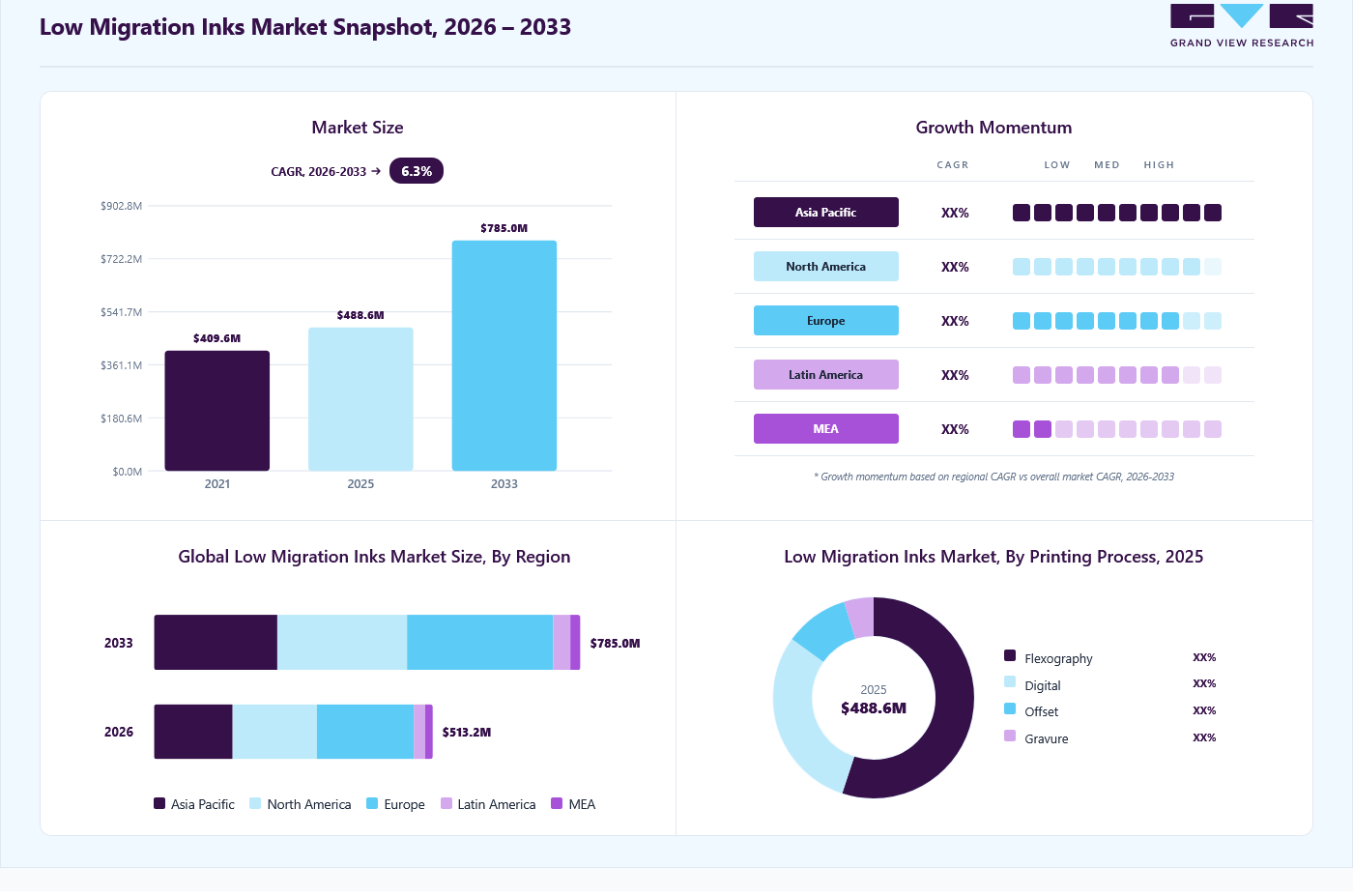
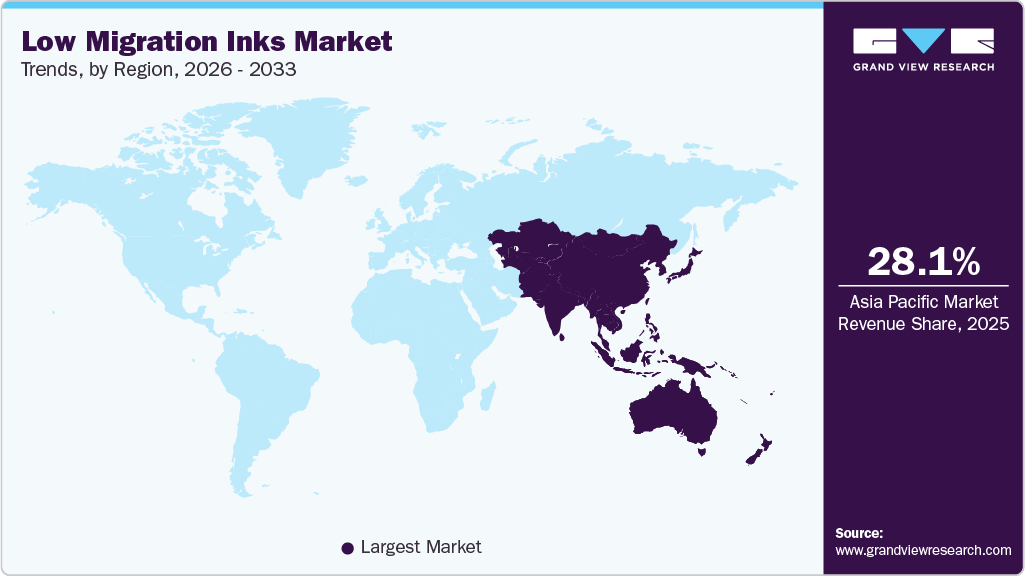
TThe global low migration inks market size was valued at USD 488.6 million in 2025 and is projected to grow from USD 513.2 million in 2026 to USD 785.0 million by 2033, at a CAGR of 6.3% from 2026 to 2033. The Asia Pacific held the largest share of 28.1% of the global market in 2025. Rising demand for safe and compliant food, pharmaceutical, and personal care packaging is driving the adoption of low migration inks, as regulators and brand owners prioritize consumer health.
Key Market Trends & Insights
- By product: Flexography segment held the largest market share of 55.0% in 2025.
- By end use: Food & beverage segment held the largest market share of 43.0% in 2025.
Regional Highlights
- Largest regional market: Asia Pacific (28.1% revenue share, 2025)
- By country: China held the largest share in 2025
Market Size & Forecast
- Market size in 2025: USD 488.6 Million
- Estimated market size in 2026: USD 513.2 Million
- Projected market size by 2033: USD 785.0 Million
- CAGR (2026-2033): 6.3%
Increasing awareness of ink migration risks and stricter global packaging safety standards are accelerating market growth. The low migration inks market is gaining strong momentum as global packaging industries face heightened scrutiny around consumer safety and compliance. Regulatory authorities such as the European Food Safety Authority (EFSA) and the U.S. Food and Drug Administration (FDA) have introduced strict guidelines that limit the transfer of potentially harmful substances from packaging materials into food, beverages, pharmaceuticals, and cosmetics. This has created a strong push for packaging converters and brand owners to shift from conventional inks to low migration formulations designed to minimize chemical transfer during storage and use. Beyond regulations, growing consumer awareness about food safety and rising preference for brands that emphasize transparency and health protection are amplifying demand.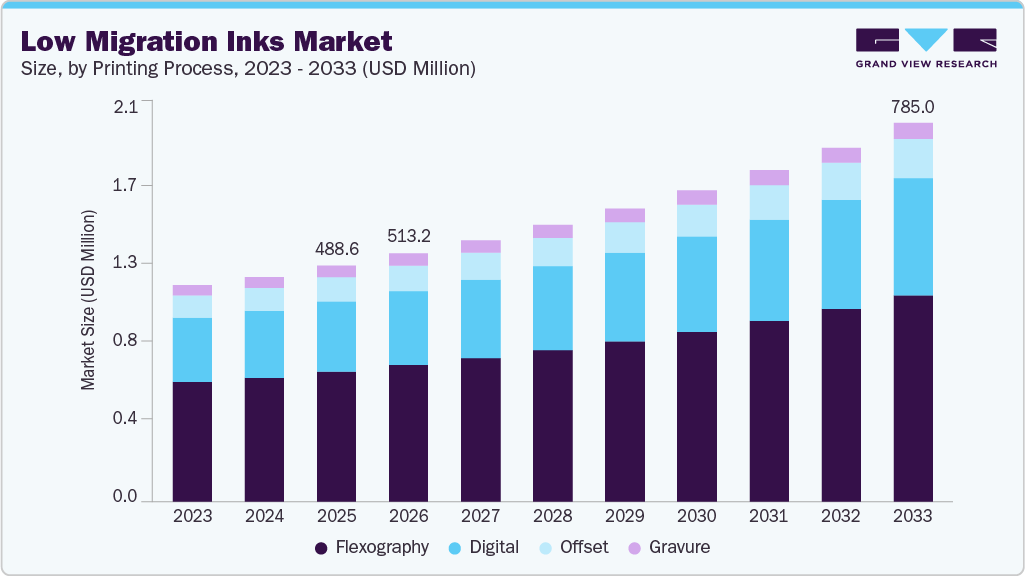
However, one of the main hurdles to adoption lies in the higher cost of production compared to standard inks. The need for specialized raw materials, testing procedures, and compliance certifications adds to the overall expense, making it less attractive for small and medium-scale printers in cost-sensitive markets. Limited awareness about the risks of ink migration also dampens uptake in developing regions, where regulatory oversight is still evolving.
Despite these challenges, opportunities are expanding with the growing demand for sustainable and eco-friendly packaging solutions. Brand owners are increasingly using safe and compliant packaging as a differentiator to build consumer trust, which positions low migration inks as a premium solution. Rapid growth of packaged food and pharmaceutical sectors in Asia Pacific and Latin America further enhances the market’s potential, creating new avenues for expansion in the coming years.
Market Concentration & Characteristics
The low migration inks market is moderately concentrated, with a mix of large multinational chemical and ink manufacturers alongside a growing number of regional players specializing in compliant packaging solutions.
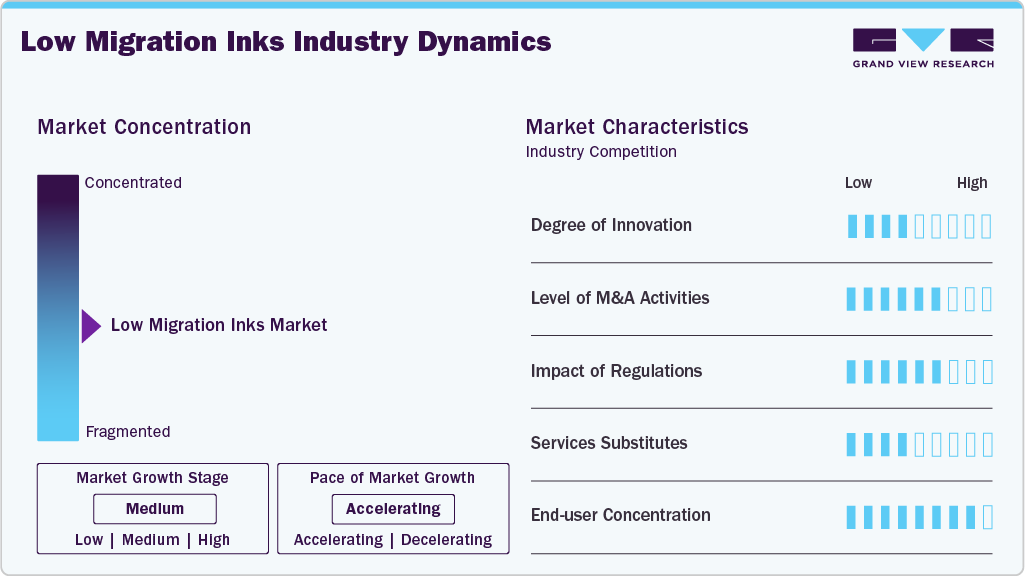
Leading global companies such as Siegwerk, Flint Group, Sun Chemical, and Toyo Ink have established strong positions through early compliance with EU and U.S. packaging regulations, wide product portfolios, and significant investments in R&D. These players often work directly with global food, beverage, and pharmaceutical brands, embedding themselves as strategic partners in packaging safety. At the same time, regional and mid-sized ink producers are increasingly entering the space, particularly in Asia Pacific, to serve the fast-growing demand for low migration solutions in local markets. This dynamic is creating a competitive environment where established leaders rely on technological innovation and regulatory expertise, while smaller players compete on cost efficiency and localized customer service.
Product Insights
Flexography’s 55.0% revenue share in 2025 reflects its market dominance, owing to its widespread use in food, beverage, and pharmaceutical packaging. The process is highly compatible with a variety of substrates such as paper, flexible plastics, and corrugated boards, which makes it the preferred choice for high-volume packaging applications. Its ability to deliver consistent print quality at scale and the adaptability of low migration formulations to flexo systems has solidified its dominance. Moreover, many packaging converters already have established flexographic setups, making the transition to low migration inks smoother from an operational standpoint.
Digital’s projected 6.7% CAGR from 2026-2033. The shift is driven by rising demand for short-run, customized, and on-demand packaging, particularly in food delivery, e-commerce, and premium consumer goods. Digital printing offers advantages such as reduced setup time, minimal waste, and efficient handling of frequent design changes. As low migration ink formulations advance to meet the technical requirements of digital platforms, adoption is accelerating across both developed and emerging markets. This trend positions digital printing as the most dynamic growth avenue within the low-migration inks landscape, complementing the established strength of flexography.
End Use Insights
The food & beverage segment, holding a 43.0% revenue share in 2025, dominates the low migration inks market, mainly driven by the high volume of packaged products and the critical need to prevent chemical transfer into consumables. With stringent regulations across regions, particularly in Europe and North America, prioritizing packaging safety to maintain consumer trust and comply with legal standards. This segment, including cartons, pouches, labels, and flexible films, further reinforces the reliance on low migration inks, making it the dominant end use application.
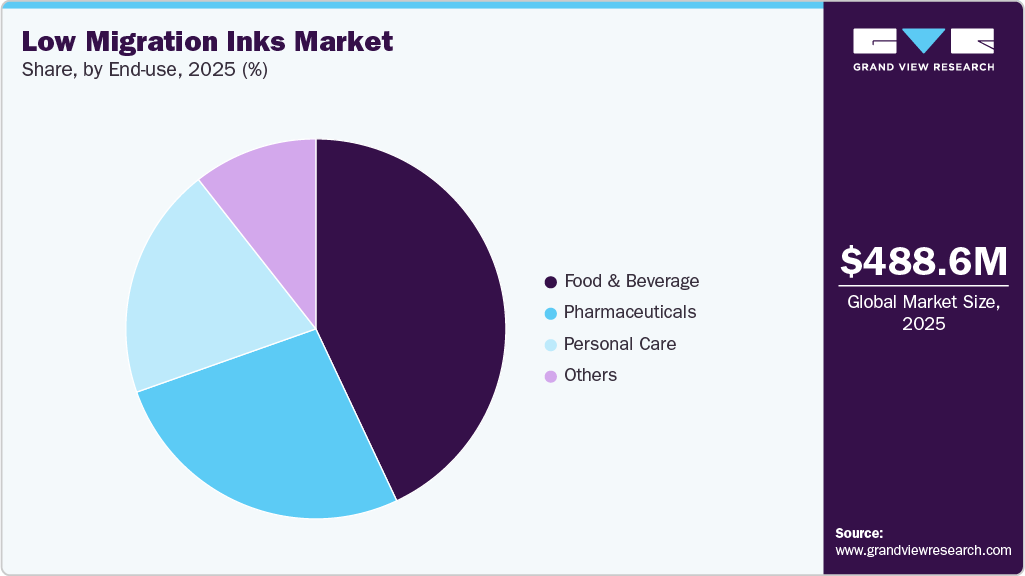
Pharmaceuticals, however, are emerging as the fastest-growing end-use segment, expected to register the highest CAGR in the coming years. The growth is fueled by the rising production of medicines, nutraceuticals, and healthcare products that require stringent packaging standards to ensure product safety and efficacy. Labels, blister packs, and cartons in pharmaceutical packaging must adhere to strict migration limits, prompting manufacturers to adopt low migration inks extensively. As global healthcare demand continues to expand and regulatory compliance becomes increasingly critical, the pharmaceutical sector presents a highly promising avenue for low migration ink suppliers.
Regional Insights
Asia Pacific held a revenue share of 28.1% in the low migration inks market in 2025, driven by rapid urbanization, large-scale infrastructure projects, and robust construction activity in countries such as China and India. Expanding Personal Care manufacturing, rising automotive production, and increasing adoption of modern building materials further support demand. Supportive government policies, growing renovation projects, and awareness of energy-efficient construction practices reinforce the region’s position as the largest revenue contributor.
China held over 48.9% revenue share of the Asia Pacific low migration inks market.China, as the largest market in Asia Pacific, is witnessing accelerated adoption due to a combination of regulatory tightening and booming food, beverage, and pharmaceutical industries. Domestic manufacturers are increasingly investing in compliant ink technologies, and multinational converters are setting up regional operations to meet stringent safety standards. Consumer awareness around product safety is also contributing to the market’s rapid growth.
Asia Pacific Low Migration Inks Market Trends
Asia Pacific is emerging as the fastest-growing regional market, driven by rising packaged food consumption, expanding pharmaceutical production, and increasing regulatory enforcement in countries such as Japan, South Korea, and India. Rapid urbanization, changing lifestyles, and a growing middle class are fueling demand for safe and reliable packaging. Local and international ink suppliers are actively expanding production capabilities to capture the rising demand for low migration solutions in the region.
North America Low Migration Inks Market Trends
North America represents a mature and highly regulated market for low migration inks, with strong adoption driven by stringent FDA regulations and growing consumer awareness regarding packaging safety. The region’s dominance is supported by well-established packaging and printing industries, particularly in food, beverage, and pharmaceuticals. Major manufacturers and brand owners in the U.S. are increasingly integrating low migration inks into their production lines to ensure compliance, reduce legal risks, and enhance consumer trust.
U.S. Low Migration Inks Market Trends
The U.S., as the largest national market within North America, mirrors the regional trends with particularly high adoption in food and pharmaceutical packaging. The presence of multinational packaging converters, coupled with advanced R&D infrastructure, allows rapid deployment of compliant ink technologies. Regulatory enforcement and consumer demand for transparency and safety continue to drive market expansion.
Europe Low Migration Inks Market Trends
Europe dominated the low migration inks market with a revenue share of 34.8%, in 2025, This is significant share in the global low migration inks market due to the region’s strict regulatory environment, particularly under EFSA guidelines. Food safety and pharmaceutical packaging standards are highly rigorous, making compliance a critical factor for market participation. Countries such as Germany, France, and the UK lead adoption, with brand owners emphasizing safe and high-quality packaging as a differentiator. Sustainability initiatives are also influencing formulation trends, with bio-based and non-toxic inks gaining traction.
Latin America Low Migration Inks Market Trends
Latin America presents a developing market for low migration inks, with growth driven primarily by Brazil and Mexico. Increasing packaged food consumption, modernization of printing and packaging infrastructure, and gradual alignment with global safety standards are supporting adoption. However, cost sensitivity and uneven regulatory enforcement across the region pose challenges to rapid market penetration.
Middle East & Africa Low Migration Inks Market Trends
The Middle East & Africa region is characterized by emerging demand for low migration inks, largely driven by rising food and pharmaceutical exports and stricter safety regulations in key markets such as Saudi Arabia and South Africa. Adoption remains concentrated among large brand owners and multinational packaging converters, while smaller players are gradually entering as awareness grows. The region presents significant potential for growth as regulatory frameworks continue to evolve and consumer demand for safe packaging increases.
Key Low Migration Inks Company Insights
The two key dominant manufacturers in the market are Agfa-Gevaert and Henkel AG, recognized for their innovation, high-performance products, and global presence across industries.
-
Toyo Ink, specializes in the development and production of printing inks for packaging, labels, and commercial printing. The company has introduced the Steraflex GIO series, a low migration flexographic ink system formulated to comply with the German Ink Ordinance. This ink system offers enhanced adhesion properties, even on low surface tension substrates such as BOPP, making it suitable for various packaging applications. Toyo Ink Europe's commitment to sustainability is reflected in its bio-based low migration ink series, made from plant-derived resins, catering to the rising demand for sustainable packaging solutions.
-
Sun Chemical, a subsidiary of the DIC Corporation, is a leading global provider of printing inks and pigments. The company offers a comprehensive range of low migration inks designed to meet stringent safety standards for food, pharmaceutical, and cosmetic packaging. Sun Chemical's migration-compliant inks are formulated using high molecular weight oligomers and polymers, ensuring minimal migration potential. These inks are available in various curing technologies, including UV, LED, and electron beam (EB), catering to diverse printing processes. Sun Chemical's commitment to innovation is evident in products such as the SunPak LMQ series, specifically developed for sensitive packaging applications.
Key Low Migration Inks Companies:
The following key companies have been profiled for this study on the low migration inks market.
- Agfa-Gevaert
- Altana
- Epple Druckfarben
- Flint Group
- Huber Group
- INX International
- Marabu GmbH
- Siegwerk Druckfarben
- Sun Chemical
- Toyo Inks
- HAPA AG
Recent Developments
-
In July 2025, Sun Chemical has introduced SunCure Advance ECO UV Inks, designed for high-speed presses. These inks feature excellent press color stability, fast curing, and low misting, helping to reduce paperboard waste during make-ready processes and after press stops. Capable of running at speeds exceeding 20,000 impressions per hour, the inks are designed to run on a wide array of paper and paperboard substrates, including low-integrity clay-coated types.
-
In August 2025, Toyo Ink Europe has launched Steraflex GIO, a low migration flexographic ink system formulated to comply with the German Ink Ordinance. This ink system offers superb print and press performance on most label substrates, sleeves, and other applications where migration is a key priority.
Low Migration Inks Market Report Scope
Report Attribute
Details
Market size in 2025
USD 488.6 million
Estimated market size in 2026
USD 513.2 million
Projected market size by 2033
USD 785.0 million
Growth rate
CAGR of 6.3% from 2026 to 2033
Base year for estimation
2025
Historical data
2021 - 2024
Forecast period
2026 - 2033
Quantitative units
Revenue in USD million/billion, volume in kilotons, and CAGR from 2026 to 2033
Report coverage
Revenue forecast, company ranking, competitive landscape, growth factors, and trends
Segments covered
Printing process, end use, and region
Regional scope
North America; Europe; Asia Pacific; Latin America; Middle East & Africa
Country scope
U.S.; Canada; Mexico; Brazil; Argentina; Germany; UK; Italy; Spain; France; China; Japan; South Korea; Saudi Arabia; South Africa
Key companies profiled
Agfa-Gevaert; Henkel AG; Epple Druckfarben; Flint Group; Huber Group; INX International; Marabu GmbH; Siegwerk Druckfarben; Sun Chemical; Toyo Inks; HAPA AG
Customization scope
Free report customization (equivalent to up to 8 analysts’ working days) with purchase. Addition or alteration to country, regional & segment scope.
Pricing and purchase options
Avail customized purchase options to meet your exact research needs. Explore purchase options
Global Low Migration Inks Market Report Segmentation
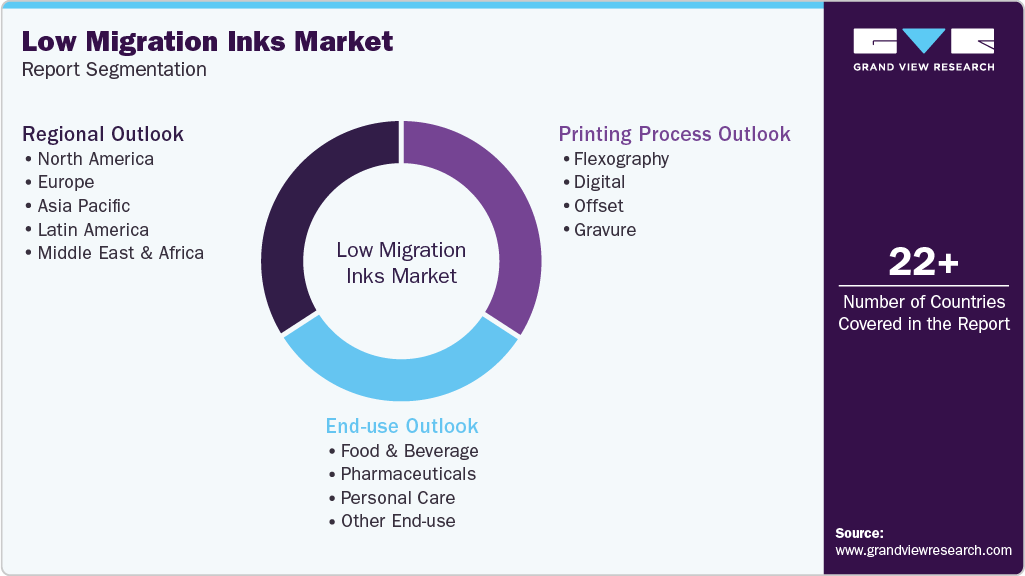
This report forecasts revenue growth at global, regional, and country levels and provides an analysis of the latest industry trends in each of the sub-segments from 2018 to 2033. For this study, Grand View Research has segmented the global low migration inks market report based on product, end use, and region.
-
Printing Process Outlook (Volume, Kilotons; Revenue, USD Million; 2021 - 2033)
-
Flexography
-
Digital
-
Offset
-
Gravure
-
-
End Use Outlook (Volume, Kilotons; Revenue, USD Million; 2021 - 2033)
-
Food and Beverage
-
Pharmaceuticals
-
Personal Care
-
Other End Use
-
-
Regional Outlook (Volume, Kilotons; Revenue, USD Million; 2021 - 2033)
-
North America
-
U.S.
-
Canada
-
Mexico
-
-
Europe
-
Germany
-
UK
-
Italy
-
Spain
-
France
-
-
Asia Pacific
-
China
-
Japan
-
South Korea
-
India
-
-
Latin America
-
Brazil
-
Argentina
-
-
Middle East & Africa
-
Saudi Arabia
-
South Africa
-
-
Frequently Asked Questions About This Report
The global low migration inks market size was estimated at USD 488.6 million in 2025 and is expected to reach USD 513.2 million in 2026.
The global low migration inks market is expected to grow at a compound annual growth rate of 6.3% from 2026 to 2033 to reach USD 785.0 million by 2033.
Some key players operating in the low migration inks market include Agfa-Gevaert; Henkel AG; Epple Druckfarben; Flint Group; Huber Group; INX International; Marabu GmbH; Siegwerk Druckfarben; Sun Chemical; Toyo Inks; HAPA AG.
Rising demand for safe and compliant food, pharmaceutical, and personal care packaging is driving the adoption of low migration inks, as regulators and brand owners prioritize consumer health. Increasing awareness of ink migration risks and stricter global packaging safety standards are accelerating market growth.
The food & beverage segment led with a 43.0% revenue share in 2025, while the pharmaceuticals segment is the fastest-growing.
The flexography segment led with a 55.0% revenue share in 2025, while the digital segment is projected 6.7% CAGR from 2026-2033.
Asia Pacific held a revenue share of 28.1% in the low migration inks market in 2025, driven by rapid urbanization, large-scale infrastructure projects, and robust construction activity in countries such as China and India. Expanding Personal Care manufacturing, rising automotive production, and increasing adoption of modern building materials further support demand. Supportive government policies, growing renovation projects, and awareness of energy-efficient construction practices reinforce the region’s position as the largest revenue contributor.
About the Author(s)
Paints, Coatings & Printing Inks Research Team
Bulk Chemicals · Paints, Coatings & Printing InksThis report was authored by the paints, coatings & printing inks research team at Grand View Research - comprising two research analysts, one senior research analyst, and one industry expert - with specialized expertise in the paints, coatings & printing inks segment of the bulk chemicals industry. All findings are based on proprietary bulk chemicals databases, executive interviews, and regulatory analysis, subject to internal peer review prior to publication.
Last Updated:
Speak to Analyst

Need a Tailored Report?
Customize this report to your needs — add regions, segments, or data points, with 20% free customization.
Or view our licence options:


ISO 9001:2015 & 27001:2022 Certified
We are GDPR and CCPA compliant! Your transaction & personal information is safe and secure. For more details, please read our privacy policy.












