
- Home
- »
- Next Generation Technologies
- »
-
Manufacturing Analytics Market Size & Share Report, 2033GVR Report cover
![Manufacturing Analytics Market (2026 - 2033)Report]()
Manufacturing Analytics Market (2026 - 2033)
Size, Share, & Trends Analysis Report By Component (Software, Services), By Deployment (Cloud, On-premises), By Enterprise Size (Large Enterprises, SMEs), By Application, By End Use, By Region, And Segment Forecasts
Market Size, 2025
$11.8BMarket Estimate, 2026
$13.0BMarket Forecast, 2033
$37.9BCAGR, 2026–2033
16.6%Manufacturing Analytics Market Summary
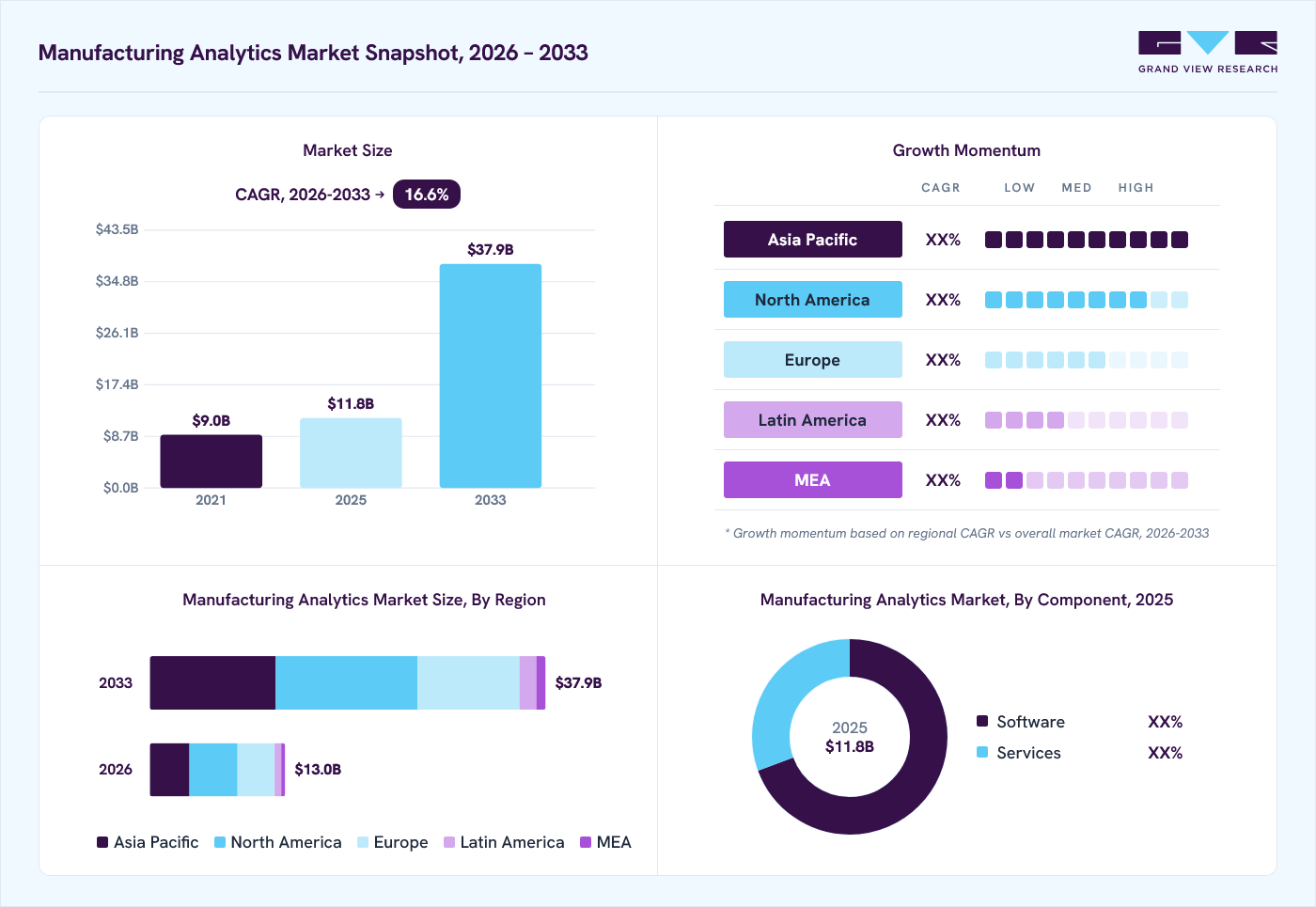
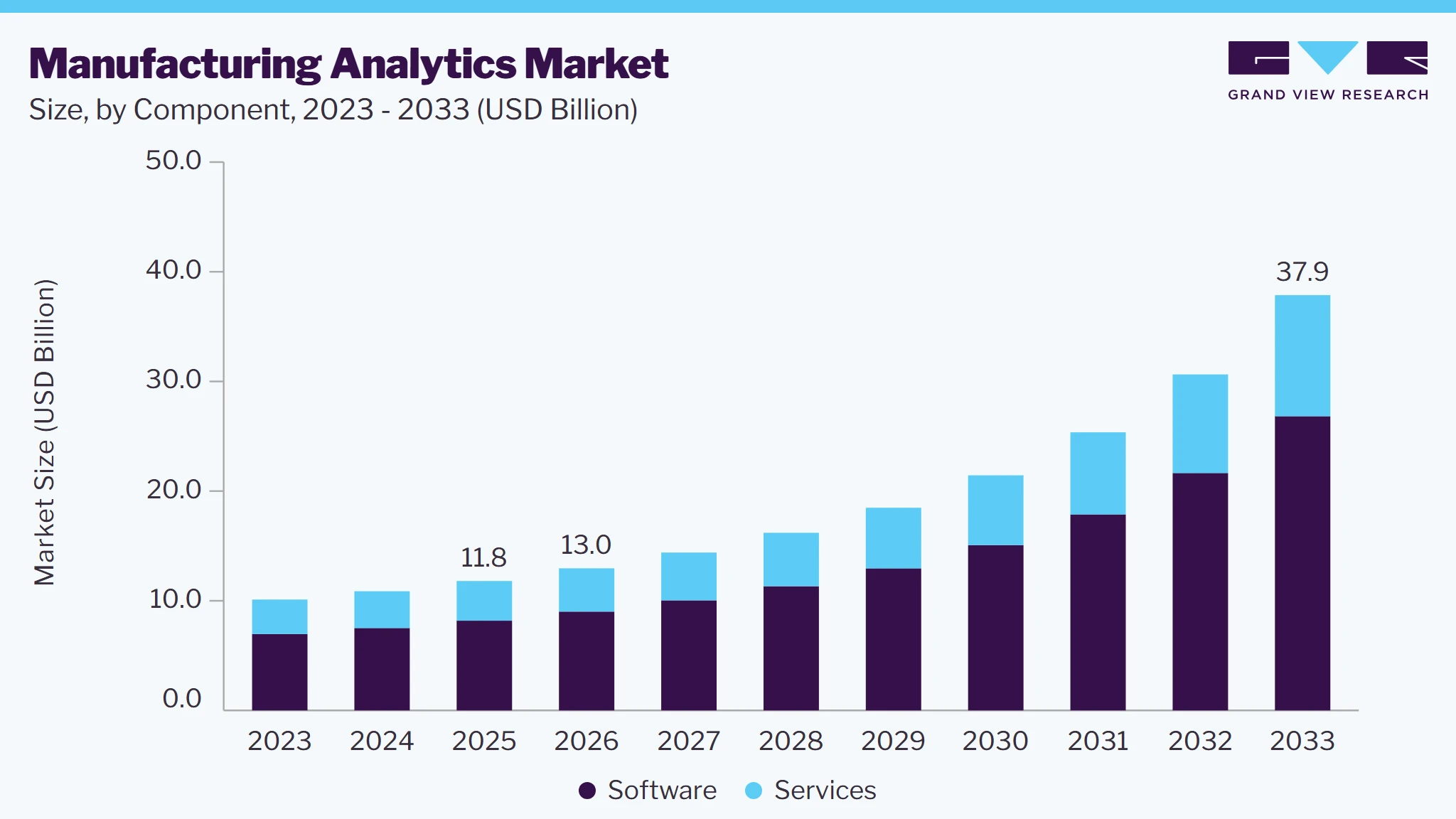
The global manufacturing analytics market size was valued at USD 11.8 billion in 2025 and is projected to grow from USD 13.0 billion in 2026 to USD 37.9 billion by 2033, growing at a CAGR of 16.6% from 2026 to 2033. North America dominated the market, accounting for a revenue share of 35.4% in 2025. The market is driven by the growing adoption of Industry 4.0, IoT, AI/ML, and real-time data analytics to optimize production, enable predictive maintenance, improve quality control, and enhance operational efficiency.
Key Market Trends & Insights
- By component: The software segment dominated the market, with a revenue share of 69.3% in 2025.
- By deployment: The cloud led the market and accounted for a share of 60.6% in 2025.
- By enterprise size: The large enterprises segment dominated the market, with a revenue share of 74.7% in 2025.
- By application: The production & process analytics segment dominated the market, with a revenue share of 24.8% in 2025.
- By end use: The automotive segment held the largest revenue share in 2025.
Regional Highlights
- Largest regional market: North America (35.4% revenue share, 2025)
- Fastest-growing regional market: Asia Pacific (highest CAGR, 2026-2033)
- By country: The U.S. held the largest market share in 2025.
Market Size & Forecast
- Market size in 2025: USD 11.8 Billion
- Estimated market size in 2026: USD 13.0 Billion
- Projected market size by 2033: USD 37.9 Billion
- CAGR (2026-2033): 16.6%
The accelerating transition toward Industry 4.0 is a significant market growth driver. Manufacturers are integrating IoT sensors, connected machinery, edge computing, cloud platforms, AI, and machine learning into production environments, generating large volumes of operational data. Manufacturing analytics platforms convert this data into actionable insights into production performance, equipment utilization, process efficiency, and resource consumption, enabling manufacturers to move from reactive operations to data-driven, intelligent production.Manufacturers are increasingly deploying analytics to monitor equipment conditions and predict potential failures before they disrupt production. Predictive analytics combines machine data, historical maintenance records, sensor readings, and AI/ML models to identify anomalies and estimate equipment failure. This helps manufacturers reduce unplanned downtime, extend asset life, optimize maintenance schedules, and lower maintenance costs, thereby increasing demand for predictive maintenance and asset analytics solutions.
The rapid advancement of AI and machine learning is expanding the capabilities of manufacturing analytics beyond conventional reporting and visualization. AI-enabled platforms can identify hidden patterns, predict equipment failures, optimize production parameters, detect quality anomalies, and support automated decision-making. The emergence of generative and agentic AI is further enabling natural-language interaction with manufacturing data and the automated generation of operational insights, thereby increasing the value proposition of analytics platforms.
Market Dynamics
The market is driven by the increasing complexity of manufacturing operations and the need to convert growing volumes of production, machine, quality, supply-chain, and energy data into actionable insights. The expansion of connected factories, industrial IoT, automation, cloud computing, edge technologies, digital twins, and AI has created increasingly data-intensive production environments. Traditional manufacturing systems often provide monitoring and reporting capabilities but have limited ability to identify hidden process patterns, predict equipment failures, optimize production parameters, or provide forward-looking insights.
The rapid adoption of Industrial AI, machine learning, IoT, and smart manufacturing technologies is driving the market as manufacturers increasingly seek to transform large volumes of machine and production data into actionable operational intelligence. AI-enabled analytics can identify anomalies, forecast equipment failures, optimize production parameters, detect quality deviations, and support continuous process improvement. In January 2026, Siemens and NVIDIA expanded their strategic partnership to develop an Industrial AI Operating System spanning design, engineering, manufacturing, production, operations, and supply chains, including AI-driven adaptive manufacturing and supply-chain applications. Siemens also highlighted plans to develop AI-driven adaptive manufacturing sites, beginning with its electronics factory in Erlangen. This development demonstrates the increasing integration of AI, industrial data, and analytics across the manufacturing value chain and supports demand for advanced manufacturing analytics platforms.
Fragmented industrial data environments and difficulties in integrating heterogeneous manufacturing systems can restrain market growth. Manufacturing organizations commonly operate a mixture of legacy machinery, PLCs, SCADA systems, MES, ERP platforms, historians, sensors, quality systems, and cloud applications, often using different protocols and data structures. Inconsistent data formats, missing information, disconnected OT and IT environments, poor data contextualization, and limited interoperability can reduce the accuracy and reliability of analytics outputs. These challenges can require substantial investment in data integration, normalization, contextualization, cybersecurity, and infrastructure modernization before manufacturers can generate reliable analytical insights. The complexity is particularly significant when organizations attempt to integrate real-time machine data with historical production, quality, maintenance, and supply chain information.
The increasing deployment of connected equipment and sensor-based monitoring creates a significant opportunity for predictive maintenance and asset analytics. Manufacturers are moving beyond scheduled or reactive maintenance toward continuous monitoring of machine conditions, anomaly detection, failure prediction, and condition-based maintenance. Analytics platforms can combine equipment telemetry, historical maintenance information, environmental conditions, and operational parameters to identify early indicators of equipment degradation and enable maintenance during planned downtime. In March 2026, Hexagon Manufacturing Intelligence launched APOLLO, an AI-powered predictive condition-monitoring platform for coordinate measuring machines and machine tools. Hexagon stated that APOLLO uses AI analytics to monitor machine behavior, environmental conditions, and operational status and can identify patterns indicating potential defects or failures up to 90 days in advance.
Analyst Perspective
The convergence of manufacturing analytics, Industrial AI, digital twins, and real-time operational intelligence is expected to increasingly shape the market. Manufacturers are moving from retrospective dashboards toward systems capable of continuously interpreting operational data and recommending or initiating corrective actions. Analytics is becoming an important intelligence layer connecting machines, production processes, quality systems, maintenance operations, supply chains, and enterprise applications. The evolution is also extending analytics beyond centralized cloud environments toward edge and on-premises intelligence, particularly where low latency, operational continuity, or data sovereignty is critical. For example, in March 2026, Siemens introduced Drivetrain Analyzer Onsite, an AI-powered on-premises analytics solution that processes industrial drive data within the customer's own infrastructure and provides continuous condition monitoring, pattern recognition, and anomaly detection.
Component Insights
The software segment dominated the market, accounting for 69.3% of revenue in 2025, driven by increasing demand for self-service, low-code, and composable analytics platforms that enable manufacturers to develop and modify analytical workflows without extensive data science expertise. Modern manufacturing analytics software increasingly combines data visualization, automated data preparation, AI-assisted analysis, embedded analytics, and configurable dashboards, enabling plant managers and operations teams to independently analyze production, quality, maintenance, and operational data.
The services segment is anticipated to grow at the highest CAGR during the forecast period, driven by the growing need for specialized implementation, integration, customization, and analytics consulting as manufacturers deploy analytics across complex production environments. Organizations often require external expertise to connect analytics platforms with MES, ERP, SCADA, historians, PLCs, IoT devices, and existing data infrastructure, while also developing industry-specific models and dashboards.
Deployment Insights
The cloud segment dominated the market and accounted for 60.6% of revenue in 2025, driven by the growing preference for scalable, subscription-based analytics infrastructure that can be deployed across multiple plants without extensive local hardware investments. Cloud environments facilitate centralized access to production data, rapid software updates, integration with AI/ML services, and scalable computing for large datasets, while enabling manufacturers to standardize analytics applications across geographically distributed facilities.
The on-premises segment is anticipated to grow at a significant CAGR during the forecast period, supported by manufacturers' requirements for low-latency analytics, operational continuity, data control, and integration with legacy plant systems. Production environments such as automotive, aerospace, pharmaceuticals, and semiconductor manufacturing can require analytics to operate close to machinery and production processes, where even short interruptions in connectivity can affect operations.
Enterprise Size Insights
The large enterprises segment dominated the market, accounting for 74.7% of revenue in 2025 due to the increasing need to manage multi-site manufacturing operations and complex production networks through centralized analytics. Large manufacturers typically operate numerous plants, production lines, suppliers, and asset fleets, generating substantial volumes of operational data that require advanced analytical infrastructure.
The small & medium enterprises (SMEs) segment is expected to grow at a significant CAGR during the forecast period as preconfigured analytics applications and lower-complexity deployment models make advanced manufacturing intelligence more accessible to smaller manufacturers. Rather than developing extensive in-house data infrastructure, SMEs can increasingly adopt packaged analytics tools that address specific operational requirements such as production monitoring, downtime analysis, quality tracking, and equipment performance.
Application Insights
The production & process analytics segment dominated the market, accounting for 24.8% of revenue in 2025, driven by manufacturers' growing emphasis on yield improvement and process consistency amid pressure to maximize output from existing production capacity. Analytics platforms can examine production parameters, cycle times, throughput, downtime patterns, and process variability to reveal the operational conditions associated with higher productivity.
The energy & sustainability analytics segment is expected to grow at a significant CAGR during the forecast period, driven by the increasing need to link manufacturing performance with resource consumption and environmental outcomes. Manufacturers are deploying analytics to associate energy and material usage with individual machines, production batches, products, and processes, enabling them to identify energy-intensive operations and quantify resource inefficiencies.
End Use Insights
The automotive segment dominated the market, accounting for 16.0% of revenue in 2025, supported by the industry's increasing reliance on highly automated, flexible, and quality-sensitive production systems. Automotive manufacturers must coordinate complex assembly operations, extensive supplier networks, robotics, machine tools, and increasingly diversified vehicle platforms. Manufacturing analytics enables them to monitor production-line performance, analyze process deviations, improve traceability, and optimize equipment utilization, while the transition toward electric and software-defined vehicles is introducing new manufacturing processes that further increase the need for data-driven production management.
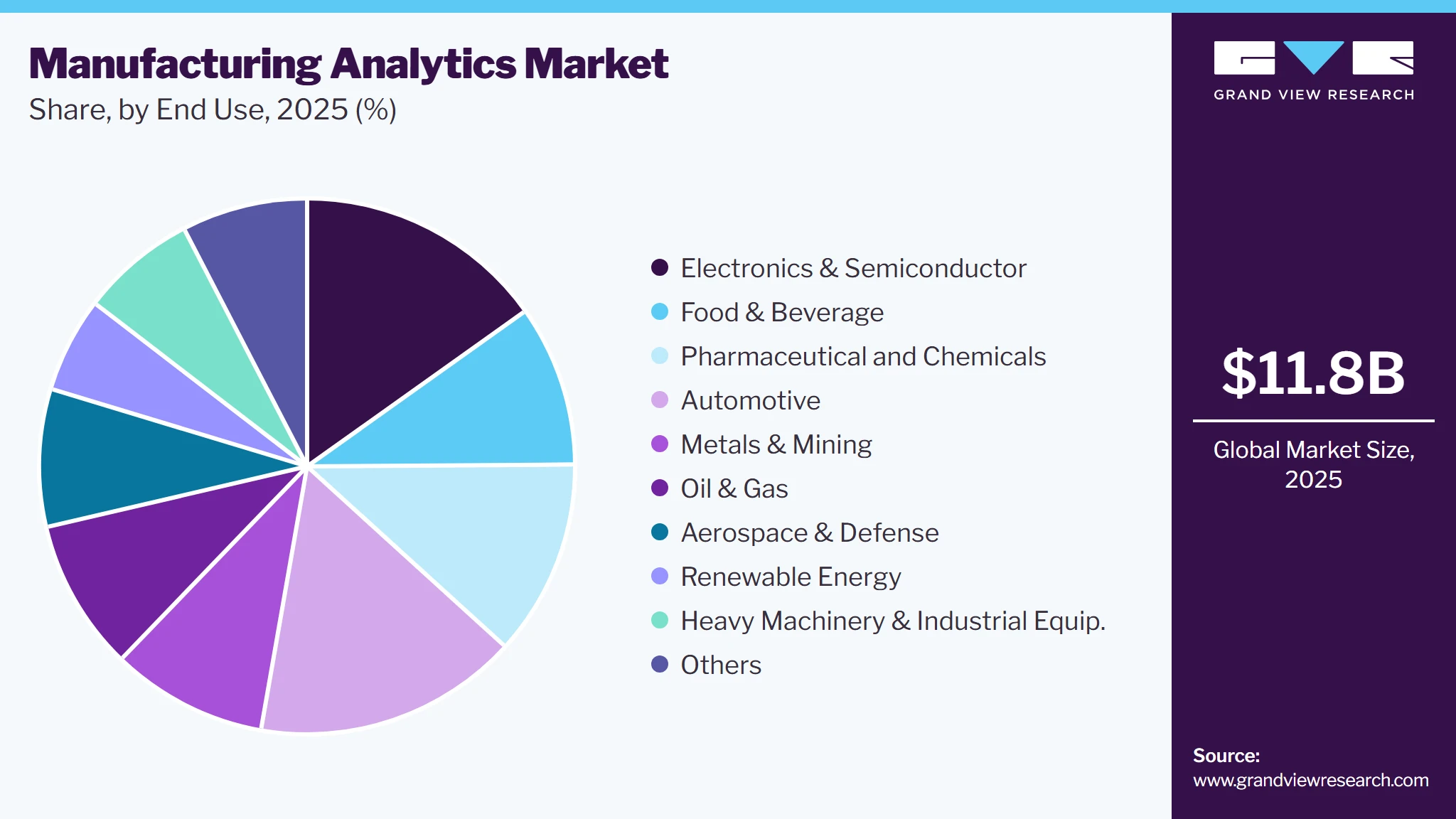
The electronics & semiconductor segment is expected to grow at a significant CAGR over the forecast period, driven by the industry's requirement for extremely high process precision, yield optimization, and rapid defect identification. Semiconductor and electronics production involves tightly controlled processes in which small variations in equipment conditions, materials, or process parameters can significantly affect yields.
Regional Insights
North America dominated the global market with the largest revenue share of 35.4% in 2025, driven by the region’s strong installed base of automated and digitally connected manufacturing assets, which generates extensive machine and operational data requiring advanced analytics. Manufacturers are increasingly integrating analytics with industrial IoT, MES, ERP, and edge-computing environments to improve plant-level visibility and coordinate complex production networks.

U.S. Manufacturing Analytics Market Trends
The manufacturing analytics market in the U.S. is expected to grow significantly, at a CAGR of 16.3%, from 2026 to 2033, driven by the rapid expansion of AI-enabled manufacturing and the reshoring of strategically important production, particularly in semiconductors, aerospace, defense, pharmaceuticals, and advanced electronics. New domestic manufacturing capacity requires sophisticated systems for production ramp-up, yield management, equipment monitoring, and operational optimization.
Europe Manufacturing Analytics Market Trends
The manufacturing analytics market in Europe is anticipated to grow considerably from 2026 to 2033, driven by the region’s emphasis on industrial competitiveness and resilient manufacturing amid high operating costs and supply-chain pressures. Manufacturers are increasingly using analytics to improve productivity, optimize scarce resources, strengthen production planning, and remain competitive with lower-cost manufacturing regions.
The UK manufacturing analytics market is expected to grow rapidly in the coming years, owing to the growing adoption of digital manufacturing technologies among small and mid-sized industrial companies. Manufacturers are increasingly using data-driven tools to modernize legacy production environments without undertaking complete factory overhauls.
The manufacturing analytics market in Germany held a substantial market share in 2025 due to the country's extensive Industry 4.0 ecosystem and engineering-intensive manufacturing base. Automotive, machinery, industrial equipment, and chemical manufacturers are increasingly integrating production analytics with cyber-physical systems, digital twins, robotics, and connected factory infrastructure.
Asia Pacific Manufacturing Analytics Market Trends
The manufacturing analytics market in the Asia Pacific held a significant share in the global market in 2025, due to the region’s rapid expansion of manufacturing capacity and transition toward higher-value, automated production. Manufacturers across emerging economies are increasingly modernizing factories with robotics, connected equipment, and digital production systems, creating new demand for analytics platforms.
Japan manufacturing analytics market is expected to grow rapidly in the coming years, driven by the need to address manufacturing workforce shortages and an aging industrial labor pool through greater automation and data-assisted operations. Manufacturers are increasingly using analytics to capture operational knowledge, monitor equipment performance, identify process deviations, and support workers with data-driven recommendations.
The manufacturing analytics market in China held a substantial share in 2025, driven by the country's large-scale transition toward intelligent manufacturing and digitally managed industrial production. Manufacturers are increasingly upgrading conventional factories with industrial software, connected equipment, machine vision, robotics, and AI-based production systems.
Key Manufacturing Analytics Company Insights
Key players operating in the manufacturing analytics industry are SAP SE, IBM Corporation, Oracle, Rockwell Automation, SAS Institute Inc., Hexagon AB, and Salesforce.com Inc. The companies are focusing on various strategic initiatives, including new product development, partnerships & collaborations, and agreements to gain a competitive advantage over their rivals. The following are some instances of such initiatives.
-
In May 2026, Hexagon AB launched PC-DMIS FUSION, a metrology analytics solution designed to strengthen data-driven quality management and manufacturing decision-making. Integrated with PC-DMIS metrology software, the platform consolidates measurement data from multiple devices and provides real-time visualization, statistical process control (SPC), historical data access, automated reporting, and alerts for quality deviations. When combined with Hexagon’s MAESTRO connected coordinate measuring machine (CMM), PC-DMIS FUSION enables continuous monitoring, automated quality workflows, predictive quality management, and faster identification of manufacturing issues, supporting manufacturers in improving production efficiency and process quality through advanced analytics.
-
In April 2026, Rockwell Automation and Cytiva jointly launched Figurate SCADA, a supervisory control and data acquisition platform designed to address digital integration challenges in biopharmaceutical manufacturing. The solution connects equipment from multiple vendors with Rockwell Automation’s FactoryTalk software, enabling centralized real-time monitoring, operational visibility, batch reporting, and data integration through an open architecture. By providing a unified digital layer across manufacturing processes, the platform supports faster deployment, improved process oversight, scalable production, and data-driven decision-making, thereby strengthening the adoption of manufacturing analytics and digital manufacturing technologies in the biopharmaceutical sector.
Key Manufacturing Analytics Companies
The following key companies have been profiled for this study on the manufacturing analytics market.
-
Alteryx Inc.
-
DXC Technology Company
-
Hexagon AB
-
IBM Corporation
-
Northwest Analytics Inc.
-
Oracle Corp.
-
QlikTech Inc.
-
Rockwell Automation
-
Salesforce.com Inc.
-
SAP SE
-
SAS Institute Inc.
-
Sisense Inc.
-
TEKsystems Global Services
-
TIBCO Software Inc.
-
Wipro Limited
Competitive Benchmarking
Category
Operating Strategies
Competitive Edge
Weakness
Established Players (SAP SE, IBM Corporation, Oracle, Rockwell Automation, SAS Institute Inc., Hexagon AB, and Salesforce.com Inc.)
- Invest in AI/ML-powered manufacturing analytics, predictive maintenance, production and process analytics, quality analytics, supply-chain intelligence, digital twins, industrial IoT, and real-time operational intelligence.
- Expand manufacturing software portfolios through strategic partnerships, acquisitions, cloud integration, and industrial technology ecosystems. Focus on integrating analytics with ERP, MES, SCADA, CRM, IoT, automation, and enterprise data platforms to provide end-to-end manufacturing intelligence.
- Strong global brands, extensive enterprise customer bases, and established relationships with large manufacturers. Broad technology portfolios spanning analytics, AI, cloud, industrial automation, ERP, MES, asset management, supply-chain management, and quality management.
- Significant R&D resources support the development of advanced predictive, prescriptive, and AI-enabled analytics. Large partner and implementation ecosystems facilitate deployment across complex, multi-site manufacturing environments.
- Higher licensing, implementation, customization, and integration costs can limit adoption among smaller manufacturers. Complex enterprise architectures can result in longer deployment and procurement cycles.
- Integration challenges may arise when connecting modern analytics platforms with legacy machinery, PLCs, SCADA, historians, MES, ERP systems, and heterogeneous plant data sources. Large portfolios can also require substantial technical expertise and change-management resources.
Emerging Players (Wipro Limited, DXC Technology Company, QlikTech Inc., Alteryx Inc., Sisense Inc.)
- Focus on cloud-based analytics, self-service BI, data integration, AI-assisted analytics, low-code analytics, embedded intelligence, and industry-specific manufacturing solutions.
- Expand capabilities through partnerships with cloud, data-platform, AI, and industrial technology providers. Emphasize rapid deployment, flexible architectures, data visualization, operational dashboards, and specialized analytics use cases such as production performance, quality, supply chain, and asset monitoring.
- Greater flexibility and faster deployment compared with complex enterprise-wide platforms. Strong capabilities in specialized areas such as data preparation, visualization, embedded analytics, cloud analytics, data integration, and AI-enabled decision support.
- Flexible deployment models can make these solutions attractive to manufacturers seeking targeted analytics applications without replacing existing manufacturing infrastructure. Services-led players can also provide customization and integration expertise.
- Smaller manufacturing-specific customer footprints and comparatively lower brand recognition than the largest enterprise and industrial technology providers. Limited ownership of core industrial automation or ERP infrastructure can increase reliance on technology partners and third-party data sources.
- Integration with highly specialized plant-floor systems may require additional implementation work. Some vendors also have narrower product portfolios and may face challenges competing for large, enterprise-wide manufacturing transformation projects.
Manufacturing Analytics Market Report Scope
Report Attribute
Details
Market size in 2025
USD 11.8 billion
Estimated market size in 2026
USD 13.0 billion
Projected market size by 2033
USD 37.9 billion
Growth rate
CAGR of 16.6% from 2026 to 2033
Actual data
2021 - 2025
Forecast period
2026 - 2033
Quantitative units
Revenue in USD billion and CAGR from 2026 to 2033
Report coverage
Revenue forecast, company share, competitive landscape, growth factors, and trends
Segments covered
Component, deployment, enterprise size, application, end use, region
Regional scope
North America; Europe; Asia Pacific; Latin America; MEA
Country scope
U.S.; Canada; Mexico; UK; Germany; France; China; India; Japan; Australia; South Korea; Brazil; UAE; Saudi Arabia; South Africa
Key companies profiled
Alteryx Inc.; DXC Technology Company; Hexagon AB; IBM Corporation; Northwest Analytics Inc.; Oracle Corp.; QlikTech Inc.; Rockwell Automation; Salesforce.com Inc.; SAP SE; SAS Institute Inc.; Sisense Inc.; TEKsystems Global Services; TIBCO Software Inc.; Wipro Limited
Customization scope
Free report customization (equivalent to 8 analysts working days) with purchase. Addition or alteration to country, regional & segment scope.
Pricing and purchase options
Avail customized purchase options to meet your exact research needs. Explore purchase options
Global Manufacturing Analytics Market Report Segmentation
This report forecasts revenue growth at the global, regional, and country levels and provides an analysis of the latest industry trends in each of the sub-segments from 2021 to 2033. For this study, Grand View Research has segmented the global manufacturing analytics market report based on component, deployment, enterprise size, application, end use, and region:
-
Component Outlook (Revenue, USD Billion, 2021 - 2033)
-
Software
-
Services
-
-
Deployment Outlook (Revenue, USD Billion, 2021 - 2033)
-
Cloud
-
On-premises
-
-
Enterprise Size Outlook (Revenue, USD Billion, 2021 - 2033)
-
Large Enterprises
-
Small & Medium Enterprises (SMEs)
-
-
Application Outlook (Revenue, USD Billion, 2021 - 2033)
-
Production & Process Analytics
-
Predictive Maintenance & Asset Analytics
-
Supply Chain & Inventory Analytics
-
Quality & Defect Analytics
-
Energy & Sustainability Analytics
-
Others
-
-
End Use Outlook (Revenue, USD Billion, 2021 - 2033)
-
Electronics & Semiconductor
-
Food & Beverage
-
Pharmaceutical and Chemicals
-
Automotive
-
Metals & Mining
-
Oil & Gas
-
Aerospace & Defense
-
Renewable Energy
-
Heavy Machinery & Industrial Equipment
-
Pulp & Paper
-
Others
-
-
Regional Outlook (Revenue, USD Billion, 2021 - 2033)
-
North America
-
U.S.
-
Canada
-
Mexico
-
-
Europe
-
UK
-
Germany
-
France
-
-
Asia Pacific
-
China
-
India
-
Japan
-
South Korea
-
Australia
-
-
Latin America
-
Brazil
-
-
Middle East & Africa
-
UAE
-
Saudi Arabia
-
South Africa
-
-
Research Methodology
The Manufacturing Analytics market figures in this report are based on a proven research process that combines executive interviews with secondary research from proprietary databases, company filings, and recognized regulatory and institutional sources. Market size is built through value-chain sizing - reconciling supply-side and demand-side estimates - and triangulated with bottom-up and top-down approaches. Every estimate passes multiple levels of expert validation before publication, with each Manufacturing Analytics segment quantified using the revenue-capture definitions in the table below.
Segment Definition
Component
Revenue capture definition
Software
Market value is captured through manufacturing analytics software platforms and applications used to collect, integrate, process, analyze, visualize, and interpret manufacturing and operational data. This includes production and process analytics, predictive maintenance, asset analytics, quality and defect analytics, supply-chain analytics, energy and sustainability analytics, AI/ML-based analytics, dashboards, reporting, and manufacturing intelligence capabilities. Revenue includes software licenses, subscriptions, SaaS fees, and usage-based charges attributable to these analytics capabilities.
Services
Market value is captured through professional and managed services directly associated with the deployment, operation, customization, and optimization of manufacturing analytics solutions. This includes consulting, implementation, systems integration, data engineering, analytics model development, customization, training, technical support, maintenance, managed analytics, and ongoing optimization services. Revenue from general IT outsourcing or unrelated manufacturing consulting is excluded unless specifically attributable to manufacturing analytics.
Deployment
Revenue capture definition
Cloud
Market value is captured through manufacturing analytics software and associated analytics capabilities hosted on cloud infrastructure and accessed remotely through public, private, hybrid, or multi-cloud environments. Revenue includes SaaS subscriptions, cloud-hosted software fees, usage-based analytics charges, and cloud analytics services directly attributable to manufacturing analytics.
On-premises
Market value is captured through manufacturing analytics software deployed and operated within the manufacturer's own facilities or dedicated infrastructure under the customer's direct control. This includes perpetual or term software licenses, locally installed analytics platforms, and associated software fees for analytics processing performed primarily on customer-controlled infrastructure.
Enterprise Size
Revenue capture definition
Large Enterprises
The large enterprises segment, with respect to the number of employees, typically comprises organizations employing more than 1,000 employees for multinational corporations.
Small & Medium Enterprises (SMEs)
The SMEs segment, with respect to the number of employees, generally includes organizations employing between 10 and 999 employees.
Application
Revenue capture definition
Production & Process Analytics
Market value is captured through analytics used to monitor, evaluate, and optimize production output, throughput, cycle times, process parameters, OEE, production bottlenecks, downtime, yield, and process performance. The segment covers analytics focused primarily on improving manufacturing-process efficiency and production performance.
Predictive Maintenance & Asset Analytics
Market value is captured through analytics used to monitor asset health and predict, prevent, or optimize equipment failures, maintenance requirements, asset utilization, reliability, and remaining useful life. This includes condition monitoring, anomaly detection, failure prediction, maintenance forecasting, and asset-performance analytics.
Supply Chain & Inventory Analytics
Market value is captured through analytics used to optimize demand forecasting, inventory levels, procurement, supplier performance, material availability, production planning, logistics, and supply-chain risks associated with manufacturing operations. Analytics focused primarily on equipment or production-process performance is excluded.
Quality & Defect Analytics
Market value is captured through analytics used to identify, predict, investigate, and reduce product defects, process deviations, quality failures, scrap, rework, and warranty-related issues. This includes statistical process control, root-cause analysis, quality monitoring, anomaly detection, and predictive quality analytics.
Energy & Sustainability Analytics
Market value is captured through analytics used to monitor and optimize energy consumption, resource utilization, emissions, waste, water usage, carbon intensity, and other environmental performance indicators associated with manufacturing activities. Solutions primarily focused on financial or operational performance without an energy or sustainability objective are excluded.
Others
Market value is captured through manufacturing analytics applications not primarily covered by the above categories, including workforce analytics, safety analytics, manufacturing cost analytics, production scheduling analytics, facility analytics, and other specialized operational analytics.
End Use
Revenue capture definition
Electronics & Semiconductor
Market value generated from analytics deployed by manufacturers of semiconductors, integrated circuits, electronic components, printed circuit boards, consumer electronics, and related electronic products to optimize production, yield, quality, assets, and operational performance.
Food & Beverage
Market value generated from analytics deployed by manufacturers involved in food processing, packaged foods, beverages, dairy, meat, bakery, and related food-production activities to improve production, quality, resource utilization, and operational performance.
Pharmaceutical and Chemicals
Market value generated from analytics deployed by manufacturers of pharmaceuticals, biopharmaceuticals, specialty chemicals, industrial chemicals, petrochemicals, and related chemical products for production, quality, asset, compliance, and process optimization.
Automotive
Market value generated from analytics deployed by manufacturers of passenger vehicles, commercial vehicles, electric vehicles, automotive components, powertrain systems, and related automotive products to optimize manufacturing, quality, assets, and production operations.
Metals & Mining
Market value generated from analytics deployed across mining, mineral processing, metal production, smelting, refining, and metal fabrication operations to optimize production, equipment, quality, resource utilization, and operational performance.
Oil & Gas
Market value generated from analytics deployed by upstream, midstream, and downstream oil and gas companies for manufacturing- and processing-related activities, including refining, petrochemical processing, asset performance, production optimization, and operational monitoring.
Aerospace & Defense
Market value generated from analytics deployed by manufacturers of aircraft, spacecraft, propulsion systems, defense equipment, weapons systems, and aerospace/defense components to improve production, quality, asset performance, and manufacturing processes.
Renewable Energy
Market value generated from analytics deployed by manufacturers of solar panels/modules, wind turbines, batteries, energy-storage systems, and other renewable-energy equipment to optimize manufacturing, quality, production, and asset performance.
Heavy Machinery & Industrial Equipment
Market value generated from analytics deployed by manufacturers of construction equipment, agricultural machinery, industrial machinery, material-handling equipment, engines, pumps, compressors, and other heavy industrial equipment to optimize production and operational performance.
Pulp & Paper
Market value generated from analytics deployed by pulp, paper, packaging, tissue, and paper-product manufacturers to optimize production processes, equipment performance, quality, energy consumption, and resource efficiency.
Others
Market value generated from manufacturing analytics deployed in manufacturing industries not covered by the specified end-use categories, including textiles, plastics and rubber, furniture, glass, ceramics, consumer products, and other discrete or process manufacturing industries.
Estimation Model
Layer
Question
Analysis
Manufacturing Data & Operational Intelligence Layer
Where is manufacturing analytics required?
Identify manufacturing environments where organizations generate large volumes of production, machine, process, quality, maintenance, supply-chain, energy, and operational data requiring continuous analysis. This layer evaluates discrete and process manufacturing facilities, connected factories, production lines, equipment fleets, plants, warehouses, and multi-site manufacturing networks across cloud, on-premises, edge, and hybrid environments where analytics are required to improve operational visibility, production efficiency, asset utilization, quality, and resource management.
Manufacturing Analytics Technology & Data Layer
What enables manufacturing analytics implementation?
Assess the technologies and data infrastructure supporting manufacturing analytics, including industrial IoT, sensors, SCADA, MES, ERP, historians, edge computing, cloud platforms, AI/ML, digital twins, data lakes, data integration, predictive models, anomaly detection, statistical process control, and advanced visualization. The effectiveness and scalability of manufacturing analytics depend on the ability to ingest, contextualize, integrate, and analyze data from heterogeneous production equipment and enterprise systems while maintaining data accuracy, interoperability, security, and real-time availability.
Manufacturing Analytics Application & Deployment Layer
How are manufacturing analytics capabilities delivered to manufacturers and operational teams?
Analyze the delivery models and applications through which manufacturing analytics are operationalized, including cloud and on-premises deployments supporting production and process analytics, predictive maintenance and asset analytics, supply-chain and inventory analytics, quality and defect analytics, and energy and sustainability analytics. Providers deliver capabilities through software platforms, dashboards, APIs, AI/ML models, alerts, real-time monitoring, automated workflows, digital twins, integration, customization, professional services, and managed services to enable continuous operational monitoring and data-driven decision-making.
Manufacturing Solutions & Enterprise Economics Layer
How is value generated within the manufacturing analytics ecosystem?
Evaluate revenue generated through manufacturing analytics software licenses, subscriptions, SaaS platforms, usage-based models, implementation and systems integration, consulting, customization, managed analytics, maintenance, training, and technical support. Additional enterprise value is generated through improved production throughput, reduced downtime, higher equipment utilization, lower scrap and rework, improved product quality, optimized inventory, reduced energy consumption, and better resource utilization.
Delivered Customization
This report has been delivered with the following In-depth customizations:
CLIENT REQUEST
CUSTOMIZATION DELIVERED
VALUE ADDS
Manufacturing Data Integration & Industrial Intelligence Trends
Conducted a focused analysis of manufacturing data integration across industrial IoT, sensors, SCADA, MES, ERP, historians, edge platforms, cloud environments, and legacy production systems.
Evaluated the role of data contextualization, interoperability, AI/ML, digital twins, and industrial data platforms in transforming fragmented production data into actionable manufacturing intelligence.
Helps stakeholders identify high-potential manufacturing data integration opportunities and assess requirements for connecting heterogeneous OT and IT environments.
Enables understanding of how manufacturers are addressing fragmented operational data, interoperability barriers, and the growing need for real-time production intelligence.
Manufacturing Analytics, Predictive Intelligence & Smart Factory Adoption Trends
Evaluated adoption trends for production and process analytics, predictive maintenance, asset analytics, quality and defect analytics, supply-chain analytics, energy analytics, and AI-powered manufacturing intelligence across industrial environments.
Assessed how manufacturers are applying AI/ML, industrial IoT, anomaly detection, predictive models, and real-time analytics to improve production efficiency, equipment reliability, quality, and resource utilization.
Provides insights into emerging manufacturing analytics technologies, smart-factory adoption patterns, and commercially attractive opportunities for analytics software and industrial technology providers.
Helps stakeholders understand the convergence of manufacturing analytics, Industrial AI, IoT, predictive maintenance, digital twins, and operational intelligence.
Manufacturing Analytics Application & Enterprise Opportunity Assessment
Assessed demand for production & process analytics, predictive maintenance & asset analytics, supply-chain & inventory analytics, quality & defect analytics, and energy & sustainability analytics across major manufacturing end-use industries.
Evaluated cloud versus on-premises deployment, large-enterprise versus SME adoption, integration requirements, industrial data complexity, implementation considerations, and analytics maturity across manufacturing environments.
Supports investment and expansion strategies by identifying high-growth application areas, evaluating manufacturing analytics adoption readiness, and highlighting opportunities for software, professional services, systems integration, and managed analytics providers.
Enables stakeholders to prioritize attractive industry verticals, enterprise-size categories, deployment models, and analytics applications for future growth.
Frequently Asked Questions About This Report
The production & process analytics segment held the largest share (over 24.8%) in 2025, while the energy & sustainability analytics segment is the fastest-growing segment.
The global manufacturing analytics market size was estimated at USD 11.8 billion in 2025 and is expected to reach USD 13.0 billion in 2026.
The global manufacturing analytics market is expected to grow at a compound annual growth rate of 16.6% from 2026 to 2033 to reach USD 37.9 billion by 2033.
Key factors include the growing adoption of Industry 4.0, IoT, AI/ML, and real-time data analytics to optimize production, predictive maintenance, quality control, and operational efficiency.
North America dominated with 35.4% revenue share in 2025.
Asia Pacific is the fastest-growing region over the forecast period.
The software segment led with a 69.3% revenue share in 2025, while the services segment is the fastest-growing segment.
The cloud segment led with a 60.6% revenue share in 2025, while the on-premises segment is the fastest-growing segment.
Key players operating in the manufacturing analytics market include Alteryx Inc., DXC Technology Company, General Electric Company, IBM Corporation, Northwest Analytics Inc., Oracle, QlikTech Inc., Rockwell Automation, Salesforce.com Inc., SAP SE, SAS Institute Inc., Sisense Inc., TEKsystems Global Services, TIBCO Software Inc., Wipro Limited
About the Author(s)
Next Generation Technologies Research Team
Technology · Next Generation TechnologiesThis report was authored by the next generation technologies research team at Grand View Research - comprising two research analysts, one senior research analyst, and one industry expert - with specialized expertise in the next generation technologies segment of the technology industry. All findings are based on proprietary technology databases, executive interviews, and regulatory analysis, subject to internal peer review prior to publication.
Last Updated:
Speak to Analyst


Customize this report to your needs — add regions, segments, or data points, with 20% free customization.
Or view our licence options:


ISO 9001:2015 & 27001:2022 Certified
We are GDPR and CCPA compliant! Your transaction & personal information is safe and secure. For more details, please read our privacy policy.


