
- Home
- »
- Next Generation Technologies
- »
-
Marine Insurance Market Size & Share Report, 2026-2033GVR Report cover

Marine Insurance Market (2026 - 2033)
Size, Share & Trends Analysis Report By Coverage, By Policy Type, By Distribution Channel (Direct, Insurance Brokers, Digital/Online Channels), By End Users, By Region, And Segment Forecasts
Market Size, 2025
$36.2BMarket Estimate, 2026
$38.3BMarket Forecast, 2033
$63.1BCAGR, 2026–2033
7.4%Marine Insurance Market Summary
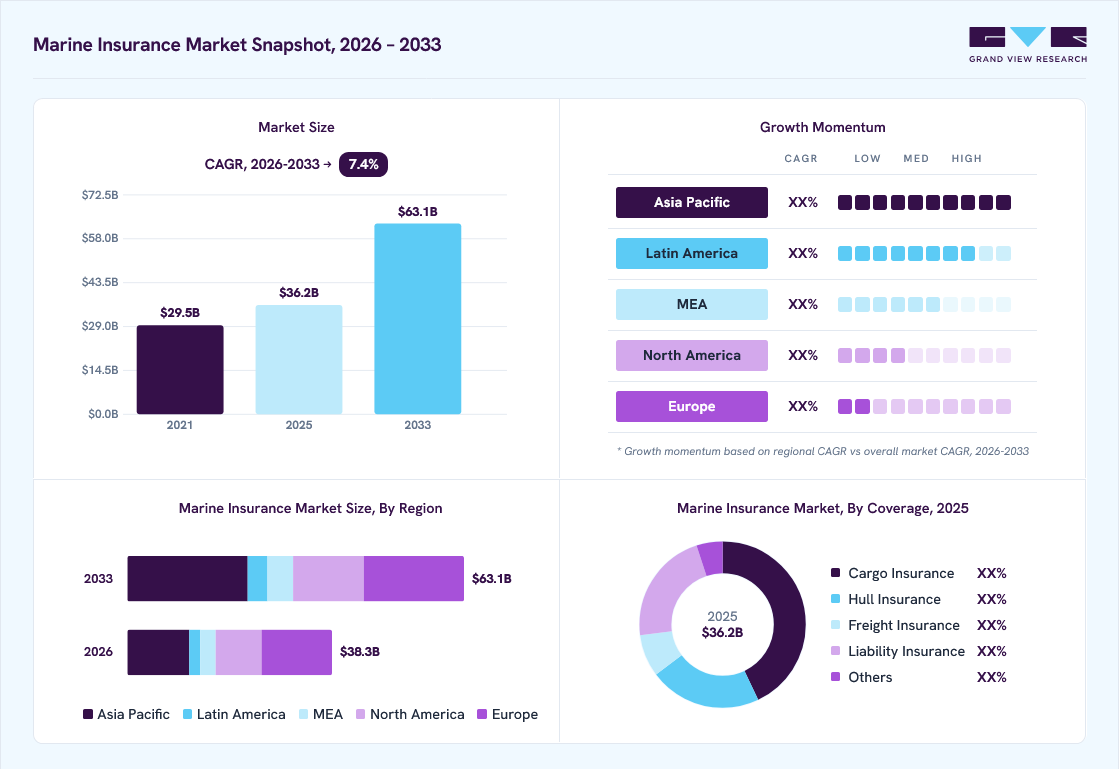
The global marine insurance market size was valued at USD 36.2 billion in 2025 and is projected to grow from USD 38.3 billion in 2026 to USD 63.1 billion by 2033, at a CAGR of 7.4% from 2026 to 2033. Europedominated the market, accounting for the largest revenue share of 35.1% in 2025. The rapid growth of global seaborne trade, which has significantly increased the movement of goods across international shipping routes, is a key factor driving the growth of the marine insurance market.
 Source: Grand View Research, IR Documents, Primary Interviews, Paid DatabasesTo learn more about this report,
 Download Free Sample Report
Key Market Trends & Insights
- By coverage: Cargo insurance segment held the largest revenue share of 42.9% in 2025
- By policy type: Time policy segment held the largest revenue share of 44.3% in 2025.
- By distribution channel: Insurance brokers segment held the largest revenue share in 2025.
- By end user: Shipping companies segment held the largest revenue share in 2025.
Regional Highlights
- Largest regional market: Europe (35.1% revenue share, 2025)
- Fastest-growing regional market: Asia Pacific (highest CAGR, 2026-2033)
- By country: The UK held the largest market share in 2025.
Market Size & Forecast
- Market size in 2025: USD 36.2 Billion
- Estimated market size in 2026: USD 38.3 Billion
- Projected market size by 2033: USD 63.1 Billion
- CAGR (2026-2033): 7.4%
Prism AI by Grand View Research Free to tryAsk a question about the marine insurance marketTry asking✓Every figure cited from GVR research Prefer the report? Download free sample →
Changing economic conditions and evolving global trade patterns are reshaping international shipping routes, creating new opportunities for the marine insurance industry. The emergence of routes such as the Northern Sea Route (NSR), driven by climate change and Arctic ice melt, is reducing transit times between Europe and Asia while improving shipping efficiency. However, these new routes expose vessels to unique operational challenges, including harsh weather conditions, limited rescue infrastructure, and environmental risks. Thus, marine insurers are adapting their underwriting practices and developing specialized coverage solutions to address the changing risk landscape, which in turn drives the growth of the market.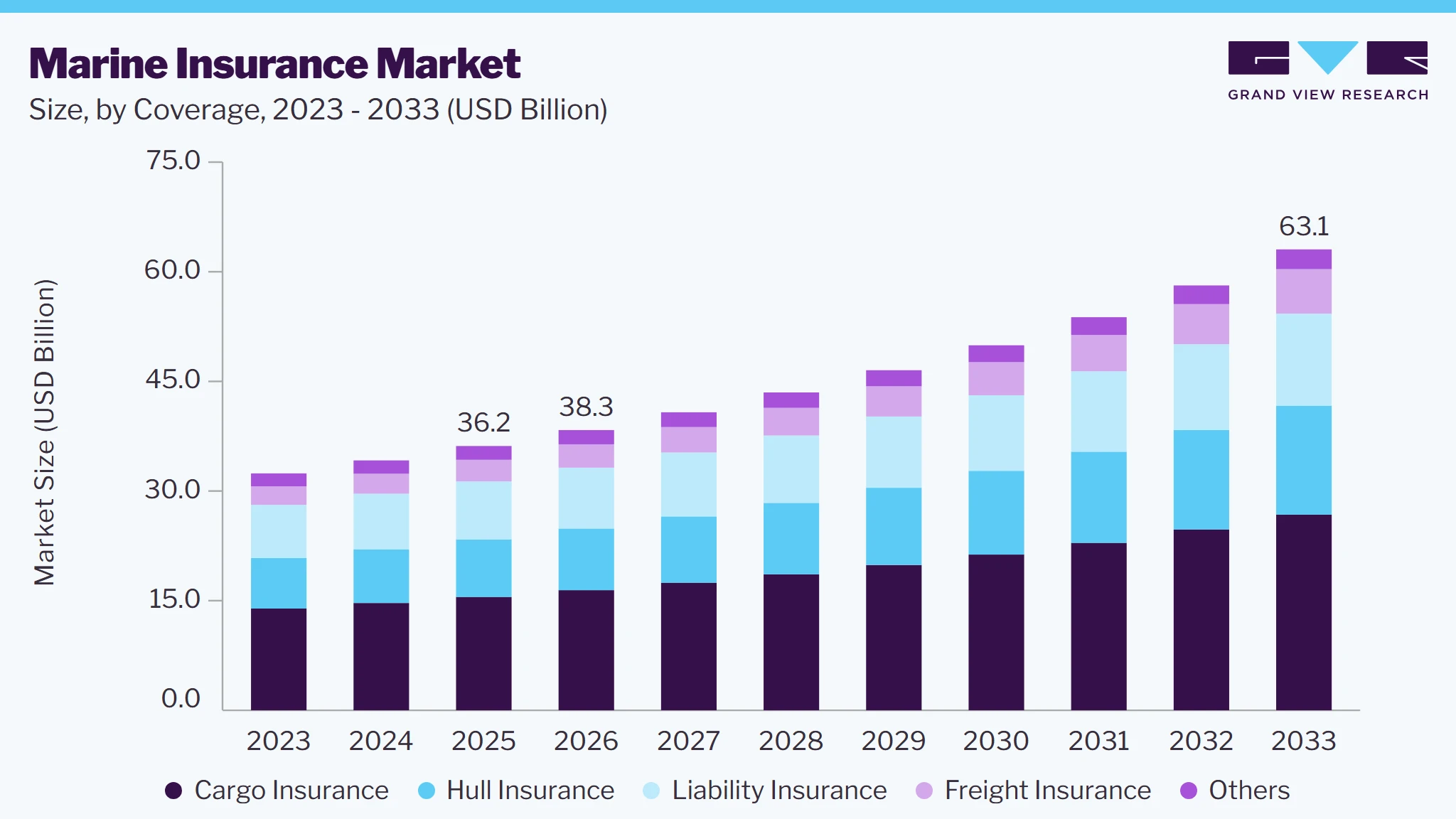 To learn more about this report, Download Free Sample Report
The marine insurance industry is rapidly adopting digital technologies to improve underwriting accuracy, claims processing, and risk assessment. Artificial intelligence (AI), machine learning, and big data analytics enable insurers to evaluate vessel conditions, cargo characteristics, weather patterns, and historical claims more effectively, resulting in more accurate premium pricing. Automated underwriting platforms and digital policy issuance have significantly reduced administrative costs and improved customer experience. In addition, AI-powered fraud detection systems help insurers identify suspicious claims and minimize financial losses. The increasing adoption of digital technologies across the shipping industry is encouraging insurers to invest in advanced analytics and automation to deliver faster, more customized, and data-driven insurance solutions.
The adoption of blockchain technology is transforming the marine insurance industry by improving transparency, security, and operational efficiency. Blockchain enables secure and tamper-proof recordkeeping for insurance transactions, reducing the risk of fraud and data manipulation. It also streamlines policy issuance, premium payments, and claims processing by facilitating faster and more transparent information sharing among stakeholders. Growing adoption of blockchain-based platforms is expected to enhance trust, improve operational efficiency, and simplify marine insurance processes across the maritime value chain.
The increasing digitalization of maritime operations has exposed shipping companies to growing cybersecurity threats, creating a strong demand for marine cyber insurance. Modern vessels rely heavily on connected navigation systems, satellite communications, cargo management software, and automated operational technologies, making them vulnerable to ransomware attacks, data breaches, and system disruptions. Cyber incidents lead to cargo delays, operational downtime, financial losses, and regulatory penalties, encouraging shipowners to seek dedicated cyber protection. Marine insurers are expanding their product portfolios by introducing standalone cyber insurance and integrated cyber liability coverage. The continuous evolution of cyber threats has made cybersecurity risk assessment an essential component of marine insurance underwriting.
Environmental, Social, and Governance (ESG) considerations are becoming an integral part of marine insurance underwriting and risk management strategies. Insurers are incorporating climate-related risks, carbon emissions, and environmental compliance into premium calculations and policy conditions. Shipping companies investing in cleaner fuels, energy-efficient vessels, and low-emission technologies are increasingly viewed as lower-risk clients and may benefit from more favorable insurance terms. Regulatory initiatives aimed at reducing greenhouse gas emissions from international shipping are also encouraging insurers to develop products that support sustainable maritime operations. This growing emphasis on sustainability is reshaping underwriting practices while creating new opportunities for green marine insurance products.
Market Dynamics
The rapid growth of global seaborne trade is a major factor behind the growth of the marine insurance market. According to the latest figures from the UN Conference on Trade and Development (UNCTAD), more than 80% of global merchandise trade by volume is transported by sea, making maritime shipping the backbone of international commerce. Rising international trade agreements, increasing industrial production, and the expansion of global supply chains have significantly increased the movement of raw materials, manufactured goods, energy products, and agricultural commodities across international shipping routes. The continued growth of containerized cargo transportation and cross-border e-commerce has further increased the value and volume of goods transported by sea. Thus, shipowners, freight forwarders, exporters, and importers are increasingly investing in marine insurance to safeguard cargo and vessels against financial losses arising from accidents, theft, natural disasters, and transit-related risks.
Furthermore, significant investments in port modernization, maritime infrastructure, and fleet expansion are supporting the growth of global shipping activities, thereby strengthening demand for marine insurance products. Emerging economies are expanding port capacity and enhancing logistics networks to facilitate higher trade volumes, while shipping companies continue to invest in larger, more technologically advanced vessels. The transportation of high-value goods such as electronics, pharmaceuticals, automobiles, and chemicals has also increased the financial exposure associated with maritime logistics, encouraging businesses to purchase comprehensive cargo and liability insurance. The continued recovery of global trade and expansion into new markets are expected to increase the demand for customized risk management solutions, creating growth opportunities for marine insurance providers.
One of the major restraints affecting the marine insurance market is the increasing cost of claims resulting from large-scale maritime losses. Natural disasters, vessel groundings, fires, cargo theft, collisions, geopolitical conflicts, and supply chain disruptions have significantly increased the frequency and severity of insurance claims in recent years. Inflation has further elevated ship repair expenses, labor costs, cargo replacement values, and legal settlements, reducing insurers' underwriting profitability. Large container ships carrying high-value cargo also expose insurers to catastrophic losses in the event of a single accident. The rising value of insurance claims is increasing pressure on insurers to maintain profitability while effectively managing greater financial risks.
In addition, rising reinsurance costs have created significant pricing challenges across the marine insurance industry. Reinsurers have increased premiums and tightened underwriting conditions due to higher global catastrophe losses and uncertain geopolitical conditions. These higher reinsurance expenses are often passed on to policyholders through increased insurance premiums and stricter coverage terms. Small and medium-sized shipping companies, which typically operate with limited financial resources, may find comprehensive marine insurance increasingly expensive, leading some businesses to reduce coverage levels. This cost pressure may slow market expansion, particularly in price-sensitive developing markets.
The rapid adoption of autonomous shipping technologies and digital maritime solutions presents a significant growth opportunity for the marine insurance market. Shipping companies are increasingly investing in autonomous vessels, AI-powered navigation systems, digital fleet management platforms, remote monitoring technologies, and smart ports to improve operational efficiency and reduce human error. These innovations generate new categories of risks associated with software failures, communication systems, cybersecurity vulnerabilities, and autonomous navigation, creating demand for specialized insurance products. Marine insurers are therefore expanding their product portfolios to address these emerging technological risks while supporting the digital transformation of the shipping industry.
Furthermore, the growing implementation of connected vessels and predictive maintenance technologies enables insurers to develop more sophisticated, data-driven insurance models. Real-time operational data collected through IoT sensors, satellite communications, and onboard monitoring systems enable insurers to continuously assess vessel performance and price policies more accurately based on actual risk exposure. Usage-based insurance, predictive risk assessment, and preventive maintenance programs reduce the frequency of claims while improving underwriting efficiency. The growing adoption of smart shipping technologies across commercial fleets is expected to create new growth opportunities, enabling insurers that invest in digital capabilities and innovative coverage solutions to gain a strong competitive advantage.
Market Concentration & Characteristics
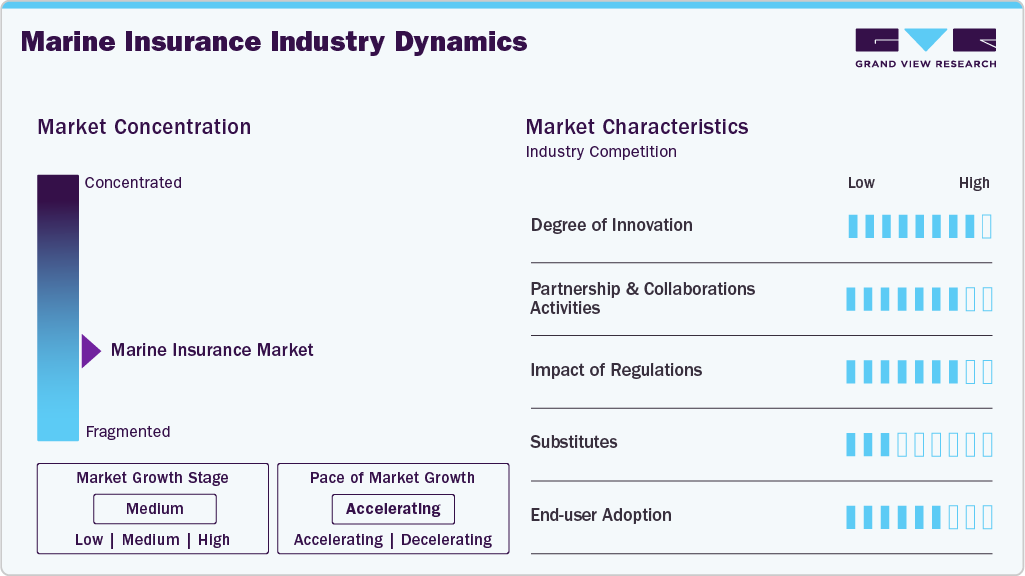
The marine insurance market is moderately consolidated, with large global insurers, reinsurers, and Protection & Indemnity (P&I) Clubs accounting for a significant share of the market, while numerous regional insurers and specialty providers compete across specific geographies and marine insurance segments. The market is currently in a medium growth stage and is experiencing an accelerating growth rate, supported by rising global seaborne trade, increasing maritime risks, expanding offshore energy activities, and growing investments in port infrastructure. Demand for marine insurance continues to increase as shipping companies seek comprehensive protection against cargo losses, vessel damage, environmental liabilities, and cyber risks.
 To learn more about this report, Download Free Sample Report
The market is characterized by a high degree of innovation, driven by the adoption of digital technologies such as artificial intelligence, blockchain, IoT, and advanced analytics to improve underwriting, claims processing, and risk assessment. Partnerships and collaborations among insurers, reinsurers, technology providers, and maritime stakeholders are increasing to develop innovative insurance solutions and enhance operational efficiency. The impact of regulations remains high due to stringent international maritime safety and environmental standards that require adequate insurance coverage. Furthermore, the market has low substitute availability, as marine insurance provides specialized financial protection that cannot be easily replaced, while end-user adoption remains medium to high owing to the growing awareness of risk management and the continued expansion of international shipping and trade.
Analyst Perspective
The marine insurance market is witnessing steady growth driven by increasing global maritime trade, rising cargo volumes, and growing investments in offshore energy and shipping infrastructure. Insurers are increasingly leveraging digital technologies, data analytics, and AI-based risk assessment to improve underwriting accuracy and claims management. The demand for specialized coverage addressing evolving risks such as cyber threats, climate-related events, and supply chain disruptions is also increasing. These trends are expected to support the continued expansion of the marine insurance market over the forecast period.
Coverage Insights
The cargo insurance segment accounted for the largest market share of 42.9% in 2025. The segment growth is driven by the continuous growth of global seaborne trade and cross-border commerce. Increasing transportation of high-value goods such as electronics, pharmaceuticals, automobiles, chemicals, and consumer products has heightened the need for financial protection against cargo loss, theft, damage, and transit delays. The expansion of containerized shipping, international supply chains, and e-commerce has further increased demand for comprehensive cargo insurance policies. In addition, growing awareness of supply chain risks and stricter contractual requirements among exporters, importers, and logistics providers continue to support the segment's dominance.
The freight insurance segment is expected to register the fastest CAGR during the forecast period. The increasing volume of international freight transportation and the growing complexity of global logistics networks is driving demand for freight insurance. Rising freight rates, supply chain disruptions, port congestion, and geopolitical uncertainties have increased the financial risks associated with cargo transportation, encouraging businesses to secure freight-related insurance coverage. The rapid growth of international trade, multimodal transportation, and cross-border e-commerce is further accelerating demand for freight insurance. Moreover, digital freight platforms and advanced logistics management solutions are improving access to customized freight insurance products, contributing to the segment's growth.
Policy Type Insights
The time policy segment accounted for the largest market share in 2025. The segment’s growth is driven by its widespread adoption among commercial shipowners and fleet operators for long-term vessel protection. These policies provide coverage for a specified period, typically one year, offering continuous protection against risks such as collisions, fire, piracy, and natural disasters during regular vessel operations. The increasing size of global commercial fleets, growing international shipping activities, and rising investments in maritime transportation continue to drive demand for time policies. Furthermore, their predictable coverage period and simplified policy management make them the preferred choice for shipping companies operating vessels on a year-round basis.
The floating policy segment is expected to register the fastest CAGR during the forecast period. The increasing frequency of international shipments and the expansion of global trade can be attributed to the growth of the segment. This policy allows businesses to insure multiple cargo consignments under a single agreement without issuing separate policies for every shipment, making it highly suitable for exporters, importers, and logistics providers with continuous shipping activities. The rapid growth of cross-border e-commerce, global supply chains, and containerized freight transportation is accelerating the adoption of floating policies by reducing administrative complexity and improving operational efficiency.
Distribution Channel Insights
The insurance brokers segment accounted for the largest market share in 2025. The growth of the insurance broker segment can be attributed to their expertise in evaluating complex maritime risks and arranging customized insurance solutions. Large shipping companies, cargo owners, and logistics providers rely on brokers to access multiple insurers, negotiate competitive premiums, and obtain specialized coverage for international shipping operations. The growing complexity of global supply chains, increasing regulatory requirements, and rising demand for comprehensive risk management continue to strengthen the role of insurance brokers. Their extensive industry knowledge and ability to provide claims support and advisory services further contribute to the segment's growth.
The direct segment is expected to register the fastest CAGR during the forecast period. Factors such as the rapid digitalization of the insurance industry and increasing adoption of online insurance platforms are expected to contribute to the growth of the market. Insurers are investing in digital portals and mobile applications that enable customers to compare policies, obtain quotations, purchase coverage, and manage claims without intermediary involvement. Growing preference for faster policy issuance, lower distribution costs, and greater pricing transparency is encouraging businesses, particularly small and medium-sized enterprises, to purchase marine insurance directly from insurers.
End Users Insights
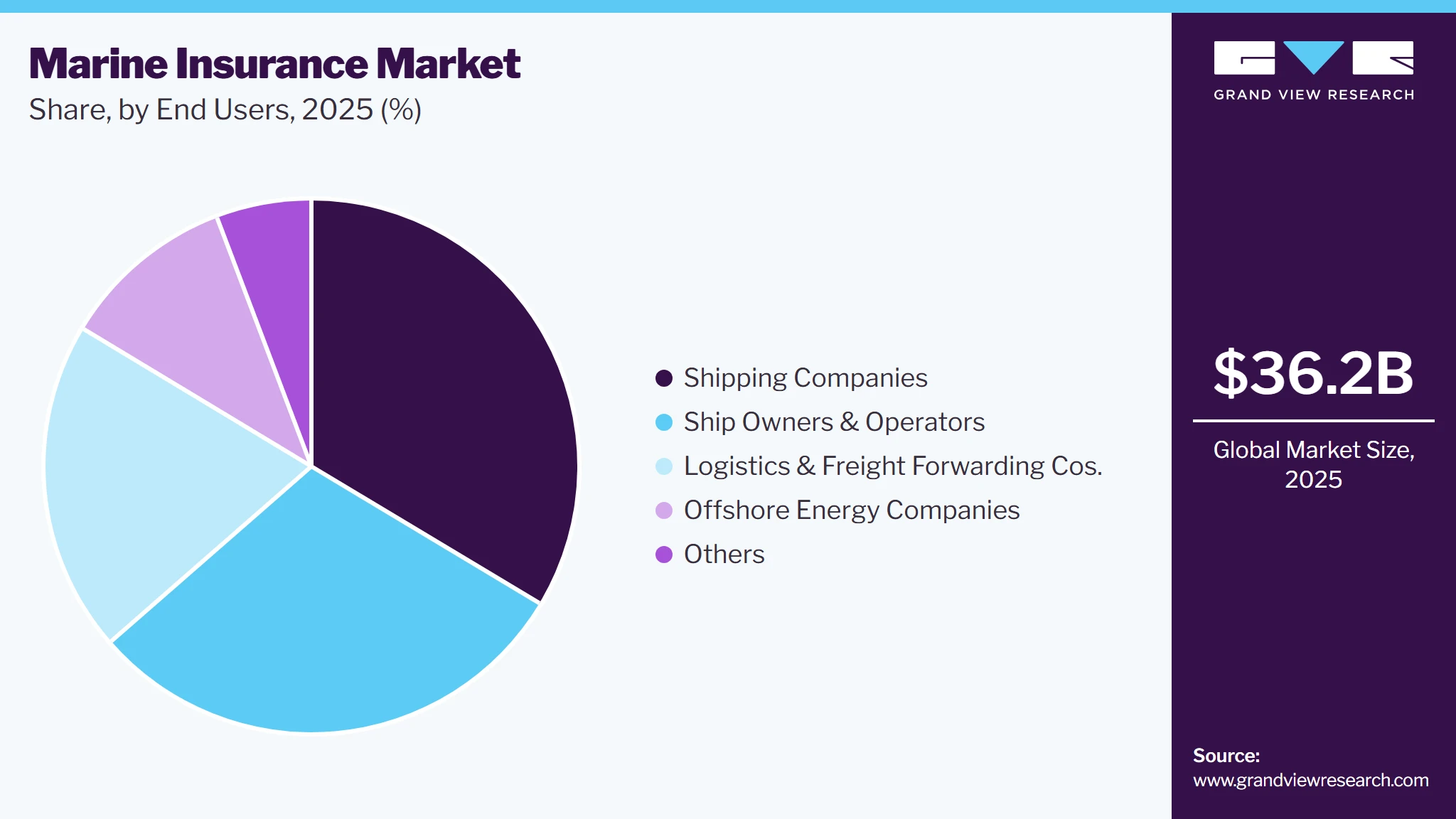
The shipping companies segment accounted for the largest market share in 2025, due to their continuous need to protect vessels, cargo, and liabilities associated with international maritime operations. The growth in global seaborne trade, expansion of commercial shipping fleets, and increasing transportation of high-value goods have significantly increased demand for comprehensive marine insurance coverage. Rising operational risks, including vessel accidents, piracy, extreme weather events, and environmental liabilities, are further encouraging shipping companies to invest in hull, cargo, and P&I insurance. In addition, stringent international maritime regulations requiring adequate insurance coverage continue to support the dominance of this segment.
 To learn more about this report, Download Free Sample Report
The offshore energy companies segment is expected to register the fastest CAGR during the forecast period. The growth of the segment can be attributed to the increasing investments in offshore oil & gas exploration and the rapid expansion of offshore renewable energy projects, particularly offshore wind farms. These operations involve high-value assets and are exposed to significant risks such as equipment damage, offshore accidents, harsh weather conditions, and environmental liabilities, driving the need for specialized marine insurance solutions. Growing investments in deepwater and ultra-deepwater exploration projects, coupled with expanding offshore infrastructure, are further fueling demand for comprehensive insurance coverage. Moreover, the global transition toward clean energy and the development of offshore renewable energy facilities are creating new opportunities for marine insurers to offer tailored risk management products.
Regional Insights
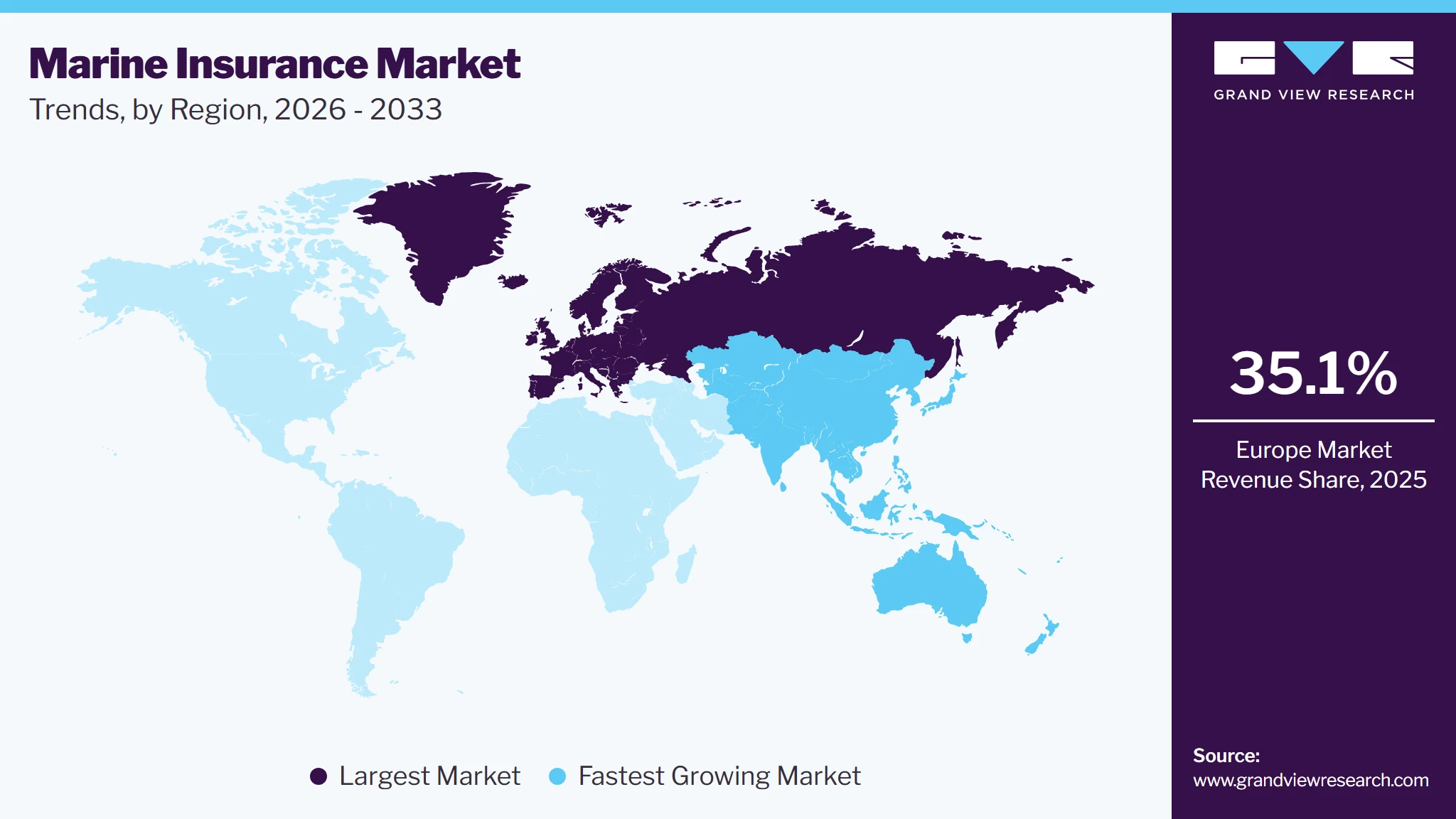
The Europe marine insurance market led the global market and accounted for 35.1% of the global revenue in 2025, due to its long-established maritime industry, presence of major marine insurers, and strong international shipping ecosystem. In addition, increasing adoption of digital underwriting technologies, growing offshore wind investments, and expanding sustainable shipping initiatives continue to reinforce the region's dominant position in the global marine insurance market.
 To learn more about this report, Download Free Sample Report
Germany Marine Insurance Market Trends
Germany held a dominant share in the Europe marine insurance market, supported by its strong export-oriented economy, advanced manufacturing sector, and well-developed maritime logistics infrastructure. Major ports such as Hamburg serve as critical gateways for international trade, driving demand for cargo, freight, and hull insurance. The country's shipping companies and logistics providers are increasingly investing in digital fleet management, cybersecurity, and sustainable shipping technologies, creating demand for innovative marine insurance products.
France marine insurance market is expected to grow at the fastest CAGR over the forecast period, supported by its strategic maritime location, extensive coastline, and major commercial ports such as Marseille-Fos, Le Havre, and Dunkirk. Increasing investments in port modernization, maritime logistics, and offshore renewable energy projects, particularly offshore wind farms, are further driving the need for specialized marine insurance solutions.
North America Marine Insurance Market Trends
North America marine insurance market is expected to grow at a moderate CAGR during the forecast period. The North American marine insurance market is driven by well-established maritime trade networks, advanced logistics infrastructure, and increasing investments in offshore energy and port modernization. The region experiences strong demand for marine insurance due to high volumes of containerized cargo, energy shipments, and inland marine transportation across the U.S., Canada, and Mexico.
The U.S. marine insurance market held a substantial share in the North America marine insurance market, supported by its extensive coastline, major commercial ports, and high volume of international trade. Increasing imports and exports, growth in offshore oil and gas activities, and expansion of offshore wind energy projects continue to generate demand for hull, cargo, and liability insurance. The country is also witnessing increased investments in port modernization and supply chain resilience initiatives, further supporting insurance adoption.
Asia Pacific Marine Insurance Market Trends
The Asia Pacific marine insurance market is expected to grow at the fastest CAGR during 2026 to 2033, driven by the region's position as the global hub for maritime trade, manufacturing, and shipbuilding. Countries such as China, India, Japan, South Korea, and Australia handle a significant share of global cargo volumes, creating sustained demand for marine insurance. Rising investments in port modernization, expanding container shipping capacity, and increasing regional trade agreements are further strengthening marine insurance adoption across the region.
The China marine insurance market dominated Asia Pacific, owing to its dominant position in international trade, container shipping, and shipbuilding. The country's extensive port network, including major ports such as Shanghai, Ningbo-Zhoushan, and Shenzhen, handles a substantial share of global cargo traffic, generating significant demand for marine insurance coverage. Continued investments under the Belt and Road Initiative (BRI), expansion of maritime logistics infrastructure, and increasing exports of high-value manufactured goods continue to support market growth.
India marine insurance market is expected to grow at a notable CAGR over the forecast period, supported by increasing exports, expanding port infrastructure, and government initiatives to strengthen the country's maritime sector. Programs such as the Sagarmala Programme and investments in multimodal logistics are improving port connectivity and increasing cargo handling capacity, thereby driving demand for marine insurance products. The rapid growth of manufacturing, pharmaceuticals, automotive exports, and cross-border e-commerce has increased the need for cargo and freight insurance.
Key Marine Insurance Company Insights
Key players operating in the marine insurance market include Chubb Limited, Allianz SE, and Zurich Insurance Group. These companies are focusing on expanding their product portfolios, strengthening digital capabilities, and enhancing risk assessment solutions to maintain their market position. They are also investing in artificial intelligence (AI), data analytics, blockchain, and Internet of Things (IoT) technologies to improve underwriting accuracy, streamline claims processing, and offer personalized insurance products.
-
Allianz SE is one of the major providers in the global marine insurance market, offering a comprehensive portfolio of marine insurance solutions, including hull, cargo, marine liability, and logistics coverage. The company leverages its extensive global network, advanced underwriting capabilities, and risk engineering expertise to serve shipping companies, logistics providers, and multinational corporations. Its continued investments in digital underwriting, predictive analytics, and claims management technologies have strengthened its competitive position in the marine insurance industry.
-
Chubb Limited is a prominent player in the marine insurance market, providing specialized insurance products for cargo, hull, inland marine, marine liability, and transportation risks. The company serves a broad customer base, including shipping companies, freight forwarders, manufacturers, and logistics providers operating across international markets. Chubb focuses on customized risk management solutions, efficient claims handling, and strong underwriting expertise, enabling it to maintain a significant presence in the global marine insurance sector.
Key Marine Insurance Companies
The following key companies have been profiled for this study on the marine insurance market
-
Arthur J. Gallagher & Co.
-
Allianz SE
-
Gard
-
AXA XL
-
Zurich Insurance Group
-
American International Group, Inc.
-
Chubb Limited
-
HDI Global SE
-
Lockton Companies
-
NorthStandard Limited
Competitive Benchmarking
Operating Strategies
Competitive Edge
Weaknesses
Mature Players: Allianz SE, AXA XL, Zurich Insurance Group, American International Group, Inc. (AIG)
These companies focus on expanding global marine insurance portfolios, strengthening underwriting capabilities, leveraging digital risk assessment tools, and offering integrated marine risk management services. They also invest in analytics, claims automation, and strategic partnerships with brokers, shipping companies, and logistics providers
These companies gain competitive advantages through strong global presence, diversified insurance portfolios, extensive underwriting expertise, robust financial strength, and established broker networks
Exposure to catastrophic losses, increasing climate-related claims, volatile shipping markets, and tightening regulatory requirements may impact underwriting profitability and premium pricing of these companies
Emerging Players: Arthur J. Gallagher & Co., Gard, Lockton Companies, NorthStandard Limited
These companies focus on specialized marine insurance, Protection & Indemnity (P&I) coverage, customized risk management solutions, and client-focused brokerage services. They emphasize digital service platforms, tailored underwriting, and expansion into niche maritime segments to strengthen their competitive position
Strong expertise in marine risk management, specialized underwriting capabilities, customer-centric service models, and flexible insurance solutions enable these companies to compete effectively in the marine insurance market
Compared to large multinational insurers, these companies generally have narrower product portfolios, lower global diversification, and greater dependence on marine-specific business segments, making them more sensitive to fluctuations in maritime trade and shipping cycles
Recent Developments:
-
In January 2026, Falvey Insurance Group announced the launch of Specialty Marine, a new marine insurance solution designed to simplify and modernize the underwriting process in the U.S. The product offers a streamlined underwriting experience through a single point of contact across all marine insurance lines and provides concurrent policy wordings between primary and excess coverage for consistent protection. It also features simplified claims management supported by an in-house team of marine insurance specialists, along with a dedicated finance and accounting contact to improve administrative efficiency.
-
In October 2025, Munich Re Specialty expanded its inland marine insurance portfolio with the launch of an admitted inland marine insurance product, complementing its existing excess and surplus (E&S) inland marine offerings. The solution is designed to address U.S. domestic risks across the construction sector, including general contractors and developers, as well as the transportation industry. The product provides up to USD 50 million in underwriting capacity and includes coverage for builders’ risk, contractors’ equipment, motor truck cargo, and various property floaters. It is supported by regional specialist underwriters and an experienced in-house claims team, enabling efficient underwriting and claims management while addressing the evolving insurance needs of brokers and insureds.
Marine Insurance Market Report Scope
Report Attribute
Details
Market size in 2025
USD 36.2 billion
Estimated market size in 2026
USD 38.3 billion
Projected market size by 2033
USD 63.1 billion
Growth rate
CAGR of 7.4% from 2026 to 2033
Base year for estimation
2025
Historical data
2021 - 2024
Forecast period
2026 - 2033
Quantitative units
Revenue in USD billion and CAGR from 2026 to 2033
Report coverage
Revenue forecast, company ranking, competitive landscape, growth factors, and trends
Segments covered
Coverage, policy type, distribution channel, end users, region
Regional scope
North America; Europe; Asia Pacific; Latin America; MEA
Country scope
U.S.; Canada; Mexico; Germany; UK; France; China; Japan; India; South Korea; Australia; Brazil; KSA; UAE; South Africa
Key companies profiled
Arthur J. Gallagher & Co.; Allianz SE; Gard; AXA XL; Zurich Insurance Group; American International Group, Inc.; Chubb Limited; HDI Global SE; Lockton Companies; NorthStandard Limited.
Customization scope
Free report customization (equivalent up to 8 analysts working days) with purchase. Addition or alteration to country, regional & segment scope.
Pricing and purchase options
Avail customized purchase options to meet your exact research needs. Explore purchase options
Global Marine Insurance Market Report Segmentation
This report forecasts revenue growth at the global, regional, and country levels and provides an analysis of the latest industry trends in each of the sub-segments from 2021 to 2033. For this study, Grand View Research has segmented the global marine insurance market report based on coverage, policy type, distribution channel, end users, and region:
-
Coverage Outlook (Revenue, USD Million, 2021 - 2033)
-
Cargo Insurance
-
Hull Insurance
-
Freight Insurance
-
Liability Insurance
-
Others
-
-
Policy Type Outlook (Revenue, USD Million, 2021 - 2033)
-
Voyage Policy
-
Time Policy
-
Floating Policy
-
Mixed Policy
-
-
Distribution Channel Outlook (Revenue, USD Million, 2021 - 2033)
-
Direct
-
Insurance Brokers
-
Digital/Online Channels
-
-
End Users Outlook (Revenue, USD Million, 2021 - 2033)
-
Shipping Companies
-
Logistics & Freight Forwarding Companies
-
Ship Owners & Operators
-
Offshore Energy Companies
-
Others
-
-
Regional Outlook (Revenue, USD Million, 2021 - 2033)
-
North America
-
U.S.
-
Canada
-
Mexico
-
-
Europe
-
Germany
-
UK
-
France
-
-
Asia Pacific
-
China
-
Japan
-
India
-
South Korea
-
Australia
-
-
Latin America
-
Brazil
-
-
Middle East and Africa (MEA)
-
KSA
-
UAE
-
South Africa
-
-
Research Methodology
The marine insurance market figures in this report are based on a proven research process that combines executive interviews with secondary research from proprietary databases, company filings, and recognized regulatory and institutional sources. Market size is built through value-chain sizing—reconciling supply-side and demand-side estimates—and triangulated with bottom-up and top-down approaches. Every estimate passes multiple levels of expert validation before publication, with each marine insurance segment quantified using the revenue-capture definitions in the table below.
Segment Definition
Segment - Coverage
Revenue capture definition
Cargo Insurance
This segment captures revenue generated from insurance policies that protect goods and merchandise against physical loss or damage during transportation by sea and multimodal transit.
Hull Insurance
This segment captures revenue generated from insurance policies that provide coverage for physical damage to ships, vessels, boats, and other marine crafts.
Freight Insurance
This segment captures revenue generated from insurance policies that protect the freight revenue or transportation charges that shipowners or carriers expect to earn.
Liability Insurance
This segment captures revenue generated from insurance policies covering legal liabilities arising from marine operations.
Others
This segment captures revenue generated from other marine insurance products such as marine war risk insurance, offshore energy insurance, port and terminal insurance, yacht insurance, marine cyber insurance, and Protection & Indemnity (P&I) coverage.
Segment - Policy Type
Revenue capture definition
Voyage Policy
This segment captures revenue generated from insurance policies that provide coverage for a specific voyage between designated ports.
Time Policy
This segment captures revenue generated from insurance policies that provide coverage for a fixed period, typically one year, regardless of the number of voyages undertaken during that time.
Floating Policy
This segment captures revenue generated from insurance policies designed for businesses that regularly transport cargo.
Mixed Policy
This segment captures revenue generated from insurance policies that combine both voyage-based and time-based coverage.
Segment - Distribution Channel
Revenue capture definition
Direct
This segment captures revenue generated from marine insurance policies sold directly by insurance companies to policyholders without intermediary involvement.
Insurance Brokers
This segment captures revenue generated from marine insurance policies distributed through licensed insurance brokers who assess client requirements, negotiate policy terms with insurers, and provide advisory and claims support services.
Digital/Online Channels
This segment captures revenue generated from marine insurance policies purchased through digital platforms, online insurance marketplaces, insurer websites, and mobile applications.
Segment - End Users
Revenue capture definition
Shipping Companies
This segment captures revenue generated from marine insurance policies purchased by commercial shipping companies operating cargo vessels, container ships, tankers, bulk carriers, and other commercial fleets.
Logistics & Freight Forwarding
Companies
This segment captures revenue generated from marine insurance policies utilized by logistics providers and freight forwarding companies to protect customer shipments, transportation liabilities, and multimodal cargo movements across international supply chains.
Ship Owners & Operators
This segment captures revenue generated from marine insurance policies purchased by vessel owners and operators to protect ships, onboard equipment, crew liabilities, operational risks, and financial interests associated with vessel ownership and management.
Offshore Energy Companies
This segment captures revenue generated from marine insurance policies used by offshore oil & gas operators, offshore wind farm developers, and other marine energy companies.
Others
This segment captures revenue generated from marine insurance policies purchased by additional end users including fishing companies, marine construction contractors, government agencies, and marine research institutions.
Estimation Model
Layer Name
Key Question
Description
Global Maritime Trade & Marine Assets Base Layer
Which maritime activities require insurance protection?
This layer establishes the total potential demand base by identifying global maritime trade, shipping activities, commercial vessels, cargo movements, offshore energy assets, ports, and marine infrastructure. It evaluates factors such as international trade volumes, fleet size, cargo shipments, vessel ownership, offshore operations, and marine transportation activity.
Addressable Marine Insurance Market Layer
Which maritime assets and operations can realistically be insured?
This layer refines the total maritime ecosystem into the serviceable marine insurance market by considering regulatory requirements, contractual obligations, international shipping standards, cargo values, vessel registrations, maritime trade routes, and risk exposure. It determines the share of maritime operations that require insurance coverage.
Marine Insurance Adoption Layer
Who is actively purchasing marine insurance policies?
This layer estimates annual demand generation by analyzing insurance adoption among shipping companies, cargo owners, logistics providers, freight forwarders, ship owners, offshore energy companies, and marine contractors. It converts the addressable market into measurable policy issuance across cargo, hull, freight, liability, and other marine insurance products.
Monetization Layer
How does insurance adoption translate into market revenue?
This layer converts policy adoption into market revenue through insurance premiums, policy renewals, brokerage commissions, and value-added marine insurance solutions. Revenue is generated by applying premium rates based on cargo value, vessel type, voyage risk, insured assets, and policy coverage across different customer segments.
Customization Table
This report has been delivered with the following In-depth customizations
Client Request
Customization Delivered
Value Adds
Regional & Country Opportunity Analysis
- Delivered region-wise and country-wise market sizing, forecasts, and growth analysis across North America, Europe, Asia Pacific, Latin America, and Middle East & Africa
- Assessment of maritime trade growth, shipping activity, port infrastructure development, and regulatory environment
- Supported geographic expansion strategies
- Enabled identification of high-growth insurance markets
Digital Marine Insurance & InsurTech Analysis
- Delivered assessment of AI-driven underwriting, blockchain-enabled marine insurance, digital claims processing, IoT-based cargo monitoring, and automated risk assessment platforms
- Analysis of technology adoption trends
- Supported digital transformation planning
- Identified innovation-driven growth opportunities
Competitive Benchmarking & Strategic Landscape Analysis
- Delivered benchmarking of major marine insurance providers based on geographic coverage, financial strength, reinsurance partnerships, and digital capabilities
- Analysis of mergers & acquisitions, partnerships, product launches, and strategic initiatives
- Supported competitive intelligence and strategic decision-making
- Enabled identification of market gaps and growth opportunities
Frequently Asked Questions About This Report
The global marine insurance market size was estimated at USD 36.2 billion in 2025 and is expected to reach USD 38.3 billion in 2026.
The global marine insurance market is expected to grow at a compound annual growth rate of 7.4% from 2026 to 2033 to reach USD 63.1 billion by 2033.
The Europe marine insurance market led the global market and accounted for 35.1% of the global revenue in 2025, due to its long-established maritime industry, presence of major marine insurers, and strong international shipping ecosystem.
The shipping companies segment accounted for the largest market share in 2025, due to their continuous need to protect vessels, cargo, and liabilities associated with international maritime operations.
The rapid growth of global seaborne trade, which has significantly increased the movement of goods across international shipping routes, is a key factor driving the growth of the marine insurance market.
Some key players operating in the marine insurance market include Arthur J. Gallagher & Co., Allianz SE, Gard, AXA XL, Zurich Insurance Group, American International Group, Inc., Chubb Limited, HDI Global SE, Lockton Companies, and NorthStandard Limited.
Asia Pacific is the fastest-growing region over the forecast period.
The cargo insurance segment accounted for the largest market share of 42.9% in 2025, while freight Insurance is the fastest-growing coverage segment.
The time policy segment accounted for the largest market share in 2025, while the floating policy is the fastest-growing policy type.
About the Author(s)
Next Generation Technologies Research Team
Technology · Next Generation TechnologiesThis report was authored by the next generation technologies research team at Grand View Research - comprising two research analysts, one senior research analyst, and one industry expert - with specialized expertise in the next generation technologies segment of the technology industry. All findings are based on proprietary technology databases, executive interviews, and regulatory analysis, subject to internal peer review prior to publication.
Last Updated:
Speak to Analyst

Customize this report to your needs - add regions, segments, or data points, with 20% free customization.
Or view our licence options:


ISO 9001:2015 & 27001:2022 Certified
We are GDPR and CCPA compliant! Your transaction & personal information is safe and secure. For more details, please read our privacy policy.


