
- Home
- »
- Next Generation Technologies
- »
-
MEA Healthcare Factoring Services Market Size Report 2033GVR Report cover
![MEA Healthcare Factoring Services Market Size, Share & Trends Report]()
MEA Healthcare Factoring Services Market (2025 - 2033) Size, Share & Trends Analysis Report By Category, By Type (Recourse, Non-recourse), By Application, By Country, And Segment Forecasts
- Report ID: GVR-4-68040-788-1
- Number of Report Pages: 110
- Format: PDF
- Historical Range: 2021 - 2024
- Forecast Period: 2025 - 2033
- Industry: Technology
- Report Summary
- Table of Contents
- Segmentation
- Methodology
- Download FREE Sample
-
 Download Sample Report
MEA Healthcare Factoring Services Market Summary
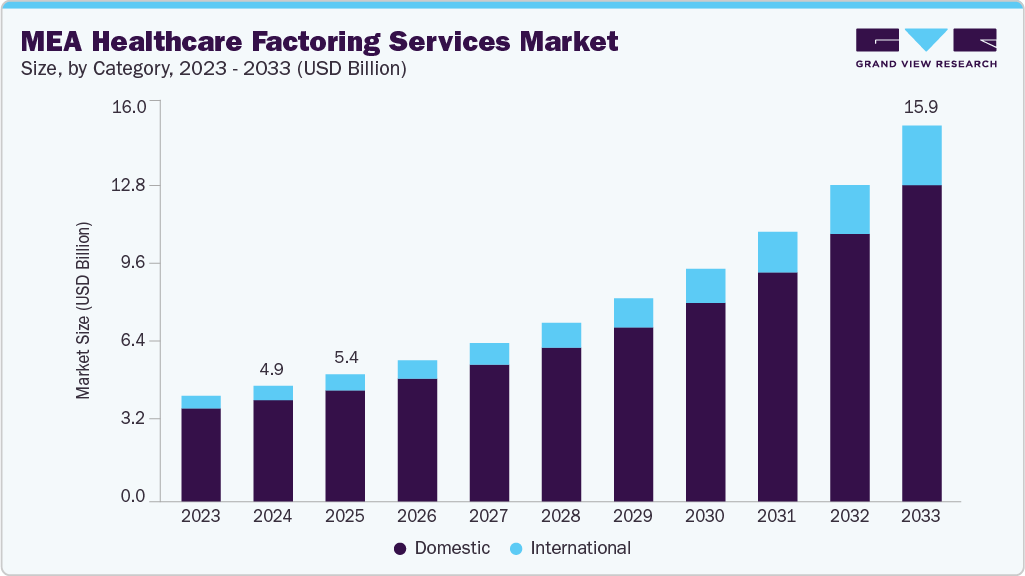
The MEA healthcare factoring services market size was estimated at USD 4.92 billion in 2024, and is projected to reach USD 15.99 billion by 2033, growing at a CAGR of 14.5% from 2025 to 2033.The market is expanding rapidly due to rising healthcare expenditure, growing demand for liquidity among providers, and the increasing complexity of healthcare payment systems.
Key Market Trends & Insights
- The South Africa healthcare factoring services market accounted for a 50.5% share in 2024.
- By category, the domestic segment accounted for the largest market share of 87.7% in 2024.
- By type, the recourse segment held the largest market share in 2024.
- By application, the medical staffing agencies segment dominated the market in 2024.
Market Size & Forecast
- 2024 Market Size: USD 4.92 Billion
- 2033 Projected Market Size: USD 15.99 Billion
- CAGR (2025-2033): 14.5%
- South Africa: Largest Market in 2024
- UAE: Fastest growing market
The region’s aging population and higher incidence of chronic diseases such as diabetes, cardiovascular disorders, and cancer are driving greater patient volumes and healthcare utilization. As governments and private players invest in hospitals, diagnostic centers, and pharmaceutical distribution networks, long billing and reimbursement cycles have intensified the need for factoring services to ensure consistent cash flow and operational stability.Technology is playing a crucial role in shaping the MEA healthcare factoring landscape. The integration of digital platforms and fintech solutions is enabling faster invoice processing, real-time credit risk assessment, and automated fund disbursement. Artificial intelligence (AI) and data analytics are being leveraged to evaluate payer reliability, detect fraud, and streamline receivables management. In addition, blockchain-based systems are emerging to enhance transparency and traceability in financial transactions, while cloud-based factoring platforms are improving accessibility and scalability, especially for small and medium healthcare providers across the region.
The MEA healthcare factoring services industry has witnessed increased participation from both domestic and international financial institutions aiming to capitalize on the growing healthcare financing gap. Regional banks, fintech startups, and specialized factoring companies are investing in innovative funding models tailored for the healthcare ecosystem. International players are forming partnerships with local healthcare organizations and insurers to expand their reach and mitigate regional payment risks. Furthermore, government-led healthcare infrastructure development programs are indirectly boosting the factoring market by creating demand for financial instruments that can sustain liquidity and fund expansion.
The regulatory environment for healthcare factoring in the MEA region is evolving, with several countries introducing financial reforms to encourage alternative financing mechanisms. Some markets, such as the UAE and Saudi Arabia, are implementing clearer guidelines on receivables financing, transparency, and anti-money laundering compliance to build investor confidence. However, regulatory frameworks remain fragmented across many African nations, with varying levels of oversight and standardization. This inconsistency can affect cross-border factoring operations, though regional cooperation and financial harmonization initiatives are gradually improving the business environment.
Despite its strong growth potential, the market faces several challenges. Limited awareness of factoring solutions among smaller healthcare providers, coupled with a lack of financial literacy, restricts adoption. Inconsistent regulatory policies and the absence of standardized factoring practices in certain countries also hinder market scalability. Moreover, high perceived credit risks, delayed claim settlements, and limited access to credit data in emerging economies deter financial institutions from offering competitive factoring terms.
Category Insights
The domestic segment led the MEA healthcare factoring services market with the largest share of 87.7% in 2024. The growth of the segment is driven by the rising healthcare spending, expanding populations, and increasing chronic disease prevalence. Governments and private players are investing in hospitals, equipment, and pharmaceutical supply chains, leading to longer billing cycles, especially with public or insurance payers. To address cash flow challenges, healthcare providers, particularly smaller clinics and pharmacies, are turning to factoring services. By selling receivables to factoring firms, they gain immediate access to working capital, enabling them to manage operations, sustain supply chains, and invest in infrastructure despite limited access to traditional bank financing.
The international segment is expected to grow at the fastest CAGR during the forecast period. The growth of international healthcare factoring services in the Middle East and Africa is driven by the region’s heavy reliance on imported medical products, including pharmaceuticals, vaccines, and advanced medical equipment. With limited local manufacturing capacity, healthcare providers depend on international suppliers, especially in rapidly urbanizing areas and during health crises. Factoring services offer credit protection and collection management, mitigating cross-border transaction risks in economically volatile markets. As healthcare imports surge due to population growth, government initiatives, and private sector expansion, international factoring has become vital for ensuring continuous access to essential medical supplies and stable financial operations.
Type Insights
The recourse segment led the MEA healthcare factoring services market with the largest share of 62.0% in 2024. The rising demand for healthcare services, driven by urbanization, population growth, and the increasing burden of chronic diseases, is pushing more providers to seek external funding to scale operations and meet demand. Recourse factoring becomes especially useful in funding inventory procurement, employee wages, and infrastructure upgrades without taking on long-term debt. By offering short-term liquidity solutions, recourse factoring enables healthcare entities to respond quickly to changing needs and invest in growth initiatives without waiting months for invoice settlements.
The non-recourse segment is expected to grow at the fastest CAGR during the forecast period. The growth of non-recourse healthcare factoring services in the Middle East and Africa is driven by the need for risk-free liquidity, delayed reimbursements, and evolving healthcare financing systems. In these arrangements, the factoring company assumes the risk of non-payment, offering greater financial security to healthcare providers. Given bureaucratic delays and inconsistent payment practices in public and insurance systems, non-recourse factoring enables hospitals, pharmacies, and distributors to maintain stable cash flow while transferring credit risk to the factoring firm.
Application Insights
The medical staffing agencies segment dominated the MEA healthcare factoring services industry in 2024. The increasing demand for temporary and flexible medical staffing solutions across the Middle East and Africa, driven by a mix of demographic shifts, healthcare reforms, and labor shortages, drives growth of the market. Seasonal disease outbreaks, such as flu surges or pandemic-related emergencies, often require hospitals to rapidly expand their workforce without permanently increasing headcount. In addition, the rapid development of healthcare infrastructure, especially in Gulf countries such as Saudi Arabia and the UAE, has intensified the need for agile staffing models that can quickly fill gaps in nursing, diagnostic, and allied health roles.
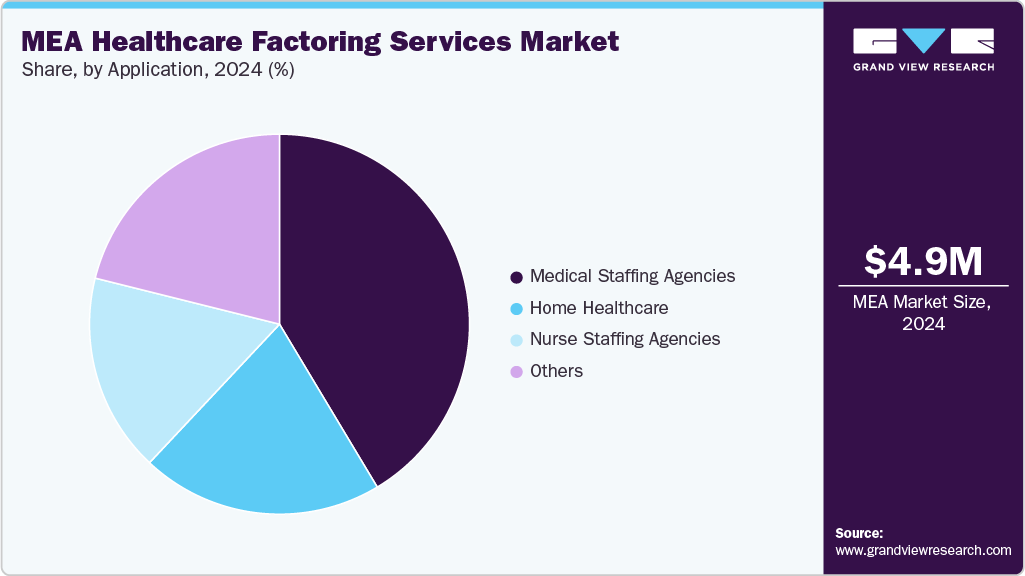
The home healthcare segment is projected to grow at a significant CAGR of 15.2% over the forecast period. The rising demand for home-based care in the region drives growth of the market in the Middle East and Africa. Several interconnected factors are fueling this trend. The region’s rapidly aging population, especially in countries such as the UAE, Saudi Arabia, and South Africa, is creating a surge in the need for long-term, continuous care services that are best delivered in the comfort of the patient’s home. Older individuals with chronic illnesses such as diabetes, cardiovascular disease, and cancer often prefer in-home care to avoid hospital remissions and prolonged institutional stays, which are both costly and emotionally taxing.
Country Insights
UAE Healthcare Factoring Services Market Trends
The healthcare factoring services market in UAE held a significant share in 2024. Healthcare factoring services across the Middle East & Africa (MEA) are gaining momentum due to the increasing pressure on providers to maintain healthy cash flows amidst rising operational costs, complex billing cycles, and expanding patient bases. Factoring allows hospitals, clinics, and diagnostic centers to sell their receivables to third-party financiers in exchange for immediate capital.
South Africa Healthcare Factoring Services Market Trends
The healthcare factoring services market in South Africa held a dominant position in 2024. Healthcare factoring services in the UAE are gaining momentum, driven by a rapidly evolving healthcare landscape, strong private sector involvement, and a maturing medical insurance ecosystem. Unlike the KSA, where public healthcare spending dominates, the UAE’s healthcare system is heavily privatized, particularly in emirates like Dubai and Abu Dhabi, where private providers handle a significant share of patient care. This results in large volumes of insurance claims and complex reimbursement cycles, creating cash flow challenges that factoring services are well-suited to address.
Oman Healthcare Factoring Services Market Trends
The healthcare factoring services market in Oman was identified as a lucrative region in 2024. Healthcare factoring services in Oman are gradually gaining relevance, driven by the country's ongoing healthcare reform efforts, increased private sector participation, and challenges in provider cash flow management. Oman’s healthcare system is at a transitional stage, shifting from a predominantly public system toward a mixed public-private model under its Health Vision 2050 initiative.
Key MEA Healthcare Factoring Services Company Insights
Some of the key companies in the MEA healthcare factoring services market include Waqati, MedFactFactor Funding Co., and Mizuho Factors, Ltd. Organizations are focusing on increasing customer base to gain a competitive edge in the industry. Therefore, key players are taking several strategic initiatives, such as mergers and acquisitions, and partnerships with other major companies.
-
Waqati is non-bank financial institution offering invoice factoring primarily to SMEs. Leveraging a digital, AI-powered platform, they convert verified invoices into cash, without requiring collateral and supporting local-currency or USD funding. Although they serve a broad range of industries, Waqati explicitly includes healthcare SMEs as a strategic vertical. Backed by founders with over two decades of regional experience, their mission is to build Africa’s “operating system for factoring,” empowering healthcare providers to access working capital with speed and transparency.
-
MedFact is a specialist debt factoring firm that purchases medical accounts receivable, such as aged, disputed, or cross-border insurance and patient claims, from healthcare institutions in the U.K., Southern Africa, and the Middle East. With over USD 13.7 million (£10 million) recovered and 1.2 million clients served, MedFact focuses on transforming outstanding medical receivables into working capital. Their services include claims management, dispute resolution, cross-border recovery, and biometric validation to ensure compliance and accelerate payments, all tailored for hospitals, clinics, and public health bodies.
Key MEA Healthcare Factoring Services Companies:
- Waqati
- MedFact
- Factor Funding Co.
- Mizuho Factors, Ltd. (a subsidiary of Mizuho Financial Group, Inc.)
- Tradewind
- Klaim AI
Recent Developments
-
In May 2024, Klaim signed a strategic partnership with Tharwat Tuwaiq to launch a USD 13.3 million (SAR 50 million) direct financing fund aimed at supporting small and medium-sized clinics in Saudi Arabia. The initiative is integrated with the NPHIES platform to accelerate claim settlement within three business days, enhancing liquidity for healthcare providers and aligning with Vision 2030 health transformation goals.
-
In March 2024, Emirates Development Bank signed an MoU with healthcare fintech firm KLAIM to co-develop a receivables financing product for UAE-based healthcare providers. The offering leverages KLAIM’s AI-powered platform to enable dynamic, short-term funding based on real-time claims data, significantly reducing the traditional 60–90day payment cycle. This initiative directly supports the healthcare factoring ecosystem in the region by unlocking liquidity tied to insurance receivables.
MEA Healthcare Factoring Services Market Report Scope
Report Attribute
Details
Market size value in 2025
USD 5.41 billion
Transaction volume forecast in 2033
USD 15.99 billion
Growth rate
CAGR of 14.5% from 2025 to 2033
Base year for estimation
2024
Historical data
2021 - 2024
Forecast period
2025 - 2033
Quantitative units
Transaction volume in USD million/billion, and CAGR from 2025 to 2033
Report type
Transaction volume forecast, company ranking, competitive landscape, growth factors, and trends
Segments covered
Category, type, application, region
Country scope
KSA; UAE; Oman; Qatar; South Africa
Key companies profiled
Waqati; MedFact; Factor Funding Co.; Mizuho Factors, Ltd. (a subsidiary of Mizuho Financial Group, Inc.); Tradewind; Klaim AI
Customization scope
Free report customization (equivalent up to 8 analysts working days) with purchase. Addition or alteration to country, regional & segment scope.
Pricing and purchase options
Avail customized purchase options to meet your exact research needs. Explore purchase options
MEA Healthcare Factoring Services Market Report Segmentation
This report forecasts transaction volume growth at the regional and country levels and provides an analysis of the latest industry trends in each of the sub-segments from 2021 to 2033. For this study, Grand View Research has segmented the MEA healthcare factoring services market report based on category, type, application, and region:.
-
Category Outlook (Transaction Volume, USD Million, 2021 - 2033)
-
Domestic
-
International
-
-
Type Outlook (Transaction Volume, USD Million, 2021 - 2033)
-
Recourse
-
Non-recourse
-
-
Application Outlook (Transaction Volume, USD Million, 2021 - 2033)
-
Medical Staffing Agencies
-
Nurse Staffing Agencies
-
Home Healthcare
-
Others
-
-
Regional Outlook (Transaction Volume, USD Million, 2021 - 2033)
-
Middle East and Africa (MEA)
-
KSA
-
UAE
-
Oman
-
Qatar
-
South Africa
-
-
Frequently Asked Questions About This Report
b. The MEA healthcare factoring service market size was estimated at USD 4.92 billion in 2024 and is expected to reach USD 5.41 billion in 2025.
b. The MEA healthcare factoring service market is expected to grow at a compound annual growth rate of 14.5% from 2025 to 2033 to reach USD 15.99 billion by 2033.
b. The domestic segment dominated the market in 2024 and accounted for the largest share of 87.7%. The growth of domestic healthcare factoring services in the Middle East and Africa is driven by rising healthcare spending, expanding populations, and increasing chronic disease prevalence.
b. Some key players operating in the MEA healthcare factoring service market include Waqati; MedFact; Factor Funding Co.; Mizuho Factors, Ltd. (a subsidiary of Mizuho Financial Group, Inc.); Tradewind; Klaim AI.
b. The MEA healthcare factoring services market is expanding rapidly due to rising healthcare expenditure, growing demand for liquidity among providers, and the increasing complexity of healthcare payment systems.


Share this report with your colleague or friend.
Need a Tailored Report?
Customize this report to your needs — add regions, segments, or data points, with 20% free customization.


ISO 9001:2015 & 27001:2022 Certified
We are GDPR and CCPA compliant! Your transaction & personal information is safe and secure. For more details, please read our privacy policy.
Trusted market insights - try a free sample
See how our reports are structured and why industry leaders rely on Grand View Research. Get a free sample or ask us to tailor this report to your needs.













