
- Home
- »
- Advanced Interior Materials
- »
-
Metals Market Size, Share And Trends Report, 2026-2035GVR Report cover
![Metals Market (2026 - 2035)Report]()
Metals Market (2026 - 2035)
Size, Share & Trends Analysis Report By Type (Ferrous Metals, Non-Ferrous Metals, Precious Metals, Rare Earth Metals), By End Use (Construction & infrastructure, Automotive & transportation, Aerospace & defense), By Region, And Segment Forecasts
Market Size, 2025
$4,427.0BMarket Estimate, 2026
$4,630.6BMarket Forecast, 2035
$6,941.1BCAGR, 2026–2035
4.6%Metals Market Summary
The global metals market size was valued at USD 4,427.0 billion in 2025 and is projected to grow from USD 4,630.6 billion in 2026 to USD 6,941.1 billion by 2035, at a CAGR of 4.6% from 2026 to 2035. Asia Pacific dominated the market, accounting for the revenue share in 2025. The market is witnessing sustained demand as metals remain essential materials across construction, infrastructure, automotive, aerospace, electronics, industrial machinery, and energy applications. Rising urbanization, infrastructure development, industrialization, electrification, and the expansion of renewable energy and advanced technologies are supporting demand for ferrous, non-ferrous, precious, and rare earth metals worldwide.
Key Market Trends & Insights
- By type: The ferrous metals segment held the largest market share in 2025.
- By end use: The construction & infrastructure segment accounted for the largest share in 2025.
Regional Highlights
- Largest regional market: Asia Pacific (revenue share, 2025)
Market Size & Forecast
- Market size in 2025: USD 4,427.0 Billion
- Estimated market size in 2026: USD 4,630.6 Billion
- Projected market size by 2035: USD 6,941.1 Billion
- CAGR (2026-2035): 4.6%
The global metals market is witnessing continued growth in demand as metals remain essential materials across construction, infrastructure, automotive, aerospace, electronics, industrial machinery, and energy sectors. Metals such as steel, aluminum, copper, nickel, and rare earth elements are widely used in structural applications, transportation systems, electrical equipment, renewable energy infrastructure, and advanced manufacturing. Growing infrastructure development, industrial expansion, and electrification initiatives are supporting long-term global demand for metal products.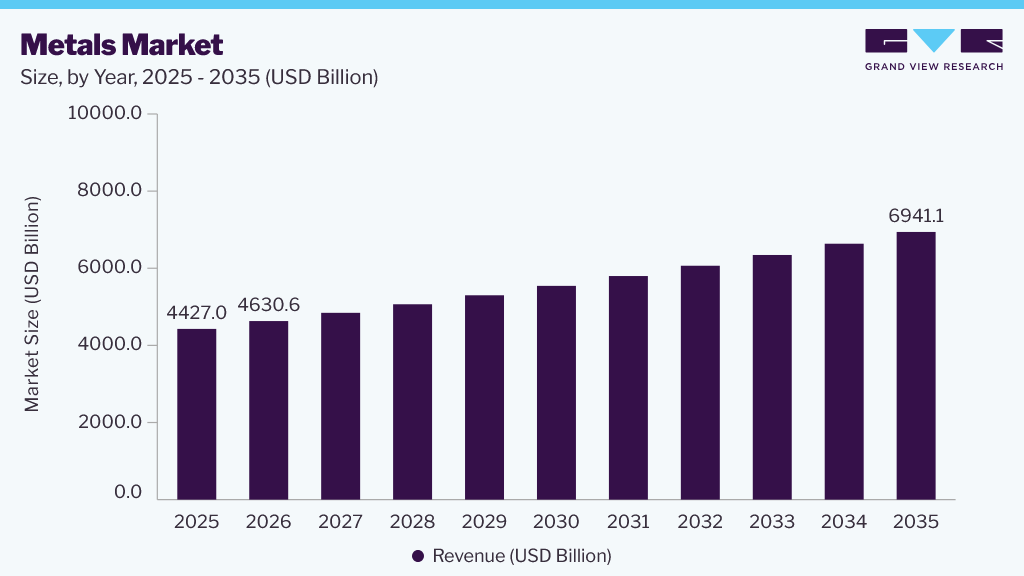
Market growth is driven by rising urbanization, infrastructure investments, automotive production, and increasing adoption of renewable energy systems. The expansion of electric vehicles, artificial intelligence infrastructure, data centers, and clean energy technologies is further increasing demand for critical metals, particularly copper, aluminum, and steel. The International Energy Agency (IEA) reported in July 2026 that demand for key energy minerals such as copper, battery materials, and rare earths continued to grow strongly in 2025, supported by the expansion of electric vehicles, energy storage, electricity grids, wind, and solar PV. The growing use of critical minerals in high-tech applications, including AI and digital systems, is further strengthening demand for selected metals and mineral inputs. In January 2026, Rio Tinto collaborated with Amazon Web Services (AWS) to supply low-carbon Nuton copper from its Johnson Camp copper mine in Arizona for U.S. data centers, highlighting the growing role of copper in digital infrastructure and energy transition applications.
However, market growth is impacted by raw material price fluctuations, energy-intensive production, environmental regulations, and supply chain challenges. Increasing focus on recycling, sustainable production, low-carbon manufacturing, and critical mineral development is expected to create new growth opportunities during the forecast period.
Analyst Perspective
The global metals market is expected to grow steadily, driven by rising demand from construction, automotive, electronics, industrial machinery, and energy sectors. Increasing adoption of electric vehicles, renewable energy systems, and advanced manufacturing is boosting demand for critical metals such as copper, aluminum, nickel, and rare earth elements. Infrastructure expansion, urbanization, and investments in digital and power infrastructure are creating new growth opportunities. However, price volatility, energy-intensive production, environmental regulations, and supply chain risks may affect market growth. Growing focus on recycling, sustainable production, and low-carbon manufacturing is expected to support long-term market expansion.
Type Insights
The ferrous metals segment held the largest market share in 2025. Ferrous metals are widely used across construction, infrastructure, automotive, machinery, and manufacturing industries due to their high strength, durability, and cost efficiency. Steel and iron remain essential materials for infrastructure development, transportation, and industrial production worldwide. Growing investments in urban development, manufacturing expansion, and construction projects are supporting demand for ferrous metals. For instance, in May 2025, Tata Steel inaugurated the second phase of its Kalinganagar operations in India, increasing crude steel capacity from 3 million tonnes per annum (MTPA) to 8 MTPA, strengthening supply for infrastructure, automotive, power, and industrial applications. Ferrous metals maintain market leadership due to their wide industrial usage, established supply networks, and critical role in economic development.
The rare earth metals segment is expected to register the fastest growth during the forecast period, driven by rising demand from electric vehicles, renewable energy systems, advanced electronics, and high-performance permanent magnets. Rare earth elements such as neodymium, praseodymium, and dysprosium are essential for manufacturing electric motors, wind turbines, and advanced electronic components. Increasing investments in domestic supply chains, mineral processing, and advanced material production are further supporting segment growth. For instance, in January 2025, MP Materials announced the start of commercial neodymium-praseodymium (NdPr) metal production and trial production of automotive-grade sintered NdFeB magnets at its Independence facility in Texas, strengthening the rare earth magnet supply chain. Growing focus on electrification, clean energy transition, and technological innovation is expected to create significant opportunities for rare earth metals.
End Use Insights
The construction & infrastructure segment held the largest market share in 2025. Metals are extensively used in structural frameworks, bridges, transportation systems, commercial buildings, and urban infrastructure projects due to their strength, durability, and recyclability. Steel, aluminum, and other metals remain essential materials for residential, commercial, and public infrastructure development. Rising urbanization, government infrastructure spending, and expansion of transportation networks are driving metal consumption across construction activities. For instance, in December 2025, Tata Steel announced plans to prioritize capacity expansion and investments in India, including infrastructure and downstream steel growth initiatives to support rising domestic demand. The segment maintains its leading position due to high-volume metal consumption and its critical role in economic and industrial development.
The energy segment is projected to register the fastest growth during the forecast period, driven by increasing demand for metals used in renewable energy systems, power transmission networks, electric vehicle charging infrastructure, and energy storage technologies. Metals such as copper, aluminum, nickel, and rare earth elements are becoming increasingly important to electrification and clean energy development. For instance, in July 2025, Teck Resources Limited announced approval for the construction of the Highland Valley Copper Mine Life Extension Project in Canada, supporting efforts to expand copper production for energy transition applications. The project is expected to strengthen copper supply, as the metal plays a critical role in renewable power generation, electricity grids, and electrification infrastructure. Rising investments in clean energy projects, grid modernization, and energy transition initiatives are therefore expected to accelerate metal demand in the energy sector.
Regional Insights
The Asia Pacific dominated the metals market with the largest revenue share in 2025, and is expected to register the fastest growth during the forecast period, driven by rapid industrialization, infrastructure expansion, automotive production, electronics manufacturing, and renewable energy investments. The region accounts for a significant share of global metal consumption due to strong demand for steel, aluminum, copper, and specialty metals across construction, transportation, energy, and technology sectors. Increasing investments in electric vehicles, battery materials, renewable energy projects, and advanced manufacturing are further creating a surge in demand for metals. For instance, in March 2026, ArcelorMittal Nippon Steel India (AM/NS India) laid the foundation stone for a new integrated steel plant in Andhra Pradesh, India, with a planned capacity of 8.2 million tonnes per annum (MTPA), supporting India’s steel production expansion and rising demand from infrastructure and manufacturing sectors. Continued industrial growth, infrastructure investments, and energy transition initiatives are expected to strengthen Asia Pacific’s leadership in the global metals market.
North America Metals Market Trends
North America is expected to witness steady growth in the metals market, supported by infrastructure modernization, renewable energy expansion, increasing adoption of electric vehicles, and efforts to strengthen domestic metal supply chains. The region is experiencing rising demand for steel, copper, aluminum, and other critical materials required for construction, automotive, energy, aerospace, and advanced manufacturing applications. Increasing investments in domestic production capacity and sustainable manufacturing are further supporting market growth. In addition, the expansion of renewable power generation, electricity grids, data centers, and electric vehicle infrastructure is increasing demand for conductive and structural metals, particularly copper and aluminum. At the same time, efforts by governments and industries to reduce dependence on overseas suppliers and secure access to critical minerals are encouraging investments in domestic mining, processing, recycling, and metal production capabilities. These trends are expected to support sustained metals consumption and strengthen North America's position as a key regional market during the forecast period.
Key Metals Market Company Insights
The metals market is highly competitive, with global, regional, and specialized players focusing on innovation, strategic partnerships, acquisitions, capacity expansion, and product development. Companies are increasingly adopting advanced manufacturing technologies, automation, AI, digital monitoring, robotics, and sustainable production practices to improve efficiency, enhance product quality, and meet the growing demand for high-performance and environmentally sustainable metal solutions.
Key Metal Companies
The following key companies have been profiled for this study on the metals market:
-
ArcelorMittal
-
China Baowu Steel Group Co., Ltd.
-
NIPPON STEEL CORPORATION.
-
POSCO HOLDINGS.
-
Tata Steel
-
JFE Holdings, Inc
-
Vale S.A.
-
Rio Tinto
-
BHP
-
Alcoa Corporation
Recent Developments
-
In July 2026, Steel Authority of India Limited (SAIL) and PT Krakatau Steel (Persero) Tbk. announced plans to establish a joint venture for a stainless steel slab manufacturing facility in Indonesia with an investment of up to USD 350 million and an annual production capacity of 500,000 metric tons. The project is expected to leverage Indonesia’s abundant nickel resources and strengthen regional stainless steel supply chains, supporting growing demand for stainless steel across industrial and infrastructure applications.
-
In January 2026, Steel Dynamics reported continued progress in the commissioning and startup of its Columbus, Mississippi aluminum flat-rolled products mill and San Luis Potosi, Mexico recycled aluminum slab center. The investments expand the company’s aluminum production capabilities and support growing demand for high-recycled-content aluminum across automotive, industrial, construction, beverage, and packaging applications.
-
In October 2025, Rio Tinto, Mitsui, and Nippon Steel announced a USD 733 million investment to develop the West Angelas Sustaining Project in Western Australia’s Pilbara region, extending the life of the iron ore operation and maintaining annual production capacity of 35 million tonnes, supporting long-term iron ore supply for global steel demand.
Metals Market Report Scope
Report Attribute
Details
Market size in 2025
USD 4,427.0 billion
Estimated market size in 2026
USD 4,630.6 billion
Projected market size by 2035
USD 6,941.1 billion
Growth rate
CAGR of 4.6% from 2026 to 2035
Base year for estimation
2025
Historical data
2021 – 2024
Forecast period
2026 – 2035
Quantitative units
Revenue in USD billion, and CAGR from 2026 to 2035
Report coverage
Revenue forecast, company ranking, competitive landscape, growth factors, and trends
Segments covered
Type, end use, region
Regional scope
North America; Europe; Asia Pacific; Latin America; Middle East & Africa
Country scope
U.S.; Canada; Mexico; UK; Germany; France; Italy; Spain; China; Japan; India; Australia; South Korea; Brazil; Argentina; South Africa; Saudi Arabia; UAE.
Key companies profiled
ArcelorMittal; China Baowu Steel Group Co., Ltd.; NIPPON STEEL CORPORATION; POSCO HOLDINGS; Tata Steel; JFE Holdings, Inc.; Vale S.A.; Rio Tinto; BHP; Alcoa Corporation
Customization scope
Free report customization (equivalent to 8 analyst working days) with purchase. Addition or alteration to country, regional & segment scope.
Pricing and purchase options
Avail of customized purchase options to meet your exact research needs. Explore purchase options
Global Metals Market Report Segmentation
This report forecasts revenue growth at the global, regional, and country levels and provides an analysis of the latest industry trends and opportunities across each sub-segment from 2021 to 2035. For this study, Grand View Research has segmented the global metals market report based on type, end use, and region:
-
Type Outlook (Revenue, USD Billion, 2021 - 2035)
-
Ferrous Metals
-
Non-Ferrous Metals
-
Precious Metals
-
Rare Earth Metals
-
-
End Use Outlook (Revenue, USD Billion, 2021 - 2035)
-
Construction & infrastructure
-
Automotive & transportation
-
Aerospace & defense
-
Industrial machinery & equipment
-
Packaging
-
Electronics & data centers
-
Energy
-
Others
-
-
Regional Outlook (Revenue, USD Billion, 2021 - 2035)
-
North America
-
U.S.
-
Canada
-
Mexico
-
-
Europe
-
UK
-
Germany
-
France
-
Italy
-
Spain
-
-
Asia Pacific
-
China
-
Japan
-
India
-
Australia
-
South Korea
-
-
Latin America
-
Brazil
-
Argentina
-
-
Middle East and Africa (MEA)
-
South Africa
-
Saudi Arabia
-
UAE
-
-
Frequently Asked Questions About This Report
The global personalized gifts market size was valued at USD 32.7 billion in 2025 and is estimated at USD 34.9 billion for 2026.
The global personalized gifts market is expected to grow at a CAGR of 6.7% from 2026 to 2035, reaching USD 62.5 billion by 2035.
North America dominated the personalized gifts market with approximately 48.0% revenue share in 2025.
The clothing segment accounted for the largest revenue share of approximately 38.0% in 2025.
Key players in the market include Etsy, Inc., Cimpress plc (VistaPrint), Shutterfly, LLC, Hallmark Cards, Inc., PersonalizationMall.com LLC, Zazzle Inc., Redbubble, CafePress, Moonpig.com Limited, 1-800-Flowers.com, Inc., and others.
About the Author(s)
Advanced Interior Materials Research Team
Advanced Materials · Advanced Interior MaterialsThis report was authored by the advanced interior materials research team at Grand View Research - comprising two research analysts, one senior research analyst, and one industry expert - with specialized expertise in the advanced interior materials segment of the advanced materials industry. All findings are based on proprietary advanced materials databases, executive interviews, and regulatory analysis, subject to internal peer review prior to publication.
Last Updated:
Speak to Analyst


Customize this report to your needs — add regions, segments, or data points, with 20% free customization.
Or view our licence options:


ISO 9001:2015 & 27001:2022 Certified
We are GDPR and CCPA compliant! Your transaction & personal information is safe and secure. For more details, please read our privacy policy.


