
- Home
- »
- Next Generation Technologies
- »
-
Metaverse In Entertainment Market Size Report, 2026-2033GVR Report cover

Metaverse In Entertainment Market (2026 - 2033)
Size, Share & Trends Analysis Report By Product (Software, Infrastructure, Hardware, Services), By Platform (Desktop, Mobile, Headsets), By End Use (Gaming, Film & Television), By Region, And Segment Forecasts
Market Size, 2025
$29.4BMarket Estimate, 2026
$40.5BMarket Forecast, 2033
$868.9BCAGR, 2026–2033
55.0%Metaverse In Entertainment Market Summary
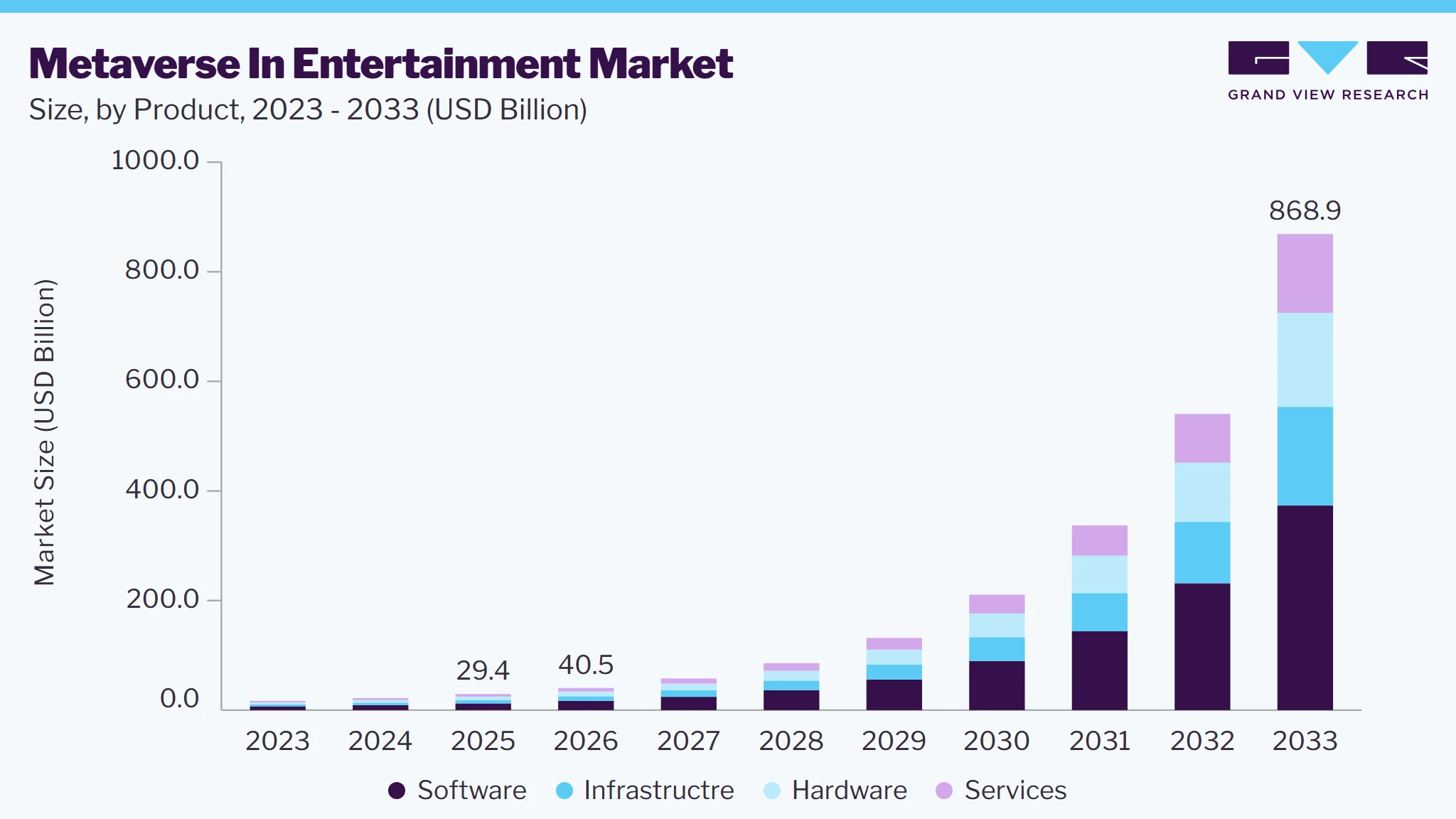
The global metaverse in entertainment market size was valued at USD 29.4 billion in 2025 and is projected to grow from USD 40.5 billion in 2026 to USD 868.9 billion by 2033, at a CAGR of 55.0% from 2026 to 2033. North America dominated the market, accounting for a revenue share of 42.0% in 2025. The market is shifting as entertainment companies and technology providers are increasing spending on 3D content, virtual production, immersive platforms, and digital experiences.
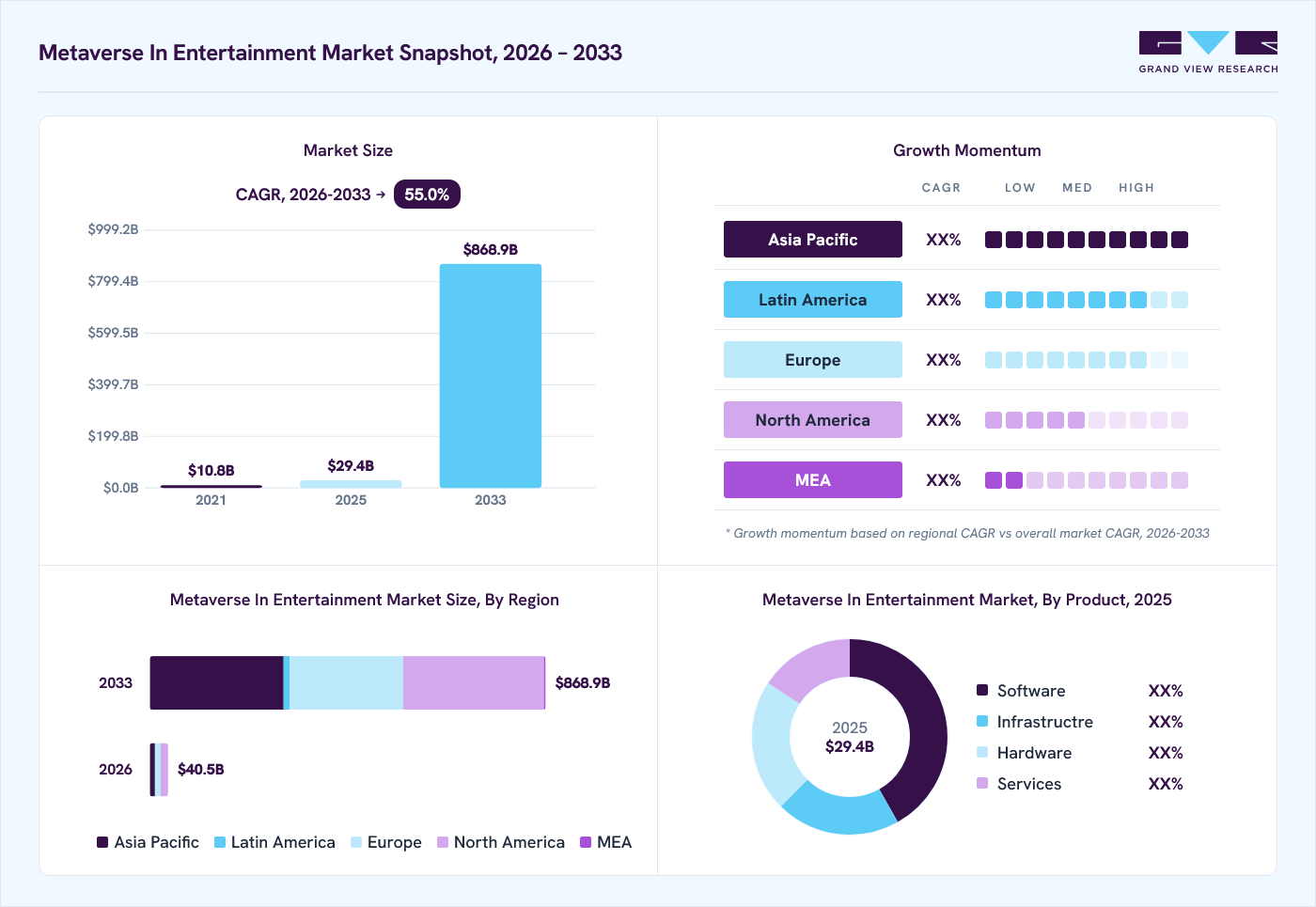 Source: Grand View Research, IR Documents, Primary Interviews, Paid DatabasesTo learn more about this report,
 Download Free Sample Report
 Key Market Trends & Insights
- By product: The software segment dominated the market, with a revenue share of 41.8% in 2025.
- By platform: The desktop segment accounted for the largest market revenue share of 41.3% in 2025.
- By end use: The gaming segment held the largest market share of 29.7% in 2025.
Regional Highlights
- Largest regional market: North America (42.0% revenue share, 2025)
- Fastest-growing regional market: Asia Pacific (highest CAGR, 2026-2033)
- By country: The U.S. held the largest market share in 2025.
Market Size & Forecast
- Market size in 2025: USD 29.4 Billion
- Estimated market size in 2026: USD 40.5 Billion
- Projected market size by 2033: USD 868.9 Billion
- CAGR (2026-2033): 55.0%
Three ways to get this report
Buy it, customize it, or ask a question.Ask an Analyst
A direct answer, usually in 1 working day
- AccessReport author, directly
- Reply timeWithin 1 working day
- No sales callDirect answer only
- FormatEmail reply
- CostFree, no cost
Get the Full Report
What the study covers
- FormatsPDF · Excel · Dashboard
- Timeline2026–2033 annual, 2025 base
- Coverage20+ countries, 5 regions
- Companies10+ key players profiled
Customize the Report
20% free customization
- IncludeCountries, segments, points
- TailorTo your product definition
- ExtendDeeper competitor detail
- OrA fully bespoke study
- Turnaround5–10 working days
Consumers are increasingly seeking entertainment formats that provide greater participation and personalization beyond conventional media. Metaverse platforms enable users to interact with virtual environments through avatars, digital spaces, and real-time social features. Gaming, virtual concerts, interactive storytelling, and virtual events are expanding the range of entertainment experiences available through these platforms. Improvements in virtual reality (VR), augmented reality (AR), spatial computing, and real-time 3D technologies are improving the quality of immersive experiences.
 To learn more about this report, Download Free Sample Report
 Entertainment companies are integrating interactive elements to increase audience participation and extend engagement across digital environments. Younger digital-native audiences also show greater familiarity with virtual communities and avatar-based interactions, supporting broader adoption of metaverse-based entertainment across gaming, music, film, sports, and live events.
The growing adoption of virtual concerts, esports competitions, digital festivals, and interactive broadcasts is expanding the application of metaverse technologies in entertainment. Virtual platforms allow audiences to participate in events without being physically present at a venue. Entertainment providers can create persistent digital environments that support social interaction, exclusive content, virtual merchandise, and interactive experiences.
Artists, sports organizations, gaming companies, and media providers are incorporating digital environments into their audience engagement strategies. Advances in cloud computing, 5G connectivity, graphics processing, and streaming infrastructure are improving access to real-time virtual experiences. These technologies also support larger audiences and geographically distributed participation compared with physical venues. The expansion of digital event formats is therefore creating additional revenue opportunities for metaverse-based entertainment services.
Furthermore, digital ownership and virtual commerce are becoming important components of metaverse-based entertainment ecosystems. Users can purchase virtual goods, character accessories, digital collectibles, event passes, and other digital content within immersive environments. Gaming platforms have established many of these monetization mechanisms through virtual currencies, in-game purchases, and digital assets. Entertainment companies are extending similar models into concerts, sports experiences, virtual communities, and branded digital spaces.
Blockchain-based technologies can provide mechanisms for recording ownership and transactions for certain types of digital assets. The expansion of digital payment infrastructure is also making transactions within virtual entertainment environments more accessible. Increasing monetization of virtual goods and experiences is supporting revenue generation across the global market.
Market Dynamics
Entertainment companies are integrating metaverse technologies across content creation, distribution, audience engagement, and monetization activities. Virtual production tools support the development of immersive environments and interactive content, while digital platforms enable audiences to access entertainment through persistent virtual spaces. Media companies, gaming studios, music providers, and sports organizations are also developing interconnected digital experiences around their core offerings. This integration creates additional touchpoints between entertainment providers and consumers. It also supports new revenue streams through virtual events, digital merchandise, premium experiences, and in-platform transactions. The growing integration across multiple stages of the entertainment value chain is expanding the commercial application of metaverse technologies globally.
The development of metaverse-based entertainment requires significant spending on 3D content, virtual environments, computing infrastructure, software development, and specialized hardware. Continuous updates and content refreshes further increase operational expenditure for entertainment providers. Smaller companies may struggle to allocate sufficient resources to develop high-quality immersive experiences. Costs related to VR/AR devices and compatible computing systems can also limit adoption among price-sensitive consumers. In addition, maintaining low-latency and high-quality virtual environments requires advanced cloud and network infrastructure. These cost requirements can extend development cycles and limit the scale of metaverse entertainment initiatives.
The integration of AI with metaverse platforms presents a major opportunity for the global market. AI can enable personalized virtual environments, adaptive storylines, intelligent avatars, virtual characters, and content recommendations based on user interactions. Entertainment providers can use these capabilities to create differentiated experiences across gaming, music, film, sports, and virtual events. Generative AI also supports faster development of 3D assets, characters, environments, and interactive content, reducing content-development requirements. The combination of AI, spatial computing, and metaverse platforms can support more dynamic and user-responsive entertainment experiences. This creates opportunities for entertainment companies to develop new digital offerings and monetization models across virtual environments.
Market Concentration & Characteristics
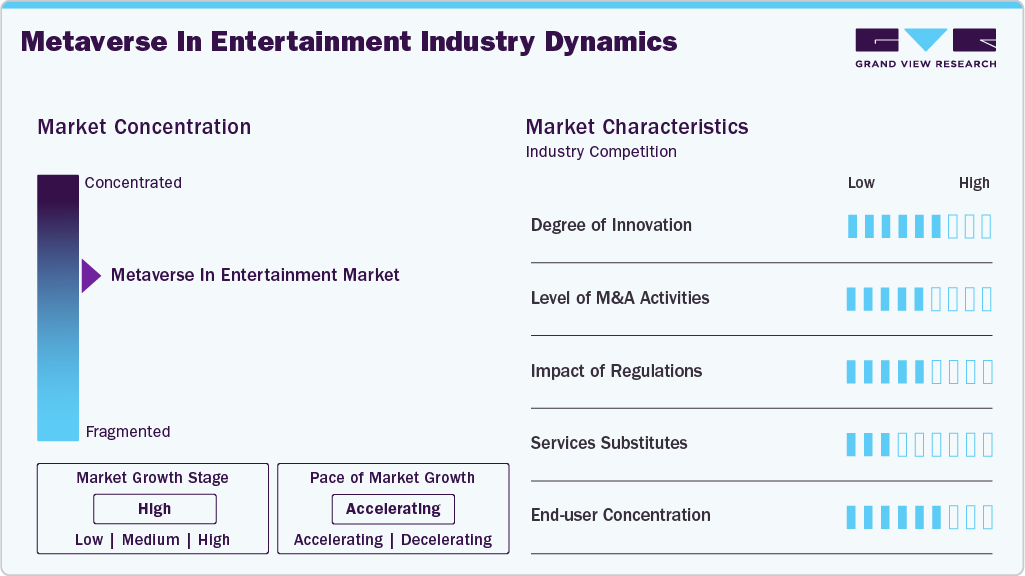
Innovation is a major characteristic of the metaverse in entertainment industry, with the chart indicating a high degree of innovation. Companies are continuously developing immersive environments, interactive content, virtual characters, spatial experiences, and real-time 3D applications. Advances in artificial intelligence, virtual reality, augmented reality, spatial computing, and graphics technologies are expanding the range of entertainment experiences. Innovation also focuses on improving accessibility, content personalization, and interaction within virtual environments. Gaming, music, sports, film, and location-based entertainment providers are experimenting with new digital formats. Rapid technology development creates frequent changes in platform capabilities and consumer experiences.
 To learn more about this report, Download Free Sample Report
 The chart indicates a moderate-to-high level of end-use concentration, reflecting significant demand from a limited number of major entertainment categories. Gaming represents a substantial user base, while location-based entertainment provides additional sources of demand. Large gaming communities and established entertainment audiences can influence platform adoption and content development. Consumer demand is also concentrated around platforms that offer extensive content libraries, social features, and established digital ecosystems. However, the market serves diverse user groups across different entertainment formats and geographic regions. This combination of large audience clusters and diversified applications results in moderate-to-high end-use concentration.
Analyst Perspective
The metaverse in entertainment market sits at the intersection of several high-growth digital entertainment trends, the expansion of immersive gaming, virtual events, interactive content, and spatial computing, supported by rapid advances in AI, XR, and real-time 3D technologies. The central market opportunity extends beyond creating virtual environments, as entertainment providers increasingly seek to transform passive audiences into active participants through persistent digital worlds, personalized experiences, and social interaction. The strongest competitive position is likely to emerge for platforms that can connect entertainment platforms within a unified ecosystem, allowing users to move across experiences without leaving the platform. Monetization is also evolving beyond conventional content sales toward virtual goods, digital collectibles, subscriptions, advertising, event access, and creator-driven commerce. The competitive moat, therefore, centers on large engaged user communities, strong creator ecosystems, proprietary content, scalable technology infrastructure, and seamless cross-platform experiences, rather than virtual environments alone.
Product Insights
The software segment led the market with the largest revenue share of 41.8% in 2025, driven by the growing use of 3D engines, virtual world platforms, and immersive content development tools that support demand for metaverse entertainment software. Gaming studios, media companies, and event organizers are adopting software solutions to create interactive environments, digital characters, and real-time experiences. The integration of artificial intelligence, spatial computing, virtual reality, and augmented reality is expanding the capabilities of software for entertainment applications. The expansion of software ecosystems is supporting the growth of the software segment.
The services segment is expected to grow at the fastest CAGR during the forecast period, driven by the fact that entertainment companies are increasingly using specialized services for virtual environment development, content creation, platform integration, consulting, and technical support. Service providers assist organizations in implementing metaverse solutions without requiring extensive internal expertise in immersive technologies. Demand is also increasing for services related to 3D asset development, virtual event management, avatar creation, and digital experience design. Ongoing platform updates and the need to manage complex virtual environments are creating recurring requirements for technical and maintenance services.
Platform Insights
The desktop segment led the market with the largest revenue share of 41.3% in 2025, benefiting from the growing use of high-performance computers for immersive gaming and metaverse-based entertainment. Desktop systems provide greater processing capacity and graphics performance, supporting detailed virtual environments, real-time rendering, and extended interactive sessions. Increasing adoption of high-resolution displays and advanced graphics hardware further improves the quality of metaverse entertainment experiences on desktops. Gaming platforms and virtual worlds also benefit from established desktop ecosystems, which offer extensive libraries of interactive content and multiplayer experiences.
The mobile segment is expected to grow at the fastest CAGR during the forecast period. The segment is driven by the widespread availability of smartphones and improving mobile internet connectivity across global markets. Increasing smartphone processing capabilities and graphics performance enable users to access virtual environments, interactive entertainment, and social experiences without dedicated hardware. The expansion of 5G networks supports faster data transmission and lower latency, improving access to real-time metaverse applications on mobile devices. Mobile platforms also provide convenient access to gaming, virtual events, digital content, and social experiences through established application ecosystems.
End Use Insights
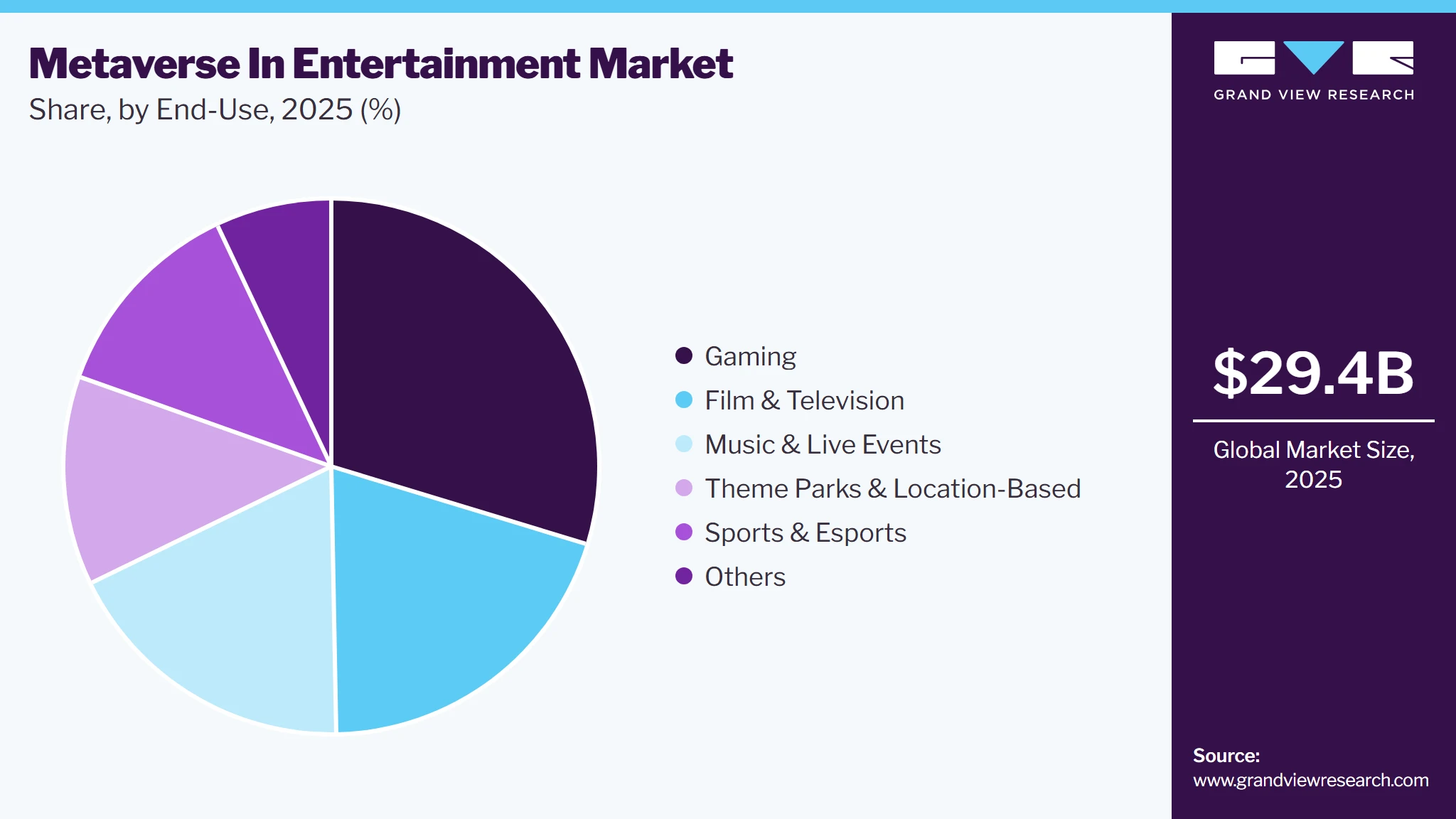
The gaming segment led the market with the largest revenue share of 29.7% in 2025. The growing consumer demand for immersive, interactive digital experiences in persistent virtual environments is driving the growth of the market. Integration of VR, AR, spatial computing, and real-time 3D technologies is enhancing gameplay and enabling greater player interaction. Expansion of multiplayer virtual worlds and user-generated content is increasing social participation and content diversity across gaming platforms. Virtual goods, digital assets, in-game purchases, and customized avatars are also creating additional monetization opportunities for game developers and platform providers.
 To learn more about this report, Download Free Sample Report
 The sports & esports segment is anticipated to grow at the fastest CAGR over the forecast period. The increasing demand for interactive fan experiences beyond conventional physical venues and broadcasts. Metaverse platforms enable virtual stadiums, immersive match viewing, digital fan communities, and interactive experiences around sporting events. Expansion of esports is further supporting demand for virtual competition environments, player interaction, digital events, and spectator participation. Sports organizations and entertainment providers are also developing virtual merchandise, digital collectibles, and branded experiences to expand audience engagement.
Regional Insights
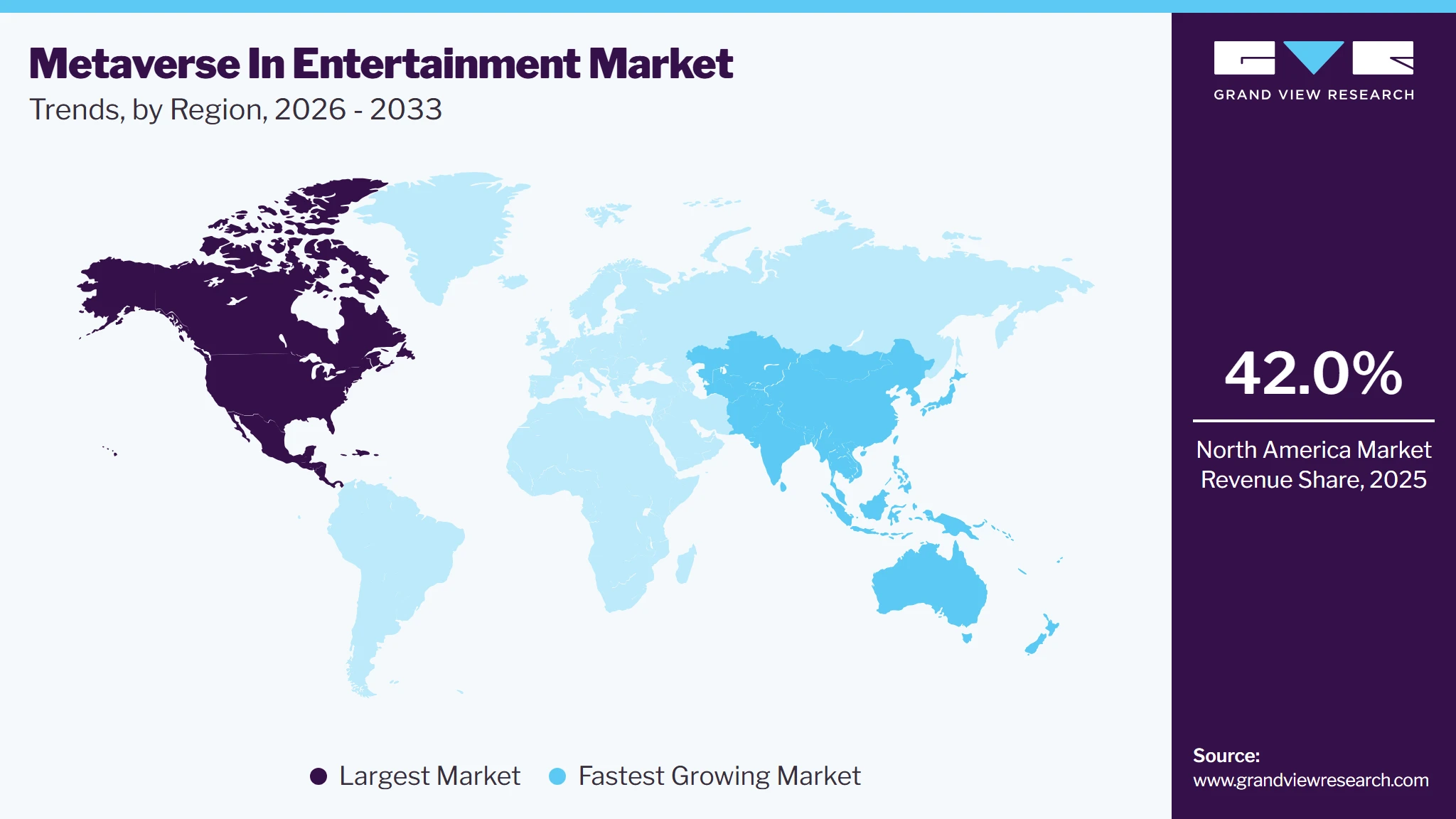
The North America metaverse in entertainment market held the largest revenue share of 42.0% in 2025, driven by strong adoption of immersive technologies across gaming, media, and interactive entertainment. High consumer spending on digital entertainment supports demand for virtual experiences, digital content, and interactive platforms. The presence of established technology and gaming ecosystems supports the development of sophisticated metaverse applications and content. The increasing integration of AI-generated content into virtual environments is also expanding personalization and interactive storytelling capabilities.
 To learn more about this report, Download Free Sample Report
 U.S. Metaverse In Entertainment Market Trends
The metaverse in entertainment market in the U.S. accounted for the largest market revenue share in North America in 2025, supported by extensive adoption of gaming, streaming, virtual reality, and interactive digital entertainment platforms. Major entertainment studios and technology companies are developing virtual production capabilities that integrate real-time 3D environments into content creation. Growing use of virtual concerts, digital fan experiences, and interactive entertainment formats is expanding applications beyond traditional gaming. Strong venture funding and private investment in immersive technology startups are supporting the development of new platforms, software, and content models.
Europe Metaverse In Entertainment Market Trends
The metaverse in entertainment market in Europe is supported by growing adoption of immersive cultural, entertainment, and media experiences across the region. Museums, cultural institutions, broadcasters, and entertainment providers are incorporating virtual environments to expand digital access for audiences. Increasing consumer interest in interactive live events and virtual social experiences is creating additional applications for metaverse platforms. Europe’s established creative industries provide a broad base for developing digital storytelling, virtual performances, and immersive content.
Asia Pacific Metaverse In Entertainment Market Trends
The metaverse in entertainment market in the Asia Pacific is anticipated to grow at the fastest CAGR during the forecast period, driven by the region’s large gaming and digital-content consumer base. Rapid adoption of smartphones and the internet is expanding access to virtual entertainment across emerging markets. Strong development of esports and online gaming communities is increasing demand for persistent virtual worlds and interactive digital experiences. Entertainment industries in countries such as China, Japan, South Korea, and India are also incorporating virtual characters, digital creators, and immersive content into consumer experiences.
Key Metaverse In Entertainment Company Insights
Some key players in the metaverse in the entertainment industry include Roblox Corporation, Sony Group Corporation, Microsoft Corporation, and others.
-
Roblox Corporation operates an immersive gaming and creation platform where users discover, play, and build interactive digital experiences. The platform combines gaming, social interaction, and user-generated content through a broad ecosystem of creators and developers. Roblox Studio provides tools for developing and publishing 3D experiences, while its cloud infrastructure supports these experiences at scale. The company is also incorporating generative AI and machine learning tools to support content creation and improve platform capabilities. Its entertainment ecosystem extends across gaming, virtual events, digital fashion, and other interactive experiences.
-
Microsoft develops software, cloud, artificial intelligence, gaming, productivity, and digital technology solutions across consumer and enterprise applications. Its portfolio includes Microsoft Cloud, Azure, AI solutions, developer tools, and gaming-related technologies that support digital entertainment ecosystems. The company integrates AI capabilities across its products, including Copilot, while also developing technologies for interactive and connected digital experiences. Microsoft’s gaming ecosystem provides access to digital games, services, platforms, and related content. Its technology infrastructure supports applications that require cloud computing, real-time processing, and scalable digital services.
Key Metaverse In Entertainment Companies
The following key companies have been profiled for this study on the metaverse in entertainment market.
-
Roblox Corporation
-
Microsoft Corporation
-
Apple Inc.
-
Sony Group Corporation
-
NVIDIA Corporation
-
Tencent Holdings Ltd.
-
Qualcomm Incorporated
-
HTC Corporation
-
ByteDance Ltd.
-
Unity Software Inc.
Competitive Benchmarking
Category
Operating Strategies
Competitive Edge
Weakness
Established Players (Roblox Corporation; Microsoft Corporation; Apple Inc.; Sony Group Corporation; NVIDIA Corporation)
- Mature players generally pursue ecosystem-based strategies, combining hardware, software, cloud infrastructure, gaming platforms, content, developer tools, and distribution channels to participate across multiple layers of the metaverse entertainment value chain.
- They also expand through strategic partnerships, platform integration, acquisitions, and continuous technology investment, allowing immersive entertainment capabilities to be incorporated into existing business ecosystems.
- Their main advantages include large user and developer ecosystems, established intellectual property, extensive technology infrastructure, and strong financial resources for sustained product development.
- Integrated capabilities across gaming, XR, AI, graphics, cloud computing, and digital content create multiple sources of competitive differentiation.
- Large organizations often face complex technology stacks, higher operating costs, and longer product-development cycles, particularly when integrating multiple platforms and business units.
- Dependence on proprietary ecosystems can also create interoperability limitations, while regulatory, privacy, and content-governance requirements add operational complexity.
Emerging Players (HTC Corporation; ByteDance Ltd.; Unity Software Inc.)
- Emerging players generally focus on specialized XR technologies, immersive hardware, virtual experiences, or targeted entertainment applications rather than covering the entire metaverse value chain.
- Their strategies often emphasize product differentiation, partnerships, platform compatibility, and expansion into selected entertainment use cases where specialized technology provides a clear application.
- Their smaller and more focused structures can support faster experimentation, specialized product development, and greater flexibility in responding to new entertainment formats.
- Expertise in specific areas such as XR devices, immersive interfaces, virtual environments, or digital content enables these companies to address market niches that broader platforms may not prioritize.
- Emerging players generally have smaller user ecosystems, limited distribution networks, and lower financial capacity compared with large technology and entertainment platforms.
- Dependence on third-party platforms, hard0ware supply chains, developer communities, or strategic partnerships can create additional challenges in scaling immersive entertainment offerings.
Recent Developments
-
In June 2026, Roblox acquired the team and technology of Morpheus AI and brought founders from Dynamics Lab and Lucid AI into the company to advance interactive AI and real-time, playable virtual world generation. The initiative focuses on AI-generated environments that users can interact with in real time, supporting the development of immersive gaming and entertainment experiences.
-
In June 2026, Sony Pictures Entertainment committed USD 100 million to Cosm’s Series C financing round, acquiring a minority interest in the company. The investment brings together Sony’s entertainment portfolio and Cosm’s Shared Reality technology, which combines digital content with immersive physical environments.
-
In June 2026, Qualcomm introduced the Snapdragon Reality Elite Platform, designed for mixed-reality and spatial-computing devices with integrated on-device AI capabilities. The platform supports immersive visual experiences, advanced hand and head tracking, and AI processing for next-generation Android XR devices.
-
In April 2026, Unity and Meta extended their multi-year partnership to support VR developers building applications and games for Meta's VR platform. The agreement expands Unity's platform support for Meta's VR ecosystem and provides developers with tools for developing, deploying, and scaling immersive applications.
Metaverse In Entertainment Market Report Scope
Report Attribute
Details
Market size value in 2025
USD 29.4 billion
Market size value in 2026
USD 40.5 billion
Revenue forecast in 2033
USD 868.9 billion
Growth rate
CAGR of 55.0% from 2026 to 2033
Base year for estimation
2025
Historical data
2021 - 2024
Forecast period
2026 - 2033
Quantitative units
Revenue in USD billion and CAGR from 2026 to 2033
Report coverage
Revenue forecast, company ranking, competitive landscape, growth factors, and trends
Segments covered
Product, platform, end use, region
Regional scope
North America; Europe; Asia Pacific; Latin America; MEA
Country scope
U.S.; Canada; Mexico; UK; Germany; France; China; India; Japan; South Korea; Australia; Brazil; UAE; South Africa; KSA
Key companies profiled
Roblox Corporation; Microsoft Corporation; Apple Inc.; Sony Group Corporation; NVIDIA Corporation; Tencent Holdings Ltd.; Qualcomm Incorporated; HTC Corporation; ByteDance Ltd.; Unity Software Inc.
Customization scope
Free report customization (equivalent up to 8 analysts working days) with purchase. Addition or alteration to country, regional & segment scope.
Pricing and purchase options
Avail customized purchase options to meet your exact research needs. Explore purchase options
Global Metaverse In Entertainment Market Report Segmentation
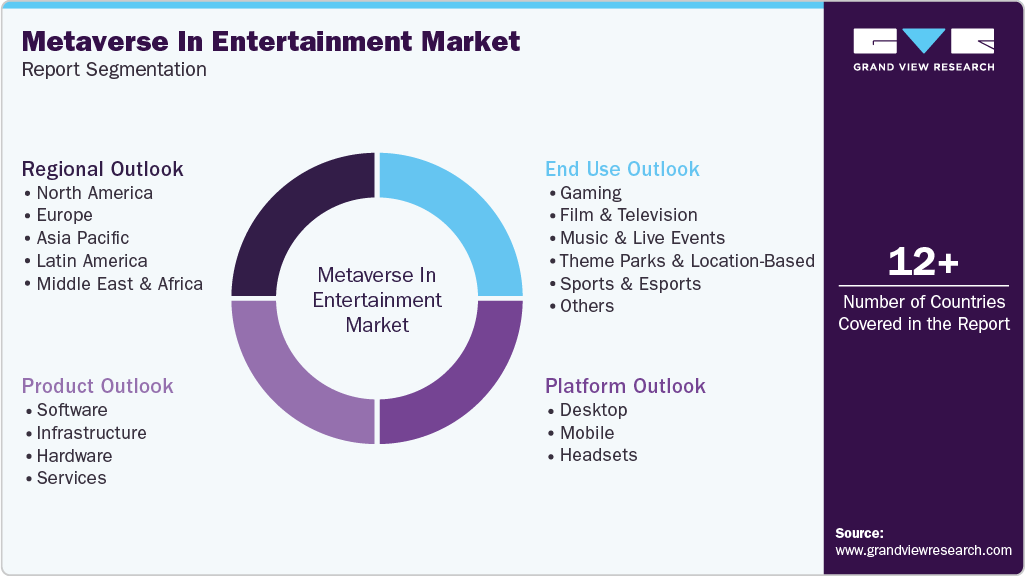
This report forecasts revenue growth at global, regional, and country levels and provides an analysis of the latest industry trends in each of the sub-segments from 2021 to 2033. For this study, Grand View Research has segmented the global metaverse in entertainment market report based on product, platform, end use, and region.
 To learn more about this report, Download Free Sample Report
 -
Product Outlook (Revenue, USD Billion, 2021 - 2033)
-
Software
-
Infrastructure
-
Hardware
-
Services
-
-
Platform Outlook (Revenue, USD Billion, 2021 - 2033)
-
Desktop
-
Mobile
-
Headsets
-
-
End Use Outlook (Revenue, USD Billion, 2021 - 2033)
-
Gaming
-
Film & Television
-
Music & Live Events
-
Theme Parks & Location-Based
-
Sports & Esports
-
Others
-
-
Regional Outlook (Revenue, USD Billion, 2021 - 2033)
-
North America
-
U.S.
-
Canada
-
Mexico
-
-
Europe
-
UK
-
Germany
-
France
-
-
Asia Pacific
-
China
-
India
-
Japan
-
Australia
-
South Korea
-
-
Latin America
-
Brazil
-
-
MEA
-
UAE
-
South Africa
-
KSA
-
-
Research Methodology
The metaverse in entertainment market figures in this report are based on a proven research process that combines executive interviews with secondary research from proprietary databases, company filings, and recognized regulatory and institutional sources. Market size is built through value-chain sizing-reconciling supply-side and demand-side estimates-and triangulated with bottom-up and top-down approaches. Every estimate passes multiple levels of expert validation before publication, with the metaverse in entertainment segment quantified using the revenue-capture definitions in the table below.
Segment Definition
Product
Revenue capture definition
Infrastructure
Revenue is captured from the physical and digital infrastructure required to host, connect, and operate metaverse entertainment environments. This includes cloud platforms, data centers, networking systems, and connectivity infrastructure supporting immersive applications.
Hardware
This segment captures revenue from devices and equipment used to access metaverse-based entertainment experiences. It covers VR/AR headsets, spatial computing devices, sensors, controllers, and other immersive hardware.
Software
Revenue is generated through metaverse platforms, game engines, virtual-world software, content creation tools, and applications that enable interactive entertainment experiences. The segment also includes software supporting virtual environments, avatars, digital assets, and real-time 3D content.
Services
Services revenue includes consulting, implementation, integration, maintenance, technical support, and content development for metaverse entertainment solutions. It also includes services supporting platform customization, virtual event development, and ongoing ecosystem management.
Platform
Revenue capture definition
Desktop
Revenue generated through metaverse entertainment experiences accessed via desktop computers, including virtual worlds, gaming environments, interactive events, and digital content platforms.
Mobile
Revenue captured from metaverse entertainment services accessed through smartphones and tablets, covering mobile gaming, virtual events, social experiences, and immersive digital content.
Headsets
Revenue associated with metaverse entertainment is consumed through VR, AR, and mixed-reality headsets, including immersive games, virtual events, and interactive 3D experiences.
End Use
Revenue capture definition
Gaming
Revenue generated from metaverse-enabled gaming experiences, including virtual worlds, in-game purchases, digital assets, avatars, and interactive features. It also covers platform fees and other monetization associated with immersive gaming ecosystems.
Film & Television
Revenue associated with immersive film and television experiences, including virtual screenings, interactive storytelling, digital content, and metaverse-based viewing environments. The segment also includes monetization from virtual access and related digital experiences.
Music & Live Events
Captures revenue from virtual concerts, digital performances, immersive music events, and metaverse-based event access. It includes virtual tickets, digital merchandise, exclusive experiences, and other event-related transactions.
Theme Parks & Location-Based
Includes revenue from metaverse-enabled attractions, immersive venues, virtual rides, interactive installations, and location-based experiences. Monetization covers admissions, premium experiences, digital content, and related virtual purchases.
Sports & Esports
Covers income from virtual sports events, immersive match experiences, esports environments, digital fan engagement, and virtual venues. Revenue sources include virtual access, digital merchandise, collectibles, and interactive sports experiences.
Others
Encompasses metaverse-based entertainment applications outside the defined end-use categories, including social entertainment and emerging interactive formats. Revenue includes platform access, digital content, virtual goods, and associated services.
Estimation Model
Layer Name
Key Questions
Description
Audience Layer
Who can access metaverse entertainment?
Identify the addressable population with access to smartphones, gaming platforms, VR/AR devices, high-speed internet, and other technologies supporting metaverse entertainment. Apply relevant adoption rates to estimate the potential consumer base for immersive entertainment experiences.
Engagement Layer
How many users engage with it?
Apply user engagement and participation rates to estimate the number of consumers actively using metaverse-based gaming, virtual events, music, sports, film, and other forms of entertainment. This converts the addressable audience into active market participants.
Platform Layer
Where are metaverse experiences consumed?
Measure the distribution of metaverse entertainment activity across gaming platforms, VR/AR ecosystems, virtual worlds, social platforms, streaming environments, and location-based experiences. This establishes the contribution of different access and distribution channels.
Monetization Layer
How much revenue is generated?
Apply average revenue per user or average transaction value across subscriptions, virtual goods, digital assets, event access, advertising, gaming purchases, and other monetization models. Aggregate these revenue streams to estimate the total market value.
Delivered Customizations
This report has been delivered with the following In-depth customizations
Client Request
Customization Delivered
Value Adds
Market Entry & Expansion Assessment
Regional demand sizing and forecasting
Customer segmentation and buying behavior analysis
Competitive landscape benchmarking
Regulatory and end use assessment
Identified high-growth market opportunities
Supported go-to-market strategy development
Highlighted investment priorities and risks
Enabled data-driven expansion planning
Technology & Innovation Assessment
Emerging platform trend analysis
Innovation pipeline
Platform adoption readiness assessment
Ecosystem and partnership mapping
Identified future growth areas
Supported innovation roadmap planning
Evaluated commercialization potential
Strengthened strategic partnership decisions
Customer & End Use Insights Study
Consumer awareness and adoption analysis
Purchase decision journey mapping
Satisfaction and loyalty assessment
Usage pattern and pain-point evaluation
Revealed key adoption drivers and barriers
Supported customer-centric product development
Improved targeting and engagement strategy
Identified opportunities for retention and upselling
Frequently Asked Questions About This Report
Asia Pacific is the fastest-growing region over the forecast period.
The desktop segment accounted for the largest market revenue share of 41.3% in 2025 while mobile segment is expected to be the fastest-growing market.
The gaming segment dominated the market with the largest revenue share of 29.7% in 2025. The growing consumer demand for immersive, interactive digital experiences in persistent virtual environments is driving the growth of the market.
The global metaverse in entertainment market size was valued at USD 29.4 billion in 2025 and is estimated at USD 40.5 billion in 2026.
The global metaverse in entertainment market is expected to grow at a compound annual growth rate of 55.0% from 2026 to 2033, reaching USD 868.9 billion by 2033.
The software segment by product dominated the metaverse in entertainment market with a share of 41.8% in 2025. Driven by the growing use of 3D engines, virtual world platforms, and immersive content development tools that support demand for metaverse entertainment software.
North America dominated the Metaverse in entertainment market with a share of 42.0% in 2025.
Key factors that are driving the market growth include the growing adoption of virtual concerts, esports competitions, digital festivals, and interactive broadcasts is expanding the application of metaverse technologies in entertainment.
Some key players operating in the metaverse in entertainment market include Roblox Corporation, Microsoft Corporation, Apple Inc., Sony Group Corporation, NVIDIA Corporation, Tencent Holdings Ltd., Qualcomm Incorporated, HTC Corporation, ByteDance Ltd., and Unity Software Inc.
About the Author(s)
Next Generation Technologies Research Team
Technology · Next Generation TechnologiesThis report was authored by the next generation technologies research team at Grand View Research - comprising two research analysts, one senior research analyst, and one industry expert - with specialized expertise in the next generation technologies segment of the technology industry. All findings are based on proprietary technology databases, executive interviews, and regulatory analysis, subject to internal peer review prior to publication.
Last Updated:
Speak to Analyst

Customize this report to your needs - add regions, segments, or data points, with 20% free customization.
Or view our licence options:


ISO 9001:2015 & 27001:2022 Certified
We are GDPR and CCPA compliant! Your transaction & personal information is safe and secure. For more details, please read our privacy policy.


