
- Home
- »
- Biotechnology
- »
-
Microplate Reader Market Size & Share Report, 2023-2030GVR Report cover

Microplate Reader Market (2023 - 2030)
Size, Share & Trends Analysis Report By Product (Single-mode Readers, Multi-mode Readers), By Application, By End Use, By Region, And Segment Forecasts
Market Size, 2022
$452.6MMarket Estimate, 2026
$599.7MMarket Forecast, 2030
$809.2MCAGR, 2023–2030
7.6%Report Overview
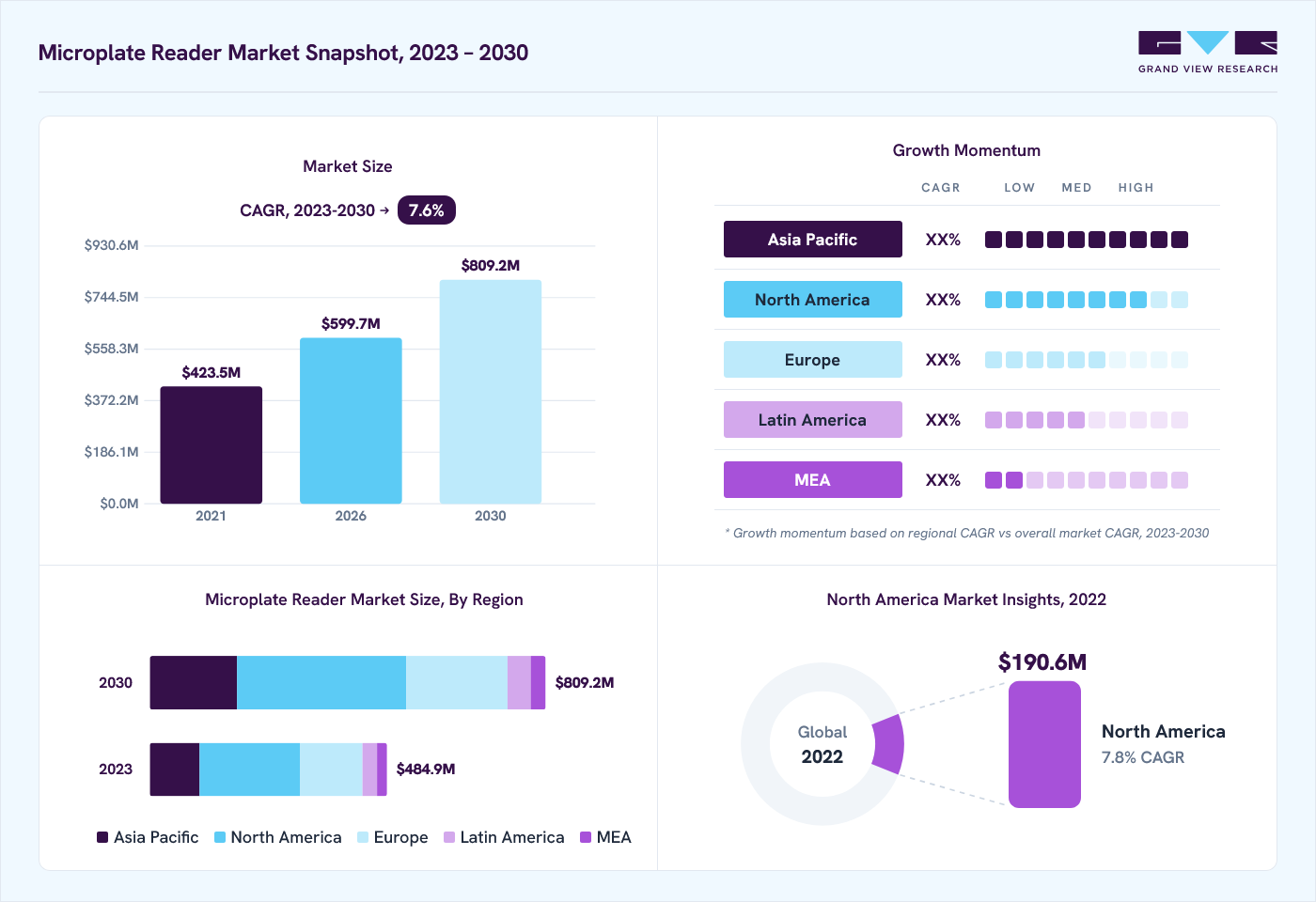
The global microplate reader market size was valued at USD 452.6 million in 2022 and is projected to grow from USD 599.7 million in 2026 to USD 809.2 million by 2030, at a CAGR of 7.6% from 2023 to 2030. North America dominated the market, accounting for a revenue share of 40.0% in 2022. The adoption of microplate readers is fueled by the growth in the biotechnology sector and the increasing scope of applications in drug discovery and genomics and proteomics research. Furthermore, advantages offered by microplate readers over spectrophotometric devices, such as increased speed and efficiency in analytical workflows, and the availability of a broad range of reading functions are likely to boost the market growth.
 Source: Grand View Research, IR Documents, Primary Interviews, Paid DatabasesTo learn more about this report,
 Download Free Sample Report
 The COVID-19 pandemic has increased the demand for point-of-care and rapid testing methods for disease surveillance and management of outbreaks. Furthermore, there has been an increase in the focus on the development of cost-effective, portable, and easy-to-use analytical devices, such as microplate readers, for supporting diagnostic testing activities. For instance, in November 2020, Enzo Biochem launched a portable microplate reader compatible with the company’s immunoassays and molecular diagnostic assays. As microwell plates are frequently used in enzyme-linked immunosorbent assays and molecular tests, such developments are expected to boost the demand for COVID-19-related offerings of microplate readers.
 To learn more about this report, Download Free Sample Report
 In addition, microplate readers are relatively maintenance-free and have a long life span. Although lamps are the most vulnerable components of microplate readers over the past few years, increasingly advanced options including deuterium, halogens, Xenon flash lamps, and LEDs have been introduced. Such developments have further increased the longevity of microplate readers, which is expected to increase the adoption of these instruments.
Moreover, detectors and associated detection methods for microplate readers have evolved to support high throughput screening and enable a faster turnaround time with high accuracy for drug screening applications. Hence, large volumes of drug compounds are now being processed with the help of assay miniaturization using microplate readers to reduce the costs of reagents required. Similarly, the integration of relevant analytical technologies with microplate systems is opening new avenues for market growth. For instance, in January 2020, Biotek Instruments, Inc. (Agilent Technologies, Inc.) launched its new Cytation 7 Cell Imaging Multi-Mode Reader that offers a combination of microscopy and multi-mode detection capabilities in a single instrument. Such innovations can enable the multipurpose use of microplate readers and boost the market growth in the near future.
Product Insights
Single-mode readers held the largest share of over 60.0% in 2022 due to their significant market penetration and established presence in various academic and industrial research and development settings. Moreover, these instruments are less expensive than multi-mode readers, and companies such as Biotek Instruments, Inc. (Agilent Technologies, Inc.), and Tecan Group Ltd. offer modular single-mode reader designs, which can be upgraded as required. In addition, single-mode readers are relatively easy to operate and are offered by a variety of manufacturers. As a result, the availability of a broad range of alternatives is anticipated to drive the segment.
The multi-mode readers segment is expected to expand at the fastest CAGR over the forecast period as manufacturers are focusing on offering greater flexibility and convenience of multi-modal instruments instead of several dedicated instruments. Moreover, along with fluorescence, absorbance, and luminescence analysis, multi-mode readers are offering various configurable modes for fluorescence resonance energy transfer, fluorescence polarization, amplified luminescent proximity homogeneous assays, and others. Such capabilities are likely to boost segment growth over the forecast period.
Application Insights
The drug discovery segment held the largest share of over 40.0% in 2022. This can be attributed to the broad range of applications of microplate reading devices in drug discovery processes. For instance, these instruments are used for automated detection and analysis of several labeled and label-free components while performing cell-based assays. Similarly, microplate readers offer high throughput capabilities by reading several wells simultaneously, and the throughput can be further increased with the help of automated robotic microplate stackers. Such technological capabilities are simplifying the use of advanced readers and are driving their adoption for drug discovery applications.
The genomics and proteomics research segment is expected to expand at a significant CAGR from 2023 to 2030 due to the availability of a variety of signal reading techniques for specific applications in genomics and proteomics. For instance, proteomics methods require the use of protein quantification methods such as Bradford, Lowry, or fluorescent assays, which can be easily performed using microplate-based AlphaScreen, fluorescence polarization, or time-resolved fluorescence energy transfer techniques. Moreover, the high demand for quantification of low concentrations of DNA for applications such as next-generation sequencing, SNP genotyping, and DNA methylation readout is likely to aid the revenue generation in this segment.
End-use Insights
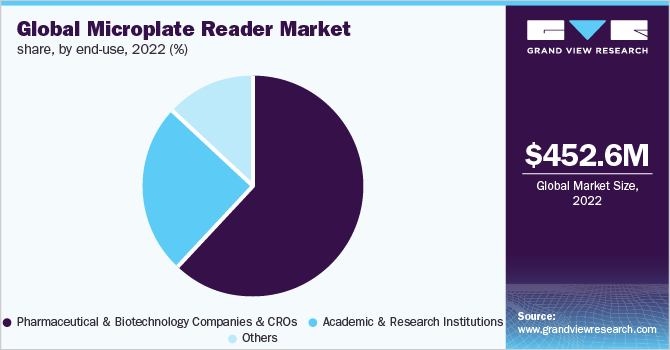
Pharmaceutical and biotechnology companies and CROs dominated the market and accounted for a share of over 60.0% in 2022 due to the high commercial success of biopharmaceuticals and rapid growth in demand for CRO services. A significant increase in investments in the pharmaceutical industry has boosted drug screening activities for the discovery of novel therapeutics. Since microplate readers form an important aspect of drug screening and target identification and validation workflows, the demand for these instruments is expected to grow over the forecast period.
 To learn more about this report, Download Free Sample Report
 The academic and research institutions segment is expected to grow at a rapid pace from 2023 to 2030. The widespread availability of benchtop readers and technological advancements in sensitivity and accuracy of detection have accelerated the adoption of such instruments in academic and research institutions. Furthermore, the rising involvement of academic institutes in the development of novel biologics and the increase in funding opportunities for life sciences research are likely to raise the adoption of the technique in the coming years.
Regional Insights
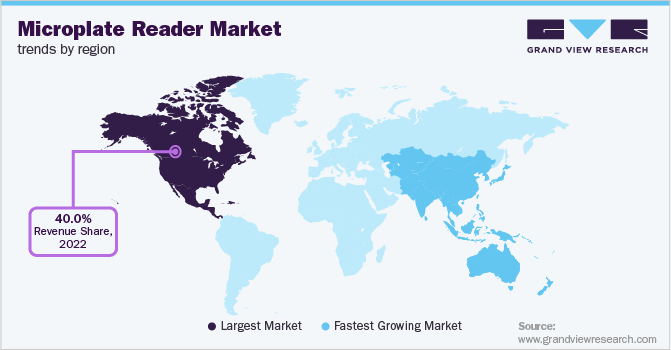
North America held the largest share of over 40.0% in 2022 due to the presence of an established biopharmaceutical and CRO industry in the region and a high extent of R&D activities. Moreover, local presence of key companies such as Agilent Technologies, Inc.; Danaher Corporation; and PerkinElmer, Inc. is expected to drive the market in the region. Furthermore, increased infectious disease testing and high demand for ELISA-based tests in the region due to the COVID-19 pandemic have positively affected the market growth in North America.
 To learn more about this report, Download Free Sample Report
 The Asia Pacific region is projected to expand at the fastest CAGR from 2023 to 2030 due to the growing life sciences industry and rising interest of contract service providers in the region. Rapid economic development and high investments in research and development activities in emerging economies, such as China and India, are expanding the growth prospects for biotechnological research, which is anticipated to boost market growth.
Key Companies & Market Share Insights
The market is growing at a rapid pace due to various strategic initiatives adopted by key companies involved. For instance, in April 2022, Danaher Corporation launched the new SpectraMax Mini Multi-Mode reader consisting of a benchtop design suitable for academic laboratories. Some prominent players in the global microplate reader market include:
-
Danaher Corporation
-
Thermo Fisher Scientific, Inc.
-
BMG Labtech
-
PerkinElmer, Inc.
-
Promega Corporation
-
Bio-Rad Laboratories
-
Lonza
-
Agilent Technologies, Inc.
-
Enzo Life Sciences
-
Berthold Technologies GmbH & Co. KG
Microplate Reader Market Report Scope
Report Attribute
Details
Market size in 2022
USD 452.6 million
Estimated market size in 2026
USD 599.7 million
Projected market size by 2030
USD 809.2 million
Growth rate
CAGR of 7.6% from 2023 to 2030
Base year for estimation
2022
Historical data
2018 - 2021
Forecast period
2023 - 2030
Quantitative units
Revenue in USD million and CAGR from 2023 to 2030
Report coverage
Revenue forecast, company ranking, competitive landscape, growth factors, and trends
Segments covered
Product, application, end-use, region
Regional scope
North America; Europe; Asia Pacific; Latin America; MEA
Country scope
U.S.; Canada; U.K.; Germany; France; Italy; Spain; Denmark; Sweden; Norway; Japan; China; India; Australia; South Korea; Thailand; Brazil; Mexico; Argentina; South Africa; Saudi Arabia; UAE; Kuwait
Key companies profiled
Danaher Corporation; Thermo Fisher Scientific, Inc.; BMG Labtech; PerkinElmer, Inc.; Promega Corporation; Bio-Rad Laboratories; Lonza; Agilent Technologies, Inc.; Enzo Life Sciences; Berthold Technologies GmbH & Co. KG
Customization scope
Free report customization (equivalent up to 8 analyst’s working days) with purchase. Addition or alteration to country, regional & segment scope.
Pricing and purchase options
Avail customized purchase options to meet your exact research needs. Explore purchase options
Global Microplate Reader Market Segmentation
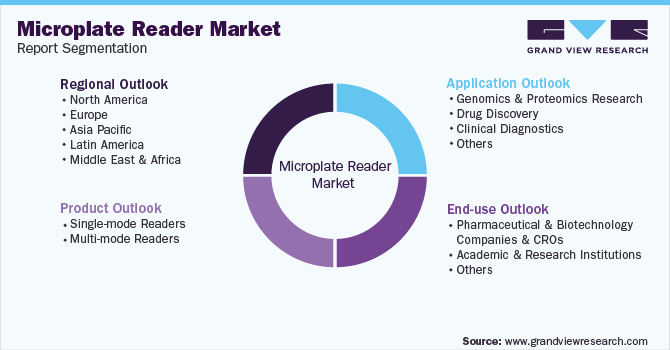
This report forecasts revenue growth at the global, regional, and country levels and provides an analysis of the latest industry trends and opportunities in each of the sub-segments from 2018 to 2030. For the purpose of this report, Grand View Research has segmented the global microplate reader market report on the basis of product, application, end-use, and region:
 To learn more about this report, Download Free Sample Report
 -
Product Outlook (Revenue, USD Million, 2018 - 2030)
-
Single-mode Readers
-
Absorbance Microplate Readers
-
Fluorescence Microplate Readers
-
Luminescence Microplate Readers
-
Others
-
-
Multi-mode Readers
-
Filter-based Microplate Readers
-
Monochromator-based Microplate Readers
-
Hybrid Microplate Readers
-
-
-
Application Outlook (Revenue, USD Million, 2018 - 2030)
-
Genomics & Proteomics Research
-
Drug Discovery
-
Clinical Diagnostics
-
Others
-
-
End-use Outlook (Revenue, USD Million, 2018 - 2030)
-
Pharmaceutical & Biotechnology Companies & CROs
-
Academic & Research Institutions
-
Others
-
-
Regional Outlook (Revenue, USD Million, 2018 - 2030)
-
North America
-
U.S.
-
Canada
-
-
Europe
-
U.K.
-
Germany
-
France
-
Italy
-
Spain
-
Denmark
-
Sweden
-
Norway
-
-
Asia Pacific
-
Japan
-
China
-
India
-
Australia
-
South Korea
-
Thailand
-
-
Latin America
-
Brazil
-
Mexico
-
Argentina
-
-
Middle East and Africa (MEA)
-
South Africa
-
Saudi Arabia
-
UAE
-
Kuwait
-
-
Frequently Asked Questions About This Report
The global microplate reader market size was valued at USD 452.6 million in 2022 and is estimated at USD 599.7 million for 2026.
The global microplate reader market is expected to grow at a CAGR of 7.6% from 2023 to 2030, reaching USD 809.2 million by 2030.
North America dominated with a revenue share of 40.0% in 2022.
Some key players operating in the microplate readers market include Danaher Corporation; Thermo Fisher Scientific, Inc.; BMG Labtech; PerkinElmer, Inc.; Promega Corporation; Bio-Rad Laboratories; Lonza; Agilent Technologies, Inc.; Enzo Life Sciences; and Berthold Technologies GmbH & Co. KG.
The adoption of microplate readers is fueled by the growth in the biotechnology sector and the increasing scope of applications in drug discovery and genomics & proteomics research.
About the Author(s)
Biotechnology Research Team
Healthcare · BiotechnologyThis report was authored by the biotechnology research team at Grand View Research - comprising two research analysts, one senior research analyst, and one industry expert - with specialized expertise in the biotechnology segment of the healthcare industry. All findings are based on proprietary healthcare databases, executive interviews, and regulatory analysis, subject to internal peer review prior to publication.
Last Updated:
Speak to Analyst -

Customize this report to your needs - add regions, segments, or data points, with 20% free customization.
Or view our licence options:


ISO 9001:2015 & 27001:2022 Certified
We are GDPR and CCPA compliant! Your transaction & personal information is safe and secure. For more details, please read our privacy policy.


