
- Home
- »
- Next Generation Technologies
- »
-
Middle East 3D Concrete Printing Market Size Report, 2033GVR Report cover
![Middle East 3D Concrete Printing Market Size, Share & Trends Report]()
Middle East 3D Concrete Printing Market (2026 - 2033) Size, Share & Trends Analysis Report By Site Type (On-site, Near-site, Off-site), By Printing System, By Element Type, By Application, By End Use, By Country, And Segment Forecasts
- Report ID: GVR-4-68040-850-2
- Number of Report Pages: 130
- Format: PDF
- Historical Range: 2021 - 2024
- Forecast Period: 2026 - 2033
- Industry: Technology
- Report Summary
- Table of Contents
- Segmentation
- Methodology
- Download FREE Sample
-
 Download Sample Report
Middle East 3D Concrete Printing Market Summary
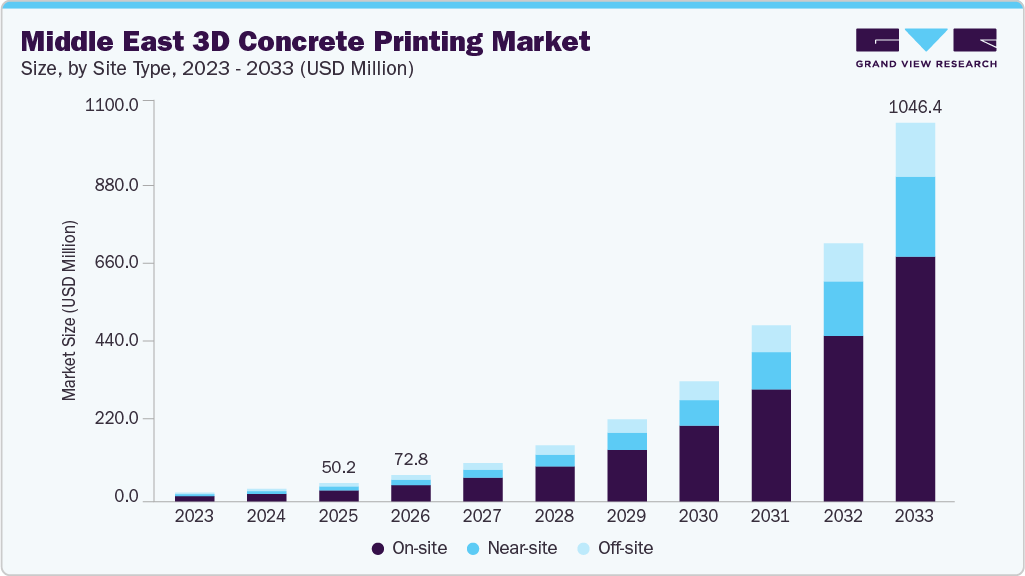
The Middle East 3D concrete printing market size was estimated at USD 50.16 million in 2025 and is projected to reach USD 1,046.39 million by 2033, growing at a CAGR of 46.3% from 2026 to 2033. The Middle East 3D concrete printing industry is gaining momentum, driven by strong government support for advanced construction technologies, rising demand for rapid and large-scale housing delivery, and increasing adoption of automation to address labor shortages and cost pressures in the construction sector.
Key Market Trends & Insights
- UAE dominated the Middle East 3D concrete printing market with the largest revenue share of 39.4% in 2025.
- By site type, the on-site segment led the market with the largest revenue share of 60.9% in 2025.
- By element type, the structural elements segment accounted for the largest market revenue share in 2025.
- By printing system, the gantry-based systems segment accounted for the largest market revenue share in 2025.
- By application, the residential housing segment accounted for the largest market revenue share in 2025.
Market Size & Forecast
- 2025 Market Size: USD 50.16 Million
- 2033 Projected Market Size: USD 1,046.39 Million
- CAGR (2026-2033): 46.3%
- UAE: Largest market in 2025
However, the lack of unified building codes and certification standards for 3D-printed structures remains a key challenge limiting large-scale commercialization. Expanding deployment across giga-projects, public infrastructure programs, and smart city developments, along with growing localization of printing systems and construction materials, presents major growth opportunities for the market.Government-led mandates across the Middle East are playing a critical role in accelerating the adoption of 3D concrete printing, particularly in the UAE and Saudi Arabia. Regional authorities are embedding additive construction technologies into national development strategies, sustainability agendas, and housing programs to improve productivity, reduce construction waste, and modernize the construction sector. Dubai has emerged as a regional leader by establishing a formal regulatory framework that governs the use of 3D printing in construction, providing clarity on licensing, compliance, and quality requirements.
Saudi Arabia is also encouraging advanced construction methods under its Vision 2030 agenda to support economic diversification and large-scale urban development. For instance, in September 2021, Dubai formalized regulations requiring the integration of 3D printing technologies in the construction sector, including a long-term target for 25% of new buildings to be 3D printed by 2030, signaling sustained government commitment. In February 2023, Dubai Municipality introduced a conformity and certification framework for 3D printed buildings, enabling developers to secure approvals through standardized processes. These initiatives reduce regulatory uncertainty, de-risk early investments, and encourage private sector participation across the Middle East.
Rapid urbanization and expanding housing requirements are major structural drivers for 3D concrete printing adoption in the Middle East. Population growth, economic diversification, and smart city initiatives are creating sustained demand for faster, scalable, and cost-efficient construction solutions. Conventional construction methods face increasing pressure from labor constraints, rising material costs, and longer project timelines, prompting developers and governments to explore automation-driven alternatives. 3D concrete printing supports accelerated build cycles, reduced dependency on manual labor, and improved material efficiency, making it well suited for high-volume residential developments.
For instance, in October 2022, a two-storey 3D printed residential villa was completed in Riyadh as part of a large housing development, demonstrating the feasibility of additive construction for mainstream residential use in desert conditions. In March 2024, Saudi Arabia inaugurated the world’s first 3D printed mosque in Jeddah, illustrating the technology’s expansion beyond pilot housing into socially and culturally significant structures. These developments highlight how urban growth pressures are directly translating into real-world adoption of 3D concrete printing across the region.
The Middle East’s expanding pipeline of giga-projects and public infrastructure programs is creating a strong platform for integrating 3D concrete printing technologies. Large-scale developments such as smart cities, economic zones, and government-led housing initiatives offer long planning horizons and centralized governance, which are well suited for piloting and scaling innovative construction methods. Public sector participation also helps absorb early technology risks while validating performance in operational environments, accelerating broader market acceptance.
For instance, in October 2021, Dubai approved the use of 3D printed structural and non-structural elements in public infrastructure and urban development projects, supporting adoption beyond isolated pilot buildings. In March 2024, a large-format 3D printed residential structure in Dubai demonstrated regulatory compliance and construction speed at scale, reinforcing the viability of additive manufacturing for urban developments. These projects position giga-projects as both demonstration platforms and volume drivers for the Middle East 3D concrete printing industry.
Despite growing adoption, the lack of unified building codes and certification standards remains a significant challenge for the Middle East 3D concrete printing industry. While certain jurisdictions have introduced localized frameworks, many countries continue to rely on construction codes developed for conventional building methods. This regulatory fragmentation forces developers to pursue approvals on a project-by-project basis, often requiring extensive material testing, hybrid structural designs, and additional engineering validation, which increases costs and extends timelines.
For instance, since 2021, Dubai has operated under a dedicated regulatory framework that provides defined approval pathways for 3D printed construction. However, in markets such as Saudi Arabia, Qatar, Kuwait, and Oman, printed structures are still typically assessed under traditional codes without standardized provisions for additive manufacturing. Projects completed in 2022 and 2023, including large residential villas, required customized compliance processes rather than uniform certification. Until regional harmonization of building codes is achieved, regulatory uncertainty will continue to constrain large-scale commercialization and cross-border expansion.
Site Type Insights
The on-site segment led the market with the largest revenue share of 60.9% in 2025 and is projected to grow at the fastest CAGR during the forecast period, driven by strong government support for on-site automated construction within housing and infrastructure programs and the need to reduce labor dependency and construction timelines on large development sites. On-site 3D concrete printing is widely adopted for villa construction, low-rise residential units, boundary walls, and site-specific structural elements, particularly within master-planned communities and public housing projects across the Middle East.
The near-site segment is expected to grow at a significant CAGR from 2026 to 2033, driven by increasing adoption of centralized printing hubs supporting multiple construction sites and rising demand for higher quality control and material consistency in printed components. Near-site printing is primarily used for pre-printing walls, façade elements, staircases, and modular structural components that are transported short distances to residential, commercial, and public infrastructure projects in urban Middle Eastern markets.
Printing System Insights
The gantry-based systems segment led the market with the largest revenue share of 53.0% in 2025, driven by their ability to print large, load-bearing wall structures with high dimensional accuracy and their suitability for repetitive, standardized building designs common in Middle Eastern housing developments. Gantry-based systems are widely used for on-site printing of single-storey and low-rise villas, affordable housing units, and boundary walls, particularly in government-led residential projects where scale, structural reliability, and predictable output are critical.
The robotic arm-based systems segment is expected to grow at the fastest CAGR from 2026 to 2033, driven by their flexibility in printing complex geometries and non-linear architectural designs and their compatibility with near-site and indoor printing environments. Robotic arm systems are increasingly adopted for architectural façades, customized structural components, decorative elements, and hybrid construction workflows, especially in premium residential, commercial, and landmark projects across the Middle East.
Element Type Insights
The structural elements segment accounted for the largest market revenue share in 2025, as 3D concrete printing is increasingly used for core load-bearing components such as walls, columns, foundations, and structural shells. Growth is fueled by rapid residential and public infrastructure development in the Middle East, where on-site printing of standardized structural components reduces construction time, labor requirements, and material waste. Structural elements are widely applied in low- to mid-rise villas, affordable housing units, and public infrastructure projects, where repeatable geometries and load-bearing reliability are critical for large-scale deployment.
The architectural elements segment is expected to grow at a significant CAGR during the forecast period, driven by demand for customized, visually complex building components in premium projects and landmark developments. This segment includes curved façades, decorative panels, sculptural walls, and feature staircases, which can be efficiently produced using robotic-arm and near-site printing systems. For instance, in October 2025, the Dubai Museum of Art, designed by Tadao Ando for the Al-Futtaim Group, showcased a twisting, curved exterior with triangular windows and sculptural interior galleries, demonstrating the potential of 3D printing to realize intricate architectural forms in high-profile Middle Eastern projects.
Application Insights
The residential housing segment accounted for the largest market revenue share in 2025, driven by rapid urbanization, demand for affordable and scalable housing, and government-led initiatives promoting faster construction methods. 3D concrete printing enables accelerated build cycles, reduced material waste, and lower labor dependency, making it particularly suitable for high-volume residential developments. In the Middle East, on-site and near-site printing is increasingly applied to villas, townhouses, and low-rise apartment projects, especially in master-planned communities where repeatable designs and speed are critical.
The public infrastructure segment is expected to register at a notable CAGR from 2026 to 2033, driven by government investment in iconic and community-focused projects that require rapid construction with high design precision. For instance, in May 2023, Dubai commissioned the world’s first 3D-printed mosque in Bur Dubai, covering 2,000 square meters and accommodating 600 worshippers. The project demonstrates the potential for 3D printing to deliver culturally significant public infrastructure efficiently, using large-scale printers to construct load-bearing walls and structural components with minimal material waste. Public infrastructure applications also include schools, mosques, bridges, and urban facilities, where speed, precision, and sustainability are prioritized.
End Use Insights
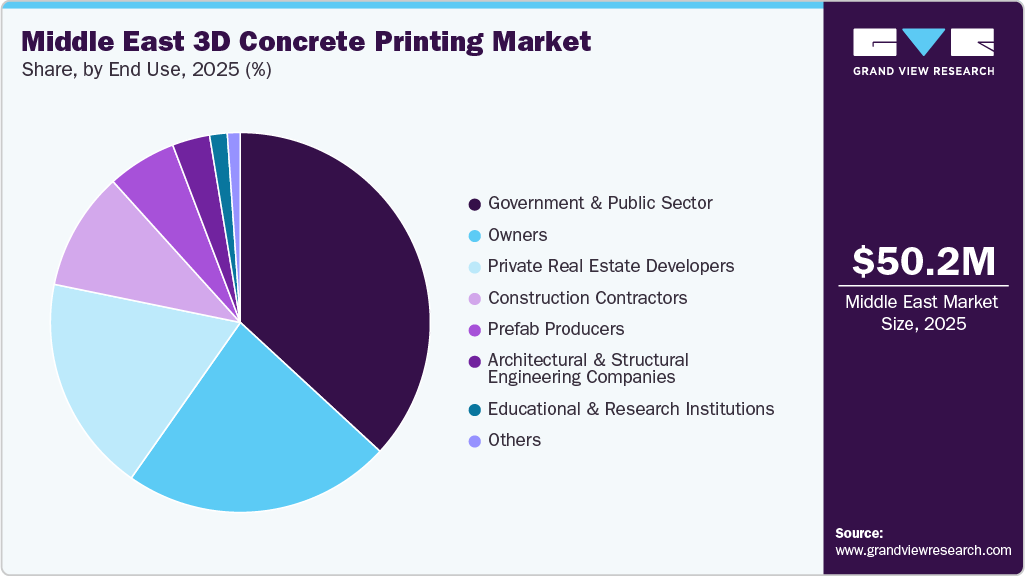
The government & public sector segment led the market with the largest revenue share of 36.9% in 2025 and is anticipated to grow at the fastest CAGR during the forecast period, driven by strategic initiatives to deploy 3D concrete printing in public infrastructure, cultural landmarks, and community-focused housing projects. Governments in the UAE and Saudi Arabia are actively leveraging the technology to reduce construction timelines, enhance sustainability, and demonstrate innovation in urban development programs. 3D printing in this segment is typically applied to public buildings, municipal offices, educational institutions, mosques, and demonstration projects, providing both functional structures and showcases for wider adoption.
For instance, in July 2022, the Dubai Municipality set a record for the largest 3D-printed structure in the region, a two-story building covering 640 square meters with a height of 9.5 meters, constructed entirely on-site by Apis Cor. The walls were 3D printed using a gypsum-based material, while reinforcement was achieved with 3D-printed formwork filled manually with rebar and concrete. This project demonstrated the technology’s resilience in local environmental conditions, proving feasibility for large-scale public infrastructure applications.
The owners segment is expected to register at a notable CAGR from 2026 to 2033, driven by developers and private real estate firms seeking cost efficiency, faster project delivery, and enhanced control over architectural and sustainability outcomes. Owners are increasingly adopting 3D concrete printing for residential units, villas, commercial buildings, and modular structural components, enabling them to optimize designs, reduce labor dependency, and meet green building standards while maintaining high-quality construction.
Country Insights
UAE 3D Concrete Printing Market Trends
UAE dominated the Middle East 3D concrete printing market with the largest revenue share of 39.4% in 2025 and is anticipated to grow at the fastest CAGR during the forecast period, supported by government innovation programs and regulatory incentives to modernize building practices and improve sustainability outcomes. Adoption is driven by federal and emirate‑level strategies that prioritize digital construction within public procurement, sustainable urban planning, and smart city development. The technology is increasingly used for institutional facilities, community infrastructure, and demonstration projects, showcasing the potential for accelerated build cycles and lower material waste. For instance, in April 2025, the Ministry of Energy and Infrastructure commissioned a 3D‑printed government facility at the Al Madam Court site in Sharjah, demonstrating government investment in large‑format additive construction for public use. The project used locally optimized concrete mixes and on‑site printing technology to reduce delivery time and waste, aligning with the UAE’s industrial strategy for digital innovation. Government incentives and partnerships continue to attract international technology providers, creating opportunities for deeper integration of 3D printing into federal and emirate‑level infrastructure plans.
Kingdom of Saudi Arabia 3D Concrete Printing Market Trends
The 3D concrete printing market in the Kingdom of Saudi Arabia held a substantial share in 2025, largely supported by the government's Vision 2030 goals emphasizing innovation, economic transformation, and advanced construction technologies. Saudi authorities are leveraging 3D concrete printing in residential developments and pilot smart homes to reduce labor intensity, cut construction costs, and support large‑scale urbanization efforts. The technology aligns with national priorities to diversify the economy beyond hydrocarbon sectors and create future‑ready housing stock.
Oman 3D Concrete Printing Market Trends
The Oman 3D concrete printing market held a notable share in 2025, supported by government encouragement of local innovation and collaborative research to modernize construction practices. Oman is working with academic institutions, government entities, and private firms to develop sustainable concrete formulations and climate‑adapted printing methods that reduce dependence on imports and strengthen domestic technical capacity. These efforts aim to make additive construction commercially viable for public buildings, climate‑resilient housing, and industrial facilities. For instance, in September 2025, the first dedicated 3D concrete printing facility opened in the Ghala Industrial Area in Muscat, serving as a hub for material research, workforce training, and technology testing. This facility supports the development of locally optimized concrete mixes and machine designs that strengthen in‑country value and reduce construction waste. Omani initiatives position the country as an emerging regional hub for sustainable additive construction practices and expanded R&D commercialization pathways over the coming decade.
Kuwait 3D Concrete Printing Market Trends
The 3D concrete printing market in Kuwait held a significant share in 2025, driven by rising government focus on smart urban redevelopment and the modernization of construction technology. Public agencies and housing authorities have initiated pilot programs and feasibility assessments to explore how 3D concrete printing can support residential housing projects, modular municipal facilities, and rapid‑build infrastructure upgrades. Early activities reflect a strategic interest in digital construction as a tool for enhanced productivity and sustainability. For instance, in July 2025, the Kuwait Authority for Partnership Projects (KAPP) launched a feasibility initiative to evaluate the integration of 3D concrete printing in national redevelopment plans, including affordable housing and smart city corridors. These assessments aim to identify scalable applications for sustainable, rapid‑build solutions within government housing strategies and urban infrastructure renewal programs. While the sector remains nascent, growing institutional interest suggests increasing adoption, though dependence on imported specialized equipment and materials presents ongoing logistical and cost challenges.
Key Middle East 3D Concrete Printing Company Insights
Some of the key players operating in the market include COBOD International A/S, ICON Technology, Inc., Apis Cor Inc. XtreeE, Winsun, BESIX 3D, and Sika AG.
-
Founded in 2017 and headquartered in Copenhagen, Denmark, COBOD International A/S specializes in 3D construction printing solutions. The company is known for its BOD2 modular construction printer, which has been deployed globally for residential, commercial, and public infrastructure projects. COBOD collaborates with major construction and material companies such as GE Renewable Energy, CEMEX, and Holcim to develop scalable and sustainable 3D printing technologies. The company’s printers are used in over 30 countries, and focuses on reducing construction time, labor costs, and material waste while increasing automation and precision in the building process.
-
Founded in 2017 and headquartered in Austin, Texas, ICON Technology, Inc. is a prominent innovator in 3D concrete printing for residential and defense construction. The company developed the Vulcan printer and Lavacrete material, enabling automated, layer-by-layer home construction. ICON Technology, Inc. has completed high-profile projects such as the first permitted 3D-printed home in the U.S. and the Wolf Ranch development in Texas, which is the world’s largest 3D-printed housing project. ICON also collaborates with NASA to explore 3D printing for lunar habitats and with the U.S. Department of Defense for rapid military infrastructure deployment.
Key Middle East 3D Concrete Printing Companies:
- ICON Technology, Inc.
- COBOD International A/S
- CyBe Construction B.V.
- Apis Cor Inc.
- XtreeE
- Winsun (Yingchuang Building Technique Co., Ltd.)
- BESIX 3D (BESIX Group)
- Sika AG
- Concreative (VINCI Construction subsidiary)
- PERI 3D Construction GmbH
Recent Developments
-
In June 2025, UCC Holding and Qatar’s Public Works Authority (Ashghal) launched the world’s largest 3D-printed construction project, building two 20,000 m² schools using COBOD’s BODXL printers. The initiative demonstrates scalable, sustainable, and climate-adapted construction for the region’s educational infrastructure.
-
In April 2025, the American University of Sharjah (AUS) was granted the UAE’s first patent for a structural-grade, self-reinforced 3D printed concrete mixture using locally sourced materials. The innovation strengthens concrete without conventional steel reinforcement, enhancing durability, crack resistance, and sustainability. Developed by AUS researchers, it addresses the Gulf’s extreme climate and reduces construction waste and carbon footprint.
-
In November 2024, Black Buffalo 3D partnered with AM Unique in Saudi Arabia to deploy NEXCON gantry 3D printers for residential, commercial, and industrial projects. The collaboration leverages localized materials, ICC-ES AC509-compliant technology, and AM Unique’s expertise for efficient, on-demand construction.
-
In December 2023, Emaar unveiled Dubai’s first 3D printed villa in Arabian Ranches III, executed using COBOD technology. The 202 m² villa features three bedrooms, four bathrooms, an integrated car park, and smart home integration with Xiaomi products. The project demonstrates rapid, cost-efficient construction with distinctive architectural design, supporting Dubai’s Smart City and 3D Printing Strategy goals of 25% of new buildings being 3D printed by 2030.
-
In September 2023, US-based Black Buffalo 3D partnered with Saudi Readymix Concrete Company to develop regional 3D construction printing materials and structural inks. The collaboration leverages Saudi Readymix’s 60 factories and R&D facilities to create mixes suitable for local building codes and extreme climates. Black Buffalo 3D brings expertise as the first ICC-ES AC509-certified 3D wall printer, enabling on-demand printing of residential, commercial, and infrastructure components.
-
In June 2023, 3DXB GROUP announced the launch of its 3D printing technology in the UAE, targeting architects, engineers, contractors, and developers. The technology enables faster, cost-efficient, and precise construction of sustainable buildings by eliminating traditional formwork and reducing manual labor. The move aligns with Dubai’s regulatory push to establish the emirate as a regional 3D printing hub, promoting efficiency, quality, and green construction practices.
Middle East 3D Concrete Printing Market Report Scope
Report Attribute
Details
Market size value in 2026
USD 72.81 million
Revenue Forecast in 2033
USD 1,046.39 million
Growth rate
CAGR of 46.3% from 2026 to 2033
Base year for estimation
2025
Historical data
2021 - 2024
Forecast period
2026 - 2033
Quantitative units
Revenue in USD million/billion and CAGR from 2026 to 2033
Report Coverage
Revenue forecast, company market share, competitive landscape, growth factors, and trends
Segments Covered
Site type, printing system, element type, application, end use, country
Regional scope
Middle East
Country scope
UAE; Kingdom of Saudi Arabia (KSA); Oman; Kuwait; Qatar
Key companies profiled
CyBe Construction B.V.; COBOD International A/S; Apis Cor Inc.; ICON Technology, Inc.; XtreeE; Winsun (Yingchuang Building Technique Co., Ltd.); BESIX 3D (BESIX Group); Sika AG; Concreative (VINCI Construction subsidiary); PERI 3D Construction GmbH
Customization scope
Free report customization (equivalent up to 8 analysts working days) with purchase. Addition or alteration to country, regional & segment scope.
Pricing and purchase options
Avail customized purchase options to meet your exact research needs. Explore purchase options
Middle East 3D Concrete Printing Market Report Segmentation
This report forecasts revenue growth at the country level and provides an analysis of the latest industry trends in each sub-segment from 2021 to 2033. For this study, Grand View Research has segmented the Middle East 3D concrete printing market report based on site type, printing system, element type, application, end use, and country.
-
Site Type Outlook (Revenue, USD Million, 2021 - 2033)
-
On-site
-
Near-site
-
Off-site
-
-
Printing System Outlook (Revenue, USD Million, 2021 - 2033)
-
Gantry-based Systems
-
Robotic Arm-based Systems
-
Crane-based/Contour Crafting Systems
-
-
Element Type Outlook (Revenue, USD Million, 2021 - 2033)
-
Architectural Elements
-
Structural Elements
-
-
Application Outlook (Revenue, USD Million, 2021 - 2033)
-
Residential Housing
-
Commercial & Office Buildings
-
Public Infrastructure
-
Industrial
-
-
End Use Outlook (Revenue, USD Million, 2021 - 2033)
-
Government & Public Sector
-
Owners
-
Private Real Estate Developers
-
Construction Contractors
-
Prefab Producers
-
Architectural and Structural Engineering Companies
-
Educational & Research Institutions
-
Others
-
-
Country Outlook (Revenue, USD Million, 2021 - 2033)
-
UAE
-
Kingdom of Saudi Arabia (KSA)
-
Qatar
-
Kuwait
-
Oman
-
Frequently Asked Questions About This Report
b. The Middle East 3D concrete printing market size was estimated at USD 50.16 million in 2025 and is projected to reach USD 1,046.39 million by 2033.
b. The Middle East 3D concrete printing market is expected to grow at a compound annual growth rate of 46.3% from 2026 to 2033 to reach USD 1,046.39 million by 2033.
b. UAE 3D concrete printing market accounted for a 39.4% share of the Middle East market in 2025, supported by government innovation programs and regulatory incentives to modernize building practices and improve sustainability outcomes. Adoption is driven by federal and emirate‑level strategies that prioritize digital construction within public procurement, sustainable urban planning, and smart city development.
b. Some key players operating in the Middle East 3D concrete printing market include CyBe Construction B.V., COBOD International A/S, Apis Cor Inc., ICON Technology, Inc., XtreeE, Winsun (Yingchuang Building Technique Co., Ltd.), BESIX 3D (BESIX Group), Sika AG, Concreative (VINCI Construction subsidiary), PERI 3D Construction GmbH
b. Key factors that are driving the market growth include increasing government support for advanced construction technologies, rising demand for rapid and large-scale housing delivery, and increasing adoption of automation to address labor shortages and cost pressures in the construction sector


Share this report with your colleague or friend.
Need a Tailored Report?
Customize this report to your needs — add regions, segments, or data points, with 20% free customization.


ISO 9001:2015 & 27001:2022 Certified
We are GDPR and CCPA compliant! Your transaction & personal information is safe and secure. For more details, please read our privacy policy.
Trusted market insights - try a free sample
See how our reports are structured and why industry leaders rely on Grand View Research. Get a free sample or ask us to tailor this report to your needs.













