
- Home
- »
- Advanced Interior Materials
- »
-
Middle East Biocomposites Market, Industry Report, 2033GVR Report cover
![Middle East Biocomposites Market Size, Share & Trends Report]()
Middle East Biocomposites Market (2025 - 2033) Size, Share & Trends Analysis Report By Fiber (Wood Fibers, Non-wood Fibers), By Product (Wood Plastic Composites, Natural Fiber Composites), By Technology, By Polymer, By End Use, By Country, And Segment Forecasts
- Report ID: GVR-4-68040-736-9
- Number of Report Pages: 107
- Format: PDF
- Historical Range: 2021 - 2024
- Forecast Period: 2025 - 2033
- Industry: Advanced Materials
- Report Summary
- Table of Contents
- Segmentation
- Methodology
- Download FREE Sample
-
 Download Sample Report
Middle East Biocomposites Market Summary
The Middle East biocomposites market size was estimated at USD 336.5 million in 2024 and is projected to reach USD 742.1 million by 2033, growing at a CAGR of 9.2% from 2025 to 2033. Demand for biocomposites in the Middle East is increasing as governments, businesses, and consumers become more conscious of the environmental impact of plastics.
Key Market Trends & Insights
- Saudi Arabia dominated the Middle East biocomposites market with the largest revenue share of 32.4% in 2024.
- By fiber, the non-wood fibers segment is expected to grow at the fastest CAGR of 9.7% over the forecast period.
- By product, the hybrid biocomposites segment is expected to grow at the fastest CAGR of 9.5% over the forecast period.
- By technology, the injection molding segment is expected to grow at the fastest CAGR of 10.3% over the forecast period.
- By polymer, the biodegradable polymer segment is expected to grow at the fastest CAGR of 9.7% over the forecast period.
Market Size & Forecast
- 2024 Market Size: USD 336.5 Million
- 2033 Projected Market Size: USD 742.1 Million
- CAGR (2025-2033): 9.2%
- Saudi Arabia: Largest market in 2024
- Egypt: Fastest growing market
Large-scale construction and infrastructure projects across the region are creating opportunities for using sustainable and durable materials, where wood fibers and natural fiber composites provide strong alternatives. The automotive, packaging, and agriculture industries are also exploring these materials for their lightweight, recyclable, and eco-friendly properties, further boosting adoption across multiple sectors.
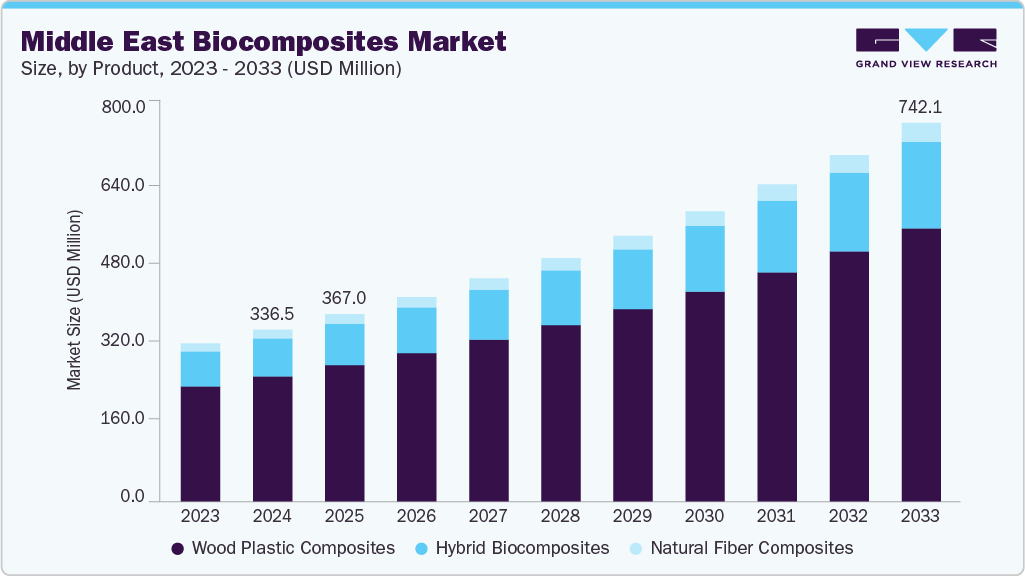
The primary drivers of demand include regulatory pressure, sustainability commitments, and the availability of local feedstocks. Plastic bans and green procurement policies are encouraging industries to shift toward bio-based materials, while corporate ESG goals are accelerating this transition. Additionally, the region’s agricultural residues, such as date-palm fibers and rice husks, provide potential feedstocks for biocomposites, while advances in hybrid formulations are making them increasingly competitive with traditional materials.
Recent innovations in fiber surface treatment, compatibilizers, and polymer blending are helping biocomposites achieve better performance in terms of strength and moisture resistance. Hybrid composites that combine natural fibers with recycled plastics are becoming popular for use in construction, decking, and consumer products. In addition, upcycling agricultural residues into bio-based fibers aligns with regional sustainability goals, making waste-to-value strategies an emerging trend. These advancements are positioning biocomposites as a viable alternative to conventional composites in the Middle East.
Market Concentration & Characteristics
The Middle East biocomposites market remains moderately fragmented, with international companies supplying high-performance materials while local manufacturers focus on low-cost and commodity-grade products. In some segments, such as large construction projects, demand is concentrated among a few suppliers who are able to meet quality and certification requirements. Over time, the market is expected to see gradual consolidation as leading players invest in local capabilities and smaller companies are acquired or merged into larger networks.
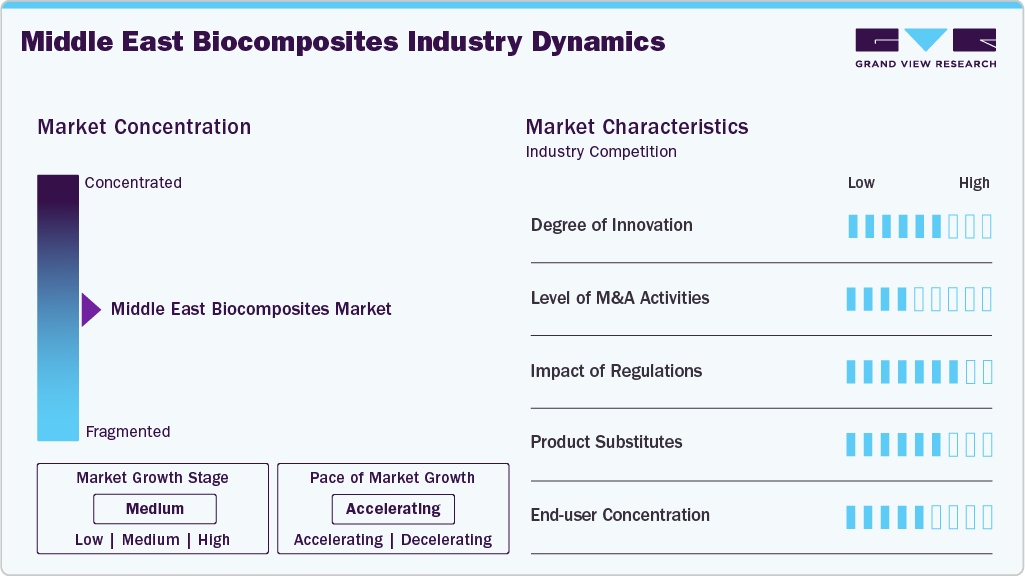
Biocomposites face strong competition from glass-fiber composites, engineered timber, and recycled plastics, which are already well-established in the region. For structural applications, synthetic composites continue to dominate due to their proven performance and certification standards. However, in projects where sustainability requirements are explicitly mandated, biocomposites gain a clear advantage. Overall, substitutes remain a challenge in price-sensitive markets, but regulatory and corporate policies are reducing the threat in targeted applications.
Fiber Insights
The wood fibers segment held the highest revenue market share of 69.3% in 2024, due to their extensive use in construction, automotive, and infrastructure applications. They offer a balance of strength, durability, and cost efficiency, making them the preferred choice for large-scale projects across the region. The availability of wood-based materials, combined with established processing technologies, ensures steady demand. In addition, the rapid urbanization and expansion of residential and commercial infrastructure in GCC countries continue to strengthen the reliance on wood fiber composites. Their ability to meet structural needs while supporting eco-friendly goals makes them the most widely adopted material category.
The non-wood fibers segment is expected to grow significantly at a CAGR of 9.7% over the forecast period in the Middle East, driven by increasing awareness of sustainability and the demand for lighter, more versatile alternatives. Fibers such as hemp, flax, jute, and kenaf are gaining traction for their biodegradability and strong mechanical properties. They are increasingly being explored in automotive interiors, consumer goods, and eco-friendly packaging, aligning with regional initiatives to promote circular economies. Industries are recognizing the potential of these fibers to reduce environmental impact while enhancing product performance. As a result, non-wood fibers are steadily emerging as a dynamic growth area within the market.
Product Insights
The wood plastic composites segment held the highest revenue market share of 72.8% in 2024, mainly due to their proven reliability in construction and infrastructure projects. Their ability to combine the natural appeal of wood with the resilience of plastics makes them well-suited for outdoor applications such as decking, cladding, and fencing. The material’s durability, low maintenance needs, and cost advantages have established WPCs as the preferred choice among developers and manufacturers. With rapid urban growth and ongoing investment in real estate and infrastructure, their dominance is expected to remain strong across the region.
The hybrid biocomposites segment is expected to grow significantly at a CAGR of 9.5% over the forecast period in the Middle East, reflecting a shift toward advanced material solutions. Blending natural fibers with synthetic reinforcements enhances strength, stability, and resistance to environmental stress. This versatility makes them particularly attractive for high-performance applications in automotive, aerospace, and energy sectors. Growing regional interest in lightweight and sustainable materials is further accelerating their uptake. As industries increasingly look for innovative alternatives, hybrid biocomposites are positioned to capture significant growth momentum.
Technology Insights
The extrusion segment held the highest revenue market share of 42.5% in 2024, as it remains the most widely used manufacturing process for producing large, uniform profiles such as decking boards, fencing, and cladding. Its efficiency in handling wood-plastic composites, along with cost-effectiveness and scalability, makes it the preferred choice for construction and infrastructure applications. With strong demand for sustainable building materials across the region, extrusion has firmly established itself as the leading production method.
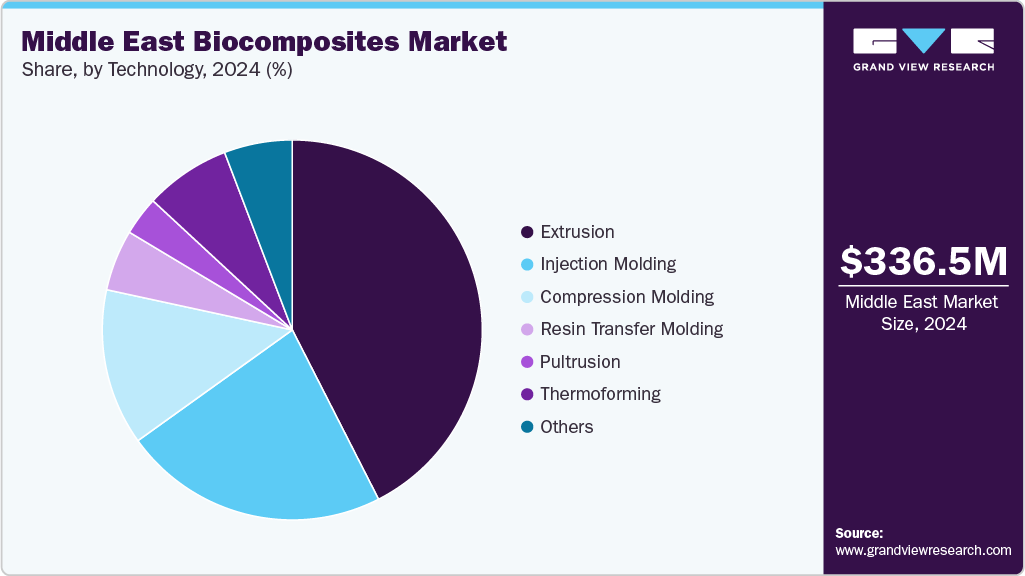
The injection molding segment is expected to grow at a significant CAGR of 10.3% over the forecast period, driven by its ability to produce complex, lightweight, and high-precision components. This method is increasingly favored in industries such as automotive, consumer goods, and packaging, where design flexibility and performance are critical. The process allows for greater integration of natural fibers into biocomposite formulations, supporting the shift toward sustainable and innovative product solutions. As demand for customized applications expands, injection molding is expected to see rapid adoption.
Polymer Insights
The synthetic polymer segment held the highest revenue market share of 63.6% in 2024, due to their established performance, availability, and compatibility with natural fibers. Their strength, durability, and resistance to harsh environmental conditions make them the material of choice in construction, automotive, and industrial applications. The region’s reliance on proven, cost-effective solutions has reinforced the widespread adoption of synthetic polymers in biocomposite production, ensuring their continued leadership across multiple end-use sectors.
The biodegradable polymer segment is expected to grow significantly at a CAGR of 9.7% over the forecast period as industries in the Middle East increasingly prioritize sustainability and circular economy practices. Their eco-friendly profile, combined with growing regulatory support for reducing plastic waste, is driving rapid interest in applications such as packaging, consumer goods, and agriculture. These polymers offer the dual advantage of high performance and reduced environmental impact, making them highly attractive for future-oriented industries. As the region shifts toward greener material choices, biodegradable polymers are gaining significant momentum.
End Use Insights
The automotive and transportation segment held the highest revenue market share of 39.2% in 2024, as manufacturers increasingly integrate natural fiber composites to achieve lightweight, durable, and cost-effective components. These materials help improve fuel efficiency, reduce emissions, and enhance vehicle sustainability, aligning with global trends and regional ambitions to modernize mobility. With strong investment in automotive manufacturing and aftermarket parts, biocomposites have become integral to interiors, panels, and structural components, reinforcing their leadership in this segment.
The building and construction segment is expected to grow significantly at a CAGR of 9.3% over the forecast period in the Middle East, driven by the region’s rapid urban development, mega infrastructure projects, and rising demand for sustainable materials. Biocomposites are being adopted for decking, cladding, insulation, and interior applications due to their strength, thermal performance, and eco-friendly profile. Governments and developers are prioritizing green building solutions, which is accelerating the shift toward biocomposites in both residential and commercial projects. This strong focus on sustainable construction is propelling growth in the sector.
Country Insights
The Middle East is at an early stage of biocomposite adoption, with demand largely driven by sustainability-linked construction projects, packaging initiatives, and automotive lightweighting. Feedstock availability is uneven, as agricultural residues are abundant in some countries while others rely more on imports of biopolymers and fibers. Standards and testing remain key challenges for scaling adoption, but regulatory pressure and corporate ESG goals are helping to accelerate market entry.
Saudi Arabia Biocomposites Market Trends
Saudi Arabia dominated the Middle East market with a revenue market share of 32.4% in 2024, driven by mega-projects under Vision 2030 and the Saudi Green Initiative. The availability of date-palm residues provides a strong local feedstock base, although further development of collection and processing infrastructure is required. Procurement standards increasingly favor low-carbon products, creating significant opportunities for suppliers of natural fiber and hybrid composites.
UAE Biocomposites Market Trends
The UAE is playing a leading role in regional adoption, thanks to its sustainability commitments, circular economy roadmap, and bans on single-use plastics. Green building codes in Dubai and Abu Dhabi encourage the use of biocomposites in construction and landscaping. Its status as a logistics and trade hub allows it to import advanced composites and re-export them to neighboring markets, making it a strategic entry point for international players.
Egypt Biocomposites Market Trends
Egypt offers strong potential for biocomposites due to its abundant agricultural residues such as rice husks and sugarcane bagasse. Local converters are experimenting with natural fiber composites for furniture and low-cost construction applications. Government support for industrial job creation and local manufacturing aligns well with the growth of the biocomposites sector, with additional potential for exports to African markets.
Qatar Biocomposites Market Trends
Qatar’s relatively small but wealthy market is adopting biocomposites for premium projects and public infrastructure, particularly in high-visibility developments. Limited local feedstock availability means the country relies on imports, but government-backed sustainability initiatives create opportunities for selective adoption. Architectural and outdoor applications remain the most promising areas of growth.
Kuwait Biocomposites Market Trends
Kuwait’s market is niche, with demand focused on durable, low-maintenance products in premium construction and public infrastructure. Government procurement is slowly integrating sustainability criteria, which may encourage the use of biocomposites in selected projects. Imports remain necessary for advanced materials, while local opportunities lie mainly in small-scale, high-value applications.
Key Middle East Biocomposites Company Insights
Some of the key players operating in the market include Arab Basalt Fiber Company, Material Composites Company Ltd
-
Arab Basalt Fiber Company specializes in producing basalt fiber-based biocomposites that are increasingly being adopted in infrastructure, automotive, and construction sectors. With growing emphasis on sustainable and durable materials in the Middle East, its products are positioned as an eco-friendly alternative to traditional composites.
-
Material Composites Company Ltd manufactures advanced composite materials that cater to industries such as automotive, construction, and consumer goods. By focusing on lightweight, high-performance, and sustainable solutions, it supports Saudi Arabia’s Vision 2030 initiatives aimed at diversification and reduced environmental impact.
TherraWood Middle East FZC and Shayyar Group are some of the emerging market participants in the biocomposites market.
-
TherraWood Middle East FZC, a recognized player in the wood-plastic composites (WPC) segment, provides products such as decking, cladding, railing, and fencing. Its offerings serve the growing demand for low-maintenance, eco-friendly, and weather-resistant building materials across the Gulf region’s booming construction market.
-
Shayyar Group is active in developing and distributing natural fiber composites for a wide range of applications, including construction, furniture, and packaging. Leveraging Jordan’s strategic location, the company plays a vital role in meeting regional demand for sustainable materials while promoting green innovation.
Key Middle East Biocomposites Ingredients Companies:
- Arab Basalt Fiber Company
- BASF SE
- TherraWood Middle East FZC
- Material Composites Company Ltd
- Fazah Industrial Group
- Peerwood WPC
- Shayyar Group
- ArchDeco
- Ecoway Biopolymers LLC
- KiSabz
Recent Developments
- In September 2024, Arab Basalt Fiber Company announced plans to start production of BFRP rebar at a new manufacturing facility in Fujairah, offering a lower-carbon alternative to steel reinforcement.
Middle East Biocomposites Market Report Scope
Report Attribute
Details
Market size value in 2025
USD 367.0 million
Revenue forecast in 2033
USD 742.1 million
Growth rate
CAGR of 9.2% from 2025 to 2033
Base year for estimation
2024
Actual estimates/Historical data
2021 - 2024
Forecast period
2025 - 2033
Quantitative units
Revenue in USD million/billion and CAGR from 2023 to 2033
Report coverage
Revenue forecast, company ranking, competitive landscape, growth factors, and trends
Segments covered
Fiber, product, technology, polymer, end use, country
Regional scope
Middle East
Country scope
Saudi Arabia; UAE; Egypt; Qatar; Kuwait
Key companies profiled
Arab Basalt Fiber Company; BASF SE; TherraWood Middle East FZC; Material Composites Company Ltd; Fazah Industrial Group; Peerwood WPC; Shayyar Group; ArchDeco; Ecoway Biopolymers LLC; KiSabz
Customization scope
Free report customization (equivalent up to 8 analysts working days) with purchase. Addition or alteration to country, regional & segment scope.
Pricing and purchase options
Avail customized purchase options to meet your exact research needs. Explore purchase options
Middle East Biocomposites Market Report Segmentation
This report forecasts revenue growth at regional & country levels and provides an analysis on the industry trends in each of the sub-segments from 2021 to 2033. For the purpose of this study, Grand View Research has segmented the Middle East biocomposites market on the basis of fiber, product, technology, polymer, end use, and region:
-
Fiber Outlook (Volume, Kilotons; Revenue, USD Million; 2021 - 2033)
-
Wood Fibers
-
Non-wood Fibers
-
-
Product Outlook (Volume, Kilotons; Revenue, USD Million; 2021 - 2033)
-
Wood Plastic Composites
-
Natural Fiber Composites
-
Hybrid Biocomposites
-
-
Technology Outlook (Volume, Kilotons; Revenue, USD Million; 2021 - 2033)
-
Compression Molding
-
Injection Molding
-
Extrusion
-
Resin Transfer Molding
-
Pultrusion
-
Thermoforming
-
Others
-
-
Polymer Outlook (Volume, Kilotons; Revenue, USD Million; 2021 - 2033)
-
Biodegradable Polymer
-
Synthetic Polymer
-
Hybrid Polymer
-
Others
-
-
End Use Outlook (Volume, Kilotons; Revenue, USD Million; 2021 - 2033)
-
Automotive and Transportation
-
Building and Construction
-
Consumer Goods
-
Aerospace
-
Medical
-
Others
-
-
Country Outlook (Volume, Kilotons; Revenue, USD Million; 2021 - 2033)
-
Saudi Arabia
-
UAE
-
Egypt
-
Qatar
-
Kuwait
-
Frequently Asked Questions About This Report
b. The Middle East biocomposites market size was estimated at USD 336.5 million in 2024 and is expected to reach USD 367.0 million in 2025.
b. The Middle East biocomposites market is expected to grow at a compound annual growth rate of 9.2% from 2025 to 2033 to reach USD 742.1 million by 2033.
b. The wood plastic composites segment held the highest revenue market share of 72.8% in 2024, mainly due to their proven reliability in construction and infrastructure projects.
b. Some of the key players operating in the biocomposites market include Arab Basalt Fiber Company, BASF SE, TherraWood Middle East FZC, Material Composites Company Ltd, Fazah Industrial Group, Peerwood WPC, Shayyar Group, ArchDeco, Ecoway Biopolymers LLC, and KiSabz.
b. Rising demand for sustainable materials, government-led green building initiatives, and increasing use of eco-friendly composites in construction, automotive, and consumer goods are the key factors driving the Middle East biocomposites market.


Share this report with your colleague or friend.
Need a Tailored Report?
Customize this report to your needs — add regions, segments, or data points, with 20% free customization.


ISO 9001:2015 & 27001:2022 Certified
We are GDPR and CCPA compliant! Your transaction & personal information is safe and secure. For more details, please read our privacy policy.
Trusted market insights - try a free sample
See how our reports are structured and why industry leaders rely on Grand View Research. Get a free sample or ask us to tailor this report to your needs.













