Middle East Direct Reduced Iron Market Summary
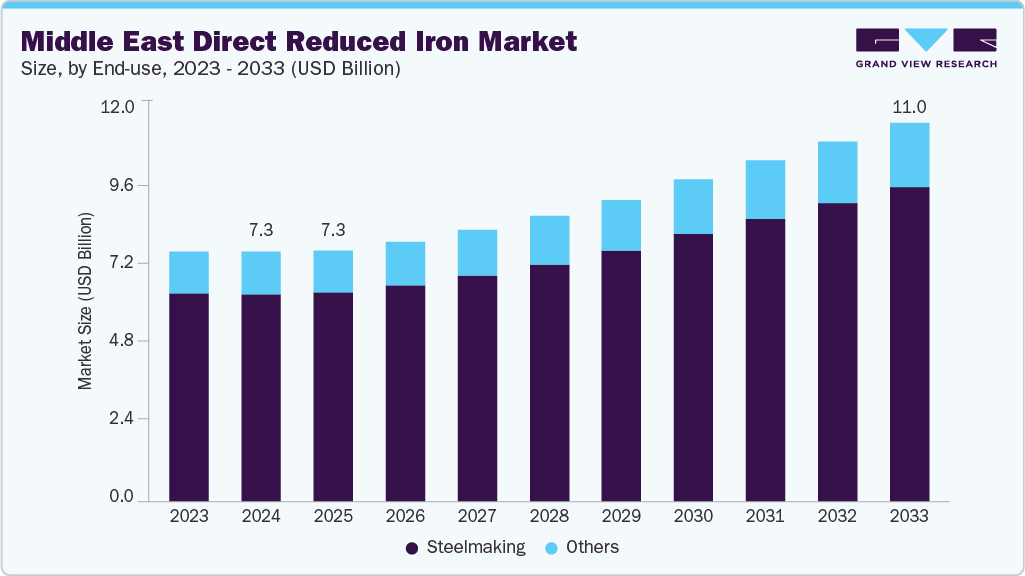
The Middle East direct reduced iron market size was estimated at USD 7.27 billion in 2024 and is projected to reach USD 11.02 billion by 2033, growing at a CAGR of 5.3% from 2025 to 2033. DRI plays a vital role in steelmaking in the Middle East and is primarily produced using natural gas.
Key Market Trends & Insights
- The direct reduced iron market in the Middle East is expected to grow at a substantial CAGR of 5.3% from 2025 to 2033.
- By end-use, the steelmaking held the largest market revenue share of 83.2% in 2024.
- By form, the cold direct reduced iron (CDRI) segment held the revenue share of 77.9% in 2024.
Market Size & Forecast
- 2024 Market Size: USD 7.27 Billion
- 2033 Projected Market Size: USD 11.02 Billion
- CAGR (2025-2033): 5.3%
The region’s accelerating infrastructure projects, urban expansion, and industrial growth, driven by initiatives such as Saudi Vision 2030 and the UAE’s development plans, are fueling steel demand and, in turn, boosting DRI usage. Rising focus on climate change and stricter environmental policies push steelmakers to adopt cleaner alternatives to traditional blast furnace processes. Gas-based Direct Reduced Iron (DRI), which emits significantly less carbon dioxide, has become the preferred option in the region, especially as governments promote low-carbon technologies in line with global decarbonization commitments. The area is already the world’s largest DRI-producing hub, supported by abundant natural gas reserves and ongoing investments in hydrogen-ready plants, positioning it at the forefront of the green steel transition.
Technological advancements in gas-based reduction processes have improved efficiency, scalability, and product quality, strengthening the region’s competitiveness in global steel supply chains. Introducing modular and hydrogen-compatible DRI plants also encourages wider adoption, enabling large producers and smaller players to expand capacity. These developments, combined with growing demand from domestic infrastructure megaprojects and strong export opportunities, are driving rapid growth of the DRI market across the region.
Drivers, Opportunities & Restraints
The region’s abundant natural gas reserves drive the DRI market, making gas-based reductions more cost-effective and sustainable than coal-based alternatives. Growing steel demand from large-scale infrastructure and industrial projects, such as Saudi Arabia’s NEOM megacity and the UAE’s real estate expansion, further fuels DRI consumption. In addition, the global shift toward low-carbon steel is boosting the adoption of DRI. Iran was expected to produce over 25 million tons of DRI in the first nine months of 2024, highlighting the region’s strong production base.
Due to its abundant solar and wind energy resources, the region is uniquely positioned to lead in hydrogen-based “green DRI” production. Governments and global players are investing heavily to capitalize on this, such as Vale’s plan to develop green iron mega-hubs in Saudi Arabia, Oman, and the UAE. With Europe’s Carbon Border Adjustment Mechanism (CBAM) tightening trade rules on carbon-intensive steel, the region has an opportunity to become a key exporter of low-carbon DRI and hot-briquetted iron (HBI) to international markets.
Despite strong growth potential, the Middle East DRI market faces challenges such as high capital requirements for hydrogen infrastructure, volatility in natural gas prices, and geopolitical risks that can disrupt production and exports. For example, supply disruptions in Iran’s steel and DRI exports during 2024 due to sanctions and logistical constraints highlighted the vulnerability of the region’s supply chain. Moreover, the transition to hydrogen-based DRI requires large-scale renewable energy deployment, and delays in such projects could slow down the region’s green steel ambitions.
End-use Insights
In the Middle East, direct reduced iron (DRI), also known as sponge iron, has become a vital feedstock for electric arc furnaces (EAFs) and other steelmaking processes due to its high purity and efficiency. With regional infrastructure development accelerating under initiatives such as Saudi Vision 2030 and large-scale projects in the UAE and Qatar, steel demand from the construction, automotive, and manufacturing sectors continues to rise, boosting the adoption of DRI. Its lower carbon footprint than traditional blast furnace processes also aligns with the region’s transition toward sustainable steelmaking.
The other segment, which includes foundry applications, ferroalloy production, and ductile iron manufacturing, is also expected to record steady growth in the Middle East. Foundries in the region are increasingly turning to DRI as a reliable, cost-effective, and environmentally sustainable alternative to pig iron and scrap. With its superior consistency and lower impurity levels, DRI is particularly well-suited for producing high-performance castings used across the automotive, machinery, and construction industries, further strengthening its role in supporting diverse industrial processes.
Form Insights
In the Middle East, Cold Direct Reduced Iron (CDRI) is produced by reducing iron ore at relatively low temperatures using natural gas or hydrogen as reducing agents, resulting in a highly metalized product that can be directly charged into electric arc furnaces (EAFs) for steelmaking. With total global CDRI production reaching 108.7 Mt in 2023, the Middle East has maintained its position as a leading producer, supported by abundant natural gas reserves and growing investments in hydrogen-ready reduction facilities. The region’s steelmakers are increasingly adopting CDRI as a sustainable feedstock, driven by its significantly lower carbon emissions than conventional blast furnace methods.
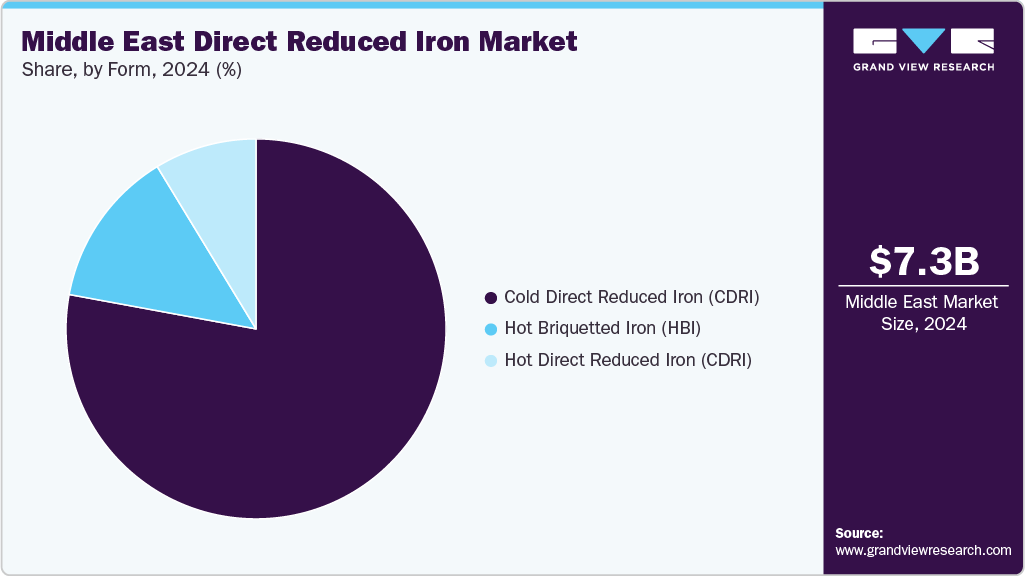
Hot Briquetted Iron (HBI) is expected to record the fastest growth rate in the Middle East over the coming years. As steel producers focus on reducing their carbon footprint, HBI is gaining traction as a cleaner alternative to pig iron and sinter feed, with the added advantage of being easier to transport and store than CDRI. The growing number of regional projects, such as Vale’s planned green iron hubs in Saudi Arabia and Oman, underscores the strategic importance of HBI in meeting domestic and export market demand.
Country Insights
The Middle East direct reduced iron (DRI) market is witnessing strong demand, driven by the rising steel requirements in rapidly industrializing economies such as India, China, and Southeast Asia. The neighbouring region has strengthened the Middle East’s position as a key supplier of Direct Reduced Iron (DRI). As these countries continue to expand infrastructure, urbanization, and manufacturing, the need for high-quality steel has surged, boosting the region’s export potential. DRI, a critical raw material for steelmaking, has seen rising demand from global markets and domestic megaprojects in the Middle East. According to the Midrex World Direct Reduction Statistics, the region accounted for nearly half of global DRI production in 2023, reaffirming its dominance in the industry.
Saudi Arabia Direct Reduced Iron Market Trends
Saudi Arabia held 9.0% revenue share of the Middle East direct reduced iron market. Saudi Arabia is rapidly emerging as a leader in DRI production, supported by large-scale infrastructure investments under Vision 2030 and the growing emphasis on sustainable steelmaking. The Kingdom is advancing hydrogen-ready DRI plants to reduce emissions, aligning with global decarbonization efforts. In 2024, projects such as Vale’s green iron mega-hub in Ras Al Khair highlighted Saudi Arabia’s strategy to position itself as a worldwide supplier of low-carbon DRI and HBI. With abundant natural gas and renewable energy potential, the country is well-placed to transition toward hydrogen-based steel production.
UAE Direct Reduced Iron Market Trends
The UAE is strengthening its role in the market through investments in both domestic capacity and green technology. Emirates Steel Arkan, one of the leading producers, has already deployed advanced gas-based reduction technologies and is investing in hydrogen-based pilots to prepare for carbon-neutral steelmaking. The UAE’s strategic location near major steel-importing regions such as India and Southeast Asia enhances its export potential. Moreover, ongoing renewable energy projects, such as the Mohammed bin Rashid Al Maktoum Solar Park, provide a foundation for cost-competitive hydrogen production, ensuring the long-term viability of DRI as a cleaner alternative to conventional steelmaking.
Key Middle East Direct Reduced Iron Company Insights
Some of the key players operating in the market include Emirates Steel Arkan, Ezz Steel, and others.
-
Emirates Steel Arkan is one of the largest integrated steel producers in the Middle East, playing a central role in the UAE’s industrial growth. The company operates advanced gas-based DRI plants using MIDREX technology, producing both Cold and Hot DRI as feedstock for its electric arc furnaces. In 2024, it launched a pilot hydrogen-based DRI project, aligning with the UAE’s vision of transitioning to green and sustainable steel production.
-
Ezz Steel, the largest steel producer in Egypt and one of the biggest in the MENA region, operates some of the world’s largest DRI modules at Suez with an annual capacity of over 5 million tonnes. Its operations focus on supplying high-quality sponge iron to its integrated steelmaking facilities, serving domestic and export markets. Recent investments have been directed toward enhancing energy efficiency and preparing its DRI plants for hydrogen-based steelmaking.
-
SULB Company, based in Bahrain, is a joint venture between Foulath Holding and Yamato Kogyo of Japan, and is recognized as the region’s only fully integrated medium and heavy section steel producer. The company operates a MIDREX-based DRI plant with a capacity of 1.5 million tonnes per year, producing both hot and cold DRI. In 2023, SULB initiated hydrogen-ready DRI plans, supporting Bahrain’s national decarbonization strategy and reinforcing its role in sustainable steelmaking.
Key Middle East Direct Reduced Iron Companies:
- Emirates Steel Arkan
- Ezz Steel
- Gol-e-Gohar Iron & Steel
- Hadeed - SABIC
- Hormozgan Steel Company
- Khouzestan Steel Company
- Libyan Iron & Steel Company (LISCO)
- Mobarakeh Steel Company
- Qatar Steel
- SULB Company
Recent Developments
-
In May 2024, Vale announced plans to develop green iron mega-hubs in Saudi Arabia, the UAE, and Oman, in partnership with local players. These hubs likely to produce hot briquetted iron (HBI) using natural gas with future readiness for green hydrogen, with an estimated capacity of up to 40 million tons annually. The initiative aims to supply low-carbon iron feedstock to regional steelmakers and key export markets, supporting global decarbonization.
-
In April 2024, Emirates Steel Arkan signed an agreement with Abu Dhabi National Energy Company (TAQA) and Abu Dhabi Ports to explore hydrogen-based DRI production. The project focuses on producing green DRI and HBI for local steelmaking and export to Europe. This collaboration positions Emirates Steel Arkan as one of the first in the GCC to transition toward hydrogen-enabled steel production.
-
In March 2024, Ezz Steel invested in expanding its DRI capacity at Suez with a new energy-efficient MIDREX module. The expansion increases the company’s production capacity beyond 5 million tons per year, reinforcing its position as one of the world’s largest DRI producers. The new module is designed to be hydrogen-ready, aligning with Egypt’s strategy to become a hub for low-carbon steel in the MENA region.
Middle East Direct Reduced Iron Market Report Scope
|
Report Attribute
|
Details
|
|
Market size value in 2025
|
USD 7.32 billion
|
|
Revenue forecast in 2033
|
USD 11.02 billion
|
|
Growth rate
|
CAGR of 5.3% from 2025 to 2033
|
|
Base year for estimation
|
2024
|
|
Historical data
|
2021 - 2023
|
|
Forecast period
|
2025 - 2033
|
|
Quantitative Units
|
Revenue in USD million/billion, volume in kilotons and CAGR from 2025 to 2033
|
|
Report coverage
|
Volume forecast, revenue forecast, competitive landscape, growth factors, and trends
|
|
Segments covered
|
End-use, form, country
|
|
Regional scope
|
Middle East
|
|
Country scope
|
Saudi Arabia; UAE; Qatar; Oman; Iran
|
|
Key companies profiled
|
Emirates Steel Arkan; Ezz Steel; Gol-e-Gohar Iron & Steel; Hadeed - SABIC; Hormozgan Steel Company; Khouzestan Steel Company; Libyan Iron & Steel Company (LISCO); Mobarakeh Steel Company; Qatar Steel; SULB Company
|
|
Customization scope
|
Free report customization (equivalent up to 8 analysts working days) with purchase. Addition or alteration to country, regional & segment scope.
|
|
Pricing and purchase options
|
Avail customized purchase options to meet your exact research needs. Explore purchase options
|
Middle East Direct Reduced Iron Market Report Segmentation
This report forecasts revenue and volume growth at regional and country levels and provides an analysis of the latest industry trends in each of the sub-segments from 2021 to 2033. For this study, Grand View Research has segmented the Middle East direct reduced iron market based on end-use, form, and country:
-
End-use Outlook (Revenue, USD Million; Volume, Kilotons, 2021 - 2033)
-
Form Outlook (Revenue, USD Million; Volume, Kilotons, 2021 - 2033)
-
Cold Direct Reduced Iron (CDRI)
-
Hot Direct Reduced Iron (CDRI)
-
Hot Briquetted Iron (HBI)
-
Country Outlook (Revenue, USD Million; Volume, Kilotons, 2021 - 2033)
-
Middle East
-
Saudi Arabia
-
UAE
-
Qatar
-
Oman
-
Iran
Frequently Asked Questions About This Report
b. The Middle East direct reduced iron market size was estimated at USD 7.27 billion in 2024 and is expected to reach USD 7.32 billion in 2025.
b. The Middle East direct reduced iron market is expected to grow at a compound annual growth rate of 5.3% from 2025 to 2033 to reach USD 11.02 billion by 2033.
b. The steelmaking segment dominated the market with a revenue share of over 83.0% in 2024.
b. Some of the key vendors in the Middle East direct reduced iron market are Emirates Steel Arkan, Ezz Steel, Gol-e-Gohar Iron & Steel, Hadeed SABIC, Hormozgan Steel Company, Khouzestan Steel Company, Libyan Iron & Steel Company (LISCO), Mobarakeh Steel Company, Qatar Steel, and SULB Company.
b. The growth of the Middle East direct reduced iron (DRI) market is primarily driven by the region’s abundant and low-cost natural gas, which makes gas-based DRI production highly competitive. Additionally, strong renewable energy potential supports a shift toward hydrogen-based “green DRI,” positioning the region as a key supplier for low-carbon steel in global markets.

 Download Sample Report
















