
- Home
- »
- Advanced Interior Materials
- »
-
Middle East Extrusion Machinery Market Size Report, 2033GVR Report cover
![Middle East Extrusion Machinery Market Size, Share & Trends Report]()
Middle East Extrusion Machinery Market (2025 - 2033) Size, Share & Trends Analysis Report By Material (Plastics, Metal), By Type (Single-screw, Twin Screw), By End-use (Construction, Consumer Goods, Packaging, Automotive), By Country, And Segment Forecasts
- Report ID: GVR-4-68040-745-0
- Number of Report Pages: 100
- Format: PDF
- Historical Range: 2021 - 2023
- Forecast Period: 2025 - 2033
- Industry: Advanced Materials
- Report Summary
- Table of Contents
- Segmentation
- Methodology
- Download FREE Sample
-
 Download Sample Report
Middle East Extrusion Machinery Market Summary
The Middle East extrusion machinery market size was estimated at USD 350.5 million in 2024 and is projected to reach USD 473.6 million by 2033, growing at a CAGR of 3.5% from 2025 to 2033. The market is witnessing steady growth, driven by rising demand across construction, packaging, and industrial applications.
Key Market Trends & Insights
- The UAE extrusion machinery market is expected to grow at a CAGR of 4.3% from 2025 to 2033.
- By material, the plastics segment is expected to grow at a CAGR of 3.6% from 2025 to 2033.
- By type, the twin screw segment is expected to grow at a CAGR of 4.3% from 2025 to 2033.
- By end use, the packaging segment is expected to grow at a CAGR of 4.3% from 2025 to 2033.
Market Size & Forecast
- 2024 Market Size: USD 350.5 Million
- 2033 Projected Market Size: USD 473.6 Million
- CAGR (2025-2033): 3.5%
Extrusion machinery is widely used in producing plastic pipes, films, sheets, and profiles that serve as essential inputs for infrastructure, consumer goods, and industrial manufacturing. The region’s construction boom, led by large-scale residential, commercial, and infrastructure projects in the GCC, continues to fuel demand for extruded building materials such as window frames, façade systems, and conduit piping.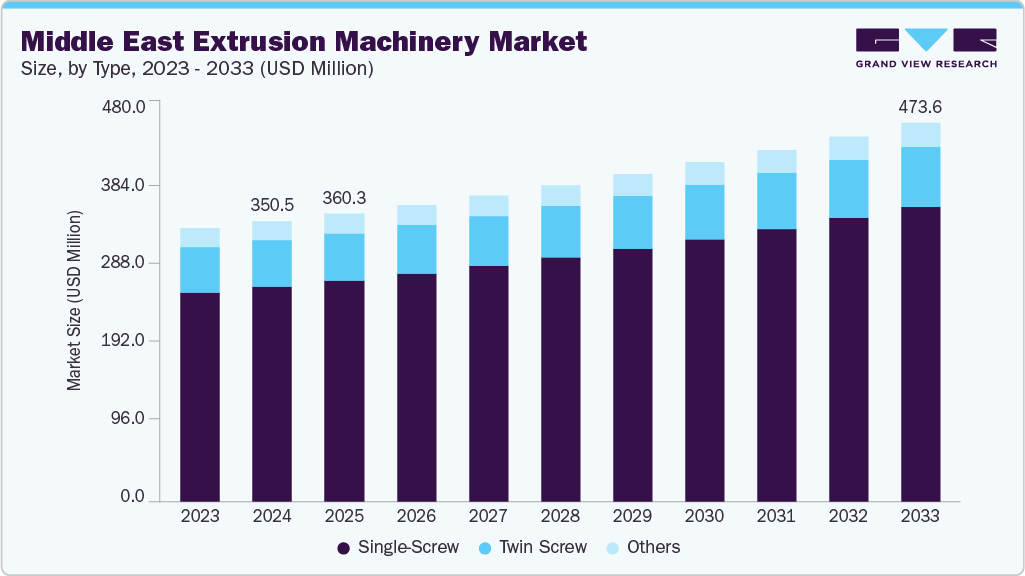
Parallel growth in regional plastics consumption and downstream fabricating capacity is expanding demand for higher-throughput, automated extrusion systems that reduce labor and energy costs. Manufacturers are therefore prioritizing machines with improved energy efficiency, faster changeover and integrated quality-control features to match contractor timelines and specification requirements.
Market Concentration & Characteristics
The Middle East extrusion-machinery industry shows a moderate degree of concentration. Most extrusion lines are supplied by international manufacturers from Europe, East Asia, and North America, with regional players mainly operating as distributors, service providers, or processors. This dependency creates a business environment where aftersales service, technical training, and spare parts availability are critical differentiators for suppliers. Localized production of machinery is limited, but growing government initiatives aimed at industrial diversification are gradually encouraging joint ventures and regional assembly operations.
The Middle East extrusion machinery industry exhibits a high degree of end use concentration, with construction and infrastructure accounting for the largest share of demand. Extrusion lines for pipes, profiles, and aluminum systems are extensively used in residential, commercial, and industrial projects, particularly in the GCC where mega-projects and urban expansion dominate investment priorities. Packaging represents the second major end use segment, driven by rising consumption of packaged food, beverages, and consumer goods, which fuels demand for film and sheet extrusion machinery.
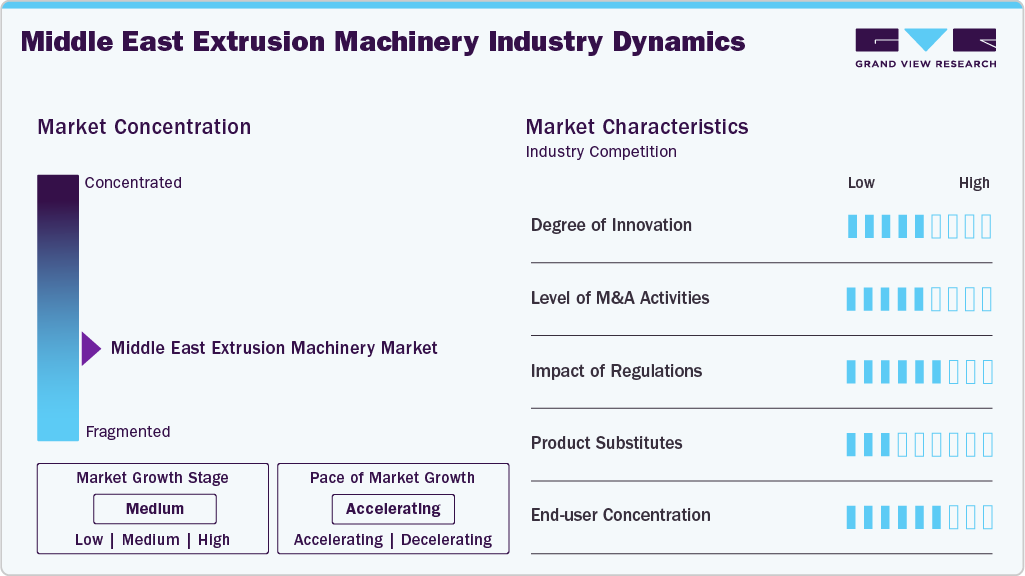
The market is also shaped by increasing demand for advanced, energy-efficient, and automated extrusion systems. Processors are gradually upgrading from legacy lines to modern machinery with higher throughput, multilayer co-extrusion capabilities, and digital control systems. This trend reflects both the rising cost pressures in manufacturing and the need for better quality consistency to serve export markets.
The regulatory landscape of the Middle East market is shaped by a combination of industrial development policies, safety and environmental standards, and trade regulations. Governments across the GCC, particularly Saudi Arabia and the UAE, have launched industrial diversification programs such as Saudi Vision 2030 and the UAE’s Operation 300bn, which incentivize local manufacturing and encourage investment in modern, energy-efficient extrusion machinery.
Drivers, Opportunities & Restraints
Market growth in the Middle East extrusion machinery sector is primarily driven by sustained investment in construction and infrastructure, which generates significant demand for extruded plastic pipes, aluminum profiles, and other building materials. Government-led diversification initiatives, such as Saudi Vision 2030 and the UAE’s industrial strategy, are further encouraging domestic manufacturing, spurring new investments in advanced extrusion lines. Rising consumption of packaged food and beverages across the region is creating strong opportunities for plastic film and sheet extrusion machinery, while the shift toward e-commerce and logistics is supporting higher packaging demand.
A key opportunity lies in the adoption of energy-efficient and automated extrusion technologies, as processors seek to reduce operating costs, improve quality, and comply with tightening sustainability standards. In addition, the development of industrial clusters, free zones, and trade-friendly policies provides a favorable environment for international machinery suppliers to expand their presence through partnerships, distribution networks, and localized service hubs.
A key restraint in the Middle East market is the high upfront capital investment required for advanced, automated lines, which often exceeds the budgets of small and mid-sized processors. Many regional firms remain reliant on used or retrofitted equipment due to the cost differential, limiting uptake of next-generation technologies. Additional challenges include fluctuating raw material prices, delays in large-scale construction projects, and supply chain disruptions that affect delivery timelines and spare-parts availability.
Type Insights
The single-screw segment is the largest by market share, accounting for 63.6% in 2024 due toits cost-effectiveness, ease of operation, and suitability for producing pipes, films, and basic profiles. Demand is supported by smaller processors and cost-sensitive markets across Qatar, Kuwait, and other emerging economies in the region. Their reliability in handling standard polymer grades makes them the preferred choice for low- to medium-capacity operations. In addition, their relatively lower maintenance requirements appeal to buyers focused on minimizing operating costs.
The twin screw segment is expected to grow at a CAGR of 4.3% from 2025 to 2033 in terms of revenue. Twin-screw extrusion machinery is increasingly preferred in the Middle East due to its higher efficiency, mixing capabilities, and ability to process complex formulations including recyclates, additives, and fillers. The push for advanced packaging, automotive components, and recycled materials is expanding adoption. Processors investing in modern facilities to serve export markets often prioritize twin-screw lines for their consistency and throughput. Government incentives for sustainable manufacturing further boost demand for twin-screw extruders that enable high-quality end products.
End-use Insights
The construction end use segment led the market and accounted for a revenue share of 30.9% in 2024, fueled by massive investments in housing, infrastructure, and mega-city projects under national diversification programs. Demand for pipes, profiles, and aluminum sections ensures consistent procurement of extrusion lines. Urbanization, water network upgrades, and renewable energy projects further expand requirements. Construction-related demand is especially strong in Saudi Arabia and the UAE, aligning with state-backed development agendas.
The packaging segment is expected to grow at a CAGR of 4.3% from 2025 to 2033 in terms of revenue. The packaging industry's adoption of extrusion machines is expected to grow considerably, with extrusion machinery used for films, sheets, and thermoformed packaging solutions. Rising food and beverage consumption, e-commerce expansion, and regulatory emphasis on recyclable packaging are pushing processors to invest in advanced, high-output lines. Twin-screw and multilayer extrusion capabilities are particularly in demand to achieve higher performance and sustainability targets. Regional export-oriented packaging producers also expand capacity to serve global markets, reinforcing machinery sales.
Material Insights
The plastics segment held the largest market share accounting for 76.6% in 2024 driven by rising infrastructure projects requiring PVC and HDPE pipes, cables, profiles, and insulation materials, particularly in water management, power distribution, and housing sectors. Regional growth in packaging and consumer goods also increases the need for film, sheet, and profile extrusion lines. Moreover, the availability of competitively priced polymer feedstock from local petrochemical plants further incentivizes processors to expand capacity.
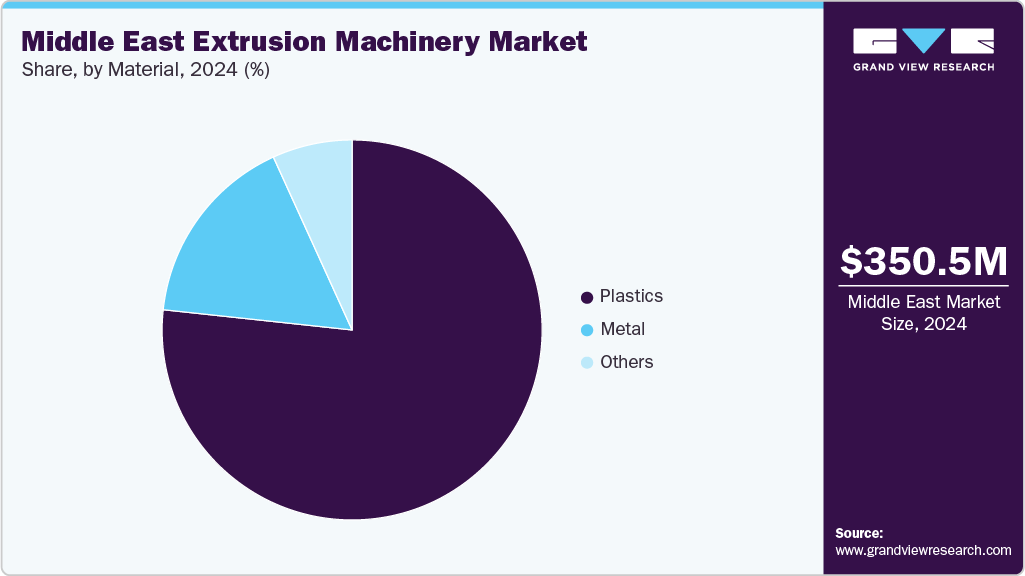
The metal segment is expected to grow at a CAGR of 3.0% from 2025 to 2033 in terms of revenue. Metal extrusion machinery demand is driven by the surge in aluminum profile production for construction, automotive, and industrial applications. Gulf countries, led by the UAE and Saudi Arabia, continue to invest heavily in downstream aluminum processing, which requires advanced presses and extrusion equipment. Lightweighting trends in transport and infrastructure boost aluminum extrusion adoption, while government-backed localization initiatives encourage regional production. Investments in energy-efficient lines and automation are also influencing buyers to modernize existing machinery.
Country Insights
Saudi Arabia Extrusion Machinery Market Trends
The extrusion machinery industry in Saudi Arabia held the largest regional revenue share, accounting for 39.3% in 2024. The country’s industrial strategy and Vision 2030 diversification agenda are driving investment in local manufacturing capacity, including extrusion for construction, packaging, and automotive components; state projects and giga-developments create predictable, large-volume demand. Local content and in-country value rules increase the attractiveness of on-shore extrusion lines and integrated supply chains, encouraging processors to partner with global OEMs for the transfer of technology and local service hubs.
UAE Extrusion Machinery Market Trends
The UAE extrusion machinery industry is expected to expand considerably with a projected CAGR of 4.3% from 2025 to 2033. The UAE’s push to “Make it in the Emirates,” combined with ADNOC-led in-country manufacturing frameworks and the Emirates’ logistics advantages, attracts investments in extrusion capabilities for aluminum and plastics processing. Strong trade-hub status (Jebel Ali, Khalifa) and proximity to African and South Asian markets make the UAE an ideal regional service and distribution base for extrusion OEMs and spare-parts supply chains. Construction, oilfield services, and an expanding upstream/downstream industrial ecosystem sustain demand for specialized lines (e.g., high-output pipe and profile extrusion).
Key Middle East Extrusion Machinery Company Insights
Some of the key players operating in the market include KraussMaffei and Davis Standard
-
KraussMaffei is an engineering company involved in plastics and rubber machinery, with a strong competency in injection molding, extrusion, and reaction process technology. Its extrusion portfolio includes single- and twin-screw extruders, lines for pipes, profiles, sheets, and compounding. Serving industries from automotive and construction to packaging and chemicals, KraussMaffei offers integrated processing solutions. It employs thousands worldwide and positions itself as a technology partner focused on efficiency and innovation.
-
Davis-Standard, LLC is a leading global manufacturer of extrusion and converting technology, headquartered in Pawcatuck, Connecticut, USA. With a history dating back to 1848, the company has established itself as one of the most recognized names in the extrusion machinery industry, offering a broad portfolio of equipment and integrated solutions. Davis-Standard specializes in designing and manufacturing extrusion systems for plastics and rubber processing, with applications spanning pipe and profile extrusion, film and sheet production, blow molding, wire and cable coating, and compounding.
Key Middle East Extrusion Machinery Companies:
- KraussMaffei
- Davis Standard
- USEON Technology Limited
- JWELL MACHINERY CO.,LTD
- DWELL
- POLYTECH MIDDLE EAST
- Fusionpac Technologies (Meaf Machines B.V.)
- Beier Group Co., Ltd.
- ADREMAC
- ALEMO
Recent Developments
-
In January 2024, Davis-Standard finalized its acquisition of Extrusion Technology Group (ETG), bringing brands like battenfeld-cincinnati, exelliq, and Simplas under its umbrella. The acquisition is aimed at broadening Davis-Standard’s product portfolio, strengthening global reach, and enhancing Material capabilities in extrusion and converting technologies. Former ETG CEO Gerold Schley will now serve as President of ETG and join Davis-Standard’s leadership team, ensuring continuity as the companies integrate operations and deliver expanded value to customers worldwide.
-
In September 2024, Rollepaal Pipe Extrusion Technology B.V. and Reifenhäuser MEA announced their strategic partnership to strengthen their presence across Africa and the Middle East in the plastic pipe extrusion industry. The move aims to combine Rollepaal’s technical expertise with the deep regional market knowledge and Material networks of Reifenhäuser MEA. Reifenhäuser MEA will represent Rollepaal in many Gulf countries (Saudi Arabia, UAE, Oman, Kuwait, Bahrain, Qatar, Yemen) and throughout most of Africa (with a few country exceptions). The joint effort aims to offer manufacturers locally-adapted, high-tech extrusion solutions with a focus on sustainability and competitiveness.
Middle East Extrusion Machinery Market Report Scope
Report Attribute
Details
Market size value in 2025
USD 360.3 million
Revenue forecast in 2033
USD 473.6 million
Growth rate
CAGR of 3.5% from 2025 to 2033
Historical data
2021 - 2023
Forecast period
2025 - 2033
Quantitative units
Revenue in USD million, and CAGR from 2025 to 2033
Report coverage
Revenue forecast, company ranking, competitive landscape, growth factors, and trends
Segments covered
Material, type, end-use, country
Country scope
Saudi Arabia; UAE; Oman; Kuwait; Israel; Qatar
Key companies profiled
KraussMaffei; Davis Standard; USEON Technology Limited; JWELL MACHINERY CO., LTD; DWELL; POLYTECH MIDDLE EAST; Fusionpac Technologies (Meaf Machines B.V.); Beier Group Co., Ltd.; ADREMAC; ALEMO
Customization scope
Free report customization (equivalent up to 8 analysts working days) with purchase. Addition or alteration to country, regional & segment scope.
Pricing and purchase options
Avail customized purchase options to meet your exact research needs. Explore purchase options
Middle East Extrusion Machinery Market Report Segmentation
This report forecasts revenue growth at country levels and provides an analysis of the latest industry trends in each of the sub-segments from 2021 to 2033. For this study, Grand View Research has segmented the Middle East extrusion machinery market report based on material, type, end-use, and country.
-
Material Outlook (Revenue, USD Million, 2021 - 2033)
-
Plastics
-
Metal
-
Others
-
-
Type Outlook (Revenue, USD Million, 2021 - 2033)
-
Single-screw
-
Twin Screw
-
Others
-
-
End-use Outlook (Revenue, USD Million, 2021 - 2033)
-
Construction
-
Consumer Goods
-
Automotive
-
Packaging
-
Others
-
-
Country Outlook (Revenue, USD Million, 2021 - 2033)
-
Saudi Arabia
-
Oman
-
UAE
-
Qatar
-
Kuwait
-
Israel
-
Frequently Asked Questions About This Report
b. The Middle East extrusion machinery market size was estimated at USD 350.5 million in 2024 and is expected to be USD 360.3 million in 2025.
b. The Middle East extrusion machinery market is expected to grow at a compound annual growth rate of 3.5% from 2025 to 2033, reaching USD 473.6 million by 2033.
b. The single-screw segment is the largest by market share, accounting for 63.6% in 2024 due to their cost-effectiveness, ease of operation, and suitability for producing pipes, films, and basic profiles. Demand is supported by smaller processors and cost-sensitive markets across Qatar, Kuwait, and other emerging economies in the region.
b. Some of the key players operating in the Middle East extrusion machinery market include KraussMaffei, Davis Standard, USEON Technology Limited, JWELL MACHINERY CO., LTD, DWELL, POLYTECH MIDDLE EAST, Fusionpac Technologies (Meaf Machines B.V.), Beier Group Co., Ltd., ADREMAC, and ALEMO.
b. The Middle East extrusion machinery market is driven by large-scale infrastructure and construction projects, coupled with growing demand for plastics and aluminum products across packaging, automotive, and utilities. Supportive government initiatives, local petrochemical feedstock availability, and sustainability-focused investments further accelerate machinery adoption.


Share this report with your colleague or friend.
Need a Tailored Report?
Customize this report to your needs — add regions, segments, or data points, with 20% free customization.


ISO 9001:2015 & 27001:2022 Certified
We are GDPR and CCPA compliant! Your transaction & personal information is safe and secure. For more details, please read our privacy policy.
Trusted market insights - try a free sample
See how our reports are structured and why industry leaders rely on Grand View Research. Get a free sample or ask us to tailor this report to your needs.













