
- Home
- »
- Renewable Chemicals
- »
-
Middle East Green Ammonia Market, Industry Report, 2033GVR Report cover
![Middle East Green Ammonia Market Size, Share & Trends Report]()
Middle East Green Ammonia Market (2025 - 2033) Size, Share & Trends Analysis Report By Technology (Solid Oxide Electrolysis, Proton Exchange Membrane, Alkaline Water Electrolysis), By End Use, By Country, And Segment Forecasts
- Report ID: GVR-4-68040-709-6
- Number of Report Pages: 80
- Format: PDF
- Historical Range: 2018 - 2023
- Forecast Period: 2025 - 2033
- Industry: Specialty & Chemicals
- Report Summary
- Table of Contents
- Segmentation
- Methodology
- Download FREE Sample
-
 Download Sample Report
Middle East Green Ammonia Market Summary
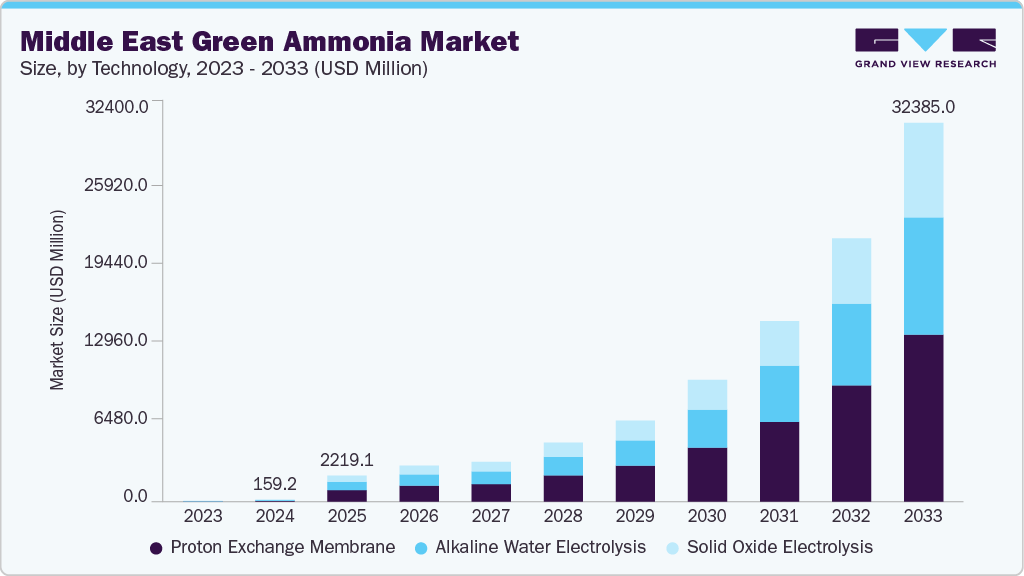
The Middle East green ammonia market size was estimated at USD 159.2 million in 2024 and is projected to reach USD 32,385 million by 2033, growing at a CAGR of 39.8% from 2025 to 2033, due to its increasing demand in fertilizers, which reinforces the need for sustainable solutions that do not compromise productivity.
Key Market Trends & Insights
- Saudi Arabia dominated the Middle East green ammonia market with the largest revenue share of 36.7% in 2024.
- By End Use, fertilizers Middle East green ammonia market is expected to witness the fastest growth of 40.9% from 2025 to 2033.
- By End Use, transportation Middle East green ammonia, by Technology dominated the market with a revenue share of 30.7% in 2024.
- By Technology, proton exchange membrane dominated the Middle East green ammonia market with a revenue share of 44.4% in 2024.
- By Technology, solid oxide electrolysis Middle East green ammonia market is expected to witness the fastest growth of 40.8% from 2025 to 2033.
Market Size & Forecast
- 2024 Market Size: USD 159.2 Million
- 2033 Projected Market Size: USD 32,385 Million
- CAGR (2025-2033): 39.8%
- Saudi Arabia: Largest market in 2024
- UAE: Fastest growing market
Technological advancements in electrolyzes and ammonia synthesis, coupled with supportive policies, further accelerate the transition toward green ammonia. Serving as a clean feedstock for nitrate-based fertilizers, green ammonia enables the fertilizer industry to significantly lower its carbon footprint while maintaining essential nutrient supplies for crops.In addition, nitrogen-based fertilizers are essential for feeding the growing population, but traditional production methods relying on fossil fuels result in significant greenhouse gas emissions, creating an urgent need for sustainable alternatives. Green ammonia addresses this challenge by using renewable energy to produce hydrogen through electrolysis, combined with nitrogen extracted from the air, enabling ammonia synthesis without carbon emissions. The key drivers for adopting green ammonia in fertilizer production include the global imperative to reduce environmental impact and meet climate commitments, the increasing availability and affordability of renewable energy sources, and the desire to strengthen supply chain resilience through localized fertilizer production.
Green ammonia, produced using renewable energy sources, presents a promising solution to decarbonize the transportation sector in the Middle East. This carbon-free fuel can replace conventional fossil fuels across multiple transportation modes including passenger and freight aviation, buses, rail, trucking, and marine shipping, sectors that are significant contributors to regional greenhouse gas emissions. By leveraging the Middle East’s abundant renewable energy potential, particularly solar power, green ammonia can be produced locally to meet transportation fuel demands, reducing reliance on fossil fuels and enhancing energy security. In addition, ammonia can be used in internal combustion engines with relatively simple modifications, similar to propane conversions, and its combustion emits only nitrogen and water vapor, making it a non-polluting alternative.
However, despite its strong growth potential, the Middle East green ammonia market faces several challenges that could impede its expansion. Strict regulatory frameworks across the region, especially those related to emissions control and environmental management, impose higher compliance costs on producers and developers of green ammonia technologies.
Market Concentration & Characteristics
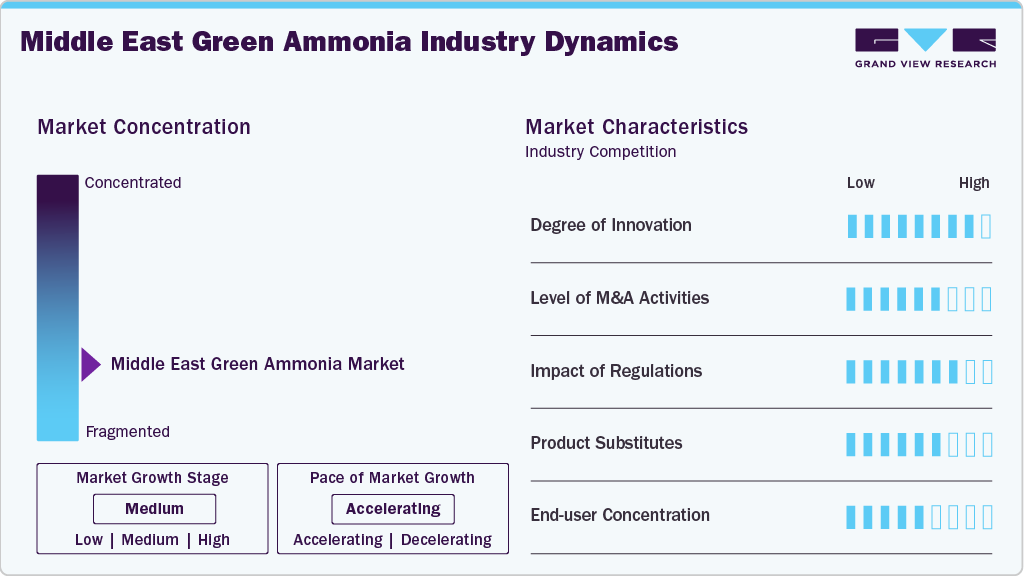
The Middle East green ammonia market in the region is moderately fragmented, with a few dominant players commanding significant market share due to their extensive vertical integration and large-scale operations. These leading companies maintain control over the entire value chain, from renewable energy sourcing and green hydrogen production to ammonia synthesis and distribution, enabling them to achieve cost efficiencies, ensure consistent product quality, and provide reliable supply. Their integrated infrastructure, coupled with robust regional distribution networks and advanced technological expertise, allows them to effectively cater to key sectors such as power generation, fertilizer production, and transportation. This strategic positioning also supports compliance with stringent regional regulatory frameworks and strengthens their ability to meet the rising demand for sustainable, carbon-neutral ammonia solutions throughout the Middle East.
Emerging players in the Middle East green ammonia market are steadily expanding their footprint by leveraging regional strengths such as accelerating industrialization, rising demand in power generation and fertilizer sectors, and growing investments in advanced green hydrogen and ammonia production technologies. These newer entrants focus on cost-effective green ammonia production methods and target key applications including power generation, transportation, and agriculture, catering to both domestic consumption and export markets. This evolving landscape, marked by the coexistence of well-established dominant companies and nimble regional players capitalizing on local resources and market demands, is reshaping the competitive dynamics of the green ammonia market in the Middle East.
However, the market faces several challenges, including supply chain disruptions, volatile prices of raw materials and renewable energy inputs, and increasing regulatory pressures related to environmental sustainability and carbon emissions. Moreover, climate-related issues such as rising temperatures, water scarcity, and extreme weather events pose risks to production facilities and feedstock availability. These technological and regulatory challenges highlight the urgent need for innovation and strategic adaptation within the green ammonia industry to ensure resilient, sustainable growth across the Middle East region.
Technology Insights
Proton exchange membrane segment dominated the market Middle East green ammonia market and accounted for the largest revenue share of 44.4% in 2024, driven by its role in advancing green ammonia production by enabling efficient and flexible green hydrogen generation. Traditional ammonia production heavily relies on hydrogen derived from fossil fuels through energy-intensive processes such as steam methane reforming, which emit substantial amounts of CO2. Transitioning to green hydrogen-produced via water electrolysis powered by renewable energy sources such as wind and solar-offers a promising pathway to decarbonize ammonia synthesis. PEM electrolyzers are especially well-suited for green ammonia applications due to their capability to rapidly respond to the variable output of renewable energy, ensuring consistent hydrogen supply despite fluctuations in power availability. This adaptability is critical because ammonia synthesis requires stable hydrogen input for efficient operation. The integration of PEM electrolyzers with weather-based data models allows accurate simulation and optimization of hydrogen production under varying renewable energy conditions, particularly fluctuating wind power.
Solid oxide electrolysis segment Middle East green ammonia market is expected to grow fastest with a CAGR of 40.8% from 2025 to 2033 during the forecast period, driven by the unique advantages in the green chemical market to decarbonize ammonia production, traditionally reliant on fossil fuels that generate significant CO2 emissions. Operating at high temperatures, SOEs can efficiently produce hydrogen by utilizing waste heat from ammonia synthesis processes, resulting in improved energy efficiency compared to low-temperature electrolysis. This streamlined approach requires only air, water, and electricity, simplifying plant design and reducing complexity. Although current costs are high due to expensive electrolyzer components and electricity prices, technological advances and renewable energy availability are expected to improve economic viability. Innovations such as replacing conventional air separation units with modular Solid Electrolyte Oxygen Pumps (SEOPs) could enable more flexible and decentralized green ammonia production. SOE technology is crucial in advancing sustainable ammonia manufacturing and supporting global net-zero emission goals.
End Use Insights
The transportation segment by End Use dominated the Middle East green ammonia market with a market share of 30.7% in 2024, due to crucial solutions for the efficient and sustainable hydrogen transportation. Although green hydrogen holds great promise as a clean energy carrier, transporting it over long distances poses significant challenges. The liquefaction process for hydrogen requires extremely low temperatures and high energy input, and the infrastructure to support this is limited, making direct hydrogen transport costly and inefficient. Green ammonia addresses these challenges by serving as an effective hydrogen and energy carrier that is easier and more economical to transport. It has a higher volumetric energy density than liquid hydrogen, allowing more energy to be shipped in the same volume.
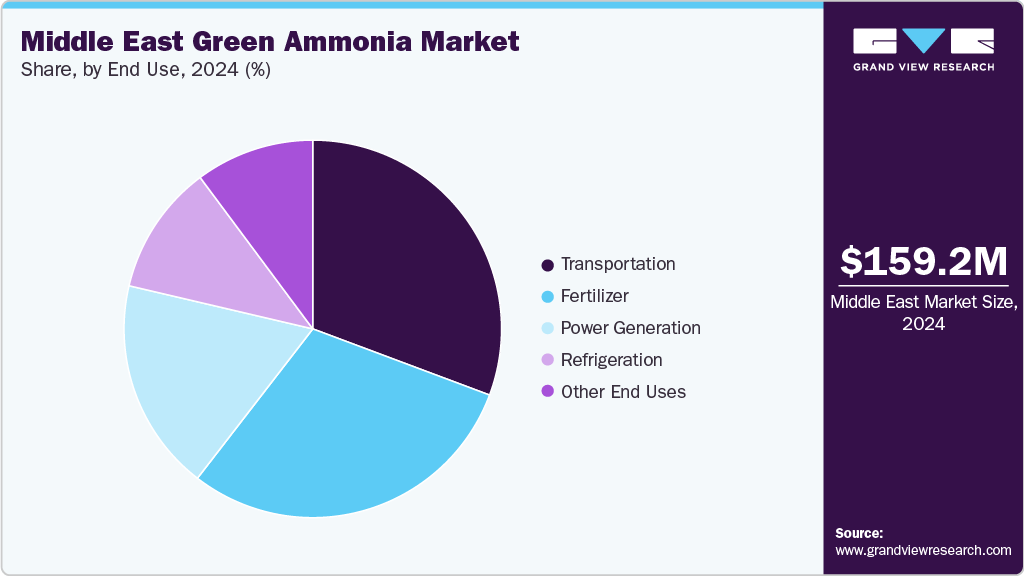
Fertilizers segment of Middle East green ammonia by End Use are expected to grow fastest with a CAGR of 40.9% from 2025 to 2033 during the forecast period due to the demand in the fertilizer industry. As the industry seeks sustainable solutions to rising costs and environmental challenges. Traditional ammonia production, heavily reliant on fossil fuels, has been a major contributor to global CO2 emissions. Green ammonia offers a carbon-neutral alternative by using renewable energy-powered water electrolysis to produce hydrogen, eliminating fossil fuel dependence and reducing emissions throughout the fertilizer production process.
In addition, on-site green ammonia production at fertilizer facilities helps cut transportation emissions and costs. With the global population rising and the demand for nitrogen-based fertilizers increasing steadily, green ammonia is becoming essential for ensuring sustainable food production. Despite the high investment and development time required for green ammonia plants, its environmental benefits and alignment with global climate goals position it as a key driver in transforming and expanding the fertilizer market.
Country Insights
Saudi Arabia Green Ammonia Market Trends
The Middle East green ammonia market in Saudi Arabia held 36.7% of the Middle East green ammonia market revenue share in 2024, strongly driven by green ammonia’s growing role as a sustainable fuel for power generation. As a future fuel, green ammonia offers near-zero carbon and sulfur oxide emissions when generated from renewable energy, making it an ideal choice for decarbonizing power plants. Its role in pioneering zero-carbon shipping fuels further accelerates its adoption in power generation. Green hydrogen, produced through electrolysis powered by renewables, is central to achieving net-zero emissions across shipping and power generation industries. By converting green hydrogen into ammonia, the energy can be transported and stored more efficiently, unlocking new pathways to decarbonize heavy industry and utilities. In August 2022, completion of the skid-mounted assembly for a 1,500 MTPA green ammonia plant in Saudi Arabia highlights the accelerating demand for green ammonia as a clean energy source in power generation. Key equipment, including the ammonia synthesis converter, water preheater, coolers, chillers, and NH3 separators, has been fully designed, manufactured, and pre-assembled off-site by KAPSOM, streamlining the installation process and reducing on-site construction time significantly
Israel Green Ammonia Market Trends
The Middle East green ammonia market in Israel are expected to grow fastest with a CAGR of 49.9% from 2025 to 2033 during the forecast period due to Israel’s growing challenges in agriculture sector, including the need for affordable and sustainable fertilizers and increasing pressures from climate change. These factors impact the resilience of local farming activities and threaten food security, affecting smallholder farmers and the broader agri-business landscape. Green ammonia, produced using green hydrogen from renewable energy-powered electrolysis, offers a low-carbon alternative to conventional ammonia-based fertilizers. This sustainable fertilizer solution supports Israel’s commitment to reducing greenhouse gas emissions and advancing climate-friendly agricultural practices. In addition, producing green ammonia can create opportunities for utilizing excess renewable electricity and enhancing seawater desalination capacity, thereby improving access to clean water and reliable energy for farming and rural communities in Israel.
Key Middle East Green Ammonia Company Insights
Some of the key players operating in the Middle East green ammonia market include ENGIE and Air Products and Chemicals, Inc.
-
ENGIE, a global leader in energy transition and decarbonization, is a mature player in the Middle East green ammonia market. With a strong focus on renewable energy integration and green hydrogen production, ENGIE has been actively advancing green ammonia projects aligned with the region’s sustainability goals and net-zero ambitions. The company operates a broad portfolio of renewable energy assets and is leveraging its expertise in large-scale project development, engineering, and energy management to enable the production of green ammonia as a clean fuel and energy carrier. ENGIE’s presence in the Middle East is supported by strategic partnerships and investments that align with regional initiatives such as Saudi Vision 2030 and the UAE’s energy diversification plans. Through innovation hubs and collaboration with governments and private stakeholders, ENGIE is helping accelerate the deployment of green ammonia technologies, integrating renewable power generation with ammonia synthesis plants to support the regional decarbonization roadmap. This integrated approach enhances energy security, promotes industrial growth, and supports the Middle East’s transition to a low-carbon economy.
Haldor Topsoe and ENOWA (NEOM) are emerging market participant in the Middle East green ammonia market.
-
ENOWA, the energy and water subsidiary of NEOM, headquartered in Saudi Arabia, is an emerging and visionary player in the Middle East green ammonia market within the MEA region. Focused on pioneering sustainable and innovative energy solutions, ENOWA is spearheading NEOM’s ambitious plans to become a global hub for green hydrogen and green ammonia production. Leveraging NEOM’s strategic location and vast renewable energy resources, ENOWA is developing integrated green ammonia projects that combine large-scale renewable power generation with state-of-the-art electrolysis and ammonia synthesis technologies, to accelerate the commercialization and deployment of green ammonia as a clean energy vector for power generation, transportation, and industrial applications. Through dedicated R&D and innovation initiatives, ENOWA is advancing cutting-edge green ammonia technologies that support the region’s transition to a low-carbon future while fostering industrial development and energy security.
Key Middle East Green Ammonia Companies:
- SABIC
- Siemens Energy
- ThyssenKrupp AG
- Yara International
- ENGIE
- Uniper
- Haldor Topsoe
- Air Products and Chemicals, Inc.
- ENOWA (NEOM)
- Greenko Group
Recent Developments
-
In May 2024, Yara Clean Ammonia and AM Green taken a major step toward expanding the global renewable ammonia market through a landmark supply agreement. Under this deal, Yara Clean Ammonia will receive up to 50% of the renewable ammonia output from Phase 1 of AM Green's production facility in Kakinada, India, which is scheduled to begin operations by 2027. The Kakinada plant will produce certified green ammonia using round-the-clock carbon-free energy, meeting strict EU RFNBO sustainability standards, making it particularly valuable for international markets.
-
In February 2023, At World Government Summit in Dubai, Brooge Renewable Energy (BRE), a subsidiary of Brooge Energy, announced a strategic partnership with Siemens Energy to develop a pioneering green hydrogen and ammonia project in Abu Dhabi. The collaboration involves constructing a 650 MW solar PV plant to power Phase 1 of BRE’s green ammonia initiative, with Siemens Energy serving as the technical partner responsible for engineering, procurement, construction, and maintenance. This project marks one of the UAE’s first privately led green ammonia ventures, aligning with the country’s energy transition goals by reducing fossil fuel dependence and creating renewable energy jobs.
Middle East Green Ammonia Market Report Scope
Report Attribute
Details
Market size value in 2025
USD 2,219.1 million
Revenue forecast in 2033
USD 32,385.0 million
Growth rate
CAGR of 39.8% from 2025 to 2033
Base year for estimation
2024
Historical data
2018 - 2023
Forecast period
2025 - 2033
Quantitative units
Revenue in USD million/billion, volume in kilotons, and CAGR from 2025 to 2033
Report coverage
Revenue forecast, company ranking, competitive landscape, growth factors, and trends
Segments covered
Technology, end use, country
Country scope
Oman; Kuwait; Saudi Arabia; UAE; Qatar; Bahrain; Israel
Key companies profiled
SABIC; Siemens Energy; ThyssenKrupp AG; Yara International; ENGIE; Uniper; Haldor Topsoe; Air Products and Chemicals, Inc.; ENOWA (NEOM); Greenko Group
Customization scope
Free report customization (equivalent to up to 8 analysts’ working days) with purchase. Addition or alteration to country, regional & segment scope.
Pricing and purchase options
Avail customized purchase options to meet your exact research needs. Explore purchase options
Middle East Green Ammonia Market Report Segmentation
This report forecasts revenue growth at country levels and provides an analysis of the latest industry trends in each of the sub-segments from 2018 to 2033. For this study, Grand View Research has segmented the Middle East green ammonia market report based on technology, end use, and country.
-
Technology Outlook (Volume, Kilotons; Revenue, USD Million; 2018 - 2033)
-
Solid Oxide Electrolysis
-
Proton Exchange Membrane
-
Proton Exchange Membrane
-
-
End Use Outlook (Volume, Kilotons; Revenue, USD Million, 2018 - 2033)
-
Power Generation
-
Transportation
-
Fertilizer
-
Refrigeration
-
Other End Uses
-
-
Country Outlook (Volume, Kilotons; Revenue, USD Million, 2018 - 2033)
-
Middle East
-
Oman
-
Kuwait
-
Saudi Arabia
-
UAE
-
Qatar
-
Bahrain
-
Israel
-
-
Frequently Asked Questions About This Report
b. The Middle East green ammonia market size was estimated at USD 159.2 million in 2024 and is expected to reach USD 2,219.1 million in 2025.
b. The Middle East green ammonia market is expected to grow at a compound annual growth rate of 39.8% from 2025 to 2033 to reach USD 32,385.0 million by 2033.
b. The Proton Exchange Membrane Middle East green ammonia segment led the market and accounted for the largest revenue share of 44.4% in 2024, driven by its role in advancing green ammonia production by enabling efficient and flexible green hydrogen generation.
b. Some of the key players operating in the Middle East green ammonia market include SABIC, Siemens Energy, ThyssenKrupp AG, Yara International, ENGIE, Uniper, Haldor Topsoe, Air Products and Chemicals, Inc., ENOWA (NEOM), Greenko Group.
b. The growth in the Middle East green ammonia market is attributed to increasing demand for fertilizers, which reinforces the need for sustainable solutions that do not compromise productivity.


Share this report with your colleague or friend.
Need a Tailored Report?
Customize this report to your needs — add regions, segments, or data points, with 20% free customization.


ISO 9001:2015 & 27001:2022 Certified
We are GDPR and CCPA compliant! Your transaction & personal information is safe and secure. For more details, please read our privacy policy.
Trusted market insights - try a free sample
See how our reports are structured and why industry leaders rely on Grand View Research. Get a free sample or ask us to tailor this report to your needs.













