Middle East Islamic Fintech Market Summary
The Middle East Islamic fintech market size was estimated at USD 1,294.21 billion in 2025, and is projected to reach USD 3,257.09 billion by 2033, growing at a CAGR of 12.6% from 2026 to 2033, supported by the region’s strong Islamic banking foundation, high liquidity levels, and government-led digital transformation strategies.
Key Market Trends & Insights
- The KSA Islamic fintech market accounted for the largest share 38.3% in the market in 2025.
- By type, the digital payments segment accounted for the largest share of 56.6% in 2025.
- By deployment, the cloud segment held the largest market share of 55.25% in 2025.
- By end use, the individuals segment dominated the market with revenue share of 60.60% in 2025.
Market Size & Forecast
- 2025 Market Size: USD 1,294.21 Billion
- 2033 Projected Market Size: USD 3,257.09 Billion
- CAGR (2026-2033): 12.6%
- KSA: Largest market in 2025
- Qatar: Fastest growing market
The growth is primarily driven by the dominance of Islamic finance in Gulf Cooperation Council (GCC) countries, where a large share of the population actively prefers Shariah-compliant financial products, combined with aggressive national agendas promoting cashless economies and fintech innovation.
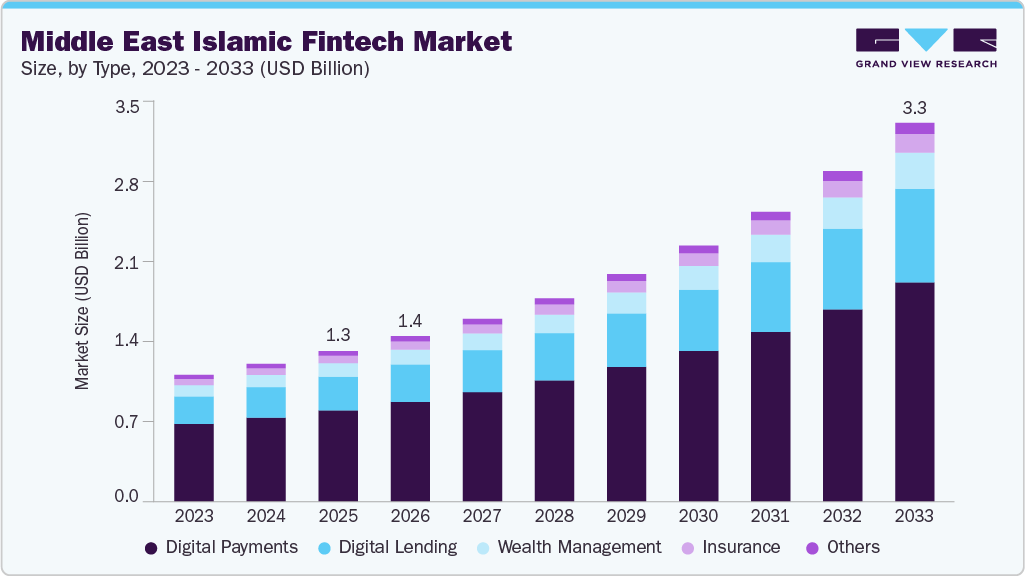
The Middle East Islamic fintech industry’s growth is uniquely driven by the high penetration of Islamic banking, particularly in Saudi Arabia and the UAE, where Islamic finance already constitutes a significant portion of total banking assets. This creates a strong foundation for fintech adoption, as digital platforms are increasingly being used to modernize existing Shariah-compliant financial services rather than introduce entirely new concepts.
Market growth is more influenced by the digital transformation of a banked population, alongside efforts to enhance the customer experience, reduce transaction costs, and improve the financial ecosystem's efficiency.
The rapid digitalization of financial services in the region is being accelerated by national transformation programs such as Saudi Vision 2030 and the UAE’s digital economy strategy. These initiatives are encouraging the adoption of mobile banking, real-time payments, and digital wallets. In addition, the region benefits from high smartphone penetration and strong purchasing power, enabling faster adoption of premium fintech solutions compared to other emerging markets.
The regulatory environment in the Middle East is among the most advanced for Islamic fintech, with financial hubs such as Abu Dhabi Global Market (ADGM) and Dubai International Financial Centre (DIFC) offering fintech sandboxes and innovation licenses. Central banks, particularly in Saudi Arabia and the UAE, are actively issuing digital banking licenses and promoting open banking frameworks, which is accelerating fintech ecosystem development.
Sovereign wealth funds, government-backed entities, and regional venture capital firms heavily support investment activity in the Middle East Islamic fintech market. Unlike other regions, funding is more concentrated and strategic, often aligned with national priorities such as financial diversification and the expansion of the digital economy. This is enabling large-scale fintech platforms to emerge and expand rapidly across the Gulf region.
Type Insights
The digital payments segment accounted for the largest share of 56.6% in 2025, driven by government-led cashless policies and real-time payment infrastructure development. Saudi Arabia, for instance, has significantly increased non-cash transaction targets, while the UAE has seen rapid growth in contactless and mobile wallet payments. The integration of global payment platforms and local fintech solutions is further accelerating adoption.
The digital lending segment is expected to grow at the fastest CAGR during the forecast period, driven by rising demand for SME financing in the GCC. Many small and medium enterprises remain underserved by traditional banking systems, creating strong demand for Shariah-compliant alternative financing solutions, including BNPL and supply chain financing.
Deployment Insights
The cloud segment accounted for the largest share of 55.25% in the Middle East Islamic fintech industry in 2025, supported by government-backed cloud infrastructure and national data strategies in countries such as the UAE and Saudi Arabia. Financial institutions are increasingly adopting cloud solutions to enhance scalability, reduce costs, and comply with evolving regulatory requirements around data localization and cybersecurity.
The on-premise segment is expected to grow at a significant CAGR during the forecast period, particularly among large Islamic banks in the region that prioritize data sovereignty, regulatory control, and Shariah compliance assurance. These institutions maintain hybrid models that combine on-premises core systems with cloud-based customer-facing applications.
End Use Insights
The individual segment dominated the Middle East Islamic fintech market with a revenue share of 60.60% in 2025, driven by high digital engagement, strong consumer spending, and preference for mobile-first banking experiences. Consumers in the Middle East are early adopters of digital financial services, particularly in urban centers such as Riyadh, Dubai, and Doha.
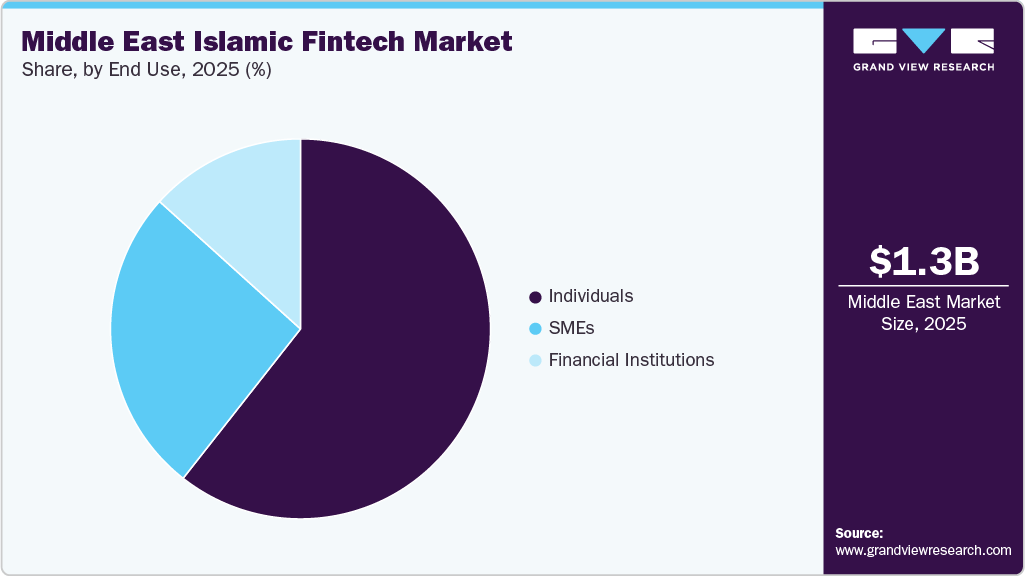
The SMEs segment is projected to grow at the fastest CAGR of 13.6% over the forecast period, supported by government initiatives to improve SME financing access and diversify economies away from oil dependency. Digital BaaS platforms are enabling SMEs to access Shariah-compliant financing, payments, and financial management tools more efficiently.
UAE Islamic Fintech Market Trends
The UAE Islamic fintech market is characterized by a highly advanced regulatory environment and its role as a regional fintech hub, with a strong concentration of innovation within financial free zones such as Abu Dhabi Global Market and Dubai International Financial Centre, where regulatory sandboxes and innovation licenses are enabling rapid development and scaling of Shariah-compliant solutions. A key trend in the market is the integration of Islamic finance with advanced technologies, including blockchain and digital assets, with increasing focus on tokenized Sukuk, digital wallets, and blockchain-based payment infrastructure. The UAE is also witnessing strong adoption of embedded finance and Banking-as-a-Service (BaaS) models, enabling Islamic financial services to be seamlessly integrated into digital ecosystems such as e-commerce and fintech platforms, thereby expanding access for both consumers and SMEs.
KSA Islamic Fintech Market Trends
The KSA Islamic fintech industry is experiencing rapid expansion, primarily driven by government initiatives under Vision 2030, which are accelerating digital transformation and promoting a cashless economy. A key trend in the market is the widespread adoption of digital payments, driven by national targets to increase non-cash transactions, resulting in significant growth in mobile wallets, contactless payments, and QR-based solutions. The market is also witnessing a surge in Shariah-compliant digital lending platforms, particularly in buy now, pay later (BNPL) and SME financing, driven by rising demand for accessible, interest-free credit solutions. Furthermore, the regulatory landscape is becoming increasingly structured, with the Saudi Central Bank actively supporting fintech innovation through licensing frameworks, regulatory sandboxes, and open banking initiatives, encouraging both domestic and international players to enter the market. In addition, significant investments in fintech infrastructure, including payment systems, digital identity platforms, and open banking ecosystems, are enabling seamless integration of Islamic financial services while supporting financial inclusion and SME development across the Kingdom.
Key Middle East Islamic Fintech Company Insights
Organizations are focusing on increasing their customer base to gain a competitive edge in the industry. Therefore, key players are taking several strategic initiatives, such as mergers and acquisitions, and partnerships with other major companies.
-
Wahed Invest Limited operates through its Shariah-compliant digital investment platform, which provides ethical wealth management solutions for Islamic finance principles. Wahed Invest Limited offers automated investing services, halal portfolios, and financial planning tools that help individuals invest in accordance with Shariah guidelines. Its platform enables users to access diversified portfolios across equities, sukuk, gold, and cash. Wahed’s digital solutions are widely used for financial inclusion, are transparent, and are affordable for retail investors.
-
Tabby is a Middle East-based financial technology company that provides buy now, pay later (BNPL) solutions designed to offer consumers interest-free, Shariah-aligned installment payment options across online and offline retail channels. The company partners with a large network of regional and international merchants, enabling customers to split purchases into deferred or installment-based payments without relying on traditional credit cards. Tabby has expanded its platform beyond core BNPL services to include products such as a consumer app, a payment card, and a shopping marketplace, supporting a broader digital financial ecosystem.
Key Middle East Islamic Fintech Companies:
The following key companies have been profiled for this study on the islamic fintech market.
- Tamara
- Tabby
- Beehive P2P Limited.
- PayTabs
- Wahed Invest Limited
- Fasset
- Beehive P2P Limited
- Musaffa
- Raqamyah
- Codebase Technologies
Recent Developments
-
In February 2025, Tabby raised USD 160 million in a Series E funding round, reaching a valuation of USD 3.3 billion and becoming the most valuable fintech startup in the region, while expanding its ecosystem with Tabby Card, marketplace integrations, and digital wallet acquisitions.
-
In September 2025, Tamara secured up to USD 2.4 billion in Shariah-compliant financing during the Money20/20 Middle East, strengthening its lending capacity and reinforcing its positioning as a large-scale Islamic consumer finance platform.
Middle East Islamic Fintech Market Report Scope
|
Report Attribute
|
Details
|
|
Market size value in 2026
|
USD 1,421.84 billion
|
|
Transaction forecast in 2033
|
USD 3,257.09 billion
|
|
Growth rate
|
CAGR of 12.6% from 2026 to 2033
|
|
Base year for estimation
|
2025
|
|
Historical data
|
2021 - 2024
|
|
Forecast period
|
2026 - 2033
|
|
Quantitative units
|
Transaction volume in USD billion and CAGR from 2026 to 2033
|
|
Report vehicle
|
Transaction forecast, company ranking, competitive landscape, growth factors, and trends
|
|
Segments covered
|
Type, deployment, end use, country
|
|
Country scope
|
KSA; UAE; Qatar; Kuwait
|
|
Key companies profiled
|
Tamara; Tabby; Beehive P2P Limited.; PayTabs; Wahed Invest Limited; Fasset; Musaffa; Raqamyah; Codebase Technologies
|
|
Customization scope
|
Free report customization (equivalent up to 8 analysts working days) with purchase. Addition or alteration to country, regional & segment scope.
|
|
Pricing and purchase options
|
Avail customized purchase options to meet your exact research needs. Explore purchase options
|
Middle East Islamic Fintech Market Report Segmentation
This report forecasts transaction volume growth at the country level and provides an analysis of the latest industry trends in each of the sub-segments from 2021 to 2033. For this study, Grand View Research has segmented the global Middle East Islamic fintech market report based on type, deployment, end use, and country:
-
Type Outlook (Transaction Volume, USD Billion, 2021 - 2033)
-
Digital Payments
-
Digital Lending
-
Wealth Management
-
Insurance
-
Others
-
Deployment Outlook (Transaction Volume, USD Billion, 2021 - 2033)
-
End Use Outlook (Transaction Volume, USD Billion, 2021 - 2033)
-
Individuals
-
SMEs
-
Financial Institutions
-
Country Outlook (Transaction Volume, USD Billion, 2021 - 2033)
Frequently Asked Questions About This Report
b. The Middle East Islamic fintech market size was estimated at USD 1,294.21 billion in 2025 and is expected to reach USD 1,421.84 billion in 2026.
b. The Middle East Islamic fintech market size is expected to grow at a significant CAGR of 12.6% to reach USD 3,257.09 billion in 2033.
b. KSA held the largest market share of 38.3% in 2025, driven by government initiatives under Vision 2030, which are accelerating digital transformation and promoting a cashless economy.
b. Some of the players in the market are Tamara, Tabby, Beehive P2P Limited., PayTabs, Wahed Invest Limited, Fasset, Beehive P2P Limited, Musaffa, Raqamyah, and Codebase Technologies.
b. The key driving trend in the Middle East Islamic fintech market is the rapid adoption of Shariah-compliant digital financial services.

 Download Sample Report
















