
- Home
- »
- Animal Health
- »
-
Middle East Livestock Health Market, Industry Report, 2033GVR Report cover
![Middle East Livestock Health Market Size, Share & Trends Report]()
Middle East Livestock Health Market (2025 - 2033) Size, Share & Trends Analysis Report By Product, By Animal (Poultry, Cattle, Sheep & Goats, Fish), By Distribution Channel, By End Use, By Country, And Segment Forecasts
- Report ID: GVR-4-68040-825-5
- Number of Report Pages: 150
- Format: PDF
- Historical Range: 2021 - 2023
- Forecast Period: 2025 - 2033
- Industry: Healthcare
- Report Summary
- Table of Contents
- Segmentation
- Methodology
- Download FREE Sample
-
 Download Sample Report
Middle East Livestock Health Market Summary
The Middle East livestock health market size was estimated at USD 0.79 billion in 2024 and is projected to reach USD 1.70 billion by 2033, growing at a CAGR of 8.9% from 2025 to 2033. The market is continuously growing driven by rising livestock populations, especially in poultry, dairy cattle, and small ruminants, increasing demand for vaccines, diagnostics, and disease-prevention tools.
Key Market Trends & Insights
- Saudi Arabia livestock health market held the largest revenue share of 52.19% of the Middle East market in 2024.
- By animal, the cattle segment held the largest revenue share of 46.92% in 2024.
- Based on product, the pharmaceuticals segment held the largest market share of 43.61% in 2024.
- By distribution channel, hospital/clinic pharmacy segment accounted for the largest revenue share of 50.63% in 2024.
- By end use, veterinary hospitals & clinics segment dominated the market, with the largest revenue share of 71.56% in 2024.
Market Size & Forecast
- 2024 Market Size: USD 0.79 Billion
- 2033 Projected Market Size: USD 1.70 Billion
- CAGR (2025-2033): 8.9%
Government food-security programs and stricter veterinary regulations are accelerating adoption of advanced health solutions, while growing awareness among producer’s boosts investment in biosecurity, herd monitoring, and preventive care.
The Middle East is witnessing the rapid development of veterinary infrastructure, driven by both government support and private sector participation. For instance, in June 2025, a Dubai-based start-up, Greener Herd, introduced the region’s first Arabic-language digital livestock management application, designed to provide farmers with advanced tools for monitoring and improving herd performance. The platform integrates features such as nutrition planning, health and vaccination tracking, digital record-keeping, and access to a comprehensive feed product database, making it highly relevant for small and medium-sized producers across the Middle East. By addressing the language barrier and tailoring the technology to regional needs, Greener Herd enables wider adoption of digital livestock management solutions, enhancing operational efficiency, animal welfare, and overall productivity.
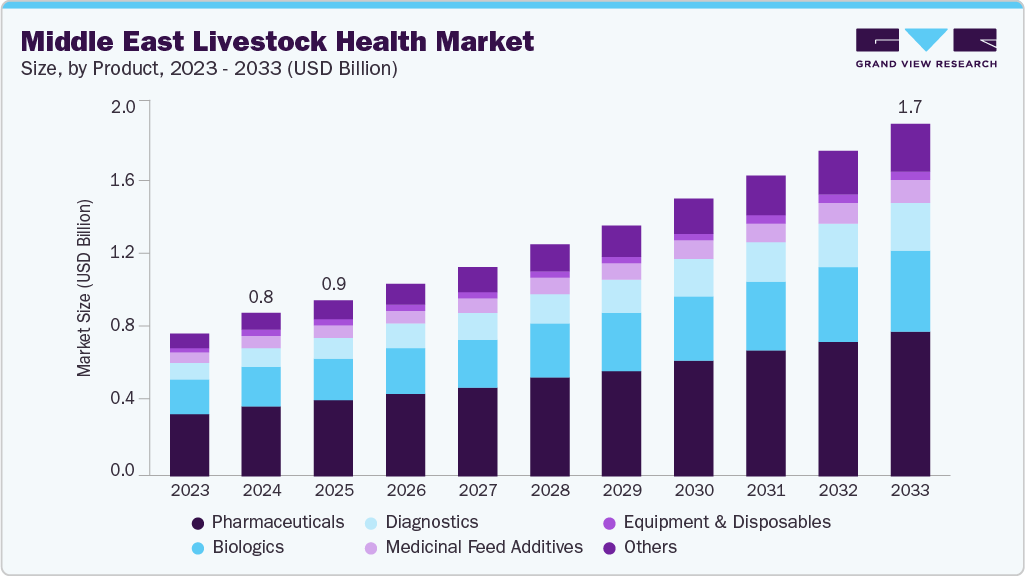
Government investments and regulatory supports also play a critical role. Countries such as Saudi Arabia and the UAE are investing in local vaccine manufacturing, digital herd-tracking systems, and modern veterinary laboratories. For instance, Saudi Arabia approved a $46.6 million contract to build a state-of-the-art veterinary laboratory in Riyadh focused on diagnosing animal diseases, developing locally tailored vaccines, and advancing DNA-based pathogen surveillance. The facility is expected to localize vaccine production using Saudi-specific microbial strains and strengthen national capacity to monitor, control, and eliminate endemic livestock diseases. The project is expected to elevate regional disease-control capabilities, reduce dependence on imported vaccines, and stimulate demand for advanced diagnostics, ultimately improving livestock productivity and enhancing biosecurity standards across the Middle East.
Furthermore, the region relies heavily on livestock for meat, milk, and other animal-based products due to cultural dietary preferences and limited arable land. According to the report of March 2025, Al-Ra’i National Livestock Company, a NADEC subsidiary, secured a USD 293.2 million loan from Saudi Arabia’s Agricultural Development Fund to enhance red meat production. The project will expand sheep and goat farming, aiming for an annual output of one million livestock.
The table below highlights some of the recent developments in Middle East region
Date
Company/
Entity
Country
Development
May-25
Vetanco
Saudi Arabia
Partnered with ARASCO’s animal-health unit Al-Emar International, granting it distribution rights in Saudi Arabia to expand access to Vetanco’s veterinary products and support the country’s Vision 2030 livestock and food-security goals.
Mar-25
Al-Watania Poultry & Halal Products Development Co.
Saudi Arabia
Signed MoU to enhance poultry R&D capacity in halal-certified food products.
Jul-24
Tanmiah Food Company
Saudi Arabia
Became first fresh chicken producer in Saudi Arabia to receive AA rating from BRCGS, reflecting investments in traceability, food safety, and operations.
May-25
Vetanco & ARASCO
Saudi Arabia
Partnered to introduce new animal health technologies and feed additives to enhance disease prevention and performance outcomes.
Mar-25
Unibio
Saudi Arabia
Received regulatory approval for microbial protein (Uniprotein) for aquaculture use, advancing sustainable feed innovation.
Jul-25
NuaFeeds & UAE entities
UAE
Partnered to convert food waste into high-protein livestock feed, addressing feed cost, sustainability, and waste management.
Dec-24
Al Ghurair Foods
UAE
Announced investments to scale up integrated poultry meat production, including modern feed mills and poultry processing facilities.
Nov-24
UAE University
UAE
Published study on microbial safety improvements in poultry meat, using molecular techniques to detect pathogens and improve quality monitoring.
Jul-25
UAE, Qatar & Belarus
UAE/Qatar/
Belarus
Began collaborative veterinary vaccine programs to prevent regional livestock epidemics, focusing on diagnostics and immunization R&D.
Market Concentration & Characteristics
The Middle East livestock health market shows moderate to high industry concentration, driven by global leaders such as Zoetis, Merck Animal Health, Boehringer Ingelheim, Elanco, and Ceva, which dominate vaccines, antibiotics, and high-tech diagnostics. Regional players such as Arasco participate mainly through distribution and partnerships, rather than competing head-to-head in advanced therapeutics. This balance of multinational dominance and selective local alliances creates a consolidated market structure with limited fragmentation.
The market shows a high degree of innovation, driven by rapid adoption of digital and preventive health technologies across dairy, poultry, and small-ruminant farms. Producers are increasingly using precision monitoring tools, such as wearable sensors for cattle to track mastitis or heat stress, and automated poultry systems that monitor flock behavior and environmental conditions. Newer biological and gut-health innovations such as organic acid blends for controlling necrotic enteritis in broilers, are reducing reliance on traditional antibiotics. These advancements, combined with growing use of tele-veterinary platforms and data-driven farm management software, are modernizing livestock health management across the region.
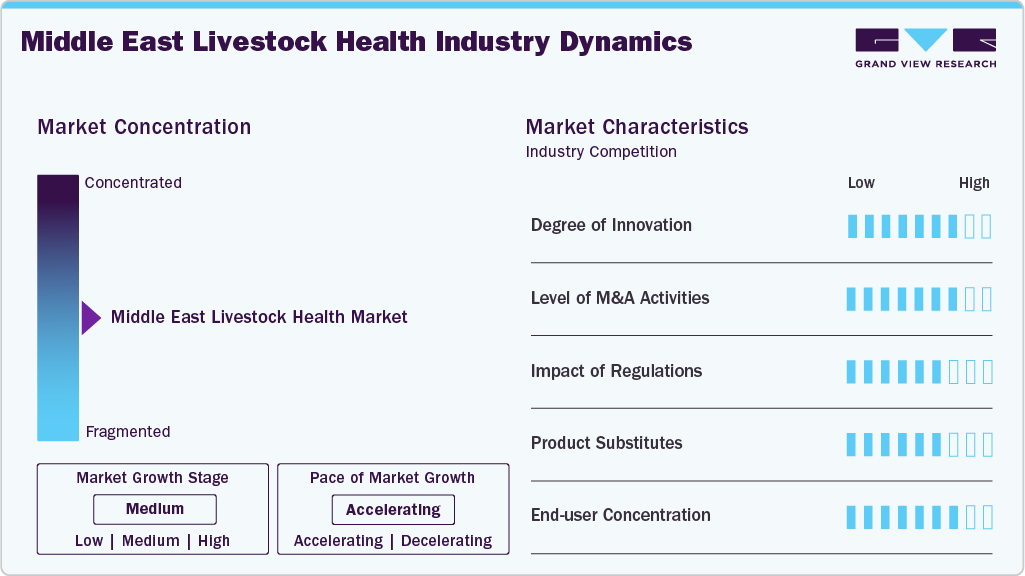
M&A activities are moderate but increasing, as global and regional players seek to strengthen their presence in the fast-growing animal-health sector. International animal health firms are entering the region via partnerships and acquisitions to access livestock and biosecurity markets. While large-scale farm consolidation and sovereign-fund investments provide deal flow, explicit high-profile cross-border M&A within strictly “livestock health” (vs. general pharmaceuticals) remains limited due to regulatory complexity and fragmented veterinary ecosystems.
Regulatory tightening across the Middle East is raising standards for drug approvals, residue limits, and veterinary credentialing, which increases compliance costs but improves market quality and trust. Examples include stricter import/export sanitary controls and mandatory veterinarian certification for clinics and pharmacies, driving demand for registered vaccines, rapid diagnostics, and cold-chain logistics. Policies limiting indiscriminate antibiotic use and enforcing residue testing are accelerating adoption of preventive tools (vaccines, probiotics, gut-health products) and point-of-care diagnostics. Overall, regulation is shifting spending from informal treatments toward formal, higher-value animal-health solutions and local manufacturing that meet compliance requirements.
Product substitutes includes natural and nutritional feed additives such as probiotics, prebiotics, organic acids, and phytogenics, which are increasingly used in place of traditional antibiotics to support gut health and reduce pathogen load. For instance, organic acids such as formic and butyric acid help lower gut pH and inhibit harmful bacteria, while phytogenic feed additives (herb extracts, essential oils) bring antimicrobial and anti-inflammatory benefits. Antimicrobial peptides and egg yolk IgY antibodies are also emerging as innovative non-antibiotic therapeutic options.
End user concentration is relatively high, dominated by large commercial farms and veterinary clinics that handle most disease management, vaccination programs, and regulatory compliance. Intensive dairy farms, commercial broiler operations, and large sheep/goat holdings depend heavily on professional veterinary services for herd-health planning, diagnostics, and biosecurity oversight, creating a concentrated customer base. Smaller breeders contribute to demand but rely on the same clinic networks, further reinforcing concentration among a few key end user groups.
Product Insights
The pharmaceuticals segment accounted for the largest revenue share in the Middle East livestock health market of 43.61% in 2024, driven by growing demand for vaccines, antibiotics, and parasiticides to prevent and treat livestock diseases. Rising awareness of animal health and government programs to boost livestock productivity are accelerating the use of preventive and therapeutic drugs. For example, the 2024 launch of HUMISYN, an organic acid blend designed to improve poultry gut health and reduce necrotic enteritis, reflects the growing shift toward advanced pharmaceutical solutions. Intensive dairy farms, broiler operations, and large sheep/goat herds consistently require vaccine schedules and disease-control medications, solidifying pharmaceuticals as the market’s dominant product category.
The others segment, comprising veterinary telehealth, farm management software, and livestock monitoring solutions is projected to be the fastest-growing product category in the Middle East livestock health market due to rapid digitalization across commercial farms. Producers are increasingly adopting wearable sensors for cattle, remote herd-monitoring platforms, and tele-veterinary consultations to detect issues such as mastitis, heat stress, and lameness earlier and reduce treatment costs. Poultry farms are implementing automated systems for real-time tracking of bird health, temperature, and feed efficiency, improving biosecurity and productivity. Government-led food security initiatives and the region’s shift toward precision livestock farming are further accelerating demand for these digital, data-driven tools.
Animal Insights
The cattle segment accounted for the largest revenue share of 46.92% in 2024. This dominance is driven by the high economic value of dairy and beef herds and the intensive health management they require. Large-scale dairy operations rely heavily on mastitis control products, reproductive health services, and metabolic disorder treatments, driving higher spending per animal compared with other species. The need for continuous monitoring, such as milk-quality testing, respiratory disease management, and herd vaccination programs further strengthens the dominance of the cattle segment in overall market revenues.
The sheep & goats segment is projected to be the fastest-growing segment in the Middle East livestock health market during the forecast period. Its growth is fuelled by region’s large and expanding small-ruminant populations, driven by cultural demand for mutton and traditional herding practices. High disease prevalence, such as PPR, sheep pox, and internal parasites is increasing demand for vaccines, dewormers, and flock-health management solutions. Expanding commercial fattening farms and government-supported breeding programs are further accelerating investments in preventive healthcare and biosecurity, making this segment the most dynamic in the market.
Distribution Channel Insights
The hospital/clinic pharmacy segment accounted for the largest revenue share of 50.63% in 2024, in the Middle East livestock health market, supported by the dominance of veterinary clinics and hospitals as primary distribution channels for animal healthcare products. Most prescription-based livestock medicines such as antibiotics for mastitis in dairy cattle, vaccines for poultry diseases, and antiparasitics for sheep and goats are dispensed exclusively through licensed veterinary clinics. These pharmacies serve as the primary distribution point for regulated drugs, diagnostic supplies, and biosecurity products required by commercial farms. Their direct integration with veterinary services ensures proper dosing, compliance with national regulations, and consistent demand from large-scale livestock operations, driving their dominant market position.
The e-commerce segment is emerging as the fastest-growing segment from 2025 to 2033, due to rising demand for quick access to veterinary supplies, especially among small and mid-size breeders. Farmers increasingly purchase dewormers, nutritional supplements, disinfectants, and poultry vaccines through online platforms that offer wider product ranges and competitive pricing. Digital marketplaces also support doorstep delivery to remote farming areas, reducing reliance on physical outlets and accelerating the adoption of online procurement across livestock operations.
End Use Insights
Veterinary hospitals and clinics segment hold the largest share of 71.56% in 2024, since they are the primary providers of diagnostics, vaccination, and emergency treatment for high-value livestock such as dairy cattle, broilers, and breeding herds. Large commercial farms rely on certified clinics for disease surveillance (e.g., avian influenza, mastitis), regulatory compliance, and advanced services such as laboratory testing and herd-health programs. Their capacity to deliver specialized care, maintain biosecurity standards, and support government-led health monitoring makes them the central point of veterinary intervention across the region.
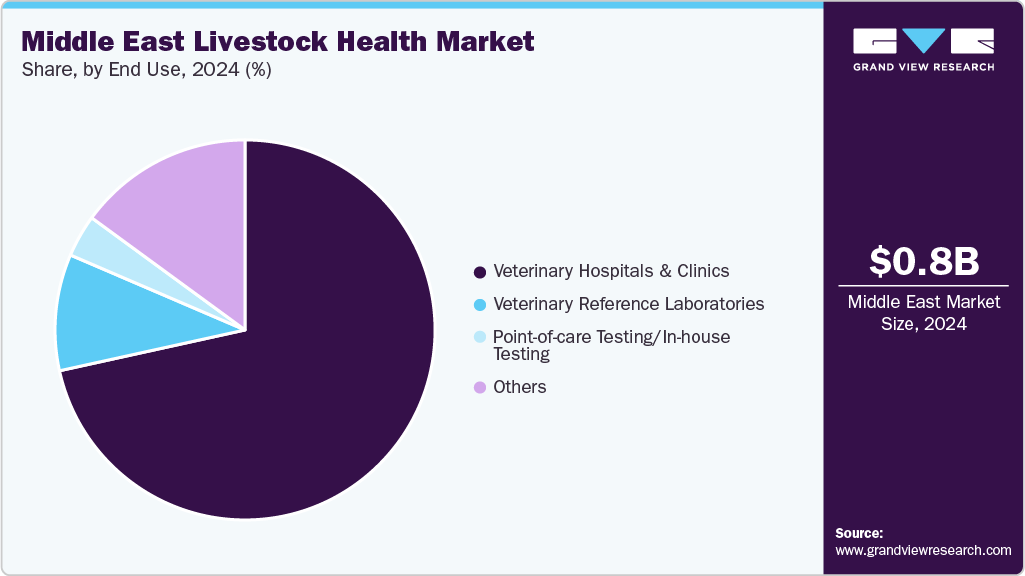
The point-of-care testing/in-house testing segment is projected to be the fastest-growing in the Middle East livestock health market, driven by the need for rapid, accurate diagnostics to support timely treatment decisions. Since, farms increasingly require rapid, on-site diagnosis to control fast-spreading diseases such as PPR in sheep, coccidiosis in poultry, and mastitis in dairy cattle. Large commercial operations are adopting portable PCR kits, handheld analyzers, and rapid antigen tests to reduce turnaround time and minimize livestock losses. Growing biosecurity demands, rising herd sizes, and the high cost of disease outbreaks are accelerating the shift from centralized labs to farm-level immediate testing, making POC solutions the most dynamic segment in the region.
Saudi Arabia Livestock Health Market Trends
Saudi Arabia’s livestock health market held the largest revenue share of 52.19% in 2024 and is among the fastest growing country over the forecast period, fueled by rapid poultry expansion, growing biosecurity needs, and rising investment in modern farm systems. According to the data published in the 2024 livestock statistics, by the General Authority for Statistics (GASTAT), the sharp increase in broiler output to 1.3 million tons and table egg production to 8.4 billion is pushing demand for advanced vaccines, disease-monitoring tools, and feed additives to control common poultry diseases such as Newcastle Disease and Salmonella. Large dairy operations, producing 2.7 billion liters of milk continue to adopt mastitis diagnostics, fertility management solutions, and precision monitoring technologies to improve herd efficiency. Meanwhile, the country’s sizeable populations of sheep, goats, and camels are driving steady demand for parasite control products and regional disease prevention (e.g., PPR and camel respiratory infections). Government-backed financing of over SR2 billion for livestock projects is accelerating upgrades to health infrastructure, supporting digital farm management systems, and encouraging partnerships with global animal health companies, making livestock health one of the fastest modernizing segments in the Kingdom’s agriculture sector.
Qatar Livestock Health Market Trends
Livestock health market in Qatar is gaining momentum, driven by rising livestock numbers and the growth of production projects drive increased demand for vaccines, biosecurity systems, and veterinary oversight especially for sheep, goats, and poultry, which dominate national production. Qatar’s Ministry of Municipality reported strong growth in the livestock sector for 2024, highlighting significant advancements in production, regulation, and food security initiatives. The country’s livestock population has reached 1,139,578 animals, dominated by sheep (681,293 heads, 60%), followed by goats (325,233, 29%), camels (94,299, 8%), and cattle (38,753, 3%). Qatar now has 7,089 registered livestock breeders, who contribute to domestic supplies of meat, milk, and poultry. A total of 50 licensed animal production projects are underway: 32 operational and 18 under construction. These include 15 meat production projects (2 active), 4 milk projects (3 operational), 8 fully operational broiler chicken projects, 5 table-egg projects, 15 local poultry projects, and 1 buffalo project. With 18 additional projects under construction, demand is rising for veterinary pharmaceuticals, diagnostic services, feed additives, and compliance-driven health protocols, making livestock health a critical and fast-developing segment within Qatar’s food security strategy.
Key Middle East Livestock Health Company Insights
The Middle East livestock health market is dominated by key players like Zoetis, Elanco, Boehringer Ingelheim, Merck Animal Health, and Virbac.
Key Middle East Livestock Health Companies:
- Boehringer Ingelheim International GmbH
- Zoetis Services LLC
- Merck & Co., Inc.
- Elanco
- Ceva Santé Animale
- Virbac
- Hester Biosciences
- Biogenesis Bago
- Biovac
- HIPRA
- Nutreco
- Julphar
Recent Developments
-
In July 2025, Australian agri-tech firm NuaFeeds partnered with UAE entities to convert food waste into high-protein livestock feed, addressing feed cost, sustainability, and waste management simultaneously.
-
In July 2025, the UAE began collaborative efforts with Qatar and Belarus to develop joint veterinary vaccine programs to prevent regional livestock epidemics, focusing on R&D for disease diagnostics and immunization strategies.
-
In March 2025, Unibio received regulatory approval for its microbial protein (Uniprotein) for aquaculture use in Saudi Arabia, marking a major step in sustainable feed innovation.
Middle East Livestock Health Market Report Scope
Report Attribute
Details
Market size in 2025
USD 0.86 billion
Revenue forecast in 2033
USD 1.70 billion
Growth rate
CAGR of 8.9% from 2025 to 2033
Historical Period
2021 - 2023
Base year of estimation
2024
Forecast period
2025 - 2033
Quantitative units
Revenue in USD million/billion and CAGR from 2025 to 2033
Report coverage
Revenue forecast, company ranking, competitive landscape, growth factors, and trends
Segments covered
Product, animal, distribution channel, end use, country
Country covered
UAE; Saudi Arabia; Oman; Qatar; Kuwait.
Key companies profiled
Boehringer Ingelheim International GmbH; Zoetis Services LLC; Merck & Co. Inc.; Elanco; Ceva Santé Animale; Hester Biosciences; Biogenesis Bago; Hipra; Biovac; Virbac; Nutreco;Julphar
Customization scope
Free report customization (equivalent to 8 analysts working days) with purchase. Addition or alteration to segment scope.
Pricing and purchase options
Avail customized purchase options to meet your exact research needs. Explore purchase options
Middle East Livestock Health Market Report Segmentation
This report forecasts revenue growth and provides an analysis of the latest industry trends in each of the sub-segments from 2021 to 2033. For this study, Grand View Research has segmented the Middle East livestock health market report based on product, animal, distribution channel, end use, and country.
-
Animal Outlook (Revenue, USD Million, 2021 - 2033)
-
Poultry
-
Cattle
-
Sheep & Goats
-
Fish
-
-
Product Outlook (Revenue, USD Million, 2021 - 2033)
-
Biologics
-
Vaccines
-
Modified/ Attenuated Live
-
Inactivated (Killed)
-
Other Vaccines
-
-
Other Biologics
-
-
Pharmaceuticals
-
Parasiticides
-
Anti-infectives
-
Anti-inflammatory
-
Analgesics
-
Others
-
-
Medicated Feed Additives
-
Diagnostics
-
Consumables, reagents and kits
-
Instruments and devices
-
-
Equipment & Disposables
-
Critical Care Consumables
-
Anesthesia Equipment
-
Fluid Management Equipment
-
Temperature Management Equipment
-
Rescue & Resuscitation Equipment
-
Research Equipment
-
Patient Monitoring Equipment
-
-
Others
-
Veterinary Telehealth
-
Veterinary Software
-
Livestock Monitoring
-
-
-
Distribution Channel Outlook (Revenue, USD Million, 2021 - 2033)
-
Retail
-
E-Commerce
-
Hospital/ Clinic Pharmacy
-
-
End Use Outlook (Revenue, USD Million, 2021 - 2033)
-
Veterinary Reference Laboratories
-
Point-of-care Testing/In-house Testing
-
Veterinary Hospitals & Clinics
-
Others
-
-
Country Outlook (Revenue, USD Million, 2021 - 2033)
-
UAE
-
Saudi Arabia
-
Kuwait
-
Qatar
-
Oman
-
Frequently Asked Questions About This Report
b. The Middle East livestock health market size was estimated at USD 0.79 billion in 2024 and is expected to reach USD 0.86 billion in 2025.
b. The Middle East livestock health market is expected to grow at a compound annual growth rate of 8.94% from 2025 to 2033 to reach USD 1.70 billion by 2033.
b. By country, Saudi Arabia’s livestock health market held the largest revenue share of 52.19% in 2024 and is among the fastest growing segment over the forecast period, fueled by rapid poultry expansion, growing biosecurity needs, and rising investment in modern farm systems.
b. Some key players operating in the Middle East livestock health market include Boehringer Ingelheim International GmbH, Zoetis Services LLC, Merck & Co., Inc., Elanco, Ceva Santé Animale, Hester Biosciences, Biogenesis Bago, Hipra, Biovac, Virbac, Nutreco, Julphar.
b. Key factors that are driving the market growth include rising livestock populations, especially in poultry, dairy cattle, and small ruminants, increasing demand for vaccines, diagnostics, and disease-prevention tools.


Share this report with your colleague or friend.
Need a Tailored Report?
Customize this report to your needs — add regions, segments, or data points, with 20% free customization.


ISO 9001:2015 & 27001:2022 Certified
We are GDPR and CCPA compliant! Your transaction & personal information is safe and secure. For more details, please read our privacy policy.
Trusted market insights - try a free sample
See how our reports are structured and why industry leaders rely on Grand View Research. Get a free sample or ask us to tailor this report to your needs.













