Middle East Plate And Frame Heat Exchanger Market Summary
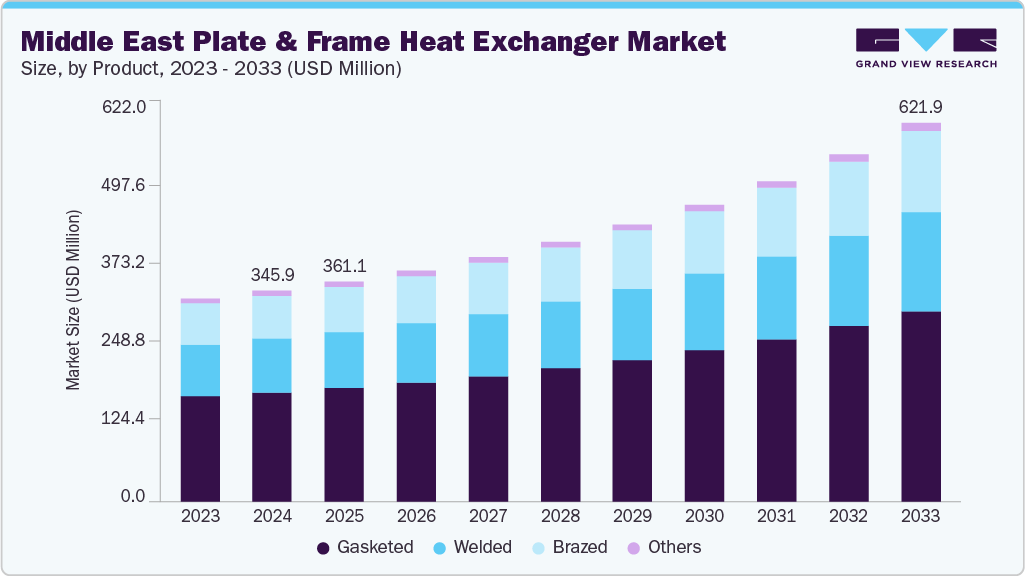
The Middle East plate and frame heat exchanger market size was estimated at USD 345.9 million in 2024 and is projected to reach USD 621.9 million by 2033, growing at a CAGR of 7.0% from 2025 to 2033, driven by increasing demand across industries such as oil and gas, chemical processing, HVAC, and power generation. With rapid industrialization and infrastructure development, there is a greater need for efficient thermal management solutions. Compact, modular designs with easier maintenance are gaining popularity.
Key Market Trends & Insights
- Saudi Arabia dominated the Middle East plate and frame heat exchanger market with the largest revenue share of 43.4% in 2024.
- By product, the gasketed plate heat exchangers segment led the market with the largest revenue share of 52.0% in 2024.
- By end-use, the HVAC and refrigeration segment led the market with the largest revenue share of 29.3% in 2024.
Market Size & Forecast
- 2024 Market Size: USD 345.9 Million
- 2033 Projected Market Size: USD 621.9 Million
- CAGR (2025-2033): 7.0%
Countries in the region are focusing more on energy efficiency and sustainability, encouraging wider adoption of advanced heat exchangers. In addition, the rise of clean energy initiatives is creating new opportunities in applications like desalination, district cooling, and solar thermal systems. These trends, along with stricter energy regulations, are expected to shape the market's growth trajectory in the forecast years.
Market Concentration & Characteristics
The Middle East plate and frame heat exchanger industry is moderately fragmented, with a combination of global manufacturers and regional players competing across sectors like oil & gas, HVAC, power, and desalination. While multinational companies benefit from advanced technologies and strong distribution networks, regional firms focus on cost-effective, locally adapted solutions. The market sees growing competition driven by the need for energy-efficient systems, customized designs, and durable materials suited to harsh environments.
The Middle East plate and frame heat exchanger industry exhibits steady innovation, with manufacturers focusing on improving thermal efficiency, compactness, and corrosion-resistant materials suited for harsh regional conditions. Integration of digital monitoring and advanced sealing technologies enhances system reliability and reduces downtime. Customized and modular designs tailored to industries like oil & gas, desalination, and power generation are increasingly common.
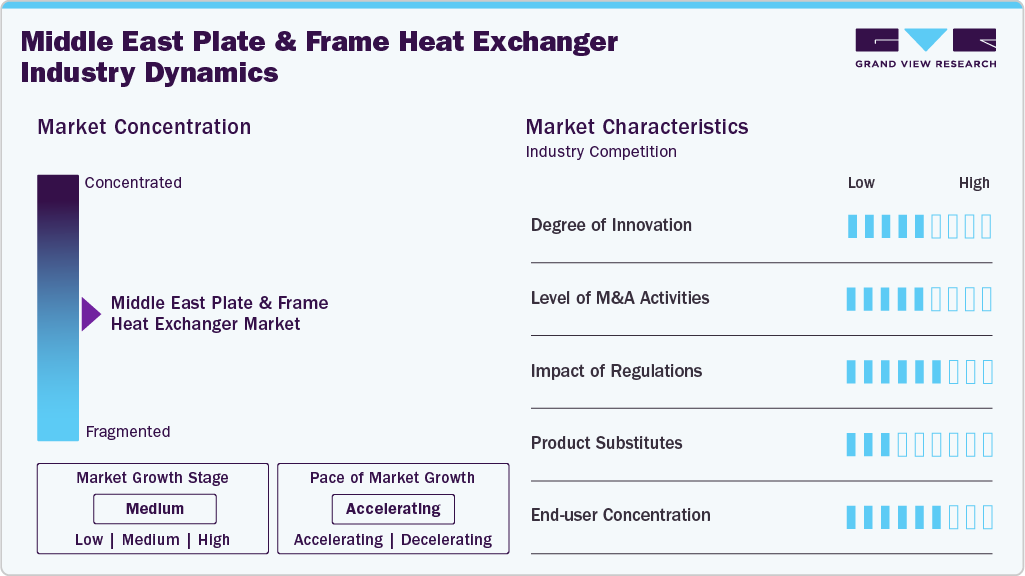
Mergers and acquisitions play a moderate but strategic role, as global companies acquire regional firms to expand their footprint and strengthen supply chains across the Gulf Cooperation Council (GCC) and neighboring markets. Such consolidations help players secure supply chains and gain access to new customer bases, especially in emerging economies.
Regulatory frameworks in the Middle East, driven by energy efficiency goals, environmental sustainability, and industry-specific standards, are accelerating the adoption of high-performance exchangers that support reduced emissions and water conservation, especially in sectors like energy, water treatment, and food processing.
Drivers, Opportunities & Restraints
In the Middle East, demand for energy-efficient solutions is a major driver for the plate and frame heat exchanger market. Their compact design, ease of maintenance, and high heat transfer efficiency make them preferred in key sectors such as power generation, oil & gas, and HVAC. Regional efforts to reduce energy consumption and comply with environmental standards further boost adoption, especially as governments prioritize sustainability in line with Vision 2030 and similar initiatives.
The Middle East offers significant growth opportunities for plate and frame heat exchangers in emerging applications like renewable energy projects, district cooling, and wastewater treatment. Large-scale infrastructure investments, especially in GCC countries, focus on sustainable technologies and modernization, creating new demand. Increasing industrial diversification and digitalization also enable more customized, smart heat exchanger solutions tailored to specific local needs and harsh environmental conditions.
Despite growing demand, high upfront costs limit the broader adoption of plate and frame heat exchangers in the Middle East. Issues such as gasket wear, fouling from dust and salt, and challenges with extreme temperatures or pressures restrict some uses. In addition, competition from shell and tube and other heat exchanger types intensifies pricing pressures. Regional supply chain volatility and fluctuating raw material costs can also disrupt manufacturing and impact profitability for local and international suppliers.
Product Insights
The gasketed plate heat exchangers segment led the market with the largest revenue share of 52.0% in 2024, due to their flexibility, ease of maintenance, and ability to handle varied industrial applications such as oil & gas, desalination, and power generation. Their modular design supports capacity scaling, which is ideal for evolving infrastructure projects. Cost-effectiveness and reliable performance in harsh operating environments ensure continued preference across industrial sectors.
The brazed plate heat exchangers segment is expected to witness at the fastest CAGR of 7.7% during the forecast period, especially in HVAC, commercial refrigeration, and solar energy systems. Their compact, leak-proof design suits space-constrained urban developments and high-performance cooling applications. With increasing regional focus on sustainability, energy efficiency, and smart infrastructure, brazed exchangers are gaining traction across both residential and commercial markets.
End-use Insights
The HVAC and refrigeration segment led the market with the largest revenue share of 29.3% in 2024. The region’s harsh climate, rapid urbanization, and expanding infrastructure projects, particularly in the Gulf, drive strong demand for energy-efficient cooling solutions in commercial buildings, residential complexes, and industrial facilities. Integration with smart building systems and district cooling networks further boosts their adoption for both comfort cooling and process applications.
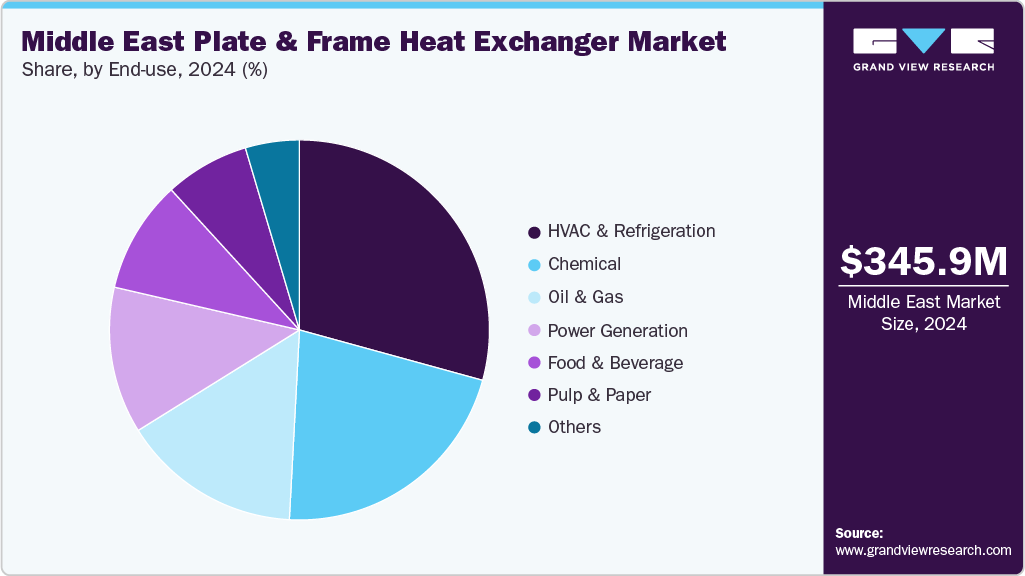
The chemical segment is anticipated to grow at the fastest CAGR of 7.6% during the forecast period. With the region’s strong focus on petrochemicals and specialty chemicals, these exchangers are critical for handling high thermal loads and corrosive fluids. Their efficiency and durability make them essential for modern chemical plants, especially in hubs like Saudi Arabia and the UAE, where industrial expansion continues to accelerate.
Country Insights
Saudi Arabia dominated the Middle East plate and frame heat exchanger market with the largest revenue share of 43.4% in 2024, due to large-scale investments in oil & gas, petrochemicals, and industrial development. Demand is rising for energy-efficient systems in HVAC, desalination, and process cooling. Government sustainability goals and infrastructure expansion will further drive adoption of compact, high-performance heat exchanger solutions across sectors.
The plate and frame heat exchanger market in the UAE is expected to grow at the fastest CAGR of 7.1%from 2025 to 2033, supported by infrastructure projects, district cooling networks, and industrial growth. Increasing focus on energy efficiency, environmental standards, and high ambient temperatures fuels demand for advanced, corrosion-resistant systems. Applications in power generation, HVAC, and water treatment continue to boost adoption across both public and private sectors.
Key Middle East Plate And Frame Heat Exchanger Company Insights
Some of the key players operating in the market include Alfa Laval, API Heat Transfer, and Danfoss.
-
Alfa Laval is a global supplier of plate and frame heat exchangers, with a strong presence in energy, marine, food, and water sectors. The company’s plate heat exchangers are designed for high thermal efficiency, compact installation, and flexible configurations, catering to industries such as HVAC, chemical processing, and power.
-
API Heat Transfer specializes in customized thermal transfer solutions, with expertise in gasketed, welded, and brazed plate heat exchangers for industrial applications. The company has a strong footprint in power generation, chemical processing, refrigeration, and oil & gas sectors, offering tailored designs for demanding operating conditions. API emphasizes advanced materials and engineering to improve durability, handle high pressures, and optimize performance in critical processes.
Key Middle East Plate and Frame Heat Exchanger Companies:
- ALFA LAVAL
- API Heat Transfer
- Danfoss
- Kelvion Holding GmbH
- Nexson Group
- Barriquand Group
- SPX Flow
- HISAKA WORKS, LTD.
- Tranter Inc.
- WCR, Inc.
Recent Developments
-
In July 2025,Alfa Laval completed the USD 865.8 million acquisition of Fives Energy Cryogenics. The acquired business, with decades of expertise in cryogenic heat transfer and pumping systems, will now function as a separate unit within Alfa Laval’s Energy Division.
-
In March 2024, Nexson Group completed the acquisition of Thermowave GmbH, a German specialist in advanced plate heat exchangers. The deal expands Nexson’s portfolio with gasketed and semi-welded technologies while allowing Thermowave to continue under its own brand identity.
Middle East Plate And Frame Heat Exchanger Market Report Scope
|
Report Attribute
|
Details
|
|
Market size value in 2025
|
USD 361.1 million
|
|
Revenue forecast in 2033
|
USD 621.9 million
|
|
Growth rate
|
CAGR of 7.0% from 2025 to 2033
|
|
Base year for estimation
|
2024
|
|
Historical data
|
2021 - 2023
|
|
Forecast period
|
2025 - 2033
|
|
Quantitative units
|
Revenue in USD million/billion and CAGR from 2025 to 2033
|
|
Report coverage
|
Revenue forecast, company market position analysis, competitive landscape, growth factors, and trends
|
|
Segments covered
|
Product, end-use, country
|
|
Country scope
|
Saudi Arabia; UAE; Oman ;Qatar; Kuwait; Israel
|
|
Key companies profiled
|
ALFA LAVAL; API Heat Transfer; Danfoss; Kelvion Holding GmbH; Nexson Group; Barriquand Group; SPX Flow; HISAKA WORKS, LTD.; Tranter Inc.; WCR, Inc.
|
|
Customization scope
|
Free report customization (equivalent up to 8 analysts working days) with purchase. Addition or alteration to country, regional & segment scope.
|
|
Pricing and purchase options
|
Avail customized purchase options to meet your exact research needs. Explore purchase options
|
Middle East Plate And Frame Heat Exchanger Market Report Segmentation
This report forecasts revenue growth at a country level and provides an analysis of the industry trends in each of the sub-segments from 2021-2033. For this study, Grand View Research has segmented the Middle East plate and frame heat exchanger market report based on product, and end use:
-
Product Outlook (Revenue, USD Million, 2021 - 2033)
-
Brazed
-
Gasketed
-
Welded
-
Welded Plate & Block
-
Welded Spiral
-
Welded Shell & Plate
-
Others
-
End-use Outlook (Revenue, USD Million, 2021 - 2033)
-
Chemical
-
Oil & Gas
-
Food & Beverage
-
HVAC & refrigeration
-
Power Generation
-
Pulp & Paper
-
Others
-
Country Outlook (Revenue, USD Million, 2021 - 2033)
-
Saudi Arabia
-
UAE
-
Oman
-
Qatar
-
Kuwait
-
Israel
Frequently Asked Questions About This Report
b. The Middle East plate and frame heat exchanger market size was estimated at USD 345.9 million in 2024 and is expected to reach USD 361.1 million in 2025.
b. The Middle East plate and frame heat exchanger market, in terms of revenue, is expected to grow at a compound annual growth rate of 7.0% from 2025 to 2033, reaching USD 621.9 million by 2033.
b. Gasketed plate heat exchangers dominate the Middle East market and accounted for 52.0% share in 2024, due to their flexibility, ease of maintenance, and suitability for a wide range of industrial applications. Their design allows plates to be added or removed, making them ideal for systems requiring capacity adjustments.
b. Some of the key players operating in the Middle East plate and frame heat exchanger market include ALFA LAVAL; API Heat Transfer; Danfoss; Kelvion Holding GmbH; Nexson Group; Barriquand Group; SPX Flow; HISAKA WORKS, LTD.; Tranter Inc.; WCRs, Inc.
b. Key factors driving the Middle East plate and frame heat exchanger market include growing demand for energy-efficient cooling in HVAC and industrial systems, expansion of oil & gas and petrochemical sectors, rising desalination activities, and increasing infrastructure development. Government sustainability initiatives and harsh climatic conditions further support market growth.

 Download Sample Report
















