
- Home
- »
- Medical Devices
- »
-
Middle East Sterilization Monitoring Market Size Report, 2033GVR Report cover
![Middle East Sterilization Monitoring Market Size, Share & Trends Report]()
Middle East Sterilization Monitoring Market (2025 - 2033) Size, Share & Trends Analysis, By Technology (Biological Indicators, Chemical Indicators), By Product (Strips), By Method (Steam Sterilization), By End Use, By Country, And Segment Forecasts
- Report ID: GVR-4-68040-718-5
- Number of Report Pages: 110
- Format: PDF
- Historical Range: 2021 - 2023
- Forecast Period: 2025 - 2033
- Industry: Healthcare
- Report Summary
- Table of Contents
- Segmentation
- Methodology
- Download FREE Sample
-
 Download Sample Report
Middle East Sterilization Monitoring Market Summary
The Middle East sterilization monitoring market size was estimated at USD 25.10 million in 2024 and is projected to reach USD 61.01 million by 2033, growing at a CAGR of 10.7% from 2025 to 2033. The market is driven by rising healthcare infrastructure investments, increasing surgical procedures, and a growing emphasis on infection control.
Key Market Trends & Insights
- UAE is witnessing the fastest growth over the forecast period in the Middle East sterilization monitoring market.
- By product, the strips segment led the market with the largest revenue share of 45.41% in 2024.
- By method, steam sterilization led the market with the largest revenue share of 51.59% in 2024.
- By end use, hospitals & clinics segment led the market with the largest revenue share of 50.22% in 2024.
- By technology, biological indicators segment is expected to grow at the fastest CAGR over the forecast period.
Market Size & Forecast
- 2024 Market Size: USD 25.10 Million
- 2033 Projected Market Size: USD 61.01 Million
- CAGR (2025-2033): 10.7%
- UAE: Largest market in 2024
Government initiatives aimed at improving patient safety and compliance with international sterilization standards further boost demand. The expansion of medical tourism in countries such as the UAE and Saudi Arabia also contributes to market growth. In addition, technological advancements in biological and chemical indicators enhance accuracy and efficiency, supporting wider adoption across hospitals and laboratories.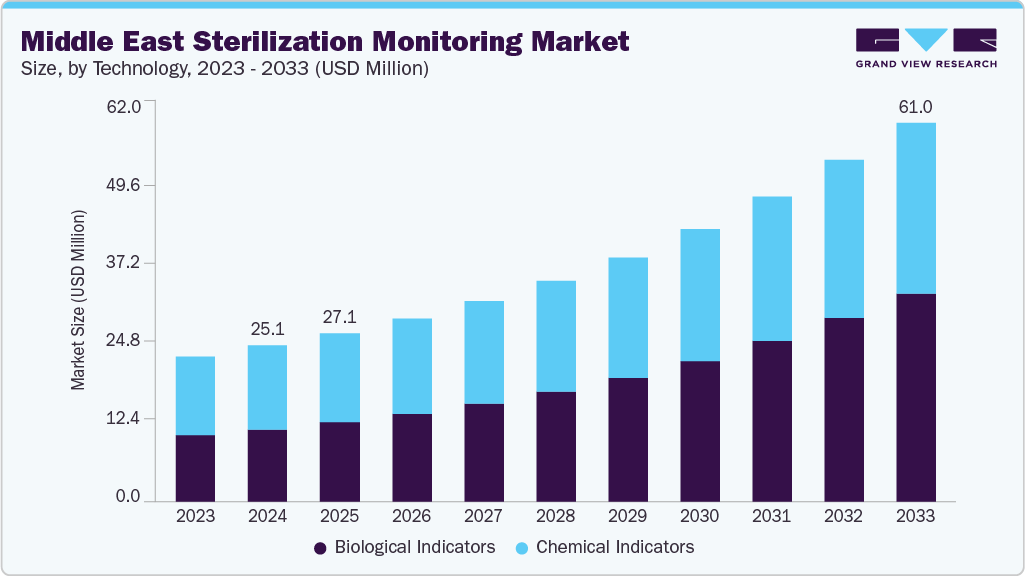
The sterilization monitoring market in the Middle East is witnessing rapid growth, driven by expanding healthcare infrastructure and increasing investments supporting the expansion. For instance, significant investments have been made to develop healthcare infrastructure as part of Saudi Vision 2030. Hospitals, clinics, and pharmaceutical facilities must adopt biological and chemical indicators to comply with strict sterilization protocols.
“We have observed significant improvements in the Saudi healthcare system since the launch of Vision 2030. The expansion of hospital infrastructure and the increased use of digital tools in healthcare are two of the most visible outcomes. One clear example is the establishment of Seha Virtual Hospital, which connects over 130 hospitals and enables remote consultations, diagnostics, and intensive care support across the country. Many hospitals have improved their service quality and achieved international accreditation, and the Ministry of Health has also encouraged private sector involvement, which has helped improve both service standards and access to care. Several of our direct partner hospitals in Saudi Arabia have benefited from these improvements,” said Bilge Bora, CEO of Turkish assistance company Marm Assistance.
Sterilization monitoring is essential in healthcare settings to ensure instruments and medical devices are properly sterilized, significantly reducing the risk of infection transmission to patients. It plays a critical role in maintaining hygiene standards, particularly in surgical and high-risk environments, by verifying the effectiveness of sterilization processes. As patient safety becomes a growing priority, reliable sterilization monitoring has become increasingly vital.
Government authorities are also intensifying efforts to strengthen infection control practices. In March 2025, the Department of Health in the Arab Emirates introduced a guidance document for Central Sterile Services Technicians and Aides. This initiative aims to enhance the sterilization of medical products and devices. Such government-led efforts highlight the growing importance of sterilization and contribute to a rising demand for sterilization monitoring solutions. These developments encourage healthcare facilities to adopt more rigorous sterilization protocols to meet regulatory requirements and improve patient safety outcomes.
Market Concentration & Characteristics
The Middle East sterilization monitoring market is in a high-growth stage, driven by rising surgical procedures, stricter infection control regulations, and healthcare infrastructure investments. Countries such as the UAE and Saudi Arabia lead this expansion, with increasing demand for reliable sterilization validation.
Industry players and researchers are increasingly focusing on developing advanced sterilization monitoring products. In addition, companies are offering innovative and novel offerings in the Middle East market. For instance, rapid-readout biological indicators such as 3M’s Attest system are available in the Middle East. This product provides faster sterilization results, enhancing efficiency and patient safety in healthcare facilities.
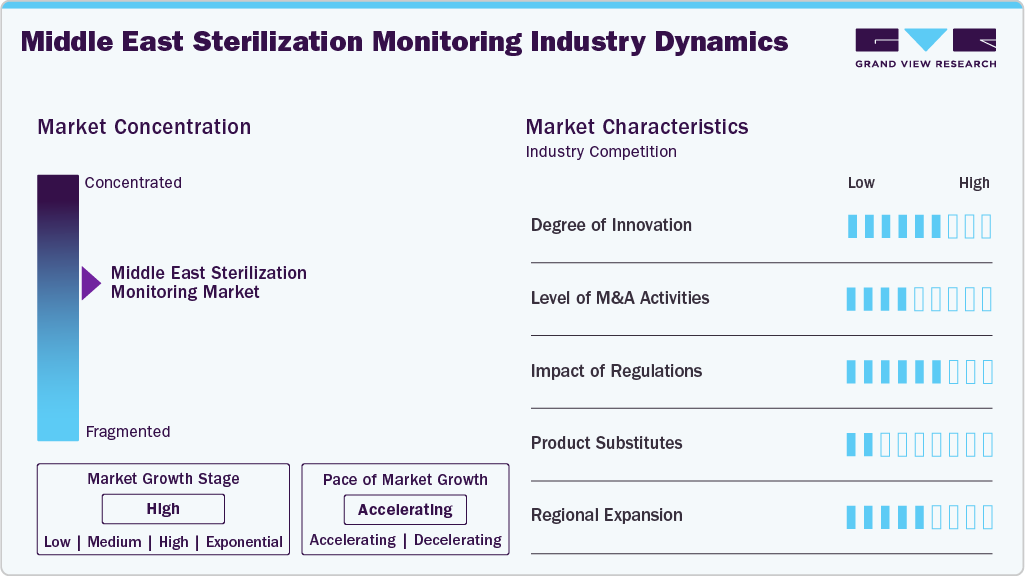
National regulatory authorities such as the Saudi Food and Drug Authority (SFDA), Dubai Health Authority (DHA), and Abu Dhabi Department of Health (DoH) regulate sterilization monitoring devices in the Middle East. Importers and manufacturers must meet regulatory authorities' dossier, labeling, and sterilization process validation requirements, which are aligned with global standards such as ISO 11138 and ISO 11140 for indicators.
M&A activity in the Middle East's sterilization monitoring market is gradually increasing, driven by rising healthcare investments, stricter infection control regulations, and demand for advanced sterilization technologies. Regional and global players are pursuing strategic acquisitions to expand their footprint and capabilities.
Sterilization monitoring is witnessing significant regional expansion across the Middle East, fueled by rising healthcare infrastructure development, regulatory reforms, and growing awareness around infection prevention. Government initiatives like national health strategies and accreditation programs also push healthcare providers to adopt more advanced sterilization monitoring systems. Additionally, medical tourism and the growth of private healthcare are creating new opportunities for global and regional players to expand their presence, either through direct entry or partnerships.
Technology Insights
The chemical indicators segment dominated the Middle East sterilization monitoring market in 2024, due to their affordability, ease of use, and quick visual confirmation of sterilization parameters. These indicators are widely utilized in hospitals, clinics, and laboratories as a reliable first-line method to verify exposure to specific sterilization conditions. Their low cost and immediate feedback make them ideal for routine checks, supporting infection control efforts and compliance with regional healthcare safety regulations.
The biological indicators segment is expected to witness the fastest growth in the Middle East sterilization monitoring market. Biological indicators (BIs) contain viable microorganisms with known resistance to specific sterilization processes and are considered the gold standard for verifying sterilization efficacy. They provide direct evidence that sterilization conditions were sufficient to inactivate highly resistant microbial forms, such as bacterial endospores. Products such as 3M’s Attest Rapid Readout Biological Indicator System, which delivers results within a few hours instead of the traditional 24-hour period, enable quicker decision-making and improved operational efficiency. The availability of such advanced, time-saving solutions is driving greater adoption across healthcare facilities, supporting the strong growth of this segment.
Product Insights
Strips segment held the largest revenue share of 45.41% in 2024 and is also expected to register the fastest growth over the forecast period in the middle east sterilization monitoring market. The strips segment includes both biological and chemical indicator strips, each serving a crucial role in verifying sterilization effectiveness. Biological indicator strips are impregnated with resistant bacterial spores to test sterilization processes like steam or ethylene oxide. Chemical indicator strips offer a cost-effective, easy-to-use solution by changing color to confirm exposure to sterilization parameters. Their instant visual feedback supports rapid decision-making and efficient workflow in healthcare and laboratory settings.
The indicator tapes segment is expected to witness a significant growth in the sterilization monitoring market. They play a vital role in ensuring efficacy of sterilization by providing a simple, visual confirmation of exposure to conditions. These tapes change color when subjected to specific parameters such as heat, steam, or gas, making them ideal for sealing sterilization packages and identifying processed instruments. Their affordability, ease of use, and clear pass/fail indication make indicator tapes widely adopted across hospitals, clinics, and laboratories for routine sterilization monitoring and compliance.
Method Insights
The steam sterilization segment accounted for the largest market share of 51.59% in 2024. Recognized as the gold standard for sterilizing a wide variety of instruments and equipment, steam sterilization is favored for its proven effectiveness, affordability, and reliability. The widespread use of steam sterilization in hospitals and clinics fuels the demand for advanced monitoring solutions specifically designed for this method. Key growth drivers include stringent regulatory requirements demanding thorough sterilization validation, the growing complexity of medical devices necessitating precise verification, and ongoing technological innovations that provide accurate, real-time monitoring of steam sterilization cycles.
The hydrogen peroxide sterilization segment is anticipated to grow fastest in the Middle East sterilization monitoring market. This method is gaining popularity due to its effectiveness in sterilizing heat—and moisture-sensitive medical devices. Hydrogen peroxide sterilization offers advantages such as shorter cycle times, environmental friendliness, and compatibility with various instruments. As healthcare facilities in the region adopt more advanced sterilization technologies, the demand for specialized monitoring solutions tailored to hydrogen peroxide processes rapidly increases, driving significant market expansion.
End Use Insights
The hospital and clinics segment dominated the Middle East sterilization monitoring market in 2024, accounting for the largest share of 50.22%. This dominance is attributed to the critical need for infection control in healthcare settings, where sterilizing medical instruments is essential to prevent hospital-acquired infections. The increasing number of surgical procedures and the rising focus on hygiene and infection control further drive the demand for sterilization services in the region.
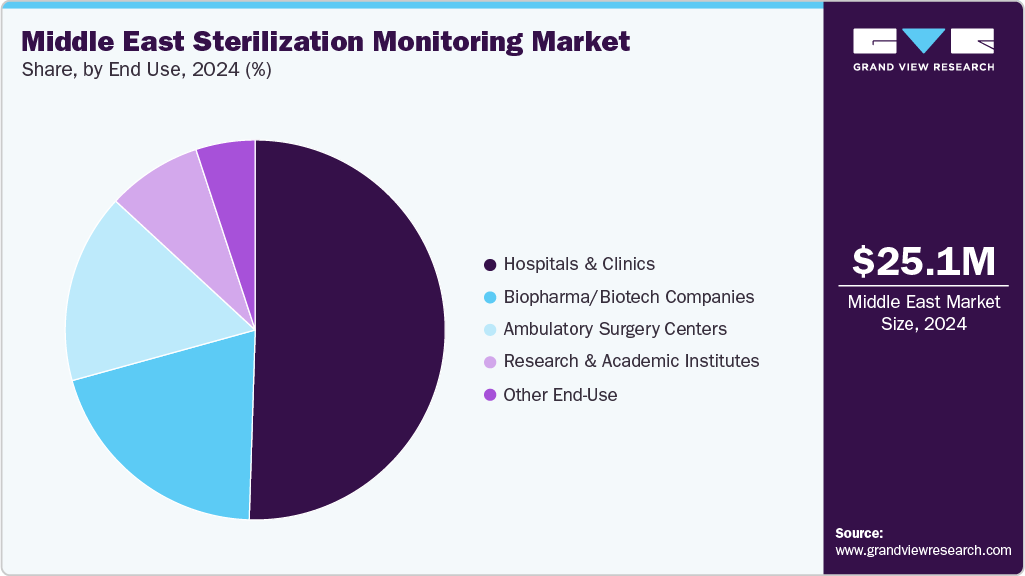
The Biopharma/Biotech Companies segment is expected to be the fastest-growing segment in the Middle East sterilization monitoring market. This growth is driven by the increasing demand for stringent sterilization processes to ensure product safety and compliance with regulatory standards. As biopharmaceutical and biotechnology industries expand in the Middle East, reliable and advanced sterilization monitoring solutions are critical to prevent contamination and maintain high-quality production. Investments in cutting-edge technologies and strict quality control measures further fuel the adoption of sterilization monitoring in this segment.
Country Insights
UAE Sterilization Monitoring Market Trends
In 2024, the UAE accounted for the largest revenue share in the Middle East sterilization monitoring market. This growth is primarily driven by the high prevalence of diabetes and obesity in the country, which leads to increased surgical procedures due to complications like diabetic foot ulcers, vascular diseases, and other chronic conditions requiring operative care. In addition, the expanding geriatric population, more susceptible to age-related health issues necessitating surgery, further fuels the demand for rigorous infection control and sterilization monitoring in healthcare facilities.
Diabetes Statistics in the UAE (2024)
Total Adult Population
7,710,700
Prevalence of Diabetes in Adults
20.70%
Total Cases of Diabetes in Adults
1,274,200
Source: IDF
Kuwait Sterilization Monitoring Market Trends
The sterilization monitoring market in Kuwait is poised for moderate growth, driven by the increasing burden of chronic diseases and the continued implementation of advanced infection prevention protocols. Non-communicable diseases (NCDs) remain the leading cause of death in the country. According to a study published in the S. Karger AG journal in December 2022, 25% of individuals in Kuwait reported having at least one NCD. This rising healthcare demand encourages greater emphasis on sterilization monitoring to ensure patient safety and infection control.
Key Middle East Sterilization Monitoring Company Insights
Solventum, STERIS, Getinge, Hu-Friedy Mfg. Co., LLC., TERRAGENE, and Steelco S.p.A are some of the major players in the Middle East sterilization monitoring market. Companies are expanding their portfolios and focusing on partnerships to meet the growing demand. Moreover, industry players are also launching innovative products to gain a competitive advantage.
Key Middle East Sterilization Monitoring Companies:
- Solventum
- ASP
- STERIS
- Getinge
- Hu-Friedy Mfg. Co., LLC.
- Terragene
- Steelco S.p.A.
Recent Development
-
In January 2025, LISTER, a provider of biological indicators, showcased its latest solutions at Arab Health 2025 in Dubai. The company engaged attendees with live demos and collaboration opportunities, supporting regional growth in infection control practices.
Middle East Sterilization Monitoring Market Report Scope
Report Attribute
Details
Market size value in 2025
USD 27.09 million
Revenue forecast in 2033
USD 61.01 million
Growth rate
CAGR of 10.7% from 2025 to 2033
Base year for estimation
2024
Historical data
2021 - 2023
Forecast period
2025 - 2033
Quantitative units
Revenue in USD million/billion and CAGR from 2025 to 2033
Report coverage
Revenue forecast, company ranking, competitive landscape, growth factors, and trends
Segments covered
Technology, product, method, end use, region
Regional scope
Middle East
Country scope
Saudi Arabia; UAE; Kuwait; Oman; Qatar
Key companies profiled
Solventum; ASP; STERIS; Getinge; Hu-Friedy Mfg. Co. LLC.; Terragene; Steelco S.p.A
Customization scope
Free report customization (equivalent up to 8 analysts working days) with purchase. Addition or alteration to country, regional & segment scope.
Pricing and purchase options
Avail customized purchase options to meet your exact research needs. Explore purchase options Middle East Sterilization Monitoring Market Report Segmentation
This report forecasts revenue growth at regional and country levels and provides an analysis of the latest industry trends in each of the sub-segments from 2021 to 2033. For this study, Grand View Research has segmented the Middle East sterilization monitoring market report based on technology, product, method, end use, and countries:
-
Technology Outlook (Revenue, USD Million, 2021 - 2033)
-
Biological Indicators
-
Chemical Indicators
-
-
Product Outlook (Revenue, USD Million, 2021 - 2033)
-
Strips
-
Indicator Tapes
-
Cards
-
Others
-
-
Method Outlook (Revenue, USD Million, 2021 - 2033)
-
Steam Sterilization
-
Ethylene Oxide Sterilization
-
Hydrogen Peroxide Sterilization
-
Others
-
-
End Use Outlook (Revenue, USD Million, 2021 - 2033)
-
Hospitals and Clinics
-
Biopharma/Biotech Companies
-
Ambulatory Surgery Centers
-
Research and Academic Institutes
-
Others
-
-
Country Outlook (Revenue, USD Million, 2021 - 2033)
-
Saudi Arabia
-
UAE
-
Kuwait
-
Qatar
-
Oman
-
Frequently Asked Questions About This Report
b. The Middle East sterilization monitoring market size was estimated at USD 25.10 million in 2024 and is expected to reach USD 27.09 million in 2025.
b. The Middle East sterilization monitoring market is expected to grow at a compound annual growth rate of 10.68% from 2025 to 2033 to reach USD 61.01 million by 2033.
b. Strips segment held the largest revenue share of 45.41% in 2024. The strips segment offers reliable, cost-effective, and easy-to-use sterilization monitoring with quick visual confirmation and accurate process validation.
b. Some key players operating in the Middle East sterilization monitoring market include Solventum, STERIS, Getinge, Hu-Friedy Mfg. Co., LLC., TERRAGENE, and Steelco S.p.A.
b. Key factors driving the market growth include the rising healthcare infrastructure investments, increasing surgical procedures, and a growing emphasis on infection control.


Share this report with your colleague or friend.
Need a Tailored Report?
Customize this report to your needs — add regions, segments, or data points, with 20% free customization.


ISO 9001:2015 & 27001:2022 Certified
We are GDPR and CCPA compliant! Your transaction & personal information is safe and secure. For more details, please read our privacy policy.
Trusted market insights - try a free sample
See how our reports are structured and why industry leaders rely on Grand View Research. Get a free sample or ask us to tailor this report to your needs.













