
- Home
- »
- Next Generation Technologies
- »
-
Middleware Software Market Size, Share Report, 2026-2033GVR Report cover

Middleware Software Market (2026 - 2033) Size, Share & Trends Analysis Report By Component (Software, Services), By Type (Communication Middleware, Integration Middleware, Platform Middleware), By Deployment, By Organization Size, By End-use, By Region, And Segment Forecasts
Market Size, 2025
$29.2BMarket Estimate, 2026
$30.3BMarket Forecast, 2033
$45.9BCAGR, 2026–2033
6.1%Middleware Software Market Summary
The global middleware software market size was valued at USD 29.2 billion in 2025 and is projected to grow from USD 30.3 billion in 2026 to USD 45.9 billion by 2033, at a CAGR of 6.1% from 2026 to 2033. North America held over 38.6% revenue share of the global market in 2025. The market is primarily driven by rapid digital transformation, increasing adoption of hybrid and cloud IT environments, and the rising need for seamless integration across complex enterprise systems.
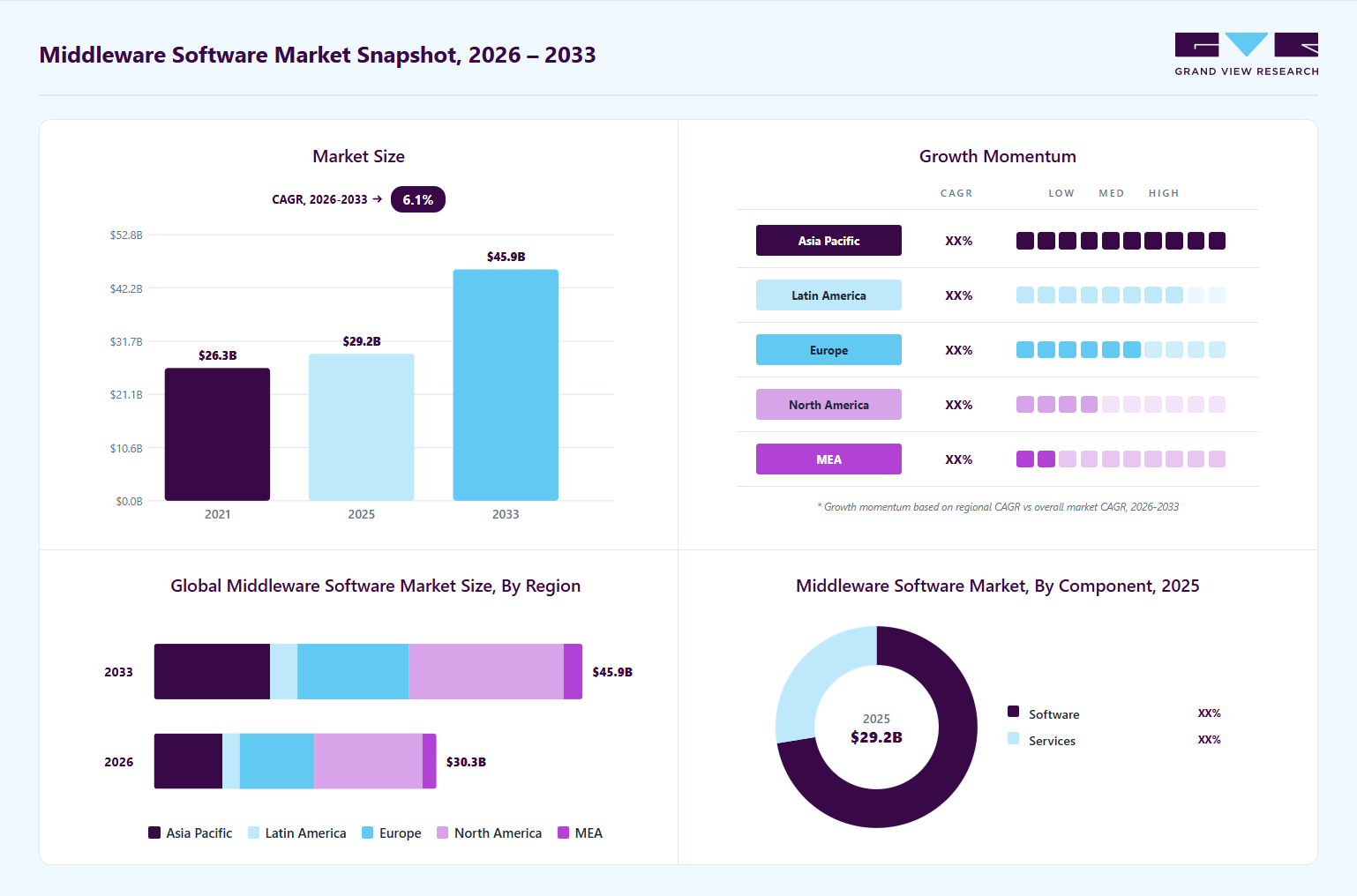 Source: Grand View Research, IR Documents, Primary Interviews, Paid DatabasesTo learn more about this report,
 Download Free Sample Report
 Key Market Trends & Insights
- By component: Software segment held the largest revenue share of over 72.0% in 2025.
- By type: Integration middleware segment held the largest revenue share in 2025.
- By deployment: Cloud segment is expected to grow at the fastest CAGR during the forecast period.
Regional Highlights
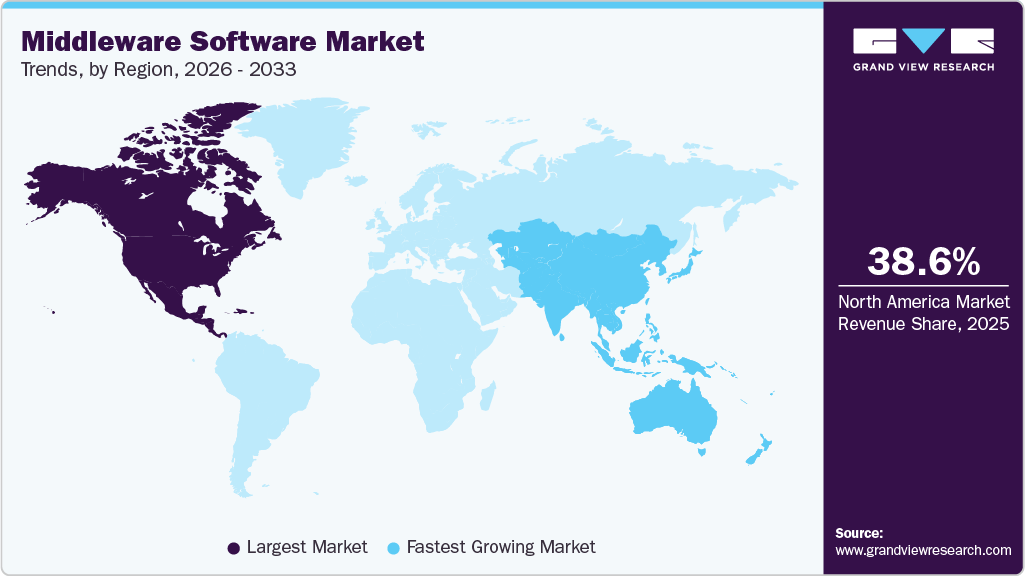
- Largest regional market: North America (38.6% revenue share, 2025)
- Fastest-growing regional market: Asia Pacific (highest CAGR, 2026-2033)
- By country: The U.S. held the largest market share in 2025.
Market Size & Forecast
- Market size in 2025: USD 29.2 Billion
- Estimated market size in 2026: USD 30.3 Billion
- Projected market size by 2033: USD 45.9 Billion
- CAGR (2026-2033): 6.1%
Three ways to get this report
Buy it, customize it, or ask a question.Ask an Analyst
A direct answer, usually in 1 working day
- AccessReport author, directly
- Reply timeWithin 1 working day
- No sales callDirect answer only
- FormatEmail reply
- CostFree, no cost
Get the Full Report
What the study covers
- FormatsPDF · Excel · Dashboard
- Timeline2026–2033 annual, 2025 base
- Coverage20+ countries, 5 regions
- Companies10+ key players profiled
Customize the Report
20% free customization
- IncludeCountries, segments, points
- TailorTo your product definition
- ExtendDeeper competitor detail
- OrA fully bespoke study
- Turnaround5–10 working days
Organizations are increasingly relying on middleware as a “connective layer” to unify applications, data, and services, as enterprises adopt hybrid IT models and accelerate integration requirements. The accelerating shift toward hybrid and multi-cloud environments is a key driver of the middleware software market. Enterprises are no longer operating within a single IT infrastructure; instead, they use a mix of on-premises, private cloud, and public cloud systems. Middleware enables interoperability across these environments, ensuring smooth communication between applications. As a result, the surge in hybrid IT adoption, driven by flexibility and scalability needs, is significantly increasing demand for integration middleware and cloud-based platforms.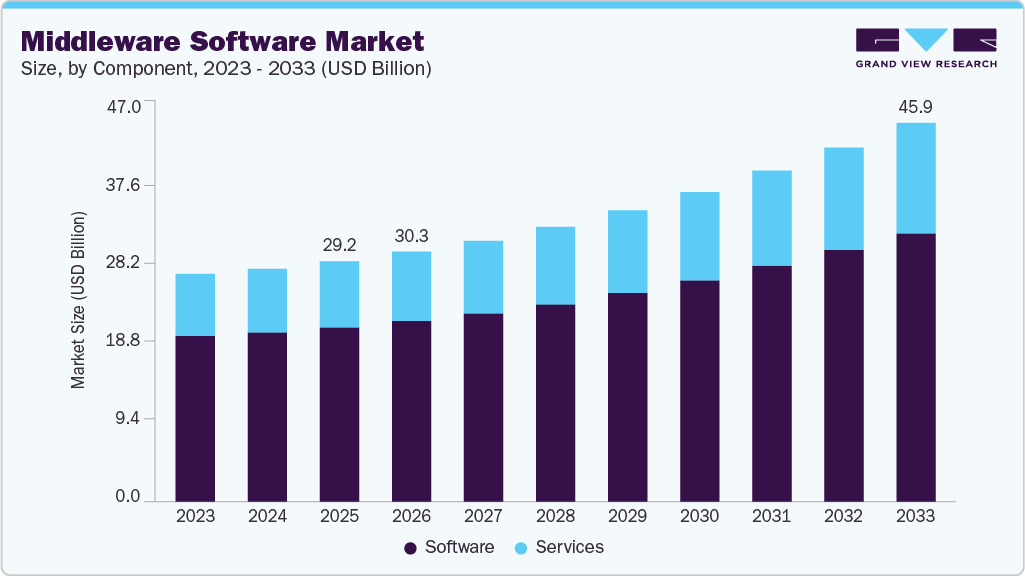 To learn more about this report, Download Free Sample Report
 Another major driver is the growing complexity of enterprise IT ecosystems. Organizations are dealing with multiple applications such as ERP, CRM, analytics platforms, and IoT systems, all of which need to communicate efficiently. Middleware simplifies this complexity by acting as an integration layer that connects legacy systems with modern applications. The rising need to modernize legacy infrastructure and enable real-time data exchange is pushing enterprises to invest heavily in middleware solutions.
The rapid adoption of cloud-native and API-led architectures drives the middleware software market. Enterprises are increasingly deploying middleware as cloud-native platforms or Integration Platform-as-a-Service (iPaaS) solutions to reduce infrastructure costs and improve scalability. According to the Eurostat, 52.74% of EU enterprises used paid cloud computing services in 2025, increasing by 7.42% points compared with 2023. This highlights the rapid shift toward cloud-based infrastructure and applications. In addition, API-driven integration is gaining traction, with more than half of enterprises focusing on API-led connectivity to enable faster digital innovation and system interoperability.
Another important trend is the growing adoption of microservices architecture and event-driven systems. Organizations are moving away from monolithic applications toward modular, microservices-based architectures, which require strong middleware for service orchestration and communication. Middleware technologies such as message brokers, event streaming platforms, and service meshes are becoming critical in enabling real-time processing and scalability. This trend, combined with increasing demand for Industry 4.0 and IoT integration, is expected to further strengthen the middleware software market growth.
Market Dynamics
Accelerating enterprise digital transformation is driving growth in the middleware software market, as organizations increasingly modernize their IT infrastructure, automate workflows, and integrate diverse business applications across cloud and on-premises environments. Enterprises are adopting middleware solutions to enable seamless communication between ERP systems, CRM platforms, databases, SaaS applications, and legacy systems, helping improve operational efficiency, scalability, and real-time data accessibility. As businesses continue expanding digital operations, middleware has become essential for ensuring interoperability and streamlined enterprise connectivity.
Data security and cybersecurity risks are significant restraints in the middleware Software Market because middleware platforms act as central communication layers connecting multiple enterprise applications, databases, cloud environments, and APIs. Since these platforms process and transfer large volumes of sensitive business and customer data, they become attractive targets for cyberattacks such as data breaches, ransomware, API exploitation, and unauthorized access. Any vulnerability within the middleware infrastructure can potentially disrupt enterprise operations and compromise critical information across interconnected systems.
The growth of IoT and connected device ecosystems is creating major opportunities for the middleware software market as enterprises increasingly deploy smart devices, sensors, industrial equipment, and connected applications across business operations. Middleware platforms play a critical role in enabling seamless communication, data exchange, and interoperability between IoT devices, cloud platforms, enterprise applications, and analytics systems. As organizations expand connected infrastructures, middleware solutions are becoming essential for managing real-time device connectivity, data integration, and operational coordination across distributed environments.
Market Concentration & Characteristics
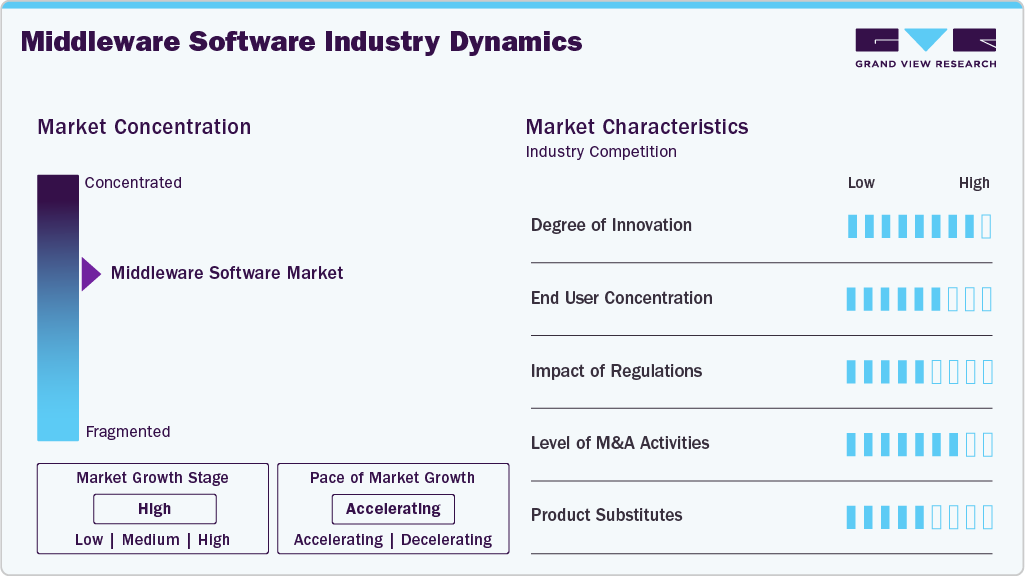
The middleware software market is moderately concentrated due to the strong dominance of established enterprise software providers with extensive integration ecosystems and long-standing enterprise relationships. Large vendors benefit from comprehensive middleware portfolios that cover application integration, API management, message-oriented middleware, enterprise service buses (ESBs), cloud integration, and hybrid IT orchestration. These companies possess significant competitive advantages through global service capabilities, installed enterprise customer bases, high switching costs, and deep compatibility with legacy enterprise systems. Despite this concentration, the market continues to see participation from cloud-native middleware startups and open-source integration platforms, particularly in API-led connectivity and microservices architectures, driving sustained competitive dynamics across the industry.
 To learn more about this report, Download Free Sample Report
 The degree of innovation in the industry is high, primarily driven by digital transformation initiatives, hybrid cloud adoption, microservice architectures, containerization, AI-driven automation, and the expansion of the API economy. Vendors are heavily investing in intelligent integration platforms, low-code integration tools, event-driven architectures, real-time data streaming, and AI-powered workflow orchestration capabilities. The transition from traditional on-premise middleware toward cloud-native and platform-as-a-service (PaaS) integration solutions is accelerating product innovation across the market. In addition, increasing enterprise demand for seamless interoperability between SaaS applications, legacy systems, IoT devices, and multi-cloud environments continues to drive rapid technological advancement and competitive product differentiation.
Component Insights
The software segment accounted for the largest revenue share of over 72.0% in 2025 in the middleware software market. This dominance is primarily driven by the growing adoption of cloud-native applications, API-led integration, and enterprise demand for scalable, flexible integration platforms. Organizations are heavily investing in middleware software solutions such as application servers, message-oriented middleware, and integration platforms to enable seamless communication across distributed systems. In addition, the growing complexity of IT ecosystems, coupled with the need to modernize legacy infrastructure and support real-time data processing, is significantly accelerating the adoption of middleware software across industries.
The services segment is anticipated to grow at the fastest CAGR during the forecast period. This growth is fueled by rising demand for consulting, integration, deployment, and managed services as enterprises increasingly adopt complex middleware environments. Organizations require specialized expertise to implement, customize, and maintain middleware solutions, particularly in hybrid and multi-cloud settings. Furthermore, the increasing shift toward outsourced IT services, along with the need for continuous monitoring, security management, and performance optimization, is driving strong demand for middleware-related services, positioning this segment for rapid expansion over the forecast period.
Type Insights
The integration middleware segment dominated the middleware software market in 2025. The market growth is driven by the rising need for seamless integration across diverse enterprise applications, data sources, and cloud environments. As organizations increasingly adopt hybrid and multi-cloud strategies, integration middleware plays a critical role in connecting legacy systems with modern applications, enabling real-time data exchange and process automation. The growing emphasis on API-led connectivity, digital transformation initiatives, and the expansion of enterprise applications such as ERP and CRM systems are key drivers accelerating the demand for integration middleware solutions.
The communication middleware segment is expected to register the fastest CAGR from 2026 to 2033. This growth is fueled by the increasing demand for real-time data transmission, event-driven architectures, and distributed computing environments. Communication middleware, including message brokers and event streaming platforms, is gaining traction as enterprises adopt microservices-based architectures and IoT ecosystems that require low-latency, high-throughput communication. In addition, the surge in data volumes, coupled with the need for reliable, scalable messaging systems across cloud and edge environments, is driving the adoption of communication middleware solutions.
Deployment Insights
The cloud segment dominated the middleware software market in 2025. This dominance is driven by the rapid adoption of cloud computing, increasing preference for scalable and flexible IT infrastructure, and the growing shift toward Software-as-a-Service (SaaS) and Platform-as-a-Service (PaaS) models. Enterprises are leveraging cloud-based middleware to enable seamless integration across distributed applications, enhance operational agility, and reduce infrastructure and maintenance costs. In addition, the rise of cloud-native development, API-led architectures, and Integration Platform-as-a-Service (iPaaS) solutions is further accelerating the adoption of cloud middleware across industries.
The on-premises segment is expected to register a significant CAGR from 2026 to 2033. This growth is primarily driven by organizations with strict data security, compliance, and regulatory requirements that prefer to maintain full control over their IT environments. Industries such as BFSI, government, and healthcare continue to rely on on-premises middleware for handling sensitive data and mission-critical operations. Furthermore, the need to integrate legacy systems with modern applications, along with increasing investments in private infrastructure and hybrid deployment models, is supporting the sustained demand for on-premises middleware solutions.
Organization Size Insights
The large enterprises segment dominated the middleware software market in 2025. This dominance is attributed to the presence of complex, large-scale IT infrastructures that require robust integration solutions to manage diverse applications, data sources, and workflows. Large organizations heavily invest in middleware to enable seamless communication across enterprise systems such as ERP, CRM, and analytics platforms, while also supporting digital transformation initiatives. In addition, higher IT budgets, increased adoption of hybrid and multi-cloud environments, and the need for real-time data processing and automation are key drivers fueling middleware adoption among large enterprises.
The SMEs segment is expected to register the fastest CAGR from 2026 to 2033. This growth is driven by the increasing digitalization of small and medium-sized businesses and their rising adoption of cloud-based solutions. SMEs are leveraging middleware, particularly cloud-based and iPaaS platforms, to streamline operations, improve scalability, and integrate various business applications without heavy upfront infrastructure investments. Furthermore, the availability of cost-effective subscription models, growing awareness of data integration benefits, and the need to enhance operational efficiency and customer experience are key factors accelerating middleware adoption among SMEs.
End-use Insights
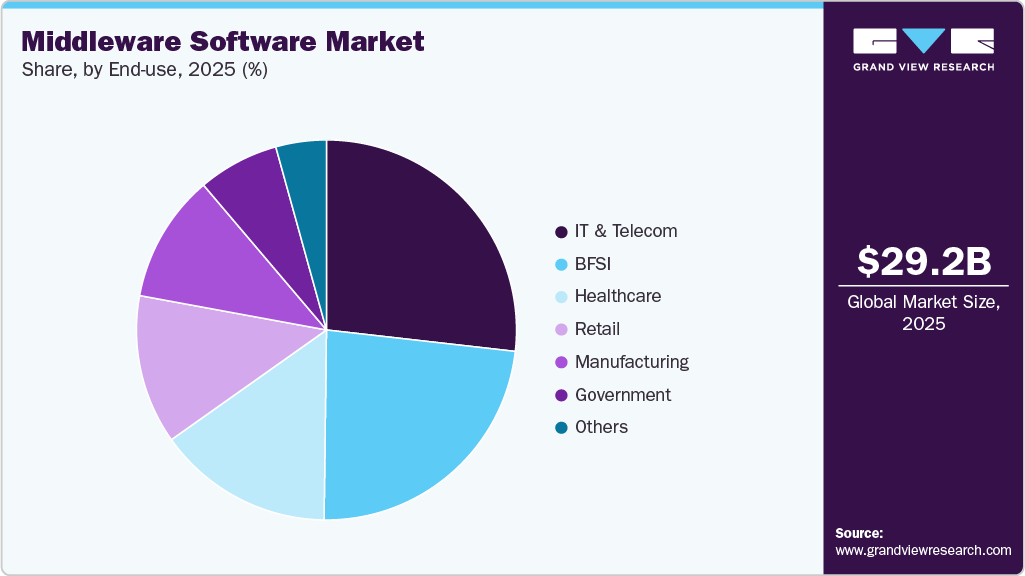
The IT & telecom segment accounted for the largest market share of the middleware software industry in 2025. This dominance is driven by the sector’s highly complex, distributed IT infrastructure, which requires robust middleware to enable seamless integration, real-time data exchange, and network management. Telecom operators and IT service providers rely heavily on middleware to support large-scale applications, cloud services, and 5G network deployments. Moreover, the increasing adoption of microservices architectures, edge computing, and high data traffic volumes is further accelerating the demand for advanced middleware platforms in this segment.
 To learn more about this report, Download Free Sample Report
 The retail segment is anticipated to register the fastest CAGR during the forecast period. This growth is fueled by the rapid digital transformation of the retail industry, including the expansion of e-commerce platforms, the adoption of omnichannel strategies, and the creation of personalized customer experiences. Retailers are increasingly adopting middleware solutions to integrate online and offline systems, manage real-time inventory, and enable seamless payment processing. Furthermore, the growing use of data analytics, customer relationship management systems, and cloud-based applications is driving the need for efficient middleware integration, positioning the retail segment for strong growth.
Regional Insights
The North America middleware software market accounted for the largest market share of 38.6% in 2025. This dominance is primarily driven by the region’s advanced IT infrastructure, high adoption of cloud computing, and early implementation of emerging technologies such as artificial intelligence, IoT, and microservices architectures. The strong presence of leading technology providers and continuous investments in digital transformation initiatives across industries further accelerate middleware adoption. In addition, the increasing demand for hybrid and multi-cloud integration, coupled with the need for real-time data processing and seamless enterprise connectivity, is significantly contributing to market growth in North America.
 To learn more about this report, Download Free Sample Report
 U.S. Middleware Software Market Trends
The U.S. middleware software industry is projected to grow significantly during the forecast period. This growth is driven by rapid enterprise digitalization, widespread adoption of cloud-native technologies, and the expansion of large-scale data-driven applications across sectors such as BFSI, healthcare, retail, and IT & telecom. U.S.-based organizations are increasingly investing in middleware solutions to modernize legacy systems and support complex, distributed IT environments. Furthermore, strong government support for digital infrastructure, rising cybersecurity requirements, and increasing deployment of advanced technologies such as 5G, edge computing, and AI are key factors fueling the growth of the market in the U.S.
Asia Pacific Middleware Software Market Trends
The middleware software industry in the Asia Pacific is expected to grow at the fastest CAGR from 2026 to 2033. This rapid growth is driven by the expanding digital economies across emerging markets, increasing adoption of e-commerce platforms, and large-scale government-led digitalization initiatives in countries such as India, China, and Southeast Asian nations. The region is witnessing a surge in mobile-first applications, fintech innovation, and smart city developments, all of which require strong middleware for seamless data exchange and system interoperability. In addition, the growing number of startups and SMEs adopting cost-effective, cloud-based integration platforms, along with rising investments in IT infrastructure, is significantly accelerating middleware adoption across the Asia Pacific.
The China middleware software industry is projected to grow steadily during the forecast period. This growth is supported by the country’s strong focus on industrial digitalization and the rapid expansion of its manufacturing and industrial internet ecosystem. Government initiatives promoting digital transformation in traditional industries, along with increasing deployment of IoT and automation technologies, are driving demand for middleware solutions to enable system integration and real-time data processing. Furthermore, the rise of domestic technology ecosystems, increasing enterprise demand for localized software solutions, and continuous advancements in smart manufacturing and digital supply chains are key factors contributing to the growth of the market in China.
The middleware software industry in Southeast Asia is projected to grow steadily during the forecast period. The growth of fintech and digital banking services is driving the market growth in the region. South East Asia has a rapidly expanding digital payments and financial services ecosystem, where secure and real-time data exchange is critical. Middleware software supports transaction processing, API integration, and secure communication between banking systems and third-party applications. This enables financial institutions to deliver faster and more reliable digital services. Increasing competition in the fintech sector is also pushing organizations to adopt more agile and scalable IT architectures. This is further accelerating middleware adoption.
Europe Middleware Software Market Trends
The middleware software industry in Europe is experiencing steady growth, supported by stringent data protection regulations such as the General Data Protection Regulation (GDPR) and the growing focus on secure, compliant data integration across enterprises. Organizations across the region are prioritizing middleware solutions that ensure data sovereignty, privacy, and regulatory compliance while enabling efficient cross-border data flows. In addition, the growing adoption of Industry 4.0 initiatives, particularly in manufacturing-heavy economies such as Germany and France, is driving demand for middleware to connect industrial systems, automation platforms, and enterprise applications. The expansion of digital public services and increasing investments in pan-European digital infrastructure further contribute to the steady growth of the market in Europe.
The UK middleware software industry is projected to grow significantly during the forecast period. This growth is driven by the country’s strong focus on financial technology innovation and the widespread adoption of open banking frameworks, supported by initiatives such as PSD2. The need for secure, real-time integration among banks, fintech platforms, and third-party service providers is accelerating the adoption of middleware solutions. Furthermore, the increasing demand for agile IT environments, rapid application deployment, and seamless integration across digital services in sectors such as BFSI and e-commerce is fueling market expansion. The presence of a mature digital ecosystem and continuous innovation in financial and enterprise technologies are key factors supporting middleware growth in the UK.
Key Middleware Software Company Insights
Some prominent players in the middleware software market include IBM Corporation, Oracle, Microsoft, Red Hat, SAP SE, and Software GmbH.
-
Oracle Corporation is a global enterprise software and cloud technology provider offering a comprehensive portfolio of database, cloud, and middleware solutions. Its flagship offering, Oracle Fusion Middleware, is a cloud-enabled platform that provides a wide range of capabilities, including application development tools, integration solutions, identity management, content management, and business intelligence.
-
Red Hat, Inc. is a global provider of open-source enterprise software solutions and plays a significant role in the middleware software market through its cloud-native and hybrid integration platforms. The company’s middleware portfolio, often delivered under Red Hat Application Foundations, includes runtimes, integration tools, messaging systems, and API management solutions that support modern application development. Red Hat Middleware enables organizations to build, integrate, and automate applications across on-premises, cloud, and containerized environments such as Red Hat OpenShift.
Key Middleware Software Companies
The following key companies have been profiled for this study on the middleware software market
-
Axway
-
Broadcom
-
Cisco Systems, Inc.
-
Dell Inc.
-
Fujitsu
-
Hewlett Packard Enterprise Development LP
-
IBM Corporation
-
Microsoft
-
Open Text Corporation
-
Oracle
-
Red Hat
-
Salesforce, Inc.
-
SAP SE
-
Software GmbH
-
WSO2 LLC
Competitive Benchmarking
Operating Strategies
Competitive Edge
Weakness
Mature Players: Axway; Broadcom; Cisco Systems, Inc.; Dell Inc.; Fujitsu; Hewlett Packard Enterprise Development LP; IBM Corporation
- Investing heavily in hybrid cloud integration, AI-driven automation, API management, and enterprise orchestration platforms to strengthen middleware ecosystems.
- Expanding cloud-native middleware portfolios supporting Kubernetes, microservices, multi-cloud integration, and edge computing environments.
- Strong enterprise customer base, global service infrastructure, and extensive partner ecosystems provide significant competitive advantages in large-scale deployments.
- Broad product portfolios covering API management, integration platforms, messaging middleware, workflow automation, and data orchestration enable end-to-end enterprise integration capabilities.
- Vendor lock-in concerns and dependence on proprietary ecosystems may reduce customer flexibility in multi-cloud environments.
- Complex deployment and integration processes often require highly skilled IT professionals and long implementation cycles.
Emerging Players: WSO2 LLC; Software GmbH
- Developing flexible and developer-friendly middleware architectures optimized for microservices, DevOps, and containerized environments.
- Expanding partnerships with cloud providers, SaaS vendors, and digital transformation service companies to improve market penetration.
- Open-source and subscription-based models provide cost-effective alternatives for enterprises seeking flexible middleware deployment options.
- Strong focus on API-first architectures and cloud-native integration improves scalability and adaptability for modern enterprise workloads.
- Limited global operational scale and smaller enterprise support infrastructure compared to established multinational vendors.
- Lower brand recognition may restrict adoption among highly regulated industries and large enterprises requiring long-term vendor stability.
Recent Developments
-
In April 2026, Axway announced a strategic partnership with HANDD Business Solutions to deliver enterprise-grade managed file transfer (MFT) and secure integration solutions. The collaboration combines HANDD’s implementation and managed services expertise with Axway’s integration platform and MFT portfolio to help organizations modernize secure data transfer across hybrid and multi-cloud environments, particularly in regulated industries. It strengthens integration middleware and managed file transfer capabilities, enabling secure data exchange and system interoperability across enterprise IT environments.
-
In February 2026, IBM announced the upcoming general availability of AI Agents for IBM Cloud Pak for Integration, scheduled for release on March 25, 2026. These AI agents enable users to interact with the integration platform using natural language to identify issues, analyze logs, detect anomalies, and gain actionable insights across hybrid environments, significantly improving operational efficiency and troubleshooting capabilities. This development directly enhances integration middleware capabilities by embedding AI-driven automation and intelligence into IBM’s Cloud Pak for Integration platform, improving system interoperability, monitoring, and performance.
-
In July 2025, Broadcom Inc. announced a monthly platform patch update for its Layer7 API Gateway, addressing operating system-related vulnerabilities (CVEs) and upgrading core components such as MySQL to newer versions. It enhances the security and reliability of API gateway middleware, which is critical for managing, securing, and integrating enterprise APIs across distributed systems.
Middleware Software Market Report Scope
Report Attribute
Details
Market size in 2025
USD 29.2 billion
Estimated Market size in 2026
USD 30.3 billion
Projected Market size by 2033
USD 45.9 billion
Growth rate
CAGR of 6.1% from 2026 to 2033
Actual data
2021 - 2025
Forecast period
2026 - 2033
Quantitative units
Revenue in USD billion, and CAGR from 2026 to 2033
Report coverage
Revenue forecast, company share, competitive landscape, growth factors, and trends
Segments covered
Component, type, deployment, organization size, end-use, region
Regional scope
North America, Europe, Asia Pacific, Latin America, MEA
Country scope
U.S.; Canada; Mexico; UK; Germany; France; China; India; Japan; Australia; South Korea; South East Asia; Brazil; UAE; Saudi Arabia; South Africa
Key companies profiled
Axway; Broadcom; Cisco Systems, Inc.; Dell Inc.; Fujitsu; Hewlett Packard Enterprise Development LP; IBM Corporation; Microsoft; Open Text Corporation; Oracle; Red Hat; Salesforce, Inc.; SAP SE; Software GmbH; WSO2 LLC
Customization scope
Free report customization (equivalent to 8 analysts working days) with purchase. Addition or alteration to country, regional & segment scope.
Pricing and purchase options
Avail customized purchase options to meet your exact research needs. Explore purchase options
Global Middleware Software Market Report Segmentation
This report forecasts revenue growth at global, regional, and country levels and provides an analysis of the latest industry trends in each of the sub-segments from 2021 to 2033. For this study, Grand View Research has segmented the global middleware software market report based on component, type, deployment, organization size, end-use, and region.
-
Component Outlook (Revenue, USD Billion, 2021 - 2033)
-
Software
-
Services
-
-
Type Outlook (Revenue, USD Billion, 2021 - 2033)
-
Communication Middleware
-
Integration Middleware
-
Platform Middleware
-
Others
-
-
Deployment Outlook (Revenue, USD Billion, 2021 - 2033)
-
Cloud
-
On-Premises
-
-
Organization Size Outlook (Revenue, USD Billion, 2021 - 2033)
-
Large Enterprises
-
SMEs
-
-
End-use Outlook (Revenue, USD Billion, 2021 - 2033)
-
BFSI
-
IT & Telecom
-
Healthcare
-
Retail
-
Manufacturing
-
Government
-
Others
-
-
Regional Outlook (Revenue, USD Billion, 2021 - 2033)
-
North America
-
U.S.
-
Canada
-
Mexico
-
-
Europe
-
Germany
-
UK
-
France
-
-
Asia Pacific
-
China
-
India
-
Japan
-
South Korea
-
Australia
-
South East Asia
-
-
Latin America
-
Brazil
-
-
Middle East & Africa
-
UAE
-
Saudi Arabia
-
South Africa
-
-
Delivered Customizations
This report has been delivered with the following In-depth customizations
Client Request
Customization Delivered
Value Adds
Enterprise application integration assessment for middleware software provider
Analysis of enterprise demand for application integration platforms and API management solutions
Evaluation of hybrid cloud and multi-cloud middleware deployment trends
Review of integration challenges across legacy and modern enterprise systems
Identified high-growth integration use cases across industries
Supported product enhancement and interoperability strategies
Highlighted evolving enterprise digital transformation requirements
Middleware modernization assessment for banking and financial services technology provider
Analysis of legacy middleware replacement trends within BFSI institutions
Evaluation of real-time transaction processing and secure integration requirements
Review of compliance-driven middleware modernization initiatives
Supported modernization roadmap planning for financial institutions
Identified opportunities in secure and scalable transaction integration platforms
Highlighted trends in digital banking infrastructure transformation.
Middleware security and compliance assessment for cybersecurity technology provider
Analysis of middleware security framework adoption trends, including identity management and secure API integration
Evaluation of enterprise concerns regarding data governance, compliance, and integration security
Review of zero-trust architecture integration within middleware environments
Supported the development of secure middleware deployment strategies
Identified opportunities in compliance-focused integration solutions
Highlighted enterprise demand for secure cross-platform connectivity
Frequently Asked Questions About This Report
Asia Pacific is the fastest-growing region over the forecast period.
The software segment led with a 72.0% revenue share in 2025, while services is the fastest-growing segment.
The global middleware software market size was estimated at USD 29.2 billion in 2025 and is expected to reach USD 30.3 billion in 2026.
The global middleware software market is expected to grow at a compound annual growth rate of 6.1% from 2026 to 2033 to reach USD 45.9 billion by 2033.
North America dominated with a 38.6% revenue share in 2025.
Some key players operating in the market Axway; Broadcom; Cisco Systems, Inc.; Dell Inc.; Fujitsu; Hewlett Packard Enterprise Development LP; IBM Corporation; Microsoft; Open Text Corporation; Oracle; Red Hat; Salesforce, Inc.; SAP SE; Software GmbH; WSO2 LLC, and Others.
Key factors include growing adoption of cloud computing and hybrid IT environments, increasing demand for seamless integration across diverse enterprise applications, and rising need for real-time data exchange and process automation play a key role in accelerating the middleware software market.
The integration segment held the highest market share in 2025. while communication is the fastest-growing segment.
The cloud segment held the highest market share in 2025, while on-premises is the significant growing.
The IT & telecom segment held the highest market share in 2025, while retail is the fastest-growing segment.
About the Author(s)
Next Generation Technologies Research Team
Technology · Next Generation TechnologiesThis report was authored by the next generation technologies research team at Grand View Research - comprising two research analysts, one senior research analyst, and one industry expert - with specialized expertise in the next generation technologies segment of the technology industry. All findings are based on proprietary technology databases, executive interviews, and regulatory analysis, subject to internal peer review prior to publication.
Last Updated:
Speak to Analyst

Customize this report to your needs - add regions, segments, or data points, with 20% free customization.
Or view our licence options:


ISO 9001:2015 & 27001:2022 Certified
We are GDPR and CCPA compliant! Your transaction & personal information is safe and secure. For more details, please read our privacy policy.


