
- Home
- »
- Next Generation Technologies
- »
-
Military Tactical Radio Market Size & Share Report 2026-2033GVR Report cover

Military Tactical Radio Market (2026 - 2033)
Size, Share & Trends Analysis Report By Type, By Frequency, By Technology (Conventional Radios, Software-Defined Radios (SDR)), By Application, By End Use (Army, Navy, Air Force), By Region, And Segment Forecasts
Market Size, 2025
$5.9BMarket Estimate, 2026
$6.2BMarket Forecast, 2033
$8.8BCAGR, 2026–2033
5.3%Military Tactical Radio Market Summary
The global military tactical radio market size was valued at USD 5.9 billion in 2025 and is projected to grow from USD 6.2 billion in 2026 to USD 8.8 billion by 2033, at a CAGR of 5.3% from 2026 to 2033. North America dominated the global market with the largest revenue share of 37.1% in 2025. The military tactical radio market is driven by increasing demand for secure, reliable, and interoperable battlefield communication systems, growing adoption of software-defined radios (SDRs), and rising modernization of military communication networks across land, air, and naval forces.
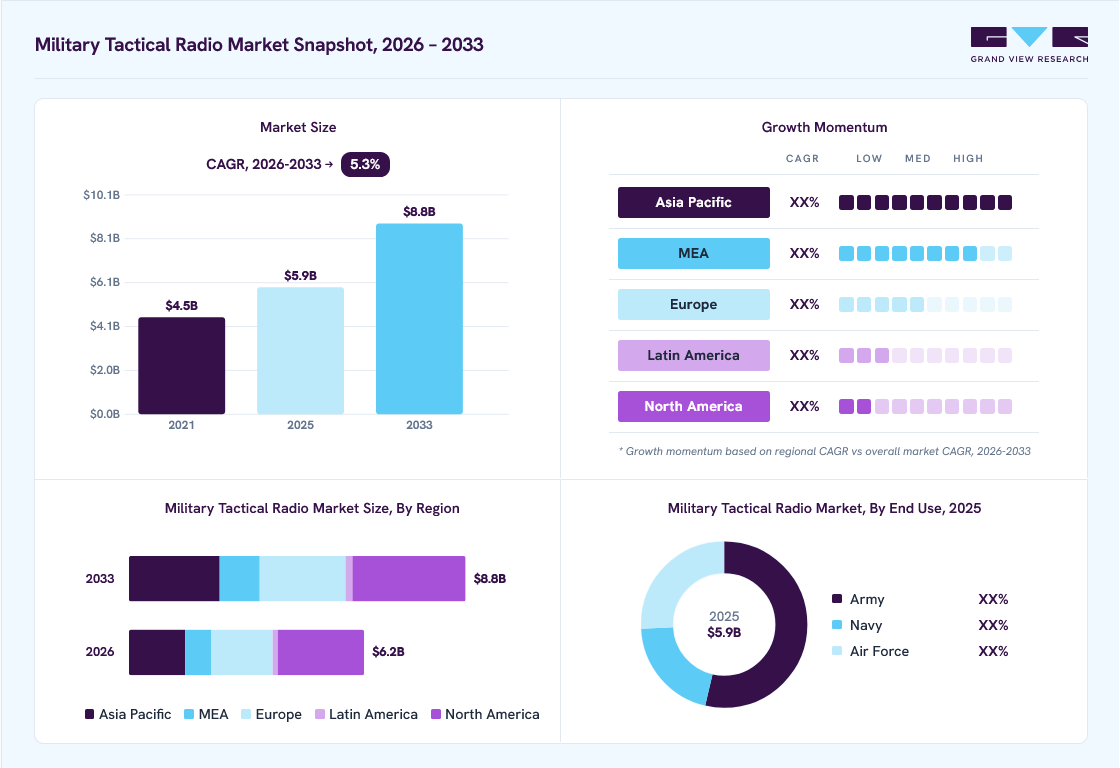 Source: Grand View Research, IR Documents, Primary Interviews, Paid DatabasesTo learn more about this report,
 Download Free Sample Report
Key Market Trends & Insights
- By type: Vehicle-mounted radio segment dominated the market, with a share of 25.4% in 2025.
- By frequency: Ultra-high frequency (UHF) development segment dominated the market with a share of 36.7% in 2025.
- By technology: Conventional radios segment held the largest market share in 2025.
- By application: Command & control communication development segment dominated the market in 2025.
Regional Highlights
- Largest regional market: North America (37.1% revenue share in 2025)
- Fastest growing regional market: Asia Pacific (highest CAGR 7.1%, 2026-2033)
- By Country: The U.S. held the largest market share in 2025.
Market Size & Forecast
- Market size in 2025: USD 5.9 Billion
- Estimated market size in 2026: USD 6.2 Billion
- Projected market size by 2033: USD 8.8 Billion
- CAGR (2026-2033): 5.3%
Prism AI by Grand View Research Free to tryAsk a question about the military tactical radio marketTry asking✓Every figure cited from GVR research Prefer the report? Download free sample →The rapid shift toward network-centric warfare and the integration of unmanned systems and AI-enabled platforms are boosting the need for tactical radios that handle voice, data, and video. Additionally, rising defense investments in infrastructure modernization, situational awareness, and software-defined radios with advanced encryption, along with growing geopolitical tensions, are expected to strongly propel market growth over the forecast period.
The growth of the military tactical radio industry is primarily driven by the increasing emphasis on interoperability and joint operations across allied defense forces. As multinational coalitions become more common in military missions, seamless communication among different platforms and forces is essential, fueling the demand for standardized and compatible tactical radio systems. Additionally, the push for unified command and control structures requires advanced radios with flexible frequency support and secure encryption. These factors are significantly contributing to the industry’s growth as governments prioritize integrated communication solutions.
 To learn more about this report, Download Free Sample Report
This military tactical radio industry expansion is driven by the modernization of legacy communication systems within land, air, and naval forces. Many defense agencies are replacing outdated analog radios with software-defined radios (SDRs) to improve operational efficiency and mission flexibility. The shift toward digitized battlefield communication is accelerating procurement and R&D in tactical radio technologies. Consequently, military forces are increasingly investing in future-proof communication systems, bolstering overall industry growth.
This surge in the demand for the military tactical radio is fueled by the growing requirements for compact, lightweight, and wearable communication devices for dismounted soldiers. Modern warfare requires highly mobile and agile units that rely on personal radios for coordination and command. Manufacturers are responding with soldier-centric radio systems that integrate seamlessly with tactical gear and sensors. This demand is shaping procurement preferences and encouraging further miniaturization and ruggedization efforts.
The military tactical radio industry is benefiting from the ongoing investments in 5G and low-earth orbit (LEO) satellite communications for defense applications. These technologies are being explored to augment traditional radio systems, especially in remote or contested terrains. By integrating with satellite and 5G infrastructure, tactical radios can achieve extended range, higher data throughput, and improved resilience. This convergence is opening new possibilities for high-performance, hybrid communication systems.
The military tactical radio industry is seeing a strong uptick in demand due to the need for cybersecurity-hardened communication solutions. With cyber threats targeting military communication networks, radios must now comply with stringent cybersecurity protocols and support secure key management features. Encryption, anti-jamming, and tamper-resistant technologies are becoming baseline requirements. This heightened focus on secure communication is steering development and procurement priorities in the industry.
Market Dynamics
The military tactical radio market is experiencing significant growth owing to the increasing focus on modernizing military communication networks, the rising demand for secure and resilient battlefield communications, and the growing adoption of network-centric warfare strategies across defense forces. Rising defense budgets, expanding investments in advanced tactical communication systems, and the procurement of next-generation software-defined radios (SDRs) are encouraging the armed forces to replace legacy communication equipment with highly interoperable, encrypted radio systems. The increasing deployment of tactical radios for land, naval, airborne, and special operations missions is expanding market penetration across global defense sectors. Continuous advancements in anti-jamming technologies, multi-band and multi-channel communication, satellite communication integration, waveform interoperability, and low-latency data transmission are enabling reliable real-time information exchange, improving situational awareness, strengthening command-and-control capabilities, and enhancing mission effectiveness, thereby creating substantial opportunities for long-term market growth.
Military organizations are replacing legacy communication systems with advanced software-defined radios (SDRs) to establish secure, interoperable, and mission-ready communication networks. These radios support multiple frequency bands, programmable waveforms, encrypted voice and data transmission, and seamless connectivity across ground, air, and naval operations. Their flexibility allows armed forces to adapt communications to changing operational requirements without replacing hardware, making them a preferred solution for modernization programs.
The increasing emphasis on network-centric warfare and joint force operations is further accelerating the adoption of next-generation tactical radios. Modern military missions require uninterrupted communication between command centers, combat units, unmanned platforms, and allied forces operating in complex environments. Advanced tactical radios improve situational awareness, reduce communication delays, strengthen command-and-control capabilities, and enable faster decision-making, thereby making communication modernization a major driver of market expansion.
The procurement of advanced military tactical radios involves significant investment due to the inclusion of secure encryption, anti-jamming technologies, software-defined architectures, and ruggedized designs capable of operating in harsh battlefield environments. In addition to equipment costs, military organizations must invest in installation, testing, certification, maintenance, software upgrades, and operator training, increasing the overall lifecycle expenditure associated with deployment.
Budget limitations remain a challenge, particularly for developing nations and smaller defense forces that continue to operate legacy communication systems. Long procurement cycles, complex defense approval processes, and compatibility requirements with existing communication infrastructure often delay modernization initiatives. These financial and operational constraints restrict the pace of new deployments and slow the replacement of older tactical radio systems across several military organizations.
The transition toward multi-domain military operations is driving strong demand for tactical radio systems that enable seamless communication across land, air, maritime, cyber, and space domains. Defense organizations are investing in interoperable communication platforms that enable secure information exchange between manned vehicles, unmanned systems, command centers, and coalition forces while maintaining operational continuity in contested environments.
Advancements in satellite communication integration, mobile ad hoc networking, cognitive radio technologies, and artificial intelligence-assisted spectrum management are expanding the capabilities of modern tactical radios. These innovations enable reliable connectivity, dynamic frequency management, and resilient communications during electronic warfare scenarios. As armed forces prioritize integrated battlefield networks, manufacturers have significant opportunities to develop highly adaptive communication solutions that meet evolving operational requirements.
Market Concentration & Characteristics
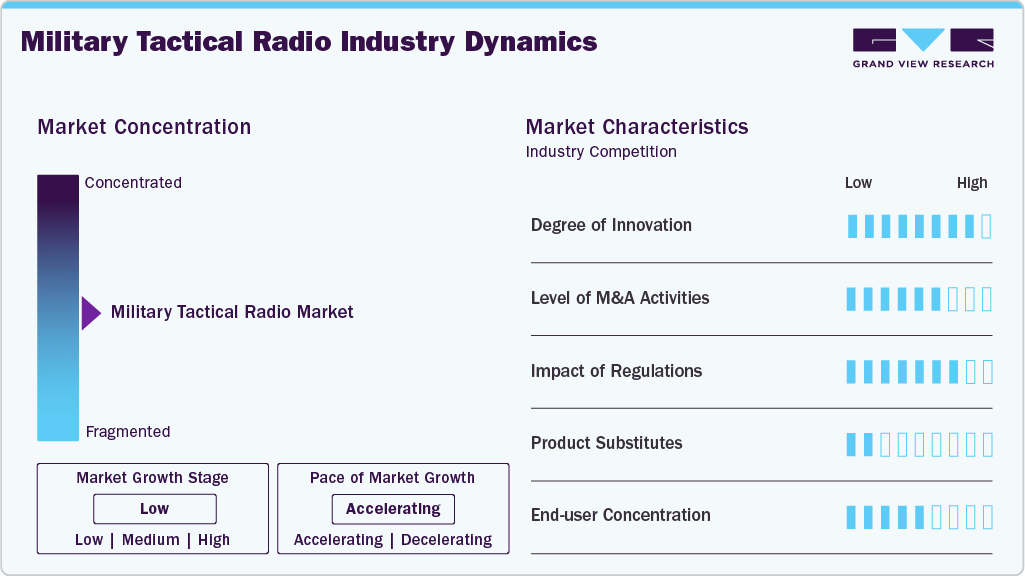
The military tactical radio market is moderately concentrated, with leading defense communication manufacturers, military electronics companies, and secure networking solution providers competing across land, naval, airborne, and special operations communication systems. Rising defense modernization programs, increasing investments in secure battlefield communications, and the growing adoption of software-defined radios (SDRs) are driving market expansion. Companies are strengthening their competitive positions through strategic partnerships, defense contracts, technology collaborations, product innovation, and continuous investments in resilient communication technologies.
 To learn more about this report, Download Free Sample Report
The market is characterized by a high degree of innovation, supported by continuous advancements in software-defined radio architectures, anti-jamming technologies, secure encryption, multi-band communication, cognitive radio capabilities, and satellite communication integration. Merger and acquisition activity remains moderately high as companies expand their defense communications portfolios and strengthen their secure networking capabilities. Regulatory impact is significant due to stringent defense procurement requirements, military communication standards, encryption regulations, spectrum management policies, and export controls. The threat of substitutes remains low because alternative communication technologies cannot provide the secure, resilient, and interoperable battlefield connectivity required for modern military operations.
Analyst Perspective
The military tactical radio market is witnessing significant expansion, driven by increasing defense modernization programs, rising demand for secure and interoperable battlefield communications, and the growing adoption of software-defined radios across land, air, and naval operations. The expanding integration of advanced encryption, anti-jamming technologies, multi-band communication, satellite connectivity, and network-centric communication systems is enhancing operational coordination, situational awareness, mission effectiveness, and command-and-control capabilities. Governments and defense organizations are increasingly prioritizing resilient communication infrastructure, multi-domain interoperability, and secure real-time information exchange to strengthen military readiness. Defense communication providers are positioned to capitalize on these evolving requirements, reinforcing long-term market expansion and sustainable revenue generation across the global defense communications ecosystem.
Type Insights
Based on type, the vehicle-mounted radio segment led the market with the largest revenue share of 25.4% in 2025 and is expected to grow at a considerable CAGR over the forecast period. These radios are critical for battalion and company-level commanders who require robust voice and data links during complex operations. Recent innovations are enhancing bandwidth capacity and satellite communication capabilities, enabling better interoperability across joint and allied forces. As military doctrines evolve to support network-centric warfare, the adoption of advanced manpack radio systems is expanding across global defense forces.
The handheld radio segment is expected to witness the fastest CAGR of over 6% from 2025 to 2033, primarily driven by the increasing demand for compact and lightweight communication systems for dismounted soldiers and special operations forces. Modern combat operations require mobility and rapid response, which handheld radios support by offering secure voice and data connectivity on the move. These devices are being engineered with longer battery life, enhanced encryption, and ruggedized designs to meet the harsh demands of battlefield environments. As ground forces emphasize soldier-level situational awareness and real-time coordination, defense agencies are prioritizing the procurement of next-generation handheld radio systems.
Frequency Insights
Based on frequency, the ultra-high frequency (UHF) segment dominated the market with the largest revenue share of 36.7% in 2025, primarily driven by its widespread use in line-of-sight communication for ground and air operations. VHF radios offer reliable performance in rugged and diverse terrains, making them essential for tactical units operating in forests, mountains, and urban environments. The growing demand for secure and interference-resistant VHF communication systems is encouraging manufacturers to enhance encryption and frequency-hopping features. As militaries focus on improving battlefield coordination and situational awareness, the VHF segment remains a critical component of tactical communication networks.
The ultra-high frequency (UHF) segment is expected to witness the fastest CAGR from 2025 to 2033, driven by the increasing demand for secure, short- to medium-range communication in tactical military operations. UHF radios are favored for their ability to communicate clearly in urban and densely forested environments where line-of-sight is often obstructed. Advances in digital modulation and encryption technologies are enhancing the security and reliability of UHF communication systems. As defense forces modernize their communication infrastructure, the UHF segment continues to play a vital role in enabling real-time coordination and mission success.
Technology Insights
Based on technology, the conventional radios segment dominated the market with a revenue share of 54.0% in 2025, primarily driven by the continued reliance on proven, cost-effective communication systems in various military applications. These radios offer simplicity and reliability, making them suitable for basic voice communication needs in both training and low-intensity operational scenarios. Despite the rise of advanced digital systems, many defense forces maintain conventional radios to ensure interoperability with legacy equipment. As budget constraints persist in certain regions, the Conventional Radios segment remains a key component in military communication portfolios.
The software-defined radios (SDR) segment is expected to witness the fastest CAGR from 2025 to 2033, driven by the increasing demand for flexible and upgradeable communication platforms capable of supporting multiple waveforms and protocols. SDR technology enables seamless interoperability across diverse military branches and allied forces, enhancing real-time information sharing and mission adaptability. Advances in miniaturization and processing power are allowing SDRs to deliver enhanced encryption and dynamic spectrum management in compact form factors. As modern warfare increasingly relies on network-centric operations, the SDR segment is becoming central to next-generation tactical communication systems.
Application Insights
Based on application, the command & control communication segment accounted for the largest market share of 41.9% in 2025, primarily driven by the rising demand for real-time situational awareness and enhanced decision-making capabilities in battlefield environments. Modern military operations increasingly rely on seamless communication between commanders and deployed units to ensure the rapid and accurate dissemination of mission-critical information. The growing adoption of integrated communication networks-combining voice, data, and video-is significantly improving operational efficiency and responsiveness. As armed forces worldwide accelerate their shift toward network-centric warfare and digital transformation, the demand for advanced command-and-control communication solutions is experiencing strong, sustained growth.
The surveillance & reconnaissance segment is expected to witness the fastest CAGR from 2025 to 2033, driven by the increasing demand for real-time intelligence gathering and secure data transmission in tactical operations. Advanced communication systems are enabling the seamless relay of high-resolution imagery and sensor data from unmanned platforms and forward-deployed units. The integration of encrypted radios with satellite and drone communication networks is enhancing battlefield awareness and operational precision. As modern militaries prioritize information superiority, the surveillance & reconnaissance segment is becoming a critical enabler of mission success.
End Use Insights
Based on end use, the army development segment dominated the market with a revenue share of 53.6% in 2025, primarily driven by the increasing need for secure and reliable communication systems to support large-scale ground operations. Tactical radios designed for infantry, armored, and artillery units are being upgraded to provide enhanced encryption, longer range, and interoperability with joint forces. The growing focus on network-centric warfare and real-time data sharing is accelerating the adoption of advanced radio technologies within army units. As defense budgets prioritize modernization, the army segment continues to be a key growth driver in the military tactical radio market.
 To learn more about this report, Download Free Sample Report
The navy segment is expected to witness the fastest CAGR from 2025 to 2033, driven by the increasing demand for secure, long-range communication systems to support maritime operations and fleet coordination. Naval tactical radios are being enhanced with advanced encryption and anti-jamming capabilities to ensure reliable communication in contested and harsh environments. The growing emphasis on networked naval warfare and integrated command systems is boosting the adoption of interoperable radio solutions across ships, submarines, and coastal units. As navies modernize their communication infrastructure, the Navy segment remains a critical contributor to the military tactical radio market.
Regional Insights
North America dominated the military tactical radio market with the largest revenue share of 37.1% in 2025, owing to the rise of electronic warfare and cyber threats, North American militaries are prioritizing radio systems with enhanced spectrum agility and secure encryption protocols. Owing to adversarial capabilities in signal interception, frequency-hopping and anti-spoofing features are now standard in new procurements. Owing to increased reliance on wireless communications, spectrum management is becoming strategically vital.
 To learn more about this report, Download Free Sample Report
U.S. Military Tactical Radio Market Trends
The military tactical radio market in the U.S. held the largest share in the North America region in 2025. primarily driven by sustained investments from the U.S. Department of Defense in modernizing tactical communication infrastructure. As a result, the U.S. market continues to lead in adoption of advanced radio technologies. Owing to the growing emphasis on network-centric warfare, software-defined radios (SDRs) are significantly integrated across military branches. Multi-domain operational requirements and strategic collaboration between defense contractors and federal agencies further support the increasing demand for secure, interoperable, and jam-resistant communications.
Europe Military Tactical Radio Market Trends
Europe military tactical radio market is expected to grow at a CAGR of 4% from 2025 to 2033, Owing to joint defense initiatives and interoperability frameworks among NATO allies, the region is rapidly embracing standardized tactical radio systems. The increasing demand for SDRs aligned with European secure software-defined radio (ESSOR) standards highlights Europe’s strategic focus on unified communication protocols. Primarily driven by regional instability in Eastern Europe, nations are fast-tracking investment in rapid-deployment communication capabilities. The growing demand for AI-enabled radio systems is also gaining traction to support cross-border operations.
The UK military tactical radio market is expected to grow at a significant rate in the coming years, Driven by the British Army’s Morpheus program, which aims to overhaul military communication systems, the UK is spearheading tactical radio modernization. The growing demand for flexible, mission-adaptable SDR platforms is well aligned with digital battlefield transformations. Owing to the rising frequency of joint operations, secure, real-time communication has become mission-critical. The UK’s commitment to NATO interoperability continues to fuel technological advancement and strategic investments.
The military tactical radio market in Germany is primarily driven by the Bundeswehr’s modernization efforts under the Digitalization of Land-Based Operations (D-LBO) program, Germany is investing in advanced tactical communication solutions. The increasing demand for encrypted high-bandwidth radios reflects a broader transformation in defense capabilities. Owing to robust collaboration between public defense authorities and private sector innovators, radio technology development is accelerating. The growing demand for modular and scalable platforms supports agile deployment strategies in complex operational settings.
Asia Pacific Military Tactical Radio Market Trends
The Asia Pacific military tactical radio market is expected to grow at the fastest CAGR of 6% from 2025 to 2033, owing to escalating geopolitical tensions and sustained growth in defense budgets, Asia Pacific is emerging as a high-growth tactical radio market. Driven by regional initiatives to develop indigenous defense capabilities, governments are heavily investing in domestic production of radio systems. The increasing demand for SDRs to enable seamless battlefield coordination is reshaping procurement landscapes. The growing demand for interoperable systems to support joint military exercises is further reinforcing adoption across regional forces.
The Japan military tactical radio market is gaining traction, primarily driven by Japan’s Self-Defense Forces’ initiatives to enhance communication in disaster response and regional security, the country is scaling up its tactical radio capabilities. The increasing demand for U.S.-compatible systems underscores the importance of bilateral interoperability. Owing to technological advancements, the deployment of miniaturized, rugged SDR units across naval and ground forces is accelerating. The growing demand for high-speed, real-time communications in joint missions is a key factor propelling system upgrades.
The military tactical radio market in China is rapidly expanding, driven by aggressive military modernization and growing R&D investments, China is advancing its capabilities in tactical communication systems. The increasing demand for AI-integrated and autonomous communication platforms is supporting domestic innovation. Primarily driven by strategic deterrence imperatives, the nation is prioritizing the development of secure, long-range radio infrastructure. Owing to rising tensions in the Indo-Pacific, there is strong momentum toward establishing resilient, encrypted tactical networks.
Key Military Tactical Radio Company Insights
Some of the key players operating in the market are Thales Group, and Raytheon Technologies and among others.
-
Thales Group is a global leader in advanced defense communications, offering cutting-edge tactical radio systems such as the SYNAPS and PR4G series. The company is known for its robust software-defined radios (SDRs), interoperable solutions, and secure communication capabilities for multi-domain operations. Thales continues to lead through innovations in NATO-standard compliance and battlefield digitization.
-
Raytheon Technologies specializes in integrated defense systems, including tactical communications with a focus on resilience and interoperability across domains. Its advanced radio systems are often deployed in complex battlefield environments, supporting real-time command and control. Raytheon plays a critical role in U.S. and allied modernization programs for electronic warfare and secure communications.
Elbit Systems Ltd., and ASELSAN A.S. are some of the emerging market participants in the military tactical radio market.
-
ASELSAN A.S. is a Turkish defense electronics company rapidly gaining ground in the tactical radio market with indigenous and NATO-compatible solutions. Its SDR-based radios are being adopted across the Middle East and parts of Asia, driven by local defense procurement strategies. ASELSAN’s focus on customization and cost-effective manufacturing makes it a strong emerging contender.
-
Elbit Systems Ltd., an Israeli defense firm, is expanding globally with innovative tactical radios and C4ISR systems. Its E-LynX SDR platform is gaining traction for its high mobility, real-time networking, and battlefield awareness applications. Elbit's growing global footprint, especially in Asia-Pacific and Europe, positions it as a competitive emerging force.
Key Military Tactical Radio Companies
The following key companies have been profiled for this study on the military tactical radio market.
-
Thales Group
-
BAE Systems
-
Raytheon Technologies
-
General Dynamics Corporation
-
L3Harris Technologies
-
Northrop Grumman Corporation
-
Leonardo S.p.A.
-
Elbit Systems Ltd.
-
Rohde & Schwarz
-
Cobham plc
-
ASELSAN A.S.
-
FLIR Systems, Inc.
Competitive Benchmarking
Category
Operating Strategies
Competitive Edge
Weakness
Established Players (Thales Group, BAE Systems, Raytheon Technologies)
- Focus on expanding secure software-defined radio portfolios through defense modernization programs and strategic military partnerships.
- Invest heavily in advanced encryption, anti-jamming technologies, interoperability, and next-generation tactical communication capabilities.
- Strong defense contracting experience, global military presence, and proven expertise in secure tactical communications.
- Ability to deliver interoperable, mission-critical, ruggedized radio systems supporting multi-domain military operations.
- Dependence on lengthy defense procurement cycles can delay product commercialization and revenue realization.
- Large organizational structures may reduce flexibility in responding to rapidly evolving communication technologies.
Emerging Players (Elbit Systems Ltd., Rohde & Schwarz, ASELSAN A.S.)
- Emerging players focus on developing innovative software-defined radios with flexible architectures for modern defense communication requirements.
- Invest in niche communication technologies through defense collaborations and specialized military research initiatives.
- Agile product development enables faster adoption of advanced tactical communication and secure networking technologies.
- Specialized expertise in customizable radio solutions supports evolving mission-specific military communication requirements.
- Limited manufacturing scale and defense-contracting experience limit participation in large military programs.
- Smaller financial resources may constrain long-term research, certifications, and global market expansion.
Recent Developments
-
In March 2025, EDGE Group partnered with Thales Group to enhance collaboration on military radio communications and Identification Friend or Foe (IFF) solutions, supporting the UAE’s defense modernization strategy. Under this partnership, Thales will provide advanced military radios and compact IFF transponders to EARTH, an EDGE entity, for integration into UAVs and other airborne platforms. The collaboration aims to boost situational awareness and contribute to building a more resilient and self-sufficient defense ecosystem in the UAE.
-
In February 2025, HIMERA partnered with Quantropi Inc., a Canadian cybersecurity company specializing in quantum-secure communication technologies. The agreement grants HIMERA exclusive distribution rights to integrate Quantropi’s post-quantum cryptographic solutions into its tactical radios, meeting NATO-secure communication standards. This collaboration aims to equip the Ukrainian Armed Forces and Special Operations Forces with next-generation quantum-resilient communication systems.
-
In June 2024, Thales Group launched its HF XL series of tactical wideband High Frequency radios, significantly boosting data bandwidth by ten times compared to earlier models. These radios support secure, long-range communication up to 10,000 km and feature a cognitive engine that automatically adapts to available frequencies for enhanced resilience. Currently offering 1 kW and 400 W models, Thales plans to expand the range with vehicle and soldier variants in 2025.
Military Tactical Radio Market Report Scope
Report Attribute
Details
Market size in 2025
USD 5.9 billion
Estimated market size in 2026
USD 6.2 billion
Projected market size by 2033
USD 8.8 billion
Growth rate
CAGR of 5.3% from 2026 to 2033
Base year for estimation
2025
Historical data
2021 - 2024
Forecast period
2026 - 2033
Quantitative units
Revenue in USD Million, and CAGR from 2026 to 2033
Report coverage
Revenue forecast, company ranking, competitive landscape, growth factors, and trends
Segments covered
Type, frequency, technology, application, end use, and region
Regional scope
North America; Europe; Asia Pacific; Latin America; MEA
Country scope
U.S.; Canada; Mexico; U.K.; Germany; France; China; Japan; India; South Korea; Australia; Brazil; Saudi Arabia; UAE; South Africa
Key companies profiled
Thales Group; BAE Systems; Raytheon Technologies; General Dynamics Corporation; L3Harris Technologies; Northrop Grumman Corporation; Leonardo S.p.A.; Elbit Systems Ltd.; Rohde & Schwarz; Cobham plc; ASELSAN A.S.; FLIR Systems, Inc.
Customization scope
Free report customization (equivalent up to 8 analysts' working days) with purchase. Addition or alteration to country, regional & segment scope.
Pricing and purchase options
Avail customized purchase options to meet your exact research needs. Explore purchase options
Global Military Tactical Radio Market Report Segmentation
This report forecasts revenue growth at global, regional, and country levels and provides an analysis of the latest technological trends in each of the sub-segments from 2021 to 2033. For this study, Grand View Research has segmented the military tactical radio market report based on type, frequency, technology, application, end use, and region:
-
Type Outlook (Revenue, USD Million, 2021 - 2033)
-
Handheld Radio
-
Manpack Radio
-
Vehicle-Mounted Radio
-
Base Station Radio
-
Airborne Radio
-
Naval Radio
-
-
Frequency Outlook (Revenue, USD Million, 2021 - 2033)
-
Very High Frequency (VHF)
-
Ultra-High Frequency (UHF)
-
High Frequency (HF)
-
Others (Multiband, SHF, EFH)
-
-
Technology Outlook (Revenue, USD Million, 2021 - 2033)
-
Conventional Radios
-
Software-Defined Radios (SDR)
-
-
Application Outlook (Revenue, USD Million, 2021 - 2033)
-
Command & Control Communication
-
Surveillance & Reconnaissance
-
Electronic Warfare
-
Others
-
-
End Use Outlook (Revenue, USD Million, 2021 - 2033)
-
Army
-
Navy
-
Air Force
-
-
Regional Outlook (Revenue, USD Million, 2021 - 2033)
-
North America
-
U.S.
-
Canada
-
Mexico
-
-
Europe
-
UK
-
Germany
-
France
-
-
Asia Pacific
-
China
-
Japan
-
India
-
South Korea
-
Australia
-
-
Latin America
-
Brazil
-
-
Middle East & Africa
-
Saudi Arabia
-
South Africa
-
UAE
-
-
Research Methodology
The military tactical radio market figures in this report are based on a proven research process that combines executive interviews with secondary research from proprietary databases, company filings, and recognized regulatory and institutional sources. Market size is built through value-chain sizing - reconciling supply-side and demand-side estimates - and triangulated with bottom-up and top-down approaches. Every estimate passes multiple levels of expert validation before publication, with each military tactical radio segment quantified using the revenue-capture definitions in the table below.
Segment Definition
Segment - Type
Revenue capture definition
Handheld Radio
Revenue is generated through compact, portable tactical radios used by dismounted soldiers for secure voice and data communication during combat, reconnaissance, and patrol missions. This segment is driven by increasing demand for lightweight, encrypted, and interoperable communication systems that enhance mobility, situational awareness, and coordination across frontline operations.
Manpack Radio
Revenue is captured through high-power portable radios carried by military personnel to enable long-range communication in tactical environments. This segment is driven by the growing need for reliable battlefield connectivity, multi-band communication, and seamless integration with command-and-control networks during complex military operations.
Vehicle-Mounted Radio
Revenue is generated through tactical radio systems installed in armored vehicles, combat vehicles, and military transport platforms for continuous battlefield communication. This segment is driven by increasing deployment of network-enabled military vehicles and the need for secure, real-time communication during mobile operations.
Base Station Radio
Revenue is captured through fixed tactical communication systems deployed at military bases, command posts, and operational headquarters to support secure communication networks. This segment is driven by growing investments in resilient command infrastructure and integrated military communication systems for mission coordination.
Airborne Radio
Revenue is generated through tactical radios integrated into military aircraft, helicopters, and unmanned aerial platforms to facilitate secure air-to-ground and air-to-air communications. This segment is driven by increasing modernization of airborne communication systems and the expansion of network-centric air operations.
Naval Radio
Revenue is captured through specialized communication systems installed on naval vessels, submarines, and maritime patrol platforms for secure maritime operations. This segment is driven by increasing naval modernization programs and the growing requirement for reliable ship-to-ship and ship-to-shore communication capabilities.
Segment – Frequency
Revenue capture definition
Very High Frequency (VHF)
Revenue is generated through VHF tactical radios designed for short- to medium-range communication across ground-based military operations. This segment is driven by widespread adoption in infantry units, vehicle communications, and command coordination requiring dependable line-of-sight connectivity.
Ultra-High Frequency (UHF)
Revenue is captured through UHF communication systems that support secure voice and data transmission for airborne, naval, and tactical missions. This segment is driven by increasing demand for high-capacity communication, satellite compatibility, and improved operational flexibility across defense applications.
High Frequency (HF)
Revenue is generated through HF tactical radios enabling beyond-line-of-sight communication over long distances without relying on satellite infrastructure. This segment is driven by military requirements for resilient communication during remote deployments and operations in contested environments.
Others (Multiband, SHF, EFH)
Revenue is captured through advanced tactical radios supporting multiple frequency bands and specialized communication technologies for diverse operational requirements. This segment is driven by the growing adoption of flexible communication platforms capable of operating across multiple military networks and mission scenarios.
Segment – Technology
Revenue capture definition
Conventional Radios
Revenue is generated through traditional hardware-based tactical radio systems offering fixed communication capabilities for military operations. This segment is driven by continued deployment in defense organizations where proven reliability, established infrastructure, and cost-effective communication solutions remain operational priorities.
Software-Defined Radios (SDR)
Revenue is captured through programmable tactical radios capable of supporting multiple waveforms, frequency bands, and communication standards using software upgrades. This segment is driven by increasing military modernization programs requiring interoperable, secure, and adaptable communication systems for multi-domain operations.
Segment – Application
Revenue capture definition
Command & Control Communication
Revenue is generated by tactical radio systems that support secure communication among commanders, operational units, and defense headquarters during military missions. This segment is driven by increasing demand for real-time information exchange, coordinated battlefield operations, and enhanced command decision-making capabilities.
Surveillance & Reconnaissance
Revenue is generated through tactical communication systems that transmit intelligence, surveillance, and reconnaissance data among sensors, unmanned platforms, and command centers. This segment is driven by growing investments in real-time situational awareness and integrated battlefield intelligence networks.
Electronic Warfare
Revenue is generated through tactical radios designed to maintain secure communications in electronically contested environments using anti-jamming and spectrum-resilient technologies. This segment is driven by increasing focus on communication resilience and electromagnetic spectrum superiority during modern military operations.
Others
Revenue is generated through tactical radio applications that support military training, disaster response, border security, peacekeeping missions, and special operations. This segment is driven by expanding defense communication requirements across diverse operational and homeland security environments.
Segment – End Use
Revenue capture definition
Army
Revenue is generated by procuring tactical radios for infantry units, armored formations, artillery, and ground command forces that require secure battlefield communication. This segment is driven by large-scale military modernization initiatives and increasing investments in land force communication capabilities.
Navy
Revenue is captured through tactical communication systems deployed across naval fleets, submarines, amphibious forces, and maritime security operations. This segment is driven by growing investments in naval modernization and the need for secure, interoperable communication across maritime defense missions.
Air Force
Revenue is generated through tactical radio systems integrated into fighter aircraft, transport aircraft, helicopters, ground control stations, and air defense networks. This segment is driven by the increasing adoption of advanced airborne communication technologies that support coordinated air operations and mission-critical connectivity.
Estimation Model
Layer No.
Layer Name
Key Question
Description
01
Defense Communication Adoption Layer
Who are the potential adopters?
Identifies the primary adopters of military tactical radio systems, including defense ministries, armed forces, special operations units, border security agencies, homeland security organizations, peacekeeping forces, coast guards, intelligence agencies, and defense contractors requiring secure, interoperable, and mission-critical communication capabilities across tactical operations.
02
Communication Technology Enablement Layer
What enables deployment of tactical radio systems?
Deployment depends on the availability of software-defined radio architectures, secure encryption technologies, anti-jamming capabilities, multi-band waveforms, satellite communication integration, advanced antennas, ruggedized hardware, military communication standards, spectrum management, and resilient networking infrastructure supporting reliable battlefield connectivity.
03
Operational Deployment Layer
Where are tactical radio systems actively utilized?
Tactical radios are deployed across infantry units, armored vehicles, military aircraft, naval vessels, submarines, command centers, special operations forces, border surveillance missions, peacekeeping operations, disaster response activities, and joint military exercises supporting secure communication across multi-domain defense operations.
04
Revenue Generation Layer
How is revenue generated?
Revenue is generated through handheld, manpack, vehicle-mounted, airborne, naval, and base station radio systems, software-defined radio platforms, communication encryption modules, system integration services, maintenance contracts, software upgrades, training programs, lifecycle support services, and long-term defense procurement and modernization contracts.
Delivered Customizations
This report has been delivered with the following In-depth customizations
Client Request
Customization Delivered
Value Adds
Software-Defined Radio Modernization & Secure Battlefield Communication Assessment
Conducted detailed evaluation of software-defined radio deployment across land, air, and naval forces, assessing secure encryption, anti-jamming technologies, interoperable waveforms, satellite communication integration, and command-and-control connectivity to strengthen mission-critical battlefield communications.
Improves communication resilience, enhances interoperability, strengthens mission coordination, supports defense modernization, and increases operational readiness.
Multi-Domain Tactical Communication Network Integration Strategy
Assessed integration of tactical radio systems across military vehicles, aircraft, naval platforms, and command centers, evaluating multi-band communication, network-centric operations, resilient networking architectures, and secure data exchange to improve operational coordination across defense missions.
Enhances battlefield connectivity, improves situational awareness, enables seamless coordination, supports joint operations, and increases mission effectiveness.
Military Communication Technology Benchmarking & Procurement Evaluation
Evaluated next-generation tactical radio technologies, supplier capabilities, encryption standards, communication range, interoperability features, lifecycle support, and modernization roadmaps to assist defense organizations in procurement planning and long-term communication infrastructure development.
Supports procurement decisions, reduces operational risks, improves technology selection, strengthens communication capabilities, and optimizes defense investments.
Frequently Asked Questions About This Report
The global military tactical radio market is expected to grow at a compound annual growth rate of 5.3% from 2026 to 2033 to reach USD 8.8 billion by 2033.
Some key players operating in the military tactical radio market include Thales Group, BAE Systems, Raytheon Technologies, General Dynamics Corporation, L3Harris Technologies, Northrop Grumman Corporation, Leonardo S.p.A., Elbit Systems Ltd., Rohde & Schwarz, Cobham plc, ASELSAN A.S., and FLIR Systems, Inc.
Key factors that are driving the market growth include increasing defense expenditures across major nations, rising need for secure and real-time communication in modern warfare, and technological advancements in software-defined radios (SDRs) enabling enhanced interoperability and flexibility.
The Asia Pacific is the fastest-growing region with a CAGR of over 7.1% from 2026 to 2033.
The vehicle-mounted radio segment dominated with a 25.4% revenue share in 2025.
The conventional radios segment dominated the market with a share of 54.0% in 2025.
The army segment accounted for the largest share, with 53.6% of revenue in 2025.
The global military tactical radio market size was estimated at USD 5.9 billion in 2025 and is expected to reach USD 6.2 billion in 2026.
North America dominated the military tactical radio market with a share of over 37.1% in 2025.
About the Author(s)
Next Generation Technologies Research Team
Technology · Next Generation TechnologiesThis report was authored by the next generation technologies research team at Grand View Research - comprising two research analysts, one senior research analyst, and one industry expert - with specialized expertise in the next generation technologies segment of the technology industry. All findings are based on proprietary technology databases, executive interviews, and regulatory analysis, subject to internal peer review prior to publication.
Last Updated:
Speak to Analyst

Customize this report to your needs - add regions, segments, or data points, with 20% free customization.
Or view our licence options:


ISO 9001:2015 & 27001:2022 Certified
We are GDPR and CCPA compliant! Your transaction & personal information is safe and secure. For more details, please read our privacy policy.


